







Abstract
Recruiting and retaining special education teachers, particularly those from historically underrepresented communities, is essential for addressing the ongoing lack of representation in the field and the issues related to the disproportionate representation of students. This qualitative study builds on Scott and Alexander’s prior research investigating motivating factors for pre-service and in-service teachers joining special education, valued aspects of teacher preparation programs, and recruitment and retention influences. Using a constructivist framework, we conducted a thematic analysis of 15 U.S. participant interviews. Thirty-one themes were identified, highlighting personal connections, practicality, representation, and financial aid as key considerations for attracting and keeping teachers of color in special education. The findings emphasize the importance of these factors for teacher-preparation programs and districts aiming to enhance the presence and longevity of diverse special education teachers. Implications and future directions are also discussed.
The field of special education is concurrently facing two critical issues: a shortage of qualified teachers overall and a lack of diverse racial and ethnic representation within the teacher workforce (Mason-Williams et al., 2020). Despite repeated calls to diversify the special education profession in the last 20 years (Billingsley & Bettini, 2019; Campbell-Whatley, 2003; Valle-Riestra et al., 2011), teachers continue to be predominantly White (Billingsley et al., 2019; Irwin et al., 2023). What is more, non-White students now make up a majority of students in U.S. schools (Irwin et al., 2023). This situation has created a ripple effect where students of color are less likely than their White peers to have a teacher of the same race or ethnicity (Gottfried & Fletcher, 2023). The lack of cultural, ethnic, and linguistic diversity in the educator workforce has been linked to both over- and under-representation of students of color in special education (Morgan et al., 2017; Skiba et al., 2006, 2016); cultural biases and the lack of shared background experiences of the predominately White special educator workforce and their students of color also have the potential to contribute to a lack of culturally responsive instruction, more restrictive placements, and increased use of exclusionary discipline practices (Redding, 2019). Having a teacher of color may offer a protective effect against inappropriate referrals to special education and promote improved academic success of students of color (Fish, 2019; Redding, 2019; Villegas & Irvine, 2010).
As schools increasingly grapple with shortages, particularly in special education, there has been an increased focus on the elements that impact recruitment and retention broadly (Billingsley & Bettini, 2019). Importantly, teachers’ initial interest and willingness to stay in the profession rely on a complex interaction between factors, both personal (e.g., passion, self-efficacy, perceptions of teaching) and environmental (e.g., school culture, administrative support, compensation, caseload size; Scott et al., 2022). Working conditions have been identified as a primary element of retention; conditions that include a high level of administrative support, a positive collegial climate, and access to resources and professional development promote retention, while those that place more demands on teachers or represent adverse culture and climate discourage retention (Billingsley & Bettini, 2019). There is evidence to suggest that the attrition of new special educators can result from stress and emotional exhaustion, often tied to unmanageable responsibilities and workloads (Bettini et al., 2017; Hagaman & Casey, 2018). Alternatively, teachers often cite their students as the most influential factor keeping them in the field (Billingsley & Bettini, 2019; Cancio et al., 2013; Hagaman & Casey, 2018).
It remains largely unclear which, if any, aspects of teacher-preparation programs (TPPs) are associated with the future retention of their graduates (Billingsley & Bettini, 2019; Theobald et al., 2021). Some evidence suggests that teachers prepared through alternative licensure routes are less likely to remain in teaching long-term than their traditionally prepared counterparts (Zhang & Zeller, 2016). Several studies have also linked a longer duration of student teaching to increased retention (Ronfeldt, 2021). Researchers have not yet assessed whether the quality or quantity of teacher preparation coursework leads to longer teaching careers (Ronfeldt, 2021). With so little known about the influence of preparatory characteristics on the retention of educators in general, there is certainly even less of an understanding of how those characteristics might uniquely impact special educators or teachers of color.
Although the demographics of the teacher workforce continue to fail to match those of the U.S. student population, some ground has been gained in the recruitment of teachers of color. The overall proportion of K-12 teachers from underrepresented racial and ethnic groups has increased from 12.5% in 1988 to 20% in 2018 (Ingersoll et al., 2021). Yet at the same time, turnover of teachers of color has also significantly increased (Ingersoll et al., 2021). In addition to the general factors impacting all special educators’ entry and continuation in the field, teachers of color are likely to experience some additional and unique enablers and barriers as well.
Special educators of color have reported being motivated by having shared identities with their students and being able to act as role models and advocates for students from marginalized backgrounds (Bettini et al., 2022; Cormier et al., 2022). Alternatively, teachers of color report stressors related to working conditions that differentially impact their intent to stay. Special educators of color have rated their school culture and collegial support lower than their White counterparts (Bettini et al., 2022). This can manifest in feeling othered, stereotyped, or tokenized based on race, potentially leading to racialized (e.g., separating, marginalizing, and/or categorizing based on race) trauma and increased burnout (Scott et al., 2023). These teachers often enter schools with curricula that reinforce racialized power structures and systemic racism (Bettini et al., 2022). Teachers of color are also more likely than their White peers to teach in high-poverty and urban schools, which frequently present poorer working conditions (Ingersoll et al., 2021). In addition, although special educators of color tend to value their shared identities with students from similar backgrounds, they also frequently experience additional, uncompensated responsibilities such as providing language interpretation, being expected to educate others about issues of culture or diversity, or especially in the case of Black men, being stereotypically expected to serve as disciplinarians in the school (Cormier et al., 2022).
Information is still lacking on the complexities of the motivators that prompt people of color to join the special education profession and the enablers and barriers that allow them to stay. Likewise, it remains largely unclear what elements of TPPs may impact their graduates’ future longevity in the field. Given the potential benefits of having a teacher of the same race and the importance of diversifying schools overall, it is critically important to understand the numerous and intersecting factors that influence recruitment and retention.
Study Purpose
In this qualitative study, we expand on the work of Scott and Alexander (2019), which focused on the experiences of Black male special educators and explored the factors that attract them to the profession. Using similar methods and research questions, we designed our present investigation to take a broader view of the experiences of non-White teachers of all genders representing a variety of racial and ethnic backgrounds. We used the following research questions: (a) What are the motivating factors for pre-service and in-service teachers of color to join the special education profession? (b) What characteristics or elements do pre-service and in-service special educators of color value in their TPPs? (c) What are some enablers and barriers to the recruitment and retention of teachers of color in the special education profession?
Method
This study used a qualitative design using semi-structured interviews and thematic analysis (Patton, 2015). Data were analyzed using a constructive theoretical perspective (Koro-Ljungberg et al., 2009), to describe the experience of the participants. Furthermore, the thematic analysis allowed us to look for similar experiences while also accounting for contradictions and diverse experiences. This design and framework are ideal for collecting, describing, and analyzing socially constructed views about an experience (Charmaz, 2006; Koro-Ljungberg et al., 2009). Furthermore, the methodology allows researchers to build a theory using interpretative and flexible methods informed by the participants’ experience as interpreted by the research team.
Positionality of the Research Team
The research team recognizes that personal identity, beliefs, and biases are unavoidable in work such as this. As we sought, aggregated, and interpreted the perspectives shared by our participants, we reflected upon our individual and collective positionality using the work of Boveda and Annamma (2023) and the QR Collective et al. (2023). The team consisted of four women currently working in academia in the field of special education. The first author identified as an Indian and Latina cis-woman and immigrant to the United States, while the second and third authors identified as White cis-women. These authors had obtained doctoral degrees in special education and worked as assistant professors in predominantly White institutions (PWIs) in the East Coast and Southern United States during the period in which the data were collected and coded. The fourth author identifies as a Black American woman and was a special education doctoral student at a PWI on the East Coast during this same time period. All authors had previous experience teaching special education in the United States. The fourth author also had experience teaching in Europe and the Middle East. Our personal and professional experiences shaped our understanding of the field of special education. We share and acknowledge that given the history of our field, students and teachers from historically minoritized backgrounds can be further marginalized by the structures and systems of special education. Individually, we all attempt to use our positions of power and research agendas to challenge these realities.
The literature that informed our research was predominantly written by researchers of color. We were committed to promoting and amplifying their voices, as well as those of other members of minoritized communities, such as teachers of color, to ensure a diverse and inclusive perspective. However, we recognize that our positions in academia may have created a hierarchy between us and our participants, potentially impacting what they were willing to share with us. In an attempt to maximize interviewees’ comfort and trust, the first author conducted all interviews, recognizing the importance of shared identity and experiences as a woman of color herself. As a research team, we continuously evaluated and reflected on how and why qualitative research could help further our field and how we, given our personal and educational backgrounds, could inform the way the data were interpreted. A team-based approach to qualitative thematic analysis coding (Patton, 2015) was used to add different perspectives, opinions, and experiences to enrich our understanding and interpretation of the data while simultaneously reducing our individual biases. We avoided treating participants as a monolith and used our discussions and group coding to resist essentialism. We worked both to represent the variance within the group and to seek commonalities between the participants’ experiences. By interpreting themes, we named similarities that can inform future advocacy and initiatives.
We further acknowledge that our personal backgrounds could lead to potential biases in the process of research analysis. For instance, all authors attended a traditional teacher certification program for their own training and were currently teaching pre-service teachers in a traditional university-based program. Whether explicitly or implicitly, we concede that these experiences likely contributed to a sense that traditional TPPs are more robust, effective, or preferable than alternative certification programs, which many of our participants attended. At the same time, our experiences also allowed us to contextualize some of the data during the coding process. For example, one author was able to offer a unique frame of reference related to teaching in city schools, while another author was able to personally relate to the experiences of Latinx teachers being called out of the classroom to provide translations. With an understanding of the complex benefits and limitations introduced by our individual and collective positionality, our ultimate goal with this work is to help disrupt the sociohistorical hegemony in education and promote awareness and progress related to the experiences and needs of teachers of color.
Participants
Five pre-service and 10 in-service K-12 special education teachers were recruited to participate in this study. To meet inclusion criteria, pre-service teachers had to be enrolled or planning to enroll in a special education TPP. In-service teachers had to be licensed or planning to become licensed in special education and currently working in a special education teacher role. Pre-service and in-service teachers were both recruited to closely follow the recruitment guidelines from the original Scott and Alexander (2019) study. Enrolling both in-service and pre-service teachers allows for a more comprehensive investigation across the employment timeline.
All participants had to self-identify as a member of a historically minoritized racial or ethnic group (i.e., Black, Asian, Native American, Hispanic/Latinx, Pacific Islander). In line with the constructivist framework of the study, the sampling strategy was purposeful. Study information was shared with potential participants via public social media posts, posts in online teacher affinity groups, and email distribution through the authors’ collegial networks. Participants were also asked to share information with colleagues who may also meet the inclusion criteria (i.e., snowball sampling). Those who met the inclusion criteria were asked to contact the first author, who directed them to complete an informed consent form and demographic questionnaire and schedule a time to meet via Zoom. All names used in this article are pseudonyms selected by the participants. All participants were compensated $30 for their time. See Table 1 for demographic information of participants.
Demographics of 15 Special Education Teachers of Color Who Participated in Interviews on Their Experiences.
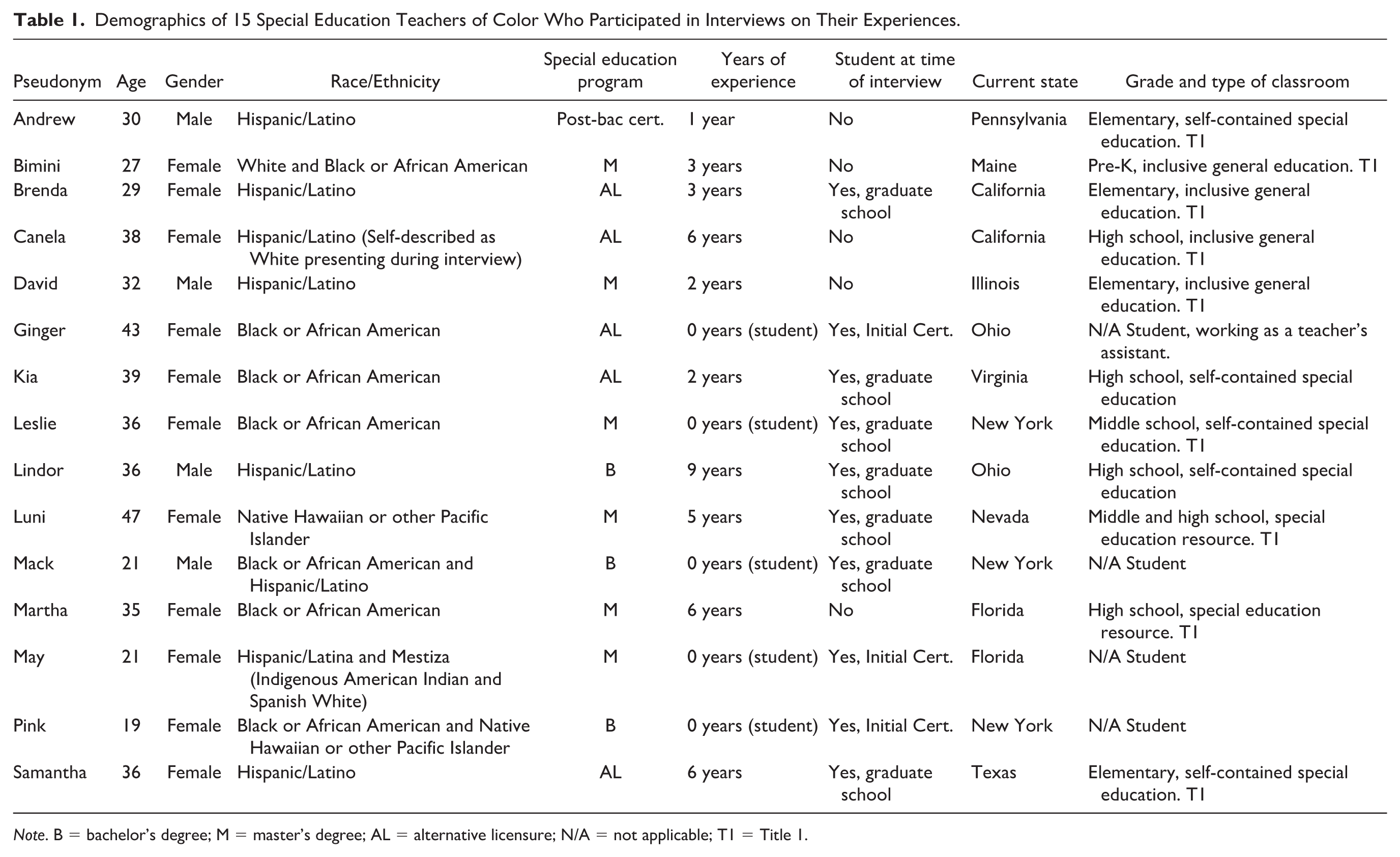
Note. B = bachelor’s degree; M = master’s degree; AL = alternative licensure; N/A = not applicable; T1 = Title 1.
All interviews took place via Zoom at a date and time convenient to the participant. The first author used a six-question interview guide to conduct semi-structured interviews with all the participants. Questions were developed using the guidelines for preparing interview research presented by Castillo-Montoya (2016) and were designed to build on the previous research on recruiting and retaining teachers of color (Billingsley et al., 2019; Patton et al., 2003; Scott & Alexander, 2019). Interviews lasted for an average of 35 minutes and were recorded and transcribed for analysis.
Data Analysis Procedures
Following constructivist principles, the data analysis was carried out through a collaborative effort. A team-based approach to qualitative thematic analysis (Patton, 2015) was used to code and analyze the data using a combination of coding notes, critical discussion analytic memos, and iterative coding (Patton, 2015; Saldaña, 2013). All four coders initially coded each interview independently. The coders then held regular meetings to discuss their coding notes on two transcripts at a time. The research team encouraged one another to discuss their positionality and its potential impact on the interpretation of the findings (i.e., researcher reflexivity), which allowed the coders to examine initial findings and discuss any unclear areas (QR Collective et al., 2023). The iterative coding approach allowed the coders to refine and clarify codes by constantly comparing transcripts and referencing previously coded transcripts. After the initial round of coding, we examined the data for emerging themes. This step was completed both independently and subsequently through group discussion to consolidate themes around the research questions. Finally, for each interview, two of the four coders compared the original transcript to the themes identified within it during the coding process. This step allowed the coders to verify the presence of that theme in the interview. Disagreements were discussed until unanimous agreement, except once, where the majority view (3 out of 4) was used.
Two forms of member checking were completed to verify the validity and reliability of our data. During the first member check, participants received a copy of their interview transcript following transcription and prior to the start of coding (Carlson, 2010). Fourteen of the 15 participants approved the transcript. The remaining participant did not provide a response to this request but did respond to the second member check. The second member checks occurred after coding. Participants were sent a summary of all themes that were developed during the coding process with a definition of each theme. Each participant also received a list of which themes the coders had identified as appearing within their interview. Participants were asked to confirm the presence or absence of each theme as well as to provide comments and/or add any information they believed was pertinent. One participant provided additional information and comments, and one participant did not respond for the second member check. All remaining participants (n = 13) approved the second round of member checks with no or minimal changes. Overall, participants overwhelmingly agreed with the information provided, and we did not gain any new information to considerably shift our analysis. We assumed this indicated that participants felt the summary accurately captured their experience but also recognize the possibility that participants did not have the time, feel it was their place, or believe they had the agency to correct our analysis.
Results
Thematic analysis of the interviews revealed 29 overarching themes that best answered the research questions. Please see Figures S1, S2, and S3 in the Supplemental Materials for a list of themes and breakdown per participant. We identified four primary motivating factors that led participants to pursue a career in special education. Specific to the pre-service period, we found three main reasons participants selected their program and three characteristics they enjoyed. More broadly, we also identified seven themes as enablers and nine themes as barriers to recruiting and retaining special education teachers of color. Finally, we present three personal context factors that influenced our participants’ personal motivations and experiences. Figure 1 provides a visual depiction of these findings and the relationships among them.
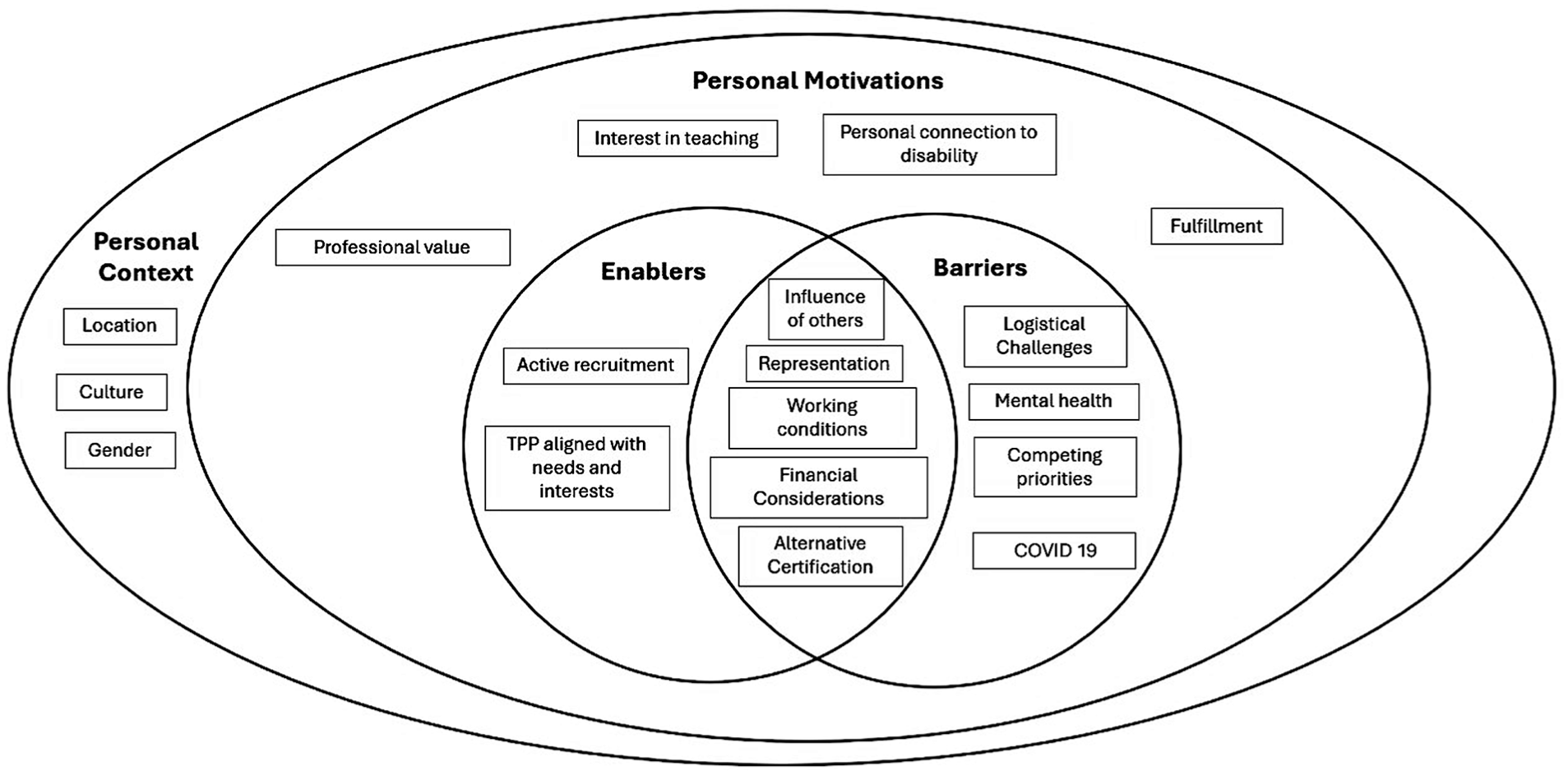
Visual model of results for factors influencing the recruitment and retention of special educators of color.
It should be noted that the results of this study are interpretative, offering insights into the constructed realities of the participants. Throughout the data coding and analysis process, we kept our positionality at the forefront and routinely discussed its potential impact on the data interpretation. In some instances, our lived experiences helped us provide context to the participants’ comments. For instance, one of the participants taught in a large, urban public school system close by where one of the coders grew up. Thus, the coder was able to provide context around specific issues (e.g., pink slips, re-hiring process) common to that system that a participant discussed and that other coders were not familiar with. In addition, ongoing self-reflection (individually and during meetings) ensured the analysis remained true to the participants’ voices while acknowledging our roles in the co-construction of the findings.
Interest in Teaching and Personal and Professional Motivations as Entry Points
Most participants (n = 12) revealed they joined the profession because it would be personally meaningful or “fulfilling.” Similarly, five participants also mentioned they had joined the profession because they considered it to be professionally valuable (e.g., making them more marketable, offering more job opportunities). David, a Latino general education teacher who planned to pursue a master’s degree in special education, described the professional value a special education certification would add:
Sometimes it’s vital too, at the end of the year when you really don’t know if we’re going to come back you know . . . they did that to my wife. They let her go because she didn’t have her bilingual endorsement . . . . And then one of the last things someone said, “Once you get this you have a golden check” which is special education. It’s like every year they’re always asking, “we need more special education teachers.”
Ten participants described always wanting to be a teacher or having an interest in education broadly. Pink, a first-year undergraduate student in a special education TPP who identified as multiracial, recapitulated her decision to become an educator and the different supports that helped her get to college:
One of the biggest reasons, I decided to become a teacher was because I had a single parent who worked all the time, and she couldn’t always help me with homework, and I had teachers in my life that like pushed me and believed in me and I wanted to make sure like I could go back and be that for someone else.
Some participants discovered their interest in special education during their TPP and changed their major, while others began a teaching career in general education and then added a special education certification later. Alternatively, five participants identified a personal connection or experience with disability (e.g., a family member with disabilities, volunteering at a high-school program for students with disabilities) as the main reason for becoming a special educator. These teachers generally expressed only wanting to teach students with disabilities, unlike the previous group of participants who were interested in teaching or education more broadly.
Personal Connections and Feasibility: Key Motivations for Choosing a TPP
We asked participants the reasons that prompted them to choose their TPP, aspects of their program they enjoyed, and any challenges they may have experienced. A personal connection to the institution was the most cited reason (n = 11) for choosing their TPP. In this theme, participants mentioned having attended the institution for a previous degree, having a family member that attended the institution, or receiving a personal recommendation from a family member, school administrator, or friend. When asked why she chose her TPP, Kia, who chose to attend the same university where she completed her undergraduate degree, mentioned it was because she “already had experience with the university . . . so it’s just natural.”
Ten participants also mentioned choosing their TPP because it was the most feasible option. Access to financial supports, scholarships, and overall convenience (e.g., location, online course availability, accelerated bachelor/master’s program) were the top cited reasons for this theme. Ginger best explained how both a personal connection and feasibility helped her decide which program would be best for her:
Well, actually, I didn’t choose it; my old university advisor chose it for me because I was going to go back to my old university [redacted], and he said, “Oh no, it’s a 45-minute drive, you don’t want to have to do that, because you have to drive and sit in the classroom, that’s a lot because you’re a single parent and you’re working, that’s going to be too much. You need to go to [redacted], it’s a fully online program, there’s no application fee, you don’t need any tests to get into the program, except just a bachelor’s degree” which I already had, like he was a huge advocate, which to me was great that he can, that he considered my situation, and he wasn’t saying, “Well just come here, so that [my] university, could get my [your] money.”
Enablers and Barriers to Recruitment and Retention
We analyzed the interviews to find evidence of enablers and barriers to joining or remaining in the special education profession. These themes comprised participants’ thoughts on what had prompted them to stay in the profession, suggestions made for recruitment and retention of teachers of color at the university level and at the school or district level, and perceptions of barriers to the recruitment and retention of special educators of color. Our definition of barriers included challenges the individual personally faced as well as barriers that they recognized as part of the system, even if they had not been directly impacted by them. We summarized our findings into two themes only experienced as enablers, four themes only experienced as barriers, and five themes that functioned as both enablers and barriers depending on the situation and the individual.
Enablers Only
Active recruitment strategies attract future teachers of color
Eleven participants mentioned that school districts should use active or purposeful recruitment strategies (e.g., sharing information about what special educators do, advertising the need for special educators of color) or “pipeline” projects to support high-school students or paraprofessionals in becoming teachers. Participants also discussed providing more opportunities for interested students to explore the classroom and obtain real-world experience early on. A pre-service teacher named Ginger, who identifies as Black, mentioned her ideas for early recruitment:
They need to go into the high schools. They always get career days, but they don’t talk about special ed. They might say “teachers,” but they don’t talk about special ed and they don’t focus on minorities, and they need to go to minorities and say, “hey you know, there’s a need, for minority, for you as a male, male minority or female minority to go into this profession . . . and there’s a lot of scholarships and things that you can get for going into this profession!”
Diverse program features appeal to student preferences
Nine participants mentioned choosing their TPP because of a specific university or program level characteristic such as the university’s reputation or prestige, the availability of specific programs, or low student-to-faculty ratio. During his interview, Lindor alluded to this theme when he said, “I actually went there to specialize in POHI [Physical or Other Health Impairment], which was one of the few programs in the country that still had an undergraduate specialization [in POHI].”
This was the only enabler of recruitment and retention that applied to TPPs exclusively. Furthermore, most participants (n = 13) talked about enjoying specific university- or program-level characteristics after enrolling in the program, such as small class sizes, the opportunities to apply their learning (e.g., field experiences, activities in the classroom), supportive professors, and supportive classmates. Such experiences promoted their self-efficacy and preparedness.
Barriers only
Logistical and administrative challenges hinder success
Five participants discussed logistics or administrative issues as a barrier. Participants listed issues related to securing their own classroom placement for practicum or student teaching, issues related to certification requirements (e.g., testing, moving across states, transferring credits), and commuting a long distance for work. Leslie, whose spouse was in the military and thus had to move in the middle of her program, mentioned how these challenges discouraged her from completing her program:
Definitely, the most challenging thing, like I said is moving around and getting settled and figuring out, you know, where I fit . . . I had to move across the country, sell my house, all while still being in school, and taking classes and everything. And then getting here and then having to find a placement for my student teaching and seeing where I fit.
Competing priorities create additional pressure
Ten participants described difficulties balancing priorities as a barrier. Participants remarked on the difficulty of working part- or full-time while going to school, struggling to balance family life and teaching, or feeling that teaching was not compatible with other important aspects of their life. Canela, a Latina special educator, described her competing priorities during her teacher certification program:
I was teaching, I was also working at a restaurant at night, to supplement my income, and then I was going into class two days a week on my days off. That experience, those two years, were just insane because I think I got like half a day off during the seven days . . . I was going nonstop from morning to night because I would get up for school at 6 AM, go to work, go straight to the job, the other job [at a restaurant]. On a good night, I get home at midnight maybe.
Mental health and COVID-19 threaten job satisfaction
Seven participants described the mental health toll of working in special education. This theme arose in connection to personal preparation experiences, job experiences, and overlapping with other barriers to recruitment and retention. Participants described feeling burnt out, having traumatic or unhealthy experiences at their job site, or being in therapy due to their job. Brenda described the feeling:
The amount of trauma that comes from having to just relive, it’s like secondary trauma, you know. Like you get so close to the students, you see everything that they’re struggling with, and it kind of brings up a lot of like things, struggles, you know if you can relate to them. So, like just living, like knowing that they live in poverty, knowing that there’s a lack of access to things, I think that has also made me kind of want to step away sometimes.
Relatedly, seven participants described negative effects because of the restrictions and alterations in schools during the COVID-19 pandemic. Participants described having fewer opportunities for in-person field experiences in their TPPs and missing service time due to quarantines. Some participants (n = 4) discussed the impacts of COVID-19 in conjunction with mental health. For instance, May’s experience captures the compounding effects of the pandemic:
During the pandemic, when we didn’t have practicum. My grades didn’t suffer but my mental health did, and my motivation for the program did. Now that I’m almost full-time in the classroom, I’ve noticed a [positive] difference in my motivation and in my teaching skills.
Conditions That Serve as Both Enablers and Barriers
The influence of others can ease and/or hinder recruitment and retention
All participants (n = 15) mentioned the important role played by various people, including students, colleagues, families, and community members, in their decision to remain in special education. Notably, these people could have either a positive or a negative influence. Specific examples included being passionate about working with children, finding value in helping students and their families, appreciating working alongside their colleagues, and/or serving their community. Martha, a Black teacher, stated her students were the only reason she was still teaching:
The kids, I can say like that is 100% why I still do my job . . . I work in high school now I see my kids for four years and to see the difference in every year of graduation. I’m always like an auntie or something you know, because you have been with them through a major milestone in their life so it’s very rewarding, 100% the kids.
Andrew, a Latino teacher, shared a similar sentiment about the important role of his colleagues:
Coworkers . . . I think it depends on like, who you work with. Two years ago, when I was student teaching the special education team wasn’t very connected . . . But (now) it’s a lot more conjoined, like we have a good team of special ED, and we have a good relationship at all different grade levels, so that makes it not fun, but makes it more enjoyable to teach and have that rapport.
When discussing supportive people, three participants mentioned the value of having a consistent cohort of students moving together through a TPP. Bimini, a biracial (White and Black) teacher, described her experience best by sharing the following statement:
I think the cohort model, having a group of people who take the same classes as each other, year after year, is a life saver and I went to a predominantly White institution, but it was still so incredibly helpful because I felt like in every class, I had someone to do group project with.
Although people were mentioned as potential enablers, 11 participants also mentioned people in their environment as a challenge to entering or remaining in the profession. Participants alluded to their families’ views of the profession, their parents’ immigrant status, as well as their own status as first-generation students as an enabler or a barrier. For instance, several participants mentioned coming from a family of teachers. Thus, in their case, a job in teaching was not only well seen but encouraged. On the other hand, several participants claimed that due to society’s view of teachers, their families discouraged them from going into teaching.
In addition, some interviewees cited challenging student behavior, increased parental demands, negative co-worker attitudes, and societal disrespect of teachers as barriers. Lindor, a Latino teacher who had recently moved from a teaching position at an urban school to one in a suburban school, explained, “[at the urban school] I felt like I could really make a difference, and the last four years, it’s about making parents happy and avoiding losses.” May, a Latina pre-service teacher, was one of two participants who discussed feeling underrepresented and/or not supported by classmates in her cohort as a challenge. She also discussed her troubles with trying to increase representation of her Latina/Mestiza background at her field placement school:
In my practicum site, I come dressed in cultural clothing because I think it’s important for the kids to be exposed to that. I bring them stuff from my culture and from other cultures and I show them, and I get stares when I walk in the hallway, and I know some of them are complimentary and I know some of them are like “oh look at her she’s back here again wearing that.”
Representation and role models enhance comfort and value in teaching
A majority of the participants (n = 12) highlighted the importance of fostering more opportunities for representation to recruit and/or retain teachers of color. These participants discussed needing to feel “comfortable” and that their voice was valued as a teacher of color. Participants also mentioned wanting “to be there” for students who look like them. Leslie, a Black pre-service teacher with experience as a paraeducator, described how she felt her students could bond with her over their shared racial backgrounds:
I reminded them of what they knew, you know, I looked like their mom and their aunts . . . they will relate to me and respond to me differently than they did with the teachers all day long . . . and I’m like this is why you guys need more brown teachers in here—You know if you not my mom, you might know her.
Participants also highlighted the significance of diverse representation within their TPP experiences. Five participants mentioned feeling valued and comfortable as a person of color during their TPP as a positive aspect of their program. They described enablers such as a curriculum representative of diverse populations, support programs designed for students of color, and/or the racial, ethnic, or linguistic diversity of the student body.
Several participants also noted the importance of being a positive representation for students who do not share the same racial and/or ethnic background. When explaining the need for teachers of color in schools and the changing attitudes surrounding diversity, David stated, “back then, our skin color wasn’t helpful for us, now it’s actually beneficial.” Finally, participants also suggested culturally responsive supports (e.g., mentors of color, diversity training) and increased representation at all levels of leadership in the school/district as strategies for recruitment and retention. Mack, a Black and Latino undergraduate student in a special education and social studies dual licensure program, described this final point by stating, “because for students who want to stay in a place, they have to be comfortable, and one of those forms of comfortability comes from seeing people like you in positions of power.”
On the other hand, 12 participants discussed a lack of representation as a barrier to recruiting and retaining teachers of color. These participants mentioned a lack of racial and ethnic diversity in all types of teaching and leadership positions in the district. Furthermore, one of the challenges often alluded to during their TPP was a lack of diversity of students or faculty. Bimini’s experiences highlighted the toll of a lack of representation. She noted,
I think it was really invalidating. It’s hard to sit there and say, “Oh I’m going to be a part of this field, I’m going to do this, I’m going to dedicate my life to this,” and you look around and you’re not visible.
Two participants discussed teachers of color being pigeonholed into working in inner city/urban schools where they are assumed to be more representative of the population, even if this is not their preference. Kia, a Black teacher, shared her experience with a district leader who presumed she would prefer to work in an inner-city school:
Sometimes you hear those kinds of comments: “Wouldn’t you want to work in the inner city?” Why? Do YOU want to work in a city? Why? Why do you think I want to work in the city? I don’t live down there.
However, other participants described a preference for working in areas, including urban, with a more diverse student population as they felt they could make a stronger impact with students who look like them. Finally, participants described feeling like the experiences of people of color were overgeneralized. Kia shared that co-workers need to “learn and get to know people on an individual basis. Don’t think because I’m Black, that I can speak for all Black people.”
Working conditions shape educators’ decision to stay or leave
Most of the participants (n = 13) described positive working conditions as a factor that prompts them to stay in the profession and/or as a recruitment and retention strategy. Specific suggestions for improving working conditions included creating more opportunities for professional learning and fostering a welcoming culture in the school for teachers of all backgrounds. Andrew stated that the value of the school culture superseded that of the financial aspects, explaining, “I like the people I work with. It’s not the school that pays the most, but it’s the school that’s the best fit for me . . . it’s that culture.” In addition, participants suggested that recruitment and retention could be fostered by providing teachers with a reasonably-sized caseload of students, encouraging teacher autonomy, offering new teachers assistance from mentors or coaches, providing more support from the administration, and offering professional development that fit their needs.
Conversely, 11 participants described poor working conditions as a barrier to the recruitment and retention of teachers of color. Participants listed a lack of administrator support, feeling overworked, having minimal resources, extensive paperwork demands, and irrelevant professional development requirements as examples. Andrew summarized this theme when he reflected on a lack of support that led him to choose between paperwork and his students:
We get two [administrative days to work on paperwork] a year . . . I haven’t taken a single one, because I know that if I take the day off they won’t give me a sub. They’ll just have my para instruct for the day or have them work on their iPads. So, I almost feel guilty taking the day off to do IEPs [individualized education programs]. So, I do IEPs during my lunch while I’m eating, working my IEP or my prep periods when I should be prepping for my classes.
Several participants also described additional uncompensated and often unrecognized responsibilities they took on because of their race and/or ethnic backgrounds. Brenda, a multilingual teacher, explained:
Even before they were my students, a lot of the time, I am the one that translates for them. If they have questions about, like, speaking to their doctor, things like that, or how they can get access like the regional center, or other offices, I, we, tend to be the people that they go to.
Alternate Certification Programs Offer Flexibility But Also Additional Difficulties
Six participants went through an alternate certification/non-traditional pathway program to earn their teaching licensure. Most cited the flexibility of non-traditional programs (e.g., classes fit their schedule, allowed them to work under an emergency license, able to work as paraeducators while finishing their degrees) as their primary benefit. Samantha, who identified as Latina, mentioned that she had left a traditional TPP to pursue an alternative certificate option since it allowed her to earn income during her program and student teaching semester. She explained, “I was teaching full-time while I was working on the alt cert, so that was nice. I was getting full teacher pay, [while] getting the alt cert masters at the same time.” Participants also noted non-traditional pathway programs allowed them to get immediate feedback on strategies they could apply right away in their own classrooms. Finally, two participants stated that they chose the state’s alternative certification program because it cost less than a traditional TPP.
Despite some of the benefits, three participants also mentioned some of the challenges associated with non-traditional pathways to certification. Some of them, like Brenda, a Latina teacher in California, decided to attend a non-traditional certification program because they “had to work” and “didn’t have the option to go through a full program like a traditional program and not work.” Brenda described this as one of her “biggest struggles.” Participants working as full-time educators while pursuing licensure commented on the stresses of balancing classes while teaching full-time. For example, they mentioned how challenging it was to work as a teacher while still learning the strategies they should have been implementing. Furthermore, some participants described programs that did not meet the most basic standards of preparation (e.g., lack of comprehensive instructional materials, unprepared instructors, disorganized classes).
Financial Challenges Diminish the Value of the Profession
All but one participant (n = 14) discussed financial challenges as a barrier to recruitment and retention. Participants described having a low salary relative to the cost of living in the area. As Martha stated, “it’s just the economics and being a single mom, that I’m just like, I really love my kids you know, I love my job, but this just isn’t gonna work.” Similarly, Luni, who identified as Native Hawaiian or other Pacific Islander, described the financial situation as “concerning” because of how low teacher pay was in her area. Furthermore, she added, “I have nieces and nephews that are you know 10–15 years younger than me and are making more money than me as a teacher.” Participants also discussed having to pay to take licensure exams multiple times before passing as a barrier. Subsequently, most of these participants discussed how financial incentives such as student stipends, scholarships for tuition, or increased teacher salaries could act as an enabler.
Latent Theme: Personal Context as an Enabler and Barrier
Throughout the coding process, it became evident that certain elements of an individual’s context permeated their personal experiences and, ultimately, their decisions to become and remain a teacher. Often, these contextual factors shaped whether a theme functioned as an enabler or a barrier for the individual. In Figure 1, these three personal context factors are positioned in the outermost circle, signifying their underlying and foundational nature.
The first factor was the participant’s location (e.g., state, city). For instance, the financial implications of salary and cost of living are highly variable across the United States, which several participants touched upon as an enabler and a barrier. Models of licensure and alternative certification were also impacted by location. For example, some participants from California noted passing the exam as a barrier, with one participant explicitly stating that the questions the exam covered did not align with her lived experiences. Finally, some participants noted the positive and negative impact of the general political context of an area and the positive impact of having strong teachers’ unions as a benefit.
The second factor was the participant’s culture. As with all lived experiences, participants’ motivations and circumstances were filtered through a cultural lens. Several participants mentioned the fact that they were first-generation students as a factor that influenced their choice of teaching profession, the knowledge of supports available to them, and disposition to access them, as well as their and their family’s perspective on the teaching profession. Related to this issue, Bimini said,
My dad did not want me to be a teacher, period. He was like “They don’t make any money, I don’t know who you think you’re going to help in this field, you’re gonna hate it, no one’s going to appreciate you, like people don’t appreciate teachers in America, you should do anything else.”
Finally, gender was another part of personal context. Out of our four male participants, all of them discussed their intersecting identities in relation to their experiences as a teacher. In addition, several of our participants, particularly those who identified as Black women, specifically mentioned the pros and cons of the intersectionality of their gender and their race throughout their careers. For instance, these participants mentioned wanting to dispel pre-conceived notions other people may have about Black women, filling a nurturing role (typically reserved for women) in the lives of some of their students, and being able to share their experiences as Black women during their TPP with their classmates and professors.
Discussion
In 2019, Scott and Alexander conducted a study to understand why Black male pre-service and in-service special educators of color chose their TPP, the factors influencing their satisfaction with the program, and the challenges they encountered during their preparation and careers. We build on their research by examining how the findings compare to a broader group of pre-service and in-service special educators who identify as people of color. In this study, five themes were found to be both enablers and barriers; two themes served exclusively as enablers, and four themes served exclusively as barriers to the recruitment and retention of special education teachers of color. In addition, four personal motivators and three personal context variables were identified. These results provide evidence of the importance of feasibility, flexibility, human capital support, representation, and finances when attracting and retaining special education teachers of color. The overlap between enablers and barriers demonstrates the complex relationship between factors that can facilitate progress and those that can hinder it. This sheds light on the dilemma that teachers, districts, and universities are facing in the recruitment and retention process: What can function as an enabler for some can simultaneously be a barrier for others, depending on the context. Therefore, it is vital to investigate how leaders can leverage the enabling aspects of these factors and minimize the barriers they may present.
Similar to the findings of Scott and Alexander (2019), many participants described a personal experience or connection to individuals with disabilities as a factor that prompted them to join the profession. Investing in opportunities for middle- and high-school students from underrepresented groups to engage with individuals with disabilities could encourage them to join the profession (e.g., Best Buddies, Unified Sports, inclusive education).
Several participants also mentioned cohort programs as an element of their TPP that worked as both an enabler and a barrier. Participants who identified it as an enabler mentioned that, even though they attended PWIs, the personal relationships built with their classmates helped them feel less isolated and more supported. Thus, grouping students into cohorts could minimize some of the challenges they face throughout their education. On the other hand, a “cliquey” cohort was described as a barrier, and under-representation of diverse races and ethnicities in a cohort was similarly described as a challenge. Ideally, TPP would group students of color into the same cohort to reduce feelings of tokenism.
Participants also discussed the benefits and drawbacks of alternative licensure programs. These programs have been known to attract a greater percentage of teachers of color than traditional programs (Scott & Alexander, 2019; Wojcik et al., 2023). Participants who completed such programs commented they appreciated the flexibility afforded by alternative pathways to licensure. However, they also complained about the challenges of attending these programs (e.g., quality of instruction, learning while teaching the same content, behavior management). Thus, alternative certification programs must ensure the good quality of their programs, as a lack of a robust educational background and a short student teaching experience can exacerbate teacher attrition (Ronfeldt, 2021; Wojcik et al., 2023; Zhang & Zeller, 2016). School districts, institutions of higher education, and state governments should consider this information and invest in developing high-quality alternative licensure programs. In addition, institutions of higher education can embed the supports provided in alternative licensure programs, such as flexible schedules, online programming, and paid student teaching, into traditional programs to make them more attractive, attainable, and feasible for pre-service teachers.
Licensure exams were also described as a barrier to becoming fully licensed as a special educator. Previous studies have examined licensure exams and have found these tests to be biased against teachers of color (Bettini et al., 2022). Efforts to minimize racial, ethnic, and linguistic biases in assessments should extend to teacher certification exams as well, mirroring the dedication of researchers to reducing biases in student evaluation.
Finally, participants mentioned personal connections to the TPP, such as family members or coworkers who attended the institution and had positive experiences, as a reason for choosing their program. TPPs looking to diversify their pool of teacher candidates could reach out to current students of color and alumni and provide them with information about the programs to support recruitment efforts.
Retention of teachers was the other focus of our research. Previous research has shown that teachers of color rate their school culture and support of colleagues lower than White special educators (Bettini et al., 2022). In our study, in-service teachers also identified personal connections within their university, school, and/or district culture as factors influencing their decision to stay at a particular school or district. Educating district personnel at all levels on topics related to creating culturally affirming school cultures and providing culturally responsive support to teachers of color could help ease some challenges. We acknowledge that these issues also require systemic changes to our society, which is outside the scope of particular schools and districts. However, increasing cultural competence at all levels continues to be a powerful tool.
When done right, representation was a factor described as an enabler. Representation helped the teachers we interviewed feel seen, and their skin color was finally being “helpful.” Sociocultural congruence plays a role in the retention of teachers of color (Bettini et al., 2022). In this study, participants expressed the importance of their roles as representatives of their race/ethnicity. Participants also mentioned how motivating it was for them to be role models and advocates for students and families from historically underrepresented backgrounds, a sentiment that is often expressed by teachers of color (Bettini et al., 2022; Cormier et al., 2022).
However, a lack of diverse racial and ethnic representation among teachers, administrators, and support staff was listed as a barrier. Despite attempts to be inclusive of the needs of all students, these teachers felt they and their students were excluded at all levels. For instance, several participants who identified as Latin/o/a/e expressed that, in the instances where diversity was discussed in their TPPs, the focus remained predominantly on issues impacting Black students, with little to no discussion of topics like the disproportionate representation of Latinx students. This added to the feeling of isolation many special education teachers face, which is compounded by their racial and ethnic differences.
Several of the participants in our study also described being expected to educate others on topics related to diversity and culture. Similar findings were identified by Cormier and colleagues (2022). These increased demands added to the stressors affecting the teacher’s mental health, all of which were made more difficult due to the COVID-19 pandemic and subsequent changes in the education system. Because previous work has emphasized the link between stress and burnout to attrition of new teachers (Bettini et al., 2017; Billingsley & Bettini, 2019; Hagaman & Casey, 2018), TPPs and school districts should carefully consider ways to reduce the additional demands that can threaten teachers’ willingness to enter and remain in the field.
Our participants also discussed the benefits of feeling valued and comfortable as a person of color, be it through affinity groups or having people that looked like them in positions of power. As Scott and Alexander (2019) also suggested, providing undergraduate and graduate students from underrepresented communities with a mentor of color and diversifying academic curricula so students can see themselves reflected in a positive light can be key to their successful retention in TPPs and teaching positions.
Financial challenges were a major factor identified by most of our participants as it relates to recruitment and retention. The cost of education and lack of competitive salaries have long been identified as barriers to recruiting new educators regardless of race, ethnicity, or teaching area (Billingsley & Bettini, 2019; Feng & Sass, 2018). However, as was described by our participants, financial barriers are often compounded for teachers of color. For instance, several participants mentioned a need to work while attending school to cover the costs associated with their education, which, in part, made alternative licensure programs more appealing. In addition, some participants mentioned being first-generation college students, which could have limited their knowledge of and, thus, access to financial aid and related economic support (Marrero et al., 2023).
Contingent on the state of residence of the participant and, in some instances, their personal situation, most participants described economic factors as a determinant while deciding to stay or leave the profession. Participants who mentioned earning a competitive salary that was commensurate with the cost of living in their area noted a desire to stay and further their education and involvement in the field. In contrast, several participants who struggled with the cost of living in their area discussed the need to find better employment opportunities. Our findings appear to indicate that where pay is higher (e.g., Chicago, New Jersey), there is more competition, fewer jobs available, and more strict entry requirements to the profession (e.g., certification programs, exams, endorsements).
Finally, in line with previous research (Billingsley & Bettini, 2019), most participants cited their students as a primary reason why they stayed in the profession, even when other factors discouraged them. Furthermore, as identified in previous work, participants also described the provision of quality professional development and opportunities for advancement as retention tools (Billingsley & Bettini, 2019; Cancio et al., 2013; Hagaman & Casey, 2018).
Limitations
While this study provides insights into the experiences of teachers of color, we acknowledge the findings are inherently interpretative and context-bound. Given our wide recruitment criteria, we have explored the experiences of current and future teachers of color broadly. However, there are nuances associated with each individual’s experience and the role race and ethnicity play in their lives. Furthermore, our own positionality as researchers could have influenced the co-construction of themes. Researchers with different positionalities might have reached different results or interpretations. Our sample included those with experiences in undergraduate, graduate, and alternative certification programs. Although this lent breadth to our findings, it may have limited the depth of interpretation of specific pathways.
Future Research
Future research should explore how experiences vary by preparation pathway, degree level, and other individual factors (e.g., state, community type). While we set out to find enablers and barriers specific to special education teachers of color, many of the themes we identified were broad and also applicable to White and/or general education teachers. Future work should extend this research and compare the themes found in this study to the experiences of White special educators. Finally, in future research, school-university partnerships could be leveraged to study the effects of specific “pipeline” projects, mentorship programs, or financial incentives on the experiences of special educators of color.
Supplemental Material
sj-docx-1-rse-10.1177_07419325241305589 – Supplemental material for “Comfortability Comes From Seeing People Like You in Positions of Power”: Experiences of Special Education Teachers of Color
Supplemental material, sj-docx-1-rse-10.1177_07419325241305589 for “Comfortability Comes From Seeing People Like You in Positions of Power”: Experiences of Special Education Teachers of Color by Naima Bhana-Lopez, Jordan M. Lukins, Mary Rose Sallese and Elyse Calhoun in Remedial and Special Education
Footnotes
Declaration of Conflicting Interests
The author(s) declared no potential conflicts of interest with respect to the research, authorship, and/or publication of this article.
Funding
This study was funded by an internal grant awarded to the first author while she was employed by Niagara University.

References
Supplementary Material
Please find the following supplemental material available below.
For Open Access articles published under a Creative Commons License, all supplemental material carries the same license as the article it is associated with.
For non-Open Access articles published, all supplemental material carries a non-exclusive license, and permission requests for re-use of supplemental material or any part of supplemental material shall be sent directly to the copyright owner as specified in the copyright notice associated with the article.
