







Abstract
Special educators often work in school contexts that are not oriented toward their students’ strengths and needs, resulting in tension–misalignment between their responsibility to students and their schools’ resources and expectations. Using grounded theory, we explored five U.S. teachers’ experiences of tension when serving students labeled with emotional/behavioral disorders in self-contained classes. We found teachers experienced tensions regarding students’ belonging, their academic instructional roles, and their roles supporting students’ behavior. Tensions reflected ways schools were not oriented toward students’ strengths and support needs. Yet, teachers’ perspectives on tensions varied greatly. Grounded in humanizing perspectives on students, some teachers experienced tension with colleagues who resisted including students and honoring students’ support needs. Other teachers held deficit-based, legalistic views of students, which underlay their acceptance of (or even advocacy for) exclusion. Findings indicate the centrality of educators’ conceptions of disability for how they conceptualize and fulfill their roles in serving students with disabilities.
Keywords
When U.S. federal law first established a national public mandate for special education in 1975, special education was created as an add-on to an existing system. Like a wing added onto an older building, students with disabilities were added to a structure not originally designed for them (Wehmeyer, 2022). Schools were designed with an assumed “normal” student in mind (Baglieri et al., 2011). From their physical architecture, to normative behavioral expectations, to their rigid schedules without breaks, schools were set up to serve students without disabilities, requiring that students with disabilities either be educated in separate spaces purportedly designed for them, or change to “fit” into the existing structure (Baglieri et al., 2011).
Although much has changed since 1975 (Williamson et al., 2020), schools’ ableist structures persist and continue to be reflected in many ways schools continue to operate (Baglieri et al., 2011). Ableism is a system of oppression that works in tandem with other systems of oppression (e.g., racism, classism, and cisheterosexism) to narrowly value bodies and minds that align with dominant privileged markers, such as being nondisabled, neurotypical, white, cis, straight, and English speaking (Lewis, 2022). As Hehir (2002, p. 3) notes, ableism:
results in societal attitudes that uncritically assert that it is better for a child to walk than roll, speak than sign, read print than read Braille, spell independently than use a spell-check, and hang out with nondisabled kids as opposed to other disabled kids, etc. . . . [that] it is preferable for disabled students to do things in the same manner as nondisabled kids.
Ableism is evident in many aspects of normative school organizational and social structures. For example, school schedules often limit students’ opportunities for breaks (Siuty & Atwood, 2022), district placement policies may constrain schools’ capacity to serve students in inclusive settings (DeMatthews & Mawhinney, 2014), educators often assume special educators have sole responsibility for students with disabilities (Gee & Gonsier-Gerdin, 2018), and disabled students’ assets and lived experiences are often minimized or erased (Annamma & Morrison, 2018).
In these contexts, special educators often need to work against the tide of their school’s organization, serving students despite organizational and social systems that are not oriented toward their students’ strengths and needs (Li & Ruppar, 2021). Doing so can create tension–misalignment between educators’ responsibility to students and their schools’ resources and expectations for them (Bettini et al., 2022). Understanding tensions special educators experience can provide insights into how school contexts are not oriented to students with disabilities, as well as how teacher educators and leaders could better support special educators to navigate schools’ organizational and social contexts. Thus, we examined special educators’ experiences of tensions. As we explain in more depth below, we focused on special educators serving students labeled with emotional/behavioral disorders (EBD) in self-contained classes because of both the substantial tensions these educators experience (e.g., Bettini et al., 2022) and how these students are marginalized in schools (e.g., DeMatthews, 2018). We specifically explored the following research questions:
1. What tensions do special educators report experiencing in efforts to provide instruction to students labeled with EBD in self-contained classes?
2. How do they experience and navigate these tensions?
3. What shapes how participants describe navigating tensions?
We define tensions as misalignment between what special educators believe should be and what is. Thus, tension includes tension with other educators, as well as tension between the resources they are provided and what they believe is needed. In the following sections, we first explain why we focused on self-contained settings for students labeled with EBD. We then describe prior research on special educators’ experiences of tensions, before presenting our investigation.
Self-Contained Settings for Students Labeled With EBD
Almost a third of students labeled with EBD (i.e., termed emotional disturbance in the Individuals with Disabilities Education Improvement Act (IDEA, 2004) are served in self-contained settings (OSEP, 2022), with significantly higher proportions of students of color and low-income students labeled with EBD in these settings (Grindal et al., 2019). Even in schools and districts committed to fully including all students, educators often continue relying on these settings in serving students with EBD. For example, Bettini et al. (2025) qualitatively studied principals’ perspectives on their responsibilities to support self-contained programs for students labeled with EBD, finding that even principals who aimed to include all students in general education settings felt separate settings were sometimes needed; these principals focused on providing strong supports and services across environments, while fostering more supportive general education classes and moving toward general education placements over time. DeMatthews (2018) conducted a case study of two students labeled with EBD in elementary schools that were trying to include all students in general education; given ableist school structures and racist divestment from communities of color, limited resources for teachers and students meant students’ strengths were unrealized and their needs unmet in general education, despite teachers’ and leaders’ commitment to including them. The two focal students ultimately returned to the self-contained setting. Thus, many students labeled with EBD continue to be served in self-contained classes, even in schools with strong commitments to inclusion.
Self-contained settings are supposed to provide more intensive supports than can be provided in general education settings, including strong instruction in both general education curricula and students’ Individualized Education Program (IEP) goals (McKenna et al., 2022). Yet, prior studies have often found poor quality services in these settings (e.g., Maggin et al., 2011). These issues have led to concerns that, instead of meeting students’ needs, these settings are often instead keeping students “out of sight, out of mind,” without fulfilling their ethical responsibilities to the students placed in them (Hoge & Rubenstein-Avila, 2014, p. 296), while also replicating the historical exclusion and institutionalization of disabled people (Siuty, 2019).
Schools’ evasion of responsibility for these students shows up in special educators’ working conditions, as special educators in these settings often report being isolated from colleagues and lacking basic resources to do their jobs, such as curricular materials (Bettini et al., 2019, 2022). For example, in a national survey study, these special educators reported seldom interacting with any other educators except for paraeducators assigned to their classes, and they reported seldom having sufficient curricular materials to teach (O’Brien et al., 2019). In a qualitative study of special educators in self-contained settings that were oriented toward moving students into general education classes, Bettini et al. (2022) found these special educators reported experiencing substantial tensions between their responsibilities to students and their schools’ social and organizational structures. For example, one special educator described how the school schedule did not allow her student the time he needed to move his body in the morning. She had to repeatedly insist, to his general educator, that he be allowed to take this time. Her student’s needs were in tension with her school’s schedule and her colleague’s assumptions, requiring her to navigate this tension to ensure his needs were met. Collectively, research on special educators’ experiences indicates that because schools are not designed to center their students’ strengths and support needs, they must often navigate tensions between their responsibilities to students and their school organizational and social structures (Bettini et al., 2022; Lillis et al., 2023). Yet prior research provides limited insights into what those tensions are or how they navigate them (Bettini et al., 2022).
Special Educators Navigating Tensions in Systems Not Built for Disabled Students
Special educators have often reported tensions over students’ belonging in the school (Billingsley et al., 2024). For example, in Griffin et al.’s (2008) study of 36 beginning special educators’ relationships with colleagues, special educators experienced tension with general educators who resisted including students with disabilities. Even when students with disabilities are welcomed, special educators often experience tension over the division of responsibilities and methods for serving them (Billingsley et al., 2024). In a case study, Naraian (2010) focused on an elementary special educator, Stephanie, who was committed to meeting the needs of students with and without disabilities naturally through the normal class structure, a commitment in tension with her co-teacher’s perspective that Stephanie was “here for the IEP kids and so . . . [she] should be there focusing exclusively . . . on the IEP kids” (p. 1682).
Although many studies have identified tensions special educators experience, only a few have explored how they navigate tensions. These studies have mostly purposively sampled educators with strong commitments to inclusive practice and have focused on tensions regarding inclusion (Li & Ruppar, 2021), but these studies provide several key insights regarding how special educators may navigate tensions. First, special educators leverage autonomy and ambiguity in their roles to enact their visions for how students should be served. For example, in Naraian’s (2010) study, Stephanie enacted her vision for inclusion in the spaces over which she had control (1:1 interactions with students). Second, colleagues can be allies in special educators’ efforts to navigate tensions. For example, in Beneke et al.’s (2022) case study of a community of critical educators, teachers’ community with one another supported them to enact anti-oppressive pedagogy that was in tension with their schools’ normative practices. Third, special educators’ identities and values shape how they try to resolve tensions. For example, in Siuty and Atwood’s (2022) study, a special educator’s commitment to anti-oppressive practice was shaped by her social identity as a Black woman educator.
Collectively, prior research suggests special educators’ experiences of tension and their approach to resolving tensions may be shaped by many factors, including their own values, the educators with whom they work, and the degree of autonomy they have (Beneke et al., 2022; Li & Ruppar, 2021; Naraian, 2010). Yet, prior research has focused on educators with strong commitments to inclusive or anti-oppressive practice, which may not be reflective of the majority of special educators. To our knowledge, no prior studies have examined how special educators who are not purposively selected based on their values experience and navigate tension, nor have any studies focused on how special educators in self-contained settings for students labeled with EBD navigate tensions, despite ample evidence that these teachers experience substantial tensions (Bettini et al., 2019, 2022).
Method
Because limited prior research reveals how special educators experience and navigate tensions in their work, we used constructivist grounded theory methods (Charmaz, 2014), which helped us approach this analysis with openness to participants’ construction of their own reality.
Positionality
We aimed to privilege participants’ perspectives, but our own lenses shaped how we collected and analyzed data. We are all white women. Four of us are currently in academia as faculty or doctoral students. The first two authors have taught students labeled with EBD in self-contained and inclusive settings; other authors have all worked with students with disabilities in various capacities (e.g., teacher, tutor, support staff). We hold complex and varied perspectives on the placement of students labeled with EBD in self-contained settings. We collectively are committed to anti-oppressive research and pedagogy, through an intersectional lens (Crenshaw, 1991) that acknowledges how ableism, racism, classism, and other systems of oppression work together to maintain inequities (Annamma, Connor, & Ferri, 2013). Our experiences as educators gave us a sense of affinity with participants, helping us build rapport, gather authentic perspectives, interpret their experiences, and empathize with them. At the same time, our affinity with participants was sometimes in tension with our anti-oppressive stance; we empathized with lack of opportunities teachers have to think critically about their work, yet we also felt disturbed by harmful views they sometimes expressed. Throughout, we discussed our individual and collective positionality, aiming to give participants grace and avoid teacher-blaming, without minimizing or reinforcing oppressive perspectives they shared (e.g., perspectives rooted in ableism, racism, classist, and anti-fatness [See Note 1]). To adhere to both our commitment to teachers and our anti-oppressive stance, we consistently acknowledged how teachers’ perspectives reflect the broader systems in which they are working (Philip et al., 2014). Throughout, we aimed to use our experiences and perspectives as interpretive lenses in our analytic process, while anchoring analytic conclusions firmly in participants’ words.
Participants and Context
Participants included five special educators who taught elementary, self-contained classes for students labeled with EBD, in four states across three US regions. All participants were women, four were white, and one was Latina (see Table 1). Participants’ contexts ranged from a small Northeastern suburban district serving mostly white, affluent students, to a large, urban district in a rapidly growing Southwestern city, serving mostly low-income, Latina students.
Characteristics of Teacher Participants and School Districts in Study of Navigating Tensions.
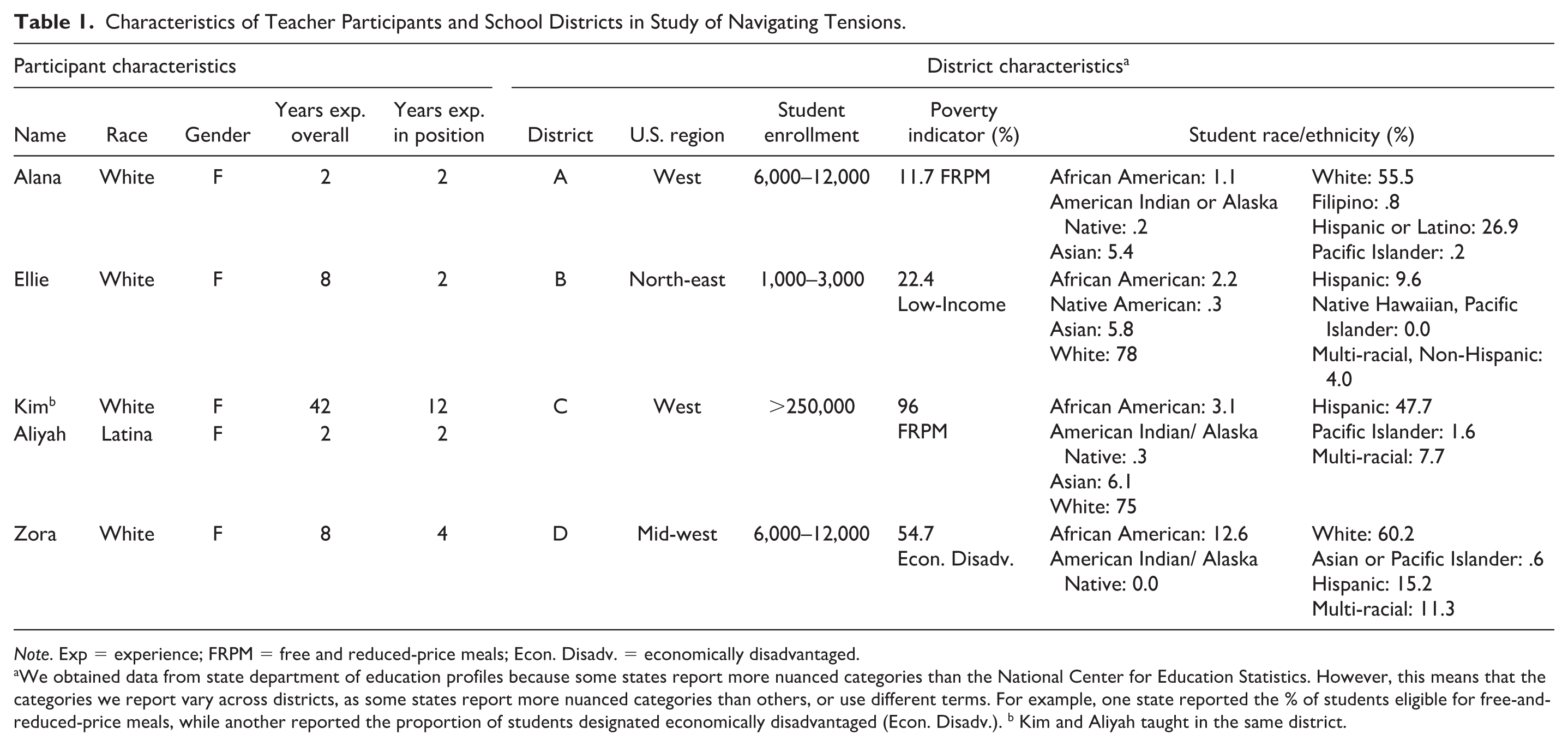
Note. Exp = experience; FRPM = free and reduced-price meals; Econ. Disadv. = economically disadvantaged.
We obtained data from state department of education profiles because some states report more nuanced categories than the National Center for Education Statistics. However, this means that the categories we report vary across districts, as some states report more nuanced categories than others, or use different terms. For example, one state reported the % of students eligible for free-and-reduced-price meals, while another reported the proportion of students designated economically disadvantaged (Econ. Disadv.). b Kim and Aliyah taught in the same district.
Participants were part of a larger study, funded by an Institute of Education Sciences grant to Dr. Elizabeth Bettini, in which we used varied data sources to understand how working conditions shaped special educators’ instructional decisions in self-contained settings for students labeled with EBD. After collecting data, we purposively selected these teachers for the present analysis because they elaborated on experiences of substantial tensions; the other four participants in the larger study either did not describe substantial tensions, or they did not elaborate on tensions in sufficient depth for an analysis focused on tensions. Results are not intended to generalize to all special educators teaching students labeled with EBD.
Data Collection
For this analysis, we focused on a subset of data collected in the 2019/2020 school year. We conducted between two and three interviews with each teacher on Zoom shortly after COVID-19 school shutdowns began. Interviews did not focus on the pandemic; we acknowledged the salience of the pandemic to their current experiences but focused on their experiences before school shutdowns. Interviews were semi-structured, taking the form of guided conversations, so we could follow teachers’ leads and ask follow-up questions.
Interview protocols did not deliberately focus on tensions, but rather, on how working conditions shaped their instructional decisions during reading instruction (i.e., the focus of the broader study). However, for five teachers (out of nine total), tensions came up naturally in the course of describing what was shaping instructional decisions. In the first interview (53–81 min long), we aimed to understand how teachers thought about reading instruction. Questions addressed how they viewed their role, students’ strengths and needs, goals for students, and resources they drew on for instruction. In the second interview (47–84 min long), we watched a video excerpt of their reading instruction (recorded before schools shut down), pausing to ask about their decisions (e.g., “Can you tell me about why you selected this text?” “Can you tell me why you asked the boy to follow along with his finger?”). For Alana, Aliyah, and Zora, we had additional instructional videos, so we also conducted a third interview, structured the same way as the second, but focused on a different video excerpt. Although interview questions did not focus on tensions, in all interviews, we asked follow-up questions about the tensions they mentioned, allowing us to gather rich data on the tensions they experienced and how they navigated them. As such, the tensions that surfaced in these interviews may not reflect the full range of tensions special educators experience, but rather, tensions that arise in the course of planning for and providing instruction. However, it is noteworthy that, without initially asking about tensions, they consistently naturally arose for these teachers.
Analysis
We first extracted teachers’ descriptions of tensions, by highlighting interview excerpts that, from the teacher’s perspective, (1) reflected misalignment between what they thought should be and what was, including both tensions with other educators or families and tensions between their responsibilities and their resources or time; and (2) interfered with efforts to do their job. We excerpted one transcript together, building consensus about the process. Each researcher then selected excerpts from their assigned transcripts, after which a second researcher reviewed the same transcript. We discussed disagreements and came to consensus about all excerpts before extracting all excerpts into separate documents, organized by the participant.
After selecting excerpts for analysis, we conducted a constructivist grounded theory analysis (Charmaz, 2014). We coded in four iterative, inductive phases (initial, focused, and theoretical coding, followed by theory development), which helped us move from concretely describing data to abstract interpretation. In all four phases, we compared inductive codes within and between participants, memoing emerging ideas and debriefing to discuss our understandings. Peer debriefing brought our different lenses to bear on interpreting the data, enriching our collective understandings, while ensuring interpretations were firmly grounded in the data.
In initial coding, we used descriptive codes reflecting all labels that could be inferred to apply to small units of data. For example, Ellie said, “The most challenging thing is getting other educators and adults to see the good in these students and see that they’re worth all of our time”; we applied codes such as, Valuing students and Wanting others to see students’ worth. We then combined initial codes salient to our emerging understanding of tensions to create focused codes. For example, those initial codes became part of the focused code, Perspectives on students. We coded data using focused codes, iteratively coding, memoing, debriefing, and revising codes.
While focused coding, we began to understand how codes related to one another. We then grouped focused codes in these theoretical categories, posing questions about each category. For example, to capture our emerging understanding of how teachers’ social context related to tensions, we posed questions such as How does her understanding of her social context connect with what she views as tensions and the strategies she employs to navigate them? One team member memoed responses to questions for each teacher; other team members reviewed the memo, raising questions and editing. In this phase, we reread the full transcripts, including text that did not address tensions, to ensure we captured all nuances and any relevant context. We then memoed each question across all teachers, noting similarities and differences among them, as well as patterns in how codes related to one another. Through memoing, we began developing an understanding of how codes related to one another, which we reflected in a draft figure. We iteratively revised the figure throughout analytic writing. During analytic writing, we collaboratively formulated assertions about how the data responded to the research questions, returning to memos and data to substantiate and deepen assertions, while revising the figure.
Trustworthiness and Credibility
We took several steps to promote trustworthiness and credibility, including considering our positionality and peer debriefing throughout. We also debriefed at key points with the fifth author, who helped collect the data and knew the data well, but was not involved in this analysis. Finally, the fourth author conducted a systematic search for disconfirming evidence. She affirmed that the data accurately reflected the findings, posing only minor clarifying questions.
Findings
Teachers consistently experienced tensions regarding (1) students’ belonging, (2) teachers’ instructional roles, and (3) teachers’ roles supporting student behavior. However, teachers took very different stances on these issues, informed by their conceptions of students, their own roles, and the purposes of education for their students. They also navigated these tensions differently depending on their positioning in their social contexts (see Figure 1). We first explain teachers’ conceptions of their students, their roles, and the purposes of education for their students, as crucial background for understanding their experiences of tensions. We then describe the tensions they experienced and how they navigated these tensions.
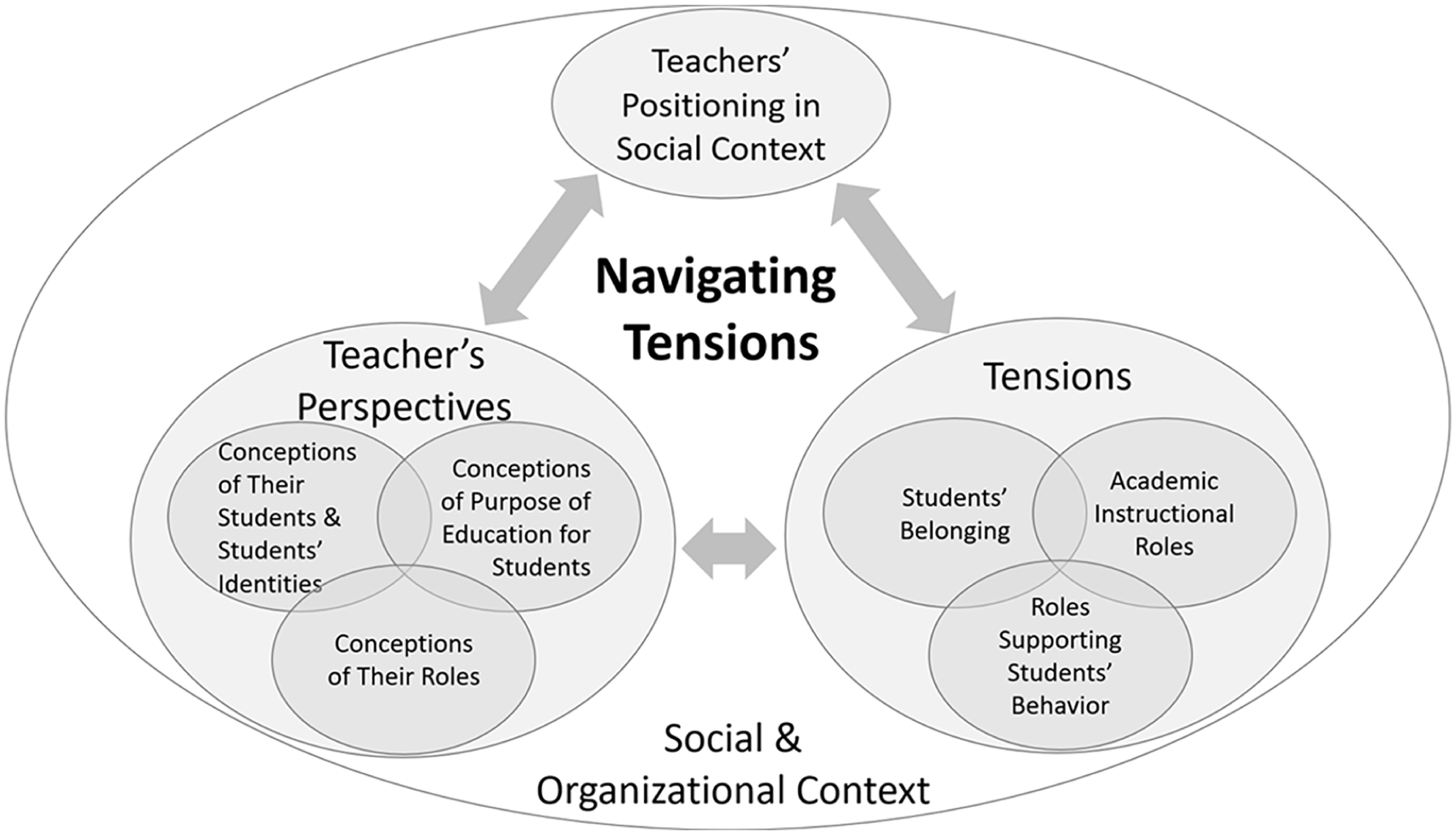
Grounded Theoretical Model of How Teachers Experienced and Navigated Tensions.
Conceptions of Students, Their Roles, and the Purpose of Education for Their Students
All teachers viewed students as having challenges or needs rooted in the child and, in some cases, the child’s family. Yet, how teachers viewed these challenges or needs varied greatly. Some teachers valued students as whole humans with support needs, whereas others held pathologizing perspectives focused on fixing students. These perspectives informed what they considered the purpose of education for their students and their own roles as teachers.
Aliyah and Ellie
Aliyah and Ellie conceptualized students as children with interests, strengths, struggles, and support needs, who were not defined by their struggles or support needs. Aliyah said, “They’re very helpful. They like to be leaders . . . When they’re not in fight-or-flight mode, they are so friendly.” Centering their strengths and interests, Aliyah acknowledged how difficulties affected them, describing specific areas of struggle: “They struggle with coping with their anger. They struggle with coping with feelings of sadness.” Similarly, Ellie viewed students’ difficulties as arising from “anxiety and mental health components,” emphasizing that, although these difficulties affected students in substantial ways, they did not define students’ worth:
The kids are wonderful. Whether they’re calm and doing their work or not, I know that that’s out of their control at some point. When a student is in crisis, it’s not them—it’s their brain is doing something that is causing them to have this outward emotional burst.
Ellie pathologized students’ brains, yet she held a humanizing perspective, describing them as whole humans who deserved an education that met their needs.
Grounded in their conceptions of students as whole humans, Aliyah and Ellie viewed the purpose of education as helping students develop coping skills, while learning academic content and fostering inclusive placements. Ellie said, “My job is to provide academic instruction,” especially “specially designed instruction,” while working with other adults to support students in general education classes. Ellie and Aliyah viewed academics and coping skills as integrated with one another. Ellie described how academics challenged students’ self-worth, and thus, her job involved addressing both academics and students’ self-concept simultaneously:
You’re asking a kid to do something that’s hard for them especially when they feel st*pid (See Note 2) or d*mb or incapable . . . I can say it till I’m blue in the face that . . . “They’re smart, they’re brilliant”. . . I have them do these affirmations before they do hard things.
Centering students’ experiences, Ellie aimed to both promote academic skills and build their self-worth. Aliyah similarly described using affirmations to build students’ self-worth, while fostering their skills to “self-advocate . . . if you feel like something isn’t right or you need help.” When students developed coping skills, she wanted them to move into general education:
I want to start pushing you out into general ed once you’re ready . . . I want you to be included . . . I just think it’s so rewarding to see . . . “Oh, you’re not punching me or anyone else now. You’re using your words, and that’s amazing.”
Both Ellie and Aliyah viewed their jobs as supporting students to develop coping skills (e.g., self-advocacy) to manage difficulties in general education settings.
Zora
Zora seldom mentioned students’ strengths or difficulties, instead describing students using IDEA (2004) labels, legal terminology from IDEA (e.g., “least restrictive environment” [LRE]), and the interventions she felt they needed. She described her program as “cross-categorical but it’s mostly emotionally disturbed students and the majority of them need intensive interventions with behaviors, coping skills.” She described prioritizing intervention for behaviors that would have negative consequences outside of school:
What am I really going to target behavior-wise? . . . I could target 10,000 things, [for] myself included, that [are] area[s] of improvement. So, I really think about what interventions I’m going to do . . . It’s things that are life skills. Like when you get mad at somebody you cannot punch them in the face . . . Those [are] things that I’ll focus in on.
In saying she also had areas of improvement, Zora normalized the need for behavior intervention, while prioritizing skills that she felt were essential for life outside of school.
Zora said her program’s goal was to move students into general education, often referencing LRE as a rationale for doing so. Like Aliyah, she felt they first needed to be “ready”:
I have some students that will go out to the general education classroom for reintegration but then there’s some that just aren’t ready for that. But the goal is to get them out and not be in the emotionally disturbed room.
Like Aliyah, she also defined readiness in terms of students’ coping skills to manage emotions:
When they’re mad, maybe walking away, taking deep breaths, counting . . . “I’m going to . . . throw a pillow instead [of a table]”. . . Saying what you want to say, but in a positive way . . . Maybe they need a change of scenery. We have a sensory room . . . a Smile Pass . . . you write 3 adults in the building that they can go visit, and [the adults] have to give them a compliment and a smile. So it resets their mood maybe and just gives them their break.
Zora thus indicated coping skills to manage emotions were the primary solution to students’ challenges in school, but she did not indicate any efforts to understand why students were having negative experiences or how those negative experiences could be prevented. However, she also highlighted how her school had changed the environment (e.g., sensory room, Smile Passes) to promote using these coping skills, outside of her classroom. She viewed her role as promoting coping skills, while providing academic instruction in the self-contained class.
Alana
Alana’s conceptions of students’ disabilities interacted with her conceptions of race and class. When students’ families aligned with middle-class, white, nondisabled norms, she attributed behaviors to a “real” disability in the child. For example, she described a student:
Kara, they are very . . . middle class . . . Her mom . . . is pretty educated. So she understands Kara’s disability and what it means. And Kara has a sister who’s typical, so the way her behaviors manifest in the classroom is definitely due to her disabilities, whereas . . . other kids, I think it’s like a mixture of environment and home life and the disability.
Kara’s family reflected Alana’s understanding of white middle-class values, thus she viewed Kara as having a disability internal to Kara. In contrast, she described another student, Seth:
[Seth] just wants love, and you can tell when he isn’t getting that at home. You can see he’s hurting but he doesn’t know how to . . . communicate that to us because he just wants his dad to love him so much, and his mom’s not in the picture . . . His dad is, like, 500 pounds . . . He was on disability for a while. Super lazy, super just entitled as well.
With clear disdain for Seth’s father, Alana viewed Seth’s behaviors as rooted in perceived family dysfunction, defined by his father’s disability, poverty, fatness, and single parenthood. She saw her role as compensating for what she felt Seth lacked at home, while trying to change his home environment (e.g., calling Child Protective Services). Thus, her conception of her role differed, depending on to what she attributed students’ difficulties. In differentiating between “real” disabilities versus needs that she perceived were caused by race, class, body size, or parental disability, Alana implied disability could be objectively identified and separated from other aspects of people’s identities, and further, that these aspects of people’s identities were problems.
Whereas Aliyah, Ellie, and Zora aimed to foster students’ coping skills, Alana aimed for students to change to meet neurotypical, nondisabled norms. She described an autistic student:
He has a disability but we’re going to get him to do pretty much everything another kid can do. It’s going to be harder for sure, and we’re going to give him . . . accommodations, but that doesn’t mean that it’s an excuse for him to act like this.
Alana viewed this student’s disability as an “excuse” and positioned accommodations as a means to neurotypical assimilation. Moreover, in saying “we’re going to get him to do,” she framed the process of assimilating him to neurotypical norms as a power struggle in which he needed to align with her perspective, paternalistically privileging her view on the student.
At the same time, Alana also emphasized that her core goal was for students to be happy and learning, expressing that behavioral compliance was not the goal:
If my kids are happy and are learning, then I’m being successful. And that’s my goal, is that they’re happy and they’re learning . . . I feel like we drift so far away into . . . making the kids compliant. Like “that’s our job . . . they need to be compliant.” But I don’t see it like that. I see it as . . . if they’re happy, they’re not going to yell at you. They’re happy.
Alana prioritized students’ experiences, rejecting compliance as an aim of special education. Yet, she assumed happiness was expressed through neurotypical behavior (not yelling). Thus, while centering positive student experiences as core to her job, she also legitimated neurotypical norms as defining indicators of happiness, positioning herself as the expert on students’ experiences.
Kim
Kim defined students by disability labels and ableist markers of competence: “I have kids that are truly cognitively lacking. I have children with autism . . . severe LD.” She said some autistic students were in her class because “the behavior is worse than the autism,” implying autism and behavior were separable and were both bad. She described students as having “strong will[s]” and being “attention-seeking,” with behaviors rooted in innate academic deficits:
If you’re a child that can’t read, that’s real frustrating . . . It’s like somebody saying to me, “. . . we’re going to do advanced chemistry. Here, here’s a formula . . . figure this out.” Well . . . I’d throw it back to them . . . That’s how a child feels when you say to them, “Here, read the word, . . ”. Academics can be a real trigger to behavior . . . They don’t want to be embarrassed. I mean nobody does, but . . . they’ve been the kid that had to sit out in the hallway because they . . . couldn’t do it . . . So you’re battling that . . . “Hey, you’re smart . . . You can do this.”
Kim expressed empathy for students’ reactions to academic challenges, indicating she thought their reactions were normal responses to work they could not do, noting stigma they experienced, and highlighting the importance of building their self-confidence. At the same time, she centered their deficits, focusing on what they could not do, without considering how ableist norms (i.e., defining students’ worth based on reading skills) underlay the stigma students had experienced.
Kim felt students’ difficulties were exacerbated by “family issues.” She said some students have “great parents,” but many parents “don’t know how to parent.” This perspective was intertwined with families’ class status: “A lot of them are single parents . . . I teach in a Title I school . . . I have . . . [the students] a chunk of the day, but they still go home.” Kim summarized her understanding of students’ disabilities: “It’s just a whole huge mess . . . It’s not just one thing.” Kim’s perspective reflected (a) an understanding of students’ difficulties as having multiple roots, (b) empathy for academic difficulties, (c) classist perspectives on families, and (d) a pathologizing orientation that foregrounded purported deficits and disability labels.
Aligned with her belief that behavior was triggered by academics, Kim viewed her role as addressing both behavior and academics: “I always looked at it as both . . . a behavior system, but in that we’re doing academics . . . they’re both [equal].” Yet, she viewed the primary purpose of her program as serving general education, by separating her students from nondisabled peers:
I always tell my aides, “Look, our goal is if we can have them in our classroom and they’re learning and they’re functioning . . . we are probably not going to cure them.” I can’t change their IQ. I can’t change their autism. But if we can . . . have them learn to live with some of the behavior and change it, then I feel successful because we’re also providing a service by getting them out of the gened classroom . . . Teachers . . . love me because I will take a child that is tearing their room apart and they’ll place them in my classroom and it’s taken that burden off of them . . . That’s kind of how I look at my job. If we can . . . save that gen ed classroom from that child . . . we can try and change some of the behavior, then I’m so golden.
Viewing her students as inherently flawed, Kim saw them as a “burden” to general education. She thus viewed her role as changing behavior while separating students from nondisabled peers, “saving” teachers from students who she statically defined by their test scores and labels.
Tensions and Projected Solutions
Teachers experienced tensions regarding (1) students’ belonging, (2) their academic instructional roles, and (3) their roles supporting behavior. Yet, their stances on these tensions varied depending on how they viewed students, the purpose of education for their students, and their roles, as well as how their conceptions related to their school’s broader context.
Tensions Over Students’ Belonging
All teachers experienced tensions over students’ placement, grounded in differing understandings of students’ belonging. However, teachers took different stances on these tensions, informed by their understanding of students’ disabilities.
Aliyah and Ellie
Aliyah and Ellie described tension with colleagues who thought their students did not belong in the school or in general education, in contrast to their strong belief in students’ worth and right to belong. Aliyah said specials teachers “remove them sometimes for something super minuscule like they didn’t do the stretches during PE, so now they have to sit out . . . It’s really frustrating.” Aliyah rejected colleagues’ belief that students needed to behave in rigidly defined ways to belong in general education. Ellie described tension with colleagues who rejected students’ presence in the school, saying colleagues asked, “Why can’t those kids go to another school? Why can’t a kid be locked in a room until they’re calm?” To Ellie, these comments revealed colleagues’ views that only students who complied with normative behavior standards belonged in the school. By contrast, Ellie felt, “they’re more deserving of an education because they’re working 37,000 times as hard.” She said, “That’s been really devastating for me having to explain that a child, a 7-year-old child, is worth all of our time.” Repeatedly emphasizing students’ worth, Ellie viewed tension over students’ belonging as rooted in differing perspectives on students’ value. Based on their strong conceptions of students’ inherent worth, Ellie and Aliyah both viewed others’ perspectives on students as the problem in need of resolution.
Alana
Alana also experienced tension with colleagues who rejected students’ presence in the school, in contrast to her view that students belonged in her class: “There were union meetings happening behind my back to get my program off of the campus.” She said colleagues said, “They get away with so much,” implying students should be more harshly punished, and “It’s not a disability.” These perspectives conflicted with her view that students’ behaviors reflected real disabilities (defined through a medicalized view of disability) and thus that students had a right to intervention. She described replying, “Think about this classroom as like a mod/severe, medically fragile classroom . . . Think of it as like an autism class . . . Think of it like a disability.” Alana compared her students to peers who colleagues understood as disabled, reflecting her view that students’ disabilities were real, and thus that they deserved an education. Like Aliyah and Ellie, Alana experienced tension over student’s presence, yet her rationale for their belonging was not rooted in students’ inherent worth, but rather, in the presumed reality of their disability.
At the same time, Alana also experienced tensions with other educators and parents who wanted her students moved into general education classes:
I’ve had kids that are [happy and learning] in my class and people are like, “Oh, then they can go to gen ed”. . . I’m like, “But it’s working so well . . . Can we just let it . . . be?” Because apparently what we’re doing in here is working, why would we now take him out and go put them somewhere else where it might not work because they don’t have supports . . . I think administrators see it as like a numbers game . . . It always comes down to money . . . “Oh well, if you have less kids, then that’s less need [for] support. That’s one less paycheck . . . .” It just depends on if the parent . . . how they view the program. If they view the program as this bad thing that their kid’s not typical and they’re . . . mourning the loss of having a typical kid, or if they view the program as a support . . . Is their kid happy and learning, then why move them?
Viewing the aim of education as keeping students “happy and learning,” Alana saw leaders’ focus on inclusion as a cynical effort to save money and parents’ interest in inclusion as evidence of failure to accept their child’s disability. Positioning herself as the expert on students, Alana sought to keep students separate based on her view of their happiness and learning.
Zora
Zora described general education colleagues who welcomed her students in their classes: “They’re so understanding. They don’t expect perfectionism . . . They’re always passing out [good behavior] tickets to my students.” Whereas other teachers’ colleagues’ rigid expectations were barriers, Zora’ colleagues did not “expect perfectionism,” supporting her students’ inclusion.
Zora instead experienced tension with administrators over outplacing students:
We have students that are extremely severe . . . When [the separate facility is] full, we’re stuck . . . If my classroom isn’t [their LRE] . . . we’re going to have to figure something out because that’s not fair to all the other students in the classroom . . . I’m talking paramedics, suicidal students. Intense. And we had nowhere to put them . . .
Aligned with her view of students through the lens of IDEA’s (2004) legal provisions, Zora justified outplacement using combination of the LRE provision, the “sever[ity]” of behavior, and her view of “fair[ness],” positioning her students’ support needs as both misaligned with her class’s position in the LRE continuum and detrimental to their peers.
Kim
Kim’s colleagues did not welcome her students in their classes. She said, “Nobody else wants to deal with” them. Yet, she did not experience tension over this, as she agreed that her students should be separated from the broader school community. Instead, rooted in her view of students as burdens, she experienced tensions with administrators over outplacement:
Certain children . . . should not be in a regular school setting . . . We have . . . a behavior school . . . for the worst of the worst . . . You not only have to be a serial killer, you have to be convicted of it before you can get to [that school] . . . That’s how hard it is to get a child there . . . There are principals that just say, “Not my problem. You deal. That’s your problem.”
Kim equated students to criminals—killers who needed to be sent away, like those incarcerated in the criminal legal system. Her pathologizing view of students, and her consequent view of her role as a savior for general education, shaped her view of students’ placement in a neighborhood school as a tension, as well as her projected solution–outplacement to a school for the “worst of the worst.” Kim likewise viewed lack of other self-contained classes in her school as a tension:
I have children that I get their behavior in line, and I have nowhere to put them because if I put them back in the gened classroom they can’t do the work, and guess what? The behaviors are going to start up again.
Without considering what supports might facilitate students’ access to general education settings, Kim felt the school should have more self-contained classes for students with learning disabilities, where her students could be placed if their behaviors were “in line.” Whereas Ellie’s and Aliyah’s value for students led to tension with colleagues who wanted students outplaced, Kim’s pathologizing perspective led to tension with leaders over limited self-contained settings.
Tension Over Academic Instruction
All teachers experienced tensions over academic instruction. These tensions took different forms, and teachers took different stances, informed by their conceptions of students, the purpose of education for their students, and their roles.
Responsibility for Academics
Aliyah and Kim both experienced tension with educators who did not see them as responsible for academic instruction, which led to further tension over access to curricula. However, they thought about these tensions very differently.
Aliyah described tension with other educators who saw her as “a behavior babysitter . . . making sure the kids don’t hurt each other all day, rather than a teacher.” She said, “It makes me feel like they’re saying [program] kids can’t learn,” reflecting low expectations in tension with her view that students could “learn just fine” with the “right tactics.” This led to tension over the discrepancy between her curricular resources and her sense of responsibility for instruction:
I was asking [the principal] about the curriculum . . . and she was like, “Well, to be honest it’s the [program] class, I’m surprised you’re even able to run academics. I’m just happy you’re running academics”. . . I hate when people say that, it makes me really mad.
She described an administrator saying, “If you . . . need to find special ed resources . . . you can always Google a special ed curriculum,” implying her students only needed “special ed” resources, which could not be guaranteed through normal school funding allocations.
Kim similarly experienced tension when others did not view her as a teacher. As with Aliyah, this manifested in lack of access to curricular resources:
We got a new [curriculum] program . . . I walked down [to get the curriculum] and I said, “Oh, hi, I’m Kim . . .,” She looked at me and she said, “Oh.” She said, “Um I’ll see what I can find for you,” but she said, “These materials are for the real teachers.” . . . We’re not really considered teachers . . . She wasn’t trying to be mean. It’s just the reality of it.
She described getting “bits and pieces” of the new curriculum and being expected to scrounge other materials. Although it bothered her that others did not see her as a “real teacher,” Kim generally viewed school instructional initiatives as irrelevant to her job. Instead, she experienced tension regarding the expectation that she participate in these initiatives. For example, she was expected to join grade level “I forget what they call them, PLCs or something.” She said, “So I go to the 1st-grade planning meeting. Why? I’m not quite sure . . . Generally it has nothing to do with me.” Likewise, Kim felt the new curriculum was not appropriate for her students:
My colleagues said . . ., “Kim it’s going to be really hard. Your second graders are going to have a tough time because it’s hard for our gen ed second graders . . .” They said it’s a lot of writing . . . What’s the number one thing sped kids don’t like to do and it’s called writing.
Grounded in her deficit view of students and her stereotype that “sped kids don’t like” writing, Kim felt relieved that, because she was excluded from the curriculum orders, she could continue using the prior curriculum—a stark contrast with Aliyah’s anger under similar circumstances.
Resources in Tension With Roles
Ellie, Alana, and Zora were expected to teach academics, but experienced tension between this role and their resources (e.g., materials and time).
Ellie had materials for “specially designed instruction,” but not general education curricula: “Curriculums are expensive . . . We kinda get . . . last [priority].’” She met with students’ general educators once a week to discuss plans and accommodations, but lack of materials challenged collaboration: “[The general educators] can’t say . . ., ‘I’m doing 5.2 in math’ because I’m like, ‘Well, what the fuck is that? . . . Is that addition? Is that subtraction?’” Without materials teachers used for planning, basic communication about instruction was harder, creating tension between her resources and her responsibility for students’ instruction in general education.
Alana also described tension over instructional resources, but for her, there was a discrepancy between her resources and her responsibility for teaching general education curricula within her self-contained classroom. With responsibility for teaching four grade levels,
I can’t do everything the gened teachers do . . . The reading curriculum . . . there’s supposed to be like three mini lessons and then we’re supposed to have . . . a reading group and then there’s supposed to be a big whole lesson and there’s just no way I can do that.
Further, she said: “I don’t have any prepping time. And if I did [careful planning] for all four grade levels, I’d be sitting there after school until 6 o’clock.” Whereas Ellie experienced tension over resources for supporting students’ instruction in general education, Alana experienced tension over resources for providing instruction in her separate placement, aligned with her priority on creating a supportive separate placement for students.
Zora was expected to provide academic instruction and she was included in her school’s instructional initiatives. However, Zora experienced tension with a professional development (PD) provider who expected rigid adherence to a scripted curriculum. She felt the PD provider was “so strict and regimented! . . . acting like we can’t skew from what we need to say, but we have emotionally disturbed students . . . It’s just not realistic.” Aligned with her focus on static, label-based definitions of students, Zora grounded her objection to rigidly following the curriculum in students’ label (“emotionally disturbed”), which, for her, was the rationale for adjusting instruction in response to students’ learning, and thus, for tension with the PD provider.
Tensions Over “Severe” Behaviors
Zora and Ellie felt some students’ “severe” behaviors (Zora) interfered with teaching other students, but they attributed this tension to different causes.
Ellie described “being pulled between” students in crisis and academic instruction:
If a student was so far gone in a crisis, just because of the relationship that I had with the students, it would be like, “Okay, if Ellie comes this’ll be over in 5 minutes, if she doesn’t, it’s going to be . . . 30 minutes. So let’s just grab her quick”. . . It’s not necessarily that I am incredible at my job, it’s just that I was the one who built the relationships with the students.
Supporting students in “crisis” was in tension with her responsibility to teach other students, leaving her feeling, “I’m not doing my job.’” Ellie attributed this tension to inadequate staffing:
We’re always told, “We can’t staff for a crisis,”. . . but the reality is . . . not a day goes by where we are not responding to a crisis . . . We’re pulling admin away from their jobs . . . pulling me away from the academic support that I’m supposed to be giving.
Ellie consistently noted that current staffing was inadequate to cope with student crises.
Zora similarly described feeling “twisted everywhere” when trying to simultaneously support both the needs of students engaging in more “severe” behaviors and her other students:
I feel like my hands got so tied up in those severe behaviors that the students . . . making good choices . . . got put on the back burner . . . I had to focus so much on [severe behaviors] because people were getting hurt. And I had other students . . . cry to me and tell me that they didn’t feel safe . . . It made my classroom . . . a terrible environment.
Whereas Ellie framed this as tension over staffing, Zora viewed this as tension over placement: “The separate facility . . . was full. And [the district didn’t] want to fork out $30,000” per student. Zora likewise felt her district did not have enough disability-specific self-contained classes:
At [my] previous district . . . if you were an ED student you were in an ED classroom. If you were . . . OHI . . . they had a room for all of that . . . The class sizes . . . [are] capped at 10 . . . Whereas here, because we can have OHI, CD, ED [in the same room] you can get up to 16. Last year I had 14, and when you have that many with ED, and then a little bit [with] CD . . . it makes it extremely hard to balance all the interventions because you have some that need such severe behavioral interventions. And then you have one that needs hardly anything [behaviorally], but gets too academically frustrated, but they’re still in the same room.
Serving students with varied disability labels, Zora described struggling to match interventions to each student’s disability, a tension rooted in her view of students through the lens of their labels.
Tension Over Behavioral Support
Aliyah, Alana, and Kim also experienced tensions over how educators should support students’ behavior.
Adherence to Rigid Behavior Norms
Aliyah and Alana both experienced tension with others regarding the rigidity/flexibility of behavior expectations, but Aliyah experienced tension with others’ rigidity, whereas Alana experienced tension with others’ expectations for flexibility.
Aliyah’s colleagues and administrators expected her to ensure students’ compliance with rigid behavior expectations, a role she rejected. For example, she said that, at recess:
If the kids are . . . running . . . everyone’s the first to tell me. I’m like, “Okay, but aren’t all the other kids running too? . . . I’m not going to intervene for that . . .” They’re like, “Well . . . it’s your job.” But I’m like, “. . . It’s recess. Your students are running around too.”
She felt this expectation was rooted in narrow perspectives on her students: “Those students have a name and if you came into my classroom you would actually realize they’re not bad kids, they just make poor decisions sometimes . . . Why are you [not] getting to know them?” Viewing her students as whole humans, she resisted others’ narrow focus on behavior, refusing to enforce rigid expectations. Instead, she felt students needed stronger support during unstructured times:
During unstructured times where my kids need the most, my principal and assistant principal are having my teacher assistants pass out ketchup and forks and helping other kids . . . They’re like, “Well, your kid did this, this, and this during lunch,” and I’m like, “Well, what did you expect when my teacher assistants . . . can’t sit by them? . .”. They’re like, “Well, we need them because we don’t have enough cafeteria assistants,.”.I was like, “. . . Then the kid’s going to run around the lunchroom. I don’t know what you want me to do.”
Aliyah contextualized students’ behaviors within the supports they were provided, which was in tension with administrators’ expectation for students to “behave” as expected without support.
Alana, in contrast, experienced tension with a parent who viewed a student’s behavior as a response to an inaccessible society, believing Alana should change the environment:
[The student’s mom] uses it as like, “My precious poor child . . . He has autism so he can’t help it”. . . She doesn’t see the potential for him to grow . . . She thinks . . . “He has autism, so therefore he can’t . . . function in society and behave. . . . Society needs to change”. . . That’s not really how I view autism or the disability. I’m like, “ . . . I see the potential for him to behave better. I think he’s manipulating us, but you’re using his autism as an excuse.”
Whereas Aliyah experienced tension with others’ expectations for students to behave in rigidly defined ways, Alana’s view of her role as promoting neurotypical behaviors led to tension with a parent who believed her role should involve adapting the environment to meet a child’s needs.
Resources for Behavior Support
Aliyah and Alana also both experienced tension with administrators over the resources needed to support her students’ behaviors. Aliyah did not have funds for reinforcers. When she asked, her administrators said, “they understood, but they just didn’t have the allocations to fund it.” She then wrote reinforcers into students’ behavior plans; yet, “They’re like, ‘Well, we have other things that we need to fund,’” and, “Just go to the Dollar Tree.” She concluded, “They don’t care.” Alana likewise experienced tension with an administrator who did not provide resources she needed to support a “really tough kiddo”:
I was writing up all these reports about . . . him being in a restraint . . . They all go to my program specialist. . . . [but he] never said anything. And then I finally started reaching out . . ., “This is not working . . . I’ve ran all my resources . . . I have nothing else.” And his response was . . ., “Oh, the kid needs a nutrition bar”. . . Then at one point he’s like, “He just needs to be on his own in a classroom”. . . So I sent him with an aide all day long in a classroom. And it just was horrible . . . They’re like, “Don’t do any academics. Just work on behavior”. . . Like, what do you mean don’t do academics, just work on behavior? They’re intertwined . . . So we let him play all day, but then he’d still have behaviors . . . One day [the administrator was] just randomly on campus. And he walks in and that kid’s in . . . an extreme behavior, where four adults are . . . dealing with it . . . He goes, “Oh no, we can’t have this . . .”
Alana referenced a restraint—an often harmful, traumatic experience for students (Butler, 2019)—to illustrate the seriousness of the student’s need for more support, yet leaders’ response (i.e., unhelpful advice) was dismissive. Her administrators then decided to outplace the student rather than provide more resources in the school, a solution with which Alana was satisfied.
Administrator Engagement With Behavior
Whereas other teachers wanted administrator support for behavior management, Kim felt their involvement created tensions for her. For example, she described tension when a principal tried to suspend a student from the bus:
[Principals] get angry at the child,
Kim felt the principal’s anger was justified, but was frustrated that her principal’s violation of IDEA became her “problem”: “I have parents that are angry at me . . . I wouldn’t have done that, but you get caught up in the administration.” Kim did not disagree with the suspension on principle, but rather because she had to deal with the consequences of the IDEA (2004) violation.
Navigating Tensions
Teachers’ positioning in their social contexts shaped how they navigated tensions, as they relied on social connections to navigate tensions. In seeking to resolve tensions, the solutions they aimed for varied depending on their stances on those tensions, rooted in varied perspectives on students, their own roles, and the purposes of education for their students.
Alana
Alana was well-connected with district and school leaders, who she perceived were invested in her program, even when she disagreed with them. These connections helped her resolve tensions in ways she thought were best. When her colleagues held a union meeting to discuss how her students should not be in the school, Alana leaned on these leaders:
I ended up emailing my special ed director, all my program specialists and my principal and said, “I can’t keep doing this because not only does it make me uncomfortable, it’s not fair to these kids. They have a disability, they’re in special ed and we are being discriminated against for having a disability.”
Administrators helped her develop and provide PD to the school about her program. By having her lead the PD, Alana’s administrators positioned her as an expert, aligning themselves with her view that her students belonged in the school. This then helped her build stronger connections:
[Before the PD] I kinda was just like, “Am I comfortable with you? I don’t know. Do you like me? I don’t know . . .”. I think what came out of [the PD] was just people telling me that they want me there . . . then I felt comfortable.
Through the PD, she developed relationships with colleagues who supported her perspective. She then became a union representative for her school: “No more are you going to talk about my program [with] the union without me knowing.” Grounded in her administrators’ positioning of her as someone who colleagues can learn from, Alana iteratively deepened her professional network, building on relationships with administrators to expand her power to promote change.
Likewise, she described leveraging her relationship with the principal and a colleague in another self-contained class to reduce the number of grade levels she was teaching:
I teach four grades . . . I was telling my principal like, “I’m at my limit . . . I’m really struggling.” . . . I would also go to my colleague who teaches the upper grades . . .“Dude, like I need you to help me out here. Can you please take third [grade]? . . . this doesn’t make any sense” . . . [He] and I have a good relationship . . . he advocated for me as well . . . . My principal came to me and said, “Hey, I’m thinking about doing this.” And I was like, “Yes, I love that idea.”
Alana’s relationships thus shaped how she navigated tensions, while her efforts to navigate tensions helped her build stronger connections. By navigating tensions with support from others, Alana changed both her social context and her positioning within that context.
Zora
Zora described one of her leaders as “just phenomenal . . . the supervisor everybody wishes they had,” and her general education colleagues as “awesome.” When Zora experienced tension over how a PD provider told her to use a curriculum, she rejected the PD provider’s rigidity: “I try my best to . . . follow the prompts . . . but if I have to . . . scaffold or . . . repeat . . . then I’m going to, because it’s for my students, it’s not for that [PD provider].” Her leaders backed her up: “[My supervisor] totally understood, and she was like, ‘. . . this just happened to be a little bit of a rough trainer.’” Zora also felt solidarity with colleagues, saying, before the trainer came, “We would always say, ‘You ready to get eaten alive?’” Leaders and colleagues helped her feel comfortable using the curriculum in ways that aligned with her view of good instruction for her students.
In contrast, Zora was not able to resolve the tension she experienced over students’ outplacement, as this required changes that her colleagues and administrators did not have control over: “My director of student services . . . his hands were tied because the treasurer was like, ‘No,’ and . . . the separate facility . . . was full.” Thus, this tension was unresolved.
Ellie
Ellie also relied on her principal to help resolve tensions. Her principal’s support helped resolve tension when her interests aligned with general educators’ interests, but not when they conflicted. When she lacked curricula, Ellie went to her principal for more materials, strategically pointing out that giving her curriculum would be convenient for general educators:
It’s also just annoying to gened teachers for me to be like, “Hey, what are you doing? What are you doing?” . . . They’re like, “Oh my god, I don’t know, like stop asking me” . . . I went on that route of [saying] . . ., “None of us have time to have this conversation [about curriculum], so . . . if I can just have this . . . I realize it’s expensive, but this is just something that’ll make everyone’s lives so much easier because I won’t have to be this annoying, pestering human.”
Ellie was then “able to get the scope and sequence for all of the content areas.” She used general educators’ interests strategically to make the case that she should get the basic resources she needed to do her job, and thereby overcome potential objections (“it’s expensive”).
However, principal support was less successful when Ellie’s and her colleagues’ interests conflicted—when colleagues filed a grievance with the union related to her students:
People felt that their . . . ability to teach was being compromised given our population . . . [Teachers] felt like they weren’t being heard by the administration and they wanted there to be more communication around some of the policies . . . in place for if a student . . . was in crisis.
Ellie’s principal called a meeting to discuss the issue, but the meeting became a forum for colleagues to share “horrible” perspectives. Unlike Alana, Ellie was not centered as someone her colleagues could learn from; colleagues’ ableist views on students were centered instead. Deeply hurt, Ellie retreated: “The language they were using was . . . really painful for me to hear . . . I actually ended up walking out of that meeting . . . crying.” Whereas Alana leveraged her position of authority in the PD to build stronger relationships, this experience left Ellie further isolated.
Ellie described how having to justify her students’ worth was “devastating.” She considered sharing more about students’ backgrounds, but felt doing so would violate students’ privacy and that more information should not be necessary to treat students well:
It’s nobody’s business for me to go in and say, “These are the 17 things that are wrong in the house that he lives in” . . . I don’t feel the need to project the why behind each of my students, but I do need people to care about them.
Further, Ellie also worried that more information could put “a target on their back”:
It causes people to lose hope in a student’s trajectory . . . “Well . . . that’s a [program] student. I don’t need to worry about them, because there are so many other things going on that their 3rd-grade education doesn’t matter” . . . I think being a [program] student with or without the negative home environment is stigmatizing . . . there’s really a lack of understanding around the underlying mental health needs of these students.
Weighing potential negative consequences, Ellie chose not to share information about students’ backgrounds. Ellie’s tension with colleagues about students’ belonging in the school was unresolved and informed her decision to leave her school at the end of the year.
Aliyah
Aliyah was disconnected from colleagues and leaders, who were unresponsive to requests for help. The only time she described them helping resolve tension was when a leader assigned a student detention, but the person overseeing detention said, “Oh, I don’t take [program] kids”:
I radioed the administrator . . ., “This person’s saying that they can’t go to detention because they’re too difficult. So, what would you like me to do with them?”. . . The principal was like . . ., “No, I told you that he has to go to detention so he’s going, whether [they like] it or not.”
Aliyah responded to all other tensions on her own. When specials teachers (e.g., Music, Art) wanted her students removed for small behaviors, she used students’ legal rights under IDEA (2004) to enforce students’ right to be included: “I understand you don’t want to have them in your classroom, but you can’t remove them because of something small . . . it’s in their IEP . . . You can’t just boot them out.” She likewise refused to enforce behavior expectations she disagreed with, saying, for example, “I’m not going to go yell at my kids for doing exactly what your kids are doing.” Aliyah also used her own money to resolve tensions over funds for reinforcers, which resolved students’ need for reinforcement, but did not change the underlying cause of this tension (i.e., lack of funding). Navigating tensions on her own, Aliyah provided students what she felt they needed, but underlying systemic factors that led to tensions remained unaddressed.
Kim
Kim likewise described navigating tensions on her own, saying, “We deal with our own problems.” This approach was informed by prior negative experiences with administrators, as well as her belief that her students were “lacking.” For example, when her class was left out of a curriculum purchase, she accepted their exclusion and continued using old materials:
Reading is reading, I mean let’s be real . . . I don’t care . . . [The district is] trying to get into more nonfiction, more writing . . . whatever they’re doing, but reading is reading. And for my kids . . . most of them are not at grade level, so just to get them to read and get basics.
Rooted in her deficit view of students as needing only “basics,” Kim accepted exclusion from school-wide initiatives. Believing that others should not have to “deal with” her students, she accepted the systems that led to tensions and the need to resolve tensions on her own.
Conclusion About Navigating Tensions
Teachers navigated tensions differently depending on how they were positioned in their social contexts, in terms of their access to supportive relationships and how they were or were not positioned as experts. Through relationships, Alana and Zora were able to resolve some tensions in ways that aligned with their perspectives. Ellie also relied on her principal to help resolve tensions, but her principal did not position her as an expert and her attempt to resolve tension over students’ belonging was unsuccessful. Even though Ellie held more positive, strengths-based perspectives about her students than Alana, she was not positioned in her school as someone who colleagues could learn from. Alana, in contrast, held harmful, deficit views of students, yet was positioned in a way that foregrounded her perspective as authoritative. Aliyah and Kim were very separate from other educators and they both resolved tensions on their own. The solutions teachers sought depended on their conceptions of students, the purpose of education for students, and their own roles.
Discussion
We found special educators experienced tensions regarding students’ belonging, teachers’ academic instructional roles, and teachers’ roles supporting students’ behavior. These tensions reflected many ways in which their schools were not oriented toward their students’ strengths and support needs. For example, school staffing systems were misaligned with students’ support needs during unstructured times (Aliyah) and instruction (Ellie), while funding structures and purchase orders were made without consideration for their students (Kim, Aliyah, Ellie). Aligned with a growing body of research on teachers’ agency (i.e., how teachers engage in social contexts to promote change; Li & Ruppar, 2021; Philip et al., 2014), we found that teachers agentically worked to resolve the tensions they experienced. Yet, teachers’ perspectives on tensions and their approaches to navigating them varied greatly, based on how they conceptualized students, the purpose of education for students, and their own roles, as well as where and how their social contexts positioned them to effect change. Findings align with prior research, indicating the importance of special educators’ own beliefs and values, as well as their relationships with other educators, for how they navigate tensions (e.g., Li & Ruppar, 2021).
Importantly, special educators’ perspectives often reflected broader ableist discourses. For example, Alana’s belief that her role involved changing a student’s behavior to fit normative expectations aligns with broader expectations for autistic people to mask their autism and with the ableist view of neurodivergence as a problem to be fixed. Moreover, in some teachers’ descriptions, ableism interacted with racism, classism, and anti-fatness, as when Kim described how students’ difficulties were rooted in purported deficits of “Title 1” parents. Ellie and Aliyah held more humanizing perspectives, emphasizing students’ inherent worth. Yet, they also sometimes relied on ableist tropes, as when Ellie described students’ challenges as resulting from pathology in their brain, without noting societal and institutional barriers (Wise, 2023), and when Aliyah said inclusion in general education classes was contingent on students’ readiness, without considering how general education could become more accessible.
Our findings indicate teachers’ conceptions of disability were central to what they perceived as tensions. Grounded in deficit and legalistic, label-based views, some teachers accepted or even advocated for segregating students, as exemplified by Zora and Kim’s push for more categorical self-contained classes. By contrast, Ellie and Aliyah’s humanizing perspectives underlay their tensions with other educators who resisted including students and honoring students’ support needs. These findings align with other research showing the centrality of educators’ conceptions of disability for how they conceptualize and fulfill their roles serving students with disabilities (Mathews et al., 2024; Ruppar et al., 2018).
Of note, teachers often used IDEA (2004) to bolster their perspectives. For example, Aliyah used IDEA to shut down colleagues’ attempts to exclude students, while Zora used IDEA to substantiate her view that some students needed more segregated placements, based on the “severity” of the disability (language used in both her explanation and in IDEA’s LRE provision). Teachers’ reliance on IDEA points to the potential of legal guidance to support educators in understanding and navigating tensions. Yet, Zora’s use of IDEA to argue for label-based exclusion, without consideration of other potential supports, points to limitations of current legal guidance. Other scholars have critiqued how IDEA orients educators’ attention toward individual student differences as pathologies that cause students’ difficulties in school, aligned with a medical model of disability, without considering the role of ableism or other systems of oppression in creating inaccessible environments (Annamma, Boelé, et al., 2013). Given limitations to IDEA, we argue that it is insufficient as a framework for teachers’ advocacy for educational equity. Rather, to engage with school contexts in ways that foster more accessible, inclusive schools, teachers may need deeper understandings of ableism and how it is instantiated in schools. Frameworks such as DisCrit (Annamma, Connor, & Ferri, 2013) and intersectionality (Collins, 2000; Crenshaw, 1991) may be especially useful for helping teachers disentangle the interlocking ableism, racism, classism, and anti-fatness that were reflected in some participants’ perspectives, as well as for helping all educators understand how they could engage with school contexts in ways that promote anti-ableist school social and organizational structures.
Limitations
Our findings reflect the perspectives of a small sample of mostly white women, and they are not intended to generalize to all special educators. Relatedly, there are many aspects of teachers’ identities that may have been relevant to their experiences of tensions, but which we did not ask about; for example, disabled teachers’ lived experiences could inform how they experience and navigate tensions (Siuty & Meyer, 2024), but we did not ask about teachers’ identities. We only examined special educators’ perspectives; others’ descriptions of these tensions (e.g., students and general educators) might have brought additional context to bear on analysis. Our data collection was not designed to focus on tensions, but rather on reading instruction; thus, findings reflect tensions that arose in the context of planning for and providing reading instruction.
Implications for Research and Practice
We recommend special educators reflect on how they can navigate tensions in ways that push schools to honor students’ strengths and support needs. Remembering that schools were not designed to serve students with disabilities (Wehmeyer, 2022), when educators perceive students as experiencing difficulties, they can consider these as indicators of barriers in the school’s structure, asking, What are this student’s experiences telling us about how our school is not inclusively designed, and thus how our school might need to change? For example, when students are struggling, educators can ask, How could we change this environment to better serve them? (as Ellie did when experiencing tension between her responsibilities for instruction and for supporting students during significant behaviors) instead of, What other places could better serve them? (as Zora did in similar circumstances). Schools are not static—they can be changed to center students with disabilities (McLeskey et al., 2014), and educators should navigate tensions with the potential for systemic change in mind. Special educators are not solely responsible for changing schools, but they have opportunities to advocate for students with disabilities and power to push for change, as some teachers’ experiences illustrated. For example, although we strongly disagree with Alana’s perspectives, the way she engaged with her leaders and colleagues clearly illustrates how special educators can leverage their roles to effect change.
Our findings also have key implications for how teacher educators and leaders could better support teachers to navigate tensions in ways that promote less ableist schools, as well as needed future research. First, aligned with growing research (e.g., Ruppar et al., 2018), we found conceptions of disability were core to how participants experienced and navigated tensions. Further research is needed on teachers’ conceptions of disability. How do teachers conceptualize disability? How do conceptions of disability vary for students labeled with EBD vs. other disabilities? How do teachers’ conceptions of disability shape interactions with students, students’ experiences, and students’ understandings of their own disability and identity? How do teachers’ conceptions of disability develop? What learning experiences could support them to unlearn ableist assumptions and develop more affirming, humanizing perspectives? What supports do teachers need to interrupt ableism and enact anti-oppressive practices in their school contexts? Although more research is needed, our findings clearly indicate teachers need opportunities to critically reflect on and revise their conceptions of disability; if special educators are to be advocates for students, they need to critically analyze what they are advocating for and why. We recommend teacher educators and leaders provide learning experiences to support teachers’ critical understanding of how ableism, racism, classism, cisheteropatriarchy, and other systems of oppression shape schools. Note, prior research has primarily highlighted ableism among general educators who did not welcome or value students with disabilities (Billingsley et al., 2024). Participants’ perspectives affirm these tensions exist; yet, our findings also indicate special/general education binaries may obscure how special educators can also hold and enact dehumanizing, ableist views. We recommend future research and professional learning include all teachers, and not make assumptions about special educators’ conceptions of disability.
Second, we found special educators’ positioning in their social contexts was critical to how they experienced and navigated tensions. To foster their capacity to engage productively with tensions, school and district leaders should consider creating systemic social supports for them to do so. Critical groups (e.g., the collective in Beneke et al.’s, 2022, study) may provide opportunities for special educators to think critically with colleagues about tensions they experience and how to navigate those tensions together. Research on establishing and supporting such groups would be useful for understanding the potential of such groups to advocate for change, as well as how they can be effectively established and run. For example, scholars could establish and study critical professional learning communities focused on normalizing mental health needs and meeting those needs through standard school social and organizational systems.
Conclusion
Special educators must navigate complex tensions to serve students with disabilities in contexts that were not designed to center their students’ strengths and support needs. Our findings indicate that supporting teachers to navigate tensions in anti-ableist ways will require attention to both (a) teachers’ conceptions of disability, their own roles, and the purpose of education for their students, and (b) how teachers are positioned in schools’ social contexts. We urge leaders and teacher educators to support educators in developing more critical perspectives on disability and to empower them to enact those perspectives, by disrupting normative ableist practices and creating new practices that honor all students’ strengths and support needs.
Footnotes
Author’s Note
Kathryn M. Meyer is also currently affiliated with the Binghamton University, Binghamton, NY, United States.
Declaration of Conflicting Interests
The author(s) declared no potential conflicts of interest with respect to the research, authorship, and/or publication of this article.
Funding
The author(s) disclosed receipt of the following financial support for the research, authorship, and/or publication of this article: The research reported here was supported by the Institute of Education Sciences, U.S. Department of Education, through Grant R324B170017 to the Trustees of Boston University. The opinions expressed are those of the authors and do not represent views of the Institute or the U.S. Department of Education.
