







Abstract
This study invokes the theory of self and identity to investigate how multiply marginalized students, namely, Black boys with disabilities, are subjected to and make sense of exclusionary discipline, as well as the ways in which it impacts their identity fashioning processes. Drawing on Intersectionality, an instrumental case study design was employed to understand the experiences of five Black boys who formed their practiced identities in and through their day-to-day engagement in and interactions with disciplinary moments within the U.S. Connor School District (CSD; pseudonym). Amid a figured world of exclusion, the boys grappled with the social discourse and practices to accept, resist, or negotiate school-imposed identities. Data sources included interviews, observations, and educational documents. Disciplinary moments and experiences were found to both mediate and constrain the boys’ self-making. Recommendations for research, practice, and policy are presented.
Introduction
Teachers, administrators, and other school staff are charged with the critical responsibility of maintaining safe, positive, and welcoming schools. A common, yet misguided, course of action in maintaining safe, positive, and welcoming schools is to remove any student who poses a threat to these aspirations (Huguley et al., 2022; Riley & Serpell, 2022). Typical mechanisms for removal are suspension (short-term) and expulsion (long-term), and in this study, they, along with any other involuntary removal from the classroom or larger school environment, are referred to as exclusionary discipline. Although a common approach, exclusionary discipline is riddled with problems, including that it has been (Children’s Defense Fund, 1975; Mayes, 2023) and continues to be used disproportionately to address the behavior of racially minoritized and disabled youth (Huguley et al., 2022; Sullivan et al., 2014), for example, Black boys with disabilities—the focus of this study.
Exclusionary Discipline
Exclusionary disciplinary practices are concerning as they are costly and have been shown to contribute to poor student academic and social outcomes (Bal et al., 2018; Riley & Serpell, 2022). Researchers have asserted that students who are more frequently subjected to exclusionary discipline practices have increased odds of receiving future disciplinary actions both in and out of school (Blake et al., 2022). The short- and long-term outcomes for students are considerably negative. Removal from classes and the school in general positions students to miss valuable instructional time, thereby impacting their overall academic success negatively. In their meta-analysis across a 26-year period, Noltemeyer and colleagues (2015) reported an inverse relationship between suspension and achievement. Beyond this, other adverse outcomes have also been associated with exclusionary practices. Researchers found that students who are subjected to such practices have an increased likelihood of dropping out or becoming involved with the juvenile justice system (Fabelo et al., 2011; Huguley et al., 2022).
Particular students, based on membership within certain demographic groups, are more at risk of being subjected to exclusionary discipline. Students of color, students with disabilities, and those at the intersection of these multiply marginalizing identities are at a significant disadvantage (Annamma, 2017; Artiles, 2013). Data from the 2020–2021 Civil Rights Data Collection from the U.S. Department of Education’s Office for Civil Rights indicated Black boys account for 8% of the total K–12 student enrollment, yet they accounted for 18% of reported suspensions and expulsions—a rate almost two times their enrollment. Disability is also a risk factor, with students with disabilities being overrepresented in exclusionary discipline. While students with disabilities served under Individuals with Disabilities Education Act (IDEA, 2004) make up 14% of the total K–12 school enrollment, they accounted for 24% of out-of-school suspensions and 17% of expulsions (U.S. Department of Education, 2023). In sum, to be Black, male, and disabled results in triple jeopardy.
Prior qualitative research at the intersections of race, disability, and gender supports the notion of triple jeopardy. In two studies (Bell, 2020; Haight et al., 2016), researchers sought to understand the experiences of Black youth who experienced exclusionary discipline and included boys and girls without specific inclusion criteria around disability. In another study, Boyd (2021) qualitatively studied the experiences of six secondary Black boys (without disabilities) who had been subjected to at least one school expulsion and their return to school following the expulsion. Based on interviews with the boys, three overarching themes related to school-based relationships, self-identity, managing adult perceptions and inclusive environments were presented. The boys reported few positive relationships with school personnel and believed the use of expulsions was to reject them as humans rather than deter future misbehavior. The boys also felt compelled to change who they were to better conform to educators’ expectations; in other words, “tone down” (p. 63) who they were. In a final study, Hawkins (2018) examined three secondary Black boys’ experiences with exclusionary discipline. Although disability was not reported as part of the inclusion criteria, all three boys had disabilities and individual education programs (IEPs). Several findings mirror those reported by Boyd (2021), such as students feeling invisible and not cared for by teachers. Moreover, the students felt targeted for unfair exclusionary discipline due to their race.
We aimed to build upon extant research in a way that centered, elevated, and prioritized the voices of Black boys with disabilities. We advance the notion that researchers’ aims should be to prioritize the voices and experiences of those we seek to understand as they work to resist, dismantle, and change systems that have traditionally excluded them. In doing so, we move from doing research on [students] to research with [students]. Robinson (2013) cautions research that continues “to count the bodies” without “consulting the people who are directly impacted” may be futile. This study, therefore, is to understand how exclusionary policies and practices impact how Black boys with disabilities fashion their identities. By centering students’ voices, we may gain the necessary insights to inform future policy, research, and practice promoting more just, culturally responsive educational systems. Consequently, we sought to answer the following questions:
What are the schooling experiences of secondary Black boys with disabilities who have experienced exclusionary discipline?
What are their perceptions about exclusionary discipline?
How have their experiences with school discipline influenced their identity formation?
In what ways do they accept, negotiate, or resist institutional positioning resulting from exclusionary discipline practices?
Theoretical Framing
We relied on two theoretical frames: Intersectionality (Crenshaw, 1989) and Figured Worlds (Holland et al., 1998). At the core of the study are the student participants and their lived experiences. Guided by Crenshaw’s (1989) theory of intersectionality, we recognize that students’ multiple identities are interconnected and lead to distinct forms of discrimination and oppression. In the present study, we adopt an intersectional approach to understanding the schooling experiences of Black boys with disabilities. This study provides an opportunity to interrogate what happens within the context of schools and disciplinary moments that position these students at the margins and influence how they make sense of themselves. To understand how the students make sense of themselves, we relied on Holland et al.’s (1998) Figured Worlds framework.
Figured Worlds is a social practice theory of self and identity that operates under the assumption that people engage in identity (re)shaping processes through their participation in socially, culturally, and historically contingent activities (Holland & Lachicotte, 2007). A figured world is “socially and culturally constructed realm of interpretation in which particular characters and actors are recognized, significance assigned to certain acts, and particular outcomes are valued over others” (Holland et al., 1998, p.52). People engage in the process of figuration, that is, fashion a sense of who they are in relation to the cultural scripts, discourses, artifacts, and interactions with others who inhabit the figured world. Part of this figuration is dependent on ways one becomes positioned by others, how such roles are negotiated, and how individuals answer the world.
Schools work across time and space to sustain the positional identities they have assigned to students. However, despite the institutional power of schools, these underwritten identities are negotiable. Within the context of the figured world, students enact agency that allows them to accept, reject, negotiate, or author new possible identities. The possibilities, however, are informed and constrained by the social, cultural, and historical artifacts (e.g., norms, traditions, rules, etc.) of the figured world and the larger context in which the figured world is situated. Yet, how these powerful discourses and artifacts influence identity formation has gone unexplored as it pertains to Black boys generally and those who are at the intersection of multiple marginalizing identities (e.g., race and disability) specifically.
Method
We utilized an instrumental case study approach (Stake, 2003) to examine how multiply marginalized students made sense of exclusionary discipline and how it impacted their futures and sense of self. The study centers the experiences, conceptualizations, perceptions, and, most importantly, voices of Black boys with disabilities.
Positionality
The first author is a Black male with experiences as a special educator, behavior interventionist, and now principal, who has worked closely with Black students who have felt marginalized and whose academic achievement and access to opportunities have been constantly threatened by social and cultural factors. Although the first author did not experience exclusionary discipline as a student, he does carry both racial and gendered identities like the study participants that allow him to approach a more nuanced understanding of their experiences. On the other hand, as an administrator and agent in a larger system of control, the first author has been on the other side of these experiences as someone responsible for making decisions about what happens to students because of their actions. Therefore, the first author recognizes that he maintains a dual identity as an individual and agent of the district. Resultantly, there are times in which his own ideas about the use of exclusionary discipline are in direct opposition to the formal district beliefs, rules, and policies that dictate how to respond.
The second author is a White, nondisabled, female university faculty member who researches the implementation of inclusive, equitable, and socially just practices for students with disabilities. She, being a White female who never experienced exclusionary discipline, has little in common with the study participants and acknowledges that her success in school, particularly as it relates to discipline, originated from a place of privilege based on her own intersectionality. From this positionality, she served as a peer debriefer, reflexive partner, and critical friend for the first author during data analysis and interpretation.
The Case
This study’s case is bounded in several ways (Stake, 2003). First, as the study explores the experiences of secondary (i.e., middle and high school) Black boys with disabilities, it is bounded around a particular group of participants who have shared intersectional identities. In addition, the study takes place in a specific school district, which ensures it is contextually bound. Finally, each of the participants also experienced exclusionary discipline, ensuring the study is bounded around a specific phenomenon. Therefore, the case was defined as the collective experiences of participants who formed their identities through their day-to-day interactions with exclusionary discipline moments within Connor School District (CSD; pseudonym). At the time of the study, the first author was a school administrator in CSD.
At the time of this study, the U.S.-based CSD was the largest urban school district in Monroe County (pseudonym) with a student enrollment of nearly 27,000. The demographics by race/ethnicity are reported as 17.9% Black, 21.7% Hispanic, and 42.2% White. All other racial or ethnic groups are reported at rates below 10%. In CSD, data reveal that although Black/African American students account for less than a fifth of the student population, this same subgroup of students had an out-of-school suspension rate of 30.8%.
Participants
The participants (identified with pseudonyms) were secondary Black boys with disabilities who had experiences with exclusionary discipline, as well as district staff who were, by sake of their position, familiar with the district’s approach to exclusionary discipline.
Student Participants
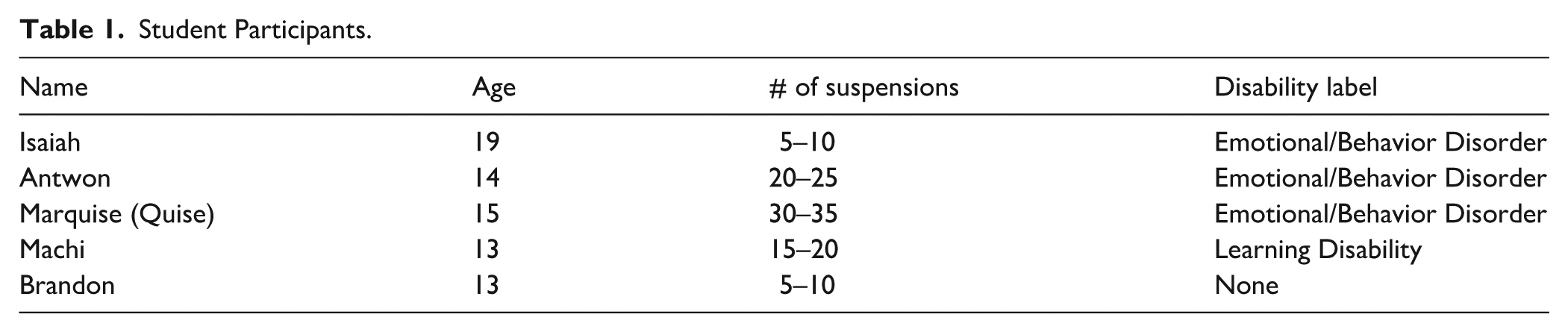
Student recruitment involved multiple strategies, including advertising the study via social media and within the district’s behavior-based alternative school. Five Black boys participated in the study. Demographic information about age/grade, number of suspensions, and the students’ disability label is reported in Table 1. All students had at least five suspensions, with one student having more than 30. All but one student had a formal disability label; the student without a disability was included because, though he did not have an official label, he was considered at risk for disability.
Student Participants.
Staff Participants
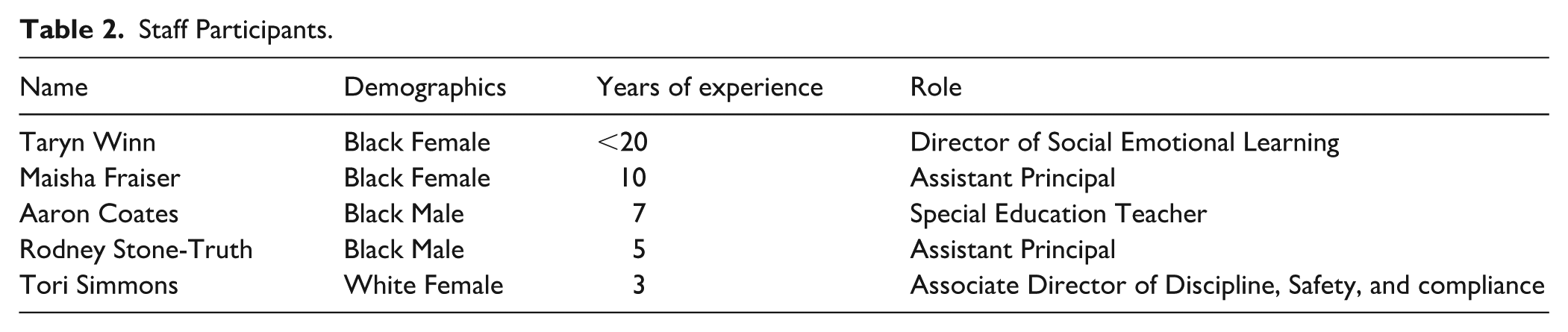
Leveraging his insider positionality as an employee of CSD, the first author contacted various school administrators and district staff who had institutional authority to suspend students or recommend them for expulsion (e.g., building principals). In addition, district staff who were involved in work around exclusionary discipline policies participated. Five staff members completed the study, and information on their backgrounds can be found in Table 2.
Staff Participants.
Data Collection
The primary data source was individual interviews with the student participants. However, to generate a more precise explanation of the case, we included several secondary sources, including interviews with staff, observations, and educational documents.
Interviews
Interviews made use of a semi-structured protocol based on reviews of the extant literature, the first author’s personal experiences, the study’s theoretical frameworks, and the overarching research questions (see Supplementary Figures S1 and S2 for interview protocols). For student participants, questions were designed to understand students’ identities generally (e.g., Tell me about yourself, including things such as your strengths, interests, and weaknesses), as well as regarding their experiences with exclusionary discipline (e.g., How does it feel to be you in school? Can you describe in detail a time you were suspended or expelled?) Staff interviews included questions like: (a) What types of shifts have you seen or experienced in the district as it pertains to exclusionary discipline? (b) Can you describe your school’s or the district’s position pertaining to exclusionary discipline?
The first author conducted the individual interviews with students and staff in a location of their choosing or via a web-based platform (e.g., WebEx) to ensure privacy and comfort. The average interview time was 46 minutes with a range of 29–62 minutes and a total of 7 hours, 39 minutes across all participants. Interviews were audio recorded, and the first author took handwritten notes during all interviews. Each interview recording was immediately transcribed. The first author wrote reflective memos following each interview, and based on insights gleaned from these memos and initial, ongoing analyses of other data sources (i.e., observations and artifacts), subsequent interviews and protocols were planned and scheduled.
Observations/Ethnographic Field Notes
The first author engaged in several different types of observations, including attending a CSD board meeting for which one of the agenda items was recommended changes to the district’s behavior plan. In addition, the first author attended four classroom/boys group observations, each being a 45-minute period. These groups were social/emotional support groups for boys in the district who had experienced exclusionary discipline. He also attended three district ad hoc planning meetings focused on school discipline and the CSD behavior plan. During each observation, the first author recorded detailed field notes, particularly on the content of the observed discussions.
Documents
The researchers included three types of documents in the study: incident referrals, IEPs, and the CSD behavior education plan. Incorporating the students’ IEPs and incident referrals alongside their interviews provided a more expansive understanding of the participants’ experiences. In addition, such documents provided insights into how teachers and school-based teams, both in subtle and not-so-subtle ways, positioned the boys. The behavior education plan yielded insights into what behaviors lend themselves to suspension or other exclusionary consequences.
Data Analysis
To begin, the first author immersed himself in data for each of the student participants, starting by reading each transcript “by hand” (Floden, 1984). Alongside the initial reading of the student transcripts, the first author analyzed each student’s behavioral record and IEP, making notes of the number of suspensions/expulsions, disability label, and original referral for special education. Next, the first author turned to the staff participant interviews, observation field notes, and CSD behavior education plan to read “by hand.” Following the transcribing and initial review of the data, the first author, with support from the second author, began a more sophisticated analysis of the data. The analytical technique that was used, meaning field reconstruction, is a multistep and iterative approach (Carspecken, 1996). Through multiple readings of the data corpus, the first and second authors (heretofore researchers/we) identified chunks of data to analyze. Initial themes revealed in the early coding stages aided in the development of higher-level codes. Throughout this process, we drafted analytical memos as a sense-making process and to strengthen trustworthiness (Saldaña, 2013).
The coding process started with Low-Level/In Vivo Coding, wherein the goal was to use in vivo codes to remain as close as possible to the participants’ own words and voices. Then we completed Meaning Field Reconstructive Horizon, which is a position-taking with a primary goal to become more aware of what you may be missing in the data (e.g., what was implied). This step provides the opportunity to examine the range of possible meanings of what the participant is communicating. By interrogating the participants’ words in nuanced ways, it provides an opportunity to access what may be unspoken or implied. The final coding stage was High-Level Coding, which involved high-level inferences and/or a descriptive interpretation of the quote or text from the data. These interpretations become particularly useful when doing the second phase of analysis: within and across case analysis. This stage consisted of comparing and synthesizing inferential codes and emerging themes across participants. The codes that were identified because of the case analysis were then grouped in relation to the guiding research questions, and illustrative quotes were selected (see Supplementary Table S1 for codebook sample).
Promoting Trustworthiness and Credibility
We employed several approaches to promote trustworthiness and credibility, including data source, member checking, and peer debriefing. We used staff interviews, observation field notes, and educational documents to triangulate study assertions. The first author also engaged in peer debriefing, conferring with the second author throughout the data analysis and writing stages to test assumptions and hypotheses as well as discuss preliminary codes and interpretations of the data, including the presence of potential disconfirming evidence. Finally, the first author engaged in researcher reflexivity by incorporating memo writing throughout the study to contemplate how biases and dispositions may be entering the study.
Findings
The case study of CSD reveals that the figured world of the Black boys with disabilities is one of constant proximity to exclusion. This exclusion can be explained by several factors that include being situated within a larger context of racism and discrimination that emits cultural scripts that depict Black boys as problems needing to be fixed or what the researchers refer to as a narrative of dehumanization (Theme 1). Furthermore, the case study gives insights into how the Black boys are left alone to navigate restrictive school environments that fail to affirm their identity. The lack of affirming school environments and relationships (Theme 2) further contributes to the boys’ experiences with moments of exclusion. Beyond not being affirmed, findings reveal that the boys find themselves traversing schools in which various policies and procedures recruit Black boys into exclusion (Theme 3) in both subtle and not-so-subtle ways. The ways the boys answer the world are unpredictable and intricately linked to the social discourse and practices of the figured world.
Setting the Context: A Narrative of Dehumanization
The boys shared their personal experiences with the various scripts, discourses, and institutional others to illustrate the ways in which they see themselves and other Black boys being perceived through deficit-based narratives. When reflecting on how Black boys are perceived in their schools, Isaiah shared, “They [school staff] look at us as like a juvenile delinquent . . . even if you’re just having a bad day and have an attitude, and you get in trouble just like—it’s not like they’ll try to help you.” Field notes from one of the boys’ support group sessions document a discussion among the boys about current issues in education that resulted in a lengthy discussion about exclusionary discipline in which one of the boys lamented, “We’re seen as the fuck ups.”
Brandon’s experiences were similar. He noted that from his experiences, Black boys are seen and treated like “gang members, rappers, bad people and as looking suspicious.” Together, the boys’ personal experiences begin to reveal the ways that Black boys in schools may be viewed and discussed through criminalizing and damaging rhetoric that begins to set the necessary conditions for excluding them. Beyond sentiments of being reflected in criminalizing ways, other participants’ reflections on how Black boys are viewed in schools left them questioning if schools even recognized their humanity. Quise shared, Like I do feel like in certain situations when there’s a Black young man and a different race—I won’t just say specifically white—that nine times out of ten, they try to label the Black man as the aggressor. And that’s not always the case.
Antwon’s perception also aligns with the other boys. He explained, “they think we’re a danger to the community or to the school, I guess.” He goes further, suggesting that this is the reason Black boys find themselves excluded from the school environment at much higher rates.
Machi’s take on how Black boys were seen at school also reveals that by virtue of their racial and gendered identities, Black boys are or can be stripped of the fullness of humanity. When asked the same question pertaining to how Black boys are seen and discussed in school, Machi shared, “Like they are n . . . humans.” When probed as to why he picked that word, Machi shared that he initially was not going to pick the word “human” and revealed that “Because some people call them niggers. That’s the word I was going to use. So, then I just said human.” He explained that he was going to use the N word “because that’s what the people know us as.”
The contributions of district staff, when asked the same question, supported the boys’ perceptions. In fact, Mrs. Taryn Winn, Director of Social Emotional Learning, spoke about how damaging societal views about Black boys become ordinary in their schools. She offered, “They see them as a threat . . . I think our media plays a huge role in that . . . that’s the lies that they’ve been told. And anything that challenges that . . . causes some real cognitive dissonance for them.”
As evidenced, Black boys are largely understood through monolithic constructions that are largely damaging and deficit-based. If history has demonstrated anything, how we come to view individuals is intricately connected to how we treat them. The narratives demonstrate the conditions under which the use of exclusionary practices aimed at Black boys manifests and persists.
Lack of Affirming School Environments and Relationships
The Black boys indicated their experiences with exclusionary discipline may be connected to the lack of an affirming school environment and minimal relationships with school staff. Several of the boys discussed the challenges they faced with being unseen, unwanted, and unheard in their respective schools. Isaiah articulated feelings of not being able to be himself and having his real identity affirmed. He expressed: Well I felt like I couldn’t be myself because I was already being viewed different. So, I had to like—going up to the school you had to like put on a different character so it wouldn’t make it seem like you were such a bad guy.
Isaiah further shared how to save himself from being suspended; he had to take on an identity that he believed school staff would interpret more favorably. Said differently, Isaiah opted to take on an identity that the school affirmed. He articulated: I felt like at some point people were running over me and I feel like I just had to allow it because it was like—after so long you get tired getting suspended and stuff like that. So, it’s like you just got to kind of let go. And I feel like I had to act white . . .
Quise offered similar sentiments, primarily speaking to the ways in which he found himself silenced and ultimately unable to advocate for himself. He shared, “I feel like they should be a little more accurate with how they do it instead of just going off of what the teacher said.”
Quise continued by sharing how a process could feel more affirming to the students while still getting to a resolution. He noted, “If I could, I’d like—I’d want the whole story. I’d ask the teacher what happened like separately. I wouldn’t even have the student and the teacher together . . .” Quise’s experience effectively silenced him, leaving him to grapple with the question of whose voice is valued and trusted.
Isaiah reflected on his experience, noting that despite him vying for help to get on track, those pleas were largely left unanswered because he was already negatively perceived. Isaiah, with a quavering voice, expressed, “When you want help to get away from that (i.e., skipping class or being with the wrong crowd) is like very heart-breaking. It’s like, dang. Everybody just thinks so low of me.” Isaiah’s reflection reveals how, because of not having strong, supportive, and caring relationships in an environment that affirmed who he wanted to be and that ignored his needs, he began to question the purpose of being in select classes or school altogether. His reflection offers a window into one way the cycle of exclusion may begin and progress. Brandon expressed how the lack of strong relationships in school left him feeling unwanted, recounting, “If I get in-school suspension or something, when I go back to class . . . they’re like, ‘Aren’t you supposed to be in in-school or something?’ It’s like they want me gone out of the classroom.”
Field notes from one of the boys’ support groups document students who have lost hope in securing any type of academic support. One student recounted his attempts to engage academically, but believed “You have to be at their standard or you fail.” The student went on to explain why he stopped asking for help: because “they [teachers] make it seem like it’s my fault I don’t understand. They try to make it seem like your slow or something, so I just give up.”
The boys’ stories present an interesting paradox. Although these boys articulated feelings of being unseen with their needs and desires seemingly invisible to school personnel, they were simultaneously hypervisible because of the negative personas imposed upon them. For example, Quise shared why he believed Black boys are suspended at disproportionate rates arguing that the more a student is suspended the likelihood of future suspensions also increases. He suggested “they only look at oh, this dude has been suspended six times and this one’s only been suspended once, and stuff like that.” He went on to share how being suspended left him being watched, sharing, “There’s always been two or more staff members that either will pull me out of class, or they will just sit there. And I know that they’re watching me . . .” He further explained: I get over there and they’re alright, hurry up and get to class, don’t do this, don’t do that, then I’ll feel like oh, okay, so I’m on yall radar. Y’all waiting for me to slip up so y’all can put me in ISS.
When asked, “What advice would you give to a Black boy coming to your school on how to be successful?” he responded with an indescribable conviction, “Don’t give these people no more reason than they already have to look at you!”
The feeling of being watched was not unique to Quise. In fact, observation data from one of the boys’ group class discussions provide evidence that this feeling is pervasive among Black boys who have experienced exclusionary discipline. During the class discussion, students were asked to think about the inequity present in school suspension data. Specifically, they were responding to the question of why Black boys might have a higher rate of suspension. One student responded that “we’re targeted . . . it’s really a race thing.” Another student in the group chimed in attempting to offer help with what was meant by “targeted,” explaining, “They focus on that student that got suspended more than others.”
Brandon spoke of this feeling of being watched being linked to technology and individual staff whose primary purpose was surveillance. He noted, “They are always on the cameras in the security guard’s office, watching, and walking around.” When asked, “How does that make you feel when you’re in the building?” Brandon responded, “Just, it’s like I’m being watched 24 . . . eight hours a day. I’m being watched the whole day.”
Although Brandon’s perception of being watched was like most of the other Black boys, one student, Antwon, offered a more positive attitude related to the notion of being watched. Antwon suggested, “Well, they probably were watching me to just stay on top of me, like to make sure I’m doing what I’m supposed to be doing as a reminder, but other than that, no [I don’t feel watched].” He also shared an explanation for the presence of surveillance technology (e.g., cameras) in his school, stating, “So they know what’s going on when the teachers are not, like, in the hallways, watching the kids, and so people won’t steal out of other people’s things.” Although he perceived being watched more positively and as a means to “stay on top of me and to make sure I’m doing what I’m supposed to be doing,” other data, such as his behavior record, which reveals that he had more than 50 behavioral referrals and more than 20 suspensions, spanning a 3-year period, might suggest him being watched was less about the proactive supports he named and more connected to reactive, exclusionary responses.
The ways the boys discussed their experiences with navigating unaffirming schools and poor relationships with most teachers and staff with whom they interacted were reified by the staff participants. Assistant Principal, Maisha Fraiser, reflected on several reasons Black boys may feel unwanted: And it’s like who do they trust in the building? . . . a principal is trying to get him to come to their office, and they won’t . . . And I can come and they will come with me. And it’s because I’ve taken the time to build that relationship . . .
She proceeded to provide a particularly insidious example, sharing: I think that people also find creative ways to do exclusionary practices, but not actually like have it listed like that. Like if you call a family and say, hey like so and so’s just struggling today, maybe it’d be best if they go home for safety reasons. And then you don’t have to call it a suspension. But you get that student out of your hair.
Aaron Coates, a former special education teacher, discussed his beliefs about why so many Black boys are left maneuvering through school feeling unseen and as though their identities are unaffirmed. He argued, “Part of that has to do with the lack of Black educators we have in CSD. I think that seeing somebody in a role of a teacher, Black kids can automatically see themselves within the classroom community.” Taryn Winn, Director of Social Emotional Learning, posited that it all begins with a simple, yet fundamental question: “Are there opportunities for students to meaningfully and authentically engage in their school environment?” She continued, sharing the mindset necessary to see, hear, and affirm Black students, “I think it really does start, too, with just beliefs in the classroom. That all students belong here . . .” Mrs. Winn continued, though shifting to think of how the creation of school rules and expectations may exacerbate feelings of being unseen, unwanted, or silenced: Who sets the values and the rules for school to begin with? . . . So, the people making these rules about what is appropriate ways to express yourself, what are appropriate ways to express your emotions are often people who do not look like our Black children and who have not experienced systems of oppression, of racism, of exclusion . . .
The individual stories and experiences of the students and staff collectively reveal the ways Black boys are left navigating school environments that fail to affirm their identities, center their voices, or truly see them for the assets they bring. It was clear from the boys’ stories that being unaffirmed or lacking positive relationships with staff left them more susceptible to exclusion.
Policies and Practices That Recruit Black Boys Into Exclusion
The stories the boys told offered insight into how, despite best intentions, various formal and informal policies and practices were exercised in ways that sustained the positional identities the school had imposed on them. In addition, the data demonstrate how such policies and practices were used to further relegate them to a figured world of exclusion. For instance, some of the boys talked about this notion of being unable to escape their past wrongdoings and mistakes. In their narratives, what becomes clear is how the practice of information sharing through school records or staff conversations hinders the ability to have a “fresh start.” An exchange with Antwon supports this notion. Antwon begins by sharing that he is relatively well regarded in his community despite having moments where he was subjected to punitive discipline. He then explained that the mistakes he made in the community found their way into his school. He said, “I guess when I got in trouble in the community, I guess they told my—I guess they knew one of my teachers, and they just told them that I wasn’t making smart decisions in the community.” He continued by sharing his feelings about the information sharing between the school and the community: It should’ve stayed separate, but at the same time, I think they should’ve told my teacher. Because them telling my teacher made me stay focused on school . . . if it would’ve stayed in the community, I would’ve just been good. I could’ve moved on, and still focused on school without having extra people know what was going on outside of school . . .
Despite Antwon’s optimism that he or other students would not be judged by what happens in the community, analysis of his educational documents (i.e., behavioral records, IEPs) reveals that these community-based behaviors did inform the development of his IEP. For example, action steps outline things such as speaking to the community officer and connecting with his previous school to gain insights about his behaviors there. The sharing of documents demonstrates why Antwon believes his ability to have a fresh start and “just move on” has been impeded.
Similarly, Isaiah shared how, because of the informal information sharing, he believed the labels that were affixed to him were stable and enduring because of his mistakes in both the community and school environments. He expressed, “I feel like the label that they had already labeled me wasn’t going to leave. I felt like it almost followed me.” Along the same lines, Quise described feelings of being judged by his past and, as a result, finding himself questioning how he should respond. Quise eloquently shared, “They judge you by your past—let people live, learn, and move on.” He further explained how the judgment affects him: I feel like you’re just judging me off of my past and you’re not trying to get to know how I am now, I feel like why should I even try to change when this is what you expect me to do already.
CSD asserts that behavioral responses are confined to the current school year. This means at the beginning of each new school year, the lowest assigned Response Level for a first occurrence of the behavior within the school year should be used for every student.
Despite this assertion, the narratives the boys shared demonstrated how they perceived the practice of information sharing across context and grade bands, though perhaps well-intended, kept them stuck within a figured world of exclusion. Some participating staff noted the consequence of this practice as well. Rodney Stone-Truth, a school administrator, shared how Black boys are disproportionately recruited into the figured world of exclusion. He acknowledged, “That happens before some of them even get in our building, like when there’s transition meetings, and like yeah, you got to watch out for these guys . . . They aren’t given an opportunity to have a fresh start.” Similarly, Taryn Winn noted, “And that information just kind of goes through that, grapevine of like, you know, this is the student to watch out for.” Maisha Fraiser echoed, I think about when we do transition meetings with the middle school and they’re like, oh like how is this student? And like you look at their behavior file . . . they had like 60 behavior referrals their eighth-grade year. And people are immediately making an assumption about that student . . .
Collectively, the data illustrate how the social, cultural, and historical artifacts (e.g., documents, information-sharing practices) have constrained the boys to a figured world of exclusion.
One of CSD’s central policies that informs how teachers and administrators respond to student behavior is the Behavior Education and Response Plan (BERP). This policy informs the district stakeholders of the philosophy that undergirds the approach to exclusionary discipline. For example, the BERP includes language around a focus on addressing racial inequities through safety, belonging, and systems of support. Given the racial disparities that exist in district disciplinary data, the goals appear timely and relevant. However, to understand how the policy comes to life and has real consequences on the lives of Black boys, it was important to gain insight into the context in which the policy is implemented. Taryn Winn expressed: I think while it’s the intent of the Behavior Education and Response Plan to, you know, move away from exclusionary practices, I mean, it’s still happening. And there has been significant backlash against the Behavior Education and Response Plan. You know, a lot of people with this mindset of like we’re letting kids get away, you know, I’ve even heard get away with murder . . .
Mr. Stone-Truth also noted similarities as he reflected on a staff meeting discussing the BERP. He shared: Teachers and staff really, when they hear the words ,—the word that they are zooming in on or emphasizing is behavior, and they’re not really thinking the word that comes after that, which is the most important word, which is education . . .
Tori Simmons, during a follow-up conversation, reminded that the concerns around what is being touted as accountability, but really meaning consequence and punishment, are not exclusive to school staff. She explained that numerous Op-Ed pieces were written that express how the larger Monroe County community has also contributed to the skepticism of the BERP. Referencing a winter school board meeting, she further argued that even some school board members have not embraced the intent of the BERP, wanting to maintain largely punitive responses, as well as having school resource officers stationed in schools. Field notes from that same winter board of education meeting indicate one board member asked, “what are we going to do at the point in time that the behavior is so out of control because we haven’t equipped our staff to deal with behavior (e.g., battery, disorderly conduct)?”
Students and staff reveal that in CSD, there exists a reliance on punishment delivered in the form of exclusion. Moreover, district policies and practices provide the necessary backing that gives way to the pervasive exclusion of Black boys. In particular, the subjective nature of related policies and a lack of any true system of checks and balances send messages to the boys that the school is not equally tolerant of their mistakes. The boys, then, are confined to the figured world of exclusion left to accept, resist, or negotiate the imposition.
The Interplay of Factors: Answering the Call
There remains the question of how, amid this figured world of exclusion, the boys responded. The boys’ stories reveal how they drew upon the discourses of the social world of their schools to answer the world. Further, their narratives evidence that despite attempts to act as agentive beings, their efforts to self-author their intersectional identities, at times, were unsuccessful. Regardless of how Black boys who have experienced exclusion in CSD respond to the figured world, they are always in proximity to exclusion.
To begin, Isaiah described his journey as academically challenging because he was often enrolled in classes that required extensive independent learning despite his need for more guided instruction and modeling. These needs were consistent with what his parent/guardian and classroom teachers noted in his referral for special education. The referral read: The parent/guardian indicated Isaiah also demonstrates difficulty with processing information and with academic tasks. Current staff members have reported concerns with Isaiah’s receptive and expressive language, specifically in times of heightened emotion.
Isaiah shared his attempts to advocate for himself: I tried to seek out help. I was talking to a counselor at the school, but it wasn’t working. It was still like the paper and the book. And I’m a hands-on type of guy . . . That kind of made me like lose interest in school because I can’t get that type of teacher.
He went on to express how, because his self-advocacy attempts were left unanswered, he found himself contemplating a critical question when he shared, “I felt like I wasn’t getting the help that I needed in the classroom, so I just like stopped going . . . what’s the point of going?”
Throughout Isaiah’s interview, he consistently shared he was viewed as a troublemaker, but when prompted as to whether that is how he wanted to be viewed, he responded, “Absolutely not! I wanted them to see me as a different person.”
Although Isaiah was adamant that he did not wish to be perceived as a troublemaker, he accepted the identity of a troublemaker to gain access to a community that would accept him, describing, “It was like being with the troublemakers, they were the only ones that accepted you at the school . . . You ain’t want to feel like an outsider, so you were like, cool.”
It becomes clear that what Isaiah hoped to find in the larger school community, he could only access in liminal spaces with other students who had been relegated to the margins.
Antwon also spoke to a desire of having access to a community and feeling as if he belonged. It became evident that, as he spoke of this desire to be in community, he, like Isaiah, used the liminal space to reject an identity that was imposed on him. Antwon shared why those peers who had been largely considered troublemakers or bad students by the overall school community were his friends. He shared, “They made me feel safe around them. Like, they made me feel like I could trust them with anything I tell them or do with them.” Unlike the school, he described himself and his friends as “intelligent, self-caring, caring about others.” We then unpacked the notion of badness, a label imposed on him. Through the conversation with Antwon, it was clear that he was intentional in separating one’s actions from identity. He rationalized, “I just think there’s students who make not-smart choices, but I wouldn’t use the word bad.” It reifies Quise’s plea to “Let people live, learn, and move on.”
Contrary to most of the boys, Machi openly accepted the identity of “bad.” During one conversation, Machi explained why he embraced this duality of being “half good and half bad” and what might be the affordances of that So peep, you know how some kids like [names omitted] get bullied or beat up? Or the girls don’t want to be around them? Like when you don’t care about getting in trouble then people don’t really mess with you.
Although Machi was clear in the initial one-on-one interview that he would prefer to be seen as “a good student,” his willingness to accept, or rather embrace, being seen as a bad student appeared to be more about status and protection. He leveraged the identity in similar ways to the other boys, which was to forge community and relationships with peers both in school and in his community. Machi, whether knowingly or otherwise, was able to see the expansive possibilities of his positioning as “bad” rather than being limited by it.
The individual student interviews and the boys’ group classroom observations also demonstrated that for the boys, it was not always about accepting, resisting, or negotiating the offered identity, but at times, they found it important to also respond in similar ways to being subjected to exclusion. In doing so, another troubling paradox emerged. To avoid various exclusionary discipline practices imposed by school personnel, the boys chose to enact a form of protective refusal in which they excluded themselves to preserve their own dignity and interests. For instance, in one of the boys’ group observations, a student shared how being late would result in in-school suspension (ISS), and if that was the case, the school might as well send him home, stating, “Then they want you sitting in a little room all day because your late so I’m like fuck the bullshit just send me home.” Along those same lines, Isaiah confessed, “The more I got suspended, the more it just made me not even try to go no more . . .”
Interview data and classroom observations collectively give insight into how the Black boys are left to answer the figured world of exclusion. Although the students’ responses may vary in terms of accepting, resisting, or negotiating, it is abundantly clear that the boys find themselves in a constant state of flux. On one hand, they are receiving messages that do not affirm their intersectional identities, while on the other hand, being positioned in deficit-based ways. Always, these boys have to grapple with how they are seen, who they truly are, and how to protect themselves while preserving their sense of self and dignity within a context that espouses holding that responsibility on their behalf.
Discussion
We used Intersectionality (Crenshaw, 1989) and Figured Worlds (Holland et al., 1998) as lenses through which to understand how Black disabled boys who have been subjected to exclusionary discipline experienced school and ultimately the freedom with which they had to imagine their identities. The participants’ intersectional experiences suggest that their subjugation to exclusionary discipline is informed largely by the socially constructed imaginings that frame Black boys as a Du Boisian “problem” and a pervasive belief that marks Black bodies as synonymous with the ultimate threat to authority (Muhammad, 2019). The extant literature supports these findings, evidencing the ways Black boys are framed through a host of dehumanizing narratives. The Black boys in the studies conducted by Boyd (2021) and Hawkins (2018) all reported experiences of being negatively perceived as “criminals,” “troublemakers,” and part of “gangs.” Howard (2013), for example, describes that many of the most frequently occurring terms during a literature search of Black males and education consisted of phrases such as “at risk,” “endangered,” and “remedial,” among other deficit-driven terms. In addition, researchers have revealed that the cost of Black boys being framed through dehumanizing narratives has resulted in their temporary or permanent removal from schools (Mayes, 2023; Simmons, 2016). Related scholarship reveals that the differential treatment of Black and White children who exhibit similar behaviors and attend relatively similar schools significantly contributes to the racial gap in school discipline (Owens & McLanahan, 2020).
Findings from this study also demonstrate how the participants encountered school environments that were unaffirming of the social and cultural assets that they brought each day. In many instances, students were left unseen, unheard, and unwanted. The boys’ narratives give insight into how, because of them being outside the realm of whiteness, they are subjected to exclusion and further relegated to the margins of school. Yet, within these contexts, the boys are still expected to draw on various resources, though largely negative, to engage in the process of authoring their intersectional selves. Said another way, within the figured world of exclusion, the boys are positioned in ways that limit their agency to fashion intersectional identities that run counter to the deficit-based identities they desperately want to escape.
The boys’ stories, like those in the Boyd (2021) and Hawkins (2018) studies, illuminated a paradox of visibility, suggesting that they are simultaneously invisible yet hypervisible. Black boys were largely invisible as it pertained to their needs and social, cultural, and historical assets and ways of knowing. In contrast, however, Black boys spoke to racialized patterns of surveillance that left them constantly under the gaze of school staff. Such experiences were more often the norm rather than the exception. This paradox of visibility has been explored by Black feminist scholars and points to similar trends as those identified by the Black boys in this study. For example, Carter Andrews and colleagues (2019) spoke of the ways Black girls are often blamed for and unsupported with issues of sexual violence. Furthermore, their assaults are minimized. Black girls are left largely invisible during critical moments of need. However, when these same girls take matters into their own hands to protect themselves, they move from a realm of invisibility to visibility regarding their perceived wrongdoings.
Finally, participant narratives demonstrated how well-intentioned policies and practices also impeded Black boys’ identity fashioning. For instance, even at times when the boys would naturally get a clean slate (e.g., moving between schools or grade bands), information sharing during IEP and transition meetings served to ensure the boys were recognized as particular types of individuals across time and space. Riley and Serpell (2022) describe it as carrying “the burden of a documented reputation of what is deemed as maladaptive behavior” (p. 113). Although the impact of data-sharing policies and procedures in relation to exclusionary school discipline has been less explored in the larger literature, Peters (2021) explains that what they term “dirty data” has a disproportionate and negative impact on Black students.
Consistent with much of the literature on exclusionary school discipline, the boys’ stories illuminate how, yet again, their race becomes a salient factor for the implementation of exclusionary discipline (Martinez et al., 2016; Mayes, 2023; Skiba et al., 2014). Resultantly, the Black boys in this study draw connections between their race and larger identity, leaving them grappling with questions of self-worth and decisions to leave school. In related scholarship, researchers have shown that students who are repeatedly subjected to exclusionary discipline have an increased propensity toward prematurely exiting school (Cholewa et al., 2018). It is abundantly clear that, despite best intentions, these policies are riddled with both unintended and intended consequences that systematically harm Black boys.
Limitations
We acknowledge several limitations of this study. First, staff participants do not represent the full range of district roles. For example, classroom teachers, resource officers, social workers, or counselors’ perspectives are not included. Moreover, the Black boys’ parents or caregivers were not included in the study. An additional limitation of this study was that it was confined to a single geographic area that is predominantly White. Therefore, the study might not reflect the experiences of Black boys and staff in more racially and ethnically diverse communities. Furthermore, the first author’s insider position as a district administrator may have rendered students reluctant to share full details of their experiences or compelled them to answer questions in what they perceived to be socially desirable ways.
Implications for Research
Researchers should further examine the ways exclusionary discipline has and continues to shape and inform the identities of Black boys with disabilities across other contexts (e.g., regions, schools, and districts that are predominantly Black). Such a cross-case analysis of boys from varying contexts might provide a more nuanced understanding of the boys’ experience, with hopes of generating recommendations for policy and practice on the national stage. In addition, future research might attempt to explore this study, leveraging a researcher without the same insider positioning to ascertain whether the Black boys narrate their story in different ways. Finally, future research would benefit from replicating this study to include the voices of more boys, as well as staff who reflect the range of individuals who interface with the boys.
Implications for Policy and Practice
The boys’ figured world is one in which simple solutions and quick fixes will be insufficient to address the deeply rooted problems that lead to the disproportionate use of exclusionary discipline. We believe effective responses will consist of top-down (policy) and bottom-up (practice) blended approaches. For one, there is a dire need to revisit educator and administrator preparation programs and the state-level policies under which they operate. Educators and administrators need to engage in more in-depth equity work, beyond superficial ethnic study requirements that treat issues of race and equity as add-ons or afterthoughts (McDonald, 2005). While in teacher education programs, preservice educators and aspiring leaders need to have extensive opportunities to engage in deep and ongoing examinations of their positioning that include reflecting on and interrogating the taken-for-granted beliefs that they hold about themselves and others (Allard & Santoro, 2011), but more specifically about Black individuals and individuals with disabilities and those with intersectional identities. In their best-evidence synthesis of school-based interventions designed to reduce disproportionality of exclusionary discipline, Cruz et al. (2021) found that effective professional learning interventions included one-to-one coaching, thereby pointing to the importance of addressing educators’ practice in addition to their knowledge and beliefs. Relatedly, professional learning centered on building positive student-teacher relationships, as opposed to student behavior, showed promise in reducing the number of suspensions (Cruz et al., 2021). We acknowledge that extended professional learning that makes use of one-to-one coaching is costly, but what would it look like if funds that have been traditionally linked to positions designated to uphold exclusionary approaches were instead reallocated to fund proactive professional learning?
In addition to individual equity work and professional learning, school personnel need frameworks to guide practice, policy, and decision-making. Many educators and leaders recognize how systems have and continue to disparately impact certain students, but all too often, they are left without feasible alternatives, leaving them to operate business as usual (Huguley et al., 2022). As Winn (2020) argues, “If suspensions and exclusions are an option, ‘they will be’ exercised, because they do not require anyone to change or challenge established views or practices” (p.16).
Winn (2020) suggests that one potential framework or paradigm shift would be the implementation of restorative justice in schools. At the core of restorative justice is a commitment to and recognition of the humanity and relationships of all individuals. Restorative justice approaches provide space for all community members to engage in collaborative problem-solving that leads to a new classroom or school ecology (Riley & Serpell, 2022). Restorative justice seems effective at reducing the use of exclusionary discipline (Fronius et al., 2019) within a school overall, but the evidence is not as clear for reducing discipline disparities based on students’ race (Cruz et al., 2021). A primary challenge in making definitive recommendations is that schoolwide adoption of restorative justice approaches is nascent, with research examining outcomes even more so. To abandon the cause at this point, however, would be premature given that school personnel have few other solutions, and the emerging research shows promise.
Another implication from this study’s findings is the need to implement strategies that counterbalance school administrators’ power with respect to exclusionary discipline. Despite the existence of district-wide disciplinary procedures, school administrators often have autonomy in enforcing such procedures, which opens the door for subjectivity and bias in decision-making (Kennedy et al., 2017). The same phenomenon is found in other disciplines. Literature from medicine, for example, supports the recommendation of a system of checks and balances, naming, “What accounts for these errors in physicians’ reasoning? It’s not incompetence or inadequate knowledge. It’s the fact that physicians tend to get stuck in particular modes of thinking” (Price, 2010, p. 50). School leaders have the same potential to get stuck in modes of thinking or hold steadfast to particular narratives about Black boys that allow bias to creep into decision-making (Love et al., 2018). Implementing a system of checks and balances provides an opportunity for school leaders to get unstuck, uncover mistakes, and consider possible alternatives. In addition, it allows others to voice concerns as they surface. A promising approach is the Learning Lab methodology. Learning Lab invokes a research-based process to build organizational capacity to address disproportionality by formulating more inclusive and equitable behavior support systems (Bal et al., 2018). At the heart of Learning Lab is an inclusive team with members from within and outside schools (e.g., family and community members) who represent the cultural, racial, linguistic, and economic diversity within a school. Through data analysis activities focused on a school’s current discipline process and resulting disparities, Learning Lab members design an improved model of behavior support that is then implemented and reviewed for possible improvements over time.
One would be remiss to ask a group of Black boys to share their stories related to exclusion and hear the ways in which these experiences have and continue to harm them, and not advocate for bringing immediate attention to the pitfalls and injustices of school exclusion. History, however, has revealed that systemic change and progress are a slow-going process. However, to stand idle in wait for change would be immoral. Rather, practitioners and policymakers must contend with the “meantime in between time” (Ross, 2021, p. 232) or actions that can ameliorate Black suffering in schools while also enacting long-term systemic solutions.
To provide one type of immediate redress that aligns with the tenets of this study’s theoretical framing, we might borrow from higher education scholars who have already begun to critically attend to what it means to create safe spaces within institutions of higher education for Black students’ well-being (Brooms et al., 2021; Ross, 2021). Brooms and colleagues (2021) describe that counterspaces are “often considered safe spaces” (p. 278) that provide community and support as individuals engage in identity work around their race alongside peers and staff who identify in similar ways while simultaneously fostering affirming relationships. Moreover, these spaces might offer a sense of protection against the dehumanizing narratives and restrictive policies that have heretofore stifled Black boys’ ability to make sense of themselves within the figured world of exclusion. In Boyd’s (2021) study, two Black boys noted their school’s implementation of a support program, like counterspaces, facilitated their school re-entry following their expulsions.
Conclusion
This study points to the need to recognize students as valuable contributors to conversations about policies and practices that have the potential to directly impact their lives. By including students’ voice, educational leaders, policymakers, and practitioners are positioned to gain their unique perspective that has the potential to disrupt mindsets, systems, practices, and beliefs that further create inequities and potentially enrich educational decision-making overall (González et al., 2017; Irizarry & Welton, 2014). Fine (2008) argues, “those who have been most systematically excluded, oppressed, or denied carry specifically revealing wisdoms about the history, structure, consequences, and the fracture points in unjust social arrangements” (p. 215). To continue to exclude the voice and contributions of youth from such critical conversations is a deliberate failure on the part of those who profess to favor racial justice and equity. The time is now to sit in the difficult space and dismantle the practice of excluding students!
Supplemental Material
sj-docx-1-rse-10.1177_07419325261442749 – Supplemental material for Punished: Identity Development of Black Boys in a Figured World of Exclusion
Supplemental material, sj-docx-1-rse-10.1177_07419325261442749 for Punished: Identity Development of Black Boys in a Figured World of Exclusion by Larry Love and Melinda M. Leko in Remedial and Special Education
Supplemental Material
sj-docx-2-rse-10.1177_07419325261442749 – Supplemental material for Punished: Identity Development of Black Boys in a Figured World of Exclusion
Supplemental material, sj-docx-2-rse-10.1177_07419325261442749 for Punished: Identity Development of Black Boys in a Figured World of Exclusion by Larry Love and Melinda M. Leko in Remedial and Special Education
Supplemental Material
sj-docx-3-rse-10.1177_07419325261442749 – Supplemental material for Punished: Identity Development of Black Boys in a Figured World of Exclusion
Supplemental material, sj-docx-3-rse-10.1177_07419325261442749 for Punished: Identity Development of Black Boys in a Figured World of Exclusion by Larry Love and Melinda M. Leko in Remedial and Special Education
Footnotes

Funding
The authors received no financial support for the research, authorship, and/or publication of this article.
Declaration of Conflicting Interests
The authors declared no potential conflicts of interest with respect to the research, authorship, and/or publication of this article.
References
Supplementary Material
Please find the following supplemental material available below.
For Open Access articles published under a Creative Commons License, all supplemental material carries the same license as the article it is associated with.
For non-Open Access articles published, all supplemental material carries a non-exclusive license, and permission requests for re-use of supplemental material or any part of supplemental material shall be sent directly to the copyright owner as specified in the copyright notice associated with the article.
