






Abstract
Successful implementation of coordinated supports for students with intensive learning and behavior needs, including students with disabilities, is complex and challenging for a variety of reasons. A multi-tiered system of support framework has the potential to help educators organize this support, but implementation barriers persist. In this article, we discuss how alignment may help address common challenges. We discuss why alignment is important, gaps that often interfere with it, and we offer four recommendations for aligning implementation: (a) leverage the implementation cascade, (b) build local capacity with effective professional development, (c) plan for alignment and integration together to promote positive school experiences, and (d) use data for continuous improvement.
Introduction
Students with intensive academic and behavioral intervention needs, including students with or at-risk for disabilities, do not have time to waste. Recent statistics indicate that these students’ academic achievement trails peers across literacy and mathematics, a trend that was exacerbated by the COVID-19 pandemic and persists (The Nation’s Report Card Achievement Gap Dashboard, n.d.). Furthermore, when compared with peers, they are more likely to be suspended or expelled from school, dropout, and be unemployed or arrested (Newman et al., 2011). Contributing to these outcomes, students with intensive needs often experience poorly aligned and coordinated educational supports as they progress through school (Butrymowicz & Mader, 2017; Hsu, 2024). Without aligned and integrated support, students with intensive needs may experience less coherence in instruction and intervention, less consistent routines and behavioral expectations, more transition time throughout the day, and less access to and participation in general education than their peers without intensive needs.
One mechanism for addressing these challenges is a multitiered system of support (MTSS) framework, which is intended to help schools organize, implement, and evaluate instruction and intervention practices across domains (e.g., academics, behavior) for all students, including those with intensive needs. Multi-tiered system of support focuses the provision of high-quality instruction and interventions along a continuum of supports and matched to student need, combined with frequent progress monitoring to make decisions about changes in instruction or goals. MTSS also prioritizes systems to support sustained high-fidelity implementation and data-based decision making to facilitate continuous improvement and ensure progress toward meaningful outcomes for students, educators, and families (e.g., Center on Positive Behavioral Interventions and Supports [PBIS], 2023).
In practice, MTSS comes in different forms. From an academic perspective, MTSS may take the form of MTSS-A (i.e., MTSS for academics), sometimes referred to as response to intervention or instruction (RtI). Interventions may occur in literacy (Gersten et al., 2008) or mathematics (Gersten et al., 2009), and RtI may be used for special education eligibility determination (Savitz et al., 2018). Multitiered system of support for behavior (MTSS-B), often referred to as PBIS, is frequently used in schools, with over 28,000 schools in the United States implementing PBIS (Center on PBIS, 2025b).
MTSS is backed by a robust evidence base for (a) supporting high-fidelity implementation of evidence-based practices and improving student outcomes across domains in the context of PBIS (Center on PBIS, 2025a; Santiago-Rosario et al., 2023) and (b) specific approaches to academic intervention and data-based decision making overall (e.g., Center on PBIS, 2025c; Gersten et al., 2008, 2009). The literature on integrated MTSS frameworks is promising, but more research is needed (Goodman et al., 2025; Integrated MTSS Research Network, 2024). Thus, MTSS frameworks have the potential to create meaningful efficiencies and help educators effectively identify and proactively support students; however, many schools struggle to effectively implement MTSS, often due to its complexity (Durrance, 2023; Lloyd et al., 2023). These challenges, coupled with persistent poor outcomes of many students with intensive needs, point to a need for considering how alignment and integration within the school context may enhance the success of MTSS efforts, particularly for students with intensive academic and behavioral needs.
In this article, we first discuss the importance of systems alignment and integration. Then, we describe gaps in knowledge, skills, capacity, and motivation that may interfere with alignment and integration. Finally, we offer four recommendations for addressing these gaps to improve intervention implementation, coherence, and outcomes. In making these recommendations, we draw from research and decades of experience operating national and state technical assistance centers focused on improving academic and behavioral outcomes for students with intensive academic and behavioral needs.
Why Is Systems Alignment Within a MTSS Framework Important?
Given the diversity of students’ skills and abilities, research and experience have shown that a “one-size-fits-all” approach will not meet the needs of every student (Goodman & Bohanon, 2018). Multitiered system of support has the potential to support all students, including students with intensive academic and behavioral needs. Interventions and supports within the tiered framework can be intensified and matched to students’ needs (Sugai & Horner, 2009). Given this premise, we know that students vary in any combination of needs in academic (e.g., literacy, mathematics) and behavioral (e.g., social, emotional, mental health) supports. Many students with more intensive needs will require support in combinations of areas (Gabriel & Börnert-Ringleb, 2023). Thus, to realize the potential benefit of MTSS, it is critical to align and integrate systems to create a coherent and sustainable structure that supports all students and particularly those with intensive academic and behavior needs.
Defining Aligned and Integrated Systems
To successfully implement MTSS, a representative leadership team invests in systems to support implementation. With a systems approach, leadership team members—comprising administrators, educators, staff, families, students, and community members—engage in the following functions to guide their implementation decisions: (a) align funding, (b) develop or adjust policies, (c) engage partners (i.e., families, students, community members), (d) enhance workforce capacity, and (e) engage in effective and integrated teaming, training, coaching, and evaluation (Center on PBIS, 2023; Integrated MTSS Research Network, 2023). These systems functions are also known as implementation drivers at the individual or organizational levels (Fixsen et al., 2005).
Both alignment and integration are important considerations when developing an effective and efficient MTSS framework. Although there are similarities, alignment and integration entail functional differences (Goodman et al., 2025). Alignment ensures that core features of practices, programs, or initiatives complement, rather than compete with, each other within an overall system with the same overarching goals. Integration strategically combines core components across systems to create a functionally unified system. Integration involves braiding or blending strategies, practices, programs, or initiatives together into a seamless approach. Alignment (e.g., aligning language across science and language arts curricula) and integration (e.g., integrating behavior support practices during instruction) are both important within an MTSS framework.
Importance of Aligned and Integrated Systems
There are many benefits to aligning and integrating systems of support for students with intensive needs (McIntosh & Goodman, 2016). Many students have co-occurring difficulties in both academic and behavioral domains that cannot adequately be addressed unless educators can attend to the connection and interaction between these traditionally separate systems (Roberts et al., 2020). Academic and behavioral systems of intervention share many common features of good instruction, such as evidence-based practice (i.e., explicit teaching, high student engagement, frequent specific feedback), data-driven decision making, and systems to support high-quality implementation (Aceves et al., 2024). Coordinating around these common features may reduce cognitive load for educators by framing effective instruction as the same across academic and behavior supports.
Separate systems of intervention for interrelated needs may not be as effective as combined approaches (Stewart et al., 2007), and siloed academic and behavioral systems may work at cross purposes (e.g., removing students from a lesson due to behavior may worsen academic problems because of missed instruction). When there is insufficient systems alignment across domains and with existing school or district policies and processes, educators, students, and families may experience unintended barriers to MTSS implementation. Consider the following examples.
As illustrated in each of these examples, a lack of systems alignment and integration can result in less efficient and less effective implementation, which is particularly problematic for students with severe and persistent learning needs—students with the greatest need for engaged learning time, systematic and explicit instruction, and opportunities for practice with feedback (Fuchs et al., 2021; Gersten et al., 2008, 2009). Navigating instructional environments that are not aligned or integrated may inhibit students’ access to effective intervention and instruction. In short, schools may inadvertently undermine the goals they are hoping to achieve in providing extra help to students with the most severe and persistent needs.
Thus, systems alignment and integration are key considerations in effective MTSS implementation. Coordinating supports by creating coherent policies, procedures, and expectations across academic and behavioral instruction, intervention, and assessment practices may facilitate more efficient use of resources (e.g., staff time, professional development) and protect against multiple competing initiatives, resulting in better sustainability (McIntosh et al., 2009). Unfortunately, barriers or gaps can prevent or inhibit alignment and integration.
Gaps That Interfere With Alignment and Integration
The level of alignment and integration within a school system may serve to either facilitate or inhibit effective intervention efforts. Common challenges in systems alignment and integration often fall into gaps between the desired actions of educators and a match with their knowledge, skills, capacity, and motivations. In the following section, we describe these gaps.
Knowledge Gap
Effective alignment and integration may be a challenge because educators have insufficient knowledge. To address this gap, school and district leaders can increase educators’ knowledge by (a) building awareness that alignment and integration can improve efficiency and effectiveness and (b) providing explicit definitions of alignment and integration, with locally meaningful examples and non-examples. In addition, they can create the conditions for successful alignment and integration by setting a manageable number of priorities (e.g., instructional practices, policies, data collection, professional development) and removing practices or requirements that are not necessary, or even conflict with the proposed initiative (e.g., intervention delivery).
Skills Gap
In some cases, educators are aware of the importance of systems alignment and integration, but they may lack the skills to make it happen. With respect to MTSS, new adopters may struggle to identify key features of the framework to align and integrate. For example, aligning academic and behavior systems of support involves common core features of intervention matched to student need, use of data for identifying student need and monitoring, and intervention adjustment in response to student progress. Integrating behavior support practices within academic instruction may require integrated materials, lesson plans or scripts, and additional training and coaching in integrated implementation (e.g., UConn I-MTSS Research Team, 2024). Other alignment and integration skills may include determining who will be involved in the process, identifying steps in the process, and evaluating if efforts are successful.
Capacity Gap
A third possible barrier to systems alignment involves a lack of capacity and human resources to plan for and support aligned and integrated implementation. To address this gap, it is necessary to make room for the work by allocating time and removing other activities that may compete for time and cognitive focus. For example, a leadership team might review current educational initiatives within the district. The team may consider each initiative based on mandates, effort involved, and impact on student outcomes. After this review, some initiatives may be combined or discontinued altogether, freeing up capacity to address other priorities. Furthermore, it is crucial that administrators prioritize activities to make time for educators to plan and engage in the alignment and integration process.
Motivation Gap
A fourth possible barrier involves the motivation of educators to align or integrate their work. Motivation is affected by each of the previously identified gaps (i.e., knowledge, skills, capacity). Educators may not be motivated to support implementation if they do not have time or understand why it is of value given the competing demands of their job. Furthermore, educators may not be motivated to align or integrate efforts if they do not see the work as important. They may consider other priorities more urgent, or they may not feel empowered to take the steps necessary to ensure aligned and integrated implementation of intervention supports for students who need them. For example, educators may have seen too many intervention strategies come and go and so are cautious of the effort involved in aligning and integrating systems. To address a motivation gap, it may be helpful for administration to visibly show support for the alignment and integration work. This may be through verbal and written statements, collaborative development of planning documents and policies, allocation of time and resources, and visible participation in the alignment and integration process.
Four Recommendations for Addressing Gaps and Improving Alignment and Integration
Considering the challenges and gaps described above, we offer four recommendations to improve systems alignment and integration to support better outcomes for students with intensive academic and behavioral needs: (a) leverage the implementation cascade; (b) build local capacity with effective professional development; (c) focus efforts to promote positive school experiences for students, teachers, and families; and (d) use data for continuous improvement and identify areas where adjustments are needed. Table 1 presents guiding questions that educators may consider when implementing these recommendations.
Guiding Questions to Support Alignment and Integration.
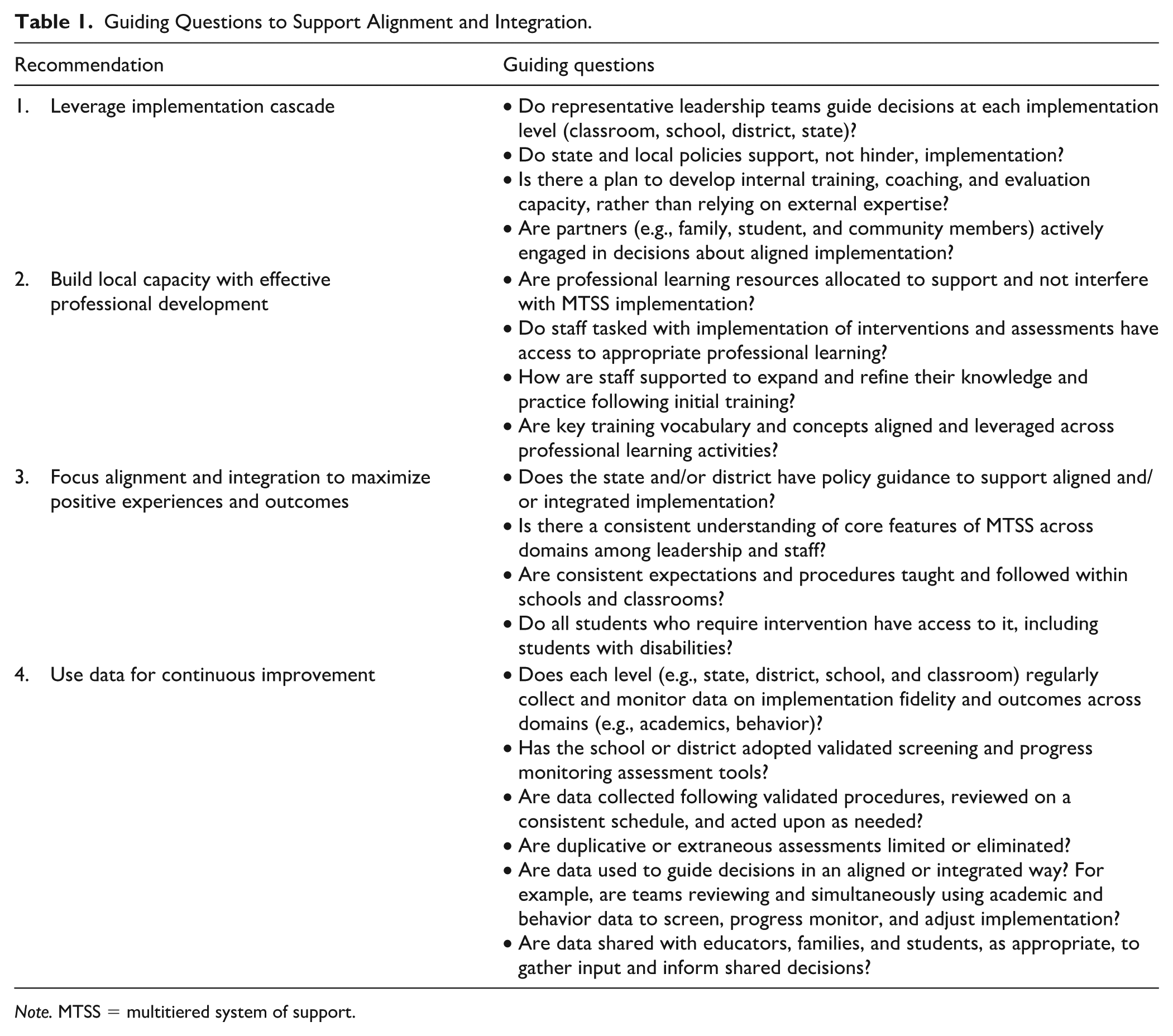
Note. MTSS = multitiered system of support.
Recommendation 1: Leverage the Implementation Cascade
When individuals working at different levels of the educational system, or implementation cascade (i.e., classroom, school, district, state), have a shared understanding and vision for implementing a coherent system of intervention, they are in a better position to work toward common goals. Early and frequent communication from school and district leaders to increase awareness of the need and benefits of providing aligned and integrated support to students with intensive needs is a critical early step in planning for successful implementation. As part of this planning, leaders must evaluate and adjust, when necessary, school and district policies and practices to ensure that they facilitate and do not hinder implementation of intervention. This may include, for example, (a) reviewing policies about the type, level, and frequency of assessments given and (b) building greater understanding among staff about the purposes of different types of assessment (e.g., screening, progress monitoring, summative). With respect to instruction, it may also mean reviewing core instructional and intervention curriculum and behavioral expectations to identify points of inconsistency, gaps in content, or places where adjustments are necessary. In addition, it is important for leaders to consider policies and processes related to scheduling, student access to intervention, and transitions to ensure that students who need intervention have adequate time to receive the supports that they require and participate in critical core instruction (to the extent appropriate). Finally, it is imperative for teachers and leaders alike to have shared expectations for student behavior, ambitious growth, and how to respond when adjustments to students’ supports are necessary.
Recommendation 2: Build Local Capacity With Effective Professional Development
Before teachers can engage productively in alignment and integration efforts, they must understand why (rationale), how (procedural steps), and what (content) they are being asked to align and integration. Components of MTSS often require staff and leaders to engage in new learning, and thus, the resource demands of this effort must be part of any coherent implementation plan. Furthermore, students with complex and intensive needs may require specialized support that goes beyond teachers’ initial training. Thus, it is critical that interventionists have access to the resources and training necessary for their role. All too often, teachers report receiving professional development that is not aligned to their role, or they are left to identify and even fund their own learning (Schwartz, 2023; Zuo et al., 2023). And paraeducators, who are often tasked with delivering interventions and assessments, may not have access to professional learning on the materials they are expected to use. Instead, they are left to teach themselves, with uneven results and incomplete implementation. Thus, initial training in alignment and integration is an important first step.
In addition to initial training, it is critical that teachers engage in ongoing professional development to allow them to ask questions, build their knowledge and skills, share learning with colleagues, and refine their practice. Evidence suggests that ongoing professional development that is job-embedded, models effective practice, and provides opportunities for collaboration and ongoing coaching with data-based feedback is supportive of improved implementation (e.g., Darling-Hammond et al., 2017; Wilkinson et al., 2020).
Recommendation 3: Focus on Alignment and Integration to Maximize Positive School Experiences for Students, Educators, and Families
When considering approaches to align and integrate supports, we find it helpful to view decisions through the lenses of student, educator, and family. From these perspectives, we discuss how vertical and horizontal alignment and integration can work together to promote positive outcomes. Picturing the triangle often used to illustrate an MTSS framework, vertical refers to alignment and integration across tiers (from the bottom to the top of the triangle) within a domain (e.g., reading, math, behavior), and horizontal alignment refers to integration within a tier (a horizontal cross-section of the triangle) across domains (e.g., integrating behavioral instruction and supports within literacy instruction).
Vertical Alignment and Integration
Students can benefit from effective vertical alignment and integration—when each layer, or tier, of instruction and support is aligned (e.g., using connected instructional approaches and materials across tiers) and integrated (e.g., integrating strategies learned in Tier 2 into Tier 1 instruction). As mentioned earlier in this article, in the absence of effective vertical alignment and integration, students may experience disconnected instruction and confusion that harms, rather than helps, their acquisition of content and skills. Consider, for example, that each reading program used in each instructional tier may have a unique approach to teaching foundational skills (e.g., decoding). Even something as basic as using different versions of sound-spelling cards (i.e., cards that cue how target sounds are spelled, often paired with a picture that includes the target sound) across instructional tiers could create confusion for a student if not effectively bridged by educators. And, the differences between approaches may be more substantial (e.g., different rules taught, conflicting ways to prompt skills, computer-based practice activities that differ in content and structure from classroom instruction), lead to greater frustration, and interfere with learning.
When instructional approaches are vertically aligned and integrated, there is coherence in the content, strategies, and materials used in universal classroom instruction (Tier 1), targeted skills groups (Tier 2), and individualized or intensive support (Tier 3), which may lead to improved student outcomes (e.g., Fien et al., 2015; Smith et al., 2016). Vertical alignment and integration (a) enables students to experience more seamless connections among content and skills and (b) maximizes the number of opportunities to practice (e.g., Fien et al., 2015). Therefore, it is critical to prioritize vertical alignment within a content area to enhance students’ ability to acquire, build fluency, and ultimately generalize their learning across contexts. Similarly, vertical alignment may reduce the demands on educators to bridge content and instructional materials from a range of approaches for the same skill/content areas and support families as they help their child with homework from various educators.
Horizontal Alignment and Integration
Students can also benefit from horizontal alignment and integration across content areas and domains. In the absence of horizontal alignment and integration, students may experience siloed support that interferes with their generalization of skills. For example, What Works Clearinghouse (WWC) Practice Guides document that, among other strategies, the following practices support growth in reading (Foorman et al., 2016; Gersten et al., 2008; Kamil et al., 2008; Vaughn et al., 2022), math (Fuchs et al., 2021; Gersten et al., 2009), and behavior (Epstein et al., 2008; Lane et al., 2024:): (a) explicit instruction, (b) effective models and instructional materials, (c) opportunities for group and individual practice, (d) specific positive feedback to praise skill use, and (e) specific and supportive feedback to correct errors. Although these practices may be implemented in a siloed way within each domain, the fidelity and outcomes of these practices may be enhanced when they are thoughtfully integrated (Integrated MTSS Research Network, 2024; UConn I-MTSS Research Team, 2024). For example, when UConn I-MTSS Research Team (2024) integrated prompts, specific praise, and specific corrections for students social-behavioral skills within a systematic and explicit reading approach (Enhanced Core Reading Instruction; e.g., Fien et al., 2015), they found that teachers improved their fidelity of implementation and students were more engaged in instruction. To support horizontal alignment and integration, district leaders can prioritize (a) integrated professional development and coaching and (b) develop and adopt integrated instructional materials (Integrated MTSS Research Network, 2023; Melton et al., 2024).
Considerations for Promoting Alignment and Integration
To support alignment and integration, school leaders, classroom-based educators, and support staff must consider how to design a schedule that enables students to (a) maximize their participation in all relevant instruction—across tiers and domains—and (b) minimize the number of transitions. Often students with the greatest need for predictability and consistency experience the greatest number of transitions and disruptions as they move between locations and groups to receive targeted, intensive, or otherwise specially designed instruction; a range of services (e.g., speech, mental health, occupational, and physical therapies); and other intervention-specific supports (e.g., more frequent breaks, access to earned activities). Although some transitions are inevitable, viewing schedules through a student’s lens highlights the importance of streamlining and simplifying schedules. In sum, when educators align and integrate the expectations, routines, instructional approaches and materials, and the skills and knowledge students need throughout their day, students can more readily acquire, apply, and generalize those skills across contexts and experience success.
Recommendation 4: Use Data for Continuous Improvement
To improve alignment efforts across the implementation levels (student, classroom, school, district, state), leadership teams should collect, monitor, and use relevant and meaningful data to guide decisions for continuous improvement.
Collect Relevant and Meaningful Data
To develop a more complete picture of the strengths and needs of a student, classroom, school, district, and community, it is important to consider data from multiple perspectives (e.g., educator, family, student) using multiple methods (e.g., academic records, direct observations, rating scales) to assess multiple indicators of fidelity (e.g., quality of systems and practices implementation), outcomes in multiple domains (e.g., academic, behavior), and social validity (e.g., acceptability, usability) over time. Priority should be given to (a) selecting locally meaningful outcomes (e.g., improving attendance, academic and behavioral outcomes, and perceptions of school climate; reducing exclusionary discipline, chronic absenteeism, and opportunity gaps), (b) identifying contextually relevant measures or indicators those outcomes, (c) selecting fidelity measures to support implementation of systems and practices that aimed at improving outcomes, (d) ensuring measures have (or establishing) adequate psychometric properties, and (e) developing an evaluation or data collection schedule that is feasible and ensures timely and repeated collection of indicators over time. For example, Southbridge Public Schools, in Massachusetts, routinely collects data on attendance, academic indicators, students’ behavior, educators’ use of exclusionary discipline, and fidelity of implementation (via monthly classroom observations and annual fidelity assessments). Derian-Toth et al. (2025a, 2025b, 2025c) summarize these data systems to support district-wide MTSS implementation to support (a) all students in classrooms, (b) students with disabilities, and (c) students receiving targeted and intensive support.
Use Data Regularly
As data are collected, leadership teams (a) review data regularly (i.e., review at start of each leadership team meeting, share highlights with staff at faculty meetings), (b) monitor implementation and progress toward identified outcomes, (c) determine gaps and points of redundancy, and (d) make decisions that maximize implementation fidelity and outcomes, with relevant input and social validity data supporting contextual fit and cultural relevance. Specifically, at each level, teams decide whether to maintain, fade, or enhance their implementation supports to promote progress toward outcomes.
In addition, teams may revisit the data they collect to ensure they are actionable and support decision making. For example, if a team finds that they are collecting data that they are not using to monitor progress, they may stop collecting those data. Teams can use data to prioritize the smallest changes that have the biggest impact, and review data to maximize efficiency and feasibility, while promoting effectiveness. See Derian-Toth et al. (2025a, 2025b) for further examples of data routines that are feasible in the current context.
Conclusion
Poor alignment of the educational systems that surround and support students with intensive learning needs may create unintended barriers to coherent, successful, and sustainable implementation of interventions designed to support these students. When systems are not well aligned and integrated, the students who need engaged learning time the most may get the least. They may also end up navigating instruction and intervention settings with differing expectations, vocabulary, instructional practices, and routines. Multitiered system of support provides a potential structure for creating more coherent, aligned, and integrated support for students, but the leaders and staff working within the system must have a consistent understanding and set of expectations about the goals of implementation.
Although further research is critically needed to guide the field in aligned and integrated MTSS implementation (Integrated MTSS Research Network, 2024), our experience implementing federal and state technical assistance centers suggests that understanding core MTSS features, common gaps, and barriers may help leaders to proactively plan for aligned implementation that results in coherent educational experiences for the students who need them most. In particular, leaders should consider how to build capacity and shared understanding of the purpose for intervention; prioritize training and coaching that promotes the development and refinement of evidence-based pedagogical, behavior support, assessment literacy, and problem-solving abilities among staff; build aligned and integrated supports that maximize positive experiences for students, staff, and families; and orient data collection efforts toward identification of opportunities to promote efficiency and continuous improvement. Planning with alignment and integration in mind has the potential to reduce complexity and help MTSS live up to its promise to promote positive outcomes for all students, particularly those with the most intensive support needs.
Footnotes

Funding
The development of this article was supported in part by the Institute of Education Sciences, U.S. Department of Education, through Grant R324N180020 to the University of Connecticut. The opinions expressed are those of the authors and do not represent views of the Institute or the U.S. Department of Education.
Declaration of Conflicting Interests
The authors declared no potential conflicts of interest with respect to the research, authorship, and/or publication of this article.