







Abstract
This article adds a new dimension of mobility among subsistence consumers to investigate their well-being during the process of rural–urban migration. Using social production function theory as the theoretic perspective as well as a mixed method, the authors identify three essential drivers that influence the life satisfaction of subsistence migrant consumers: financial resources, social connection, and sense of control (the last of which also mediates the relationship between social connection and well-being). Findings show that family closeness and social comparison orientation moderate the main effects of financial and social resources on life satisfaction. Family closeness enhances the positive effect of financial resources, while social comparison weakens the positive effect of social connection. This research contributes to the literature on subsistence consumers by introducing social production function theory into the subsistence marketplace and adopting a mixed approach to uncover the complexity of the perception of life satisfaction among subsistence migrant consumers.
Keywords
The introduction of subsistence marketplaces as a theoretical concept offers a different approach to understand impoverished consumers (Viswanathan and Rosa 2007). It complements the macroeconomic approach and microbusiness strategic approach by steering the attention to a more thorough understanding of behavioral fundamentals that underline the economic transactions and marketplace interaction of the poor (Prahalad 2009; Viswanathan 2013). Such an approach is bottom-up and starts with examining the behaviors of consumers and sellers as an outcome of interacting with a particular marketplace environment. “Subsistence” is connoted as a state of being resource-poor and is intended to capture the broad range of low-income subsistence consumers who barely make ends meet (Viswanathan 2013). But research shows that the poor also have tangible assets (e.g., labor, housing) as well as intangible assets (e.g., household, community relations), which can be transformed into consumption capabilities and quality of life perceptions (Blocker et al. 2013; Viswanathan et al. 2012).
In recent years, with urbanization and the ongoing movement of migrants from rural regions to urban areas, subsistence marketplaces have become more diverse and complex. Subsistence migrant consumers, as an emerging segment of consumers, have not received adequate scholarly attention in marketing and consumer research. As recognized by economists, migration is an escape route out of poverty (Narayan, Pritchett, and Kapoor 2009), and migrants are or have been migrating to pursue remunerative livelihood opportunities in other places both domestically and globally. In this research, we study the phenomenon of subsistence migration—that is, the long-term relocation of low-income people in search of economic opportunities, typically from lower-income locations or countries to higher-income locations or countries.
During the movement from rural poor to urban settlements, subsistence migrant consumers face myriad restrictions in a completely different urban environment and deploy a variety of behavioral and emotional coping strategies to manage such restrictions and deprivations. They experience revolutionary and evolutionary changes in their lives as well as in themselves when they struggle to survive and thrive in new social and cultural settings. In light of this, subsistence migrant consumers’ scarce assets after migrating, as well as the interactions between their self-evolution and the changing external environment, could play critical roles in shaping their perceived life satisfaction that further affect their future consumption behaviors (Martin and Hill 2012).
Our research aims to shed light on the development of subsistence migrant consumers’ life satisfaction, to better understand their emerging needs and potential consumption behaviors. Using internal migrants in China as a case study, we adopt a mixed method to examine how the perception of life satisfaction is affected by these migration experiences given these unique marketplaces and institutional norms. The article is structured as follows. First, we review the present literature on subsistence marketplaces and life satisfaction. Next, we present hypotheses and a conceptual model. We employed a large-scale survey to empirically test the conceptual model. Finally, we discuss the findings of this research and their implications for theory development and public policies.
Conceptual Background
Theoretical Perspectives
Consumer well-being in subsistence marketplaces
Consumer well-being has been widely studied as a consequence of exchange relationships from various perspectives, including the formal market exchange system (Sirgy, Samli, and Meadow 1982) and informal or one-to-one systems characterized by subsistence marketplace (Viswanathan et al. 2012). Subsistence consumers have insufficient financial resources individually and collectively, which, in turn, affects their participation in the market exchange and the way they cope with the environment (Hill and Gaines 2007). However, subsistence marketplaces can be rich in terms of social relationships; that is, the interactional environment is characterized by enduring relationships and interactional empathy (Viswanathan et al. 2012). In this regard, the roles of affect and self-esteem have been emphasized in the context of low literacy, which is highly associated with low income (Viswanathan, Rosa, and Harris 2005). Thus, affective and social elements are important sources of well-being sought by subsistence consumers.
Life satisfaction is a core indicator of consumers’ subjective well-being, referring to people’s emotional and cognitive evaluations of their lives (Diener 1984). Whereas common wisdom usually links material abundance to life satisfaction, prior research in both psychological and economic literature has yielded inconsistent results (Diener and Biswas-Diener 2002). Several studies have indicated that the relationship between income and life satisfaction is the strongest at lower income levels and tends to decline as income rises (Diener and Biswas-Diener 2002; Veenhoven 1991). Recently, Hill, Martin, and Chaplin (2012) and Martin and Hill (2015) examined the nuanced relationship between material abundance (consumption adequacy or savings) and life satisfaction across nations. Their findings confirm that material abundance and financial resources enhance consumers’ well-being significantly under certain boundary conditions (e.g., lower societal poverty, downward comparison). Another line of research has studied subsistence marketplace as an informal economy (Viswanathan et al. 2012) that is not regulated by the market force and the state. Within such an exchange system, buyers and sellers have stabilized a one-to-one form of communication that relies on interpersonal empathy, trust, and dependence due to the thick social capital that is embedded. As a result, a high level of life satisfaction is observed among subsistence consumers (Blocker et al. 2013), despite their constrained resources for market exchange.
In our study context, Chu and Hail (2014) found a U-shaped relationship between income and life satisfaction among urban migrants in China. Knight and Gunatilaka (2010) found a positive but moderate relationship between income and happiness. In contrast, Nielsen, Smyth, and Zhai’s (2010) study on Chinese off-farm migrants reported no significant difference in well-being across income groups.
The lack of consistent findings on the impact of material abundance on life satisfaction reflects the complexities in how subsistence consumers develop perceptions of their life satisfaction. Life satisfaction could be shaped by influencing factors other than material abundance, such as employment, family relationships, health, education, and perceived income inequality. Recent studies show that impoverished consumers are often unable to rise above their circumstances and experience negative reactions that capture long-term consequences such as frustration, humiliation, inferiority, and loss of control over essential aspects of their lives (Hill and Gaines 2007). These arguments have opened a promising avenue for investigating the lives of subsistence consumers using a situated perspective, which has sometimes been adopted in the previous research. The lack of well-being of subsistence consumers largely stems from their potential vulnerability (Baker, Gentry, and Rittenburg 2005). However, vulnerability is not a permanent condition attached to the state of being poor (Viswanathan et al. 2012). It is not a trait but the result of interactions among internal resources and external factors, such as market exchange structures.
Among Chinese subsistence migrant consumers, the problems contributing to their vulnerability can be traced to the institutional hukou system (China’s household registration system), such that a lack of access to urban hukou leads to limited resources, constrained consumption, and restricted access to the market. 1 For example, without an urban hukou, many migrant workers undertake dirty, dangerous, and demanding jobs with an average income approximately half that of urban workers. They are inexperienced consumers and cannot afford material status symbols as local urbanites do (Gao and Smyth 2011). Consequently, subsistence migrant consumers are excluded from the dominant marketplace and social security system in urban cities, which complicates their migration experiences.
Social production function theory
We propose social production function (SPF) theory (Lindenberg 1986; Lindenberg 1991) as an analytical heuristic in this research to explore how subjective well-being is related to objective living conditions and resource limitations among subsistence migrant consumers. Social production functions rest on satisfying universal needs on the one hand and instrumental needs on the other hand. The universal need that is invariant across individuals is the psychological well-being determined by physical and social well-being. The instrumental goals relevant for physical well-being are comfort and stimulation, whereas social well-being is attained by the instrumental goals of status, behavioral confirmation, and affection. Social production function theory views human beings as actively shaping and reshaping their activities to attain goals, using all their personal and environmental resources at hand (Lindenberg 1996). It asserts that people produce their own well-being by optimizing achievements within the environmental and functional limitations they face.
One key characteristic of SPF theory is the hierarchical structure among needs, instrumental goals, activities, and resources, with universal needs at the top and resources at the lowest level, linked by production functions that specify the relationships between needs, goals, activities, and resources for a particular group of people (Ormel et al. 1999). The notion of the situation specificity of production functions in SPF theory is pivotal for the purpose of this research, as we aim to understand well-being among a particular population of subsistence migrant consumers in unique personal, economic, cultural, and social contexts. Starting with an awareness of the limited resources subsistence migrant consumers face enables us to explore of the role of environmental characteristics (e.g., separation from children) in relation to the activities in which subsistence migrant consumers participate, the instrumental goals they target, and ultimately, life satisfaction. Social production function theory is helpful in identifying which goals are promoted or hindered by environmental conditions. Thus, SPF theory is useful in describing people’s capacity to attain subjective well-being and explaining how subjective well-being develops.
Another key notion of SPF theory is substitution—the notion that instrumental goals are viewed as substitutable depending on their relative cost (Lindenberg and Frey 1993). People consider benefit–cost ratios to determine their preferences. For example, if opportunities and resources for the realization of status decrease, an individual is likely to increase the production of other instrumental goals, such as behavioral confirmation and affection, or the production of resources needed for the achievement of status becomes an instrumental goal in itself (Ormel et al. 1997). This implies that SPF theory is a theory of alternatives, in that individuals shift their activities and change their preferences according to the resources available. This core idea embedded in SPF theory makes it a suitable heuristic tool for this research, which examines the exploratory and interpretative nature of life satisfaction among subsistence migrant consumers. The ever-changing life conditions affect subsistence migrant consumers’ evaluation and selection of instrumental goals to be fulfilled in the process of achieving overall life satisfaction.
In summary, SPF theory meaningfully relates people’s resources to their activities with a focus on well-being. In this light, it offers a highly appropriate theoretical perspective from which we can relate the effects of individual-level poverty and environmental-level constraints to the behaviors and activities engaged in by subsistence migrant consumers to produce and maintain well-being. We adopt the theoretical perspective of SPF theory (Lindenberg 1996) to tap into the interplay between individuals and environments when examining how subsistence migrant consumers cope with living in an urban environment and achieve life satisfaction.
Hypothesis Development
Financial Resources
Compared with local consumers, subsistence migrant consumers may face more financial difficulties and, more significantly, a higher level of uncertainty for future. Most subsistence migrant consumers will not be given an urban hukou even after living in the city for over a decade. Stratification and segregation become common when subsistence migrant consumers are viewed as outside laborers rather than as members of urban society (Solinger 1999; Wang and Tian 2014). As a result, subsistence migrant consumers do not desire to settle in the cities long-term but prefer to return to their home towns at some point. They pin their hopes on their children to care for them in their old age when back in the countryside (Fan and Wang 2008). Yet there is evidence that more children of migrant workers want to start a new life themselves elsewhere, away from their parents, and thus may not be available as their parents reach old age (Nielsen, Smyth, and Zhai 2010). Facing such a situation, subsistence migrant consumers are prone to a state of powerlessness and experience consumer vulnerability (Baker, Gentry, and Rittenburg 2005). What they can do, though, is enhance their sense of security (Howell, Howell, and Schwabe 2006) by accumulating income and minimizing consumption. Personal savings become a major source of financial resources that offer a buffer against resource constraints and further decline in life satisfaction. Prior research has suggested that financial elements may improve life satisfaction among low-income populations (Deci et al. 2001; Howell, Howell, and Schwabe 2006; Martin and Hill 2012).
Social Connection
Social or relational richness promotes market exchanges and well-being among subsistence consumers (Viswanathan et al. 2012, 2014). Social connections offer migrant workers an opportunity to join the collaborative construction of a community as well as a context that facilitates their interpretation of the local environment and the formulation of coping strategies. Migrant consumers may maintain broad connections back in their home villages, while establishing limited connections in urban cities. Such narrowly structured social capital is common in societies with legacies of horizontal inequality and social exclusion (Morgues and Carter 2005). Social connections offer migrant workers peer support, market information, and product access (Chikweche and Fletcher 2010), as well as status, which, in turn, may provide access to economic resources such as jobs or credits (Ingenbleek 2014). Thus, we argue that stronger social connection leads to higher life satisfaction.
Sense of Control
Sense of control indicates the extent to which migrant workers feel autonomous about the way they lead their lives. Autonomy reflects perceptions of power or control over one’s actions (Patrick et al. 2007), which is one of the fundamental psychological needs to be met for people to experience fulfillment (Martin and Hill 2012). Individuals are “autonomous when they act in accordance with their authentic interests or integrated values and desires” (Chirkov et al. 2003, p. 98). The perceived control of one’s own actions may lead to higher life satisfaction.
Subsistence migrant workers may realize the low likelihood of achieving material abundance in urban cities and accept their financial vulnerability. They cope with such situations by taking a conservative and risk-averse approach in spending money and planning for the future. Through a realistic strategy in financial management such as disciplined spending, restrained hedonic consumption, and the setting of short-term attainable goals, migrant consumers are more likely to feel autonomous about their lives (i.e., taking control of their migration life in urban cities), which may lead to enhanced well-being. Therefore, the positive impact of financial resources on life satisfaction may be mediated by migrant workers’ perceived sense of control.
Whereas thick social capital has been recognized in classic subsistence marketplaces and consumers (Viswanathan et al. 2012), such social capital becomes increasingly ineffective as a mechanism of capital access for poor people in a context of high inequality (Morgues and Carter 2005). Subsistence migrant consumers may not be able to connect with people from the host society easily. They may intentionally adopt inward social networking strategies, connecting with similar individuals and seeking a higher level of mutual support, attention, and assistance from others (Chirkov et al. 2003). This reduces their social stress and thus makes them feel more in tune with their own needs and interests, leading to a stronger sense of control over their migration life. Because social connection promotes individuals’ sense of control, which further predicts their life satisfaction, we propose that the relationship between social connection and life satisfaction is mediated by sense of control.
Family Closeness
Family is considered the fundamental unit, especially in collective cultures. Research has revealed the positive relationship between perceived family support and life satisfaction (Edwards and Lopez 2006). Extant literature has reported the possible direct effect of family support on life satisfaction (e.g., Edwards and Lopez 2006). Akay et al. (2014) discovered that more financial support offered to family leads to higher subjective well-being among Chinese migrant workers. The SPF theory posits that behavioral confirmation (i.e., the feeling of having done the right thing in the eyes of relevant others) is an important instrumental goal for the attainment of subjective well-being (Nieboer et al. 2005; Ormel et al. 1999). By financially supporting their families, migrant workers may feel more accepted by and connected to their families, which, in turn, elevates the importance attached to families in their perception of life satisfaction. The positive impact of financial resources on life satisfaction will thus be strengthened when family closeness is greater. In summary, we propose a positive interaction between family closeness and financial resources.
Social Comparison
Social comparison is a universal tendency for people to “learn about the self through comparison with others” (Festinger 1954; Gibbons and Buunk 1999, p. 129). Knight, Song, and Gunatilaka (2009) found that the main reference group of comparison for Chinese migrant workers was their village of origin. The bonding with other migrant workers is rooted in the shared life experiences and emotional connections that provide a sense of community (McMillan and Chavis 1986).
However, the same relationships that provide social support may be a source of social strain (Sangalang and Gee 2012), such that those who are more inclined to conduct social comparisons would expect more benefits from social partners such as status and recognition. For migrant workers, the expected benefits from the social network may not always be attainable because of their highly limited resources. According to equity theory, such “disturbance of expected reciprocity, either in the form of not being able to return benefits or not receiving benefits in return from others” (Buunk and Hoorens 1992, p. 448), generates negative feelings and inferior self-perceptions. Moreover, high social comparison orientation is associated with depression (Ahrens and Alloy 1997) and negative social experiences, which lower emotional functioning (Lepore 1992). These factors together could create frustrating experiences within existing social networks, thus decreasing perceived well-being (Antonucci, Akiyama, and Lansford 1998), regardless of the supportive interactions embedded in the network. The enhancement of life satisfaction by social connection would be counteracted by the negative consequences accompanied with social comparison, leading to a weakened effect of social connection on life satisfaction.
Figure 1 summarizes the hypotheses and presents the conceptual model for empirical testing.

Conceptual framework.
Study
As a pilot study, 16 migrant workers living in Shanghai were interviewed for exploratory purposes to help us evolve our understanding and design the quantitative study. The exploratory findings are presented in Appendices A and B. Our main study is described next.
Sample and Data Collection
We recruited 596 migrant workers to participate in our survey. They were selected using equal intervals with a random initial selection based on the census provided by Shanghai Municipal Statistics Bureau. Excluding missing data, we obtained 560 valid samples, 75.36% of whom were male. Respondents had an average age of 36.52 years and had been living in Shanghai for 8.4 years on average. Most of the migrant workers were employed at domestic private businesses or self-employed (76.43%) across various industries including manufacturing, construction, business services, retailing, restaurants, transportation, and delivery express.
We used Harman’s one-factor test to assess the effect of potential common method variance, using exploratory factor analysis without rotation for all self-reported survey items. Our analysis extracted five factors with eigenvalues greater than 1, with the first and largest factor explaining less than 20% (19.43%) of the variance. This result indicates that common method variance does not pose a serious concern for this study.
Measures
Participants rated all the items based on a seven-point Likert scale (1 = “strongly disagree,” and 7 = “strongly agree”). We measured life satisfaction using five items from the satisfaction with life scale developed by Diener et al. (1985). The Cronbach’s alpha is .78.
We measured respondents’ sense of control with four items adapted from the autonomy subscale of the basic psychological needs scale developed by Deci et al. (2001). The Cronbach’s alpha was .60, close to the value (.62) reported by Deci et al. in the Bulgarian sample. We measured family closeness and social connection using items selected from the social and emotional loneliness scale (Ditommaso and Spinner 1993). We selected three items from the subscale of family loneliness to measure family closeness. The Cronbach’s alpha was .81. We selected another two items from the subscale of social loneliness to measure social connection, with the scale reliability being .73. We measured social comparison orientation with the ability subscale of social comparison orientation created by Gibbons and Buunk (1999). The Cronbach’s alpha of the five-item scale was .79.
We adopted an objective measurement approach to measure financial resources by asking respondents to report their bank account balance and the amount of money they had invested in financial products. The figures provided were summed to indicate their level of financial resources (measured in 10,000 RMB). This study controlled for a range of demographic variables, including gender, age, marital status, children, occupation, education, and years of migration. Appendix C provides a full list of items.
Validity Test
We examined the validity of the measurement model with the statistical package LISREL. The measurement model showed an acceptable fit (root mean square error of approximation = .065 [<.08]) and the model fit indices were mostly above .90 (goodness-of-fit index = .92, comparative fit index = .91, incremental fit index = .91, nonnormed fit index = .89). We adopted confirmatory factor analysis to test the convergent validity of the measurement model and found that the loading of each item was significant, and the composite factor reliability values were mostly greater than .70 (Hair et al. 1995), except that the composite factor reliability for sense of control was .61. A sufficient discriminant validity requires that interconstruct correlations for each variable should be less than the square root of the average variance extracted (Fornell and Larcker 1981), so that an item can be better explained by its corresponding construct than by other constructs. Table 1 shows the means, standard deviations, correlations, and the square root of average variance extracted (placed along the diagonal) for all variables, indicating an acceptable discriminant validity.
Descriptive Statistics and Construct Correlations.

†p < .10.
*p < .05.
**p < .01.
***p < .001.
Results
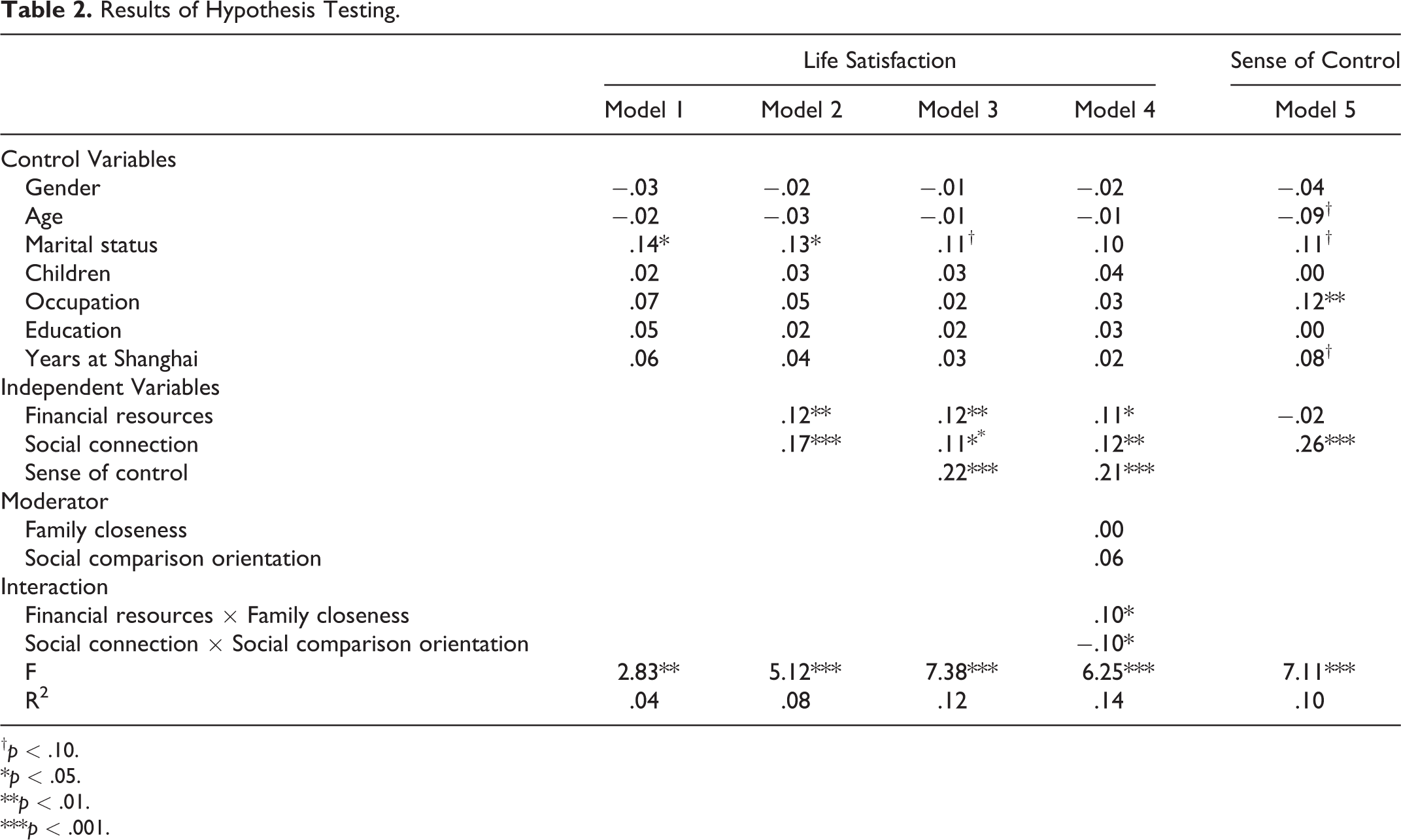
We used hierarchical multiple regressions to test the hypotheses, and the results are presented in Table 2. All interaction terms were created by mean-centered variables to minimize multicollinearity, which was not a problem throughout our analyses (variance inflation factor < 3.3, condition index < 30) (Diamantopoulos and Siguaw 2006).
Results of Hypothesis Testing.
†p < .10.
*p < .05.
**p < .01.
***p < .001.
We took three steps to test the proposed main effects (H1–H3). First, we entered the control variables into the regression (Model 1) and found that only marital status had a positive effect on life satisfaction. We then entered the two antecedents simultaneously into the regression analysis to test their incremental effects on life satisfaction (Model 2). The explanatory power increased from 4% to 8%, and the overall equation was highly significant (F = 5.12, p < .001). We found that financial resources (β = .12, p < .01) and social connection (β = .17, p < .001) were positively related to life satisfaction. Thus, H1 and H2 were both supported. Next, we entered the proposed mediator of sense of control into the equation (Model 3). The explanatory power increased from 8% to 12% (F = 7.38, p < .001), and sense of control had a significantly positive effect on life satisfaction (β = .22, p < .001). H3 was also supported.
We tested hypotheses of moderating effects (H6 and H7) by entering both the moderators and corresponding interaction terms into the regression (Model 4). The explanatory power of the equation further increases to 14% with an overall significance (F = 6.25, p < .001). Consistent with our hypotheses, all the moderation effects were significant. Family closeness enhanced the positive effect of financial resources on life satisfaction (β = .10, p < .05). Social comparison orientation reduced the positive effect of social connection on life satisfaction (β = −.10, p < .05). These results lend support to the moderating hypotheses H6 and H7.
In addition, we explored these moderating effects on life satisfaction by conducting two simple slope tests (Aiken and West 1991). We found that financial resources have no significant impact on life satisfaction at a low level of family closeness (r = .00, n.s.) but substantially increase life satisfaction when workers perceive a high level of family closeness (r = .23, p < .001). For migrant workers with a high level of social comparison, their social connection had no significant effect on life satisfaction (r = .05, n.s.). However, for those who have a low level of social comparison, their social connection positively related to their life satisfaction (r = .29, p < .001).
We adopted multiple methods to test the mediation effects. First, we followed the procedure recommended by Baron and Kenny (1986) using hierarchical regressions. Controlling for all the demographic variables in Model 5 with sense of control as dependent variable, we found that financial resources had no impact on sense of control (β = −.02, n.s.), whereas social connection was positively related to sense of control (β = .26, p < .001). After the addition of sense of control into Model 3 with life satisfaction as dependent variable, the effect of financial resources on life satisfaction remained unchanged (β = .12, p < .01), but the effect of social connection shows a substantial decrease (β = .11, p < .01). These initial results indicate that sense of control partially mediates the relationship between social connection and life satisfaction (H5) but does not mediate the relationship between financial resources and life satisfaction (H4). Second, we adopted the Sobel test to analyze the significance of mediation effects (Sobel 1982). Results showed a significant mediation through sense of control between social connection and life satisfaction (Z = 3.96, p < .001), but the mediation between financial resources and life satisfaction was nonsignificant (Z = −.50, n.s.). Third, we conducted a bootstrap analysis using Hayes’s (2018) PROCESS program in SPSS. Results were based on bias-corrected 95% confidence intervals (BC 95% CI) with 5,000 iterations, including demographic variables set as covariates. We found that the indirect effect of social connection accounted for 31.82% of its total effect on life satisfaction (effect size = .04, BC 95% CI = [.0200, .0622]), whereas that of the financial resources is nonsignificant (effect size = −.00, BC 95% CI = [−.0047, .0030]). Overall, the mediation hypothesis H5 was supported, whereas H4 was not supported.
We also did a post-hoc analysis to check the robustness of our framework by investigating the existence of potential moderated mediation mechanisms. Following Edwards and Lambert (2007), we adopted bootstrap analysis based on BC 95% CIs with 2,000 iterations using Mplus scripts. If mediation is moderated by the moderator, then we should observe a significant difference in the indirect effect across levels of the moderator variable. Our results show that this difference does not significantly deviate from zero between one standard deviation above and below the mean of social comparison orientation (BC 95% CI = [−.0250, .0420]), lending no support to moderated mediation. This result excludes the existence of alternative mechanisms, indicating that only social comparison orientation moderates the direct effect of social connection on life satisfaction.
General Discussion
Subsistence migrant consumers represent a unique segment in the subsistence marketplace, involving not only material restrictions but also, and more importantly, mobile experiences of migration. Exclusion from the urban household registration has deprived migrant workers in China from full access to social welfare, social network resources, and market offerings in urban cities. However, the loss of important resources does not necessarily lead to long-term decrease in life satisfaction because people shift activities toward alternatives (Ormel et al. 1999). Instead of being passive recipients of their experiences, subsistence migrant consumers cognitively process their urban living experiences and adapt their expectations, perceptions, and behaviors as they cope with the environment, leading to life satisfaction.
Our research reveals that when resources for achieving material abundance and status are scarce, subsistence migrant consumers are prone to engage in activities that increase affection, internal comfort, and sense of control instead of status (Ormel et al. 1999) to gain life satisfaction. They turn to two important resources, financial resources and social connections, and take corresponding actions to satisfy instrumental and psychological needs. They rely more on immediate gratification to drive life satisfaction and accordingly, direct their activities to achieve a sense of independence with the social support from families and others. The interplay among resources, motives, actions, and need satisfaction adds to the complexity of the cognitive, psychological, and connotative processes subsistence migrant workers experience in striving for life satisfaction in urban cities.
Our research shows that the general positive effect of financial resources on life satisfaction is significantly moderated by family closeness (i.e., the positive effect of financial resources on life satisfaction is stronger when subsistence migrant consumers have closer relationships with their families). This finding indicates that the existence of close emotional ties with family offers a buffer to alleviate the pressure and pains of subsistence migrant consumers who suffer deprivation of material resources when working and living in urban cities. When subsistence migrant consumers are able to make financial contributions to support their families, the felt poverty (Blocker et al. 2013) is reduced and the contentment with their financial status increases, leading to a more salient positive impact of financial resources on life satisfaction. It further indicates that the satisfied instrumental goals of affection would have feedback effect on the perception of resources, providing new pathways for life satisfaction among subsistence migrant consumers.
However, the mediating role of sense of control in the relation between financial resources and life satisfaction is not empirically supported. Whereas subsistence migrant consumers accumulate their financial resources through stable incomes and savings, most of them take low-wage jobs without social benefits (Liang 2016), especially when they first migrate to urban cities and struggle to settle down. They feel financially secure when they have regular incomes and savings. However, the low amount of money earned and saved is insufficient to provide them with a sense of control. Instead, their feelings of autonomy are accrued through how the money is planned and spent. As our pilot study suggests, subsistence migrant workers are conservative consumers who prefer to use cash when shopping, are self-disciplined in online purchases, and are strict with budget planning. This implies that sense of control is a key psychological need to be fulfilled for life satisfaction and is more influenced by (non)consumption than possession in the context of subsistence marketplaces.
It has been widely acknowledged that social comparisons are significantly more powerful determinants of life satisfaction for poorer consumers than affluent ones (Martin and Hill 2012). Our research reports an important finding of negative moderating effects of social comparison on how social connections affect life satisfaction. The poor often find it impossible to seek psychological and material restoration on their own because scarcity elicits greater engagement and because a focus on current problems can lead to neglect of future problems (Shah, Mullainathan, and Shafir 2012); thus, the scope (quantity) and content (quality) of their social connections are important for avoiding risky decisions and gaining better well-being (Jachimowicz et al. 2017). However, subsistence migrant consumers often interact with people similar to themselves (i.e., other migrants with limited resources). When subsistence migrant consumers are engaged in intense social comparisons, they are more likely to realize that little instrumental benefit can be achieved from enhanced relatedness or greater community of migrant workers, thus reducing the perceived importance of social connections to life satisfaction. They are more likely to seek and rely on the emotional bonding within social groups.
On the one hand, when subsistence migrant consumers develop their social connections through relationships with only similar others, their sense of desolation in the marketplace will be reinforced and further permeate their material environment (Martin and Hill 2012). On the other hand, connections with similar others contribute to the enhancement of life satisfaction through sense of control. One explanation for this finding is that consumers are influenced to a great extent by others’ choices when evaluating their overall well-being. Subsistence migrant consumers feel more confident in establishing and maintaining narrow and homogenous social networks when facing restrictions in economic and institutional environments in urban cities. The similar value orientation, life experiences, and urban living conditions among community members dilute the feeling of a “possession gap” experienced by subsistence migrant consumers and create a “position gain” in social status (Ordabayeva and Chandon 2011), which generates feelings of a sense of control in their lives. Sense of control as the mediator between social connections and life satisfaction provides a nuanced understanding of the relationship between social capital and well-being. Avoidance of social networking with local communities (i.e., permanent city dwellers with hukou) in urban cities may be an effective coping strategy to avoid the loss of control in leading their migrant lifestyle.
Research Implications
Theoretical Implications
On the one hand, subsistence migrant consumers are similar to impoverished consumers in terms of limited material resources. On the other hand, the migration process distinguishes subsistence migrants from other subsistence consumers in that migration produces a unique life experience involving hope and aspirations as well as separation, stress, and associated risks. As a result, subsistence migrant consumers are exposed to an environment with different challenges from those faced by other subsistence consumers. Our research focusing on subsistence migrant consumers addresses an important knowledge gap.
This research incorporates migration experience into subsistence consumers’ discourse and extends the previous subsistence contexts. Change is one of the main themes in the lives of subsistence migrant consumers when they strive to survive and thrive in different societies, and this is true of life satisfaction as well. Changes in perceptions lead them to engage in different activities and focus on different instrumental goals to achieve life satisfaction. The potential of a situated approach can be realized when it includes a temporal dimension. Thus, a longitudinal perspective in future research can fully capture changes in vulnerable consumers’ lives while shedding light on dynamics of life satisfaction and overall well-being. Finally, the adoption of SPF theory as a theoretical perspective allows for a bottom-up, context-specific approach and a lens to explain the findings in this research. For example, substitution mechanisms focusing on the idea of change of preference offer an explanation for why subsistence migrant consumers are still able to achieve life satisfaction despite the limited resources at hand. Although SPF theory has been frequently applied in well-being studies, its use in the context of subsistence migrant consumers from a marketing perspective is novel.
Implications for Policy Makers
Our research provides insight into the strategies practiced by subsistence migrant consumers to attain life satisfaction in the face of structural barriers in the form of government policies and are treated as inferior members in urban societies. Our findings may be applicable to other similar groups in the world, such as international refugees and undocumented immigrants. They leave their hometowns for better opportunities. Viewing subsistence consumers as the poor, public policy makers always view financial resources (or consumption adequacy) as the highest-priority need for subsistence consumers. Therefore, current public policies have focused on increasing their incomes and encouraging their fair involvement in the market exchange system. However, our research reveals that the problems that create subsistence migrant consumers’ vulnerability are outcomes of the interaction between poverty and migration. In particular, some institutional barriers (such as the hukou system) have put on extra pressure on subsistence migrant consumers. These complexities embedded in their migration life trigger different needs, priorities, and solutions to achieve life satisfaction, thus requiring more relevant support from governments and policy makers.
Our research has identified multiple paths that lead to life satisfaction. Governments should invest more effort into facilitating family well-being and encouraging support from social networks to develop community trust (Jachimowicz et al. 2017). In the example of China, public policies should aim to foster an inclusive labor market and promote equal rights for migrants in the labor market to improve their social and employment security. As our research reveals, it is essential for regulators and policy makers to understand the mechanisms that drive changes in life satisfaction to take better steps to promote well-being in society. In this regard, marketplace literacy education, which addresses skills, knowledge, and self-confidence in a socially embedded context is particularly important (Viswanathan, Gajendiran, and Venkatesan 2008). Recent literature has noted the phenomenon of how some individuals leave their social context—and, therefore, their socially embedded marketplace literacy—due to life circumstances (Viswanathan, Arias, and Sreekumar 2018).
Our research suggests that subsistence migrant consumers’ sense of control is important for them to achieve life satisfaction. Lack of power to change is prevalent among subsistence consumers (Blocker et al. 2013), leading to a lack of sense of control. Because chronic deprivation and scarcity could deplete their cognitive skills and encourage short-term perspectives, associated support services for subsistence migrant workers would improve their capabilities and fulfill psychological needs such as independence and autonomy. Governments should consider collaborating with third-party training organizations and nongovernmental organizations to offer skill-training and personal enhancement programs. Such initiatives can broaden subsistence migrant consumers’ vision for the future and help them to gain resources to engage in mainstream marketplaces (Chu, Leonhardt, and Liu 2015).
Our study shows the positive effect of social connections on subsistence migrant consumers’ life satisfaction but also suggests that more extensive social connections do not necessarily lead to higher life satisfaction. For subsistence migrant consumers who make social comparisons frequently, single-structure social connections with in-group migrant workers but without out-group local residents will not satisfy their psychological need for connectedness, because of the absence of bridging social capital (Narayan 1999). This indicates that a one-size-fits-all public policy that creates opportunities for migrant workers to meet each other and build communities among themselves may not be sufficient, working for some but not others. Migrant workers who have had long migration experiences and have settled in urban cities are more likely to engage in social comparison and may seek more diversified social connections with higher relationship qualities. Public policies should be implemented with awareness of the recipients and should be adapted for subsistence migrant consumers at different stages of life after migration. More comprehensive, progressive, and customized intervention strategies (e.g., community involvement programs) should be designed and delivered to improve the well-being of subsistence migrant consumers.
Conclusion
Drawing on two streams of literature (i.e., consumer well-being in subsistence marketplaces and SPF theory), we examine consumers’ situated well-being during the process of rural–urban migration. Empirical findings reveal that the subjective well-being of subsistence migrant consumers is shaped as an outcome of a situation-specific, sense-making process whereby these consumers apply internal resources, such as financial resources and social connections, to develop motives and participate in intentional activities to achieve primary goals. The cognitive, emotional, and behavioral choices are influenced by the ongoing migration experiences that lead to subjective well-being among subsistence migrant consumers. Like any study, our research has limitations. Our sample consisted of migrant workers without urban hukou. Future research could examine subsistence migrant consumers with urban hukou to develop a more thorough understanding of the role of the hukou system on consumer well-being. In addition, this research used China as a case study. Future research should consider the influence of culture in explaining the dynamics of life satisfaction among subsistence migrant consumers in other countries.
Footnotes
Appendix A. Demographic Characteristic of Interviewees

| ID | Gender | Age (Years) | Highest Level of Education | Occupation | Marital Status | Monthly Salary (RMB) | Years Living in Shanghai |
|---|---|---|---|---|---|---|---|
| 1 | Male | 38 | Junior high school | School canteen staff | Married | 3,000 | 22 |
| 2 | Male | 40 | Junior high school | School canteen staff | Married | 3,000 | 19 |
| 3 | Male | 37 | College | School canteen manager | Married | 4,000 | 20 |
| 4 | Male | 47 | Junior high school | Cleaner | Married | 3,800 | 9 |
| 5 | Female | 44 | Primary school | Cleaner | Married | 1,900 | 13 |
| 6 | Female | 24 | College | Secretary | Single | 3,500 | 2 |
| 7 | Male | 27 | College | Salesperson | Single | 3,500 | 5 |
| 8 | Male | 31 | Senior high school | Factory worker | Married | 4,000 | 4 |
| 9 | Male | 35 | Junior high school | Electrician | Married | 4,000 | 15 |
| 10 | Female | 25 | College | Secretary | Single | 3,000 | 8 |
| 11 | Male | 24 | Junior high school | Cleaner | Married | 3,800 | 8 |
| 12 | Female | 33 | Junior high school | Nail shop owner | Married | 3,000 | 17 |
| 13 | Female | 35 | Polytechnic school | Accountant | Married | 5,000 | 15 |
| 14 | Male | 31 | Senior high school | Factory worker | Married | 2,700 | 5 |
| 15 | Male | 34 | Junior high school | Street vendor | Married | 5,000 | 19 |
| 16 | Female | 44 | Primary school | Street vendor | Married | 3,500 | 14 |
Appendix B. Summary of Findings in the Pilot Exploratory Study

| Findings Related to Life Satisfaction | Sample Quotes |
|---|---|
| Relying on jobs with stable incomes | “My job is okay. I do not care much what the job is so long as I am able to keep it. At least this job enables me to make my life here settled, and I can have regular flow of income to raise my child and support my family.” (Mr. An, 24 years old, 8 years in Shanghai) “My husband always wants to start his own business. But he cannot do it now, because we cannot afford losing money. If his business fails, we will be in big trouble as we will not have any money to raise our child. We don’t want to go back to the old penniless days. Though our salaries are not high in our current jobs, at least we have money in every month.” (Mrs. Liang, 44 years old, 13 years in Shanghai) “A good life is when you can have a job and also have some savings.” (Mr. An, 24 years old, 8 years in Shanghai) |
| Attachment to family | “My life is good. We are happy enough with the new baby and won’t think much about other things.” (Mr. Xu, 40 years old, 20 years in Shanghai). |
| “My parents still live in the hometown, but I contact them often. Usually I would call them four times a month, sometimes more if I am not busy. I try to go back home twice a year, in summer and during the Chinese New Year. I normally do not send money back to them on a regular base, but I would give them 1,000 RMB each time I visit them back home.” (Mr. Xu, 40 years old, 19 years in Shanghai) | |
| Seeking sense of control | I left my hometown with a hope to get to a place where I can develop my own career.” (Mr. Li, 27 years old, 5 years in Shanghai). |
| “I don’t save money to buy something, but if I want to register for some classes which cost money, I’ll have the money for it.” (Mr. Li, 27 years old, 5 years in Shanghai) | |
| Developing social connections | “I have 59 contacts saved in my mobile. A third of them are my family relatives, and the rest are my friends. My friends are mostly colleagues that I met in my former and current jobs. They are all migrant workers about my age, some of whom are from the same hometown. We used to catch up often but now we all got married and some of them have moved to other cities, so now we stay in touch by calls. I don’t have any local friends from Shanghai.” (Mr. An, 24 years old, 8 years in Shanghai) |
| Not engaged in social comparison | “I am happy with my salary, but it cannot be compared to those of Shanghainese.” (Mr. Yin, 47 years old, 9 years in Shanghai) |
Appendix C. Item Specification

| Scale | Items | Literature |
|---|---|---|
| Life satisfaction | In most ways my life is close to my ideal. | Diener et al. (1985) |
| The conditions of my life are excellent. | ||
| I am satisfied with my life. | ||
| So far, I have gotten the important things I want in life. | ||
| If I could live my life over again, I would change almost nothing. | ||
| Sense of control | I feel like I am free to decide for myself how to live my life. | Deci et al. (2001) |
| I generally feel free to express my ideas and opinions. | ||
| People I interact with on a daily basis tend to take my feelings into consideration. | ||
| I feel like I can pretty much be myself in my daily situations. | ||
| Family closeness | I feel close to my family. | Ditommaso and Spinner (1993) |
| I feel part of my family. | ||
| My family really cares about me. | ||
| Social connection | I don’t have any friends who share my views, but I wish I did (reversed). | Ditommaso and Spinner (1993) |
| I do not have any friends who understand me, but I wish I did (reversed). | ||
| Social comparison orientation | I often compare how my loved ones (boy or girlfriend, family members, etc.) are doing with how others are doing. | Gibbons and Buunk (1999) |
| I always pay a lot of attention to how I do things compared with how others do things. | ||
| If I want to find out how well I have done something, I compare what I have done with how others have done. | ||
| I often compare how I am doing socially (e.g., social skills, popularity) with other people. | ||
| I often compare myself with others with respect to what I have accomplished in life. | ||
| Control variables | Gender: 1 = male, 0 = female | |
| Marital status: 1 = married, 0 = single, divorced, or other | ||
| Children: 1 = having one or more children, 0 = having no children | ||
| Occupation: 1 = domestic and foreign private business or self-employment, 0 = government, public institutions, or state-owned enterprises. |
Author Notes
All the authors contributed equally to the manuscript.
Associate Editor
Raed Elaydi served as associate editor for this article.
Declaration of Conflicting Interests
The authors declared no potential conflicts of interest with respect to the research, authorship, and/or publication of this article.
Funding
The authors disclosed receipt of the following financial support for the research, authorship, and/or publication of this article: This research was supported in part by grants from the National Social Science Foundation of China (Grant 13CSH071) and the Innovation Program of Shanghai Municipal Education Commission (Grant 15ZS003) to the second author.