







Abstract
Many Americans living in poverty rely on a constellation of social services to meet their consumption needs. This article explores the conditions under which social service programs enhance or detract from holistic well-being, from recipients’ perspectives. Depth interviews with 45 rural and urban recipients reveal, through a power–justice–access model, that holistic well-being extends beyond access to social service programs to include power to choose and control resource outcomes and justice (respect) in recipients’ experiences with elements of the social service ecosystem (design, practices, actors, resources). Theoretically, focusing on the social service ecosystem allows a broader understanding of holistic well-being than is possible through a resource-based or dyadic perspective. In terms of policy, the findings suggest the need to include subjective, versus solely objective, approaches in assessing the performance of the social service ecosystem in meeting consumption needs. Finally, the authors offer a practical principle termed “sensitized standardization,” whereby, at the local level, needs are addressed in relation to the context of recipients’ daily lives and the macro structure of the social service ecosystem.
The test of our progress is not whether we add more to the abundance of those who have much; it is whether we provide enough for those who have little. —President Franklin D. Roosevelt (1937)
In the United States, resource provisioning occurs via multiple, networked institutions operating within a marketing system that provides goods and services to meet individuals’ needs (Layton 2019; Wilkie and Moore 1999). People experiencing poverty often lack the financial means to garner enough resources via commercial transactions in the marketing system; thus, they depend on a constellation of federal, state, and local social service programs to fulfill their resource needs (Rayburn 2015). This constellation of interconnected provider and program types constitutes the social service ecosystem, a macrostructure that highlights the interplay between macro, meso (contextual), and micro factors in understanding and delivering value to recipients (Trischler and Charles 2019).
Social service recipients interact with any number of institutional types within the social service ecosystem, including commercial providers, government agencies, and nonprofit organizations. The social service ecosystem includes entities such as grocery stores, clothing banks, public housing, homeless shelters, food pantries, soup kitchens, and public health centers. Each program within the social service ecosystem may have different requirements and a distinct application process. The programs share many commonalities: recipients most often are not required to provide anything of material or financial value in exchange for their resources, recipients depend on these resources to help fill gaps in consumption needs, and programs determine access on the basis of recipients’ proof of need, inability to pay, or low-income status (Rayburn 2015).
For people living in poverty, obtaining access to goods and services is an ongoing struggle that affects their well-being (Hill 2001; Rayburn 2015; Santos and Laczniak 2009; Viswanathan et al. 2009). Well-being is defined as a state of security (McGregor and Goldsmith 1998), in which people realize their potential, cope with everyday life stresses, work productively, and contribute to their communities (World Health Organization 2018). Well-being involves different domains of life: physical, mental, social, political, spiritual, economic, and material (McGregor and Goldsmith 1998; Mick et al. 2012; World Health Organization 2020). Marketing and public policy scholars’ attention to well-being generally centers on whether people have access to and choices for a combination of goods and services that meet their consumption needs (Hill 2001). Accordingly, consumption well-being often is defined as adequacy or security in resource circumstances; it is a resource-based understanding of positive functioning (Burroughs and Rindfleisch 2002; U.S. Census Bureau 2007). In this work, our focus moves beyond a resource-based understanding of consumption well-being to include any aspect of the social service ecosystem that contributes to or detracts from recipients’ perceptions of their holistic well-being, such as system design, procedures to determine eligibility, interpersonal exchanges between different types of social actors within the ecosystem, recurring interactions across provider types in the social service ecosystem, and the goods and services provided.
Holistic well-being is socially and spatially negotiated and inherently grounded in a moral evaluation of the worth of one’s life in relation to the environment in which one lives. As President Franklin D. Roosevelt asserted in the opening quote, a test of the brand promise of the United States is “not whether we add more to the abundance of those who have much; it is whether we provide enough for those who have little.” From recipients’ perspectives, what is “enough,” when “enough” is considered through the lens of the social service ecosystem?
In this article, we focus on the social service ecosystem to isolate a set of environmental conditions (meso level) that lead to understanding of external and structural conditions (macro level) that contribute to holistic well-being (micro level) for resource-constrained members of society. We examine the meanings recipients derive from their experiences with the social service ecosystem to arrive at a deeper understanding of how the social service system contributes to holistic well-being.
This research contributes to the literature in three primary ways. First, by embracing a recipient perspective, it offers substantial insight into well-being considerations that stretch beyond resource concerns for social service recipients to include concerns regarding how the social service ecosystem (design, practices, actors, and resources) functions to deliver value to social service recipients. Objective measures, such as the federal poverty threshold (FPT), often are used to determine access to social programs; further objective measures, such as the number of households served and the number of goods and services distributed, are often used to assess the effectiveness of programs. The recipients’ perspectives on holistic well-being offer substantial insights into the importance of including subjective elements, such as dignity and respect, in any approach to determining access criteria and assessing outcomes emanating from the social service ecosystem.
Second, through development of a power–justice–access model, we illustrate tensions between the social service ecosystem design and recipients’ holistic well-being. In our model, power is derived from recipients’ abilities and opportunities to choose, express, and control resource outcomes that are consistent with their individual preferences; justice is socially constructed interpersonal respect that occurs in and around the social service ecosystem; and access comes from the perceived effectiveness of opportunities to gain entry into social service programs and utilize resources that flow in and through the social service ecosystem. The model highlights the theoretical richness of moving beyond a dyadic perspective that emphasizes relationships between recipients and resources or recipients and providers. While such approaches are valuable, a systems-oriented perspective provides richness in understanding how macro structures interact with and relate to the contextual nuances and multifaceted, subjective nature of holistic well-being.
Third, the article provides insights on an alternative organizing principle for the social service ecosystem that focuses on lifting people out of poverty instead of leaving them stuck in place. Specifically, the logic of social service design may better serve recipients’ needs if design logic varies according to provider proximity to recipients. While efficiency and standardization may be necessary (and appropriate) at the federal and state level, local programs may consider the adoption of a design principle we offer to the literature and term “sensitized standardization.” Sensitized standardization is a relationship-oriented design principle that recognizes how recipients’ needs evolve over time within the context of their daily lives and interactions within and around the social service ecosystem.
We begin by discussing the social service ecosystem in the United States. Next, we provide conceptual background on marketing systems and well-being. After discussing the philosophy of existential phenomenology that guided our research, we describe the data collection methods. Then, we offer a thematic analysis that unpacks holistic well-being for social service recipients through a power–justice–access model. The article ends with implications for theory, policy, and practice.
Background
The Social Service Ecosystem in the United States
American households boast a median annual income of $61,372 (U.S. Census Bureau 2018a, p. 2), making the United States the 19th richest nation by gross domestic product per capita (Central Intelligence Agency 2018). Impressive as it may be, this statistic belies unfortunate truths. Nearly 40 million Americans (12.3%) live below the poverty line (U.S. Census Bureau 2018a, p. 12). In 2018, the FPT, as determined by the U.S. Census Bureau, was $12,140 for a single person and $25,100 for a household of four (U.S. Department of Health and Human Services 2018).
Many Americans living at or below the FPT rely on a constellation of social service programs and resources to meet their consumption needs (Rayburn 2015). Social service programs are offered by government agencies, such as the U.S. Department of Agriculture’s Special Supplemental Nutrition Program for Women, Infants, and Children (WIC), and by charitable organizations, such as United Way or Catholic Charities, at the federal, state, and local levels.
Approximately one in five American families (21.8%) receive monthly assistance from federal entitlement programs within the social service ecosystem (Bureau of Labor Statistics 2018b). Entitlement programs are “federal programs or provisions of law that require payments to any person or unit of government that meets the criteria established by law” (U.S. Senate 2018). Means-tested entitlement programs are administered by the federal government and are available to applicants who demonstrate financial need relative to the poverty threshold.
Locally based social service programs provide an additional safety net. Local programs often follow a similar approach to federal programs in determination of eligibility, relying on the FPT (Trattner 2007). An estimated 6.5% of the population calls on these programs for food, transportation, clothing, and housing (U.S. Census Bureau 2017b).
Marketing Systems and Social Service Ecosystems
Food, transportation, clothing, housing assistance, public health services, and a variety of other goods and services become accessible to individuals via a vast network of institutions commonly referred to as a marketing system. Marketing systems may be described in terms of their logic, design, practices, actors, and resources (Layton 2019). Within a marketing system, multiple, networked institutions and actors play roles embedded in everyday life; thus, marketing systems play a vital and ubiquitous role in structuring social relationships and processes (Layton 2019; Wilkie and Moore 1999).
Marketing systems exist to analyze and satisfy needs and wants, and relationships form and are sustained through continuous interactions between actors participating in the system (Layton 2019; Wilkie and Moore 1999). Marketing systems may be distinguished in various ways, including by (1) the type of resource provisioned, such as food (Shultz et al. 2005) or health care (Mittelstaedt, Duke, and Mittelstaedt 2009), (2) whether exchanges occur with or without the use of money (Haase, Becker, and Pick 2018), and (3) whether exchanges serve commercial or social interests (Baker et al. 2015; Trischler and Charles 2019). The focus of our investigation is on marketing systems that exist to serve social interests, which typically do not use money as a mechanism of exchange, and which may include provision of food, health care, clothing, housing, utilities, financial resources, and other types of consumable goods and services. The characteristics of this type of marketing system qualify it as a social service ecosystem (Trischler and Charles 2019).
In contrast to the dyadic approach typically used in evaluating marketing exchange relationships, a social service ecosystem approach recognizes the complexity of the problem of acquiring resources through an assortment of providers (Baker et al. 2015; Trischler and Charles 2019). A service ecosystem approach recognizes that the value of social programs is socially constructed and negotiated between providers, participants, and the broader citizenry (Trischler and Charles 2019). Within this perspective, the determination of what is “enough” is an ongoing negotiation between the various actors, including recipients, within the social service ecosystem.
The social service ecosystem perspective emphasizes that even when one recipient is provided the same resources as another recipient, each recipient may attribute different meanings to the resources (Trischler and Charles 2019). In other words, it is important to understand how the social service ecosystem contributes to individual recipients’ holistic well-being, especially from their perspective (Anderson et al. 2013; Baker et al. 2015; Layton 2019; Ostrom et al. 2010; Trischler and Charles 2019).
The social service ecosystem includes governments and their representatives, nonprofit organizations, volunteers, public–private partnerships, and various collectives within a community that influence resource flows directed toward recipients (Baker et al. 2015). Applicants with limited financial or material resources exchange their time, efforts, personal data, and, in some cases, freedom of choice for access to the goods and services necessary to meet their needs. Consequently, access to the social service ecosystem may be limited on the basis of program policies, power in the exchange relationship between provider and recipient is often imbalanced in the provider’s favor, and recipients may receive some goods and services but be left feeling devalued as human beings in the exchange process (Rayburn 2015). Moreover, reliance on the FPT as the qualification standard without adequate adjustment for localized circumstances engenders a system that is more static than dynamic. In other words, failure to adjust the FPT to localized conditions contributes to the cycle of poverty, keeping people in place rather than lifting them up.
The social service ecosystem framework considers the entire constellation of social programs, providers, and available resources, a perspective that may result in a more effective allocation of resources. The social service ecosystem framework also captures the present circumstances of recipients’ lives and perceptions, which, when implemented effectively, may generate transformative solutions, creating uplifting changes to positively influence holistic well-being (Anderson and Ostrom 2015; Shultz 2007; Trischler and Charles 2019).
Holistic Well-Being
As noted previously, holistic well-being encompasses both the objective economic and material resources (e.g., money, food, clothing, shelter, electronics, utilities) that people have access to, as well as recipients’ subjective perceptions of how those resources, along with the process and effort required to obtain them, contribute to their life quality. The FPT is a relatively simplistic measure of economic circumstances and therefore is a common proxy for objective well-being. Developed on the assumption that households spend approximately one-third of their income on food (U.S. Department of Health and Human Services 1997), the FPT applies a multiplier of three to the lowest-cost (though sufficiently nutritious) food plan devised by the Department of Agriculture (U.S. Department of Health and Human Services 1997). In 1969, the threshold was indexed against the Consumer Price Index and accepted as the federal government’s official statistical definition of poverty (U.S. Department of Health and Human Services 1997). Since its introduction, debates have been waged about the adequacy of the FPT in assessing objective well-being. Governmental reports indicate limitations of the FPT and suggest the need for additional measures to better capture living conditions, including whether consumers have (1) appliances and electronics; (2) adequate housing conditions; (3) adequate neighborhood conditions, including road conditions and crime rates; (4) the means to pay bills to avoid eviction and acquire adequate food; and (5) social support for assistance, should the need arise (U.S. Census Bureau 2007).
Marketing and consumer behavior scholars consider a more nuanced (subjective) understanding of well-being than that demonstrated by the economic (objective) measures most often used in formulating public policies. In consumer cultures, such as in the United States, holistic well-being is associated with prerogative; individuals are expected to meet their personal consumption needs using resources available to make choices for themselves in the marketplace (Baker 2006), while simultaneously depending on commercial institutions to provide fairness, access, and support (Shultz 2007). The social expectations inherent in consumer cultures—cultures that transpire in, through, and around marketing systems—fuel valuations of individuals in terms of their dignity and worth as members of society (Baker 2006; Baker et al. 2015). We now turn to the methods used to explore the conditions under which the social service ecosystem meets consumption needs.
Method
Research Approach
In this research to understand the experiences and outcomes of individuals who receive social services, we were guided by an existential-phenomenological philosophy (Thompson, Locander, and Pollio 1989). This approach develops an understanding of life experiences from the emic perspective (recipient of social services), rather than relying on a third-person perspective (e.g., provider of social services, member of broader citizenry). Furthermore, the approach acknowledges variation between recipients and recognizes that individuals have unique consumption needs across multiple dimensions of life. Through depth interviewing techniques, the research team captured the conditions under which social service programs meet or do not meet consumption needs, as well as the meanings recipients attach to social service programs and resources.
Interview Data
Forty-two depth interviews were conducted with 45 individuals currently receiving resources through one or more programs within the social service ecosystem. The interviews, three of which were conducted with recipient pairs, took place in two different regions of the United States, including 15 interviews in a small, rural town in the west and 27 interviews in a large, urban area in the northeast. Institutional Review Boards from a university in each region approved the study. Participants were recruited with flyers placed in social service program locations. Interviews lasted between 20 minutes and 2 hours and were audio recorded and transcribed verbatim. Per Institutional Review Board protocols, data were stored in both digital and paper formats. Participants, whose names have been changed to preserve anonymity, provided informed consent and were paid 20 dollars. Table 1 describes the participants.
Participant Descriptors.
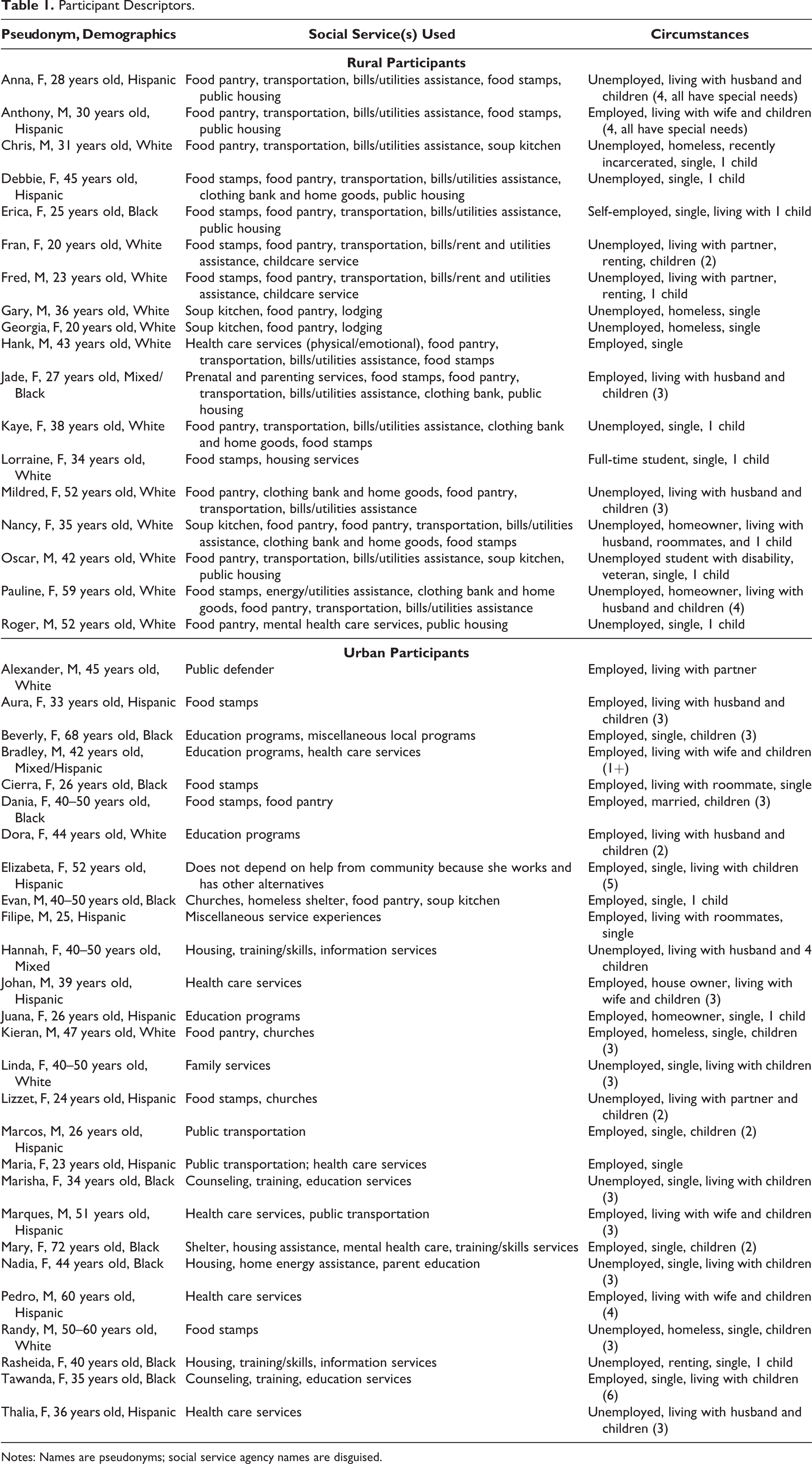
Notes: Names are pseudonyms; social service agency names are disguised.
Participants determined the interview locations, which included their homes, motel rooms, public library meeting rooms, university offices, and social service agencies. Participants were asked to describe their lives, discuss their consumption needs, and share their past experiences with social service programs, describing instances when their dignity was either diminished or affirmed. Consistent with interviewing techniques discussed by Thompson, Locander, and Pollio (1989), conversations unfolded around topics the participants found relevant. Conversation topics moved from general to specific, eventually focusing on a specific social program, and then circling back to compare programs.
Analysis
Analysis took place throughout the data collection process; early interviews informed later interviews and probing. As interview transcripts were completed, the researchers reflected deeply on the texts; sought relevant academic literature, particularly literature related to marketing systems and well-being; and developed deeper knowledge on the range of social services available to the participants. Independently, each member of the research team deeply read interview transcripts, and then the research team held weekly meetings to discuss emergent themes and develop a list of codes. Next, a more formal coding transpired, wherein each of the team members coded individual interview transcripts for key ideas, followed by intercase analyses focusing on ideas that crossed multiple interviews (Thompson 1997). Then, tacking back and forth between literature and data allowed the researchers to set aside expectations and develop an understanding of the informants’ worldviews illuminated in three central themes (Thompson, Locander, and Pollio 1989).
Thematic Interpretation
Three major themes, which reflect tensions between the social service ecosystem (macro), local context (meso), and individual (micro), arose: (1) power to choose and control resource outcomes, (2) justice in social interactions occurring in and around the social service ecosystem, and (3) perceived access to the social service ecosystem. While these three themes or sources of tension are discussed as mutually exclusive, they are inextricably connected. In other words, individual interactions with the social service ecosystem may simultaneously include more than one type of tension. In addition, although we discuss power in terms of recipients’ opportunity and ability to choose and control resource outcomes, other types of power (legitimate, informational) are evident in our data (Raven 1992). For ease of exposition, we use the term “power” in this article only in reference to choosing and controlling resource outcomes. Moreover, we discuss justice in terms of interactional justice (Bies and Moag 1986), yet elements of other types of justice are present in our themes. For example, both distributive justice (Adams 1965) and procedural justice (Lind and Tyler 1988) are apparent across themes. Again, we avoid the use of the term “justice” except as it relates to interactional justice. Finally, the term “access” relates to a judgment on the effectiveness of the opportunities, policies, and procedures used to address recipients’ impoverished circumstances.
Power over Outcomes: Freedom of Choice Versus Predetermined Needs
Within the social service ecosystem, recipients of resources experience power through freedom of choice over and control of resource outcomes consistent with their preferences and lifestyles. Though recipients depend on community resources to meet many of their needs, they also desire to live consistently with their personal values and beliefs. In conjunction with this, they desire specific goods or services to express their uniqueness or individuality; however, social service program design may predetermine needs, rights, and resource configurations. As a result, recipients must find ways to cope with their lack of power and control over choices and outcomes.
Having some choices enhances holistic well-being
Social service program design often includes standards for the assortment of goods and services to be provided; however, people living with daily adversity may hold different perspectives on what their actual needs are.
They give you heaping amounts of bread; it was like they give you so much bread, you don’t want to eat bread for the rest of your life; it’s like that. Other things they give you are beans, tomato soup. I can’t eat tomato soup every single day. It’s really nice that people do try to help out in any way they can. Don’t get me wrong, because I’m not trying to be picky or choosy or nothing like that; I’m not saying that. Give us something that we can actually use. (Gary, male, 36 years old, rural) [Describing experience with medical service resource provider] I felt like I’m not worth anything because I don’t have enough money—the perfect word is “minimized.” I feel minimized. I didn’t have other options at that time. I had to either take what was available or leave it. (Elizabeta, female, 52 years old, urban)
The verbatim comments of Gary and Elizabeta reveal that the social service system may render recipients powerless—they must take what is offered, even when it does not match their needs, or go without (Desmond 2017). Furthermore, the quotes reveal that a mismatch between needs and resources supplied may leave recipients feeling invisible and unworthy, an idea discussed more fully in the next section.
Despite individual and familial differences in circumstances and hardships, social service recipients often encounter a one-size-fits-all model of resource distribution. Standardized approaches exist at a macro level, such as federal programs dictating equivalent maximum resource allocation for people living anywhere, regardless of cost-of-living indicators in different locations (U.S. Department of Agriculture 2017). Moreover, recipients find that the design of social service programs often does not allow for deviations to accommodate their specific circumstances or needs.
The only thing that we really experience with WIC that we don’t like, is the bread. We have to get 16 oz.…It is ridiculously hard to find, because most bread is 20 oz. It really doesn’t matter, because it goes on WIC.…You get frustrated with it, and you just give up on it, because it’s like nowhere in [grocery store] do you find 16 oz. whole wheat bread, and you don’t want to go all the way across town to Walmart to look for a loaf of bread. That would be the only thing I think they should change to make it 20 oz. of whole wheat. It’s just that a 16 oz. loaf is hard to find. (Fred, male, 23 years old, rural)
The specified item that Fred is permitted to purchase in the federal program is almost impossible to find in his local market. In this case, Fred is powerless both in changing the rules of the social service program, with its 16-ounce policy, and in changing the offerings or location of local grocery providers, who only sell 20-ounce options. The current system is designed around efficiency and equality, yet the three previous verbatim comments indicate that policies regarding the uniform distribution of goods and careful calculations of eligibility do not account for the contextualized nature of individual, family, or market situations. At the mercy of such rules, recipients experience powerlessness in choice and control over outcomes.
In stark contrast, Marisha’s account details how social service programs have enhanced her choice power.
[Discussing one local social service provider] Even though people may come in here and they’re down or they feel some kind of way, when they leave out of here, they feel different.…I go in there with no hope and I come out and there’s hope because, you know, they found somewhere to stay for the night, or they gave me food when my kids didn’t have food. (Marisha, female, 34 years old, urban)
Marisha, a single mother, has a place to stay, versus going without; she and her children have food to eat, versus going without. Numerous experiences with different programs within the social service ecosystem, as well as the adversities she has experienced, form Marisha’s expectations of “no hope” to improve her circumstances. Mercifully, Marisha’s experience with this social service program enhances her power: the resources acquired exceed expectations, and outcomes are perceived as equitable (Adams 1965). Beyond functional resources, such as shelter and food, Marisha receives emotional resources when the resources provided are consistent with her actual needs. The right resources are enough.
Having a voice in the social service ecosystem enhances holistic well-being
To combat their feelings of powerlessness stemming from their lack of choice over (1) dependence on the social service ecosystem and (2) resources derived from the system, recipients actively and constructively exert a modicum of control by acquiring an occasional indulgence. These self-gifts provide reward or therapy and allow for momentary peace (Mick and DeMoss 1990). Indulgences include such things as having a pet, treating oneself to an occasional Starbucks beverage, or maintaining a strict vegetarian diet.
My mom, at times, will send me a Starbucks card. It’s my only thing. I don’t buy new bras, I don’t buy new socks, nothing, but it’s my one thing; it’s $3 a day. She’ll send me cards every now and then. This woman looks at me and says, “That’s really interesting that you’re using a Plus card, when you can afford a $5 coffee.”…So, it’s kind of prejudgment, and people not knowing what you’re going through and why you’re not working. I’m carrying 18–21 credits per semester, just to hurry and get done, so I don’t have to deal with it anymore and not to abuse it either. I utilize it only for what I need it for, so I can be the best mom I can be and the best student I can be and give back when I’m done. (Lorraine, female, 34 years old, rural)
Indulgences validate to recipients that they still have the power to make choices for themselves. However, in the context of the broader ecosystem where recipients have low power over choices and high dependence on resources, recipients may experience or perceive harsh judgment from other actors within the social service ecosystem. Thus, indulgence as a form of empowerment may come with social and emotional costs, an idea discussed more deeply in the next section.
Some organizations within the social service ecosystem intentionally create situations to offer recipients indulgences, or resource provisions above and beyond what is typically available within the social service ecosystem. For example, several providers in both the rural and urban communities provide presents to families during the holidays. Though many recipients may be unable to afford the luxury of participating in gift-giving rituals consistent with the holiday experience, these programs help create meaningful experiences for recipients’ families.
I was waiting for the disability, so they had told us we had to leave. And I didn’t have nowhere to go. And somebody had called [governmental agency] on me…and really it was the best thing that could have ever happened to me, because they did so much stuff for us! They paid all my bills, they got us a new house, got all my kids Christmas. I didn’t know they did all that! (Tawanda, female, 35 years old, urban) On the paperwork that you fill out, you write a request for certain things, if they need clothes, hats, gloves, or just warm clothes. What size they wear, if they like books or toys, what kind of toys, electronics or simple toys. They do what they can to fulfill the need.…I didn’t have to feel bad about not having a Christmas, because there have been a couple of times, we would not have anything for Christmas. (Kaye, female, 38 years old, rural)
The indulgences at Christmas for Tawanda’s and Kaye’s children allow the recipients to escape the shame that would accompany Christmas without gifts for their children. Furthermore, the program design provides recipients a sense of control in that they may request specific items. It lifts them up, versus holding them in place, as is the case when they repeatedly have no control or choice in the products used in their everyday lives.
At times, recipients must become self-advocates for their rights to resources available through the social service ecosystem, and sometimes their choice to engage in self-advocacy may be essential for survival.
I had to do everything they asked, and when I was down and ready to say, “Just forget it,” one of the pastors in town that supported me, he said to me, “Make them tell you ‘No.’ Make them tell you clearly ‘No,’ that they will not help you, before you stop working for the help.” That was the best advice that anybody had given me that year, because when I did all the hoops and everything, basically the [program administrator] was backed into a corner, and wrote the check, because he would have had to tell me “No,” and I was a seven-month pregnant woman living in a tent. (Erica, female, 25 years old, rural)
In this case, Erica perceives that she has no choice but to do everything the provider requests, yet even that does not seem to be enough. Erica asserted her voice to control outcomes; otherwise, she would not have received the resources she and her unborn child needed to survive. In cases such as these, recipients weigh the costs (in time, energy, and information/privacy) versus the gains (in resource support) to choose how to respond. In dire circumstances, as when Erica was pregnant and living in a tent, continuing to push toward gaining access is critical, even when the costs and barriers are high.
Recipients’ eventual lack of reliance on and contributions to the social service ecosystem enhance holistic well-being
When recipients find themselves with extra resources, some choose to give back to the organizations that help them, such as by donating extra food, money, time, or material items. Their active participation is an intentional choice that provides an outcome they desire: the feeling of giving back and being a contributing member within the social service ecosystem.
If I don’t reach out and try to help other people, I feel really bad sometimes. I could go off somewhere and wallow and think about myself, where I could think, “OK, there’s somebody out there that is worse off than me. What can I do?” (Hank, male, 43 years old, rural) I wish I had more to give. I would give so much more. My goal is to be a philanthropist. (Dania, female, 40–50 years old, urban)
As their voices reveal, Hank and Dania choose to find ways to reciprocate so that they may control outcomes related to their participation in the social service ecosystem. At these times, the role shifts from recipient to provider, and they move from being the ones relying on resources to being people who are relied on. The active choice to shift roles provides them power and control over the outcomes garnered through their participation in the social service ecosystem.
Recipients desire to contribute their own resources into the social service ecosystem for others’ use, and most indicate a strong preference for not having to rely on the social service ecosystem at all. Recipients would much rather have the power to choose to participate in the commercial marketing system.
My family always taught me that when it comes to things that you really have to have in life, and I was taught that your rent should come first, food, clothing, utilities, and all this other stuff should come in line after that.…I would love to have a job to where I didn’t have to get help from food banks, from the government or anything else. I really and truly would like that, because I would get more satisfaction having a regular job and being able to say, “This is my money. No one has given it to me or nothing. I’m the one who’s working my ass off for it, and no one is giving it to me.” I think that would boost up my confidence in myself, and it would make me feel better about myself. (Gary, male, 36 years old, rural) Going there [service agency] is like everyone is thinking that I can’t do it, and that I’m not a good parent, because I’m going to them for help. I think that they know why I’m going to them. It makes me feel like I’m not a good parent, if I have to go to them. (Fran, female, 20 years old, rural)
Fran and Gary have little choice but to participate in the social service ecosystem. Though Fran and Gary meet program guidelines and have a right to receive resources, that does not mean they want to exercise their rights. Their lack of choice and inability to control outcomes for themselves makes them feel powerless and detracts from their holistic well-being (Rayburn 2015).
Overall, this theme reveals tensions between social service ecosystem objectives in predetermining needs and recipients’ objectives in having more freedom to choose how to express their needs. The social service ecosystem enhances power when some choices over what is consumed are consistent with program design, when recipients’ voices are included in the social processes in and around the distribution of social service resources, and when recipients are afforded opportunities to contribute their own resources (time, money, goods) back into the ecosystem. These three subthemes reveal how the power to choose and control resource outcomes enhances recipients’ holistic well-being, and, conversely, the lack of such power detracts from their well-being.
Justice in Interactions: Encouraging Interactions Versus Exacerbation of Vulnerability
Justice arises from the dignity resource recipients are afforded in relational exchanges that occur within and around the social service ecosystem. This theme illuminates equity theory (Adams 1965), one aspect of which highlights how justice or injustice in exchange relationships is judged on the basis of the level of interpersonal respect demonstrated within interactions (Bies and Moag 1986). Although our participants shared many instances of respect, compassion, and mercy bestowed by providers within the social service ecosystem, numerous other stories reflect perceived social injustices. These perceptions stem from requirements in the process that force recipients to provide detailed, highly personal information about themselves, their circumstances, and their past in order to demonstrate their need effectively. Such practices may be deemed to be outside the bounds of interpersonal respect.
Compassionate interactions with the social service ecosystem enhance holistic well-being
Providers’ kindness, encouragement, and compassion are part of what recipients need from the social service ecosystem.
All they say is, “Oh, what size? And here you go,” you know?…There’s certain, other like facilities and you tell them that you need Pampers, then they’re like, “Oh, we need ID, we need this, we need that,” or whatever. Well, if you come here, you get regardless. That’s what I like about here, you don’t got to break yourself down, and you know, tell them all your business. All you need to do is say, “I need this,” and you get it. It’s not like you have to fight for getting it. You know? (Marisha, female, 34 years old, urban)
Marisha feels relief from not being required to explain her circumstances, as she has had to do with other providers, and the respect leaves her feeling encouraged and hopeful as she attempts to improve her family’s situation.
Conversely, our data show that interactions with social service providers that do not involve a basic level of respect for recipients can leave them feeling overly scrutinized and disparaged, turning a painful situation (of needing resources) into an agonizing one (of feeling shame for needing resources).
But I didn’t have the feeling like, “Sure it’s fine.” But it was more like, I mean, “How can you think it’s okay to deal with people [treating them poorly]?” and the empirical answer to that is that the people you are dealing with have no recourse. (Alexander, male, 45 years old, urban)
Lack of recourse means that when recipients experience negative interactions, they may have nowhere else to turn—no other option from which to acquire the resource. Instead of feeling that he has the right to receive resources, Alexander feels that his needs open him up to poor treatment from some providers.
Our data show that in some cases social service providers ask questions beyond the scope of reasonably proving need, including personally invasive questions.
Well, he asked me how many kids we had, and I told him. That was okay to ask, but then he asked, “Well, aren’t you on birth control?” And he was just really at me. And then I did tell him, you know, that I had an IUD, but that it didn’t work with our third daughter. Why did he ask me that? And then I told him about our fourth daughter. And he seemed just really—I don’t know—just like it wasn’t right. I did tell him that she had been abandoned with us, and literally left on our doorstep. What was I supposed to do? She needed us. And then he asked me all these questions about everything we spend money on. I told him about the groceries, the gas, the doctor bills, the kids growing so fast, and everything else. It seemed like he really needed to know every single detail of our lives and like I was less than human or something. (Anna, female, 28 years old, rural)
The burden of proof can be overwhelming, requiring the recipient to toe the line between proof of need and proof of desperation. This line of questioning is made possible by an unbalanced relationship stemming from the provider holding resources that are needed by the client and the client being at the provider’s mercy. Anna’s perception that she is “less than human” reveals that interactional fairness, or perceptions of whether one is treated with dignity, courtesy, and respect (Adams 1965; Bies and Moag 1986), contributes to overall perceptions of how the social service ecosystem meets one’s needs and thereby affects holistic well-being. The need to engage in multiple, sustained interactions across the constellation of programs that constitute the social service ecosystem means that recipients face numerous opportunities to get the message that they are not equals, or even worthy of respect; in fact, they may be perceived as passive recipients who should keep their opinions (and perceived needs) to themselves.
Considering recipients’ unique circumstances enhances holistic well-being
Paperwork, frequent applications, and interviews that require demonstrating need (and sometimes desperation) can leave recipients emotionally drained. The system for applying for resources is time intensive, and although many recipients are unemployed or underemployed, our informants accounted for the many ways in which the nuances of poverty cause time to be yet another scarce resource. For example, doing laundry by hand in a sink or bathtub or dealing with unreliable public transportation adds to the challenges of meeting basic needs and getting by. Although the social service system is designed to provide goods and services to underresourced members of society, the ample administrative demands indicate a lack of consideration and understanding of the circumstances of those who are living in poverty, including their lack of time.
At times, the social service ecosystem (actors, design, practices) dehumanizes recipients. Recipients (the out-group) are perceived as less human than providers and people who do not rely on social service programs to meet their needs (the in-group; Gervais et al. 2013). Dehumanization encompasses both the denial of human nature and the denial of human uniqueness (Haslam 2006); it decontextualizes the circumstances of recipients, who may be asked to make choices that providers and nonrecipients likely would not consider.
There’s justification, but I don’t believe in it.…That I’m capable of working in [another city] as an assembler. I would have to stand on my feet, and I can’t do that. That also would mean that I would have to leave [current city] to find an assembly job. I’m not leaving [current city]. My daughter is here; my grandson is here. My soon-to-be granddaughter will be here. (Debbie, female, 45 years old, rural)
As Debbie’s narrative illustrates, the process of administering resources to those in need, at times, directs how an individual or family should cope with their circumstances, without considering the social and emotional dependencies at play. Although most people desire interaction with and proximity to loved ones, recipients reveal that providers may ask them to relocate, away from their families and social networks, in pursuit of jobs. This approach represents a tension point, wherein the goals of resource providers and those of resource recipients are in conflict. Relocation may enhance an individual’s or family’s financial well-being but most likely would diminish the social-emotional component of their well-being. Program administrators have no legitimate authority or responsibility over these personal issues and may not be aware of them at all, yet recipients may feel pressure to comply with providers’ directions in fear that noncompliance may result in loss of access to resources.
When individuals apply for jobs or for social service benefits, they are asked to list information such as home address, telephone number, and bank information. However, many social service recipients do not possess a permanent residence, a cell phone, or a checking account.
They needed an address to mail the card to, which kind of sucks because what if you are really homeless and you don’t have an address, you know what I mean, you are going to have to find somebody or some organization or whatever or some church that is going to let you use their mailbox to get the card. (Chris, male, 31 years old, rural)
The process of applying for and demonstrating need often demands large amounts of time and indirect financial costs (lost wages, transportation costs, childcare costs) to obtain a minimum level of resources. Although providing documentation for one program may not be overly burdensome, providing documentation to the host of programs that constitute the social service ecosystem often demands extensive time that recipients could use to apply for jobs, care for family members, or engage in self-care. Resource recipients are often left in difficult positions, as assumptions are made about how individuals are able to operate and what is needed for survival, without consideration of the circumstantial details.
Resource distribution based on basic assumptions or strict policies, rather than the individual needs of recipients, can result in a lack of fit and diminish access to resources within the service system. For instance, a clothing bank may allow one ensemble per person at no cost; however, when a recipient has a new job and requires clean work clothes each day, one ensemble may be insufficient (particularly if access to laundry appliances is lacking). Thus, the recipient may seek assistance from other sources, but if none are available, the recipient will go without. Further, this approach assumes that the recipient has access to a washer and dryer or to other resources within the broader social service ecosystem.
Resource distribution often relies on assumptions that recipients have access to certain tools or goods that support or facilitate the use of other items received through the system. For example, many food items require tools for opening the package, a microwave or stove for cooking, or a refrigerator for storage.
[We] can always use peanut butter and jelly. It’s like living in the kind of conditions we are in now, in a hotel room, it makes it harder; you can’t cook. Everything in here depends on a microwave. (Gary, male, 36 years old, rural)
For recipients who are homeless, even the most basic tools may be unavailable, and for those who are impoverished, many appliances are a luxury out of reach. As Gary relates, even providing access to food may not be enough to truly provide access to the ability to eat successfully.
Future-oriented approaches to meeting needs enhance holistic well-being
The design of many social service programs often centers on satisfying immediate needs, such as food, clothing, and shelter, and helping the recipient acquire a job. However, including a future-oriented approach may result in a more effective and sustainable usage of resources (Baker et al. 2015). We find in our data that the focus of some resource providers is for recipients to secure the first available job to receive an income as expediently as possible, to stop drawing resources from the social service system. This focus becomes an issue when recipients are taking steps to earn education or training that would give them greater upward mobility upon completion. In several accounts, our informants report feeling stereotyped and judged by providers and others who were critical of them for their lack of employment and inability to support themselves and their families (Brauer and Bourhis 2006). In these cases, jobs, rather than education and careers, are emphasized, and the focus is placed on surviving, rather than on future earning potential and financial independence.
Basically, I told him that I was going to [vocational training program], and he was like, “Well, that’s not a job.” I said, “The whole point of them helping me is to get me out of the poverty situation.” Things just happened all at once, and it was very unplanned, and with a little bit of the money management, I could easily get back on track. I just needed help, like a step-up.…That’s what [vocational training program] is helping me with. They’re getting me to get all my projections and everything, showing me how to make it an actual, viable business. Once I do, if they find it to be a viable business, they will help me with production costs. (Erica, female, 25 years old, rural)
Erica seeks to rise above her circumstances by creating her own business and pursuing a long-term career. She wants to work in a fulfilling career path and financially support her family. However, in the short term, she must defend this decision, which she perceives as unfair. Erica’s experience reveals that a stronger emphasis on independence from community resources in the long run (via a career) may make it more likely that recipients can move beyond a cyclical state of barely meeting their basic needs and depending on program resources. Such a system would help level the playing field, moving beyond the systemic inequities that plague many people living in poverty (Desmond 2017).
In some cases, providers encourage recipients to move toward independence through a balanced approach. By coupling assistance with responsibility, providers seek to motivate participants toward security and self-reliance.
Once the lady had given me a talk, and I actually respect her for this.…She told us that she was going to help us pay, but I can’t remember how much it was. I think it was $150, and our rent was $600. She said, “I’m not doing this to be mean; I’m not doing this to be rude, but I’m going to make you come up with the rest, because it’s your responsibility.” So, she wants us to learn how to get out on our own, get jobs and work, so we are able to pay for stuff on our own, which I have done since I was 18. It’s something that helps, even that little bit. Like, she paid $90 this month on our rent; that is a big help. (Fran, female, 20 years old, rural)
In this example, by both providing resources and asking the recipient to contribute, the provider ultimately creates a situation in which the outcome feels fair for both parties, as well as earned for the recipient. In addition, because of the provider’s effective communication of the process behind the system, Fran felt respected, encouraged, and ready to engage with the provider.
Overall, this theme shows that resource recipients want to feel recognized as human beings and treated with respect. They desire interactional justice (Adams 1965; Bies and Moag 1986). Interactional justice contributes to holistic well-being, which is experienced when recipients are treated with compassion and as human beings, their consumption needs are understood, and future possibilities are explored. Injustice is experienced in social exchanges where recipients must prove desperation (rather than solely focus on needs) and when actors in the ecosystem make assumptions, stigmatize, blame, and dehumanize recipients, rather than treating them with respect and considering their future potential.
Access: Procedural Consistency and Transparency Versus Inequitable Provisioning of Resources
The final theme considers access—entry into the social service ecosystem—including rights and effective opportunities for recipients to participate. Gaining entry to social service programs and exercising rights to acquire and utilize resources derived from the social service system may enhance, maintain, or diminish recipients’ well-being. Perceived access reflects recipients’ understandings of the effectiveness of organizational decision making, whether rules as they understand them make sense in the context of their everyday lives, and whether the implementation of rules seems to be fair and consistent among all recipients. The overall evaluation of access is also tempered by beliefs about the effectiveness of the system in preventing abuse of social service resources, as well as by the design of program policies and procedures and how they affect the most disadvantaged groups in society.
Transparent, clear policies enhance holistic well-being
At times, policies and procedures for access into a social program may be unclear, and even when available, they may vary extensively between providers within the social service ecosystem, which creates confusion.
You can only get food there [food pantry] twice a month. I think it would be cool if you could get it once a week or something like four times a month. 'Cause I wasted my one time; I got two boxes of mac and cheese and some ramen noodles, you know, and I—that wasn’t very much. But I was thinking that it was once a week. But at the soup kitchen they have two racks and they will let you get food twice a week there. You can get a bag, you know just like a shopping bag, and they will let you get food twice a week to take home and whatnot. (Chris, male, 31, rural)
This comparison of the two providers highlights important elements about process. Without an understanding of the policies and procedures of distribution, recipients make uninformed decisions by relying on heuristics, such as when Chris assumed that he could return more regularly, as he does with another provider.
Standardized policies that fail to consider individual needs and circumstances are apparent in the distribution of many social services. Thalia explains that her family technically does not qualify for Medicaid coverage because her husband is self-employed with intermittent wages, which does not provide resources to afford medical care on their own.
I have applied two times for the government medical insurance because I thought that since they are both in school they would qualify, but they have not approved [us]. I don’t understand why if I have been compliant with all the applications and the last time they told me that I had to fill out a paper stating how much my husband earns. But the problem is that [my husband] doesn’t work; he just does little independent things here and there. I filled the applications out twice and by the second time I felt that I had enough [information], and I didn’t try it again. (Thalia, female, 36 years old, urban)
Policies and procedures that overlook the unique circumstances of the people they are designed to assist can have unintended consequences that reverberate across the system. The financial implications for the lack of health insurance coverage are staggering. When medical issues arise for her family, Thalia and her husband must weigh the health-related risk of not seeking care versus the financial risk of falling deeper into poverty. Furthermore, the addition of each new family that slips into poverty adds stress to the social service ecosystem and its sustainability.
Pursuing equity and procedural fairness enhances holistic well-being
In some cases, providers have the leeway to choose who receives goods and services, based on their own subjective judgments in determining and prioritizing needs. Recipients’ perceptions about the lack of procedural fairness (Lind and Tyler 1988) often are based on a seeming lack of adherence to procedures, varied levels of familiarity between individual recipients and providers, and the prevailing freedom to offer flexibility at a local level.
Policies often are designed to provide fair access to all who qualify and to manage limited resources successfully. In some instances, concrete rules regarding the distribution and quantity of resources may result in equal access to assistance for those in need.
Then, we have to go to the [doctor’s] appointments. I think it’s every three months that you have to go and reapply [at public health]. They do checkups. They weigh [the baby], and they see how she has grown. They do percentiles to see what percentile the baby is in. They scan the card, and they do the changes; if there are any changes, it’s like what food should be on her baby food. If there are, they’ll put them on there; they update the card every appointment.…I love it, because they’re there to help us, and at the same token, they’re there to help me understand where my child is at on the chart, and to know at what percentile she is. (Fran, female, 20 years old, rural)
The policies and procedures used in public health and other social services help maintain order and document ongoing need. In this case, Fran found the process to be helpful and informative; she appreciates access to quality care for her baby.
Conversely, several informants expressed concern about agencies that seem to “treat everyone the same” regardless of individual needs. The tension emerges in cases where the same process is in place for every group. Fairness, to some informants, would mean distributing assistance based on need, rather than equal quantities for all who qualify, regardless of need. Because each individual situation varies, some informants’ stories reflect their belief that equity, rather than equal treatment across cases, is an appropriate metric for effective resource allocation.
We have even gotten clothes on one day and gone back the next day. These clothes tear; I’m a guy, so—I’m pretty rough on my jeans. Every now and then, I’ll get holes in my knees, and I’ll need to go back for another pair of pants, and they understand about that. It’s pretty nice. They’ve also helped out when we had our trailer; we didn’t have any dishes there. So, we needed a few things, and they helped out with plates, forks, bowls, cups, and that was pretty nice, too. (Fred, male, 23 years old, rural)
In Fred’s case, the understanding and access to goods when he intermittently needed a new pair of jeans made him feel that he was being treated equitably. Instead of maintaining rigid rules about the allocation of clothing resources, this provider acknowledged his actual need (a working man damaging his work jeans) and delivered access to the resources that made Fred feel whole.
As noted in the discussion of our first theme, some recipients believe that providers approve equal assistance, or even above-average resources for some recipients, despite an apparent lack of need. Resentment emerges toward the system and toward other recipients who are thought to embellish their qualification details to get more resources. Perceived variation in the distribution process is the main source of some recipients’ perception of inequities in the social service system.
The services there are there to help those who need the help. One of them, at that time she was married. She and her husband both worked. Her husband had two jobs, she had two jobs. They had just bought a house, and they have two brand-new vehicles, and you’re going to tell me that you need assistance? How is that? You have one kid who is living at home. How is it that you need their assistance? The other two families, they’re actually husband and wife, filing separately. Before they went to that new system at [provider], he’d go in and say there were six or seven people in his group. Then, she’d go in. If he had said seven, then she’d go down to six. How is that possible?…At that time, [provider] knew them, but there was nothing that they could do. (Debbie, female, 45 years old, rural)
Stories of perceived abuses arise, and because service providers may lack procedures for detecting and preventing this behavior, other resource recipients find it unfair and frustrating. Thus, the lack of procedural structure to hold individuals responsible is difficult to understand for those who are attempting to follow program rules.
I’ve used all of the [provider] resources, like I’ve gone and used the food from their pantry. You can go in two times a month, but again there’s no “why do you need this?” I get that they’re trying to help, and it does make it simple for those who truly need help, but there are a lot of wasted resources because of that. People just like to get free things whether they need it or not, and knowing that they can, they’re going to. It’s frustrating, because there were times when I signed up for food stamps in October. I didn’t get my food stamps until the first of December. So, we had that time when I was pregnant and not working and [my husband] was making $8.50, and we had no food; we had nothing. I used resources as much as I could, because I needed it. I know people who do use it, just because they can. (Jade, female, 27 years old, rural)
When some recipients gain (or appear to gain) access to resources through dishonest means, this troubled some of our participants, who felt that they themselves were “doing things right” or who felt that their level of need required more. Also, recipients reported that repeated interactions with dishonest resource recipients often left service providers more suspicious of clients, less willing to be flexible and understanding when warranted, and discouraged overall.
Informants also reported cases in which they perceived other recipients were shown favoritism by providers. Relationships and power dynamics between specific individuals in the exchange may allow for rule bending or rule following. Some providers may use that flexibility to distribute additional resources to individuals. For example, recipients who have developed strong rapport with a provider may receive access to greater quantities of food or clothing. Conversely, recipients may be restricted from community resources or offered inferior goods or services because of unfavorable standing with a provider. Elizabeta gives an account of experiencing discrimination and receiving inferior service based on her health care provider’s subjective judgment.
This is one of the poorest states and where there are people of low resources. They treat the people just like they are. Because when there is good insurance, people get treated very differently, but when we use funds from Medicaid, even though we pay for it as taxpayers, we get treated very differently. The difference is obvious. If you are going to get surgery or something like that you get hospitalized for as long as you need it and you are treated like it should be. But when there is something like a public resource in between, the quality of care is noted. (Elizabeta, female, 52 years old, urban)
Elizabeta believes that her quality of care is affected by her status as a Medicaid recipient. She believes that people with good insurance receive more effective treatments. Both the actual and perceived discrepancies between care based on financial access affect holistic well-being.
Implementing a fluid, adaptive approach enhances holistic well-being
At times, the social service ecosystem design places constraints on recipients’ access to resources that meet their actual needs. Study participants gave accounts of feeling discouraged in cases when they found themselves worse off after following the rules. Some who obtained full-time employment had resource assistance abruptly cut off although they were behind on debts and could have benefited from a weaning process. Consequently, those who are working are sometimes financially behind those who are relying on resources. Our data also show that some recipients feel punished or wronged for following the rules and for accurately providing the requested information regarding their need and their circumstances. In some cases, this causes them to become frustrated and turn away from the service providers and resources they desperately need. The perceived lack of fairness is especially evident when it may be more beneficial for them to remain unemployed or underemployed to maintain eligibility for resources they need to survive.
In a way it’s like, “We want you to work, but we don’t want you to be saving your money for that month.” So, I’m getting this much, but how am I supposed to get out of the rut I’m in?…I don’t want to be a debt to society any more of my life. I want to be able to do something with myself.…The government says that they don’t want you to depend on them, but yet, they won’t give us that break to do that.…It’s like, no matter what you try to do, it’s like a dead end. They only allow you to make $82 every two weeks. Anything above that, they start taking away from you. (Gary, male, 36 years old, rural)
For many providers, the basic level of need is defined on the basis of survival. However, just barely scraping by from week to week tends to result in an inability to ever get ahead and establish independence. The current system does not account for a recovery period; instead, as soon as income is established and meets the minimum threshold to disqualify individuals from services, resource provision ends. As Gary’s story reveals, this policy does not account for those using community resources who have gotten behind on bills, credit, and other payments, especially given that reliance on credit can sometimes be the only way people living in poverty can meet their subsistence needs (Hill 2001; Viswanathan et al. 2009).
As previously discussed, recipients have little opportunity for recourse in the face of procedural inequities. For example, one of our informants felt that if she complained, then assistance would be withdrawn.
He writes down on the computer what you’re doing to change your situation and what your situation is with all the details. As he was doing that, he says, “Well, you just seem a little desperate for help.” I said, “Well, that’s why I’m here.” He said, “I think [counseling service] would be a good place for you to go see a counselor, because you need to learn how to deal with your stress.” The reason he said that was because he made me break down crying in his office before I got to the interview with the police report. I said, “I just ran; I was trying to get into a safe place; I didn’t want to have to deal with and bring all that stuff up again, and bring this police report out and do all this other stuff to prove to you that I need help.” (Erica, female, 25 years old, rural)
In this situation, Erica was asked to revisit a traumatizing experience (leaving domestic abuse) to obtain resources. Upon sharing this information and becoming emotional, she was called “desperate” and told to seek counseling. For impoverished individuals, with little or nothing to offer in exchange for resources, privacy and information become their currency. A fluid, adaptive approach would take into account how recipients’ needs change over time; be flexible enough to account for changes in personal circumstances, such as job status; and allow for compassion, consistent with interactional justice, in providing resource access.
The final theme uncovers many important insights. Service providers, especially at a local level, often have the power to be flexible at their own discretion. Though adaptable by design, these programs may not lend themselves to accountability or oversight in the determination of eligibility for or distribution of resources. Unlike federal programs, eligibility standards for local programs often are not enforced or even published (Keiser 1999). In addition, these programs typically are not required to report performance metrics, except for those required to maintain nonprofit status. This form of latitude often results in outcomes perceived as unfair and inequitable. At the same time, the rigid structure of rules, coupled with the high variability in individual recipient needs, leaves service providers to rely on their own ad hoc judgments in trying to determine a fair, equitable distribution of resources. When rules are in place, yet exceptions are made, this may result in an overall perception of procedural unfairness (Lind and Tyler 1988). Yet, latitude at the local level is exactly what may be required to lift people out of poverty, versus holding them in place. Ultimately, this theme reveals that each circumstance is unique, and although meeting needs through rigid policies and procedures in a social service system may be efficient and reflect objective equality, it is not necessarily effective in addressing needs, nor does it result in equitable access.
Power–Justice–Access Model
Taken together, our themes reveal a power–justice–access model that emerges from the data and is informed by extant literature on marketing systems and well-being (Figure 1). When power, justice, and access are present in recipients’ experiences with the social service ecosystem, holistic well-being is enhanced, from recipients’ perspectives. The figure illustrates how power in terms of choice and outcomes in the social service ecosystem, justice in relation to respect and empathy experienced in and around the social service ecosystem, and perceived access to the resources flowing in and through the social service ecosystem are inextricably connected, swirling about as if in a funnel. Power, justice, and access serve as routes toward and pillars of social service recipients’ holistic well-being; the three work together as a triad. Each is a route in that when any one is present, recipients’ holistic well-being is more likely to improve, even if only partially. But to achieve holistic well-being, which has the power to lift people out of poverty versus keeping them in place, all three pillars must work in tandem.
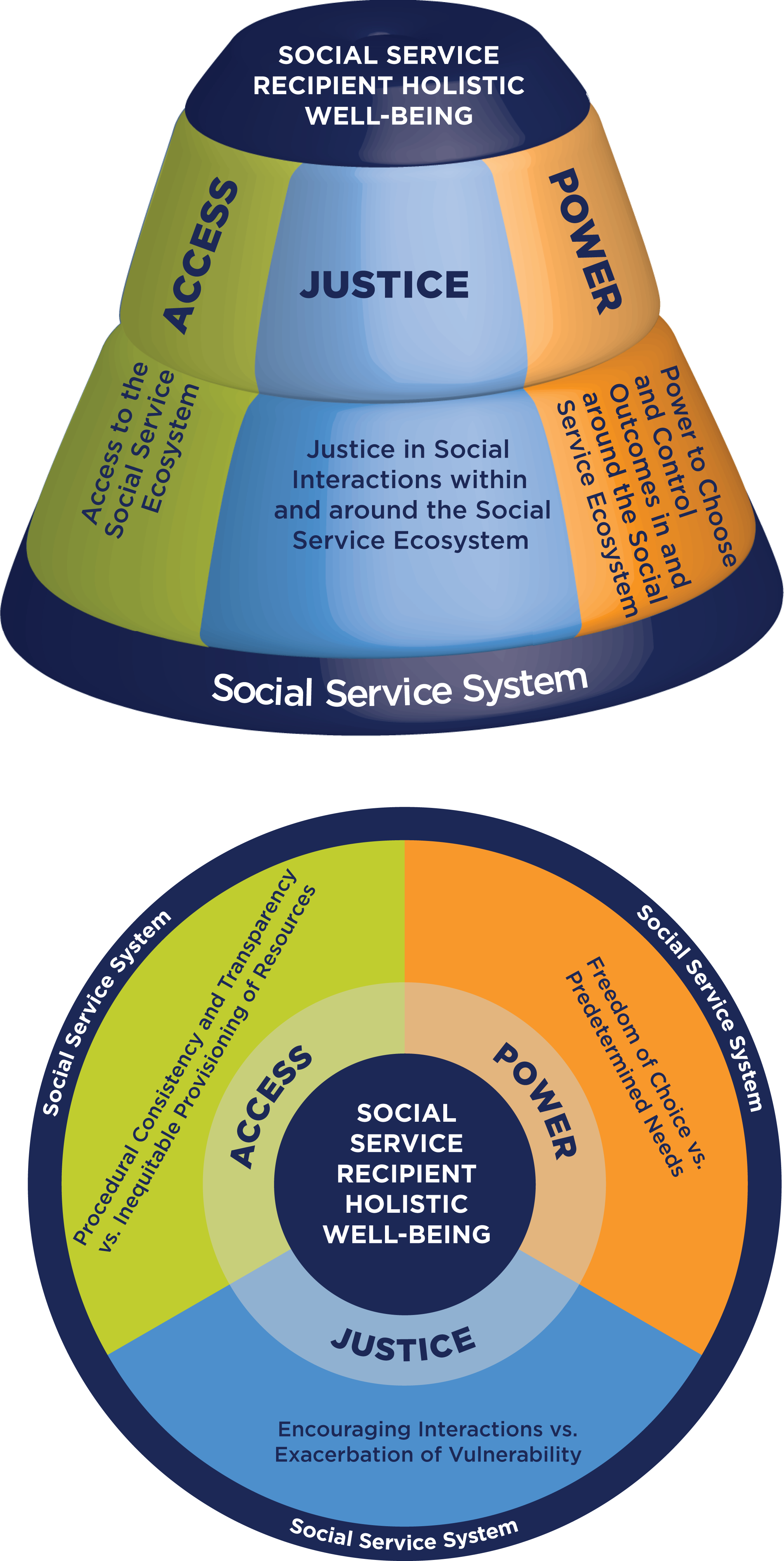
Power–Justice–Access Model of Social Service Recipient Holistic Well-Being.
The social service ecosystem is porous and fluid, with the network of institutional types, recipients, providers, the broader citizenry, and policies constantly changing. The effectiveness of the social service ecosystem must not be viewed solely from a view of whether individuals and families have access to a uniform basket of goods; rather, as the recipients in our study have witnessed, the consideration of its effectiveness must also be informed by the uplifting ideals of power, justice, and access.
Discussion
Theoretical Implications
People living in poverty rely on a constellation of social service programs and resources to meet their consumption needs. Recipients’ narratives unpack the conditions present when the social service ecosystem meets consumption needs, from their perspectives. The analysis of their narratives yields four primary theoretical contributions to the marketing and public policy literature. First, the power–justice–access model reveals that resources (goods and services) are not enough; resources alone do not provide holistic well-being. Holistic well-being stems from a variety of social interactions that occur in and around the social service ecosystem. Yet, at present, the social service ecosystem (and much of the marketing literature) is oriented around a resource-based view of well-being. Eligibility for receipt of goods and services from within the social service ecosystem is almost exclusively tied to earnings (Trischler and Charles 2019; U.S. Census Bureau 2007; U.S. Census Bureau 2018b). According to this orientation, when people at or below the FPT are matched with a set of predetermined resources, then the social service ecosystem has done its job. This resource-based orientation fails to capture how individuals derive power from participating in the decisions and processes that affect their lives; how justice, in terms of dignity and respect, is communicated in the interactions surrounding the social service ecosystem; and how perceived access to the social service ecosystem provides opportunities to lift people up or keep them down. An orientation toward holistic well-being, which incorporates power, justice, and access, may yield a more satisfying approach to addressing poverty.
Providing “enough for those who have little” and constructing a more inclusive society are characteristics that President Roosevelt suggested were important in formalizing the social service ecosystem in the United States. Clearly, he envisioned a system that captured both resource and human elements. The marketing literature can energize, or at least move in tandem with, the creation of uplifting changes in society by advancing a more socially and spatially oriented understanding of the value derived from interactions in and around the social service ecosystem. Certainly, bodies of work within the transformative consumer research (Mick et al. 2012) and transformative service research (Anderson and Ostrom 2015; Ostrom et al. 2010) areas within the marketing discipline offer such theoretical possibilities.
Second, our findings highlight why dyadic approaches, which focus on recipient–resource or provider–recipient relationships, limit our understanding of what it means to depend on social services to meet consumption needs (see also Baker et al. 2015; Rayburn 2015; Trischler and Charles 2019). Employing a systems approach highlights the importance of a broader consideration of needs across multiple levels of analysis: individual (micro), context (meso), and ecosystem structure (macro). Need fulfillment is considered in relation to holistic well-being that conceives of the whole person, not just the individual’s economic worth or material means (micro). At the micro level, holistic well-being illuminates how individuals desire to participate in the decisions that affect their lives (power), to be treated with dignity and respect (justice), and to have equitable opportunities, regardless of social categorization (access). At the meso level, holistic well-being is considered in relation to the context in which people live, including such things as cost of living, culture, market characteristics, and resource availability. For example, the size of a loaf of bread available in a local grocery store or how local conditions influence cost of living are important determinants in evaluating whether resources provided meet consumption needs. Furthermore, at the macro level, holistic well-being is considered in relation to the structure of the social service ecosystem, which includes its logic, design, practices, resources, and social actors. For example, the logic of the social service ecosystem is designed around the principles of efficiency and equality, and these principles, such as predetermined needs, may enhance or detract from recipients’ holistic well-being.
Third, the lived experiences of our study participants, who describe active and constructive attempts to move themselves away from dependence on the social service ecosystem, raise questions about the appropriate organizing principle for the social service ecosystem, as well as the nature of desired outcomes (Baker et al. 2015; Layton 2019; Trischler and Charles 2019; Wilkie and Moore 1999). At present, the dominant organizing principle of the social service ecosystem is one of efficiency and standardization: deliver a predetermined set of goods and services to the largest number of people in as efficient a manner as possible. This design logic assumes that it is enough to provide resources to recipients who qualify. However, the recipients in our study indicate the possibility of an alternative logic, a logic oriented around their actual (versus perceived) consumption needs in the context of their lives. Many recipients in our study indicated a deep desire to move away from their dependence on social service programs and resources, yet the design of the social service ecosystem often inhibits this movement. Predetermined needs that fail to account for individual variation, social interactions that exacerbate vulnerability, and inequity in resource access and provisioning seem to keep recipients in the system rather than moving them toward new possibilities.
Finally, this research contributes to growing recognition within our field that well-being is multifaceted (Block et al. 2011; Mick et al. 2012); it is not determined solely by whether people have access to goods and services. Holistic well-being includes mental, emotional, and spiritual aspects. It is not enough to ensure that a person has access to a good or service when research shows that physical and mental health are just as critical to the survival and well-being of human beings (see also Block et al. 2011). It is unlikely that one or two negative interactions within the social service system would have long-term deleterious effects on holistic well-being, but when an individual or family is caught in the cycle of poverty, repeated negative social interactions that occur in and around the social service ecosystem are likely to diminish holistic well-being and generate extensive mental and physical effects. The power–justice–access model offers an alternative possibility: the social service ecosystem could enhance recipients’ holistic well-being by incorporating their ideals of power, justice, and access. Holistic well-being is enhanced when recipients have power over some of the choices that affect their daily lives, when they have a voice in the social service ecosystem, and when they find ways to make contributions to the social service ecosystem, such as by volunteering their time or providing donations for others. Justice is perceived in social interactions that occur in and around the social service ecosystem when interactions display compassion, when the unique circumstances of an individual or family are considered, and when interactions are future-oriented versus designed around the logic of an emergency or a static state of existence. Perceived access and holistic well-being are enhanced with clear, accessible policies, when the social service ecosystem pursues equity and delivers procedural fairness, and when fluid, adaptive approaches are implemented.
Although the findings of our study are particularized to the set of recipients we interviewed and the contexts of their lives, the four contributions from our theoretical framework are generalizable to other situations when the marketing system serves social interests, when money is not the primary consideration in exchange, and when exchange includes the provision of goods, services, and ideas within and around a broader social system. The model captures the multifaceted and multilayered nature of well-being, and the service ecosystem approach to the analysis presents intriguing possibilities to more fully understand issues such as children’s acculturation to the marketing system or ethnic and immigrant groups’ interactions and experiences within the marketing system.
Policy and Practice Implications
Our theoretical contributions reveal the importance of examining the consumption needs of the whole person (micro) in the context of their lives (meso) considered through the lens of the broader social structure (macro). Our theoretical focus on holistic well-being presents an opportunity for critical reflection on the policies and practices inherent in the social service ecosystem. Undoubtedly readers embedded in the everyday workings of the social service ecosystem will see possibilities that we cannot see. As marketing and public policy scholars, we see the potential for contributions to policies and practices surrounding eligibility standards and outcome measures and in considering the design logic of social service programs, particularly at the local level. Our study supports the need for dialogue between recipients, policy makers, service providers, and scholars to reconsider practice.
An expanded approach to eligibility standards and outcome measures
Although our field has identified multiple types of well-being (Mick et al. 2012), in policy and practice the social service ecosystem continues to focus solely on economic well-being as a measure of poverty and subsistence living. This approach fails to account for the totality of a person’s daily life and environmental context, including social and emotional needs, resource circumstances, and local market conditions. The appropriateness of the FPT, which is ubiquitous in its usage as a measure of well-being but flawed in its design, is debatable. Debate hinges, largely, on the narrow scope and inflexibility of the measure. A readily available alternative, developed to address the shortcomings of FPT, is the Supplemental Poverty Measure (SPM). The SPM is a more holistic measurement of poverty intended to improve our understanding of the well-being of those living in poverty (U.S. Census Bureau 2018b).
Although both were designed to capture poverty, these two measures differ significantly. The FPT is based solely on gross pretax income, without regard to assistance provided by the government or expenses a family may carry (U.S. Census Bureau 2018b). More sensitive to each household’s circumstance, the SPM takes an expansive approach to the calculation of financial well-being. The SPM extends consideration of essential costs beyond food to include clothing, shelter, and utilities; expands the legal definition of family to include coresident unrelated children, foster children, unmarried partners, relatives, and unrelated residents; and compares before-tax cash income to the threshold, considering other sources of income, including noncash benefits, as well as expenses including taxes, working expenses, medical bills, and child support paid to other households. Although the SPM permits the development of policies better suited to adapt to the myriad of circumstances facing consumers, the FPT remains the standard used to develop policy within the network of providers that constitute the social service system.
The SPM is an improvement over the FPT, moving the needle toward a more expansive understanding of well-being; however, it still falls short. We encourage policy makers to go a step further, revisiting how poverty is approached. Specifically, this study suggests the need for development and application of a more holistic (and humanistic) approach to capture nuances inherent in the social interactions and processes that occur in and around the social service ecosystem. While financial well-being might be a root problem, the evidence shows that resulting detriments affect physical, social, emotional, psychological, and other dimensions of well-being (Desmond 2017). For consideration, then, is a social service system designed to and evaluated by its ability to meet consumption needs as evaluated within a broader material, social, and ecological context (Baker et al. 2015). Beyond the extended conceptualization of financial well-being offered via the SPM, we suggest the introduction of metrics that address the totality of the person, operating within a given social and ecological community, rather than the narrow and short-term focus on financial or material well-being.
Financial and resource-based views of their lives do not incorporate the voices and experiences of social service recipients. Recipients may be excluded from the practices and processes that affect their lives. In addition, potential deleterious effects, such as discrimination and dehumanization, are not addressed by a sole focus on financial and resource-based perspectives (Bennett et al. 2016). Recipients interviewed in our study highlight the motivating ideals of power, justice, and access that may help lift people out of poverty or at least improve their daily lives.
A useful starting point for developing subjective measures of holistic well-being emanating from interactions within the social service ecosystem comes from the recipients interviewed in our study. Their perspectives suggest measures that include consideration of (1) perceived power over some of the choices that affect daily life, (2) perceived voice, (3) realized contributions (time, donations) back to the social service ecosystem, (4) experiences of compassionate interactions, (5) experiences when the unique circumstances of their individual or family life are considered, (6) interactions focused on future potential, (7) experiences with clear, transparent policies, (8) experiences when policies and procedures are equitable, and (9) experiences with adaptive approaches in meeting their needs over time. Not all providers operating within the social service ecosystem will be able to deliver fully on each of these ideals, but these ideals provide a basis from which to assess progress.
An alternative design logic for social service programs
Our findings highlight the opportunity for different provider types within the service ecosystem to consider alternative program design logics. Federal and state programs may be best served by a focus on efficiency and standardization in their design, as is currently the case; however, holistic well-being for recipients may be more likely achieved if local program design focuses on empowerment, relationships, and equity. In accordance with recipients’ perspectives, we encourage adoption of a new principle, which we term “sensitized standardization.” Sensitized standardization recognizes how recipients’ needs evolve over time and has an explicit focus on equity and lifting people out of poverty instead of leaving them stuck in place. Rather than simply treating lack of financial resources as a symptom of the disease of poverty (as suggested by objective measures of access), social service programs could focus on treatment of the whole person in the context of available resources within the local environment as well as within the macro structure of the social service ecosystem. In other words, sensitized standardization would be implemented at the local level, and implementation would consider the entire system of resources recipients can access.
Sensitized standardization is a suggested practice whose design logic is informed by recipients’ perspectives on holistic well-being. Holistic well-being is enhanced when recipients have power and control over choices that affect their lives, when recipients experience interactional justice (respect), and when they have access to resources that consider the fluidity of their everyday lives. Sensitized standardization is a service-oriented approach that anticipates and allows for intentional flexibility, but one that does so without assumptions about the capabilities and needs of its recipients. Centering on a holistic definition of well-being, sensitized standardization has the capacity to offer recipients expression and empowerment through the recalibration of interactional justice as experienced in their access (or lack of access) to the social service ecosystem.
Sensitized standardization humanizes recipients’ experiences within the social service ecosystem. At the practical level, by learning about recipients’ living conditions (housed/homeless), a provider may be able to allocate foods that would best complement their current circumstances. Recipients without a refrigerator would receive nonperishable items; those with storage capabilities would be able to receive a wider variety of items. As another example, by learning about the kind of aspirations recipients have for their employment or productivity in society, a social service provider would be more likely to assist recipients in developing a career or fulfilling lifestyle versus simply finding a job. Recipients who have a job but no laundry appliances may receive a larger clothing allocation than recipients who have a washer and dryer at home.
In terms of implementation of sensitized standardization, software applications exist to track family needs and resources within the social service ecosystem. Case managers could be assigned at the local level, and extensive collaboration between providers could be encouraged. Technologies could be used to track families in the same circumstances, without regard to providers’ subjective opinions, so that recipients could be provided with similar levels of resources, sensitized to a family’s needs. Relatedly, these procedures could allow for relative consistency in experiences and outcomes.
Concluding Remarks
A quotation from President Franklin D. Roosevelt, who was speaking about the social service ecosystem, opened this article; it seems fitting to conclude by recalling his words. He led the United States through the Great Depression, a time when many Americans experienced extreme difficulties in meeting their consumption needs. In the face of that adversity, FDR spoke passionately about a social service ecosystem that would contribute to a more inclusive society. He encouraged Americans to consider that a test of our progress was whether we considered our neighbors’ lack of abundance in relation to our own abundance. Clearly, FDR envisioned a society in which the social service ecosystem was not simply based on provision of resources to people with limited financial or material resources. Instead, he envisioned a social service ecosystem that addresses our common humanity. The recipients interviewed in this study reveal that, in the social interactions and processes occurring in and around the social service ecosystem, power over choices and outcomes, interactional justice, and access to resources that make sense in the context of people’s lives are the building blocks to reach that common humanity.
Footnotes
Editorial Team
M. Paula Fitzgerald served as guest editor and Sterling A. Bone served as associate editor for this article.
Acknowledgments
All authors are indebted to Julie Ruth for her inspiration and insights on this project. The article is dedicated to her for her legacy of contributions to our field and to this ongoing project, as well as for her unconditional friendship to Stacey. The authors are also indebted to the JPPM special issue review team for their many helpful insights.
Declaration of Conflicting Interests
The author(s) declared no potential conflicts of interest with respect to the research, authorship, and/or publication of this article.
Funding
The author(s) disclosed receipt of the following financial support for the research, authorship, and/or publication of this article: This research was supported by a Transformative Consumer Research grant from the Association for Consumer Research and the Sheth Foundation awarded to Julie Ruth and Stacey Menzel Baker.