







Abstract
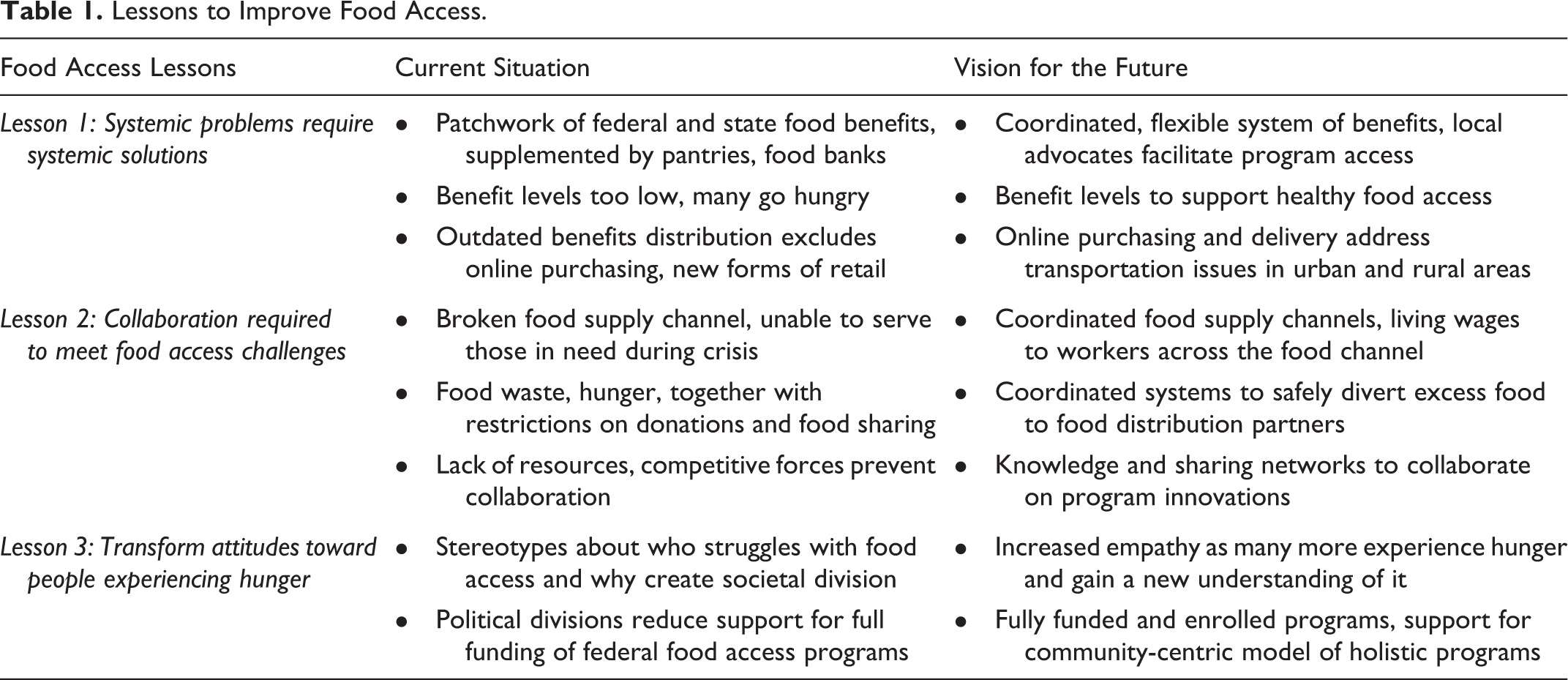
Emergencies and disasters often expose existing flaws in our systems. As Warren Buffet said, “It’s only when the tide goes out that you discover who’s been swimming naked” (Emanuel 2020). We have been swimming in the buff. The COVID-19 pandemic has exposed systemic vulnerabilities in food access for people experiencing hunger. Simultaneously, it has revealed opportunities to strengthen food access. Working with Hunger Task Force (HTF), an antihunger nonprofit that operates a food bank in Milwaukee and advocates for local, state, and federal policy to end hunger (Bublitz et al. 2019), we outline three lessons from the COVID-19 pandemic and raise policy and research questions related to ensuring food access for all. These lessons are outlined in Table 1.
Lessons to Improve Food Access.
Lesson 1: The Systemic Problem of Food Access Requires a Systematic Solution
Federal nutrition programs must offer uninterrupted benefits that support healthy and sufficient food access. The COVID-19 crisis has underscored the critical role of the Supplemental Nutrition Assistance Program (SNAP) in providing a safety net against hunger. In April 2020, to combat hunger resulting from the crisis, SNAP increased emergency food benefits by 40% per family, adding approximately $6.5 billion to food purchasing power for those vulnerable to hunger (U.S. Department of Agriculture 2020). Properly administered and fully enrolled, federal nutrition programs such as SNAP, Commodity Supplemental Food Program, Summer Food Service Program, and National School Meal Programs offer unmatched resources and buying power for food. However, when schools closed, many children lost critical access to school meals. To compensate, several food banks across the United States including HTF responded by immediately launching their summer meal programs to feed children. Not all communities, particularly those in rural areas, were able to feed hungry children during this crisis.
The crisis has also revealed how a coordinated, local food access distribution system is superior to a patchwork of organizations struggling to secure and distribute food. In the United States, the emergency food distribution system includes food banks that supply local food pantries. Even well-established food banks that depend on retailers’ donations of excess inventory are struggling during this crisis, often failing to supply food pantries as retailers’ donations slowed. Food banks and pantries were also unable to purchase food through retailers that imposed quantity restrictions on purchases. By contrast, food banks with well-developed wholesale suppliers have been better able to maintain food access and innovate alternative distribution mechanisms. These food banks continued to supply pantries and pivoted to deliver food boxes for curbside pickup. In addition, HTF’s Mobile Market, a grocery store on wheels, modified its procedures to maintain social distance but has continued to serve people living in Milwaukee’s food deserts (Bublitz et al. 2019).
Policy and Research Questions to Strengthen Food Access
How can a comprehensive approach to food access offer continuity and flexibility to compensate if one program experiences challenges? How can federal nutrition programs work with food banks to ensure uninterrupted benefits that, in turn, support healthy and sufficient food access? How can technology be leveraged to modernize access to SNAP benefits and provide online shopping and delivery for SNAP recipients? What can be done to ensure crisis-related increases in SNAP benefits and policy changes continue? How can food access be improved for those in rural areas and those facing mobility and transportation challenges?
Lesson 2: Organizations Must Collaborate to Serve People in Need
Greater collaboration of organizations within the food access distribution system is needed (Bublitz et al. 2019). As this crisis makes clear, collaboration is vital in rural areas (Reiley 2020). An example of collaboration is the Hunger Relief Federation, a network of community-based food banks, pantries, and emergency food providers working in rural counties across Wisconsin toward the collective goal of ending hunger. Organizations share resources such as marketing materials, program ideas, and policy advocacy templates. During the crisis, they continue to collaborate, share knowledge to improve operations, and distribute food to prevent fresh food waste through partnerships including the Wisconsin Dairy Recovery Program (Peterson 2020).
Collaboration does decrease food waste. Food is wasted at every step of the distribution system (Block et al. 2016). Across the country, farmers struggle to sell produce and milk while food banks face shortages of these items. During the crisis, food distribution channels designed to bring farm fresh foods to commercial customers could not easily pivot to serve food banks, resulting in farmers plowing produce into the soil and dumping milk and eggs while people went hungry (Reiley 2020).
The problem of food access does not occur in isolation (Bublitz et al. 2019). Many who face hunger also need access to housing, healthcare, childcare, job training, and other services. Providing for such needs through separate channels creates systematic inefficiencies, highlighting the importance of coordination between nonprofit and governmental partners. During the crisis, all but one food pantry closed in Milwaukee’s Amani neighborhood, a food desert. With many Amani residents suddenly unemployed, food needs surged. Amani’s COA Youth & Family Centers’ food pantry and HTF worked together to ramp up from serving 65 families on March 1, to 402 families on April 1 through federal nutrition program reimbursements and private donations. COA’s pantry is now performing triage, much like a hospital emergency department, serving as an entry point for Amani families needing to access more services.
Policy and Research Questions Surrounding Collaboration
Food unites us: how can it unite organizations serving those in poverty? What policy initiatives build collaboration between and among nonprofits and governmental entities? What barriers make it difficult for these organizations to share funding, costs, staff, and resources as they collaborate? How can we overcome the barriers to collaboration within the food supply channels to decrease food waste and increase food access? How can a community-centric model of holistic programs provide clients in need of food with additional services and collaborative approaches to tackle poverty?
Lesson 3: Facing Hunger Transforms Attitudes Toward People Who Experience Hunger
With the crisis resulting in unprecedented levels of unemployment, people who have never before experienced hunger are becoming vulnerable. An estimated 40% of people served by food banks in recent weeks are first-time clients (Reiley 2020). Take, for example, Tini Mason, who recently visited a Pittsburgh food bank for the first time in his life after losing his job. Mason said, “We have to stretch every can, every package, everything that we have, because we don’t know what’s around the corner.” He described the sight of mile after mile of people lined up in cars to get food as “an eye-opener, mind-blowing, an experience I will never forget” (Kulish 2020). Such awareness can change attitudes and beliefs about hunger and why it persists, overcoming the misperception that people who experience hunger are lazy and need to work harder. Indeed, this crisis could prompt empathy (Eisenberg and Miller 1987) and understanding that transforms perceptions, hearts, and minds.
Policy and Research Questions Surrounding Perceptions of Food Access
How does this crisis challenge stereotypes about and shift attitudes toward those experiencing hunger? How does experiencing such a crisis themselves help individuals and policy makers better understand the experience of hunger? Will this new understanding increase social and financial support for and volunteerism around food access?
There is no question that as a society we need to better serve those who are vulnerable. As Barack Obama said, With just a slight change in priorities, we can make sure that every child in America has a decent shot at life. (Obama 2004)
Footnotes
Acknowledgments
The authors thank the dedicated staff, volunteers, and supporters of Hunger Task Force and their collaborative partners for all of their work and vigilance in the fight against hunger, especially during the COVID-19 crisis.
Declaration of Conflicting Interests
The author(s) declared no potential conflicts of interest with respect to the research, authorship, and/or publication of this article.
Funding
The author(s) received no financial support for the research, authorship, and/or publication of this article.