







Abstract
The global refugee crisis presents a complex challenge, with millions experiencing protracted displacement in inhospitable conditions. This study examines the lived experiences of Syrian refugee women in Lebanon, focusing on how they resource hope and maintain well-being amid forced liquidity and uncertainty. Drawing on ethnographic interviews with 26 Syrian refugee women, the authors uncover the profound effects of changed consumer roles and the critical function of agentive anchoring acts of consumption in resourcing hope. The findings reveal that refugees employ four types of anchoring acts—domesticity, spirituality, self-care, and socializing—to momentarily restore normalcy, affirm dignity, and enhance well-being. These acts serve as vessels for resourcing and mobilizing hope, enabling refugees to “live through” their present circumstances while aspiring for a better future. The authors introduce the concept of hope as a social resource that can be collectively shared and mobilized, highlighting the dynamic interplay between hope and hopelessness in refugee experiences. This research contributes to understanding how marketing and service systems can improve refugee well-being in protracted displacement, offering insights for stakeholders to create conditions that foster rather than inhibit subjective well-being to resource hope among vulnerable consumers experiencing protracted displacement and involuntary liquidity in global modernity.
Keywords
I like to fix the house [tent]. It gives me hope. … I see my tent is clean. Now that the kids and the house are taken care of, I am good. (Sariya, age 30, mother of five)
The refugee crisis affects the world's population, with displaced people reaching 86.5 million in 2021 (Boenigk et al. 2021). Most sources predict constantly increasing refugee flows for many decades (Boenigk et al. 2021). Forcibly displaced from their home country by war, violence, and other circumstances, each refugee has a unique experience. Nevertheless, the refugee experience can be characterized in terms of a triggering event that leads to displacement, followed by a journey leading to temporary settlement and/or permanent resettlement (Shultz et al. 2020). Resettlement, while still filled with uncertainty about the future, is nevertheless viewed by refugees as a possible path to well-being (Aldiabat et al. 2021; El-Shaarawi 2015; Hokkinen 2023). Importantly, opportunities for resettlement are extremely limited,with only about 1% of refugees ever resettled (El-Shaarawi 2015, p. 50). Many studies have examined refugees’ resettlement experiences in Norway, Finland, Germany, Canada, Australia, the United States, and other countries, perhaps because researchers are often located in countries where refugees seek to permanently resettle (Boenigk et al. 2021; Hokkinen 2023).
Refugees experience forced liquidity, where they own little or nothing—their consumer role is dramatically changed (Bauman 2002). Their lives are filled with uncertainty, economic precarity, exclusion, stigmatization, and marginalization (Boenigk et al. 2021; DeQuero-Navarro et al. 2022; Kelcey and Chatila 2020). In hostile host countries, afraid or unable to return home, these refugees experience permanent impermanence and limited agency. Protracted “temporary” settlement, often in a country neighboring their nation of origin, where refugees frequently experience inhospitable subhuman conditions with limited access to clean water, sanitation, education, health care, and nutrition, has received less research attention (see Boenigk et al. 2021; Brun 2016; Clayton 2020; El-Shaarawi 2015; Subramanian, Finsterwalder, and Hall 2022). Yet, many refugees live years, decades, or lifetimes in these conditions, and long-term displacement becomes the new normal (Brun and Fábos 2017). The experience of refugees residing in neighboring host countries is shaped by politics of uncertainty and ambiguity that create a “manufactured vulnerability,” making their situation extremely precarious (Stel 2020). For example, 13 years since Syria's conflict started, Lebanon remains home to 1.5 million Syrians, in a country of about 4 million Lebanese. Per capita, this is the largest refugee population in the world (Gebeily and Madi 2024). At this writing, there is rising antirefugee rhetoric with no end in sight (Hamadi 2024).
There is growing yet still nascent recognition that marketing and service systems need to address the global refugee crisis and contribute to humanitarian programs for refugee well-being (Boenigk et al. 2021; Nasr and Fisk 2019; Subramanian, Finsterwalder, and Hall 2022). Of course, it is important to understand refugee needs and experience across all phases of the refugee journey, employing macro-, meso-, and micro-level analysis (Boenigk et al. 2021; Shultz et al. 2020). However, a particularly critical research gap is to understand how marketing and service systems can improve the well-being of refugees experiencing protracted displacement in inhospitable conditions. The purpose of our research is to shed light on this pervasive and complex problem. Specifically, this research examines the lived experience of refugees in protracted displacement in inhospitable conditions to identify their sources of subjective well-being. Understanding whether, when, and how refugees experience well-being in these harsh conditions provides a foundation for stakeholders to create conditions that foster rather than inhibit or attenuate it. Research concurs that factors such as hope, agency, and human dignity contribute to subjective well-being (Hojman and Miranda 2018; Pleeging, Burger, and Van Exel 2021; Venugopal and Viswanathan 2021). Yet, how in these dire circumstances of protracted displacement do refugees assert agency, feel hope, affirm their human dignity, and experience well-being? We bring together theory and research on forced liquidity, agentive consumption, and hope (how hope is manifested, used, resourced, and mobilized) to inform this research question. The introductory quote illustrates each of these theoretical components. In protracted forced liquidity (living in a tent she does not own), Sariya employs agentive consumption to resource hope, and the positive consequences of her consumer agency give her a sense of subjective well-being.
Drawing on this theoretical framework, our research uncovers the profound effects of changed consumer roles initiated by forced liquidity and the critical function of agentive anchoring acts of consumption as vessels for resourcing and mobilizing hope. An initial foundation for the potential link between “agentive consumption” and refugee dignity and well-being is provided by Oka (2014). He argues that the ability and resources to choose, purchase, and consume small but comforting, familiar, and desired “nonessentials” is fundamental for coping with stressful periods. We extend and elaborate on Oka's work to investigate how refugees’ agentive consumption (broadly defined) is used to resource hope, an area of research overlooked in consumer and marketing scholarship. In addition, we examine the underappreciated slippage between hope and hopelessness that shapes refugee informants’ lives and likely that of other vulnerable and impoverished consumers.
Through an ethnographic study with 26 Syrian refugee women residing in Lebanon, we find that feelings of protracted uncertainty without agency shape the refugee experience of forced liquidity and inform how hope is socially resourced through agentive anchoring acts. We find that refugees’ hope is less aimed at goal-directed behavior toward a future good, and more for a persistent hope “to live through” (Zigon 2009, p. 258). As in other consumer and psychological investigations of hope, refugees use hope for dreams of a better life, for a return to a life lost, and for specific goals (such as education and skills) that they hope to accomplish (Brun 2015). However, we find that hope is also used as a critical social resource “to live through,” where hope is fueled by acting to capture fragments of normalcy, sanity, and emotional well-being that enable hope to sustain another moment and day. Consumer research has not investigated hope as a social resource, although sparse sociological and anthropological research employs this lens (Lipatova 2022; Mosley et al. 2020). Hope as a commodity that can be resourced and collectively shared offers an important additional lens for consumer and marketing research. Understanding the social resourcing of hope against a backdrop of hopelessness is vital for addressing the well-being of refugees, but also consumer well-being. We highlight how this understanding informs the development of effective strategies to support refugees to resource hope and experience human dignity and well-being. Moreover, we open research avenues for investigating the transformative power of agentic consumer roles.
In what follows we provide an overview of liquidity and hope as they relate to our refugee context and agentive consumption. Both are highly contextualized constructs, reflecting multifaceted life factors, so it is not our intent to provide comprehensive reviews. We aim to uncover the explanatory power of these lenses for understanding our informants’ refugee experiences. Next, we describe our context, data collection, and analysis. Findings are based on in-depth interviews conducted in Arabic by the first author, privately, at a school for refugees in Lebanon, with 26 Syrian women. The findings explicate an emergent model for understanding the lived experience of refugee consumption under conditions of protracted displacement. We first describe the forced liquidity, changed consumer roles, and protracted uncertainty in the disrupted lives of our informants. Refugees contrast the uncertainty and liquidity of the present with the “normalcy” and “solidity” of a wished-for or remembered life. Next, we examine the interplay of hope and hopelessness. Informants actively assert agency and resource hope to live through their present and toward a positive future. Most importantly, we unpack refugees’ use of anchoring agentive consumption acts to resource hope, affirm dignity, and enhance well-being. Acts of domesticity help refugees momentarily anchor to restore normalcy to family life and affirm the value of maternal and marital roles; acts of spirituality through prayer, reading, and devotion provide another anchor to normalcy and order; acts of self-care affirm dignity and solidify an agentive self in a liquid terrain; and acts of socializing with family and friends provide fleeting anchors to normalcy, dignity, and enhanced well-being. Our findings underscore the importance of refugees in protracted displacement acting to resource hope, even if the anchors are temporary and shifting. We unfold how refugees navigate between mobilizing hope to build a better future through education and skill-building for themselves and their families and resourcing hope to “live through” the next day. As is likely the case for other involuntarily liquid consumers in protracted uncertainty, the social resourcing of hope, often through agentive acts of consumption, is key to dignity and well-being yet has not been explicated in marketing and policy research. We conclude with implications for consumer and marketing research and public policy. Specifically, we uncover challenges and opportunities within current institutional structures for stakeholders to create, reinforce, and sustain subjective well-being opportunities for consumers experiencing forced liquidity and protracted displacement. Many recommendations conflict with conventional nongovernmental organization (NGO), policy, and marketing strategies and tactics for servicing vulnerable populations.
Conceptual Foundation
Refugee camps are characterized by “a ‘frozen transience’, an ongoing, lasting state of temporariness, a duration patched together by moments none of which is lived through as an element of, and a contribution to, perpetuity” (Bauman 2002, p. 345). Bauman refers to refugees’ temporary/permanent tents as an extreme limit of the “liquid” phase of modernity—people involuntarily stripped of their stuff and identities. In much other writing, Bauman speaks to the involuntarily liquid, distressing, uncertain, and “wasted lives” of people condemned to the margins of society (Bauman 2013). As Bauman (2002) provocatively argues, refugees are unwillingly cast into these circumstances.
Not surprisingly, refugees’ responses to circumstances of losing ownership and not owning anything stand in sharp contrast to consumers who view flexibility, mobility, and access rather than ownership as freedom—voluntarily electing to live what they view as a secure liquid life, unencumbered by possessions (Atanasova, Eckhardt, and Husemann 2023; Bardhi and Eckhardt 2017). While digital nomads and executive road warriors traverse the globe with liquid suitcases of billable assets of skills, reputation, and education (Atanasova, Eckhardt, and Husemann 2023), the emic experience of refugee informants reveals a state of liquidity, uncertainty, lack of agency, few consumption choices, and loss of hope. Refugees’ necessity to resource hope is thus framed by circumstances of protracted uncertainty and forced liquidity (Bauman 2002), which result in unimaginable suffering, including long-lasting ill-health effects (El-Shaarawi 2015). These circumstances make hope a critical social resource—they reveal “the conditions in which hope is manifest and put to use,” as Zigon argues (2009, p. 262). In these conditions hope becomes a necessity—refugees must find ways to act to resource hope.
Forced Liquidity and Protracted Displacement
Theory surrounding consumer liquidity acknowledges that many consumers are thrown into liquidity, experiencing it as nonagentive, threatening, and extremely uncertain (Bardhi and Eckhardt 2017; Mimoun and Bardhi 2022). Eckhardt and Bardhi (2020) note that more research is needed to understand consumers experiencing forced liquidity. Hokkinen (2023) find that as part of resettlement, refugees learned to navigate forced liquidity through increased liquid consumption, still cherishing owned objects with functional value. The research also revealed the importance of “solid social relationships,” in contrast with prior research that tends to view social ties as burdensome (Bardhi and Eckhardt 2017). Also, in contrast with other research on liquid consumption, hopes were directed at returning to solid consumption when circumstances allowed. Hokkinen (2023) highlights the continued yearning for solid consumption in conditions of forced liquidity, but also the willingness of refugees to shed possessions and integrate liquid consumption to pursue this new life. However, these refugees, now Finnish residents, likely experience consumer liquidity and uncertainty differently from refugees currently housed in neighboring countries with extremely limited agency and few or no known pathways to a positive future (Bauman 2002; Oka 2014).
Brun (2015) fruitfully defines protracted displacement in fluid, not static terms. She argues that it is important to understand the fluid process of protracted uncertainty, drawing on the interlinked concepts of agency, waiting, and hope. She posits that there is a tendency to represent people living in protracted displacement as living in a state of limbo. Brun (2015, p. 20) defines “agency-in-waiting” as the capacity to act purposefully in the here and now, informed by an individual's experience of displacement and shaped by their aspirations and hopes for what the future may hold. Refugees use hope as an active strategy to “stay afloat,” and keep alive the possibility to move on and define alternative futures (Brun 2015, p. 33). If we seek to understand the uncertainty and liquidity of refugees in protracted displacement, we must investigate active strategies to hope, understand how refugees hope, and examine the changing content of hope.
Hope and Hopelessness
Across a century plus of multidisciplinary theory and research, there is little consensus on what hope is (Luo et al. 2022). Is hope cognition, emotion, active, goal-directed, wishful, false? Hope is a suitcase word, a word packed with a variety of meanings (Minsky 2007). We do not intend to explicate or resolve these complex and varied viewpoints that derive from various disciplinary perspectives. We are most interested in how hope is actively resourced and used by refugees in circumstances of protracted displacement (despair, loss, uncertainty) and how the resourcing of hope contributes to well-being. Everyday language reveals that hope is crucial for coping with situations of despair (Luo et al. 2022). This resonates with theory and research that finds activating hope is especially critical as a tool against hopelessness (Zigon 2009).
The social resourcing of hope
How refugees hope and the changing content of hope is worthy of research in public policy and marketing because hopefulness affects consumers’ ability to cope with adverse environments (Lazarus 1999) and aids in coping with distress and anxiety over an uncertain future (MacInnis and De Mello 2005). Some anthropological research adopts a resource perspective on hope, identifying individual and collective strategies that can be used to resource and replenish hope in dire conditions (Mosley et al. 2020). While hope is viewed as crucial in interventions to address situations of violence, uncertainty, loss, and protracted displacement, there is little critical engagement with how hope is resourced and expressed in these settings (Eggerman and Panter-Brick 2010; Lipatova 2022). Resourcing hope to persevere is most evident in conditions where slippage into hopelessness is greatly feared and highly probable. In conditions of despair, hope is resourced as a weapon against despair; it is active human agency working toward perseverance (Lazarus 1999; Zigon 2009).
Zigon's (2009) research resonates with Brun's (2015) description of the close relationship between “agency-in-waiting” and hope. Specifically, Zigon helps us make the connection between acting as not just coping, but as resourcing hope. Viewed through this additional lens, Oka's (2014) description of acts of agentive consumption that create sociality and normalcy can be seen as ways to resource hope. These acts are often dismissed by outsiders, including policy makers, as frivolous and wasteful uses of scarce resources. For example, the relief food that coordinators worked to ensure was nutritional and available for refugees was viewed as making them feel helpless in an overwhelmingly frustrating uncertain wait. Oka finds that the ability of refugees to occasionally purchase, prepare, consume, and share food that reminds them of their normal dignified lives in the past is central to their well-being.
Bringing the concept of hope as a social resource to Oka's findings, we can see how his findings exemplify refugees’ need to “live through” hopelessness and temporarily assert dignity and well-being (Brun 2015; Zigon 2009). Hope can therefore be viewed as a commodity that can be given or taken away, depleted or replenished (Hage 2009; Lipatova 2022). In her ethnography of asylum seekers and refugees in Greece, Lipatova finds that practices of waiting and hoping are highly interlinked as a means of navigating the present. She also finds that hope “is not only an individual asset, but it may be collectively shared” (Lipatova 2022, p. 1100).
Recognizing hope as a resource that can be collectively shared and replenished through action when depleted has not been explicated in consumer and marketing research. This perspective complements research on the transformative power of hope. Viewing hope as a resource has implications for how policy makers can give hope or take it away. In this research, we extend and elaborate Oka's (2014) preliminary findings around the coping value of agentive consumption to show how it is used to resource hope and reestablish subjective well-being in conditions of despair, providing a more nuanced perspective on agency and hope. Important research in subsistence contexts illustrates how agency is negotiated in the face of consumption constraints (Venugopal and Viswanathan 2021). This research demonstrates how women in strong patriarchal social institutions engage as entrepreneurs to confront and challenge constraints, finding a middle ground between institutional dictates and unbridled agency (Venugopal and Viswanathan 2021, p. 340). Many aspects of this research resonate with our own informants’ life stories, including finding a middle ground around patriarchal institutional dictates. However, the agency of impoverished women entrepreneurs is not “agency-in-waiting,” but rather agency directed to a hoped-for possible and known better future. The importance of this distinction in how agency and hope are intertwined is further elaborated in the next section.
Hope and consumption
Hope and consumption are closely intertwined in ways that may increase or decrease social welfare. MacInnis and De Mello (2005) outline marketing tactics to motivate consumers to take action to consume a product or service to attain hoped-for goals. One important set of tactics is to show how a product or service can improve the possibility of achieving a hoped-for goal. Relationships between consumption and hope are evident in many populations, including refugees. In broad terms, this research elucidates the relationship between hoping and acts of consumption—both hoping to consume and hoping to consume to achieve other goals.
Our research recognizes the relationship between hope and consumption for refugees but interrogates a different relationship—the relationship between acts of consumption and resources to hope. How consumers socially resource hope through agentive acts of consumption is underexplored, and valuable to consider in the context of refugees’ lived experiences. Evidence from other contexts hints at how material activities can resource hope, including, for example, Mardi Gras celebrations following Hurricane Katrina (Weinberger and Wallendorf 2012), community responses to natural disasters (Baker 2009), and survival strategies in the context of multigenerational poverty (Hill 2002). Nevertheless, marketing policy research has not investigated connections between agentive consumption acts and hope. Such research is needed because of the important implications for consumer dignity and well-being.
Like hope, consumption is also a suitcase word (Minsky 2007). Boundary conditions on what constitutes consumption are widely negotiated (Evans 2019; Graeber 2011). For example, Mardi Gras celebrations can be viewed as community gift-giving rituals, but they involve ownership and display of consumption. Similarly, pilgrimages directed at spiritual goals involve elaborate servicescapes, considerable resources, and extensive consumption (Higgins and Hamilton 2019; Husemann and Eckhardt 2019). Consistent with prior theory and research, we adopt a broad perspective on agentive acts of consumption.
Our findings emerged from informant voices enduring uncertainty and changed consumer roles in circumstances of forced liquidity during protracted displacement. Understanding how consumers resource and direct hope is vital. Our research has important implications for policy makers engaged with refugees in protracted displacement. In what follows we describe our method and findings.
Research Methods
Context
As noted, there are few studies on the lived consumer experience of refugees displaced in neighboring countries awaiting transit to places where future life trajectories may take shape. Our inquiry focuses on Syrian women refugees living in Lebanon, host to one of the largest Syrian refugee populations per capita in the world (UNHCR 2021). In Lebanon, 29% of Syrians registered by UNHCR as refugees live below a minimum expenditure survival basket ($2–$3/day), with 48% living below the poverty line of $4/day, and refugee women suffer harassment, early marriage, isolation, exploitation, and limited resource access (El-Nakib et al. 2022; Lehmann, Bain, and Pandit 2014).
Contributing to refugee vulnerability is the lack of official residency status. According to Lebanese legislation, it is illegal to reside without a residency permit, which puts refugees at risk of being arrested and detained (Atallah and Mahdi 2017, p. 25). Without official residency status, refugees’ access to services is also limited. Stel (2020) explains that the institutionalization of ambiguity in refugee governance in neighboring host countries operates on three axes: informality, liminality, and exceptionalism. Informality relates to governance concerns not recognized, controlled, or made possible by the state. Informality is related to illegality, extra-legality, and the criminalization of refugees (De Genova 2002). The absence of formal refugee status contributes to stripping refugees of the “right to have rights.” Liminality, or the “liquid” appropriation of time, enables pervasive uncertainty. Last, exceptionalism refers to the “state of exception” that places refugees outside of normal political and legal frameworks and inside mechanisms of repression and surveillance.
We focus on Syrian refugee women in part because women and children constitute the majority of refugees and bear the greatest burden, yet their voices and perspectives are often left unheard (IRC 2014). Despite active international organizations like UNHCR, the Danish Refugee Council, and other NGOs providing humanitarian aid to Syrian refugees in Lebanon, refugees live in undignified conditions and experience insecurity, uncertainty, lack of agency and control over their lives, and economic precarity with a grim outlook. In Lebanon, there are no formal refugee camps, and most refugees either live in informal tented settlements (ITSs) or rent accommodations in unfinished building structures or garages, an economic drain that is becoming increasingly unsustainable. In Lebanon, refugees live in dehumanizing conditions, dealing with unimaginable stress and rejection from local communities.
There are around 600 ITSs in Lebanon; the largest are in the Bekaa Valley. We followed an action research approach, which “seeks to bring together action and reflection, theory and practice, in participation with others, in the pursuit of practical solutions to issues of pressing concern to people, and more generally the flourishing of individual persons and their communities” (Reason and Bradbury 2001, p. 1). We collaborated with the Center for Civic Engagement at a leading academic institution in Lebanon. The center had several collaborative projects with various local and international NGOs relating to the establishment of schools for refugees in Bekaa. The center facilitated access of the first author into the ITS since access to the ITS was restricted to aid workers and NGOs.
Data Collection
Research was conducted at one of the refugee schools, and interviews were held privately in a classroom. It was not possible to conduct the research in the camps or tents due to a lack of privacy and overcrowding. In total, 26 interviews were conducted in Arabic by the first author, a native Lebanese woman, over four months, and the informants’ ages ranged between 22 and 67.
The interviews took a conversational form to allow interviews to flow naturally, and informants were eager to tell their life stories (McCracken 1988). The interviewer asked informants to introduce themselves and then asked them about daily life routines, social and individual activities, and daily hardships as well as hopeful moments in their daily lives. Informants talked unprompted about their past, what it was like living in Syria, and their imagined futures. Interviews lasted between 30 and 60 minutes, dictated by the informants’ schedule, availability, and responsibilities. The sample size was not determined a priori; instead, data collection ended when additional interviews did not add further significant insights (Corbin and Strauss 1990; Suddaby 2006). Interviews were analyzed in comparison with prior interviews to identify contrasts and similarities. With one exception, interviews were audio recorded and transcribed. The first author took field notes complemented by photos to contextualize the research. Interviewees were given pseudonyms to ensure anonymity. Table 1 includes a description of our informants.
Informant Table.
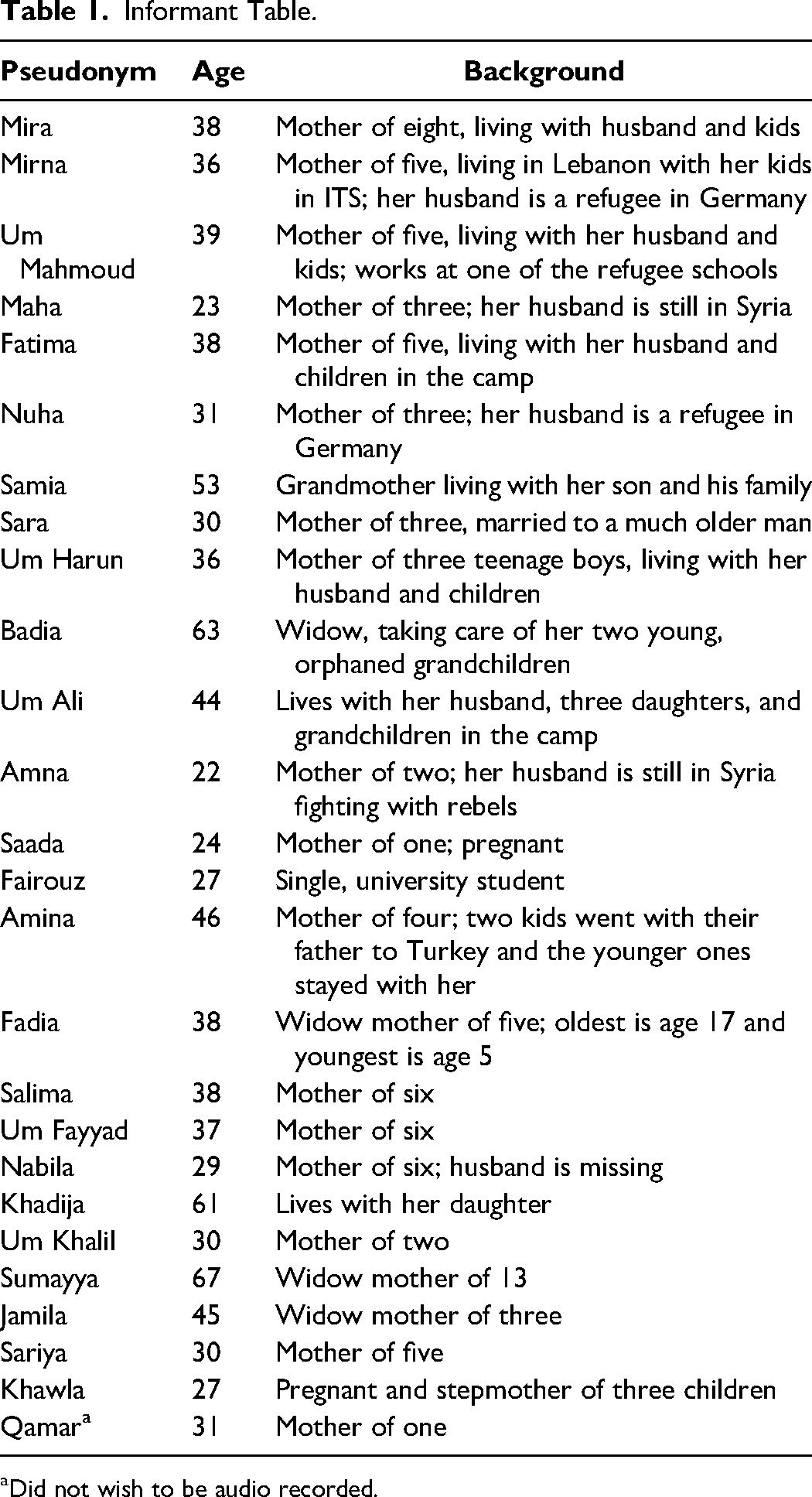
Did not wish to be audio recorded.
Data Analysis
As interpretive researchers, we sought to understand motives, emotions, meanings, and other subjective experiences that are time- and context-bound. We used thematic analysis to identify, analyze, and report themes—looking for differences and similarities, recurrent topics, and emerging patterns. Employing open coding techniques and idiographic analysis across interviews within and between informants, we looked for commonalities and noted differences (Thompson, Locander, and Pollio 1989). We engaged in an iterative analytical process, such that data collection shaped interpretations and theoretical development, which then shaped further data collection and interpretation. Through a multistage iterative process, “ideas were used to make sense of data, and data used to change ideas” (Hammersley and Atkinson 2019, p. 158). To move between emic participant understandings and etic researcher interpretations, we followed McCracken's (1988) advice to start with a literal reading of the text and incrementally move toward a holistic view across the collective data. Individual and joint analysis strengthened our interpretation and increased triangulation (Husemann and Eckhardt 2019). Our goal was to provide a thick and trustworthy description of our findings (Arnould and Wallendorf 1994).
Analysis of the data was conducted in three stages using the principles outlined by Braun and Clarke (2016). Initial coding revealed common themes of hope, escapism, fantasizing, images of the past, images of the future, and daily activities in refugee communities linked to feeling hope and well-being. Interviews were analyzed with a focus on activities that guide hopefulness in different individual and social contexts. Analysis followed an iterative process of coding, categorizing, and abstracting to unravel patterns within and across interviews until common themes emerged and themes became saturated (Spiggle 1994). We first coded themes relating to emotions and activities for each participant. In the second stage of coding, categories were grouped under a range of emotions and activities (e.g., emotional practices, socializing practices, self-care practices), and themes coded for each participant were compared across all participants to produce higher-order abstractions (Spiggle 1994). The final stage of analysis consisted of theoretical coding whereby we interrogated emergent themes with extant literature, resulting in Figure 1.
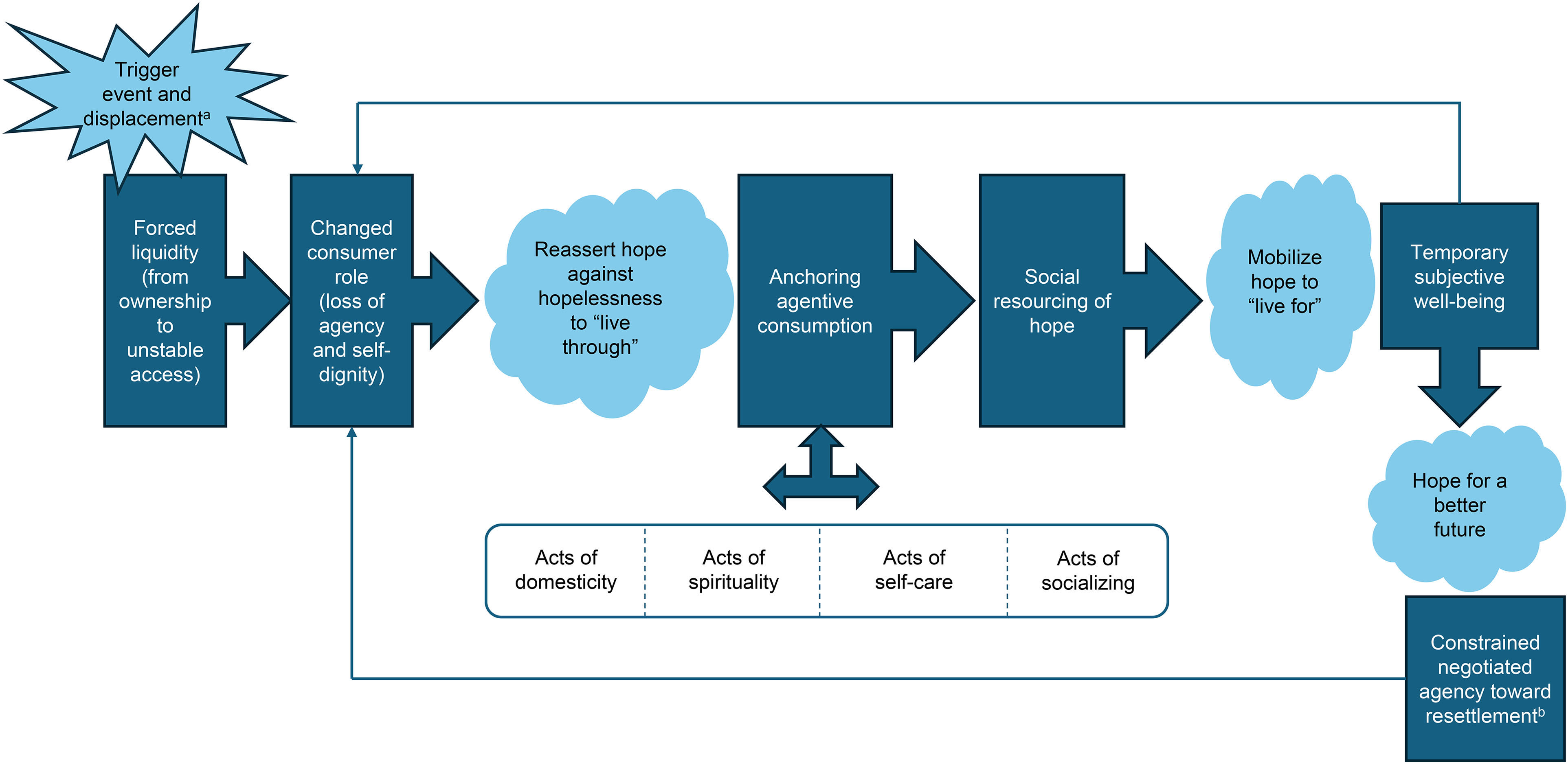
Refugee Agentive Consumption to Resource Hope in Protracted Displacement.
Findings
Each kid had his/her own stuff, toys, clothes, everything. They used to say, “This is mine, this is my room.” My daughters had their own rooms, their own beds, their own toys. But now, we are all living in one small tent, and it is not even our tent, they might take it away from us at any time. (Um Mahmoud, age 39, mother of five)
For informants, consumer liquidity and agency are intertwined in their consequences (Bauman 2002). Informants spoke unprompted about forced liquidity, contrasting a remembered, unrecoverable past of ownership and agency with the present. Refugees experienced a tragic disruption moving them from ownership with agency to liquidity without agency—from owning things and controlling spaces to inhabiting shared spaces with no ownership and little agency. Um Mahmoud continues: “I can’t tell night from day (sobs), ever since we got a call from the society [NGO renting the land and providing tents and rooms], they have decided to take back the caravan.” Refugees living in ITSs suffer heightened instability, facing eviction at any time.
A dramatically changed consumer role is prompted by the transition from ownership to liquidity and leads refugees to experience loss of agency and diminished dignity. Their role as providers of consumption is central to the identity of our female informants. In resettlement, refugees also experience this loss but establish new consumer identities and possessions (Hokkinen 2023); however, in protracted displacement, the lost consumer role haunts informants’ daily lives. Prior research on refugees in protracted displacement has not identified the significance of this changed consumer role. Because long-term displacement is now the norm for a majority of refugees, critical attention should be directed to the fundamental practices of home and homemaking that reproduce normal life and strategies for enabling them in protracted displacement (Brun and Fábos 2017).
Informants describe the loss of consumption choices and agency over mundane consumption that result in a loss of dignity (Oka 2014). Mira, a mother of eight children, describes this loss of dignity because she cannot provide basic material needs for her children. My eldest keeps saying, “I need clothes, I need feminine products.” They all want stuff. I get $27 a month per child from the UN but it's not enough. Every month I spend $100 on bread, a large cooking oil can, sugar and tea, flour, milk, and diapers. And my husband works but they don’t pay him his dues. My son Mohamad tells me, “You are a mother? Why did you bring us to this life? We need things and you don’t get us what we need.”
This passage illustrates the critical market-mediated role in Mira's and her children's desires. For Mira and her children, to be a mother is to provision consumption. Mira labors to cater to her children's needs and wants, falling short. Mira's inability to participate in the market is emotionally exhausting and depreciates her sense of self. This is consistent with Salem's (2023) exploration of how Syrian refugee youth in Jordan preserve hope through daily strategies, including consumption practices. It also aligns with the analysis of Schiltz et al. (2019) on how pervasive uncertainty in forced displacement impacts agency and consumption. Mira's diminished market role decreases her agency, leading to diminished self-worth.
Like Mira, Um Harun contrasts her current forced liquidity with an abundant past—a time of solidity, self-sufficiency, and consumption agency. Informants frequently used the phrase “our own,” signaling their changed consumer roles and how ownership of mundane things provides an anchor: When we were living in Syria, I used to buy them anything they wanted, they were not deprived of anything. I baked for them all kinds of sweets every day, I had my own oven and a fully equipped kitchen. We ate fruit every day, and we grew fruit in our garden. I had everything. I swear to God. I had a fridge, and it was always full. (Um Harun, age 36)
Other informants echo Mira's and Um Harun's despair at their diminished consumer roles. For example, Sariya observes that “money mostly” causes her despair due to her diminished agency to provide for her children: “when the kids’ needs get too much and you can’t give them what they want.” Because identity is strongly linked to homemaking, refugees’ changed consumer role causes them to experience a huge loss of agency and self-dignity. While this is not surprising (Epp and Velagaleti 2014), it is worthy of more focused research attention in the context of vulnerable populations. Refugee mothers, like most mothers, do not just want their children's needs to be met; they want to perform the role that meets these needs. Um Harun takes great pride in the performance of her role as mother, a role that is now under constant threat with little hope of change.
As highlighted in prior quotes, informants experience protracted forced liquidity as an endless state of waiting (Brun 2015, 2016). Amna, a mother of two whose husband is still in Syria, notes that every day passes with no hope for change: “There is no escape. Life is going by like that, nothing new is happening.” This aligns with Janeja and Bandak's (2018) ethnographies of waiting. The protracted loss of agency and self-dignity, key factors that determine well-being, lead refugees to feel hopeless. Finding a way to hope becomes critical to survival.
Hope to Live for and Hope to Live Through
Informants express the difficulty of hoping in protracted conditions of forced liquidity with little agency. Khadija explains how agency, ownership, and hope go hand in hand: “People are hopeful when they have work, when they can make money. You need fertile land. If you don’t work, you don’t get anything.” Amna fluctuates between expressing hope and hopelessness throughout her interview. She imagines improbable things that could happen to provide a path to a solid future, noting that hope and a possible positive future go together: The future and hope are tied together. The future must be something pleasant, for me to anticipate it. If I had a chance to travel to a place where I get a house, and stability, for instance, a place where I do not need anything from anyone. (Amna, age 22)
Hope and hopelessness are threaded throughout. Informants hope for imagined and improbable futures, and for unrecoverable pasts (to go back to Syria, rebuild, and have their previous lives). They hope for themselves, and their family, especially their children, but they also hope for neighbors and other children. Of course, informants hope for and work toward possible goals that they might accomplish. Here hope for a better future motivates action to attain that future, similar to how hope and agency are described in research on other vulnerable populations (Rosa, Geiger-Oneto, and Fajardo 2012; Venugopal and Viswanathan 2021). Among the hoped-for goals they express, they try to learn useful skills such as hairdressing, get an education, help their children get educated, and save and plan to visit Kaaba. This is consistent with Cook and Cuervo's (2019) conceptualization of hope as an essential component of agency, futurity, and representation that can help people achieve goals (MacInnis and De Mello 2005). As one illustration, visiting Kaaba in the future is a dream Um Ali plans to accomplish. Hajj refers to the pilgrimage made to Kaaba, the “House of Allah,” in the sacred city of Mecca in Saudi Arabia. Um Ali uses this dream and responsibility as a reason to live. Present-day tasks are organized around realizing this possibility. I always say I hope I don’t die anytime soon, to be able to go to Hajj. Next year, I told Abu Khalid, that if my job gets better, when I finish fixing my teeth, I want to go to Hajj. I want to go visit God's home. Hajj is an obligation for us. When I get the chance to go to Hajj, I will have accomplished my happiness in life. (Um Ali, age 44)
This narrative reflects Higgins and Hamilton’s (2014) study on how faith, hope, and love are woven into family life through the act of pilgrimage. Informants also describe changing hoped-for goals to adapt to present circumstances. For example, informants reshape educational goals around present circumstances. Fairouz is age 27 and single. She graduated in Syria with a degree in medical laboratory research but never had a chance to practice her skills. She is now studying sociology at a Lebanese university. Education keeps her hopeful because it restores her agency and independence: “When I feel like I am doing something, and I am progressing in my life, this gives me hope, that everything I did, did not go to waste.” We are staying in tents, waiting for humanitarian aid to come help us. This is not a life. I don’t want this life. … I want to try to get a better future. I love university, I love education. I think education changed my life, I learned a lot about how to get by in a foreign country, and how to rely on myself, I am providing for my family, and I don’t need anyone. (Fairouz, age 27)
Dryden-Peterson (2017) underscores the importance of education for refugees, emphasizing that education provides a sense of purpose and hope for an unknowable future. This is evident in Fairouz's narrative, where education is not only a means to improve her present situation but also a way to envision and work toward a better future.
At the same time, a more prominent hope theme in our data is the need to resource hope at the edge of despair and hopelessness. Our informants actively look for ways to find hope. They actively assert agency to resource hope to live through their present. Like Zigon's (2009) informants, our informants cannot let hope run dry, and they take action to create sociality and reproduce a normal life—they socially resource hope. Hope is something that can be given or taken away and can be collectively created and shared (Lipatova 2022). This resonates with Stone's (2018) analysis of how sports as a collective act can foster a sense of hope and belongingness among refugees.
In the next section, we examine how informants resource hope through agentive anchoring acts. As noted, we take a broad perspective on consumption. Acts of domesticity, spirituality, self-care, and socializing often involve agentive acts of consumption. Of course, not all agentive action is consumption. For example, prayer can be seen as active hoping, but not consumption, and Mirna's ability to make people laugh is active social resourcing of hope, but not consumption. At the same time, planning for the Hajj or provisioning to create sociality with family, friends, and neighbors involves agentive acts of consumption.
Emergent in our analysis was the key role of agentive acts and consumption as resources for hoping. Although the role of agentive consumption in asserting normalcy and dignity has been hinted at in prior research (Oka 2014), our findings detail how agentive acts provide anchors that help informants hope for another day, affirm dignity, and enhance well-being. Refugees resource hope through agentive acts of domesticity, spirituality, self-care, and socializing. Hope enables informants to live through the present and mobilizes them to engage in actions to prepare for a desired future.
Acts of Agentive Consumption to Resource Hope
Women informants sought to resource hope through agentive acts, many involving consumption. Hope is resourced through acts of domesticity, spirituality, self-care, and socializing. With a few exceptions, informants engage in each of these types of agentive acts. Our findings expand on prior marketing and policy research by unpacking how agentive consumption acts resource hope, affirm dignity, and enhance well-being. In addition to how hope fuels constrained, negotiated agency (Venugopal and Viswanathan 2021), our findings highlight how agentive consumption fuels hope.
Acts of domesticity
Acts of domesticity help refugees resource hope in the present. Providing for children and fulfilling their roles as mothers affirm informants’ dignity and help them experience agency and control over their lives. Refugees resource hope by recreating the abundance of the past (normalcy) at least sometimes. Their resourcefulness and creativity make them proud, affirming dignity. Despite Mira's hopelessness because of a diminished consumer role, she resources hope by being creative, productive, and resourceful in feeding her family—producing a sense of abundance despite limited means. Mira says that she feels hopeful in the present by creating the solidity and abundance of the past: I focus on my kids and husband. I cater to their needs and get them what they want. I do my best not to make them feel that we are displaced. Like I prepare the food in the way we used to in Syria and put the food on the table with generosity and abundance. I make them all types of food, sweets, and everything. I don’t make them feel we are in a foreign land or that we are displaced. (Mira, age 38)
Mira affirms her dignity by fulfilling her role as mother when she says, “I am still standing. I did not fall apart. I am a strong woman, resourceful.” Her agency is threatened daily, but Mira uses small agentive acts to assert control and evoke a welcoming home: making the house smell nice, making jam from “grapes that were not so great looking.” Little agentive consumption acts resource hope (for her and her family) against hopelessness and despair.
Caring for family and fulfilling the role of mother or grandmother is central to the dignity and well-being of refugee women's lived experiences of displacement. By creating moments of happiness for the family, refugee women affirm they are caring mothers and wives. This creates and shares hope, reframing their insecure circumstances, as Um Ali describes: The best part of my day is when my daughters and my son come and visit me, and we gather all of us, as a family. The family is around me, and the kids, and I get them some fruits, milk, and coffee, and we talk together. Praise Allah. In the evening, they come and have a family gathering. This is the best part of my day, it's as if I own the whole world.
Both agency and ownership are highlighted in Um Ali's quote. She feels she owns the whole world through her actions that gather family. Expanding the quote presented at the beginning of this article, we observe how active consumption resources hope, asserts agency, and affirms well-being for Sariya: I like to fix the house. It gives me hope. I feel like you accomplished something. For me, the most important thing is the home [tent]. I like to fix and decorate, get nice things, and keep the children comfortable. I like cleanliness. I feel so relaxed when I see my tent is clean. Now that the kids and the house are taken care of, I am good.
In this quote, we see the direct connection between agentive consumption and resourcing hope: Fixing the tent is the way to acquire hope and, in turn, feel good. Informants resource hope through acts of domesticity that affirm agency and reestablish normal life temporarily. Badia feels despair “when I am not able to feed the kids, when we don’t have purchasing abilities,” but describes that she feels “at ease” when “I have fed [the children] properly and satisfied their hunger, they are clean,” adding “this barely happens, actually.” Amna resources hope by “sometimes” buying the children ice cream, “buying something to entertain them.” Um Fayyad finds that the hardest part of her time is “when my kids ask me for something I can’t afford. Or, if we get visitors and I can’t offer them anything,” underscoring a key role of agentive consumption for resourcing hope through sociality. Particularly in the context of protracted displacement, more research is needed on how to enable homemaking activities and spaces that our findings show are central to how refugee women resource hope (Brun and Fábos 2017).
Acts of spirituality
Some may view trusting “the will of God” as passive hope, but the reality is far different. A young Orthodox priest explains: “Of course God is very kind to us,” but rather than passively waiting for God’s help, “we do things through our actions and prayers as we hope” (Zigon 2009, p. 255). Zigon (2009) argues that offering to pray can offer hope to those who lose a loved one, fight illness, or face despair. It is an active offer of help when other avenues are closed. People may gift others with prayers of hope in return for support and help because they have little else to give. Um Harun describes a woman who “travels all the way from Beirut” to bring clothes and help her, noting, “I always pray to God that everything she does, God will reward her what she deserves and even more. … I always pray for her.”
Many informants use acts of spirituality to resource hope. They act through prayers, reading, and devotion, believing that, with time and patience, God will help them. Recall Um Ali, who is saving and organizing her life for a pilgrimage to Mecca. She expresses how she resources hope and anchors in the present through active engagement with God: My belief in God is what gives me hope. … When I wake up early in the morning, I pray to God, and I become optimistic. … I am patient, and I am happy practicing religion, … And inshallah [God willing], God will solve our problems.
For Um Ali, praying is an active way to resource hope: “Praying makes me feel good because I am doing something that satisfies God. You feel like you did something that satisfies God. I also fast, alhamdulillah [praise God]. I fast a lot, alhamdulillah.” She fasts “so God will put all the Syrians at ease.” She worries because her husband does not pray often, so she prays for him, and she also prays that he will pray more often. Echoing the value of “agency-in-waiting,” Um Ali emphasizes the need to accept the present reality but act and continue to hope (Brun 2015). Amna also uses prayer and spiritual reading to feel secure and hopeful, even if for a short term: Only God is my security. When I feel scared, I turn on the light, I do my prayers, I play the Qur’an on my phone, and I listen to the Qur’an. I try to relax myself. I feel better when I listen to the Qur’an.
Løland (2020) emphasizes the role of religious practices and memories in maintaining a connection to the prewar lives of refugees, providing them with a sense of continuity and stability in their disrupted lives. In Amna's life, the Qur’an, prayers, and her connection to God may also serve this function.
Recall that Um Mahmoud and her family face eviction and she struggles between hope and hopelessness. Um Mahmoud also resources hope through agentive acts of devotion: I always read the Qur’an and use my rosary beads; I always have big hope in God. I always think that even though we have to leave our current tent. … You never know why God wants us to leave this camp. What if another police raid is going to happen in this camp and God wants us to avoid it? You see we suffered a lot in the camps in Arsal because of police raids. So, God knows better.
Through acts of faith and devotion, God will help with small things, such as blankets and food for the children, but also finding work, a tent, and resettlement, and will put all Syrians at ease. That people turn to religion when feeling hopeless and as a source of comfort and continuity is of course not surprising. These themes are copresent in our data. Nonetheless, we were surprised by our informants’ view of prayer and devotion as agentic acts. Devotional practices to assert agency have received little research attention, but for our informants, they foster agency, resource hope, and promote well-being. The institutional logics and conditions that support these connections are worthy of additional research (Suárez and López Fidanza 2020).
Acts of self-care
Self-care is a pathway to healing and empowerment (Anderson 2010). Unprompted, informants described agentive acts of self-care to resource hope and affirm self-dignity. Nuha uses self-care to make herself happy: I like to take care of my skin, I sometimes put masks on my face. I never let my skin get dry. I always use moisturizers. I don’t stand in the sun a lot. I make masks at home for my hair. I use olive oil and ginger; it strengthens the hair. I don’t have anyone that takes care of me, but the way I think about it is if you don’t have anyone that makes you happy, then you try to make yourself happy. … I make myself happy. I create my happiness. I create an atmosphere of happiness around me. (Nuha, age 31) After I finish my morning prayers and as soon as I send my children off to school, the first thing I do is brush my hair, fix my makeup, dress up, and then do housework. This way, if I get unexpected visitors, I would already be fixed up to welcome them. (Sara, age 30)
However, because informants carry the problems of the family, children, husband, and finances, they struggle to value or engage in self-care. Many define themselves as caregivers for others, not themselves. This illustrates the complex interplay of agency and consumer constraints aligned with institutional norms and structures (Venugopal and Viswanathan 2021). Mirna describes: “I feel better about myself when I help someone. I am the kind of person, thank God, that helps others. If I can help, I always do my best. … I love giving, I am not a taker.” Others, even if they want to engage in self-care, cannot. Fatima cried through most of her interview. She desires to have time alone for a few days outside the camp. But her husband denies her, prioritizing her job as a sacrificial mother and caregiver: My brother and his family are living in Ob Elias, I told my family I want to go visit them but I want to go alone without my youngest son. My husband didn’t approve of me leaving my son to go there for a three-day break. He said, “Your daughters go to school, who will take care of the little boy? He is two years old.” I don’t want to leave my son; I just need a break for three days to relax. I need to go out and breathe some fresh air. I need to do something new just for one whole day. I want to live in simplicity. I want to forget all the hardships I am living in. (Fatima, age 38)
Field notes following this interview reveal Fatima's struggle to resource hope through self-care. Acts of self-care are fleeting and rare for most of our informants: Halfway through the interview with Fatima, she got so emotional, sobbing loudly, I had to turn off the recorder and just gave her a big hug. She said it reminded her of her mother's hug, which she said she desperately needed. I reminded her that she matters too, not just the husband and the children. … She laughed shyly and wiped her face and said, “I need to take care of myself, yes I am a strong woman.” … The interview ended with her telling me that her shoulders no longer hurt, and the pain in her chest was gone. She asked me to take a photo of her so that she could see how happy she felt. She wanted to send the picture to her family and friends to show them she was happy. (field notes, Fatima interview) I called her [Fatima] the following day to tell her about a job vacancy I had learned about at one of the refugee schools close to where she lives. I called again a few days later to check how she was doing because I couldn’t stop thinking about her and what she had been through. She was well, she said she had found a job and was feeling good and thanked me for reminding her that she mattered and that she needed to take care of herself. (field notes)
As already noted, overcrowding in tents and lack of personal space are a source of distress, embarrassment, and shame. Like Fatima, refugees temporarily escape this by spending time outside the camps with relatives. Such places are seen as luxuries, spaces for resourcing hope through short periods in quiet, spacious houses outside the camp and away from one's children: The tent is very small. My sister, her children, my children, my other sister, and I live in this tent. The tent gets very loud and chaotic. … But I have a sister who lives alone. She's been in Lebanon for a long time. She rented a house by herself, and her husband has a job here. When I go to visit her, I feel really happy. I love her a lot, and her house is spacious and quiet. There is no noise. (Maha, age 23) Now every time there is a course, I go and register for it. I have six certificates so far. My husband says: “Yeah, pile up those certificates; I don’t know how you will benefit from them.” … I like to go attend those courses and sessions so I can have a change of air, do something new. They ask us sometimes if we would like them to do the courses inside the refugee camp, and we say, “No! Take us somewhere different than here.”
As illustrated in informant quotes, acts of self-care and sociality are often tightly interwoven. For example, Mirna, who sees herself as a giver, takes care of herself and resources hope by socializing and laughing with new friends and family online and with neighbors. Many other informants also use acts of socializing to resource hope and experience well-being. We turn next to this form of agentive consumption to resource hope and enhance subjective well-being.
Acts of socializing
Mirna experiences despair and depression mostly at night and when asked what she does to get herself out of this despair, Mirna explained how she resorts to socializing in digital space to create fleeting moments of happiness in the present: I like to socialize. I hate to be alone. I spend time with my friends. I have female friends from Egypt, and we have groups on Facebook and WhatsApp. We have fun and we joke, and we laugh. … We do our best to support each other. When I am in a state of despair. I message my friend(s). … We spend two to three hours talking sometimes. We laugh and joke and talk. We laugh at our misery. We created this group to talk together and pull ourselves out of this negativity we are living in. (Mirna, age 36) We also have male friends in the group, my husband and brother of course are with us in the group, so I have no problems talking with other men in the group. I have nothing to hide. We laugh and joke and talk. … WhatsApp and Facebook gave me this escape from all these social rules and constraints.
The role of digital spaces in enabling moments of solidity has been detailed in prior research (Kozinets, Patterson, and Ashman 2017; Rosenberg, Weijo, and Kerkelä 2023). Informants can create a short-lived different reality. Facebook and WhatsApp groups help refugees reach out to new people with similar challenges. They laugh at their misery together and shift attention from a present where they feel out of place and ostracized to a digital space where they feel included and supported. In Mirna's case, online platforms offer a space of solidarity and support shared with new and old friends and family, including her husband and brother—together they have carved out a private space in which to be themselves. The collective agency and potential to socially resource hope is clear in this case. Sara offers a contrasting case. She uses online platforms to escape and not be herself.
Sara, a mother of two little girls, is married to a man 20 years her senior. She does not love her husband, saying he is “not modern, his character is outdated, he is unromantic,” and it bothers her that when she walks down the street with him people think he is her father. Sara fell in love with one of her husband's friends, a married man, and uses WhatsApp to connect with him outside of society's scrutiny. “I only talk to him over WhatsApp, I don’t have the courage to engage with him at all when we meet face to face. It is easier to express my feelings for him using my phone.” Sara cannot divorce her husband; instead she escapes a loveless marriage using digital space and mobile technology. She uses digital space to live an alternate reality, not just escaping refugee status but escaping a loveless marriage and desiring love.
From the contrasting cases of Mirna and Sara, it is tempting to conclude that online platforms operate in refugee camps as they operate outside refugee camps, in our own daily lives—some of us finding support and others escaping real life. More research is needed to better understand how online platforms can be used in places of protracted displacement to productively enhance collective agency, affirm dignity, socially resource hope, and enhance well-being, rather than simply providing avenues for escape.
Most of our informants describe acts of socializing with family, friends, and neighbors within the camp to resource hope and create temporary happiness. Nuha gathers with neighbors to socialize and smoke hookah pipe. She emphasizes the role of sociality in resourcing hope and creating social spaces of happiness in the present: Like for example I hang out with my neighbors, or they come over, they put narghile hookah pipe, and I smoke with them, although I don’t like narghile that much because it's not good for my skin, eyes, and teeth. But I say, “Yallah, go for it!” I rarely smoke it though, like once a month. I am not addicted to it. It is nice; it is entertaining because it gets people to gather around it. I don’t like to have it alone. I like having people around me and I like joking and laughing with them.
Fairouz also uses sociality, highlighting how socializing is action taken to reassert well-being: “When I feel depressed, I try to visit my friends, take a walk; I used to sleep at my friend's place. I try to keep myself busy. I feel lost today. I am happy I spoke to you.” The connection between socializing and resourcing hope is explicit in Amina's interview. During the day, I go up to the neighbors, who invite me for coffee. I don’t drink coffee but with them, I drink. I don’t smoke. But now sometimes if they hand me a cigarette I smoke. I hate narghile, I hate women who smoke narghile, but now I must sit with them so that I have hope for tomorrow. So, I feel more comfortable sitting with them … so I can regain my strength. I see how they have hope for tomorrow, in God, in their children, hope in other things. (Amina, age 46)
Um Harun's 19-year-old son is getting married. She is ambivalent about him marrying so young, yet it offers another moment of happiness. The collective support and social resourcing of hope are also evident in her account of the agentive steps she takes to fuel happiness and hope: I asked all ten families living in the neighboring tents to lend me their cups. I swear to God I am not lying. I picked 48 empty cups to use at my son's engagement. Tomorrow, we will throw the engagement party, and serve tea in these, in God's will and blessing. What else can I do? We never miss a chance to take advantage of any moment that can make us happy. What else can we do? We will serve the people some tea and put a ring on the bride-to-be, and that's enough.
Online or offline, socializing helps refugees socially resource hope and create moments of normalcy. Importantly, as with the other forms of agentive consumption, socializing helps mobilize hope and enhance well-being, albeit temporarily. Taking things lightly with music and dancing with neighbors, for instance, helps Um Harun cope with the hopelessness of displacement by creating spaces of hope. Yet, reality sinks in and refugees question themselves, as Um Harun does: When I feel down, I always talk with my female neighbors, everyone has similar problems. … But we always try to take things lightly, like we play music on our mobile phones, and we dance and perform Dabkeh dance [Levantine folklore dance]. It makes me very happy. … Like yesterday evening we gathered and had so much fun. We always try to have fun. The last time we had a gathering, we were laughing and dancing. But at the end of the night, when you enter your tent, you get a reality check. And then you think to yourself how were we able to dance and go crazy like that?
Discussion
We bring together theory and research on forced liquidity, changed consumer roles, agentive consumption, and hope (how it is manifested, used, sustained, and mobilized) to understand how, in conditions of protracted displacement, refugee women assert agency, resource hope, affirm their dignity, and experience well-being. By revealing the profound impact of loss of the consumer role on the refugee experience, we see how important agentive, anchoring acts of consumption are in replenishing and mobilizing hope to help refugees live through the present and for a desired future. Our findings have implications for improving consumer well-being under situations of forced liquidity leading to a lost consumer role and protracted displacement of uncertain duration. While we focus on the extreme case of Syrian refugee camps in Lebanon, many consumers at the socioeconomic margin tumble into forced liquidity and uncertain displacement because of a lost job, a missed mortgage, or a medical emergency. As importantly, due to war, climate, and famine, every day sees increasing numbers of displaced persons having left behind everything that was not destroyed and facing an uncertain future.
Resourcing Hope in Forced Liquidity and Protracted Displacement
Refugees confronted with protracted displacement, loss of ownership, and lack of consumer agency experience an existence marked by unending uncertainty, an experience in stark contrast to the voluntary fluidity often associated with contemporary lifestyles (Eckhardt and Bardhi 2020). Our informants have a vivid experience of a changed consumer role and its detrimental effects on agency and self-dignity. A compounded effect weighs heavily and leaves refugees feeling hopeless. Pursuit of a portfolio of fragile, fleeting agentive acts helps them resource hope, live through the present, affirm dignity, and experience temporary well-being critical to survival.
Refugees face conditions in which hope becomes an essential resource for life. Hope serves as a means to help them get through the day; a hope to live through protects refugees from the impending specter of hopelessness. Our research reveals the dynamic nature of hope in forced liquidity and protracted displacement and the “agency-in-waiting” that enables it. Hope is revealed as a proactive strategy—a resource and action that refugees pursue to deal with forced liquidity, uncertainty, and accompanying despair. The tension between hope toward and hope to live through illustrates the complexities of hope—hope for a stable future is inextricably linked to hope to live through present circumstances. This research reflects a shift in our understanding of the link between consumption, agency, hope, and well-being. While marketing frequently links products to consumer desires, our research reveals a contrasting story in which agentive consumption acts become a strategy for replenishing hope, affirming dignity, and fostering well-being in the face of long-term displacement.
Implications for Public Policy
From a public policy and marketing perspective, understanding the nuanced interconnections between hope, agency, and forced liquidity has significant implications. Our findings point to the need to empower and help refugees resource hope through policies, business practices, and marketing efforts that restore a sense of agency—with consumer agency being a critical part. Despite active international organizations like UNHCR, the Danish Refugee Council, and other NGOs providing humanitarian aid to Syrian refugees in Lebanon, the various forms of aid provided, such as access to education and monthly financial support, are far from enough to provide women with an ability to perform their critical identity role as family and community provisioner of consumption. Addressing refugees’ basic needs such as food, shelter, and health care is crucial, but not sufficient for promoting refugee well-being. Designing more effective humanitarian aid necessitates a nuanced understanding of the various agentic practices that refugees perform to resource hope and well-being in conditions of protracted displacement.
Recognizing the impact of forced liquidity and changed consumer roles
Emergent in our research and only hinted at in prior investigations is the paramount importance of a changed consumer role in refugees’ lives in protracted displacement. Policy makers and humanitarian organizations must acknowledge that these changes in consumer roles are not merely economic disruptions but are deeply tied to the dignity and identity of refugees. Our findings suggest the importance of offering aid that empowers and supports autonomy, agency, and the creative imaginative role of refugees as provisioning consumers. Restoring a sense of control and agency through agentive acts of consumption is vital. Policies and aid initiatives should be designed to provide refugees with opportunities to engage in meaningful consumption activities that help them regain a sense of normalcy and resource hope in the moment.
Facilitating agentive consumption and the social resourcing of hope
Providing material resources needed by refugees is understandably a priority for most refugee aid organizations, but NGOs should also be attentive to refugees’ need for agency and control. Importantly, ways that refugees, as reduced consumers, agentically “live through” often conflict with NGO ideas of how to “live toward.” Simply acknowledging the dual functions of hope can help direct NGO action. Policy makers should prioritize interventions that empower refugees by enhancing their agency, rather than simply providing goods and services using a top-down approach.
Findings elucidate that refugee women are proactive in provisioning and participating in the market to affirm their dignity as mothers and individuals. NGOs can organize thrift shops or secondhand goods markets within camps, enabling refugees to participate as consumers. They can help refugees present market goods as provisioning accomplishments to their family. For example, they could organize donation drives where host communities can donate toys, clothes, kitchen utensils, and cutlery that can be distributed or “sold” at nominal prices to refugees in thrift markets within camps. In the same way that privileging women's productive roles can be transformative (Venugopal and Viswanathan 2021), we posit that in a protracted displacement refugee context, privileging women's provisioning consumer roles can also be transformative.
Aid initiatives should also help mothers provision clothes for their children, not just as body cover, but also to engage in consuming “trendy fashion,” which is important for teenagers. This also applies to provisioning toys and snacks. Many refugee women spoke of how they sold aid boxes for cash that could then be used to buy things for their children not otherwise provided by NGOs. Creating legitimate “market” spaces outside or within the camps where refugee women can trade and sell aid boxes for cash can restore some of their consumer and provisioning agency with their family.
The role of community and privacy in refugee well-being
Justifiably, humanitarian aid provided to refugees often focuses on sustenance, shelter, education, and other practical issues, but policy makers and aid agencies often fail to understand and cater to psychological well-being issues resulting from overcrowding and changed consumer roles. Our research highlighted the central role of privacy and personal space for refugee well-being in protracted displacement. Policies and aid should examine how to provide or assist refugees with agentic consumption that provides privacy. At the same time, our data reveal the importance of community. Agentic acts of socializing and consuming with others is a key way to resource hope and experience temporary well-being. Organizers of aid initiatives must understand the need for both social and private spaces and create therapeutic spaces where agentic acts of socializing and self-care can take place. Our findings illustrate that refugee women sought to escape to spaces outside the camp, create spaces within the camp to practice self-care, or create social spaces to experience love and appreciation from others and resource hope. From a public policy and humanitarian aid perspective, NGOs could create spaces of escape inside and especially outside camps, such as in community centers, where refugees could enjoy personal space essential for self-care and mental well-being. This contrasts with marketing practices of bringing services to the consumer—refugee women yearn to escape camp confines. Beyond usefulness, skill-building workshops, often focused on cooking skills and language learning, are seen as fun opportunities to escape the camp and as recuperative social spaces.
Even though refugee women create social spaces of hope and solidity where they share stories and socialize, in this action-oriented research program we learned how much they benefited from talking to someone outside the camp who would listen and maintain their privacy. Understanding this tension between the need for privacy and the need to socialize for well-being is crucial in designing psychosocial support initiatives. Furthermore, findings reveal that refugee women use social media to socialize and escape refugee reality, which invites many opportunities to provide accessible and affordable psychosocial support through apps and digital spaces. For example, an application could be designed to provide free one-on-one counseling, and the app could also feature forums where refugees could interact and socialize with others while remaining anonymous, thereby creating a private and safe space for therapeutic socializing and counseling.
Tailoring policies to cultural and contextual nuances
We highlight the multifaceted needs of forcibly displaced populations by expanding our focus from macro-level policies to micro-level experiences; both are critical. From a policy perspective, there is a need to engage with refugees to understand the meanings and sources of anchoring agentive consumption acts because hopeful acts likely vary by age and stage in life. Dialogue with refugees is essential to define how agency and anchoring are experienced, using a bottom-up rather than top-down approach. Given the diverse backgrounds and experiences of refugee populations, it is imperative that policies be tailored to the specific cultural and contextual needs of the refugees they aim to serve. Understanding how different groups experience and enact agency is essential for designing effective interventions. Dialogue with refugees should be prioritized to ensure that policies are responsive to their lived realities and not just based on generalized assumptions.
Promoting sustainable self-care practices
Self-care is a foundational aspect of well-being, yet it is often overlooked in the context of refugee aid. Our research suggests that self-care strategies, though subtle, are vital for maintaining hope and mental health in protracted displacement. For example, the provision of beauty products or personal care items, often considered nonessential, can significantly contribute to the well-being and self-esteem of refugee women, helping them maintain a sense of identity and dignity.
The complexity of whether and how to support self-care for refugees in protracted displacement is highlighted by the paucity of informant references to self-care and the nuances of our informants’ circumstances and strategies for self-care. For example, our informants depict complex relationships between space, privacy, and self-care. While some research addresses self-care for individuals who support and provide services to refugees, there is a paucity of research on self-care for refugees, especially refugees in protracted displacement. According to the World Health Organization (2024), self-care is the foundation for all other forms of care. Because self-care strategies can be a vital source of hope and well-being, further research is needed (for a useful review, see Mehjabeen et al. [2023]). Of Syrian refugees resettled in ten countries, “40% had PTSD symptoms, 40% had depression and 26% had generalized anxiety symptoms” (Mehjabeen et al. 2023, p. 2). The incidence of these mental health conditions is likely even higher among our informant population.
Policy makers should explore ways to integrate self-care into humanitarian aid, recognizing that practices such as providing beauty products or creating spaces for personal reflection can have a profound impact on refugee well-being. Moreover, there is a need for further research into the specific self-care practices that are most effective in different refugee contexts, particularly for women who play a central role in family and community care.
Enhancing collaboration between NGOs and policy makers
Finally, our findings call for enhanced collaboration between NGOs and policy makers to ensure that aid efforts are comprehensive and well-coordinated. While NGOs often focus on immediate relief, policy makers must look at the long-term implications of forced displacement and work to create conditions that promote sustained well-being. This includes supporting initiatives that not only provide material aid but also empower refugees through education, skill-building, and opportunities for agentic anchoring consumption. By working together, NGOs and policy makers can create a more holistic approach to refugee aid, one that addresses both the immediate and long-term needs of displaced populations.
Theoretical Contributions
The refugee experience displays an extreme case of the “liquid” phase of modernity with displaced people involuntarily stripped of their belongings and identities (Bauman 2002). Refugees’ experience of forced liquidity in protracted displacement in neighboring countries differs from the experience of other vulnerable consumers, for example in subsistence marketplaces at the bottom of the pyramid (Atanasova, Eckhardt, and Husemann 2023; Viswanathan et al. 2019). The precarity of the lived experience of refugees residing in neighboring host countries is compounded by politics of ambiguity where they lack legal status, rights, and access to public services (Stel 2020).
This research is the first to theorize and illustrate how agentive acts of consumption (Oka 2014) enable refugees to resource hope (Lipatova 2022). Our findings empirically explicate four ways refugees take action to resource hope: spirituality, domesticity, self-care, and socializing. Hope is resourced to live through the present and mobilized to act for a better future. As depicted in Figure 1, our exploration points to how, through agentive consumption, refugees resource hope to establish a sense of well-being that enables them to mobilize hope to take action toward a better future through, for example, education and skill-building. Our findings support that hope is resourced through action, contrasting with prior research, but then hope is used to motivate agentive action toward a desired future, as much prior research affirms (Lazarus 1999; MacInnis and De Mello 2005). For our informants, as with other vulnerable groups, actions toward the goal of resettlement and a better future are negotiated and constrained in myriad ways (Venugopal and Viswanathan 2021).
Our research highlights that hope is a multifaceted and adaptive social resource that transcends conventional conceptualizations as a goal-directed pursuit of a desired future (MacInnis and De Mello 2005). Acting to cultivate hope assumes a critical role in sustaining emotional resilience and a sense of well-being—reasserting agency in limbo to combat despair (Zigon 2009). The duality of hope, directed both “to live through” and “to live for,” is revealed through the narratives, underscoring that hope serves not only as a catalyst for envisioning a better future but also as a resource for surviving the present. Both are critical for marketing researchers to understand. A resource perspective on hope has not been explored thus far in consumer and marketing research. Identifying that hope can be depleted, but also created and shared provides numerous avenues for research, marketing practice, and public policy.
Contributing to the broader literature on agency, we illustrate how agency leads to hope, in contrast to the more conventional path of hope for a better future leading to agentic acts. We expand Oka's (2014) definition of agentive acts of consumption to explicate various forms of agentive consumption acts to resource hope, contributing to increased subjective well-being. Further, we uncover agentive consumption as an avenue for future studies and invite additional explication of types of agentive consumption to resource hope. Much future marketing and policy research should be directed to understanding how consumers resource hope and how to better enable the rekindling of hope in dire circumstances of disadvantage and vulnerability.
Limitations and Future Research
There are challenges and limitations inherent to our research that pave the way for future research. For instance, we only interviewed women, who are mostly mothers. Given that men and younger single adults have different consumer roles from women, future research should examine experiences of changed consumer roles and hope among these different consumer groups. Furthermore, the gender component of hope under conditions of forced liquidity and displacement is an area worthy of exploration. Our research highlighted the loss of self-dignity from a changed consumer role and the role that agentic consumption can play in restoring self-dignity. Future research should examine in more detail the self-dignity component of consumption to gain a deeper understanding of the relationship between self-dignity, changed consumer roles, and agentic consumption, especially under conditions of protracted displacement. Future research should also examine the nuanced and complex meanings of self-care to destitute consumers and the different agentic consumption strategies employed in conditions of uncertainty and forced liquidity. Given that each country's approach reflects its unique sociocultural and political context, resources, and priorities in addressing refugee needs, refugees’ lived experiences may unfold differently. For instance, the lived experience of refugees in Turkey differs from that in Lebanon. Turkey's temporary protection regime gives refugees legal status and access to certain services, including education and health care. Future research that examines urban refugees and refugee camps in different countries that have different policies, regulatory structures, and integration policies would increase the depth and breadth of our findings.
Conclusion
We contribute to the ongoing discourse on the refugee experience, emphasizing the indispensable role of agentive acts to resource hope and traverse the challenges of forced displacement. We underscore the implications of refugees’ changed consumer roles and the significance of agentive acts including consumption as vessels for resourcing hope, offering valuable implications for policies and interventions aimed at enhancing the well-being of refugees and other vulnerable consumer populations experiencing involuntary liquidity and protracted uncertainties. By bringing these insights together, we hope to inspire further research, policy changes, and more compassionate and practical approaches toward vulnerable populations.
Footnotes
Joint Editors in Chief
Jeremy Kees and Beth Vallen
Special Issue Editors
Clifford J. Shultz, José Antonio Rosa, and Alan J. Malter
Declaration of Conflicting Interests
The author(s) declared no potential conflicts of interest with respect to the research, authorship, and/or publication of this article.
Funding
The author(s) received no financial support for the research, authorship, and/or publication of this article.
