







Abstract
Poverty has existed throughout human history, but its eradication has defied considerable efforts. This article takes a novel approach, recognizing that belief systems of the larger public as well as policymakers are informed by moral traditions that explain why poverty persists despite available resources for remediation. The discussion demonstrates moral and ethical responsibility for beliefs, arguing that faulty belief systems about the poor are crystalized as immoral behavior. This perspective is advanced by invoking research on the Stereotype Content Model. The conceptual integration reveals that perceptions of free will are the basis of negative stereotypes, which blame impoverished consumers for their circumstances, perceiving them as low in competence and warmth. This understanding is crucial for shaping effective public policy that addresses causes of continued poverty as a lack of sufficient consideration and resources. The authors discuss three viable pathways to overcome faulty belief systems: informing belief systems through interconnection, redefining what is considered “enough,” and enacting dignity and right beliefs. These ideas aim to improve material lives of impoverished consumers through intimate connections with those who control access to needed goods and services, providing a foundation for interventions that foster equitable access and promote social justice.
Wise people are not absorbed in their own needs. They take the needs of all people as their own. …Wise people merge with all others rather than stand apart judgmentally. 1
—Lao Tzu (2016) on wisdom, Tao Te Ching
You drive down a familiar road as you exit the Capital Beltway, seeing the same woman and her preteen daughter standing by the light with a sign that includes the word “homeless.” You try to empathize with her, but your natural tendency is to judge her capabilities to work and as a parent. Why is her child with her? Are they really homeless? She looks able-bodied; what is keeping her from working? Your mind drifts to images of desperately poor people from the television and requests for their financial support. How much of your money goes to them? What do they use it for? These questions and their potential answers emanate from our ingrained belief systems, which are informed by our moral traditions. Answers to these questions also impact the way average citizens, as well as politicians, understand and stereotype impoverished consumers as they determine how to respond to their plight, if at all. The resulting portraits of the woman and her child may have little, if any, relationship to their lived experiences, suggesting that our belief systems and their discriminatory power are suspect (Chignell 2018).
Decades of scholarship have examined impoverished and base-of-the-pyramid consumers from marketing (e.g., Blocker et al. 2023; Chakravarti 2006; Varman, Skålén, and Belk 2012), ethical (e.g., Dembek, Sivasubramaniam, and Chmielewski 2020; Gupta et al. 2024; Hill 2002a), subsistence (e.g., Viswanathan and Venugopal 2015), and transdisciplinary (see Hill 2008) lenses. Despite this extensive body of work and the availability of resources to address poverty (Corus et al. 2016), it remains a persistent challenge in the marketplace. Notable scholars argue that poverty persists not because of resource scarcity but rather because of misaligned priorities and systemic barriers (Sachs 2005; Sen 1999). While Sachs (2005) emphasizes government and community-level action to achieve consumption adequacy (CA), Sen (1999) focuses on expanding individual freedoms and capabilities through national development that removes “unfreedoms” obstructing meaningful life pursuits. Wilkinson and Pickett (2009) complement these views by demonstrating that greater societal equality leads to stronger, healthier communities, reinforcing the moral and practical imperative to address poverty through changed beliefs and equitable resource allocation. These perspectives notwithstanding, persistent poverty exists in all corners of the world (Blocker et al. 2023).
This article examines the psychological and moral underpinnings of policy neglect in the arena of poverty alleviation and derives a conceptual framework encompassing pathways for practice and research. First, we initiate a critical dialogue on the enduring nature of poverty, highlighting how moral traditions—particularly beliefs in unconstrained free will—shape public perceptions and policy responses toward impoverished consumers. In so doing, we link moral philosophy and social psychology to explain how entrenched belief systems about the poor influence public policy. As our findings and opening vignette illustrate, such beliefs often lead to blame and stereotyping, reinforcing harmful narratives. This insight bridges moral psychology and consumer vulnerability literatures, positioning belief in absolute free will as a key driver of moral judgment in poverty discourse. We challenge these assumptions and advocate for a more ethical, inclusive, and bottom-up, dignity-centered approach to poverty alleviation.
We then innovate a conceptual framework that introduces three synergistic pathways to counteract flawed assumptions and promote ethical engagement with impoverished consumers: (1) fostering interconnection to reshape belief systems, (2) redefining CA to broaden poverty metrics, and (3) enacting dignity and rights-based principles to guide policy design. These pathways propose concrete, positive routes to align moral values with policy action, and they are supported by empirical case studies and policy strategies, culminating in a call for morally accountable interventions rooted in equity and social justice. Our framework provides a series of policy implications demonstrating what policymakers could do differently. First, we advocate for sustained engagement between policymakers and impoverished communities through participatory design and advisory boards. Second, we call for a redefinition of poverty metrics to reflect dignified living standards, incorporating qualitative indicators of well-being and social inclusion. Third, we propose reframing poverty policy from charity to shared societal responsibility, supported by progressive taxation, redistributive programs, and ethical budgeting practices that prioritize the needs of the vulnerable as a moral imperative.
In the sections that follow, we adopt an interdisciplinary lens to examine how moral belief systems contribute to the dehumanization of impoverished consumers. By integrating moral philosophy, applied psychology, and consumer behavior, we reveal how entrenched belief systems influence societal and policy responses to poverty. Specifically, we incorporate free will as a mechanism in stereotype formation, extending Fiske's Stereotype Content Model (Fiske 2018). We then present our multidimensional framework to challenge flawed assumptions and promote ethical engagement with impoverished consumers. In closing, we provide a robust research agenda, followed by a series of theoretical contributions and policy implications.
Theoretical Foundation
Marketing and Public Policy Frameworks for Poverty Remediation
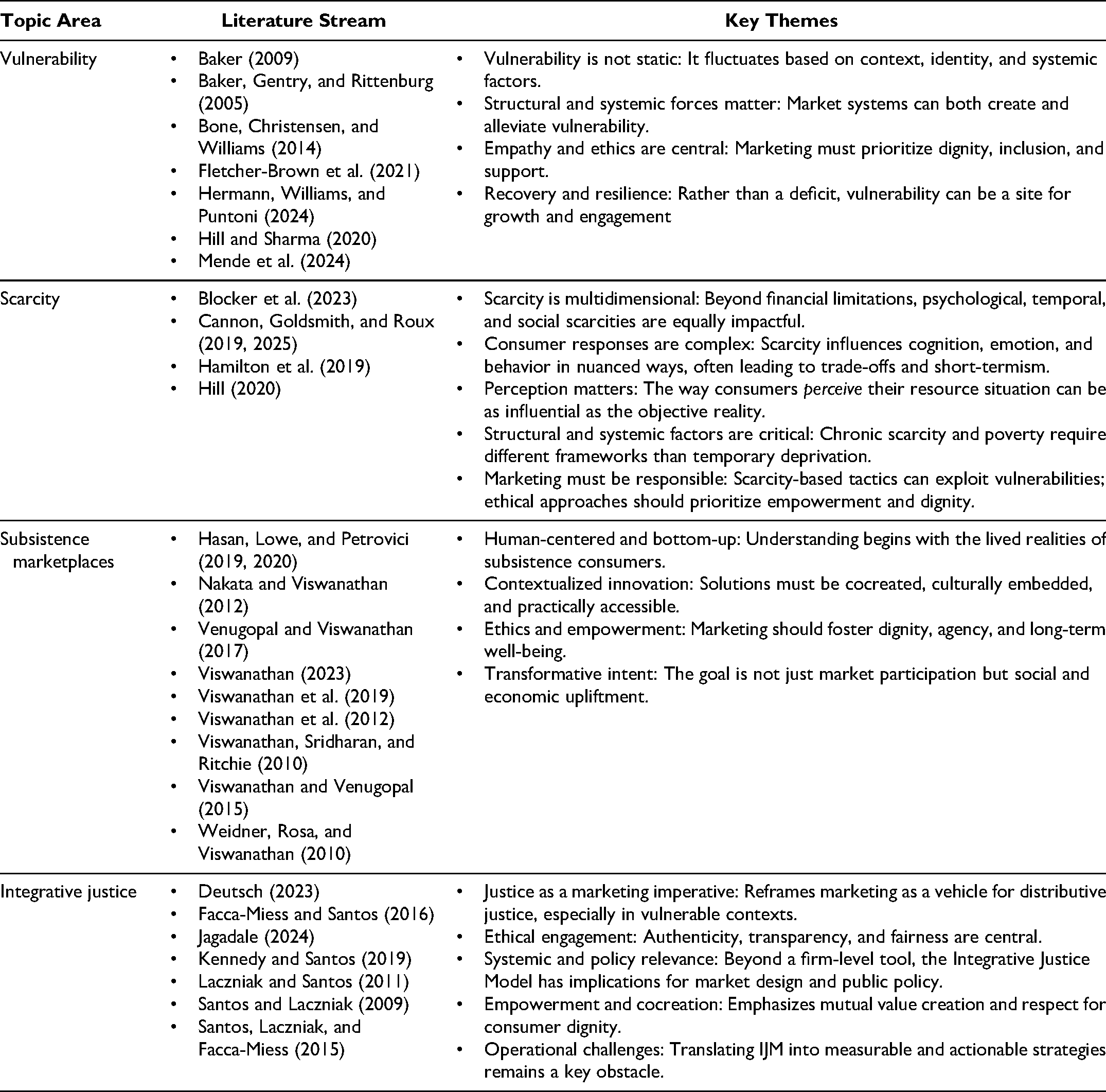
Existing frameworks in marketing and public policy have innovated insights into impoverishment over the years (Blocker et al. 2023; Hill and Sharma 2020; Santos and Laczniak 2009; Viswanathan et al. 2019; see the Appendix). Yet, poverty remains a continuous challenge. Our focal questions are as follows: Why do public policies continually fall short despite ongoing innovation and interventions? What are the psychological and moral underpinnings of policy neglect? And what are the implications of such insights for pathways forward for policy? Prior research on impoverished consumers and resource scarcity has illuminated the lived experience of deprivation (Blocker et al. 2023) and the harm caused by restricted access to resources (Hill and Sharma 2020). Within subsistence marketplaces, organizations often lack understanding of the daily life realities of low-income consumers, and decades of research have called for a bottom-up approach to design solutions starting from the lived experiences of subsistence consumers (Viswanathan et al. 2019). Similarly, the Integrative Justice Model calls for organizations to embrace justice as a strategic imperative by cocreating offerings, avoiding manipulative and exploitative practices, and advocating for fair and inclusive economic policies (Santos and Laczniak 2009).
These prior frameworks collectively emphasize structural constraints and challenge deficit-based views. However, they do not directly focus on the psychological and moral underpinnings of policy neglect and the consequent implications for practice and research. We advance this discourse by introducing moral traditions—the ethical frameworks and belief systems that guide perceptions of right and wrong—as a critical, yet overlooked, lens that can impact policymaker deliberations. Our approach reveals how moral traditions become distorted through psychological drivers of beliefs (how things are), and how ideological perspectives on unconstrained free will inform stereotypes and justify neglect or punitive policies. Furthermore, this deeper examination exposes how faulty beliefs are not merely cognitive errors but ethical failures with real consequences, and it illuminates why policy to address poverty continues to fail despite investment and innovation.
Moral Traditions and Belief Systems in Poverty Discourse
Moral traditions encompass established values, customs, and reasoning patterns that guide ethical behavior within a group or community (Nyíri and Smith 1988); these traditions represent principles that guide how consumers believe things should be. Examples include Buddhism, Quakerism, and Confucianism (e.g., Burton and Vu 2021; Galston and Hoffenberg 2010). These traditions offer ethical ideals, but consumers also hold enacted belief systems, which are public beliefs that may distort those ideals. Like heuristic biases (Tversky and Kahneman 1974), these distortions can turn compassionate frameworks into punitive ideologies. That is, compassion and blame can coexist within the same tradition, revealing the need to critically examine how moral ideals are distorted in practice. We argue that consumers hold the obligation to align beliefs with truth and dignity, and that policy neglect is not merely structural—it reflects a collapse of moral traditions.
Diverse philosophical perspectives outline moral and ethical approaches for addressing poverty. Some philosophers suggest that morality is designed to protect the most vulnerable and helpless citizens in society (see Shue 1996). An alternative vantagepoint comes from Rawls’s (2020)veil of ignorance concept, which argues that if individuals’ personal outcomes or relative statuses in society were unknown, then they would be more open to protecting the poor, as no one would accept the high probability of being in poverty (Hill 2002b; Sud and VanSandt 2011). Scholars have intimated that Rawls’s veil of ignorance could advance the case of impoverished consumers (Scott et al. 2011), but this judgment-less perspective is steeped in selfishness that is hard to moderate under ordinary circumstances. Song (2019) finds that human rights conversations and emphases around the world have failed to bring injustice in material access into the foreground or to seek possible ways to capture and adjudicate such injustices. Etinson (2020, p. 355) shifts the focus from human rights to human dignity and proposes that “we avoid subjecting people to specific (socially oriented) harm of humiliation or degradation and, more positively, that we help protect them from such harm.” Thoma (2023) examines how the social sciences can inform democracy and the political system, and one concern is that homogenizing tools used to recognize the plight of impoverished consumers (e.g., cost of living) fail to capture their individual consumptive lives on the ground. Finally, Miller (2004) argues that people have a duty to give of their material largesse to help others in dire need. Collectively, these perspectives highlight a sense of moral accountability for citizens’ well-being, yet reality does not align with the dictates embedded within these moral traditions.
Consider the biblical verse, “For you always have the poor with you.” 2 In cities across the United States, unhoused individuals are visible reminders of persistent poverty. Globally, similar conditions exist in subsistence marketplaces (Hill 2008; Viswanathan et al. 2019; Viswanathan, Umashankar, et al. 2021). While moral traditions may frame the poor as blameless and needy, public beliefs often shift toward viewing them as ignorant, immoral, or lazy, reflecting a perception embedded in policymaking and social discourse. A recent Harris Poll indicates that 62% of Americans cite personal choices as a major factor in why people remain in poverty (The Associated Press and NORC 2025). Even well-intentioned initiatives suggest that policies should “help [poor] people get back on their feet,” implying that poverty is a temporary condition caused by a stumble, and that the poor simply need to be nudged into self-sufficiency (https://povertyusa.org/policies). For instance, some may question whether it is morally acceptable for the woman and her child in our introductory vignette to live “at the expense” of others or society (Otteson 2011). The same may be true of women struggling in subsistence economies (Venugopal and Viswanathan 2021).
Why do observers ignore the poor in front of them or fail to support those in distant lands? Part of the answer lies in how moral traditions shape belief systems, and how social discrimination reinforces these views (Hagerty, Barasz, and Norton 2022; Shelby 2007). Chignell (2018) explores this terrain, arguing that beliefs must be based on sufficient understanding to be morally sound. Building on Clifford's work (in Madigan [2008]), he emphasizes the duty to seek credible evidence and to reject falsehoods—even when they challenge our expectations. Additionally, development of beliefs is often not consciously attended to and may be viewed as involuntary (see Hill and Stamey [1990] for an example). The next subsection explores psychological drivers that distort beliefs guided by well-intentioned moral traditions.
Psychological Drivers of Belief Distortions
Moral traditions in isolation present noble principles on which to base beliefs. However, these traditions are often subconsciously influenced by psychological drivers of beliefs. The extant research in psychology on heuristics and biases emphasizes the many pitfalls of consumers’ cognitive processing (Tversky and Kahneman 1974). With respect to person perception, consumers often comprehend their surroundings based on two dimensions: First, they must determine whether others intend good or ill; then they determine how capable others are of enacting those intentions (Fiske 2018; Fiske, Cuddy, and Glick 2007). Thus, moral traditions are highly influenced by psychological drivers; beliefs regarding how things should be become subconsciously distorted.
The Stereotype Content Model (SCM; Fiske 2018) therefore offers insight into the negative automatic responses associated with various stigmatized groups. The SCM encompasses reactions to stigmatized persons based on race, lifestyle, socioeconomic level, housing status, and other factors (Fiske 2018). Over time, this research has categorized such persons as high or low on two global characteristics of warmth and competence (Cuddy, Fiske, and Glick 2008). The warmth dimension comprises traits that suggest a person's intent, such as friendliness and helpfulness, whereas the competence dimension comprises traits related to implementing intent, such as skill, ability, and intelligence (Fiske, Cuddy, and Glick 2007), and people spontaneously employ these dimensions when assessing a broad range of social groups (Nicolas, Bai, and Fiske 2022). Together, these two dimensions comprise the content responsible for stereotyped outgroups.
Societal discrimination without legitimate beliefs often happens when a group is low on warmth and competence. Take, for example, drug addicts, 3 who are viewed as cold and incompetent. Cikara et al. (2010) used a thought experiment, asking participants to decide whether to throw a switch that would change the course of a fast-moving train that is headed for a larger number of people to a smaller number. Most respondents would not modify its course because they do not want to be responsible for anyone's demise. However, they are more likely to do so if the people who would be killed are part of a stigmatized group like consumers with substance abuse problems. Clearly, participants’ beliefs about drug addicts may not be supported by their actual lived experiences. These stereotypes violate the ethical imperative to form beliefs based on holistic understanding and diverse perspectives.
Impoverished consumers fared no better. Like drug addicts, the poor are stigmatized and dehumanized by outsiders, eliciting feelings of disgust (Harris and Fiske 2006). Despite helping people respond negatively to unethical actions (Chowdhury 2019), disgust can also invite aversion to stigmatized groups (Harris and Fiske 2006). In Fiske's (2018) two-by-two framework, impoverished consumers are also seen as low in competence and warmth, placing them in a stereotypical category that denudes them of other traits that would make them distinct as human beings (Hill and Martin 2014). Such classifications are in violation of precepts for the creation of right beliefs in that they manifest a holistic portrait of an individual that gives the illusion of homogenous information without the necessary search for alternative perspectives.
Take the woman and her daughter described in our introduction. What if you learned that the woman’s husband had recently abandoned them, taking all the money they had in their home before his departure? The mother works for minimum wage at a fast-food restaurant and does not have the income to afford her former apartment and other expenses. She panhandles on the weekends, bringing her daughter along to elicit additional sympathy. Still, do either the people who drive past or politicians have an ethical obligation to better understand her situation? Given that her importance is low relative to other people in their belief systems (e.g., family, friends), it is unsurprising that neither group is willing to exert much effort on the woman's behalf.
However, if the beliefs we hold foster homogenizing viewpoints that are different than others’ self-reflections, then these beliefs may fail to recognize the humanity of such society members. Normatively, we argue that moral traditions should encourage deeper cognitive engagement and restraint from judgment in the absence of sufficient information. People are responsible for the beliefs they hold, regardless of the traditions that inform them. Thus, we see here how psychological drivers interact with moral traditions.
Oscar Lewis's (1959) “culture of poverty” theory had a profound impact on such public discourse and policy, but its legacy is mixed. While it brought attention to the lived experiences of the poor, it also perpetuated simplistic and stigmatizing views that obscured the structural roots of poverty. Small, Harding, and Lamont (2010) argue that Lewis's original ethnographic work resulted in oversimplified and overgeneralized ideas, creating a narrative that blamed the poor for their condition. In his critique, Philippe Bourgois (2015) emphasized that Lewis's concept resonated with moralistic ideologies that stigmatized the poor. He noted that the theory was often used to justify punitive welfare policies and neglect of structural reforms. Building on this foundation, our interrogation of free will and the SCM rejects simplistic “culture of poverty” accounts. Focusing on the belief systems of the nonpoor (e.g., voters, managers, policymakers) and their moral accountability, we highlight how such logic manifests through moral traditions via presumptions of free will and the enactment of stereotypical responses. Thus, the “culture” at issue here is dominant public and policy beliefs, not the subculture of those living in poverty. In the next section, we examine how ideological perceptions of free will distort moral traditions and personal responsibility in belief formation.
Ideological Perceptions of Free Will
Thus far, we have detailed moral traditions (how things should be) that become distorted by psychological drivers of cognitive processing (how things are); we next detail the motivational role of observers’ ideologies (how consumers think things are) that perpetuate faulty beliefs. At the heart of homogenizing and inaccurate prejudices is the conviction that people are enacting free will to make inappropriate decisions that upend their lives. Extant research on just-world beliefs demonstrates that individuals are motivated to perceive the world as orderly and fair, where people receive outcomes that they deserve (Furnham 2003; Van den Bos and Maas 2009). Although such a belief system can serve as a coping mechanism, it also facilitates victim-blaming, prejudice, and resistance to social change (e.g., Furnham 2003; Hafer and Sutton 2016; Lerner and Simmons 1966). Blaming victims for their misfortunes enables individuals to preserve a sense of control and predictability (Twardawski et al. 2025). While just-world theory explains the psychological need to perceive fairness in outcomes, we propose that consumers moralize agency through the presumption of free will, which functions as a proximal trigger for blame and SCM activation, reinforcing perceptions that consumers are responsible for their actions. Once blame is assigned, stereotype content (e.g., low warmth, low competence) is activated to rationalize and reinforce moral judgments. This mechanism also complements system justification theory, which posits that individuals legitimize social hierarchies by attributing outcomes to personal responsibility (Jost, Banaji, and Nosek 2004). In this way, free-will beliefs serve as a cognitive scaffold that rationalizes policy neglect through stereotype activation and moral disengagement.
Free will has received attention in consumer research (e.g., Baumeister et al. 2008; Hofmann, Strack, and Deutsch 2008; Wertenbroch et al. 2020; Wilson, Gaines, and Hill 2008), but less so as it pertains to decisions regarding consumer access to goods and services that meet ordinary needs (Hill 2020). There has been considerable debate historically within moral traditions as to whether free will exists under most circumstances, as well as with the advent of neuroscientific research (Gazzaniga 2012; Robertson, Voegtlin, and Maak 2017; Wilson, Gaines, and Hill 2008). From the perspective of this article, the origin or enactment of free will is less important than what it signals to observers of impoverished consumers who are users of those items needed to ensure a reasonable consumptive quality of life. Consumer research as a social scientific domain uses the term “vulnerability” to describe persons who lack sufficient access and are subject to associated harms (Hill and Sharma 2020). Much of this scholarship seeks to position vulnerable consumers as victims and not causal agents in settings that lead to market restrictions. Thus, observers may use their own free-will positions to determine what the poor should and should not do instead of looking to them for their lived experiences.
In his book The Illusion of Conscious Will, psychologist Daniel Wegner (2017, p. 145) tells readers, “The illusion of the will is so compelling that it can prompt the belief that acts were intended when they could not have been. It is as though people aspire to be ideal agents who know all their actions in advance.” Whether valid or invalid, the point is that many, if not most, consumers believe that they control at least some portion of their decision-making processes, and they hold others to the same principle. Thus, we have a tension between the consumer literature that emphasizes structural or societal conditions as causal factors for impoverished consumers’ lack of freedom to acquire and use what they need, and the moral position of free will that may signal complicity. What causes movement from one perspective to another (assuming there is no possible in-between) is the way in which consumers are perceived by observers. If they are considered unimportant (i.e., little relevance to their lives), with concomitant character flaws (i.e., low competence and low warmth, in Fiske's [2018] terms), then they are more likely to be ignored and disdained. Such conditions may lead to stereotypes that reduce observer cognitive processing based on discrimination and wrong beliefs. This path is, for the most part, the fate of the woman and her daughter in our vignette, showing little concern for their humanity or well-being.
Imposition of the expectation of free will by observers on impoverished consumers only makes sense under certain conditions. For instance, free will typically can exist when a person believes that alternative pathways to meeting needs are currently available. Yet the poor face substantial restrictions, especially in their marketplace interactions (Botti et al. 2008; Bublitz et al. 2019; Hill 2002b; Santos and Laczniak 2009; Viswanathan et al. 2009). Many people in the developed world face a plethora of options and opportunities that are constrained by their desire, decision architecture, and willingness to conduct an extended search. (Of course, virtually everyone has some limitations to their resource availability and buying power.) Nevertheless, persons like the woman and her daughter may face access limitations that all but dictate what they can and cannot have. Without sufficient resources, choices of living quarters may approach zero, placing them outside the housing market in their community (Hill 2002b, 2008). This condition may exist for other items essential to their basic life satisfaction that we will present in detail in a subsequent section.
Free will can be encumbered for psychological reasons as well. Some people, as members of discriminated groups, face situations that may undermine their agency and restrict options in the marketplace. Consider the case of African American consumers, who have been characterized as “shopping while Black” in the consumer psychology literature (Bone, Christensen, and Williams 2014; Crockett 2022). Their vulnerability is due to a personal attribute that is not of their making, and the philosopher Rawls (2020) claims such identifiers are morally arbitrary in that the individual should not be facilitated or constrained by them in their navigation of social institutions. This historic lack of access is exacerbated by the dearth of goods and services available in many communities predominantly inhabited by people of color (Bublitz et al. 2023; Mende et al. 2020; Shelby 2014; Stajkovic and Stajkovic 2024). Unfortunately, their ability to leave their neighborhoods for more affluent environs can be limited due to transportation problems along with beliefs that they would not be welcome there.
This discussion of free will and its relationship to impoverished consumers reveals the conflict between living in poverty and the perceptions of poor individuals by outside observers who impact their consumptive quality of life. We circle back to the original conversation on beliefs as informed by moral traditions, recognizing that lived experiences of persons in poverty and their free will expressions may be markedly different from how others see them. This statement may not fully recognize the true complexity of impoverished consumption. We mean here that their options are highly constrained or nonexistent, manifesting as a lack of access to preferable choices. Underlying such beliefs is a third-party orientation to market access that fails to consider the full range of restrictions that exist when an individual lacks the resources engage in marketplace exchanges or is inhibited by discriminatory behavior based on personal characteristics that are not germane to need satisfaction. Nonetheless, the negative stereotypes uncovered by Fiske (2018) create the illusion of a homogenous portrait of a human community that fails to understand the human behind the community.
Pathways for Belief-Based Poverty Reform
We next present three pathways to update belief systems regarding the poor for a more ethical and moral approach to those experiencing poverty (see Figure 1). This framework builds on our theoretical integration to provide a cohesive agenda for belief-based poverty reform. Each pathway is designed to counteract flawed assumptions about impoverished consumers and promote morally accountable engagement. Together, they operationalize our theoretical foundation by integrating insights from moral traditions, which offer ethical ideals often distorted in practice by psychological drivers of cognitive processing; free will, which functions as an ideological motivational scaffold perpetuating blame and stereotype activation; and the SCM, which reveals how impoverished consumers are subconsciously dehumanized through perceptions of low warmth and competence. The thematic principles of interconnection, CA, and dignity offer avenues to give impoverished consumers the ability to have unobstructed access to things that will allow them to live complete existences in the societies in which they are embedded, consistent with bottom-up approaches.
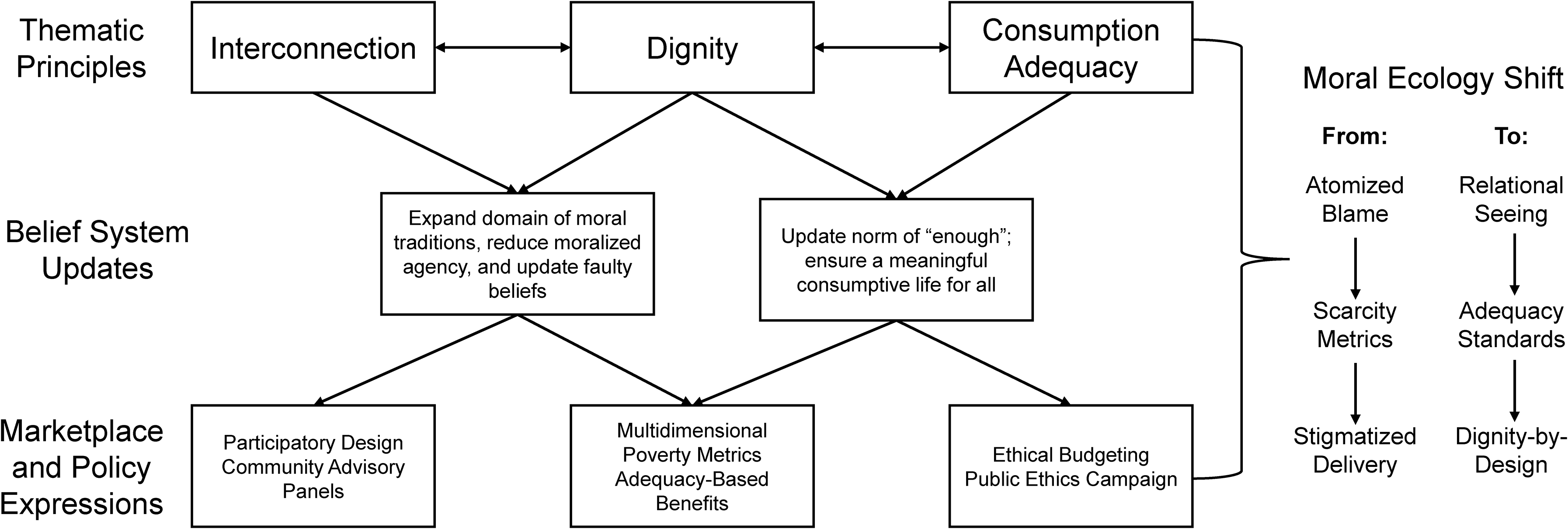
Pathways to Align Moral Traditions and Belief Systems for Poverty Reform.
Thus, to advance a morally accountable approach to poverty alleviation, we introduce a conceptual framework comprising three interrelated pathways: (1) challenging psychological drivers of distorted belief systems through interconnection, (2) enabling more accurate assessment of what is considered “enough” that overcomes faulty ideological perspectives, and (3) enacting dignity and right beliefs that are aligned with moral traditions. These pathways respond directly to the ethical failures outlined in our theoretical foundation, where distorted moral traditions, presumptions of unconstrained free will, and stereotype activation via the SCM collectively sustain harmful narratives about impoverished consumers. The first pathway emphasizes interconnection to challenge automatic judgments and restore the relational ethics embedded in moral traditions. The second pathway reframes poverty through the lens of CA, countering free will–based blame by illuminating structural constraints on access. The third pathway centers dignity as a moral imperative, rejecting SCM-driven dehumanization and affirming the ethical obligation to form beliefs grounded in truth and compassion. Together, these pathways offer a roadmap for belief-based reform that rehumanizes impoverished consumers and guides policy toward equity and justice. The result is an ecological shift from atomized blame, scarcity metrics, and stigmatized delivery to relational seeing, adequacy standards, and dignity-by-design.
Pathway 1: Informing Belief Systems Through Interconnection
Our first pathway directly addresses the ethical failure of forming beliefs without sufficient understanding. As noted, moral traditions often emphasize compassion and interconnectedness, yet public and policy beliefs frequently distort these ideals through heuristic shortcuts and stereotypes. The SCM shows that impoverished consumers are often perceived as low in warmth and competence, a categorization that dehumanizes and justifies neglect. Interconnection serves as a corrective mechanism. By fostering sustained, intimate engagement between policymakers and impoverished individuals, this pathway operationalizes moral traditions like Confucianism and Ubuntu, which emphasize relational ethics. It also challenges the presumption of free will that underpins blame and stereotype activation. Moving beyond empathy, this pathway promotes epistemic responsibility. It demands that belief formation be grounded in credible evidence and a holistic understanding, aligning with Chignell's (2018) ethics of belief and Clifford's (Madigan 2008) moral imperative to reject falsehoods. Interconnection thus becomes a moral act that rehumanizes the poor and reorients policy toward justice.
Our moral traditions inform our belief systems, and they often provide virtuous grounding for approaching various ethical challenges. At the same time, we are often faced with multiple foci—our family, our professions, our own personal livelihoods, and so on—that do not include those who are beyond our immediate concern. Like the mother and daughter in our opening vignette, we center our attention on our priorities, reducing the extent to which we process their lived experiences. While moral traditions may enable policymakers’ ethical treatment and prioritization of relevant considerations, they may rely on simple heuristic processing beyond that realm. Thus, aligned with the notion of expanding one's moral reach beyond close intimate relationships (Singer 2011), Pathway 1 argues for interconnection to allow our moral traditions and belief systems to transcend our individual priorities and staunch subconscious psychological processes that distort beliefs in practice. Our care ethics, such as Confucianism, the Ubuntu tradition, Quakerism, and Buddhism, offer guidance on relational qualities and skills of openness and responsiveness (Burton and Vu 2021); we demonstrate how care ethics can incorporate distant others through association. This approach humanizes the policy process, ensuring that it is informed by lived experiences and not abstract assumptions.
Prior research collectively highlights how interconnection—or the lack thereof—shapes the experiences of marginalized groups in institutional settings. The seminal work of Viswanathan, Sreekumar, et al. (2024) has shown that the path forward for the resolution of poverty conditions is to actively include the participation of all impacted parties, especially those who have traditionally been marginalized. They describe the process as “bottom-up,” moving the power position away from the advantaged to the most vulnerable. When Viswanathan, Jaikumar, et al. (2024) created their empowering and proactive approach to marketplace literacy, they faced and overcame cultural mores that clearly disadvantaged women. Bottom-up approaches, such as symbiotic academic-social enterprises (Viswanathan, Baskentli, et al. 2021), empower impoverished consumers through immersive strategies that can disrupt policy neglect.
We follow their lead in a different context that also places vulnerable consumers against those who control resources. In a shelter for homeless women and children, strict rules and cultural barriers prevented meaningful relationships between staff and residents, reinforcing dehumanizing conditions and limiting residents’ agency (Hill 1991). Moreover, as evidenced by the deep connection between volunteers and staff and the concomitant lack of interconnection among the volunteers/staff and shelter inhabitants, moral traditions failed to expand beyond close others. Without dialogue and interconnection, the volunteers and sisters could not overcome the stereotypical negative reactions to inhabitants.
In contrast, a study of homeless teenagers showed that personal interaction between service providers and youths helped dismantle stereotypes and fostered more compassionate and effective policy responses (Hill 2002a). Through this process, the moral traditions readily applied to service providers’ kin and close others permeated their interactions with the impoverished youths. Similarly, in a maximum-security prison, structured dialogue and humanizing practices, such as using full names and shared seating, enabled decision-makers to see incarcerated men as individuals, leading to more ethical perspectives and potential reforms (Hill, Cunningham, and Gramercy Gentlemen 2016). Through conversation, automatic assumptions of the prisoners moved to the fuller picture of their lived experiences, allowing for faulty belief systems to be replaced with more ethical and moral perspectives.
Across all circumstances, moral traditions and empathy expanded when interconnection was prioritized. Such interaction enables policymakers to override their automatic interpretations of impoverished consumers. Additionally, fostering interconnection enables observers to engage in perspective taking, which is an effortful cognitive process that promotes a shared identity and enhanced self–other overlap (Gupta et al. 2024). This perspective-taking and shared identity allows for productive dialogue in which observers are open to impoverished consumers’ points of view, improving their levels of empathy and understanding (Goldstein, Vezich, and Shapiro 2014; Gupta et al. 2024; Lteif et al. 2024). The plights of many of the impoverished consumers detailed herein were not a result of their free will; abuse, violence, and deprivation thrust them into poverty. Through interconnection, these uncontrollable forces became more apparent to observers. When interconnection is avoided, as was documented in the opening example of homeless women, impoverished consumers fall victim to stereotypical interpretation by observers.
There is a gap between moral traditions’ core teachings and how individuals interpret those teachings under contemporary sociopolitical conditions and cultural contexts. Interconnection offers a prominent pathway to correct misinterpretations based on faulty and incomplete information. Therein, interconnection enables consumers to align their perceptions with their moral traditions.
Case Examples
Our first case example entails the West Harlem Environmental Action (WE ACT) Diesel Bus Pollution Reform (Minkler et al. 2008). In Northern Manhattan, community members partnered with Columbia University researchers to address health issues caused by diesel bus depots. Through community-based participatory research, residents shared firsthand experiences of asthma and other respiratory problems. Their direct engagement with policymakers led to the relocation of bus depots and the adoption of cleaner fuel technologies. This case illustrates how lived experience and dialogue with affected communities can drive environmental justice reforms.
Another example comes from the Del Norte and Tribal Lands Human-Centered Design for Health Equity (Morrison 2020). In rural Northern California, the Building Healthy Communities initiative used human-centered design to engage Native American communities and other marginalized groups in shaping health equity policies. Policymakers and community members cocreated solutions by listening to stories of generational trauma and systemic exclusion. This process led to more inclusive and culturally responsive health programs, demonstrating how empathy and codesign can transform public health policy.
Internationally, we offer a case example from the SPRING Project, focusing on Migrant Integration Policy in the European Union (EU; Aly et al. 2023). The SPRING initiative in Europe applied codesign methodologies to improve migrant well-being. Migrants and migrant-led organizations were invited to share their lived experiences with policymakers, influencing the EU Action Plan on Integration and Inclusion (2021–2027). This participatory approach helped shift policy focus from top-down mandates to community-informed strategies that better reflect migrants’ real needs.
Policy Strategies
The goal of our first pathway is to foster intimate, sustained engagement between policymakers and impoverished consumers to inform empathetic and effective legislation. Connecting policymakers, who hold sway over consumptive existences of the marginalized poor, with those they serve would require observers and other gatekeepers to take time to gain a familiarity with these constituents that is almost always lacking. While it may seem rather simple, our first pathway suggests that creating connections among haves and have-nots allows the former to better understand the lived experiences and personal characteristics of the latter on a firsthand basis. Herein, we present specific strategies to enact this pathway.
First, we propose a bottom-up approach to policy design through the development of participatory policy panels. Such panels would involve establishing community advisory boards composed of individuals with lived experience of poverty who regularly consult with local, state, and federal policymakers. These panels would have formal input into the design and evaluation of poverty-related policies. Second, we advocate for immersive policy fellowships, where policymakers spend time embedded in communities experiencing poverty. For example, these fellowships may entail attending community events, shadowing service providers, and engaging in structured dialogues with residents. Finally, we propose lived experience testimony requirements. Such requirements may come in the form of a mandate that public hearings on poverty-related legislation include testimony from individuals currently or recently experiencing poverty, ensuring their voices are part of the official legislative record. In the next section, we discuss CA as a pathway for overcoming faulty beliefs about what impoverished consumers need and should consume (Durante and Fiske 2017).
Pathway 2: Redefining What Is Considered “Enough”
This pathway builds on our critique of how free will beliefs distort perceptions of need. The SCM reveals that impoverished consumers are stereotyped as undeserving, often because observers assume they have chosen their circumstances. These assumptions obscure the reality of constrained agency and consumption deprivation. CA reframes poverty not as a failure of effort, but as a failure of access. It challenges the moral arbitrariness of birth entitlements (Rawls 2020) and insists that dignity requires a baseline of goods and services—housing, food, clothing, healthcare, and job opportunities. This reframing aligns with moral traditions that prioritize care and protection for the vulnerable, and it counters the just-world bias that rationalizes inequality. By redefining “enough,” this pathway updates the moral calculus used by policymakers. It shifts the focus from income thresholds to lived realities, making visible the barriers that undermine free will and perpetuate stereotypes. It also provides a concrete framework for policy design rooted in ethical principles, not economic expediency.
The theory of distributive justice advanced by Rawls (2020) and others (Larsen and Lawson 2013; Ramos et al. 2024; Sud and VanSandt 2011) argues that there are certain basic goods that should be distributed to all, and marketed goods that should be distributed to those who desire them. Yet, stereotypical reactions to impoverished consumers are maligned with beliefs regarding what these consumers need (Durante and Fiske 2017). To further explore the basic goods required to live a reasonable consumptive life in society regardless of constraints, we discuss CA from consumer behavior (Martin and Hill 2012). The purpose is to better recognize what an individual needs that often escapes consideration of the abrogation of their free will by policymakers without similar poverty experiences. This pathway seeks to update social norms applied when determining the goods and services to which every person deserves to have access. Establishing this aspect of moral tradition heightens the standard by which policymakers judge others’ misfortune, allowing for more ethical treatment of impoverished consumers. In line with prior poverty research (Blocker et al. 2023; Dembek, Sivasubramaniam, and Chmielewski 2020; VanSandt and Sud 2012), this pathway also implicitly broadens our perspective on what it means to be impoverished, enabling a multidimensional definition to improve our understanding of poverty (Yurdakul, Atik, and Dholakia 2017).
The construct of CA originated over 20 years ago and has been subject to empirical evaluation (Martin and Hill 2012). Its tenets are in direct contrast to belief systems that fail to recognize the true extent of impoverishment in the consumptive lives of persons around the world. While CA has been used to examine how nations support material access for their citizens, it can also focus on restrictions to acquiring goods and services at the individual level (Hill and Mady 2024).
CA is composed of five categories of goods and services necessary to survive and eventually thrive to avoid constant attention to what one lacks so that higher-order desires can be pursued, regardless of effort or abilities. First, CA requires that every human have housing that is protective against the weather and possible assaults, while simultaneously meeting basic sanitary, sleeping, cooking, and individual privacy needs (Marmor 2015). The next category contains foods and drinks that support physical and psychological development in necessary amounts and within the cultural milieu for taste and preparation. CA also entails continuous access to and replacement of clothes for everyone that is protective against fluctuations in climate conditions, along with opportunities to dress that are consonant with the social setting. Healthcare is another essential ingredient to CA, and it seeks service delivery that guarantees necessary procedures on demand for preventative and remedial care consistent with the person's existing conditions and development. The final category entails opportunities for professional advancement and increased job prospects. Each item is necessary in and of itself without any attempt to determine which is more important, or how absence of one item impacts life satisfaction versus multiple deficits.
Historically, poverty statuses are determined by income level and access to assets (e.g., Farrell and Hill 2018). The notion of CA elevates perceptions of a basic minimum set of goods and services, enabling a fuller portrait of humanity by recognizing that everyone deserves necessities that go beyond what many can acquire. Instantiating CA as the norm in moral traditions enables ethical and appropriate assessments of the impoverished consumers we study, encounter, and evaluate. CA makes no assertions regarding positive or negative judgments of the poor as impoverished consumers; rather it serves as a basis for determining whether impoverished consumers have the tools needed to live meaningful consumptive lives as a moral imperative.
Case Examples
Some policy examples demonstrate the impact of thinking through the lens of CA. Take, for example, the Medicaid Nutrition Benefit Redesign in both California and North Carolina (Jantz and Bank 2024). Both states implemented Medicaid nutrition interventions that go beyond basic healthcare by addressing food insecurity as a health-related social need. These programs include home-delivered meals tailored to medical conditions, nutrition prescriptions, and pantry stocking and grocery provisions. These services are designed not just to provide calories but also to ensure culturally appropriate, nutritionally adequate diets that support long-term health and dignity. The programs were developed with input from Medicaid members, centering on their lived experiences.
In 2021, the U.S. Department of Agriculture (USDA) revised the Thrifty Food Plan, which determines Supplemental Nutrition Assistance Program (SNAP) benefit levels, to better reflect the real cost of a healthy diet (USDA 2021). This marked the first time the plan was updated without requiring cost neutrality, resulting in a permanent increase in SNAP benefits. The revision acknowledged that previous benefit levels were insufficient for families to afford nutritious food, and it aimed to support dignified, health-promoting food choices. Finally, under the American Rescue Plan, the U.S. Department of Housing and Urban Development (HUD) launched initiatives like the Emergency Housing Voucher and HOME Investment Partnerships programs (United States Interagency Council on Homelessness 2021). Both programs go beyond basic shelter by supporting wraparound services like case management and landlord engagement, as well as promoting Housing First models that emphasize stability and dignity over compliance. Taken together, these programs aim to make homelessness rare, brief, and nonrecurring, reflecting a shift toward adequacy-based housing policy. While such policies have been challenged by the current administration, their processes are in line with our perspective of best practices.
Policy Strategies
As our analysis of CA illustrates, poverty metrics must be redefined to extend beyond income-based thresholds and encompass standards of living that uphold human dignity. This reconceptualization would reshape eligibility criteria for social programs by integrating qualitative indicators of well-being and social inclusion. The overarching aim is to transition from income-centric models of poverty measurement and program eligibility toward frameworks that also account for dignity, CA, and social inclusion.
Multiple policy strategies can be implemented to achieve our second pathway. We first suggest that policymakers adopt or adapt the United Nations’ Multidimensional Poverty Index at the municipal or state level that includes indicators like housing quality, access to transportation, digital connectivity, and social participation. With respect to shelter, policymakers may consider conducting living standards audits. These audits of welfare programs could assess whether they meet a minimum standard of dignified living, such as whether food assistance allows for culturally appropriate and nutritionally adequate diets leading to CA. Finally, we advocate for adequacy-based benefit design. This would require a redesign of benefits (e.g., SNAP, housing vouchers) based on CA benchmarks rather than arbitrary caps, thereby ensuring they reflect real costs of living and support full participation in society.
Having established CA and interconnection as two pathways to overcome faulty beliefs and expand the circle to which our moral traditions apply, we next discuss how dignity-by-design serves as a final pathway for aligning moral traditions and enacted beliefs.
Pathway 3: Enacting Dignity and Right Beliefs
Pathway 3 synthesizes our core argument that beliefs about the poor are not just inaccurate, but unethical. The SCM shows how stereotypes strip individuals of their humanity, and free will beliefs reinforce these judgments by attributing poverty to personal failure. Moral traditions, however, call for the recognition of inherent dignity and the rejection of humiliation and degradation. Enacting dignity means embedding ethical principles into policy and service delivery. It requires a shift from charity to shared societal responsibility, where the poor are not passive recipients but active participants. This pathway operationalizes Etinson’s (2020) call to protect against socially oriented harm and Nussbaum’s (2001) emphasis on dignity as a foundation for justice. Right beliefs are those formed through effortful cognitive engagement, perspective-taking, and moral accountability. They reject the illusion of homogeneity and affirm the complexity of human experience. This pathway demands that policymakers and institutions move beyond stereotypes and embrace the full humanity of impoverished consumers. Thus, as noted in the interconnection pathway, beyond adopting external principles, belief-system updates can occur within one's own tradition; belief repair can be internally coherent, and not merely externally imposed.
Inherent to Rawls’s (2020) conception of justice as fairness is the notion that all individuals have equal dignity because all meet the conditions of a moral person. Christianity, among other traditions, emphasizes human dignity, and scholarship demonstrates the capability of dignity to inform and improve business ethics (Mea and Sims 2019). Dignity represents a fundamental human drive (Fukuyama 2018), and marketers may affirm or deny dignity in the way they present and deliver market offerings (Lamberton 2019; Lamberton et al. 2024). Dignity-affirming actions focus on ensuring that all consumers feel included and accepted, whereas dignity-denying actions intentionally or unintentionally exclude or stigmatize consumers (Chaney, Sanchez, and Maimon 2019; Lamberton 2019). In the presence of dignity-denying actions and absence of dignity-affirming ones, strategies to alleviate consumer poverty will fail.
Even organizations designed to serve impoverished consumers may inadvertently stigmatize their constituents in various ways (Mirabito et al. 2016). For example, creating separate lines to offer free meals for impoverished children legitimizes their stigmatized status (Gundersen 2015; Pogash 2008). Similarly, food and housing services routinely subordinate homeless consumers, reinforcing their position as passive receivers and disallowing them to proceed as active participants (Cherrier and Hill 2018). Nonprofit organizations that reinforce homeless subordination undermine the capacity for reciprocal exchange—a fundamental tenet of marketing. As a result, impoverished consumers avoid or reject nonprofit services, finding alternative ways to satisfy their needs while maintaining agency and active involvement (Cherrier and Hill 2018; Hill 2023).
Dignity-denying actions also emanate from policymakers’ expectations that impoverished consumers must aspire to and work toward eliminating their poverty status, and such legislators may become apathetic to any constituents who fail to move up the social hierarchy (Kryda and Compton 2009). These expectations and stereotypical perceptions of consumers can impact how service providers and other observers treat them during interactions (Phillips and Kuyini 2018).
Case Examples
As of 2025, multiple states now offer universal free school meals, thereby affirming dignity and eliminating the stigma discussed previously (Sheldon 2024). These policies mean that students no longer need to be identified as “low-income” to receive meals, avoiding lunch shaming and social exclusion. Moreover, all students eat together, fostering a sense of equality and community.
Another exemplary case of instantiating dignity comes from the San Bernardino Americans with Disabilities Act (ADA) Settlement for Unhoused Individuals with Disabilities (American Civil Liberties Union [ACLU] 2024). In Tyson v. San Bernardino, the ACLU of Southern California and advocacy partners reached a landmark legal agreement with the City of San Bernardino to protect the rights of unhoused individuals with disabilities. The agreement prohibits the city from displacing unhoused individuals during encampment cleanups unless noncongregate interim housing (e.g., hotel rooms) is offered. Critically, it also requires reasonable accommodations under the ADA and prevents the destruction of personal property during cleanups. This policy affirms dignity by recognizing the human rights and agency of disabled, unhoused individuals and ensuring humane treatment during city actions.
Policy Strategies
The goal of Pathway 3 is to embed ethical principles into social policy design, and there are various ways this may be achieved. For example, ethical budgeting frameworks can be designed at the city or state level, where budget decisions are evaluated based on their impact on impoverished populations and their alignment with principles of dignity and equity. Similarly, to increase public support, we propose a public ethics campaign. This may include launching public education campaigns that reframe poverty as a societal failure rather than an individual fault, using storytelling, data, and moral appeals to shift public opinion and build support for dignified treatment and redistributive policies.
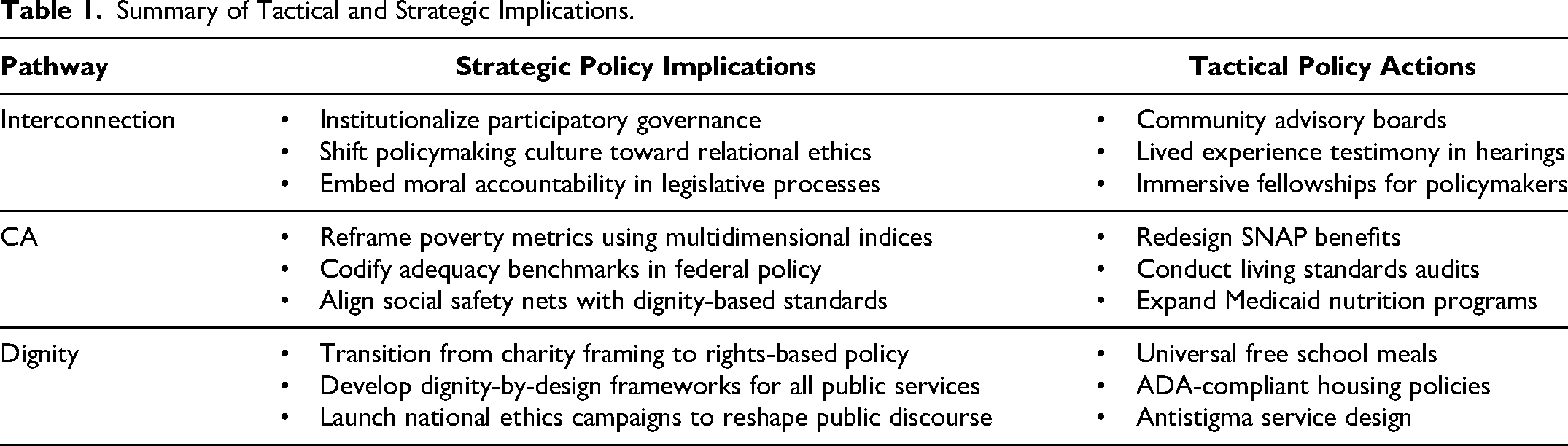
Interconnection, CA, and dignity collectively offer avenues to expand the realm of moral traditions, overcome faulty belief systems, and ultimately address impoverished consumers morally and ethically. These concepts are synergistic insomuch as more interconnection among the impoverished and observers like policymakers enables greater awareness of the lack of CA, and it naturally encourages more dignified treatment of impoverished consumers through greater understanding of their lived experiences. Similarly, recognition of dignity as a basic human right enables greater interconnection that fosters these positive moral outcomes (Pless, Maak, and Harris 2017). Table 1 presents a summary of the broad-level strategic focus of these pathways along with the concrete, tactical actions.
Summary of Tactical and Strategic Implications.
Discussion
Our conceptual framework offers a transformative lens that integrates moral philosophy, consumer vulnerability, and stereotype theory to challenge existing assumptions in marketing and public policy. We shift the focus from impoverished consumers’ behavior to the moral traditions of the nonpoor, including voters, managers, and legislators. We show that beliefs—not just systems—must change. We then offer actionable pathways (interconnection, CA, and dignity), advocating for sustained engagement between policymakers and impoverished communities through participatory design and advisory boards; a redefinition of poverty metrics to reflect dignified living standards, incorporating qualitative indicators of well-being and social inclusion; and a reframing of poverty policy from charity to shared societal responsibility, supported by progressive taxation, redistributive programs, and ethical budgeting practices that prioritize the needs of the vulnerable as a moral imperative. Collectively, these pathways reorient foundational constructs toward ethical inclusion, structural awareness, and human dignity. Our framework provides novel theoretical and practical contributions, organized around a central question: Why do public policies continually fall short despite ongoing innovation and investment in poverty interventions?
Theoretical Implications
We introduce moral philosophy as a critical lens for understanding poverty-related belief systems. Prior research has emphasized structural constraints (e.g., Blocker et al. 2023; Hill and Sharma 2020), ethical marketing (e.g., Santos and Laczniak 2009), and bottom-up engagement (e.g., Viswanathan et al. 2019); however, they largely assume good faith on the part of policymakers and institutions. We challenge this assumption by revealing overlooked dimensions, beginning with belief systems as barriers showcasing that faulty moral beliefs, not just lack of information or resources, are central to policy failure. Further, we explore dehumanization mechanisms. Specifically, we integrate the concept of free will into Fiske's (2018) SCM, showing how beliefs in unconstrained free will activate stereotypes that portray impoverished consumers as low in warmth and competence. This integration provides a psychological mechanism for understanding how dehumanization occurs and is sustained in societal and policy contexts. Through SCM and free will theory, we explain how impoverished consumers are systematically devalued and stigmatized, even within well-intentioned frameworks. Therefore, our first theoretical contribution identifies that public policies fail not just due to design flaws or resource gaps, but because they are informed by flawed moral traditions and belief systems that blame the poor for their circumstances (via belief in free will), dehumanize them (via SCM stereotypes). and justify neglect or punitive approaches (via just-world beliefs and system justification).
We then present a solution framework to this dilemma through our three pathways for belief-based poverty reform. Pathway 1 advocates for sustained intimate engagement between policymakers and impoverished consumers. It emphasizes relational ethics and epistemic responsibility in belief formation. Pathway 2 operationalizes CA as a multidimensional poverty metric, moving beyond income thresholds to include housing, food, clothing, healthcare, and job opportunities as essential goods. Pathway 3 centers human dignity as a moral imperative in policy design, calling for a shift from charity-based models to shared societal responsibility and dignity-by-design approaches.
Using a belief-based lens, our framework extends and reorients mainstream marketing theories and perspectives. Traditional market orientation emphasizes responsiveness to customer needs and competitive intelligence (Jaworski and Kohli 1993; Rokkan 2023), but we challenge this paradigm by introducing moral traditions and interconnection as essential extensions. Our framework critiques the assumption that market orientation inherently serves all consumers, showing how impoverished consumers are often excluded due to stereotypes rooted in beliefs about unconstrained free will. Drawing on Fiske's (2018) SCM and moral philosophy, we argue that market orientation must evolve to include epistemic responsibility: the obligation to form beliefs based on holistic understanding rather than heuristic bias. Market orientation must therefore include accountability for which voices are heard and how beliefs about consumers are formed.
Additionally, customer value has traditionally been defined in terms of utility, satisfaction, and exchange benefits (Woodruff 1997). However, our framework reorients this construct by introducing CA and dignity as prerequisites for value cocreation. Building on Martin and Hill (2012), we argue that value cannot be realized when consumers lack access to basic goods and services such as housing, food, clothing, healthcare, and job opportunities. This reframing challenges income-based poverty metrics and calls for a multidimensional understanding of value rooted in human flourishing. Recent work by Lamberton et al. (2024) supports this shift, emphasizing dignity as a psychological and moral foundation for consumer well-being. Value cocreation must therefore be reciprocal and respectful, recognizing consumers as active participants rather than passive recipients. Consumer value, then, is not just about utility or satisfaction but must be redefined to include adequacy and dignity. This shifts the focus from transactional benefits to ethical and human-centered outcomes.
Finally, relationship marketing has long focused on long-term engagement and an intimate understanding of the customer (Sheth and Parvatiyar 1995; Zhang et al. 2016). We build on this foundation by demonstrating the need to update what it means to develop close, interactive relationships with customers (e.g., Sheth and Parvatiyar 1995). Drawing on care ethics traditions such as Ubuntu and Confucianism, our framework suggests that true relationship marketing must go beyond transactional loyalty to include perspective-taking and ethical engagement. We advocate for moral interconnection, which involves deep, sustained engagement that challenges stereotypes and fosters mutual understanding. This goes beyond proximity or frequency of interaction to include ethical depth and relational empathy. Relationship marketing must evolve to prioritize ethical engagement and stereotype disruption, making moral interconnection a core component of relational strategy. Thus, our framework updates relationship marketing to prioritize rehumanization and stereotype disruption as central to building meaningful consumer relationships.
Future Public Policy and Marketing Research Opportunities
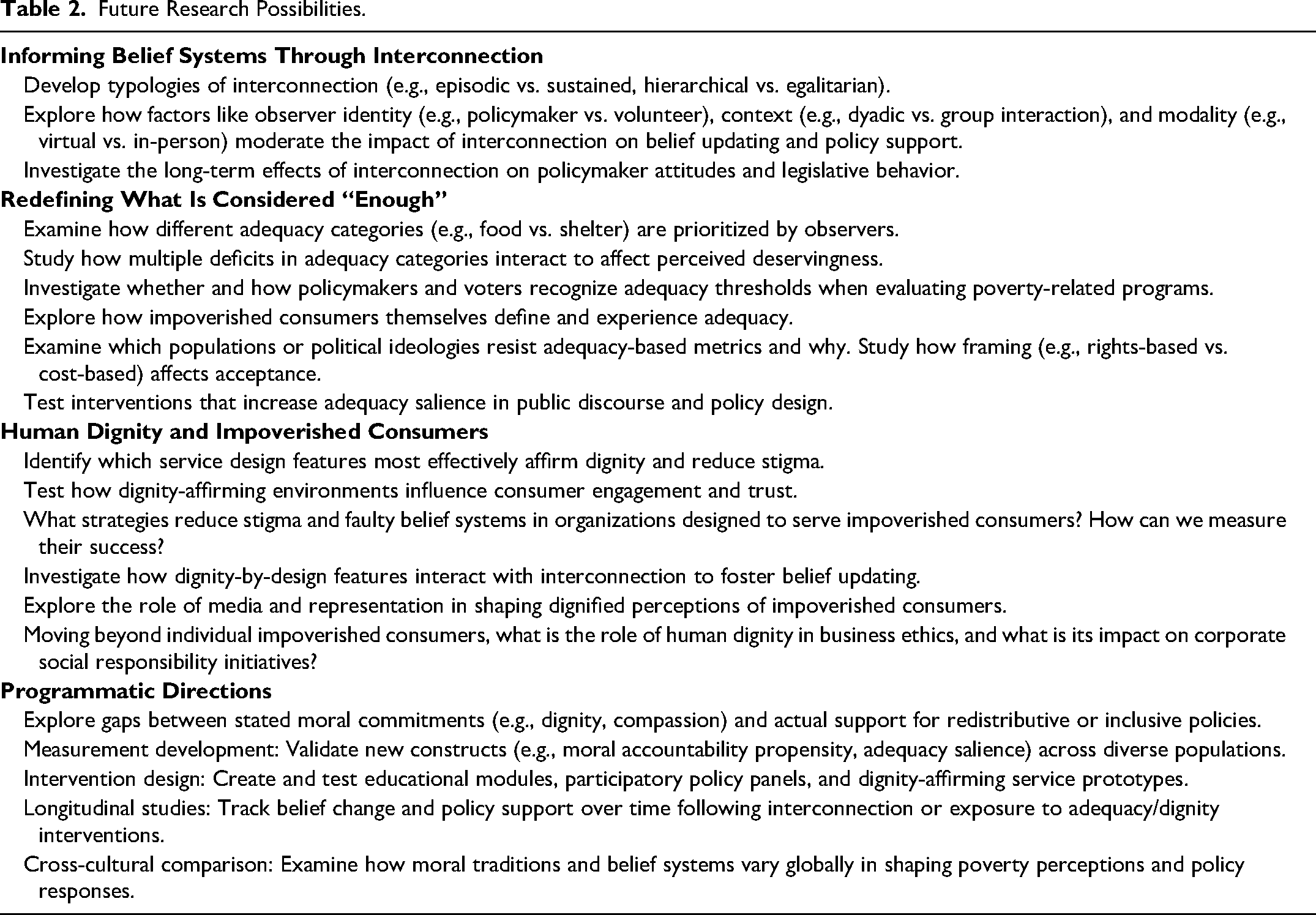
Our conceptual framework detailed herein provides a foundation for myriad future research directions. We discuss a few key opportunities, with more available in Table 2.
Future Research Possibilities.
Future research should interrogate the conditions under which interconnection—defined as sustained, relational engagement between observers and impoverished consumers—facilitates or undermines belief revision. While prior work emphasizes empathy and perspective-taking, our framework suggests that interconnection may backfire when interactions reinforce paternalism or stereotype confirmation. Scholars should explore the boundary conditions of interconnection: What forms (e.g., cocreation vs. service provision), durations, and relational dynamics foster genuine moral responsibility? This invites development of the construct moral propensity, which captures an individual's willingness to revise beliefs when confronted with counterevidence. Operationalizing this construct could involve measuring openness to belief change, discomfort with unsupported assumptions, and perceived ethical duty to seek truth—offering a foundation for longitudinal studies and intervention design.
In reframing customer value through the lens of CA, our framework challenges income-based poverty metrics and emphasizes access to essential goods and services. Future research should examine how the cognitive accessibility of adequacy benchmarks (i.e., adequacy salience) influences policy judgments and public support. What rhetorical frames (e.g., rights-based vs. cost-based) increase acceptance of adequacy standards? What ideological or cultural factors moderate this salience? Scholars can also explore boundary conditions for adequacy acceptance, identifying when and why certain groups resist adequacy-based policy reforms. These inquiries support the development of new measurement tools and experimental designs that test how adequacy framing affects perceived fairness, deservingness, and support for redistributive programs.
Our third pathway calls for embedding ethical principles into service delivery and policy environments. Future research should investigate how specific design features (e.g., inclusive language, spatial arrangements, participatory protocols) influence perceptions of deservingness and reduce stigma. This invites the creation of a dignity-by-design index, a tool for auditing service environments based on the presence or absence of stigmatizing cues. Additionally, scholars should explore the construct of belief–policy congruence, which assesses the alignment between individuals’ stated moral ideals (e.g., compassion, dignity) and their actual policy preferences. These constructs offer fertile ground for mixed-methods research, including surveys, field experiments, and policy audits, and they support a broader agenda of rehumanizing impoverished consumers through ethically grounded interventions.
While prior public policy and marketing research has demonstrated the importance of interconnection to updating belief systems and elucidating the humanness of impoverished consumers, we have yet to fully understand the best practices for such interconnection. For example, policymakers and other observers may volunteer their time to serve those in need, such as at a soup kitchen. This form of interconnection may allow for subtle updating, but might it also reinforce a paternalistic perspective? Evidence from the homeless youth (Hill 2002a) and prisoners (Hill et al. 2016) suggest that a more effective form of interconnection entails engaging with impoverished consumers to cocreate solutions to consumption problems. Similarly, these observers may interact with impoverished consumers intermittently across sporadic occurrences or more consistently across regularly scheduled events. Thus, can one foster interconnection through intermittent episodes, or is a longer duration needed to fully update faulty belief systems? Additionally, does duration ever backfire—perhaps as it combines with the form of interaction (e.g., serving vs. working with impoverished consumers)—such that spending more time with them may reinforce rather than mitigate faulty belief systems? Future research is needed to offer a more comprehensive conceptualization of forms and situational contexts that foster versus undermine interconnection.
Concluding Remarks
Our discussion opened with the viewpoint that most observers do not take the time to understand who the poor are and how they survive, erring on the side of negative stereotypes with little validation of beliefs that show them as low in warmth and competence. Ultimately, this position is a function of free will, suggesting they are responsible for their difficult circumstances. We posit that a moral belief system would both recognize their humanity and individuality and invoke the pathways offered that actualize ethical public policy. Looking across the five categories of goods and services needed to live a reasonable consumptive quality of life suggests that people should be treated with an inherent dignity that acknowledges Rawls's (2020) perspective that all entitlements available to individuals at birth are arbitrary and should not lead to imbalances in CA. To do so is to realize that a lack of CA is a serious violation of ethical treatment of one another.
Footnotes
Appendix: Marketing and Public Policy Frameworks on Impoverished Consumers
|
|
|
|
|---|---|---|
| Vulnerability |
Vulnerability is not static: It fluctuates based on context, identity, and systemic factors. Structural and systemic forces matter: Market systems can both create and alleviate vulnerability. Empathy and ethics are central: Marketing must prioritize dignity, inclusion, and support. Recovery and resilience: Rather than a deficit, vulnerability can be a site for growth and engagement |
|
| Scarcity |
Scarcity is multidimensional: Beyond financial limitations, psychological, temporal, and social scarcities are equally impactful. Consumer responses are complex: Scarcity influences cognition, emotion, and behavior in nuanced ways, often leading to trade-offs and short-termism. Perception matters: The way consumers perceive their resource situation can be as influential as the objective reality. Structural and systemic factors are critical: Chronic scarcity and poverty require different frameworks than temporary deprivation. Marketing must be responsible: Scarcity-based tactics can exploit vulnerabilities; ethical approaches should prioritize empowerment and dignity. |
|
| Subsistence marketplaces |
Human-centered and bottom-up: Understanding begins with the lived realities of subsistence consumers. Contextualized innovation: Solutions must be cocreated, culturally embedded, and practically accessible. Ethics and empowerment: Marketing should foster dignity, agency, and long-term well-being. Transformative intent: The goal is not just market participation but social and economic upliftment. |
|
| Integrative justice |
Justice as a marketing imperative: Reframes marketing as a vehicle for distributive justice, especially in vulnerable contexts. Ethical engagement: Authenticity, transparency, and fairness are central. Systemic and policy relevance: Beyond a firm-level tool, the Integrative Justice Model has implications for market design and public policy. Empowerment and cocreation: Emphasizes mutual value creation and respect for consumer dignity. Operational challenges: Translating IJM into measurable and actionable strategies remains a key obstacle. |
Acknowledgments
No acknowledgment of financial, technical, or other assistance was offered beyond the ordinary support of departments, universities, and colleagues. The authors thank the JPP&M review team for their helpful remarks.
Joint Editors in Chief
Jeremy Kees and Beth Vallen
Associate Editor
Cliff J. Shultz
Declaration of Conflicting Interests
The authors declared no potential conflicts of interest with respect to the research, authorship, and/or publication of this article.
Funding
The authors received no financial support for the research, authorship, and/or publication of this article.
