







Abstract
Can—and should—marketplace inclusion extend to nonhuman animals? Research traditionally conceptualizes marketplace inclusion as a human-centered concern, focusing on fair access, participation, and representation of human consumers (Henderson and Williams 2013). Yet this approach may itself be exclusionary, as it adopts an anthropocentric focus that excludes nonhuman participants in the marketplace. However, animals play a pivotal role in markets—as consumers of products and as providers of services, including entertainment and assistance (Tallberg, Huopalainen, and García-Rosell 2025)—thereby making them stakeholders who are vital to a firm’s survival and success (Evan and Freeman 1988).
In this light, marketplace inclusion must broaden beyond an anthropocentric lens. We draw on multispecies justice (Raymond et al. 2025) as theoretical scaffolding that emphasizes the interdependence between humans and other species and highlights conflicts across three dimensions—representation, distribution, and agency—thereby enabling us to transcend a purely human-centered understanding of marketplace inclusion. Representation concerns how nonhuman animals are recognized and positioned within market structures. Distribution addresses the (un)fair allocation of market-based benefits, risks, and harms across species. Agency considers animals’ capacity for voluntary, goal-directed action and whether this capacity is recognized as morally relevant. To ground this framework, we outline three key roles that animals occupy in marketplaces and examine how they are included either independently or as part of human–animal ensembles.
First, research discusses whether companion animals are objects or subjects of consumption (Hirschman 1994). Even when animals are framed as companions or family, research typically centers on human consumers as decisive agents, particularly in consumption decisions directed toward animals. Examples include expenditure on pet food, veterinary services, and animal-related hobbies. Although animals themselves could be understood as consuming subjects or consumers (Kylkilahti et al. 2016), they are most often treated as targets of human action.
Second, animals play a crucial role as service workers by supporting or enhancing customer experiences, whether in intimate assistance relationships, such as those between consumers and guide dogs, or in commercial settings involving therapy animals, transportation horses, or cats in cat cafés (Rimppi et al. 2026). Human–animal ensembles, such as handler–guide dog teams or individuals accompanied by emotional support animals, thus enable access to market offerings that would otherwise be restricted, illustrating that animals can facilitate more inclusive participation for consumers with disabilities, anxiety, or mobility limitations.
Third, animals can be entertainers, whether in livestock shows, sports competitions, or performances on television, in films, or in documentaries. Entertaining encounters with nondomesticated animals take place in zoos, wildlife reserves, and tourism, with wild animals treated as objects, captives, or managed workers (Kisora and Driessen 2025). Animals become marketable performers, selected and trained to entertain paying audiences or used as tools for advertising and branding, thereby commodifying the human–animal ensemble (Shamayleh and Arsel 2026). Here, animals facilitate human inclusion through emotional engagement, distraction, novelty, recreation, and, at times, sensationalism, learning, and cultural performance.
Together, these roles provide a basis for analyzing how multispecies marketplace inclusion is shaped through the lenses of representation, distribution, and agency. Focusing on representational inclusion, we examine how animals and human–animal ensembles are recognized and legitimized within market contexts. Ideally, representational inclusion entails that marketplace offerings acknowledge the diverse needs of human–animal ensembles, recognize animals as central actors rather than peripheral resources, and legitimize their consideration in market design and decision-making. In such configurations, animals are represented as stakeholders whose roles, interests, and well-being are explicitly valued and meaningfully integrated into market practices.
Our examples show that animals can contribute to human inclusion through tourism encounters, affective engagement in domestic and commercial spaces, and parasocial interactions in media contexts. Animals may also facilitate market participation by supporting individuals with specific physical, emotional, or social needs, thereby enabling human inclusion and social connection. However, animals’ representational exclusion remains widespread. Many practices reinforce asymmetries between human and nonhuman interests, as media and marketing often portray animals as resources, symbols, or tools for value creation, rather than stakeholders with their own needs and interests. For example, marketers instrumentalize animals by deliberately assigning influencer roles to petfluencers, who are perceived as more sincere than human influencers, thereby increasing the persuasive effectiveness of social media campaigns. While such representations can reshape cultural norms around animals, they may also reinforce speciesist assumptions by prioritizing market value over animal well-being. Although representational inclusion is visible, animals are frequently excluded when their roles are insufficiently recognized, and their needs and well-being receive less legitimacy than those of other stakeholders. In these cases, animals remain present in markets but are marginalized, revealing the limits of representational inclusion in multispecies market settings.
With respect to distributional inclusion, animals’ access to resources, protections, and benefits remains limited despite their economic contributions. Ideally, distributional inclusion would mean that animals’ value creation is accompanied by equitable access to labor protections, welfare safeguards, and institutionalized benefits, as well as a fair allocation of risks and responsibilities across market actors. However, animals in working roles are rarely recognized as employees and thus lack access to labor protections, occupational safety standards, or institutionalized safeguards, reflecting distributional exclusion. In entertainment and social media contexts, responsibility for animal welfare is unevenly enacted and often relies on voluntary standards rather than enforceable protections. More broadly, animal workers’ welfare depends on national animal protection laws and providers’ practices, revealing inequalities in how risks, harm, and benefits are allocated across species. Responsibility for these outcomes extends beyond owners to include producers, brands, digital platforms, and consumers, underscoring how distributional arrangements systematically privilege human beneficiaries while externalizing risks to animals.
Across many market contexts, animals’ capacity to act and influence market outcomes remains significantly constrained. Ideally, agential inclusion would entail that market environments are designed to accommodate animals’ interests, grant them meaningful opportunities to express preferences, influence interactions, and opt out of expected performances, thereby respecting their autonomy and dignity. In practice, however, markets rarely provide such opportunities. Animals are seldom able to influence their own consumption choices or withdraw from market roles, reflecting persistent agential exclusion. Although relationships with companion animals increasingly reflect attempts to respect agency (e.g., by offering choices during activities such as dog walking), such considerations are far less prevalent in professional market contexts. These limitations raise ethical concerns, such as in entertainment markets where animals are used for nonessential purposes and continue to perform despite restricted autonomy (Fennell 2022).
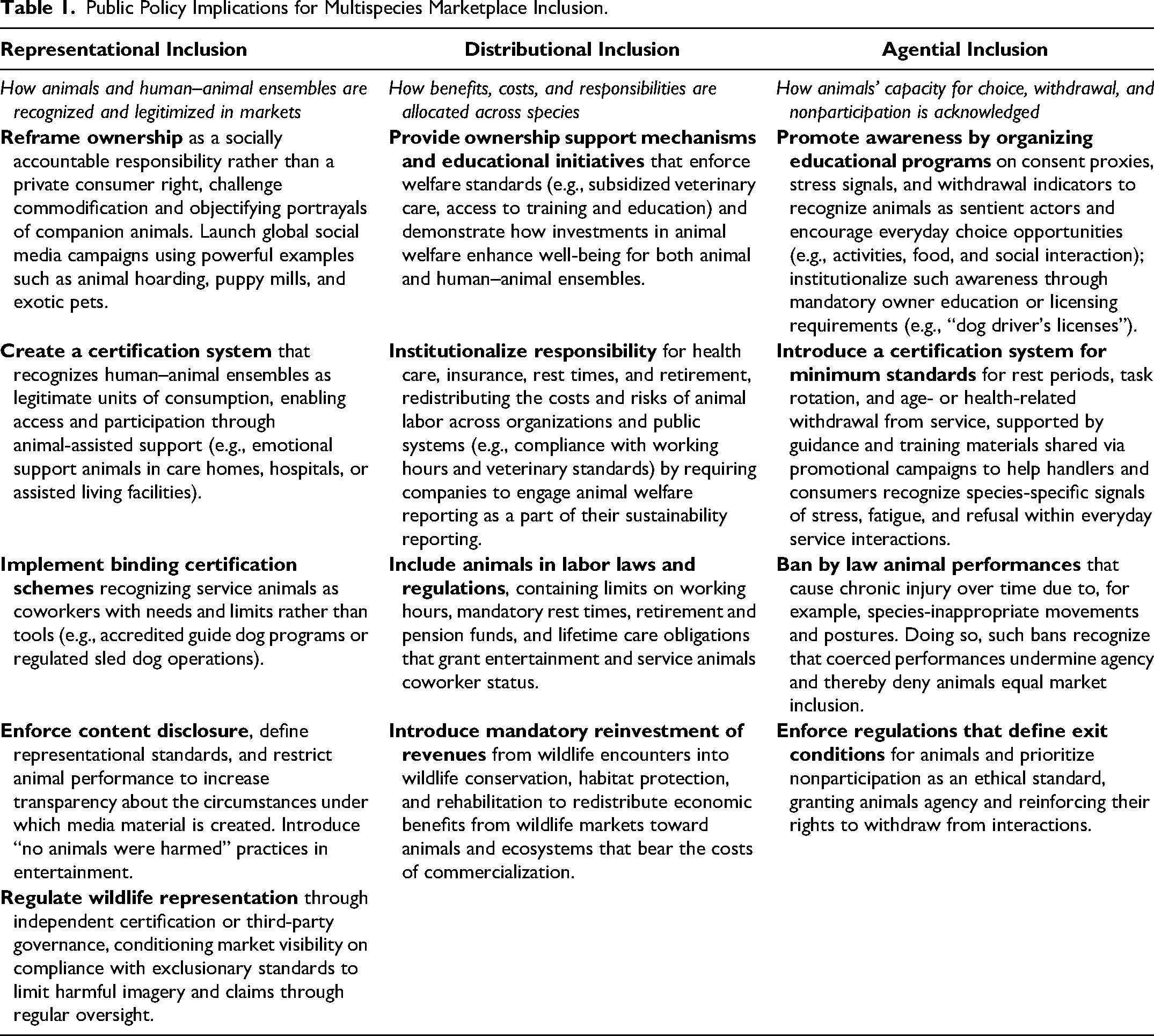
Together, these patterns of representational, distributional, and agential exclusion highlight that multispecies inclusion in markets cannot be achieved through symbolic recognition or voluntary ethics alone. Building on the ideal and exclusionary states identified across the three dimensions, Table 1 translates these analytical insights into actionable public policy implications. Across animals’ roles as companions, service workers, and entertainers, the table outlines interventions that reframe ownership and legitimize human–animal ensembles as units, enforce welfare standards and redistribute the costs and benefits of animal labor, and institutionalize rest, withdrawal, nonparticipation, and retirement as legitimate market outcomes. Although these measures operate through human governance and regulatory arrangements, they challenge the treatment of animals as passive resources and reposition them as stakeholders and, in some contexts, as coworkers or participants in human–animal ensembles. They aim to enhance inclusion for both animals and the humans whose participation depends on them and extend agency considerations beyond individual animals to broader ecological systems—such as plants, soils, and habitats—whose interests are affected by market activity but cannot be directly articulated.
Public Policy Implications for Multispecies Marketplace Inclusion.
Footnotes
Joint Editors in Chief
Jeremy Kees and Beth Vallen
Special Issue Editors
Samantha N.N. Cross, Rebeca Perren, Eileen Fischer, and Anders Gustafsson
Declaration of Conflicting Interests
The author(s) declared no potential conflicts of interest with respect to the research, authorship, and/or publication of this article.
Funding
The author(s) received no financial support for the research, authorship, and/or publication of this article.

Data Availability
Data transparency does not apply. No data were created or analyzed for this article.