






Abstract

With a new title that better describes its future, Sculpture Review (SR) in January 2024 will be offering exciting new features as it retitles as Sculpture, Monuments and Open Space (SMOS). This change reflects the journal’s commitment to expanding its scope and engaging with new audiences. The December issue will be the last as Sculpture Review.
All subscriptions will continue in January with the exception of the small list from the National Sculpture Society (NSS). In the future, individual subscribers will automatically become members of the International Sculpture Society, a new aspect of the journal that includes a number of past NSS members. This shift in membership underscores the journal’s intention to foster a more interconnected global sculpture community. Journal services will be handled by Wiley, with its 1,700 journals as the world’s largest affiliate of scholarly societies. The SMOS is one of 35 journals owned by the Policy Studies Organization (PSO), of which 19 are marketed by Wiley. The transition to a new publishing platform signifies a fresh chapter for the journal. To emphasize, the former arrangement of SR with Sage and NSS ends with the December 2023 issue.
Several prominent sculpture-related societies and a number of galleries will be affiliated with SMOS, and the ownership of the journal continues with the Policy Studies Organization, which bought the journal five years ago. Gordon Alt continues as editor, and Yingjie Wu continues as Managing Editor. Kelvin Low at PSO headquarters will handle advertising.
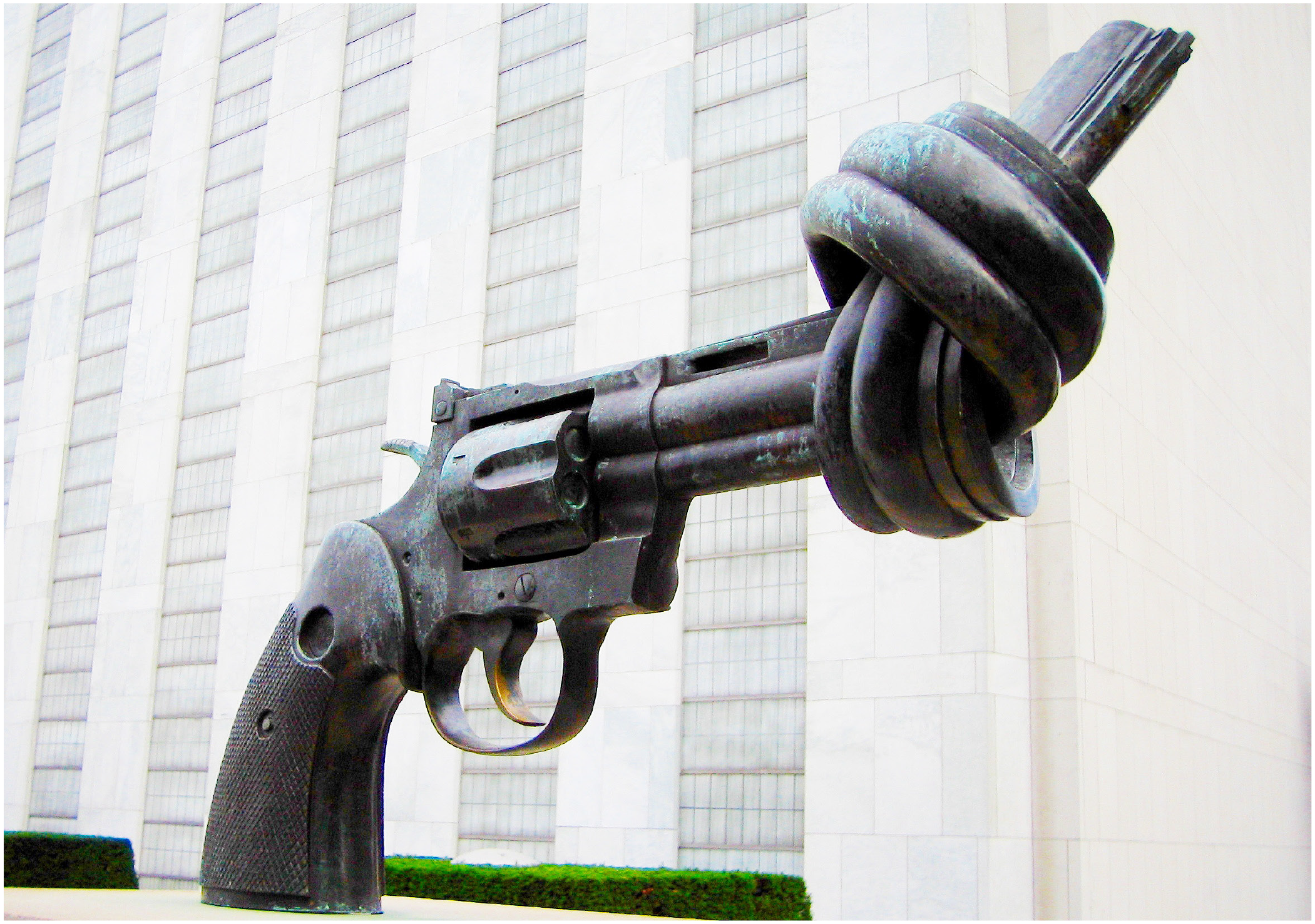
The Non-Violence by Carl Frederk Reutersward at the United Nations headquarters in New York City. The knotted gun honors John Lennon’s vision of a world at peace. In 1988, the Government of Luxembourg bought the sculpture and donated it to the United Nations. More details at www.un.org/ungifts/non-violence-0.
Photo: Didier Moïse, CC BY-SA 4.0 <https://creativecommons.org/licenses/by-sa/4.0>, via Wikimedia Commons
The bulk of present subscribers in the last few years have become museums, galleries, universities, foundations, and non-NSS individuals. We are adding leaders of change in the worlds of cemeteries, golf courses, and parks. They will be represented on the new boards and committees. This diversification of subscriber demographics highlights the journal’s intention to embrace a broader audience, recognizing the myriad spaces where sculpture holds significance. With this issue, the terms of office of the previous boards come to an end, with thanks for their service.
Over the last five years of our PSO ownership, the journal’s growth has suggested that readers want a world view. We feel strongly that art is the universal language. Recently, the PSO was honored to be accepted as a Special Consultant to the United Nations, confirming the role of this journal in the future. The recognition by a global institution reaffirms the journal’s mission to transcend borders and cultures through artistic discourse. Our other journals and offices are headquartered in Leiden, Paris, Mexico City, Manila, Sydney, and many other “overseas” locations. Our boards and committees represent many nationalities and world views.
In some ways, if one reads the newspapers, nationalism has continued to be the source of difficulties in the world. Of course, it’s fine to be proud of our culture and country, but that should not be at odds with how art can bring people together across boundaries and biases. The role of art in promoting unity amid diversity is more critical than ever, especially in a world often marked by division. Whatever can be done now to foster international understanding should be done, and the journal is going to try hard to demonstrate that forcefully in the years to come—while absolutely honoring its past.
Many years ago, at the founding of the PSO, there was a spirited discussion over its name. The founders, in the end, did not wish to have a society that was restricted to one country. We feel that is basic to the arts. The journal’s commitment to transcending national boundaries is rooted in PSO’s history and ethos.
Another major goal of the revamping is to reach out to galleries and collectors. Recently, we received a telling letter from a venerable member of the NSS in which he said, “Unfortunately, sculptors do not, in general, buy each other’s works. We need a journal that reaches those who do, such as collectors, galleries, reviewers, architects, and others where our work can be showcased. The present gallery in New York and the annual conference need rethinking.”
We agree. The imperative to bridge this gap underscores the journal’s aspiration to be a hub for the exchange of ideas and art within the industry. The journal will sponsor major international conferences every June and will vigorously pursue galleries as well as art schools, architects, and others who need much more than at present to be introduced to those who are working with realism. The commitment to fostering a more interconnected community is evident in the journal’s proactive steps to facilitate dialogues and connections through these conferences and engagements with various art-related sectors.
The journal will sponsor major international conferences every June and will vigorously pursue galleries as well as art schools, architects, and others who need much more than at present to be introduced to those who are working with realism.
We are negotiating for major spaces to showcase the work of our readers and contributors. For too long, the field has been largely occupied by what we often frankly see as an imposition on our senses by ignoring the significant and creative projects that are continually emerging in the arts, and focusing instead on piles of dirt, rooms filled with balloons, embalmed sharks, boxes of rusting bicycle parts, etc. All of this is marketed without a murmur. It is time for a much, much more vigorous rebuttal.
This is not to say that the art world should be dogmatic or partisan. It should be diverse, ecumenical, generous in discourse, and in dialogue at all times. Embracing a culture of inclusivity and open dialogue, the journal aims to be a platform for a wide spectrum of artistic voices and perspectives. We hope the augmented and invigorated journal will serve those ends. Since acquiring the journal, we at PSO have given much thought to just why the proponents of what we feel is often—let’s be honest—junk have prevailed. Part of the reason is the lack of enough voice about the situation, and hence our decision to renew and revamp. Through this rejuvenation, the journal aims to counterbalance the prevailing discourse and promote a more balanced representation of artistic expression.
That does not mean that politeness and scholarship should ever be lacking in the conversation. But we are not reconciled to realism. If that is the right word, it should have no place at the table. For the last issue of this year as Sculpture Review and looking towards next year as Sculpture, Monuments and Open Space, we invite your comments. Kindly Send them to Yingjie Wu at
Friends, please hear us loud and clear. Bob Dylan, who unites us with his songs, writes:
Come gather ‘round people
Wherever you roam
And admit that the waters
Around you have grown
And accept it that soon
You’ll be drenched to the bone
If your time to you is worth savin’
And you better start swimmin’
Or you’ll sink like a stone
For the times they are a-changin.’
So it is. Welcome to Sculpture, Monuments and Open Space. •
Footnotes
About the authors:
Yingjie Wu is Managing Editor of Sculpture Review and senior editor of the Policy Studies Organization and its Westphalia Press. Paul Rich is president of the Policy Studies Organization and its Westphalia Press.