







Abstract
According to social cognitive theory, people are most likely to emulate the behaviors of admired models. Though potentially valuable to researchers and practitioners, this postulate remains untested, as there is no validated measure of admiration. To facilitate research on admiration, a 14-item measure was constructed and the resulting scores were validated across two studies.
Social cognitive theory (SCT) postulates that people acquire a significant amount of information vicariously, typically by observing, and then replicating, the actions of models. This informal, vicarious “learning,” as Bandura (1969) conceptualized it, is an “identificatory process” (p. 213), one in which people shape their own complex patterns of thoughts, emotions, and actions through the emulation of another person or persons. Imitating the effectual and efficient behavioral patterns modeled by experienced, socially competent agents allows people to circumvent the potential burden of individual, trial-and-error experimentation. Bandura (1969) asserted that the degree of acceleration of the learning process was dependent on the extent to which people could “successfully match the behavior of appropriate societal models” (p. 213). Akers (1998) stated, “Whether the behavior modeled by others will be imitated is affected by the characteristics of the models, the behavior observed, and the observed consequences (vicarious reinforcement) of the behavior.” (p. 75).
To further elucidate the phenomenon of observational social learning and to distinguish between appropriate and inappropriate models, it is essential to determine which attributes of models are most likely to facilitate identification and foster emulation. In other words, which model characteristics enhance the observer’s initial attention to the model and motivate the observer to reproduce the behavior?
According to SCT and other social-learning theories, vicarious learning is more likely to be triggered by models that are admired (Akers, 1998; Bandura, 2009; Wareham, Boots, & Chavez, 2009). Wareham et al. (2009) maintained that imitation results from watching the behavior of “respected, admired, and frequently observed role models” (p. 164). Bandura’s (1986) ideas about identification with models meant that a relationship could develop between an observer and a model whether that model is someone in the observer’s material world (direct model) or mediated world (indirect or vicarious model). That is, an observer could learn from a television or movie character or the actor playing that character as long as the observer has realized identification with that model (Jensen, Bernat, Wilson, & Goonwardene, 2011). In fact, the more admired by or the more similar to the observer the model is perceived to be, the greater the likelihood that the modeled behavior will be enacted (Bandura, 2009).
Vicarious models are frequently encountered in the form of celebrities, journalists, actors, ministers, politicians, and star athletes depicted in the media on a regular basis. Depending on the behavioral goal, these vicarious models are at times more influential than parents or peers, especially when they enjoy the admiration of the observers. They have been shown to have an impact on adolescents’ career-related choices, and when celebrity models are used to endorse consumer products, they are frequently influential in shaping attitudes toward the brands and the actual buying decisions (Martin & Bush, 2000).
Cram, Fendrick, Inadomi, Cowen, Carpenter, and Vijan (2003) demonstrated important evidence of the potential impact of vicarious models in their study of the “Katie Couric Effect” (p. 1601). In March of 2000, Katie Couric, a well-known, national television broadcaster, whose own husband had recently died of colon cancer, hosted a week-long colon cancer awareness campaign on the Today Show. In an effort to empirically assess the influence of a celebrity endorsement of specific health behavior, Cram et al. (2003) evaluated the number of colonoscopies per doctor before and after the campaign. On the basis of data collected from two different patient populations, Couric’s promotional efforts resulted in a significant increase in colon cancer screening test rates for both groups. The authors could not offer conclusions about Couric’s attributes, which may have contributed to the success of the campaign, but they did note that the characteristics of those getting colonoscopies after the campaign were more consistent with the demographics of her regular audience, that is, women and younger individuals. It is possible that watching a highly regarded or admired celebrity such as Couric undergo the procedure herself, as she did in real time during the first show of that week, could induce an observer to engage in the same activity. This effect could be driven by the story, admiration for Couric, or both (Jensen et al., 2014).
At present, there is no validated measure of admiration; thus, research investigating the validity of SCT and admiration is still relatively scarce. Not only is there a lack of research on admiration, but there is also confusion about the exact definition of the term and how it relates to other emotions. For instance, “adoration” and “admiration” are often used interchangeably even though the former has little to do with emulation (Schindler, Zink, Windrich, & Menninghaus, 2013). Considering that SCT makes certain assumptions about the characteristics of appropriate models of behavior, it will be useful to have a validated tool to measure those traits. Counselors often use models and modeling to enact behavior change; hence, validating a measure of admiration would benefit counselors by helping identify optimal models or to explicate why certain models prove more influential than others. The present study addresses this gap by developing and validating a measure of admiration.
Literature Review
Definitions of Admiration
Admiration is a positive emotion, which is usually written about in conjunction with similar other emotions. The objective of this study is to determine whether admiration manifests as something distinguishable from these other feelings people have. Admiration is typically described as an other-praising, adaptive emotion that facilitates emulation or learning (e.g., Algoe & Haidt, 2009; Haidt & Seder, 1999; Henrich & Gil-White, 2001; Schindler et al., 2013). Admiration is often discussed in terms of its ability to motivate and help humans learn adaptive behaviors (Algoe & Haidt, 2009; Immordino-Yang & Sylvan, 2010).
Turning to the Oxford English Dictionary (1989), we find a basic definition of admiration: “agreeable surprise; wonder mingled with reverence, esteem, approbation; hence, in late usage, pleased or gratified contemplation.” An earlier definition of admiration that is still cited comes from Darwin (1872/1998): “surprise associated with pleasure and a sense of approval” (p. 269). Definitions since Darwin’s have elaborated on that “sense of approval” and “reverence” and its implications. Smith (2000) noted that admiration occurs when a favorable person attracts attention through “extraordinary and praiseworthy actions” (p. 185).
Part of this approval and esteem is the desire for emulation. In fact, Haidt and Seder (1999) specifically described admiration as a particularly human “emotion that facilitates learning” (p. 4). When someone admires another person, there can be a desire to “be like” that other person, in terms of skill, work ethic, character, or other qualities. In other words, people copy or emulate the behavior of those whom they admire. Becker and Luthar’s (2007) study of peer-perceived popularity among adolescents even used ratings on the qualities “want to be like,” “admiration,” and “respect” to operationalize peer admiration.
In a similar vein, Henrich and Gil-White (2001) set forth an adaptive sense of the highly similar construct, prestige. Note that Bandura (2009) also referenced prestige in his work on SCT. Henrich and Gil-White’s (2001) definition of prestige shares marked similarities with definitions of admiration. In particular, prestige results from “excellence in valued domains of activity” (p. 167). It does not result from antagonistic force. Prestige is also described as a facilitator of cultural transmission, or social learning. According to Henrich and Gil-White (2001), “Humans are default infocopiers, who try to first learn directly from others instead of ‘reinventing the wheel’” (p. 175). Prestige leads us to better role models from which to learn, allowing us to acquire adaptive behaviors more quickly. Likewise, Algoe and Haidt (2009) argued that admiration is an emotion that points us to the best role models for learning skills. Admiration is accompanied by a desire to be close to those who are admired, and typically results in some form of inspiration. Watching the object of admiration conquer some challenge or obstacle triggers this inspiration.
This adaptive, evolutionary tone to admiration carries over into Schlenker, Weigold, and Schlenker’s (2008) discussion of what makes a hero. They reference several key characteristics of admiration in describing heroes. They observed that a hero is associated with nobility and great achievement, stating that a hero is someone with “laudable achievements and praiseworthy actions” (p. 327).
As a result of these qualities, heroes are thought to disproportionately contribute to a group’s prosperity and ability to survive. The recognition and emulation of heroes can facilitate infocopying, thus helping spread vital skills in a group.
Given admiration’s value for basic group survival, it is no surprise that it has been shown as being tied to basic physiological survival processes. Immordino-Yang and Sylvan (2010) revealed this through a neuroscientific study of admiration for virtue. In their experiment, participants took part in a 2-hour interview in which they discussed true stories, some of which recounted particularly virtuous and admirable acts. Shortly after, participants underwent functional magnetic resonance imaging scanning and completed other psychophysiological measures. Immordino-Yang and Sylvan found that strong feelings of admiration for virtue were associated with increased activity in the parts of the brain responsible for memory retrieval, and other higher level cognitive, conscious processes. At the same time, admiration for virtue was associated with an increase in activity in the anterior insular cortex (the area responsible for feeling a racing heart or feeling your “gut”). The increased activity in areas of the brain responsible for conscious thought and basic internal body sensation suggest that admiration for virtue is rooted in basic physiological survival processes.
Motivation is a second key part of admiration. Because admired behaviors are positive or extraordinary, admiration can motivate individuals to improve themselves (Algoe & Haidt, 2009). In fact, Immordino-Yang and Sylvan (2010) argued that admiration for virtue is a “profoundly motivating” emotion (p. 110). When the researchers exposed participants to true stories about others’ virtuosic acts, those participants spontaneously brought up in later discussions the desire to live a better life and engage in noble actions.
Finally, existing research suggests two dimensions or two different types of admiration. While researchers like Schlenker et al. (2008) defined admiration as a response toward “those who exemplify high integrity” (p. 328), Algoe and Haidt (2009) specifically defined admiration as a positive emotional “response to non-moral excellence” (p. 107). Algoe and Haidt’s particular definition focused on skills, achievements, and actions, as opposed to other personal qualities. In doing so, they distinguished admiration from another other-praising emotion—elevation. Elevation is considered to be “a response to moral excellence” (Algoe & Haidt, p. 107). We admire those who display excellence in their achievements, actions, and skills; we elevate those who act with virtue or moral fortitude. Someone may admire Einstein for his mastery of physics, yet elevate Mother Teresa for her selflessness toward others. Distinction between skill and virtue has been observed in other studies of admiration: Immordino-Yang and Sylvan (2010), for example, specifically analyzed “admiration for virtue” (p. 110).
Convergent and Divergent Validity
Based on the previously discussed definitions of admiration, we expect several key convergent and divergent relationships. In short, research suggests that admiration should be positively correlated with both respect and trust for a referent. Prior research also suggests potential positive correlations with celebrity attitude and need for admiration. Dispositional envy is expected to negatively correlate with admiration. Finally, an association with liking is expected, although we argue that liking and admiration are theoretically distinct constructs.
According to Frei and Shaver (2002), the construct “respect in close relationships” is an emotion that “deepens security and increases mutual trust” (p. 122). It is also described as the opposite of contempt. To further explicate respect, Frei and Shaver conducted several studies using a prototype approach. In one study, participants rated features of respect according to their importance in close personal relationships. Of these, “honest,” “not abusive,” “loyal,” and “trustworthy and reliable” were considered most central to respect. “Having moral qualities” and “admirable talents and skills” appeared lower down on that list as well. This measure of respect included characteristics not directly associated with admiration, indicating distinction. However, “inspiring” and “admirable talents and skills” were associated with definitions of admiration, suggesting a potential positive correlation between these constructs.
Since trust was a key factor in respect in relationships, it may correlate positively with admiration as well. According to Wheeless and Grotz (1977), “holding certain relevant, favorable perceptions of another person” (p. 251) is a key part of interpersonal trust. To measure trust, Wheeless and Grotz created a semantic differential scale. The scale included items measuring trustworthiness, benevolence, respect, and honesty. Given previous definitions of admiration, it is difficult to imagine admiring someone (in terms of virtue) who does not possess these particular characteristics, or who possesses the opposite characteristics.
A strong correlation between liking and respect already has been established, for example, r = .75 (Frei & Shaver, 2002), and the researchers concluded that liking was a dimension of respect. Frei and Shaver (2002) even went so far as to argue that Rubin’s (1970) liking scale was more so a measure of respect. Since we have predicted a positive correlation with respect, we also predict a positive correlation with liking. Additionally, an item on Rubin’s (1970) liking scale references the construct: “It seems to me that it is very easy for _________ to gain admiration.” Based on previous research, admiration and liking should be related. Yet definitions of admiration indicate distinction from liking. Unlike liking, admiration requires some sort of comparison or recognition of another person’s excellence, as well as a reflexive desire to do (or want to do) something in response. After all, it is possible to like someone without wanting to emulate that person’s behavior.
Admiration should also diverge from several related but distinct constructs. Celebrity attitude is the degree to which individuals worship and/or are attracted to a celebrity (Maltby, Houran, Lange, Ashe, & McCutcheon, 2002). As the desire to emulate is a part of admiration, admiration and celebrity attitude could be positively correlated. However, the two constructs are conceptually distinct in that not all admired targets are worshipped.
Similarly, research on dispositional envy suggests divergent validity with admiration. Dispositional envy comprises two components: feelings of inferiority and feelings of ill will (Smith, Parrott, Diener, Hoyle, & Kim, 1999). Envy is typically brought on by an “unflattering social comparison” (Smith et al., 1999, p. 1009) resulting in feelings of inferiority for the person at hand. Envy is also associated with a sense of frustration and injustice. The person at the other end of the upward comparison may be perceived as having an unfair advantage in some respect. Dispositional envy is triggered by social comparison, but it lacks the approval, motivation, and inspiration associated with admiration. So while admiration is a positive response to an upward social comparison, envy is a negative response. Based on this understanding, someone who experiences higher levels of dispositional envy would be less likely to feel admiration for others.
Finally, from an audience characteristic standpoint, admiration and need for admiration should be unique constructs. Rice, Kubal, and Preusser (2004) stated that need for admiration is a construct addressing “interest in being recognized, admired, and appreciated for exemplary work and high standards” (p. 280). Rice et al. also noted that need for admiration is theoretically distinct from perfectionism. In the present study, participant need for admiration should be largely unrelated to perceptions of target admiration. Yet it is worth noting that admiration of others is a powerful motivator that may increase the desire to do admirable things (Immordino-Yang & Sylvan, 2010). Individuals motivated to do admirable things may desire to be recognized for doing so. The potential to be admired, alone, could be a powerful motivator in and of itself. Hence, those who experience higher levels of admiration for others may experience a greater need to be admired themselves.
Study 1
Given the need for a measure of admiration, a study was carried out with college students to develop a Multidimensional Admiration scale (MAS). The primary goals of the study were to examine factor structure and convergent/divergent validity for the MAS.
Method
Participants and Procedure
Undergraduate students (N = 182) from a large, Midwestern university completed an online survey for extra credit. Participant ages ranged from 18 to 28 years (M = 20.21, SD = 1.70). Females comprised 52.2% of the sample and males 47.8%. Most of the participants were White/Caucasian (74.7%). Participants also described themselves as Asian (17%), Black/African American (3.8%), and Other (4.4%). Of the total sample, 3.3% considered themselves to be Hispanic/Latino.
Participants completed the survey via a departmental research participation research pool. All students in communication courses were eligible. The bulk of the participants were from introductory public speaking classes (which represent a cross-section of the student body). Participants were able to select the study from an online list of available studies. On study selection, they were directed to the study, given instructions, and asked to complete the questionnaire. For completing the survey, participants earned 0.5% course credit for a communication course of their choosing. This study was approved by the university’s institutional review board.
Measures
Multidimensional Admiration Scale
The MAS was created to assess the degree to which a target individual is admired and includes items designed to tap into two theoretical dimensions of admiration: admiration for moral excellence and admiration for virtuosic skill (Immordino-Yang, McColl, Damasio, & Damasio, 2009). Thirty-three items were developed based on theoretical literature on admiration, morality, and excellence. Questions 1, 5, 6, 7, 9, and 12 were adapted from Frei and Shaver’s (2002) Respect for Partner Scale, as these items were designed to measure morality and have performed well in the past. Responses were measured on discrete visual analog scale (DVAS) 5-point items ranging from Strongly Disagree to Strongly Agree (Uebersax, 2006). The response scale also included an “I do not know who this person is” option, as it was conceivable that some participants may not recognize the target. These responses were to be coded as “missing” data. Sample items included “She/he is altruistic” and “She/he is the best at what she/he does.”
The present study used the MAS to examine admiration toward three target individuals: Katie Couric (a national news anchor), Tiger Woods (a professional golfer), and Bill Clinton (a former U.S. President). These targets were selected because they were likely to be familiar to the participant sample, and they had the potential to represent variance in admiration (i.e., of virtue and skill). The scale items were given in the same format, order, and wording for each target with the exception of changes of pronoun (he/she) and changes of the target name (e.g., “Katie Couric is . . .”). To reduce participant fatigue, additional person-targeted scales (i.e., trust, respect, liking, and envy) were administered only once, using Katie Couric as the target individual.
Trust
The Individualized Trust Scale is a 15-item, semantic-differential scale measured on a 7-point scale. It was developed by Wheeless and Grotz (1977) to measure the trustworthiness of a specific target person rather than the general trustworthiness of others and, as such, was ideal for the current purpose. It has performed consistently in the past, with Cronbach’s alphas ranging from .77 to .92 (Nass & Lee, 2001; Wheeless & Grotz, 1977). The current study returned a Cronbach’s alpha of .93 (M = 65.83, SD = 12.38). Sample items include “Not Deceitful–Deceitful” and “Faithful–Unfaithful.”
Respect for Partner Scale (Adapted)
The 20-item version of Frei and Shaver’s (2002) Respect for Partner Scale consists of 20 items scored on 7-point, DVAS items ranging from Disagree Strongly to Agree Strongly and is designed to measure respect toward another person, Cronbach’s α = .88 to .95 (Frei & Shaver, 2002; Letzring & Noftle, 2010; Uebersax, 2006). It was adapted by the original authors to replace personal pronouns (me, my) with other pronouns (e.g., from another person’s perspective, such as she or she/he). Sample items include “She/he fosters mutuality and cooperation” and “She is cruel or hurtful.” In the current study, we achieved a Cronbach’s alpha of .94 (M = 94.21, SD = 16.32).
Celebrity Attitude Scale
The Celebrity Attitude Scale was developed in order to assess the degree to which individuals worship/are attracted to a celebrity (Maltby et al., 2002). The scale consists of 23 items scored on 5-point, DVAS items ranging from Strongly Disagree to Strongly Agree and has performed well in terms of reliability, Cronbach’s α = .86 (Giles & Maltby, 2004; Maltby et al., 2002; Uebersax, 2006). It typically loads on three factors: Entertainment/Social, Intense/Personal Feelings about Celebrities, and Mild Pathological Attitudes (Maltby et al., 2002). Sample items include “My friends and I like to discuss what my favorite celebrity has done” and “I enjoy watching, reading, or listening to my favorite celebrity because it means a good time.” The current study returned a Cronbach’s α of .95 (M = 50.27, SD = 15.84).
Liking
Rubin’s (1970) scale of liking was used to evaluate liking toward the target person. This 13-item, 7-point DVAS has been extensively used in the context of person evaluation and has traditionally performed well (Cronbach’s α = .81–.83; Uebersax, 2006). The scale is anchored by two response options: Not at all true; Completely disagree and Definitely true; Agree completely. In this study, two items were dropped from Rubin’s original 13-item scale. One dropped item asked for an evaluation that was illogical given the current project (i.e., “When I am with ____, we are almost always in the same mood”). The second dropped item was not included as the result of experimenter error (“________ is the sort of person whom I myself would like to be”). This produced an 11-item scale tailored to evaluation of an interpersonally distant other. Sample items include “I would highly recommend ____ for a responsible job” and “I feel that ____ is an extremely intelligent person.” The current study found a Cronbach’s α of .93 (M = 57.07, SD = 18.58).
Dispositional Envy Scale (Reduced, Adapted)
Three items of the Dispositional Envy Scale (Smith et al., 1999) were used to tap into feelings of comparative envy. Of the original eight-item scale, only three of the items were suitable for measuring envy toward a particular target, while the other five items focused on dispositional envy in general. Thus, the current study used only these three items.
Item wording was adapted to replace more general terms (e.g., “some people”) with pronouns referring to the target individual (e.g., “her”). Items are measured on 7-point, DVAS items (Strongly Disagree to Strongly Agree; Uebersax, 2006). The scale performed reliably in the current study (Cronbach’s α = .90, M = 7.68, SD = 3.62). A sample item would be, “Frankly, his/her success makes me resent her.”
Need for Admiration
This study used the Need for Admiration subscale of the Adaptive/Maladaptive Perfectionism Scale developed by Rice and Preusser (2002). It consists of four items measured on 4-point DVAS items (Really Unlike Me to Really Like Me) and has demonstrated acceptably reliable scores (Cronbach’s α = .83–.89; Rice et al., 2004; Rice & Preusser, 2002; Uebersax, 2006; Ye, Rice, & Storch, 2008). It also showed acceptably reliable scores in the current study (Cronbach’s α = .80, M = 10.87, SD = 2.81). Sample items include “I want to be known as the best at what I do” and “I like to be praised for my work because then others will want to be like me.”
Results
Interitem Covariance Matrix
According to DeVellis (2003), initially testing a scale composed of as many as 33 items “is a form of insurance against poor internal consistency” (p. 66). In other words, the use of numerous items is expected to artificially inflate score reliability and is actually recommended at the beginning of scale development. However, it is also critical to take a close look at interitem correlations to determine whether items can/should be eliminated. For the Couric MAS, interitem correlations ranged from a low of .13 to a high of .80; for Bill Clinton, from .14 to .90; and for Tiger Woods, from .01 to .95. The wide variation among the interitem correlations for each scale indicates a lack of clustering around the average interitem correlation, which is the preferred condition for reliable and valid scores. Simms and Watson (2007) claimed this could be suggestive of a number of potential problems. For one, inordinately high interitem correlations could be indicative of unnecessary item redundancy. Pairs of highly correlated items should be carefully reviewed, and one of the items in each such pair should be deleted from the scale. Simms and Watson maintained, “Moreover, significant variability in the inter-item correlations may be due to multidimensionality within the scale, which must be explored” (p. 251). The scale was pared down from the original 33 items to eliminate item redundancy, being careful to remove the same items from all three sets of results (i.e., Couric, Clinton, and Woods). Nineteen items, which were consistently correlating at high Pearson r levels (ranging from .80 to .95) with other items in the scale, were removed, resulting in a 14-item scale (see Table 1 for all items).
Principle Axis Analysis of MAS for Couric, Clinton, and Woods.

Note. Principle axis analysis with direct oblimin rotation; MAS = Multidimensional Admiration Scale.
Principle Axis Analysis
Principle axis analysis of the Couric MAS was performed using direct oblimin rotation (see Table 1). The results were consistent with a two-factor solution: seven items measuring skill and seven items measuring moral excellence (see Figure 1). Parallel analysis was employed to investigate the validity of scores on the dimensions. Parallel analysis utilizes the basic characteristics of the analysis (14 items, 181 participants, 1,000 iterations) to estimate eigenvalue cutoff scores. Eigenvalues that are greater than these estimated scores are deemed to be probable dimensions whereas those below these scores are likely false factors. Parallel analysis was consistent with a two-factor interpretation as eigenvalues had to be greater than 1.49 (for Factor 1), 1.37 (for Factor 2), and 1.28 (for Factor 3). Factors 1 and 2 accounted for a cumulative 66.84% of the variance in the data set. Cronbach’s alpha for Couric Factor 1 (skill) was .92 (M = 3.92, SD = 0.74), and for Couric Factor 2 (moral excellence) it was .90 (M = 3.44, SD = 0.64), showing high reliability for the scores on each factor. Accordingly, the Clinton MAS and the Woods MAS resolved into the same two-factor solution with similarly high reliability of the scores. Cronbach’s alpha for Clinton skill and moral factors were .93 (M = 3.51, SD = 1.05) and .90 (M = 2.82, SD = 0.92), respectively. Cronbach’s alpha for Woods’s skill dimension was extremely high at .98 (M = 4.12, SD = 1.36). The reliability of scores on his moral factor was lower but still considered high (= .86, M = 2.45, SD = 0.81).
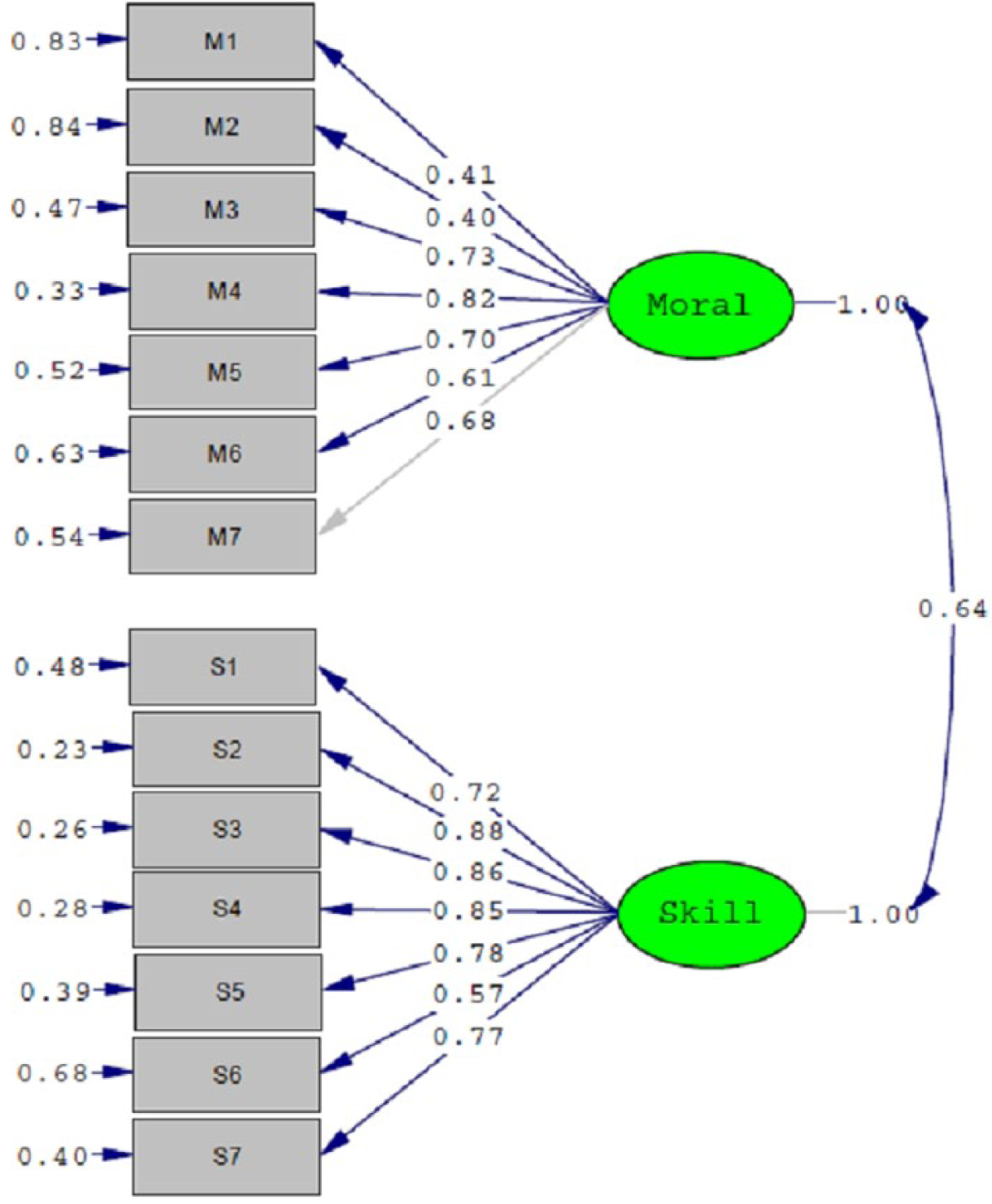
Standardized loadings and errors for two factor model. Couric MAS data from Study 2.
Convergent and Divergent Validity
To reduce participant fatigue, the person-targeted convergent and divergent scales (i.e., trust, respect, liking, and envy) were administered only once, using Katie Couric as the target individual. Internal reliability was examined for the five scales predicted to manifest convergence with the MAS and the one scale predicted to reveal divergence: (a) respect = .94; (b) trust = .93; (c) Celebrity Attitude = .95; (d) Need for Admiration = .80; (e) liking = .93; and (f) envy = .90. The results are consistent with the high alphas traditionally associated with these scales.
Pearson correlations were calculated between the two factors of MAS and the other variables for Katie Couric (see Table 2). Admiration for skill was positively associated with trust (r = .45, p < .001), respect (r = .46, p < .001), and liking (r = .62, p < .001). Correspondingly, admiration for moral virtue was positively related to trust (r = .65, p < .001), respect (r = .62, p < .001), and liking (r = .65, p < .001).
Correlation Matrix for Couric MAS.
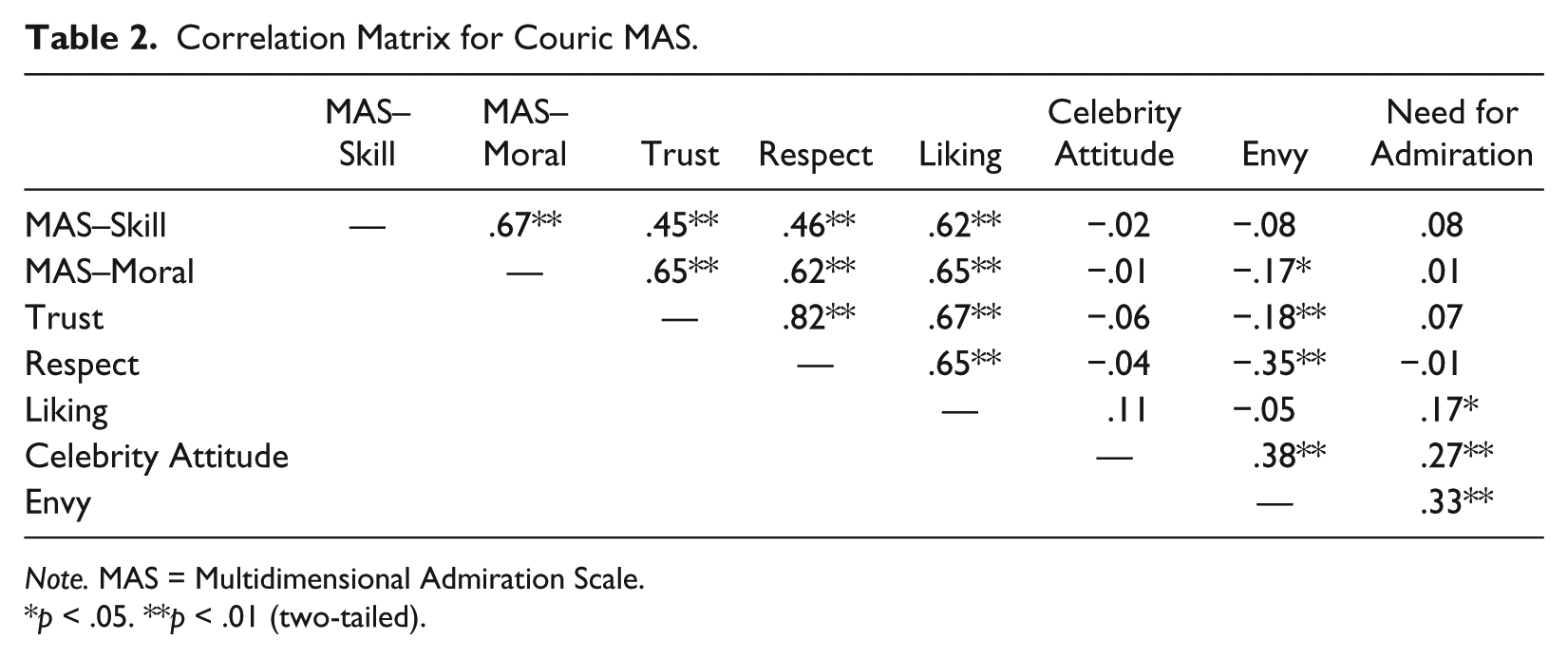
Note. MAS = Multidimensional Admiration Scale.
p < .05. **p < .01 (two-tailed).
Admiration for moral value was negatively related to envy (r = −.17, p = .032).
Discussion
The results of Study 1 corroborated logical predictions implied by Bandura’s SCT (1969, 1986, 2009). More precisely, the results revealed a two-factor structure of admiration, found the MAS to result in reliable scores on both factors, and substantiated the measure’s convergence with scales for respect, trust, and liking and divergence with celebrity attitude and need for admiration.
Study 2
As part of the validation process, a follow-up study was conducted that largely mirrored the method of Study 1 except that participants assessed the celebrities at two points in time. The goal of the study was to assess test–retest reliability of scores and to confirm the factor structure (DeVellis, 2003).
Method
Participants and Procedure
Undergraduate students (N = 308) from a large, Midwestern university completed an online survey for extra credit. Participant ages ranged from 18 to 32 (M = 20.58, SD = 1.69). Females comprised 64.3% of the sample and males 35.7%. Most of the participants were White/Caucasian (70.5%). Participants also described themselves as Asian (26%), Black/African American (2.9%), Native American (0.3%), Pacific Islander (0.3%), and Other (4.2%). Of the total sample, 4.0% considered themselves to be Hispanic/Latino.
Participants completed the survey via a departmental research participation pool. Only students who had not participated in Study 1 were eligible. On study selection, they were directed to the study, given instructions, and asked to complete the questionnaire. Two weeks after completing the initial survey, all participants were sent a link to a follow-up survey. For completing the survey, participants earned 1% course credit for a communication course of their choosing. This study was approved by the university’s institutional review board.
Measures
Study 2 included the 14-item MAS identified in Study 1. Participants completed the measure for all three celebrities (Couric, Clinton, and Woods) at two points in time.
Results
Missing Data and Nonnormality
Approximately 2% of the data were missing and replaced using expectation maximization (Schafer & Olsen, 1998). Ten items were significantly skewed and 9 items were significantly kurtotic. As a set, the items exhibited significant multivariate abnormality, skewness = 34.76, p < .001, and kurtosis = 17.40, p < .001.
Confirmatory Factor Analysis: MAS
The Katie Couric MAS data were examined using confirmatory factor analysis. Model estimation was carried out using Lisrel 8.8. Because the data were nonnormal, confirmatory factor analysis was carried out using the asymptotic covariance matrix. Thus, a Satorra–Bentler (S-B) χ2 is reported, which adjusts for nonnormal distributions (see Satorra & Bentler, 2010). In addition to the S-B χ2, which can be sensitive to sample size, five other fit indices were examined: χ2/df ratio, CFI (comparative fit index), RMSEA (root mean square error of approximation), SRMR (standardized root mean square residual), and Model AIC (Akaike Information Criterion). The χ2/df ratio adjusts for sample size by dividing the χ2 by the degrees of freedom. Ratios below three indicate a good fit to the data (Kline, 2004). For CFI, conventional standards suggest .95 or higher to indicate good fit (Hu & Bentler, 1999). For RMSEA, .08 and lower indicates good fit, while .05 or lower indicates excellent fit (Holbert & Stephenson, 2008; Hu & Bentler, 1999). The standardized RMR (SRMR) indicates good fit at .08 or lower (Hu & Bentler, 1999). The Model AIC is used to compare different models; lower scores indicate better fit (Akaike, 1987).
As a baseline, the basic measurement model consisted of one latent variable (MAS) and 14 indicators. The basic model was a poor fit for the data, S-B χ2(77, N = 308) = 522.17, p < .001, χ2/df ratio = 6.78, CFI = .91, RMSEA = .14 (90% confidence interval = .13, .15), SRMR = .10, Model AIC = 578.17. Both the explication and Study 1 suggested a two-factor model (MAS–Moral and MAS–Skill), so a revised measurement model was examined with latent variables (Moral and Skill). The two-factor model was a good fit for the data, S-B χ2(76, N = 308) = 199.19, p < .001, χ2/df ratio = 2.62, CFI = .98, RMSEA = .07 (90% confidence interval = .06, .09), SRMR = .06, Model AIC = 257.19. The S-B χ2 was significant, but all other indicators indicated adequate to good fit. Thus, the two-factor model was confirmed.
Test–Retest
Admiration is a disposition, thus it should remain relatively stable for a particular target barring some significant perception-changing event. Participants in Study 2 completed the MAS at two different points in time (initially and 2 weeks later) for all three celebrity targets. Only 215 of the original 308 participants provided data within the 2-week time (the remainder failed to complete the second survey or failed to do so in a 2-week span). The results reveal an acceptable degree of stability for MAS scores from Time 1 to Time 2: Couric (r = .83, p < .001), Clinton (r = .52, p < .001), and Woods (r = .50, p < .001). The fact that MAS scores for Clinton and Woods demonstrate a lower degree of stability than scores for Couric may be indicative of the fact that perceptions of these figures are somewhat more variable or ambiguous than perceptions of Couric.
Discussion
The MAS assesses one of Bandura’s (1986) positive model attributes, which, to date, has not been measurable. Combined with measures of other model characteristics (e.g., liking, credibility), the MAS offers a tool for identifying and understanding vicarious or indirect models. The MAS enhances the predictability of SCT assumptions by tapping into qualities of the potential endorser that are more narrowly related to attributes an observer evaluates when making a behavioral change decision.
Future research with the MAS should examine concurrent and predictive validity of the scores on the MAS. Concerning the latter, higher MAS scores (for skill, moral excellence, or both) should predict greater emulation of the target by the message audience. A strong test of predictive validity would be an experimental research program in which targets varying in admiration of skill and moral excellence were used as models in interventions/campaigns. Not only would this further validate scores on the MAS, but it would also facilitate the development of specific emulation postulates concerning admiration of skill and moral excellence.
Test–retest reliability of scores was excellent for Couric, but lower for both Clinton and Woods. Clinton and Woods have both experienced well-known public scandals, which likely damaged their reputations with certain segments. Perhaps as a result of these scandals, public admiration of Clinton and Woods is also more unstable and, therefore, prone to larger shifts over time. Indeed, popularity and effectiveness are routinely measured for presidents and poll data for these indicators are prone to relatively large shifts following scandals. Future work could elucidate this situation by tracking several prominent figures over time, including before and after a major scandal. If admiration scores become more unstable following a scandal—even after the scandal has faded from public discussion—then it would lend credence to this interpretation of the present results.
Limitations
The current studies had several limitations. The sample may not be representative of a more diverse group of adults. Students in their late teens and early 20s will frequently have a limited knowledge of people beyond a certain age range, especially if those people do not operate within the spheres of the students’ interests. On a similar note, the scores were validated for only three celebrity targets. Validating the scores on the MAS with other celebrities as well as noncelebrity targets is a priority for future research.
Conclusion
Bandura postulated that admiration was an important component in behavior change efforts. The MAS provides researchers with an instrument that delivers reliable scores for identifying optimal models and testing postulates about admired models. It could also advance research on how certain individuals come to be admired.
Footnotes
Authors’ Note
Data files can be obtained from the authors.
Declaration of Conflicting Interests
The author(s) declared no potential conflicts of interest with respect to the research, authorship, and/or publication of this article.
Funding
The author(s) received no financial support for the research, authorship, and/or publication of this article.