







Abstract
Traditionally, the herbal drugs are well established for their therapeutic benefits. Depending upon their geographical sources sometimes the trace and heavy metals’ content may differ, which may lead to severe toxicity. So, the toxicological and safety assessment of these herbal drugs are one of the major issues in recent days. Eight different plant species including Aloe vera, Centella asiatica, Calendula officinalis, Cucumis sativus, Camellia sinensis, Clitoria ternatea, Piper betel and Tagetes erecta were selected to determine their heavy and trace metals content and thereby to assure their safer therapeutic application. The trace and heavy metals were detected through atomic absorption spectrometry analysis. The selected medicinal plant materials were collected from the local cultivated regions of West Bengal, India, and were digested with nitric acid and hydrochloric acid as specified. Absorbance was measured through atomic absorption spectrometer (AA 303) and the concentration of different trace and heavy metals in the plant samples were calculated. The quantitative determinations were carried out using standard calibration curve obtained by the standard solutions of different metals. The contents of heavy metals were found to be within the prescribed limit. Other trace metals were found to be present in significant amount. Thus, on the basis of experimental outcome, it can be concluded that the plant materials collected from the specific region are safe and may not produce any harmful effect of metal toxicity during their therapeutic application. The investigated medicinal plants contain trace metals such as copper (Cu), chromium (Cr), manganese (Mn), iron (Fe) and nickel (Ni) as well as heavy metals such as arsenic (As), lead (Pb) and mercury (Hg), which were present within the permissible limit.
Introduction
The use of medicinal herbs to relieve and treat human diseases is an age old practice in Ayurveda (Mukherjee et al., 2012). Many curative effects of medicinal herbs used in the phytotherapy are due to the presence of very minute quantities of trace elements. These elements are iron (Fe), copper (Cu), cobalt, nickel (Ni), zinc (Zn), magnesium, manganese (Mn), molybdenum, chromium (Cr), vanadium, lithium, selenium, fluorine (F) and iodine (I) (Shirin et al., 2010). Plants readily assimilate such elements through roots, which are dissolved in water and remains in ionic forms. Other heavy metals like lead (Pb), cadmium (Cd) and mercury (Hg) are toxic at very lower concentration (LLobet et al., 2003). World Health organization (WHO, 1989) declares the maximum permissible levels in food and drug materials for arsenic (As), Cd and Pb as amount to 1.0, 0.3 and 10 mg/kg, respectively, (Basgel and Erdemoglu, 2006). A high supplementation of Cu had been related with liver damage. Zn may produce adverse nutrient interactions with Cu. Zn reduces the immune function and levels of high-density lipoproteins (Food and Drug Administration, 2001). Pb is known to induce renal tumors, reduce cognitive development and increase blood pressure and cardiovascular disease in adults. Cd induces kidney dysfunction, osteomalacia and reproductive deficiencies. Hg causes neurological disorders and has toxic effect on the kidney (Haider et al., 2004). Trace amounts of trivalent Cr is required in humans for sugar and lipid metabolism, and its deficiency may cause a disease called Cr deficiency, whereas its hexavalent form is extremely toxic and carcinogenic (Kota's and Stasicka, 2000). It can enter the human cell because of its easy permeation through biological membrane and transferred into more stable form, which can damage DNA (Pellerin and Booker, 2000). For normal synthesis and secretion of insulin, Mn is required in trace amounts. It acts as a cofactor for a number of enzymatic systems (Korc, 1983). Fe is an essential element for human beings and animals and is an essential component of hemoglobin. Low Fe content causes gastrointestinal infection, nose bleeding and myocardial infarction. Fe is capable of generating reactive oxygen species, which contributes pathogenesis of diabetes and its complications as diabetic nephropathy (Hunt, 1994; Jiang et al., 2004). Ni is mostly present in the pancreas, where it plays an important role in the production of insulin. Its minute quantity is required and its deficiency results in the disorder of liver, whereas at higher concentration, it shows allergic dermatitis known as Ni itch (Pendias and Pendias, 1992). Arsenic neuropathy is a recognized complication of As toxicity. As is associated with the cancers of skin and internal organs or is associated with vascular diseases (Kapaj et al., 2006).
Thus, quantification of metals in plants, especially medicinal herbs, is part of quality control, which has been established by their purity, safety and efficacy (Ajasa et al., 2004; Mukherjee, 2002). In the present study, eight different plant species including Aloe vera, Centella asiatica, Calendula officinalis, Cucumis sativus, Camellia sinensis, Clitoria ternatea, Piper betel and Tagetes erecta were selected from Ayurveda to determine the trace (Cu, Cr, Mn, Fe and Ni) and heavy (As, Pb and Hg) metals through atomic absorption spectrometry and thereby to assure the safer therapeutic application of these plants.
Material and methods
Material
Leaf of Aloe vera (L.) Burm. f. (Liliaceae), leaf of Centella asiatica (L.) Urban (Umbelliferae), flower of Calendula officinalis L. (Asteraceae), fresh fruit of Cucumis sativus L. (Cucurbitaceae), leaf of Camellia sinensis L. (Theaceae), leaf of Clitoria ternatea L. (Fabaceae), leaf of Piper betel L. (Piperaceae) and flower of Tagetes erecta L. (Asteraceae) were collected from the local cultivation land of West Bengal, India, and authenticated. The voucher specimens (SNPS-JU/2009/1066, SNPS-JU/2009/1045, SNPS-JU/2010/1069, SNPS-JU/2010/1060, SNPS-JU/2009/1067, SNPS-JU/2010/1068, SNPS-JU/2010/1050 and SNPS-JU/2010/1062, respectively) were deposited as herbarium at the School of Natural Product Studies, Jadavpur University, Kolkata, India, for future reference. The samples were washed with Milli-Q water and dried at 40–60°C for 5–6 h. After drying, the samples were stored in an air tight polyethylene container.
Reagent and chemicals
Milli-Q Water (Millipore, Billerica, Massachusetts, USA) was used throughout the analysis; nitric acid (HNO3), perchloric acid (HClO4), hydrochloric acid (HCl) and sulfuric acid (H2SO4) were of analytical grade. Stock solution of 1000 ppm concentration for all the metals was procured from Merck (Darmstadt, Germany). All the working concentrations were prepared freshly on the day of analysis.
Instrumentation
The atomic absorption measurements were performed using Thermofisher AA 303 atomic absorption spectrometer with hollow cathode lamp light source. For the analysis of all the metals, oxy-acetylene flame was used. Arsenic and Hg were determined using hydride generator, where these metals were converted into their volatile hydride forms using sodium borohydride and concentrated HCl. The vapor of hydride generated in the system was sent to the optical cell using peristaltic pump. Determination of Hg was carried out by the way of cold vapor analysis. The standard instrumental configuration and experimental condition maintained for the analysis of Cu, Cr, Mn, Fe, Ni, As, Pb, and Hg has been given in Table 1.
Instrumental condition for trace and heavy metal analysis by atomic absorption spectrometry.
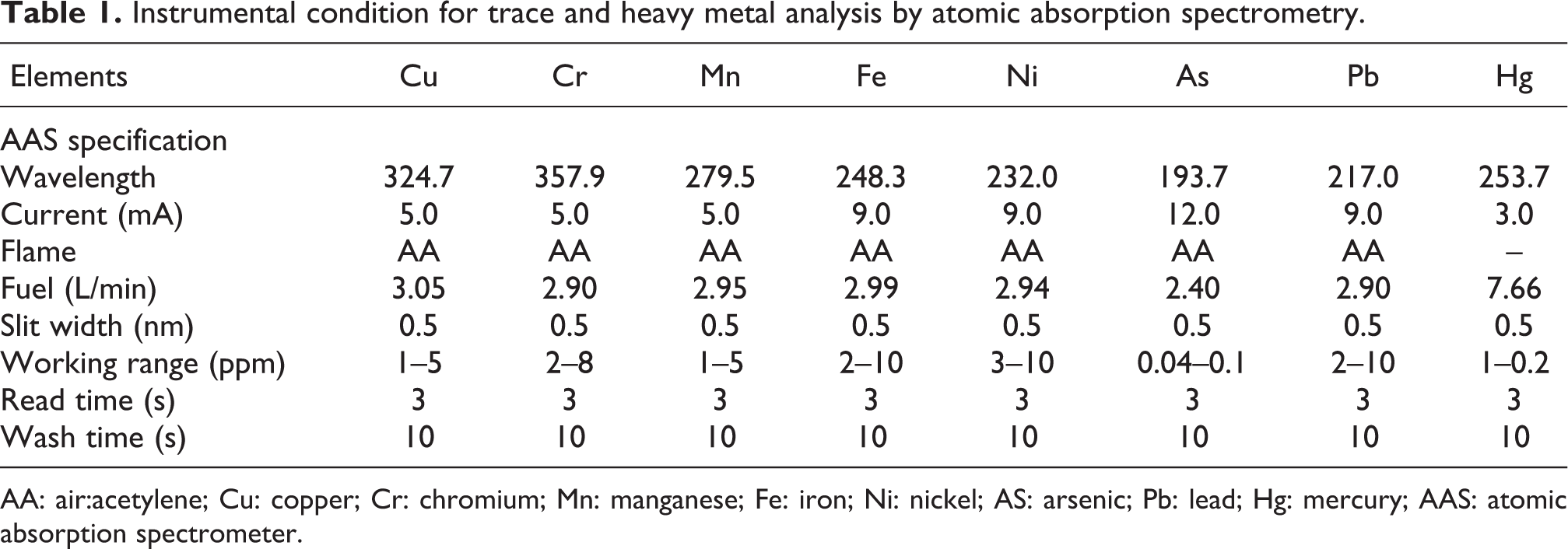
AA: air:acetylene; Cu: copper; Cr: chromium; Mn: manganese; Fe: iron; Ni: nickel; AS: arsenic; Pb: lead; Hg: mercury; AAS: atomic absorption spectrometer.
Sample preparation
For the analysis, samples were ground to a fine powder and dried at 55–70°C for 6–8 h in a controlled environment, to remove moisture. Immediately after drying, accurately weighed sample of 3.0 g was placed in a flask and treated with 3 ml of concentrated HNO3 for 4–5 h. A mixture of HNO3 and HClO4 in a ratio of 2:1 (3 ml/g of sample) was added. The mixture was heated at 120–130°C for 5–6 h, until fumes stop and until the resulting solution is clear. Then, 10 ml of milli-Q water was added and boiled again for 10–15 min and the volume was reduced to half, cooled to room temperature and filtered using Whatman filter paper no. 42. The entire filterate was mixed and made the volume upto 50 ml with Milli-Q water. A blank was also prepared for every sample in the same way. Each sample was aspirated twice and the experiment was repeated for five times.
Statistical analysis
The data were represented as the mean ± SEM using the GraphPad Prism Version 5.0. on the basis of the number of samples analyzed.
Results and discussion
In the present work, concentration of eight metals, including heavy metals, were determined for some commonly used herbs from Indian origin. The quantitative determinations were carried out using standard calibration curve obtained by the standard solution of metals having optimal detectable concentration ranges. The concentration of the metals obtained in plant material was expressed in terms of parts per million (Table 2). The levels of heavy metals quantified in all the plant samples were well in prescribed limits (WHO, 1999). Cu is one of the most abundant trace elements present in the body with a vital effect in the human physiological system. The total amount of Cu present in the body is assumed to be 50–120 mg and involved in several biochemical processes. It is present in more than 13 enzymes, namely, cytochrome oxidase, tyrosinase, monoamine oxidase and so on, which are important for preventing cell damage, anemia and maintenance of connective tissue, nail, hair and so on (Saracoglua et al., 2009). The concentrations of Cu determined in all the plant materials were found to be present in a considerable amount with highest concentration in P. betel and lowest in C. ternatea.
Metal content of some Indian medicinal plants detected by AAS (in ppm).
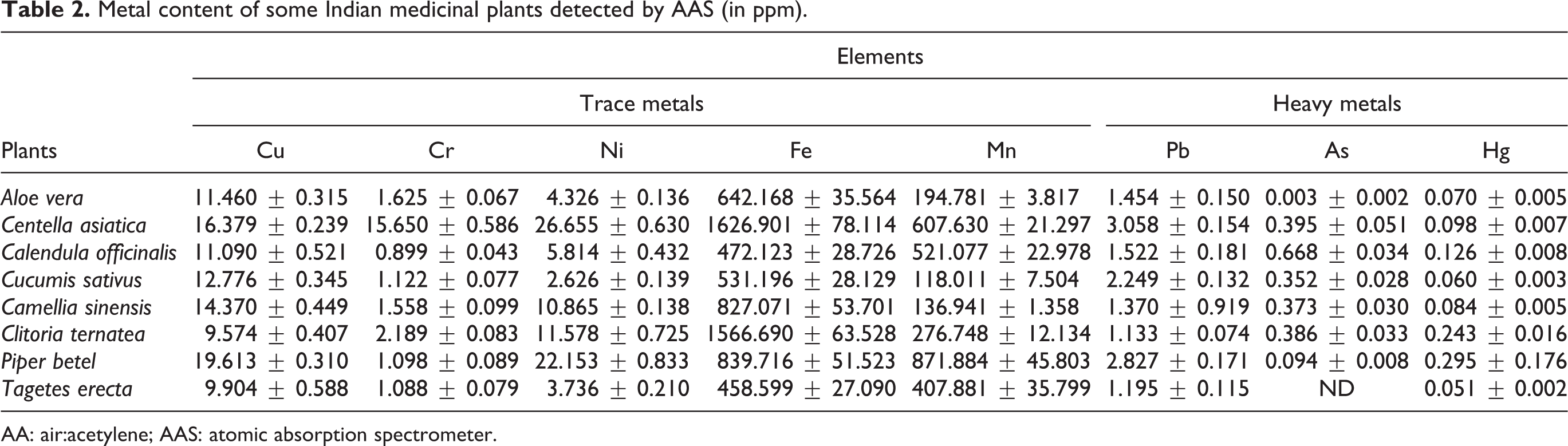
AA: air:acetylene; AAS: atomic absorption spectrometer.
Fe is one of the most important elements required in the human body for the circulation of oxygen in the blood. The concentration of Fe present in all the plants was in appreciable quantity to justify its use in human circulation system, with a highest value in C. asiatica and lowest in T. erecta. Mn is one of the most important elements required for many enzymatic activities. The concentration quantified in the analyzed samples varies from highest concentration in P. betel to lowest in C. sativus. The concentration of Ni in the plant sample was found to vary with a minimum in C. sativus to maximum in C. asiatica. Another trace metal Cr was quantified and found to be minimum in C. officinalis and maximum in C. asiatica. Heavy metals were also found but were present in permissible limits as shown in Table 2.
It can be concluded that the plant materials collected from specific region were safe and may not produce any toxic effect upon their therapeutic application. In conclusion, it was observed that the heavy metals present in the plant materials were within the prescribed limits and other trace metals were found to be present in a considerable amount and were safe for their use.
Footnotes
Acknowledgement
Authors are thankful to the Department of Science and Technology, Drug and Pharmaceutical Research Programme (DST-DPRP, File No. VI-D&P/287/08-09/TDT), Government of India, New Delhi, India.
Conflict of interest
The authors declared no conflicts of interest.
Funding
This work was supported by Parker Robinson Pvt. Ltd, Kolkata, India.