







Abstract
Objective:
To establish if serum levels of interleukin-10 (IL-10) in subjects exposed to benzene are connected with age, working years, and employment age.
Methods:
We evaluated serum levels of IL-10 in 51 employees working in oil refinery (group A) and in 16 office workers who resided in the same area (group B).
Results:
There was no statistically significant difference between serum concentrations of IL-10 in groups A and B. There was a statistically significant dependent relationship in group A between age, working years, and serum concentration of IL-10. There was a statistically significant and positive dependent relationship in group A between serum concentration of IL-10 and employment age.
Conclusions:
The role played by IL-10 in benzene immune suppression may be relevant and attention should be directed toward assessment of age, working years, and employment age in benzene-exposed populations.
Introduction
Simple aromatic hydrocarbon benzene (benzol; 1,3,5-cyclohexatriene; C6H6) occurs naturally in crude oil and petroleum. Benzene has been internationally recognised as a haematotoxin and carcinogen (United Stated National Toxicology Study Report, 1986). These characteristics have been proven with studies on mice where inhibition of cell-mediated tumour surveillance processes has been observed (Rosenthal and Snyder, 1987).
Recently, benzene has shown a strong immunotoxicity with its main effects on immune suppression in both animals and humans (Veraldi et al., 2006). Numerous immunotoxicity studies have provided strong evidence on the detrimental effects of benzene on cell subtypes. In fact, consistent depression of T- and B-lymphocytes and mitogen responses after exposure to benzene vapour has been observed in rodent studies (Aoyama, 1986).
Richardson in 2008 illustrated the importance of attention to dynamic changes in exposure–response patterns with temporal factors such as employment age and demonstrated that leukaemia was more strongly associated with benzene exposures accrued at older ages than with exposures accrued at younger ages.
Cytokines are important soluble mediators produced in tissues undergoing defence, growth, differentiation, and repair processes. Interleukin-10 (IL-10) is a type II cytokine and the founding member of a family of cytokines that include IL-19, IL-20, IL-22, IL-24, IL-26, IL-28, and IL-29 (Mosser and Zhang, 2008). This cytokine is a homodimeric molecule with a wide range of inhibitory actions. It is produced by a variety of cells, including monocytes and T-cells (the major T-cell sources of IL-10 are some subsets of regulatory T-cells designated Tr1, Th1, Th17, T-helper type 2 cells, and, recently, Th22 and Th9 cells) and can exert its effects on both myeloid and lymphoid cells (Eyerich et al., 2009; Mosser and Zhang, 2008; Soroosh and Doherty, 2009).
It is worth noting that many of the immuno-inhibitory characteristics of IL-10 can be traced to their effect on antigen-presenting cell to prevent the production of Th1-associated cytokines IL-2 and interferon-γ (IFN- γ) as well as the Th2-associated IL-4 and IL-5. The other fundamental effect of IL-10 is to inhibit the production of proinflammatory cytokines and mediators from macrophages and dendritic cells. The major inflammatory cytokines, IL-1, IL-6, IL-12, and tumour necrosis factor (TNF), are all drastically repressed following exposure to IL-10 (Mosser and Zhang, 2008).
Hydroquinone, a major metabolite of benzene, has been reported to suppress the production of proinflammatory cytokines, such as IL-1β, IL-2, IFN-γ, and TNF-α, that play important roles in the host defence against infection and cancer (Ouyang et al., 2000). Therefore, we supposed that IL-10 played a role in inhibiting upstream of these cytokines by the benzene.
For these reasons, we hypothesised the involvement of IL-10 in benzene immune suppression. The aim of this study is to assess: Modification of circulating serum levels of IL-10 in subjects exposed to benzene as opposed to a control group living in the same area. Correlate circulating serum levels of IL-10 with age, working years, and employment age.
Patients and methods
We evaluated serum levels of IL-10 in 51 oil refinery employees working in Priolo, in the southeastern part of Sicily (group A). These workers were engaged in tasks that increased their exposure to benzene (dock workers, employees of the load floor, and working at the console). We also evaluated serum levels of IL-10 in 16 office workers who resided in the same area (group B).
Workers as part of health surveillance underwent a questionnaire to clarify the current smoking and exclude chronic and habitual use of drugs.
Benzene exposure during the entire work-shift (approximately 8 h) was measured at the breathing zone level in all subjects, using personal diffusive samplers containing an active carbon cartridge (Radiello®). Analysis was performed using gas chromatography with flame ionization detector (GC-FID) after desorption of benzene from the active carbon with carbon disulfide.
The venous samples were collected in the morning (before the work shift) in workers exposed to chronic low doses of benzene. Serum samples were obtained using a serum separator tube and by allowing samples to clot for 30 min before centrifugation (15 min at approximately 1000g); serum aliquots were stored at −20° C until the assay. Serum concentrations of IL-10 were measured by a quantitative enzyme immunoassay technique performed using a ommercially available kit (R&D Systems Europe, Abingdon, UK). A microplate reader (BioRad Laboratories, Model 550, Milan) capable of measuring absorbance at 450 nm (correction wavelength set at 540 nm) was used to measure the intensity of colour developed in each well. All samples were analyzed in duplicate.
The statistical analysis was performed with SPSS for Windows (version 13.0). Data were presented as mean ± SD. Differences between the groups were analyzed by the Mann-Whitney test.
A partial correlation between all possible pairs of variables of time (age, working years, and employment age) was performed for controlling the effects of the remaining variable and has obtained a high statistical significance (p < 0.001); it was considered appropriate to use only the employment age that is a function of the other two (employment age = age − working years). Therefore, a multivariate regression model was estimated in order to assess the possible dependence of IL-10 to two covariates as employment age and smoking.
The variables of time not included (age and working years) have been taken into consideration in order to assess their influence on serum levels of IL-10. Therefore, another multivariate regression model was estimated in order to assess the possible dependence of IL-10 to three covariates as age, working years, and smoking. Statistical significance was set at p < 0.05. The graphs were performed with GraphPad Prism® version 5.01.
Results
The 51 oil refinery employees were all males (mean age = 40.59 ± 10.80 years); 16 office workers were males (mean age = 40.19 ± 11.03 years). There was not a statistically significant difference between the two groups regarding potential confounders such as body mass index (26.80 ± 2.66 vs. 28.49 ± 4.03; p = 0.300) and cigarette smoking (group A: 23 smokers and 28 non smokers; group B: 5 smokers and 11 non smokers; p = 0.327).
The exposure to benzene of group A was low when compared with the American Conference of Governmental Industrial Hygienists limit values (0.5 ppm) but significantly higher compared with group B (0.022 ± 0.022 vs. 0.004 ± 0.001 ppm, p < 0.0001).
The serum concentrations of IL-10 in groups A were higher, although not statistically significant than group B (38.94 ± 37.85 vs. 26.75 ± 24.72 pg/ml, p = 0.126; Figure 1).
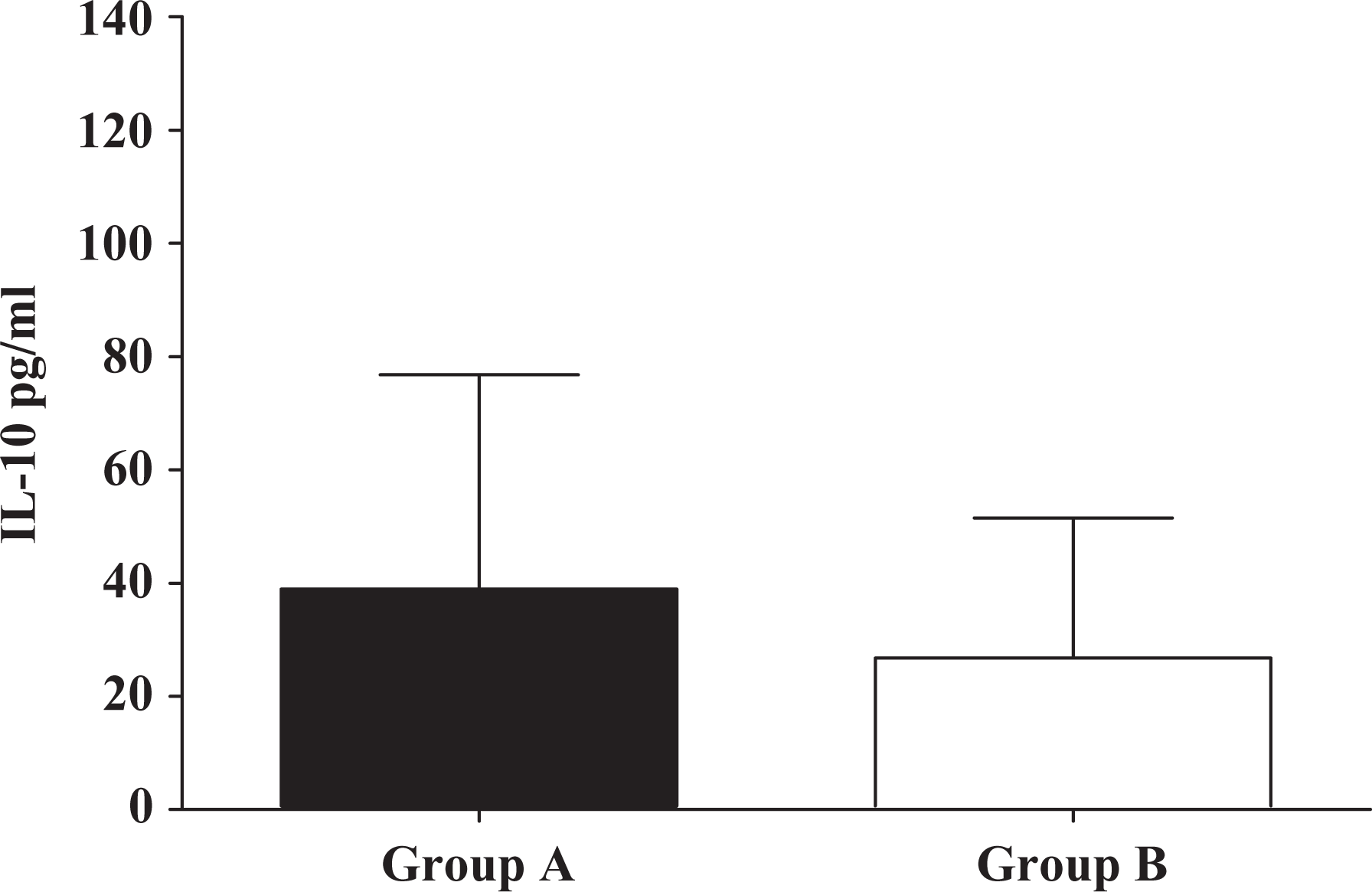
Bars represent means ± SDs of serum concentration of IL-10 in oil refinery employees (group A) and in office workers (group B).
There was a statistically significant dependent relationship in group A between age, working years, smoking, and serum concentration of IL-10 (p = 0.033), and specifically this relationship was positive between serum concentration of IL-10 and age (unstandardised coefficient = 1.07, p = 0.050), and negative between serum concentration of IL-10 and working years (unstandardised coefficient = −1.18, p = 0.044), whereas there was no relation to IL-10 and smoking (unstandardised coefficient = −14.48, p = 0.167). There was a statistically significant dependent relationship in group A between employment age, smoking, and serum concentration of IL-10 (p = 0.016), and specifically this relationship was positive between IL-10 and employment age (unstandardised coefficient = 1.18, p = 0.024) (Figure 2), whereas there was no relation to IL-10 and smoking.
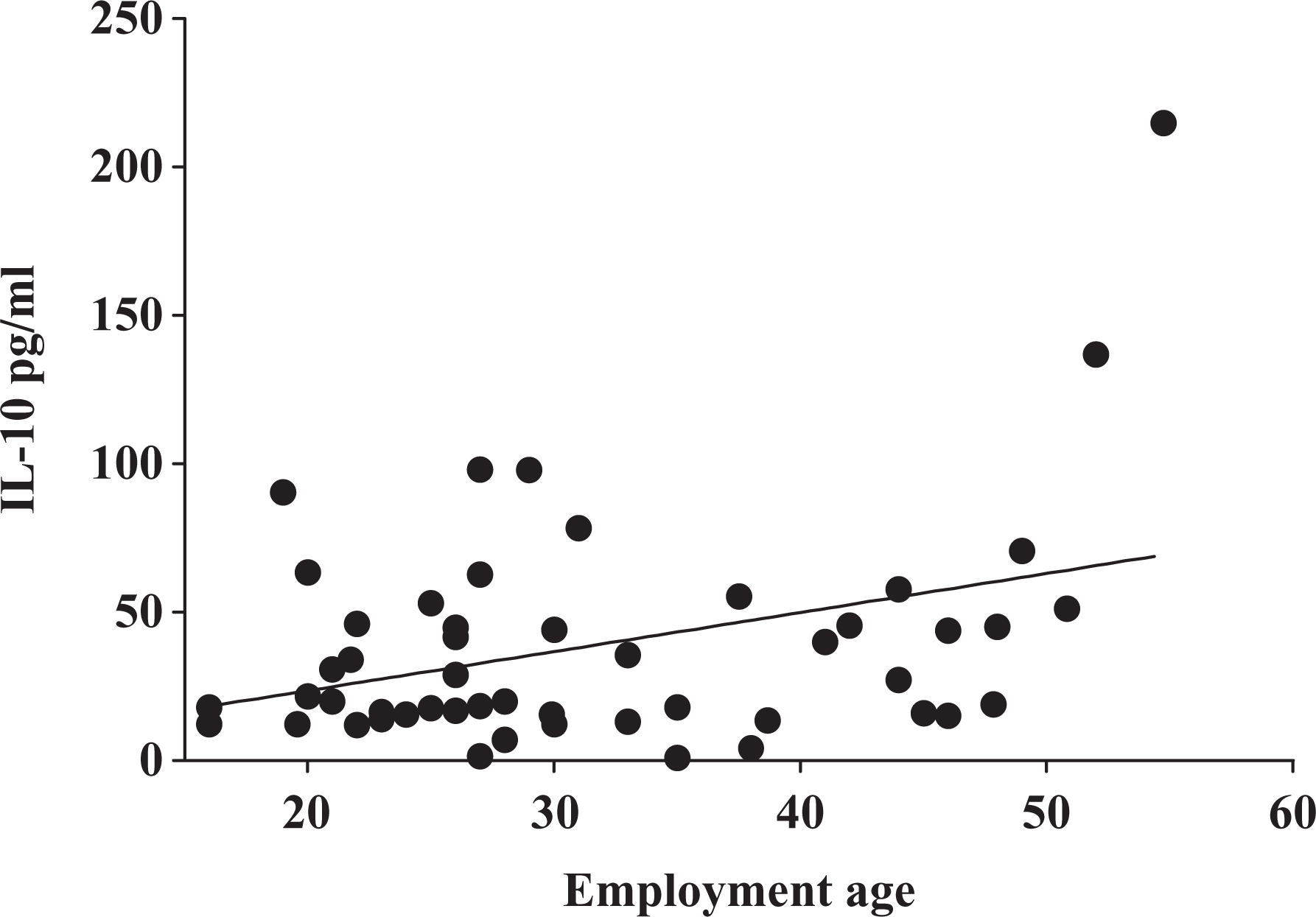
Relationship between serum concentration of IL-10 and employment age of oil refinery employees.
Discussion
It is known that benzene has an immune suppressive action in both animals and humans (Veraldi et al., 2006). To our knowledge, aromatic hydrocarbons found in fuel are the active agents responsible for suppressing delayed-type hypersensitivity, a prototypical cell-mediated immune reaction as explained by Ramos et al. in 2007. Furthermore, IL-10 plays an essential role in fuel-induced immune suppression, as reversed immune suppression can be observed when injecting anti-IL-10 antibodies into fuel-treated mice (Ullrich and Lyons, 2000).
The data obtained showed that benzene exposure was definitely higher in all oil refinery employees with respect to office workers, but the serum levels of IL-10 were only slightly higher in the first than the latter, as safety standards were met.
The negative relationship between serum levels of IL-10 and working years can be explained by the subsequent compensation mechanisms.
On the other hand, the positive relationship between age and serum levels of IL-10 was in agreement with the more potently suppressed production of anti-inflammatory cytokine IL-10 from CD4(+) and CD25(−) T-cells in the elderly individual more than in the young individual (Hwang et al., 2009).
We found a positive relationship between serum levels of IL-10 and age at employment. In our opinion, this relationship suggests that the effect of benzene on serum levels of IL-10 is affected by age at employment. These data were consistent with anepidemiologic study by Richardson in 2008, which highlighted the potentially greater susceptibility of older workers to benzene-induced leukaemia finding that the effect of an increment in benzene exposure on leukaemia mortality is of greater magnitude for workers exposed at older ages than for those exposed at younger ages. These temporal patterns of association are consistent with a late-stage carcinogen and suggest that occupational protection efforts give particular consideration to the risks of benzene-induced leukaemia faced by older workers. Further attention should be given to the assessment of age at exposure in other benzene-exposed populations, specifically to the potentially greater susceptibility of older workers to benzene-induced leukaemia.
However, we cannot exclude the involvement of an individual genetic predisposition as in benzene haematotoxicity (Hosgood et al., 2009).
Conclusions
We found that serum levels of IL-10, in subjects exposed to benzene, were related to age, working years, and employment age. So we can conclude by asserting that the role played by IL-10 in benzene immune suppression may be relevant and that attention should be directed toward assessment of age, working years, and employment age in benzene exposed populations.
Footnotes
Acknowledgments
We would like to thank Ms A. Donato for the editing the text and A. Alibrandi (Department of Economical, Financial, Social, Enviromental, Statistical and Territorial Sciences, University of Messina) for statistical consulting.
Conflict of interest
The authors declared no conflict of interest.
Funding
This study is partly supported by MIUR-PRIN (Ministero dell'Istruzione, dell'Università e della Ricerca – Programmi di ricerca di Rilevante Interesse Nazionale) 2006, n. 2006068922_004.