







Abstract
Chemical materials are environmental contaminants, are extensively used in laboratories, and may cause various forms of health hazards in laboratory workers. Therefore, this toxicity most likely is a result of the oxidative metabolism of chemical to reactive products. As green tea (GT) possesses antioxidant effects, the objective of this study was to examine any amelioration oxidative stress in chemical laboratory workers drinking one cup (3 g/300 ml water) of freshly prepared tea once daily. Baseline characteristics including age, sex, smoking, fruit consumption, and duration of exposure were recorded via questionnaire to the subjects. Saliva level oxidative stress parameters such as total antioxidant capacity (TAC), glutathione peroxidase (GPx), catalase (CAT), and superoxide dismutase (SOD) were estimated before and after consumption of GT in these workers. Treatment of subjects with GT induced a significant reduction in saliva GPx activity (406.61 ± 22.07 vs. 238.96 ± 16.26 U/l p = 0.001) and induction in TAC (0.46 ± 0.029 μmol/ml vs. 0.56 ± 0.031, p = 0.016). No statistically significant alteration was found for saliva SOD (0.080 ± 0.0019 vs. 0.079 ± 0.0014, p > 0.05) and CAT (20.36 ± 0.69 vs. 19.78 ± 0.71, p > 0.05) after 28 days treatment by GT. These results demonstrate that drinking GT during chemical exposure can reduce several parameters indicative of oxidative stress. In conclusion, using GT as a dietary supplement can be a rational protocol to control source of hazards in chemical laboratory workers.
Introduction
Tea (Camellia sinensis, Theaceae) is second only to water in terms of worldwide popularity (Yang and Wang, 2010). Green tea (GT) originates from the C. sinensis. Important GT components are the polyphenols, which constitute the most interesting group amongst the components of GT leaves (Narotzki et al., 2012).
GT contain antioxidative polyphenols; polyphenols in GT consist of flavan 3-ols such as (1)-catechin, (2)-epicatechin (EC), (2)-epigallocatechin (EGC), (2)-epicatechingallate, and (2)-epigallocatechingallate. The main polyphenols in GT are catechins (flavan-3-ols) (Graham, 1992). The four main catechins are epigallocatechin-3-gallate (EGCG) that constitutes about 59% of total catechins, epigallocatech to (EGC) about 19%, epicatechin-3-gallate to about 13.6%, and EC to about 6.4% (Narotzki et al., 2012).
The free radicals are highly reactive and harmful to lipids, proteins, and nucleic acids, resulting in structural and functional impairment (Mohamadin et al., 2005). GT polyphenols are due to its acting as a direct free radical scavenger of reactive oxygen and nitrogen species, including the hydroxyl radical (OH
Exposure to occupational and environmental contaminants is a major contributor to human health problems. Inhalation of gases, vapors, aerosols, and mixtures of these can cause a wide range of adverse health effects (Bakand et al., 2005).
The laboratory has become the center for acquiring knowledge and developing new materials for future use, as well as for monitoring and controlling those chemicals currently used routinely in thousands of commercial and industrial processes. Many of these chemicals are beneficial, but others have the potential to cause damage to human health and the environment, and therefore also to public attitude toward the chemicals that are harmful on which we all so heavily dependent (Hall, 1994). Accordingly, since oxidative stress has main hazard of exposure to various chemicals, the present study was undertaken to explore possible protective effects of GT.
Materials and methods
Chemicals
Tetraethoxypropane (malondialdehyde), 2-thiobarbit-uric acid, trichloroacetic acid, n-butanol, ethylenediamine tetra acetic acid, dithiobis-2-nitrobenzoic acid, tris base, and 2,4, Aldrich company 6-tripyridyl-S-triazine (TPTZ) were used in this study. All other chemicals were obtained from Sigma Aldrich.
Subjects
In this cross-sectional study, 30 workers of a chemistry laboratory in the age range of 23–41 years and a work history range of 2–10 years were included. These workers were active, starting their work at 7:30 a.m. and finishing their work at 4.00 p.m. Demographic data concerning their health status, history of chronic disease, cigarette smoking, occupational history, and dietary regimen were collected. After this control period, the volunteers consumed 300 ml of GT prepared with 10 mg of dried leaves for every milliliter of hot water (80°C), once time per day (morning) for 28 days (Table 1).
Demographic basic characteristics of study subjects.

The study was conducted in accordance with the declaration of Helsinki protocol. All participants were provided with specific written information about the aims of the study before signed consents were obtained.
The samples collected were unstipulated whole expectorated saliva from each subject, into sterile tubes, between 9 and 10 a.m., after a single mouth rinse with 15.0 ml of distilled water to wash out exfoliated cells (Navazesh, 2006). Saliva samples were collected in the morning, before and after consuming GT for the day. About 1.5 ml of saliva were collected on ice immediately, then centrifuged those at 3000 r/min and the supernatant were used for the analysis of superoxide dismutase (SOD) activity, glutathione peroxidase (GPx), catalase (CAT), and total antioxidant capacity (TAC).
Assay of TAC
It was measured by the ferric reducing ability of plasma method. This method is based on the ability of plasma to reduce Fe3+ to Fe+2 in the presence of TPTZ. The reaction of Fe 2+ and TPTZ gives a complex with blue color and maximum absorbance in 593 nm (Benzie and Strain, 1996).
Measurement of Cu/Zn-SOD activity
The activity of copper (Cu)-/zinc (Zn)-SOD was measured using a commercial kit (Ransod kit, Randox Laboratories Ltd, Crumlin, UK). Measurement of the enzyme was based on the generation of superoxide radicals produced by xanthine and xanthine oxidase and reacted with 2-(4-iodophenyl)-3-(4-nitrofenol) 5-phenyltetrazolium chloride (INT) to form a red formazan dye. The formazan was read at 505 nm. One unit of Cu-/Zn-SOD was defined as the amount of enzyme necessary to produce 50% inhibition in the INT reduction rate.
Measurement of GPx activity
The amount of GPx was determined using a commercially available kit (Ransel kit, Randox Laboratories Ltd, Crumlin, UK) by measuring the rate of oxidation of NADPH (nicotinamide adenine dinuclotide phosphate) at 340 nm. A unit of enzyme was expressed as the amount of enzyme needed to oxidize 1 nmol of NADPH oxidase/min.
Measurement of CAT activity
CAT activity was assayed in the samples by measuring the decrease in the absorbance at 240 nm in a reaction medium containing hydrogen peroxide (H2O2; 10 mM) and sodium phosphate buffer (50 mM, pH = 7.0). One unit of the enzyme is defined as 1 mol of H2O2 as substrate consumed/min, and the specific activity is reported as units per milliliter plasma.
Statistical analysis
Results are expressed as mean ± standard error, 95% confidence interval. The differences between groups were assessed by paired Student’s t test. A p value of 0.05 was assumed to specify a significant difference.
Results
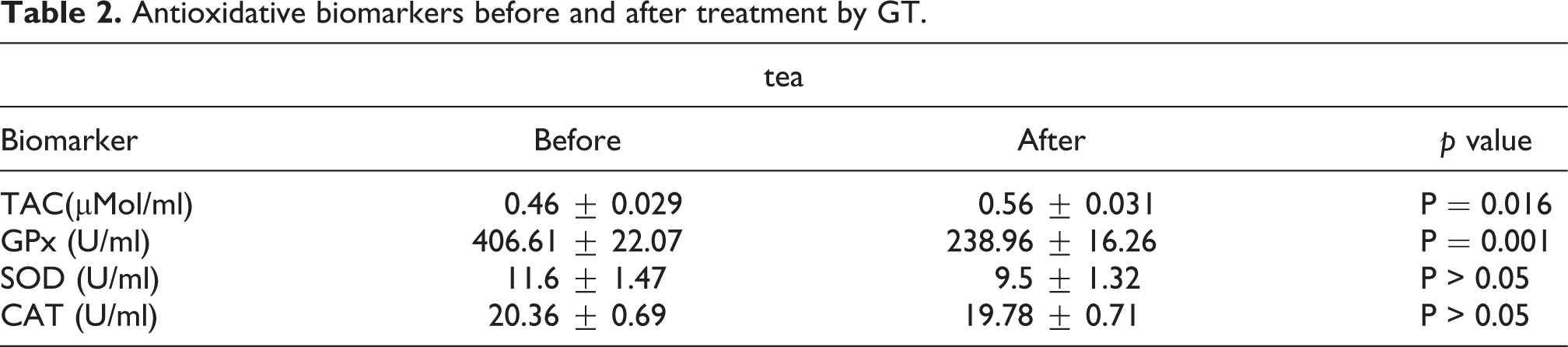
As shown in Table 2, the mean levels of salivary antioxidants showed that the mean GPx activity before and after GT drinking was 406.61 ± 22.07 versus 238.96 ± 16.26 U/l, p = 0.001, in the workers. The mean concentrations of salivary TAC were 0.46 ± 0.029 μmol/ml versus 0.56 ± 0.031, respectively, p = 0.016. The mean SOD activity was not different before and after use of GT, p > 0.05, which was 0.080 ± 0.0019 versus 0.079 ± 0.0014. However, the mean CAT activity was not different before and after use of GT, p > 0.05, which was 20.36 ± 0.69 versus 19.78 ± 0.71.
Antioxidative biomarkers before and after treatment by GT.
Discussion
In a chemical laboratory, there are a mixture of chemicals compounds such as corrosive materials, for example, strong acids, strong bases, and oxidizers materials, such as hypochlorite and hypo halide compounds, ammonium nitrate, halogens, chromate, dichromate compounds, and peroxide production materials, such as diethyl ether, tetrahydrofuran, vinyl acetylene, vinyl pyridine, and styrene (Fairhall, 1949).
The present results indicated the positive potential of GT in increasing saliva TAC and decreasing GPx activity. In the body, antioxidants act as free radical scavengers and thus protect cells from being exposed to free radicals and further cellular damage. This is the mechanism by which they protect the human body from several diseases attributed to the reactions of radicals (Halliwell, 1994). Molecules of primary importance are in chemistry laboratories contains carcinogens such as pyridine, phenol, toluene, benzene, formaldehyde, and acrolein (Halliwell and Gutteridge, 1999; Nel et al., 2006).
It is well established that the antioxidant effects of EGCG are due to its acting as a direct free radical scavenger of reactive oxygen and nitrogen species, including superoxide and hydroxyl radicals and NO
Tea polyphenols, catechins, and flavonols scavenge reactive oxygen species (ROS) (Potenza et al., 2007) and chelate transition metal ions in a structure-dependent manner (Brown et al., 1998; Ranjbar et al., 2008). Pathological effects have been reported for chronic ROS in several diseases such as chronic renal failure (Rocha et al., 2010), atherosclerosis (Leitinger, 2003), organophosphorus insecticides effects (Ranjbar et al., 2002), and operating room (Ranjbar et al., 2007). Recently, the role of ROS in mediating apoptosis in various cancer cells is well established (Simon et al., 2000). Release of cytochrome c appears to be the central event, since it is critical for the aggregation of the adapter molecule (Apaf1). The proapoptotic member of the Bcl-2 family Bax can directly cause mitochondria to release cytochrome c (Gottlieb, 2001). In addition, EGCG can indirectly regulate the expression of Bcl2-Xl messenger RNA (Ahmad et al., 2000). The overexpression of Bcl-2 in HCC (hepatocellular carcinoma) cells was shown to reduce Fas-mediated apoptosis (Yang et al., 2002). EGCG may activate caspase-8 through reactivation of the Fas–Fas ligand pathway by downregulation of Bcl-2α expression. Another possibility is that EGCG directly activates caspase-8 through its binding to Fas (Hayakawa et al., 2001).
Previous studies have shown that both GPx and SOD abrogated ROS generation, (Ranjbar et al., 2010; Rathore et al., 1998). In addition, it has been reported that ROS directly downregulates the Bcl-2 and Mcl-1 levels (Kayanoki et al., 1996). Therefore, GPx and SOD protected the downregulation of Bcl-2 and Mcl-1 in various cells (Greenlund et al., 1995; Kayanoki et al., 1996). Exposure to pollution in work place induce chronic disease such as pulmonary disease (Becklake, 1989), Parkinson’s disease (Gorell et al., 1999), cardiovascular disease (House, 1974; Landsbergis et al., 2003), rheumatoid disease (Melvin and Barnes, 1982), and liver disease (Redlich et al., 1988). Extensive laboratory and epidemiological studies have suggested that GT and GT polyphenols, especially EGCG, have preventive effects against chronic diseases including heart disease, diabetes, neurodegenerative disease, and cancer (Frei and Higdon, 2003). Numerous mechanisms have been proposed to account for the cancer preventive effects of GT and EGCG in laboratory animal models (Cai et al., 2002; Imai et al., 1997; Kumar et al., 2012) The antioxidant activity of GT polyphenols and, more recently, the prooxidant effects of these compounds have also been suggested as potential mechanisms for cancer prevention (Divya Nair et al., 2012; Frei and Higdon, 2003; Lambert and Elias, 2010).
It is believed that medicinal plants are a potential source of antioxidants and ROS scavenger molecules (Arora et al., 2005; Divya Nair et al., 2012; Hatcher et al., 2012). Previous studies indicated the antioxidative property of medical plants such as GT (Azam et al., 2004; Thiagarajan et al., 2001), Cinnamomum zeylanicum (Ranjbar et al., 2006a), and Echium amoenum Fisch & C.A (Ranjbar et al., 2006b) have shown both the trapping effect of ROS as well as the inhibitory effect of lipid peroxidation and induction of TAC (Negishi et al., 2004). However, in this study, after consumption of the GT in these subjects, GPx activity and TAC have been changed significantly.
Our study was based on the subjects working in the laboratories, who are exposed to occupational chemical substances, including different compounds with specific toxicity. Our investigation was limited to the individuals who have all been exposed to several materials and not specific material in this place.
In conclusion, this study provides evidence that GT protects against ROS-/reactive nitrogen species-mediated damage in chemical chronic exposure. Further studies are warranted to determine chemical specific in workplace and effects of various natural antioxidants could be recommended as a dietary strategy to lower the risk of oxidative injuries.
Footnotes
Funding
This research received no specific grant from any funding agency in the public, commercial, or not-for-profit sectors.