







Abstract
The antitumor activity of various six fractions of Launaea procumbens were studied using the potato disk bioassay technique. Three concentrations (10, 100, and 1000 ppm) of all these six fractions were used for characterization of antitumor activity. Among these fractions, methanolic fraction exhibited significant inhibition of crown gall tumors caused by Agrobacterium tumefaciens followed by butanolic fraction. These results revealed that methanolic and butanolic fractions contain bioactive constituents responsible for inhibition of tumor. Further purification and characterization are in progress in our laboratory.
Introduction
Potato disk assay is broadly used for screening antitumor potential of the medicinal plants and synthetic compounds. Screening for new antitumor potent drug is a convenient and an inexpensive assay system. In this mechanism, Agrobacterium tumefaciens induces tumors (crown galls) in potato disk (McLaughlin and Rogers, 1998). Crown gall is a neoplastic plant disease in which normal cells are transformed into tumor cells in a short period of time (Galsky et al., 1980). The potato disk assay demonstrated the inhibition of tumor formation on potato disks; materials that inhibit these plant tumors have a high predictability in mice (Ferrigini et al., 1982) and also a good correlation with compounds and extracts involved in 3PS leukemia in mice (Galsky et al., 1981).
A. tumefaciens is a gram-negative bacterium, which induces crown gall neoplastic disease, in which a spongy or hard mass is produced from tissue called tumor, just like the tumor formed in humans and animals. During the process of tumor formation, A. tumefaciens, a tumor-inducing plasmid, present in the bacterial DNA is incorporated into plant DNA. When plant tissues are wounded, it releases phenols and other chemicals that activate plasmid to multiply rapidly; similar mechanism has been reported in nucleic acid and histology of human and in rats. Using the potato disk bioassay, we can examine extracts and purified compounds of plant origin, unknown antitumor activity in animals, or the effect on the initiation of crown gall, which can be used as a fairly rapid, inexpensive, and reliable prescreening process of antitumor activity (McLaughlin, 1991).
Medicinal plants play important role in scavenging free radicals (Khan et al., 2009, 2010, 2011, 2012; Sahreen et al., 2010, 2011), controlling microbial diseases (Ahmad et al., 2011), and protecting DNA damages (Khan and Ahmad, 2009). The present study was therefore arranged to evaluate the antitumor efficacy of various fractions of Launaea procumbens against A. tumefaciens that causes tumor.
Materials and methods
Plant material collection and extract preparation
Aerial parts of L. procumbens plant (leaves, stem, flowers, and seeds) were collected, identified, and shade dried under room temperature for 2 weeks, chopped and grinded mechanically to mesh size 1 mm. Dried powder sample of 2 kg of L. procumbens was extracted twice with 80% methanol at 25°C for 48 h. The extracts were filtrated through Whatman No 1 filter paper and concentrated using a rotary evaporator (Panchun Scientific Co., Kaohsiung, Taiwan) under reduced pressure at 40°C. The dried extract was stored at 4°C for antitumor investigations.
Antitumor potato disk assay
Potato disk assay (antitumor activity) was conducted according to the procedure described by Ferrigini et al. (1982). During this assay A. tumefaciens virulent strains (At10) were grown for 48 h in Luria broth medium containing rifampicin (10 µg/ml). Red-skinned potatoes were surface sterilized in 0.1% mercuric chloride solution for 10 min and thoroughly washed with autoclaved distilled water. Potato disks (5 × 8 mm2) were made with cork borer and placed on agar (2%) plates (10 disks per plate). Agrobacterium culture (2 ml) mixed with 50 µl each of 10, 100, and 1000 ppm of extract (prepared in dimethyl sulfoxide) was applied on the surface of each disk of respective concentration. Petri plates were then placed at 28°C for 21 days. After 21 days, the disks were stained with Lugol’s solution (10% potassium iodide and 5% iodine) for 30 min and then observed under dissecting microscope. Numbers of tumors per disk were counted and percentage inhibition for each concentration was determined.
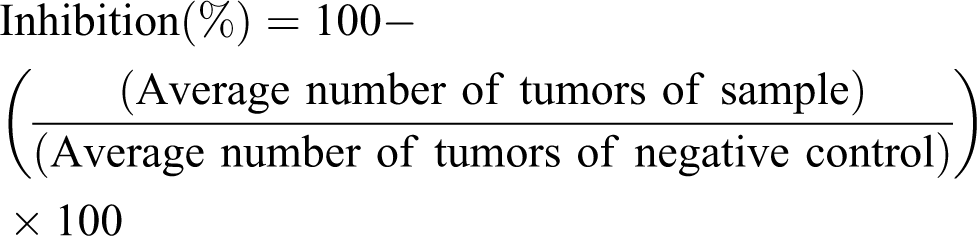
Tumor inhibition with 20% was considered significant. Half maximal inhibitory concentration 50 (IC50) was recorded using graphpad prism software (GraphPad Software, San Diego, California, USA).
Results and discussions
Bioassays present extraordinary compensation for detection of medicinal plant extracts. Most often, a pet biological reaction is not due to one constituent but somewhat to a mixture of bioactive plant components. Therefore, screening of plant extract provides a base for isolation of bioactive compounds. Potato disk assay was conducted to confirm the anticancer potential of medicinal plants. Antitumor potato disk assay is a valuable tool for determining antitumor activity of various fractions and isolation of bioactive compounds from medicinal plants against the characteristic crown galls induced in wounded potato tissues by A. tumefaciens (Fadli et al., 1991; Galsky et al., 1980). Similar mechanisms of tumorigenesis, such as the intracellular incorporation of extraneous nucleic acids, are common in both plants and animals (McLaughlin, 1991).
The antitumor potential of the present study is summarized in Figures 1 to 6 and Table 1. Red-skinned potatoes were sterilized in 0.1% mercuric chloride solution for 10 min and thoroughly washed with autoclaved distilled water. Potato disks were placed on agar and Agrobacterium culture mixed with extract was on disk. After 21 days, potato disks were stained with Lugol’s solution. Number of tumors was counted and their order of IC50 for L. procumbens were determined as: L. procumbens methanolic extract (LPME; 13 ± 0.2) > L. procumbens butanolic extract (LPBE; 55 ± 2.3) > L. procumbens water (aqueous) extract (58 ± 1.6) > z L. procumbens chloroform extract (65 ± 1.9) > L. procumbens n-hexane extract (325 ± 5.7 > L. procumbens ethyl acetate extract (495 ± 6.2), respectively (Table 1). LPME markedly controlled tumor formation and their IC50 value was near to control. Hussain et al. (2007) reported that methanolic extract of Fagonia cretica L. showed potent antitumor activities as compared to control, which supports our results. The results documented by Das et al. (2007) are also in accordance with our results. Mullein extract was tested for antitumorigenic activity against A. tumefaciens-induced tumors on potato disks, which are in close association to our present finding (Turker and Camper, 2002). They indicated antitumor potato disk assay as an acceptable tool to primarily screen antineoplastic activity of various crude extracts as well as purified fractions regardless of mode of inhibitory action on tumor formation.
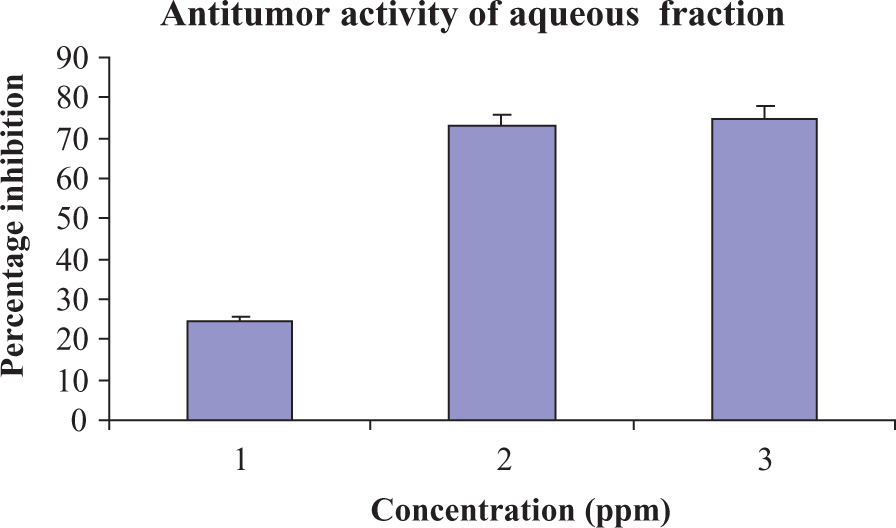
Percentage inhibition of tumors by LPWE. Concentration 1 indicated 10 ppm, concentration 2 indicated 100 ppm, and concentration 3 indicated 1000 ppm. LPWE: Launaea procumbens water (aqueous) extract.
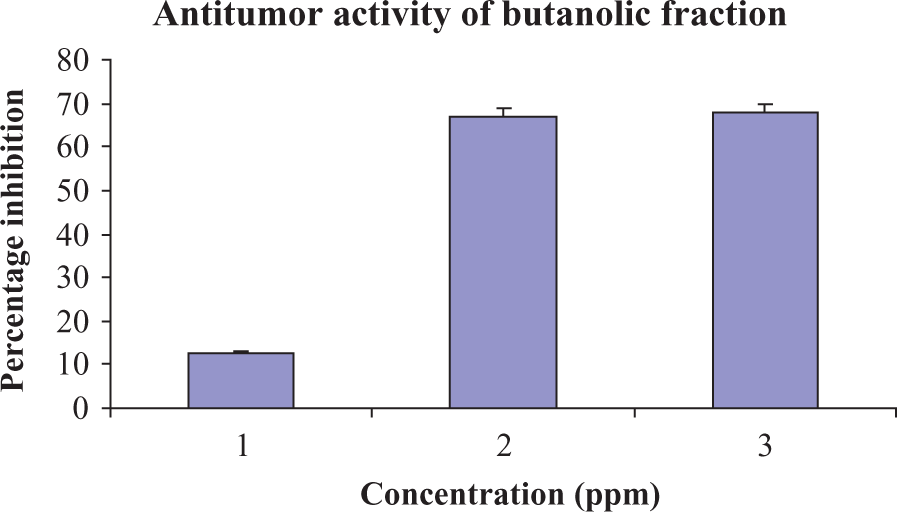
Percentage inhibition of tumors by butanolic fraction of Launaea procumbens Concentration 1 indicated 10 ppm, concentration 2 indicated 100 ppm, and concentration 3 indicated 1000 ppm. LPBE: Launaea procumbens butanolic extract.

Percentage inhibition of tumors by LPME. Concentration 1 indicated 10 ppm, concentration 2 indicated 100 ppm, and concentration 3 indicated 1000 ppm. LPME: Launaea procumbens methanolic extract.
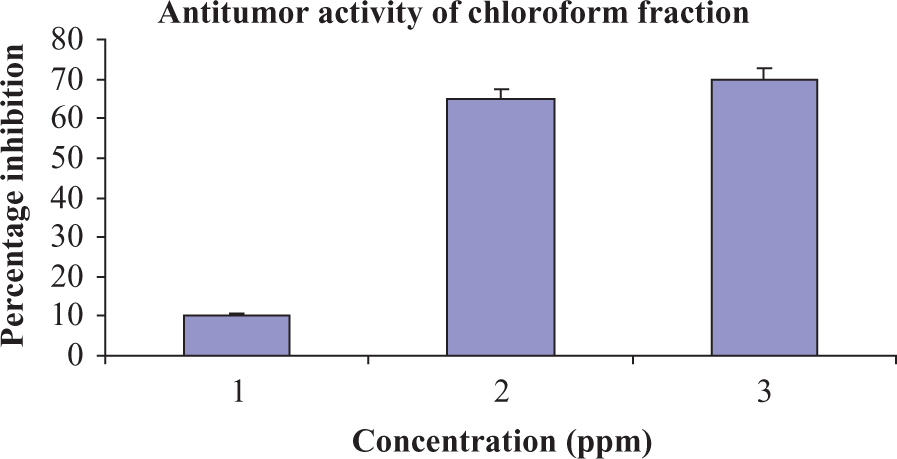
Percentage inhibition of LPCE. Concentration 1 revealed 10 ppm, concentration 2 indicated 100 ppm, and concentration 3 indicated 1000 ppm. LPCE: Launaea procumbens chloroform extract.
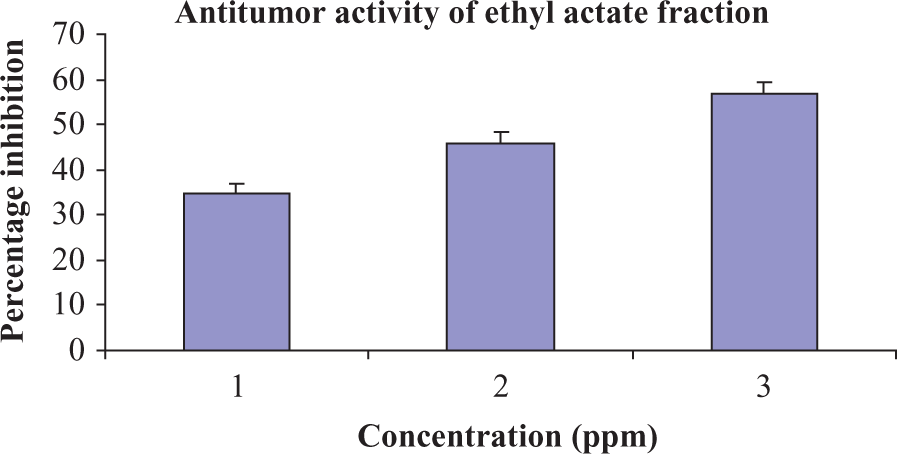
Percentage inhibition of tumors by LPEE. Concentration 1 revealed 10 ppm, concentration 2 indicated 100 ppm, and concentration 3 indicated 1000 ppm. LPWE: Launaea procumbens ethyl acetate extract.
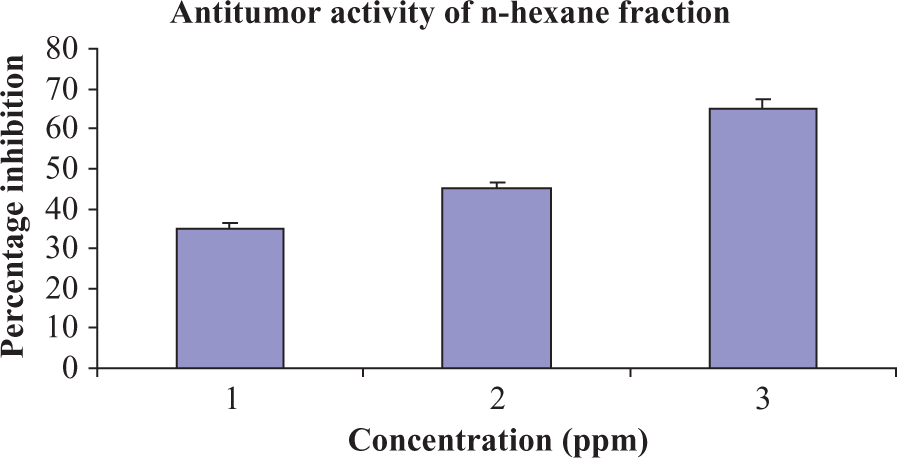
Percentage inhibition of LPHE. Concentration 1 revealed 10 ppm, concentration 2 indicated 100 ppm, and concentration 3 indicated 1000 ppm. LPHE: Launaea procumbens n-hexane extract.
IC50 of antitumor activity of various fractions of Launaea procumbens.a
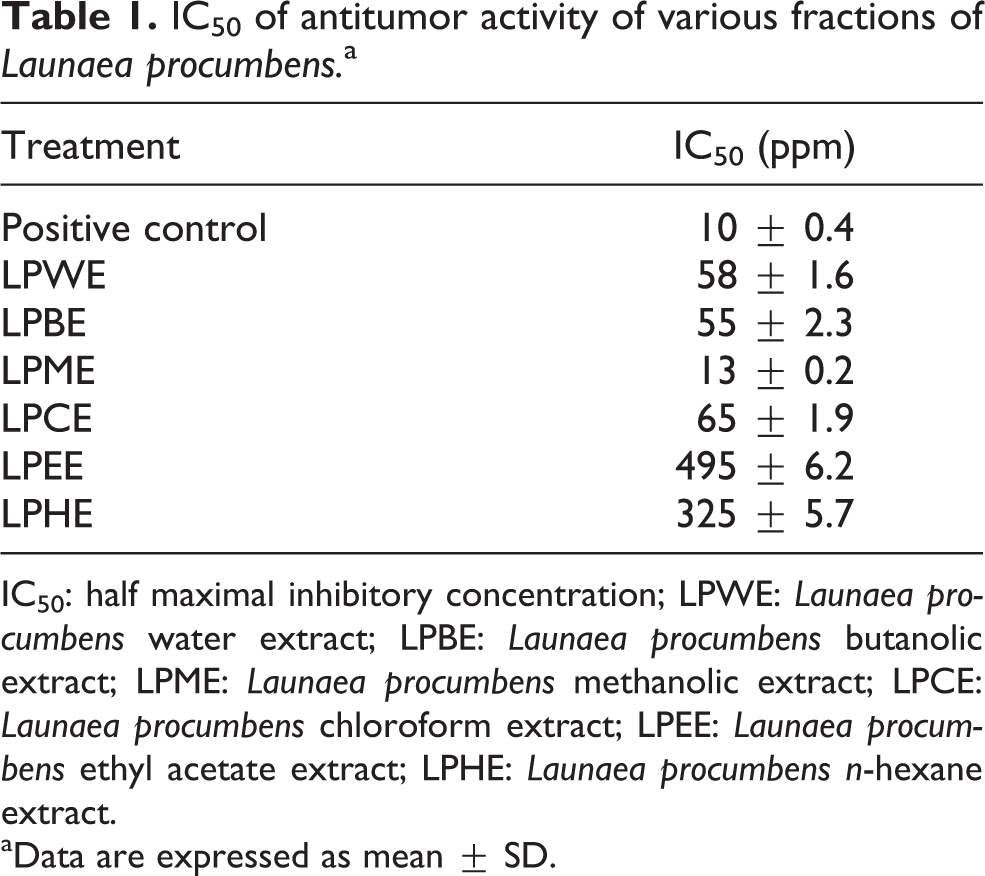
IC50: half maximal inhibitory concentration; LPWE: Launaea procumbens water extract; LPBE: Launaea procumbens butanolic extract; LPME: Launaea procumbens methanolic extract; LPCE: Launaea procumbens chloroform extract; LPEE: Launaea procumbens ethyl acetate extract; LPHE: Launaea procumbens n-hexane extract.
aData are expressed as mean ± SD.
Conclusion
This study provided the scientific proof that LPME and LPBE significantly inhibited tumor induction. Therefore, future isolation and purification of these bioactive constituents are recommended for further studies.
Footnotes
Funding
This research received no specific grant from any funding agency in the public, commercial, or not-for-profit sectors.