







Abstract
This study presents an overview of the existence and effects of six heavy metals, chromium (Cr), lead (Pb), cadmium (Cd), mercury (Hg), manganese (Mn), and aluminum (Al), in tannery effluents released to the Buriganga River in Dhaka, Bangladesh. The pollutants were found in three different sources, such as effluents from tanneries, contaminated river water and three species of fish—climbing perch (Anabas testudineus), spotted snakehead (Channa punctata), and Black tilapia (Oreochromis mossambicus) caught from the river. Tannery effluents, water, and fish samples were collected from three different factories, five sample stations, and three different harvesting points, respectively. Effluents from all three factories contained significant amounts of heavy metals, especially Cr (374.19 ppm in average), whereas lesser amounts were found in the tissues of the three fish species studied. The trends in tissue elemental concentrations of fish were Cr > Pb > Al > Hg > Mn > Cd. In most cases (Cr, Cd, Mn, and Al), heavy metal concentrations were found to be greater in climbing perch than in Black tilapia and spotted snakehead. Although the river water contained high concentrations of harmful heavy metals, the fish species under study had concentrations well below the permissible Food and Agriculture Organization/World Health Organization levels for those metals and seemed to be safe for human consumption.
Introduction
The discharge of untreated tannery effluents is a long-time problem in the leather industries of Bangladesh (Huq, 1998; Rasul et al., 2006). The export of tanned leathers by this country is increasing following a decline of leather production in the developed world due to more stringent environmental controls. The increased number of tanneries in Bangladesh is causing environmental hazards as the untreated effluent used in the tanning process is released into the water resources.
Pollutants from leather industries discharge into rivers and lakes, leach into ground water, or are emitted into air as particulate matter (Abernathy et al., 1984; Diagomanolin et al., 2004; Shokrzadeh et al., 2009) increasing the accumulation of metals in sediments, biota, and ultimately humans (Gibbs and Miskiewicz, 1995). The primary pollutants produced are heavy metals, chromium (Cr), lead (Pb), aluminum (Al), cadmium (Cd), and mercury (Hg), various organic chemicals, and acids (Bosnic et al., 2000; Dean et al., 1972).
Fish and bivalves are used in bioaccumulation tests because they are higher tropic level organisms and are usually eaten by human beings. Fish from estuaries and coastal waters associated with industrial and sewage discharges have been found to be contaminated with heavy metals (Chan et al., 1999; Gibbs and Miskiewicz, 1995; Tariq et al., 1993). The aquatic organisms can tolerate high concentrations of essential and nonessential metals by accumulating at nonactive sites like bone, feather, or exoskeleton, whereas some others can effectively store in kidney and liver tissues without any adverse effect (Malik et al., 2010). So liver, kidney, muscle, and visceral organs of the whole organism are analyzed to determine the concentration of the metals (Sharif, 2009a). Heavy metals are hazardous pollutants for aquatic ecosystem because of their potential toxicity, persistence, and bioaccumulation. They can transmit potential toxicity through the food chain to human beings due to biomagnification over time (Ipinmoroti et al., 1997; Shokrzadeh and Saeedi, 2009). The extent of toxic effects can be influenced by various abiotic environmental factors like oxygen, hardness, pH, alkalinity, and temperature (Adhikari et al., 2006; Ghillebaert et al., 1995) as well as by the organism itself. In case of fish, time of exposure to metals can affect the toxicity in addition to the length and weight of fish (Haffor and Al-Ayed, 2003; Nsikak et al., 2007).
It is of concern that very few tanneries in Bangladesh have any type of waste treatment facility, and the runoff is released into the nearest drain (most likely an open one) and then to any water body. The effluent is not controlled by any treatment process, waste recycling, or end-of-pipe treatment. Often the tanneries are located in residential areas with a large numbers of people rather than in industrial areas due to the scarcity of land resources (Huq, 1998; Rasul et al., 2006).
From the perspective of Bangladesh, only a few baseline data or lists of the maximum permissible concentrations of toxic elements in water are available and nothing is stated in a national legislation (Haque et al., 2003). The analysis of heavy metal concentrations in leather effluent, river water, and fish muscles provides potential insight into the possible harmful effects among individuals, the general population, or the ecosystem. The present study was undertaken to evaluate the extent of heavy metal (Cr, Pb, Cd, Hg, Mn, and Al) pollution in water and fish species in the Buriganga River.
Materials and methods
Study area
The study area was near the Buriganga River located in Dhaka, the capital city of Bangladesh (latitude 23°44′45.61′′N and longitude 90°21′46.64′′E). It is a tide-influenced river far away (200 km) from the sea with low current and water flow in both directions. Tannery effluents from three factories, contaminated water samples from five different sampling stations, and fish from three harvesting points were collected (Figure 1). The study was conducted through a 1-year period in 2010.
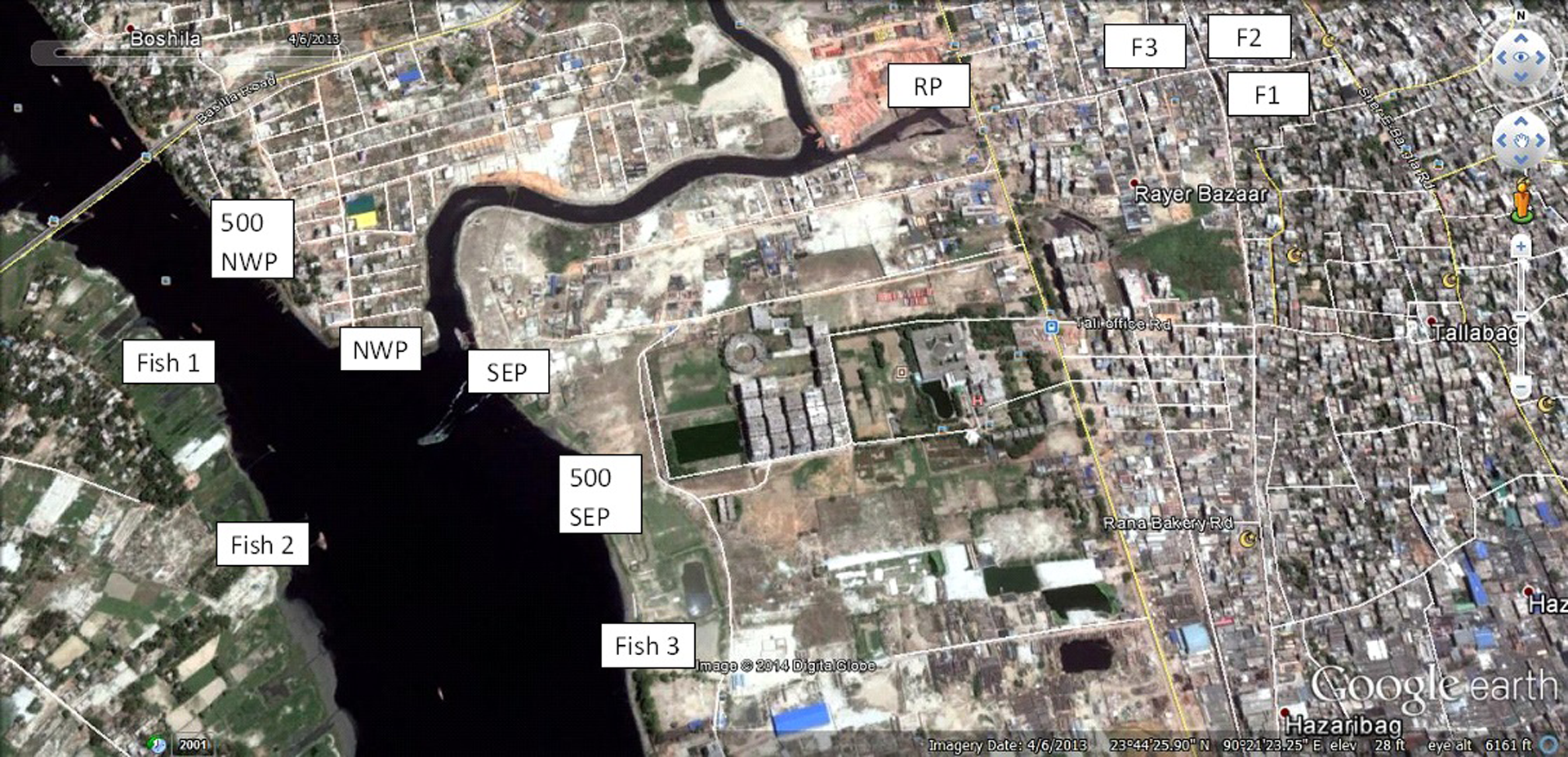
Satellite image of the study area showing factory locations, water sampling stations, and fish harvesting points.
Collection of leather effluent, contaminated water, and fish samples
The points for water sample collection were the drainage system of three factories (effluents), releasing point (RP), where the mixture of tannery effluents from different factories is released into a small canal that meets the Buriganga River and the Northwest point (NWP) and Southeast point (SEP), which are at the junction points of the effluent-releasing canal and the river. The other two different locations are 500 m northwest of the junction point (500 NWP) and 500 m southeast of the junction point (500 SEP). Fish samples were collected from the fishermen in three popular harvesting points near the junction point and toward 500 SEP. All the samples were collected in four rounds (March, June, September, and December) in 2010. Standard methods were used for collection and analysis of effluents and fish samples (Andreji et al., 2005; APHA, 1998; Jain and Bhatia, 1987).
Method of sample collection
Two liters of water samples were collected using 1-L capacity white polyethylene plastic bottles prewashed with 10% nitric acid (HNO3) and thoroughly rinsed with deionized water. The samples were stored in a refrigerator at 4°C. The fish samples were caught by fishing nets, wrapped in polyethylene bags, and transported to the laboratory on the same day. After dissecting with sterilized instruments, muscle samples were obtained from the left side of the body in the dorsal area, without skin or bones. After collection, the tissue samples were stored at −20°C.
Analysis of water samples
Water samples (100 ml) were taken, filtered through Whatman 42 filter paper, and then acidified with 5 ml concentrated HNO3 to decrease the pH to 2.0 and to remove the organic compounds. The samples were digested for 30 min, placed in 100-ml volumetric flasks, and brought to volume with double-distilled water. Digested samples were collected in plastic containers for analysis.
Analysis of fish samples
Fish were dried by pressing gently with tissue papers, brought to room temperature, washed thoroughly with tap water, and finally with double-distilled water. These fish samples were then dried in sunlight until reaching a constant weight, and the muscle part was taken as samples. One gram of dried tissue samples (in three replications) were placed into a muffle furnace and heated at 100, 200, 300, and 400°C for 1 h and at 500°C for 6 h. The samples were filtered through Whatman 42 filter paper, acidified by a solution of HNO3:H2O in the ratio of 2:1, and heated again at 500°C to undergo complete combustion. The samples were placed in 100-ml volumetric flasks, brought up to volume with double-distilled water, and collected in plastic containers.
All the collected samples were analyzed with an AA240 FS-Varian atomic absorption spectrophotometer (Palo Alto, California, USA). Two sample blanks were analyzed together with each sample batch. Concentrations of metals in blanks were below detection limits (0.01 ppm) in all analyses.
Statistical analysis
The experimental results are presented as mean ± SD. Differences in means were evaluated by two-tailed Student’s t test, with the values of p < 0.05 considered to be statistically significant (Gomez and Gomez, 1984).
Results
All three factories discharged similar concentrations of heavy metals that became constantly diluted in all the sampling points studied. This study reveals that while the concentrations of Hg, Al, Mn, and Cd in water samples were within the accepted limits, those of Cr and Pb were beyond the limits (Dean et al., 1972; FAO/WHO, 1987, 1990). The average concentration of Cr found in the effluents was 374.19 ppm that decreased gradually to 188.3 (RP), 152.5 (SEP), 151.04 (NWP), 49.9 (500 SEP), and 52.5 ppm (500 NWP). In the case of Pb, these values were 5.95 (effluents), 4.51 (RP), 2.92 (SEP), 2.91 (NWP), 1.89 (500 SEP), and 2.04 ppm (500 NWP). Depending on the season, concentrations of all other metals in effluents were highest in round 1 after the dry season (January–February) and lowest in round 2 when the rainfall is maximum (May–June; Table 1).
Concentrations of Cr, Pb, Cd, Hg, Mn, and Al in tannery effluents, discharged water samples and river water samples.a
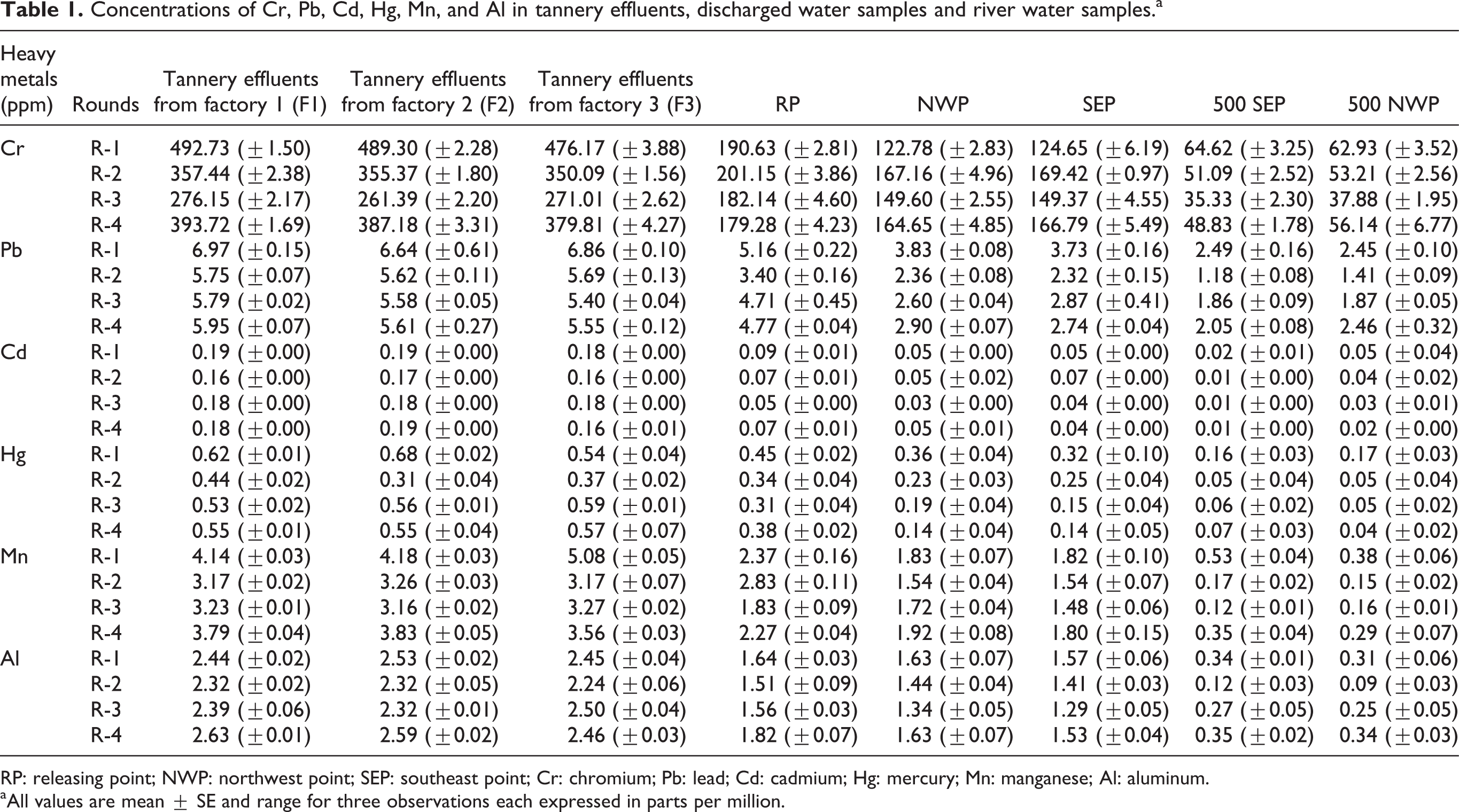
RP: releasing point; NWP: northwest point; SEP: southeast point; Cr: chromium; Pb: lead; Cd: cadmium; Hg: mercury; Mn: manganese; Al: aluminum.
aAll values are mean ± SE and range for three observations each expressed in parts per million.
Despite the high concentration of heavy metals (especially Cr and Pb) in the river water, far less were found in the three fish species studied. In muscle samples, mean concentrations for Cr, Pb, Al, Hg, Mn, and Cd were 2.70, 0.72, 0.66, 0.56, 0.53, and 0.12 mg/kg, respectively, which are below the limits recommended by Food and Agriculture Organization (FAO)/World Health Organization (WHO) and adopted by many countries (FAO/WHO, 1987). No specific pattern of metal accumulation was found combining different periods of the year. In most cases (Cr, Cd, Mn, and Al), heavy metal concentrations in climbing perch were greater than in Black tilapia and spotted snakehead (Figure 2). The levels of all the heavy metals studied were minimum in spotted snakehead. The concentration of heavy metals differed from species to species due to their different ecological niches, metabolic activities, and feeding habits.
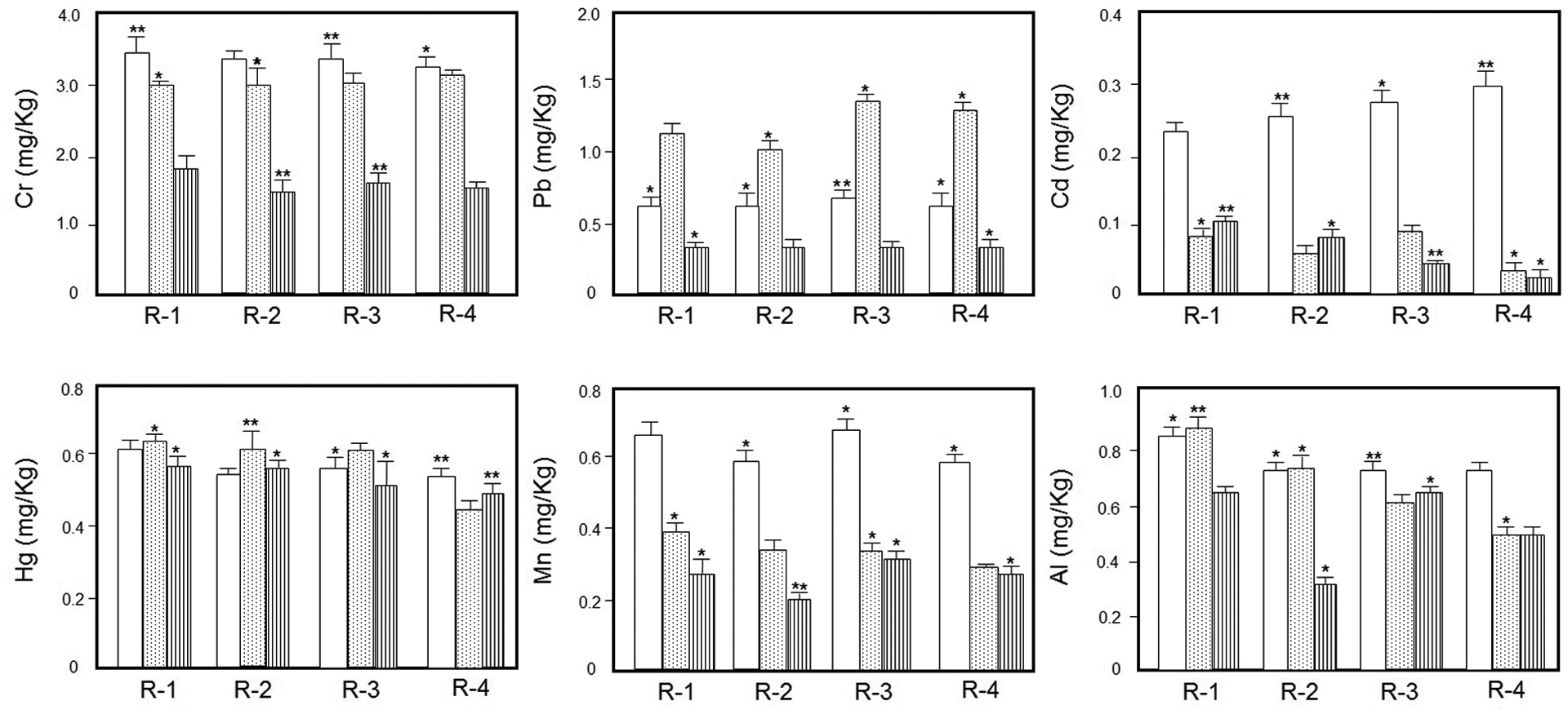
Concentrations of Cr, Pb, Cd, Hg, Mn, and Al found in muscles of three fish species. Here white bar, dotted bar, and striped bar denote the values for climbing perch, Black tilapia, and spotted snakehead, respectively. Error bars: the results are calculated from three independent experiments.
Discussion
The average value of Cr (374.19 ppm) in effluent samples far exceeds the worldwide accepted regulatory limit of 0.5–15 ppm (Buljan, 1996). In the process of tanning, Cr salt is used in substantial amounts to convert hide to leather along with maintaining leather quality (Forstner and Wittmann, 1981). It is likely that only 70% of Cr used is taken up by the dermal collagen fibers during tanning and the remainder is discharged in effluents. High Cr concentration in tannery discharges into rivers was found in a number of studies (Jordao et al., 1997; Parveen, 2013; Takarina et al., 2004). Enhanced levels (1475, 592, and 410 ppm, respectively) of Cr were reported in the effluents from tanneries located at Leon, Mexico as well as at Sialkot and Kasur in Pakistan (Ali et al., 2013; Contreras-Ramos et al., 2004; Tariq et al., 2006). In the present study, the average Cr level in the tannery effluent is in line with those results. Concentration of Pb in tannery effluents from Mexico (9.1 ppm) was higher than that of the present study (5.95 ppm), whereas relatively lower values were observed from tannery effluents in Pakistan (up to 1.18 ppm) (Ali et al., 2013; Contreras-Ramos et al, 2004).
Waste output of Al, Mn, Hg, and Cd was also substantial. The average concentration for Al (0.87 ppm) in river water was found to be less than the values obtained from two rivers in Brazil (1.39 ppm), whereas opposite results were found in the case of Mn (0.98 ppm compared with 0.036 ppm) (Rodrigues and Formoso, 2005). Similar values for Mn (0.988 ppm) were reported in tannery effluents from Haridwar, Uttarakhand, India (Deepali, 2010). The average concentration for Cd in tannery effluent was recorded as 0.176 ppm, while a higher value (0.59 ppm) was observed in Sialkot, Pakistan (Ali et al., 2013). Although the presence of Hg is less common in tannery effluents than Al, Cd, or Mn, average values found in the present study were 0.52 ppm in effluents and 0.15 ppm in river water (Bosnic et al., 2000).
The highest concentrations of heavy metals in water samples were found in March (round 1) and the lowest in September, after the rainy season (round 3). Dissolved oxygen (DO) and biological oxygen demand (BOD) are important limnological parameters indicating the level of water quality and organic production (Wetzel and Likens, 2006). A previous study on the water quality of the Buriganga River reported that DO decreased (from 5.41 to 4.24 mg/L) whereas BOD increased (from 2.21 to 6.82 mg/L) in the dry season compared with the rainy season (Hasan et al., 2009). Probably in both cases, the changes resulted from the large amount of tannery wastes discharged after the Eid-ul-Azha festival that takes place in late November. As a large number of animals were slaughtered during the festival, raw leathers were collected and processed over the following 2 or 3 months producing increased tannery wastes and heavy metal concentrations in March. In November, BOD and heavy metal concentrations both decreased probably because of sample dilution as has also been reported in a previous study (Jain and Sharma, 2001).
Although it has been reported that heavy metals accumulate in bones to a greater extent than muscles (Emara et al., 1993; Gbem et al., 2001), the muscle is the major tissue of interest under routine monitoring of environmental contamination with metals. As expected, Cr and Pb were the most abundant metals accumulated in all fish species. Mean concentration of Cr in muscles of three fish species was found as 2.70 mg/kg. Similar to this study, several tanneries operating at the state of Minas Gerais in Brazil discharge their wastes directly into rivers without any previous treatment and Cr concentration in fish tissue was recorded as high as 3.5 mg/kg (Jordao et al, 1997). In another study, average concentration of Cr and Pb in the tissue of five freshwater fish species from Vellar River, Salem, Tamil Nadu, India, was 1.03 and 0.53 mg/kg, respectively, that corresponds to the values obtained in the present study, 2.70 and 0.72 mg/kg, respectively (Ambedkar and Muniyan, 2011).
The likelihood of ingesting high levels from eating fish from the study area is greater for Cr and Pb than for Mn, Al, Hg, and Cd. The mean concentrations of three of the most prominent heavy metals, Pb, Cd, and Hg in these fish are 0.72, 0.12, and 0.56 mg/kg, respectively. Average fish consumption per person per day in Bangladesh is only 38 g or 14 kg/year (FAO, 2005). So it can be estimated that the average intakes of Pb, Cd, and Hg through fish are 27.36, 4.56, and 21.28 μg, respectively. These values of Pb, Cd, and Hg are below the provisional tolerable intakes by human being of total Pb (7.1 μg/kg body weight (b.w.)/day), Cd (1.102 μg/kg b.w./day), and Hg (0.7 mg/kg b.w./day) for an adult person weighing 70 kg (FAO/WHO, 1987, 1990; WHO, 1973, 1990). Mean concentrations of Pb and Cd were found to be 2.46 mg/kg (3.4 times higher than the present study) and 0.094 mg/kg (1.2 times lower than the present study), respectively, in a number of commonly consumed fresh water fish collected from different areas of Bangladesh (Sharif, 2009a). In case of Hg, lower amounts (0.377 and 0.44 mg/kg) were found in two previous studies (Holsbeek et al., 1996; Sharif et al., 2009b).
In summary, heavy metal concentrations observed in this study are within the maximum permissible levels according to the codes of FAO and WHO (FAO, 1983; WHO, 1973). The data indicate that despite high levels of heavy metals in river water levels in fish appear to be within safe limits; hence, consumption of fish caught from these contaminated areas should have no toxicological effect on human health as part of a normal diet. But this situation could change in the future if preventive measures are not taken. For example, vegetable tannins from the barks of several plants might be utilized as an alternative to processes that result in Cr pollution. It is hoped that the data obtained will be helpful in designing management plans and tannery pollution abatement strategies at the national level.
Footnotes
Acknowledgments
We are grateful to Professor ANM Hamidul Kabir (Department of Applied Chemistry and Chemical Technology, University of Dhaka, Dhaka, Bangladesh) for providing the guideline in critical phases of analysis. We would like to thank Dr Sirajul Islam (Head of Environmental Micrbiology Laboratory, ICDDR’B, Dhaka, Bangladesh) for the laboratory support.
Conflict of interest
The authors declared no conflicts of interest.
Funding
This research received no specific grant from any funding agency in the public, commercial, or not-for-profit sectors.