







Abstract
Industrial wastewater has attracted increasing attention in recent years because of its impact on ecosystems and human health. Whole-effluent tests are generally used to monitor toxicities of unknown chemicals and conventional pollutants from industrial effluent discharges. This study described identification evaluation (TIE) procedures to determine the acute toxicity of a nonmetallic mineral mining facility effluent that was toxic to Daphnia magna. In the characterization step (TIE phase I), toxic effects of heavy metals, organic compounds, oxidants, volatile organic compounds, suspended solids, and ammonia were screened. Results revealed that the source of toxicity was beyond these toxicants. Chemical analysis (TIE phase II) of total dissolved solid showed that the concentration of chloride ion (15,302.5 mg/L) was substantially higher than the predicted EC50 value for D. magna. Chemical analysis for heavy metal and ionic materials used ion chromatography and induced coupled plasma–optic emission spectroscopy. In the confirmation step (TIE phase III), using spiking and deletion approaches, it was demonstrated that chloride ion was the main toxicant in this effluent. Concentrations of potassium (317.5 mg/L), magnesium (970.5 mg/L), sodium (8595.3 mg/L), and sulfate (2854.3 mg/L) were not high enough to cause toxicity to D. magna. Finally, we concluded that chloride was the main toxicant in the nonmetallic mineral mining facility effluent. Based on these results, advanced treatment processes such as ion exchange and reverse osmosis technology are recommended to treat wastewater in this and similar situations. Further research is needed to provide technical support for toxin identification and evaluation of various types of wastewater treatment plant discharge.
Introduction
Whole effluent toxicity (WET) tests are recommended by the US Environmental Protection Agency (EPA) to describe the total effect of environmental exposure of aquatic life to toxic pollutants in an effluent without requiring the identification of the specific pollutants. WET has been applied by many countries to monitor wastewater. It was included in South Korea’s Water Quality and Ecosystem Conservation Act in 2011. It has been applied to 35 types of industry. In wastewater systems, monitoring effluents is very important. When monitoring wastewater in treatment facilities, toxicity identification evaluation (TIE) has many merits. This method is especially good at finding unknown chemical substances in mixtures. However, WET cannot identify which chemical substance might influence toxicity of effluent in the wastewater system. Some toxicants might not be identified by the WET method. However, TIE procedure can identify these substances. The TIE method has been used to separate causative toxic substances from effluent in the wastewater system (USEPA, 1991, 1993a, b). TIE involves a series of procedures to characterize, identify, and confirm the causative toxic substance(s) in a given sample by conducting chemical analysis and bioassays simultaneously. TIE includes physical and chemical analyses for effluent and ecotoxicity tests using Daphnia magna to characterize latent toxic substances. In addition, quantitative and qualitative experiments are performed under TIE to identify potential toxicants in phases I and II. According to effluent features, TIE processes can be changed. The TIE method has high efficiency in confirming toxic substances in effluents. Many studies have been conducted using the TIE assessment method. It has been applied in urban (Amweg et al., 2006; Budd et al., 2007; Holmes et al., 2008; Ng et al., 2008; Trimble et al., 2009; Weston et al., 2005, 2006, 2008c) and agricultural environments (Amweg et al., 2005; Anderson et al., 2008; Hunt et al., 2008; Phillips et al., 2006; Weston et al., 2004, 2008a, b; You et al., 2008). Mount and Hockett (2000) identified hexavalent chromium as a toxic substance in effluent using ion exchange resin. Hongxia et al. (2004) discovered that 2-propylbezaldehyde oxime is the substance in effluent that causes acute toxicity to D. magna using a solid phase sampling process. To date, toxicity of effluents discharged from nonmetallic mineral mining facility have not been evaluated. The objective of this study was to use WET and TIE to evaluate the toxicity of effluent discharged from a nonmetallic mineral mining facility located in South Korea. Toxicities of wastewater materials were estimated with ecotoxical experiments using D. magna. Physical and chemical features of effluent were determined in phase I of TIE. Compounds and ions present in the effluent were identified using ion chromatography (ICS) and induced coupled plasma–optic emission spectroscopy (ICP-OES) in TIE phases I and II.
Materials and methods
Sampling site description
Effluent samples were taken from a nonmetallic mineral mining facility located in Incheon city, the western part of Korea. The facility was established in 2005. It has a designated flocculation capacity of 1900 m3/day, with discharges of about 1800 m3/day of effluent after the final product.
Sample collection and analysis
Effluent samples were collected four times using the grab sampling method. All samples were subjected to bioassay (WET with D. magna) and TIE phases I, II, and III. An amber glass bottle and an aseptic polyethylene bag (quality certified by the manufacturer) were separately utilized to collect organic and ionic compound samples. Temperature, dissolved oxygen (DO), specific conductivity, oxidation–reduction potential, total dissolved solid (TDS), pH, and salinity were directly measured for each sample using YSI (Professional Plus).
Collected samples were transported and stored in a laboratory refrigerator. In the laboratory, biochemical oxygen demand (BOD), chemical oxygen demand (COD), suspended solid (SS), total nitrogen (TN), total phosphorus (TP), and hardness were confirmed in accordance with Standard Methods for the Examination of Water (Ministry of Environment of Korea). Ion concentrations were measured using ICS and ICP-OES to quantify the amount of anion and cation in the sample. For the D. magna 24-h acute toxicity test, iced samples were placed in a clean room to increase the sample temperature to 20°C ± 1°C.
Toxicity test and statistics
Daphnia magna (water fleas) acclimatized for 3 weeks were used for each experiment. To guarantee the health of D. magna, a QA/QC test was conducted using chromium (6+) weekly. For culturing D. magna, the culturing water contained hard-water ion (potassium chloride (KCl) 8 mg/L, CaSO4·4H2O 120 mg/L, magnesium sulfate 120 mg/L, and sodium bicarbonate 192 mg/L). The hardness of culture water was maintained at 160–180 mg/L as calcium carbonate (CaCO3). Its pH value was between 7.6–8.0. DO concentration was higher than 5.0 mg/L. Before experiments, water was aerated. Organisms were kept in a temperature-controlled chamber (20°C) with a 16:8 light/dark cycle. Water renewals were performed daily, and organisms were fed a 3:1 mix of Pseudokirchneriella subcapitata (approximately 3.0 × 10⁷ cells/mL) and YCT (trout chow, yeast, and CEROPHYL®). The toxicity test using D. magna was conducted in accordance with TIE (USEPA, 1991, 1993a, b) and WET test guidelines. WET tests were carried out upon the arrival of sample.
Briefly, less than 24-h-old neonates were used as test organisms in toxicity tests. In the 24-h acute toxicity test, third-brood neonates of D. magna neonates were used within 24 h in each experiment. D. magna were exposed to 20°C ± 1°C. Illumination was kept at 16-h light and 8-h dark. For the standard reference test, potassium dichromate was used as a positive control for acute toxicity tests. Results of reference experiments were expressed as acute toxicity data. EC50 concentration ranged from 0.9 to 2.1 mg/L. If EC50 value exceeded this range, all experiments were stopped and water fleas were redistributed. Toxicity test was conducted after serial dilution of wastewater with culture water to obtain 100%, 50%, 25%, 12.5%, and 6.25% of wastewater. As a negative control, culture water only was used. Glass beakers (50 mL) were used for all toxicity tests. In each beaker, five neonates were placed in the experiment solution. All experimental tests were performed in triplicate. Each test result was expressed as EC50 value. EC50 (median effective concentration) was calculated using the Toxcalc 5.0 Program. Resulting values were then converted to toxic units (TU = 100/EC50).
Toxicity identification evaluation
TIE procedures developed by the US EPA (USEPA, 1991, 1993a, b) were used with some modifications. TIE phase I had many processes including filtration, C18 solid phase column passage (C18 5 g, 25 mL, Biotage), ethylenediaminetetraacetic acid (EDTA) chelation, sodium thiosulfate reduction, aeration, ammonia addition (pH adjusted), and cation and anion mixed bed exchange. These procedures were implemented individually for each wastewater sample. GF/C filtrations were used to screen suspended particles. The C18 cartridge was used to screen organic materials. Sodium thiosulfate was used to remove oxidative compounds (e.g. chlorine). EDTA was used to eliminate heavy metal substances by developing chelate complexes. In TIE phase II, anion suspected as key a toxicant was analyzed using Dionex ion chromatography (Dionex ICS 1100). Major toxicants identified by anion analysis were confirmed by with additional tests in phase III of TIE.
Phases II and III of TIE identification
In phase I, high-toxicity samples manipulated by ion exchange showed significant decrease in toxicity. In phase I of TIE, dissolved ion concentration was analyzed by ICP spectrometry and ICS. The following ions were analyzed: Cl, SO4, Na, Mg, K, Pb, Cu, and Zn. By comparing analysis data with the ECOTOX database, their potential toxicities were then considered. In phase III of TIE, chloride ion was demonstrated to be the main toxicant in this effluent based on spiking and deletion test.
Results and discussion
Result of baseline D. magna toxicity test
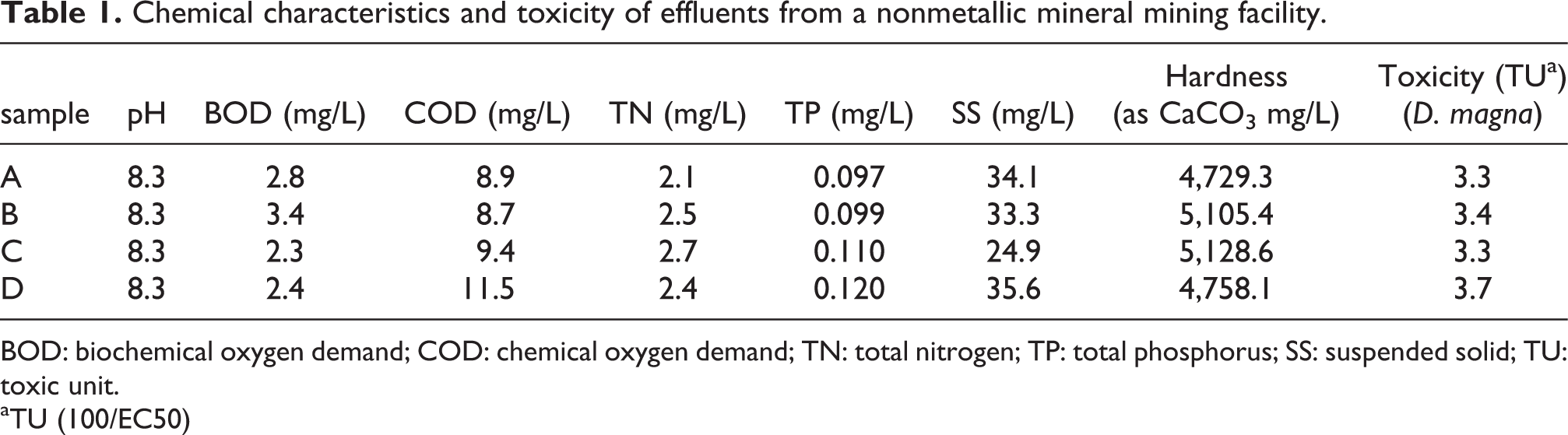
Based on water quality measurement of influent and wastewater as well as operation database in the plant, there was no operational problem while sampling was conducted. Although wastewater samples expressed general physicochemical results, effluent sample showed high toxic values (Table 1).
Chemical characteristics and toxicity of effluents from a nonmetallic mineral mining facility.
BOD: biochemical oxygen demand; COD: chemical oxygen demand; TN: total nitrogen; TP: total phosphorus; SS: suspended solid; TU: toxic unit.
aTU (100/EC50)
Each sample presented toxic units (TU) greater than 3, indicating that this processing method of WWTP could not sufficiently remove the toxic substances from the effluent. Based on the assessment results, general parameters were found to contain low toxic substances. In addition to general materials, ionic materials were analyzed in phase II of TIE. Ion concentrations were measured by ICS and ICP.
Phase I characterization
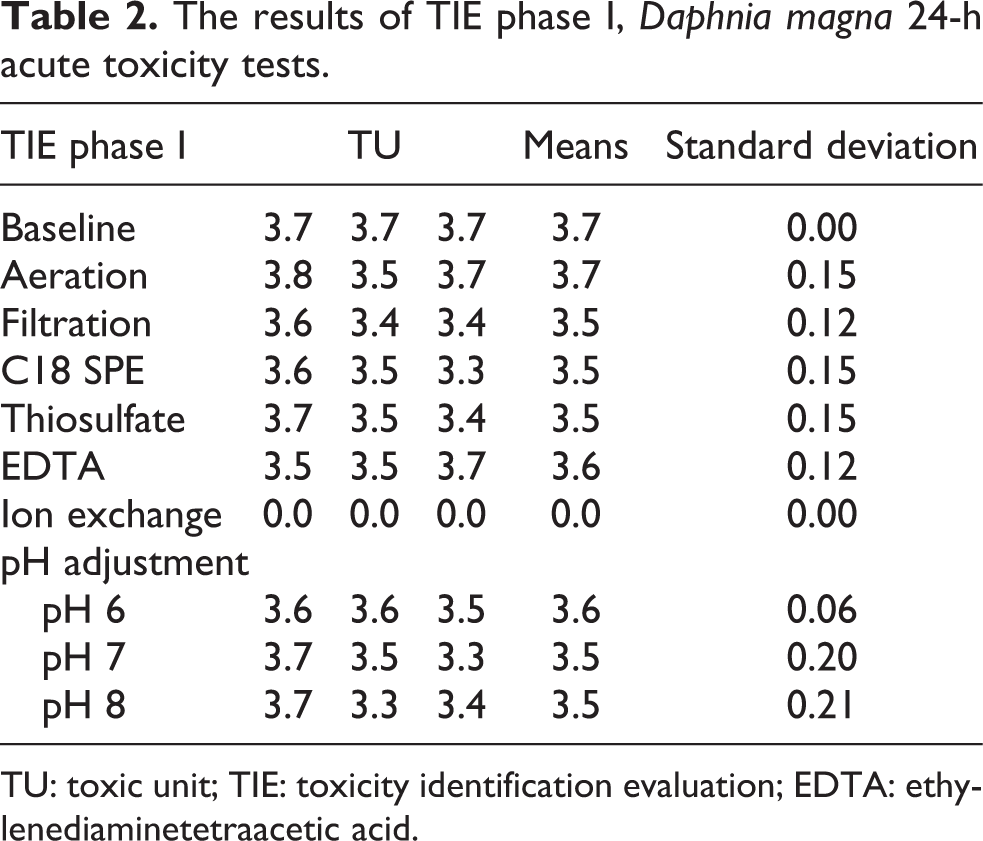
There was no change in toxicity value after manipulating effluent samples with EDTA, addition of thiosulfate, aeration, C18 SPE, filtration, or pH adjustment. After ion exchange treatment, the toxic value was completely removed. Results of toxicity tests in phase I of TIE are summarized in Table 2.
The results of TIE phase I, Daphnia magna 24-h acute toxicity tests.
TU: toxic unit; TIE: toxicity identification evaluation; EDTA: ethylenediaminetetraacetic acid.
Based on the results shown above, the toxicity to Daphnia was found to be caused by ionic materials. Ion exchange resin was capable of exchanging both cations and anions. According to Phase I characterization, ion materials in the effluent were found to be the major toxicants present in the nonmetallic mineral mining facility effluent.
Phases II and III identification and confirmation
Ion concentration in whole effluent
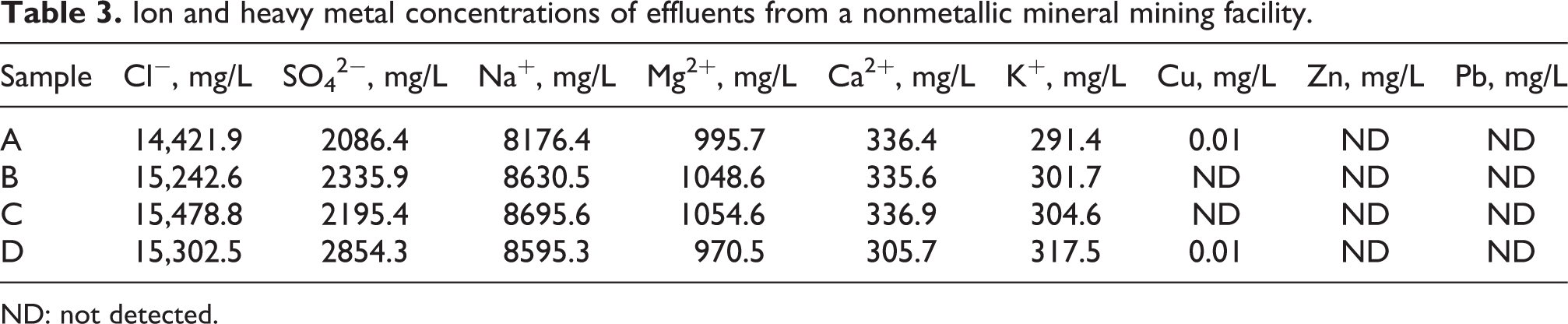
A total of six ions and three heavy metals including copper were analyzed. Results of ion substance and heavy metal analyses confirmed that chlorine ions were present at a high concentration that could cause toxicity. Copper, zinc, or lead was not detected. Concentrations of these ions and heavy metals measured in effluent samples are summarized in Table 3.
Ion and heavy metal concentrations of effluents from a nonmetallic mineral mining facility.
ND: not detected.
The results of Daphnia 24-h acute toxicity test.

To evaluate the potential toxicity of ions, chemical toxicity evaluation was carried out using the water flea (D. magna). Sodium chloride was used to determine the characteristics of chlorine ions. For sulfate ions, sulfuric acid was used. For potassium ions, KCl was used. Each EC50 value was presented as an average value from three measurements. EC50 values of chloride, sulfate, and potassium ions were found to be 5348, 3537, and 397 mg/L, respectively.
Deletion and addition approach
In the ion exchange experiment, effluent toxicities were greatly decreased from 3.7 TU to 0.0 TU after 24 h of exposure. For chlorine ions, addition of the same amount as the sample was evaluated for the first time and its toxicity was found to be 3.7 TU.
These results showed that ion exchange treatment was highly efficient in removing toxic substances from the target effluent. Therefore, the ion exchange process is recommended for this and similar nonmetallic mineral mining facilities to control the highly toxic ionic materials in the effluent.
Conclusion
The present study found that toxicities were caused mainly by TDS (chloride). To prevent toxicities caused by chloride, an ion exchange treatment process is recommended for this typical nonmetallic mineral mining facility to treat its effluent. Therefore, ion exchange treatment or similar system is highly recommended for wastewater treatment plants. In summary, TIE procedures can be successfully applied to nonmetallic mineral mining facilities to analyze effluents for toxicity.
Footnotes
Declaration of Conflicting Interests
The author(s) declared no potential conflicts of interest with respect to the research, authorship, and/or publication of this article.
Funding
The author(s) disclosed receipt of the following financial support for the research, authorship, and/or publication of this article: This research was supported by a grant (16IFIP-B089908-03) of Plant Research Program funded by the Ministry of Land, Infrastructure and Transport, Republic of Korea. This study was also supported by a funding from Hankuk University of Foreign Studies (2016).