







Abstract

Su et al. recently published in the Toxicology and Industrial Health a paper entitled “The neurotoxicity of nanoparticles: A bibliometric analysis” (Su et al., 2018). In the section of Methods, the authors mentioned that “Studies were collected from the Web of Science Core Collection database.” and “In order to collect potentially relevant research articles, a systematic search was performed using a Boolean operator, where TS = ((NPs* OR Nanomaterial* OR Nanocrystals* OR nano*) AND (Neurotoxicity* OR Poisoning, Nervous System*)). The searches were conducted from 2008 to 2017.”
Web of Science Core Collection includes Web of Science Core Collection: Citation Indexesÿ
Science Citation Index Expanded (SCI-EXPANDEÿD) Social Sciences Citation Index (SSCI) Arts & Humanities Citation Index (A&HCI) Conference Proceedings Citation Index—Science (CPCI-S) Conference Proceedings Citation Index—Social Science & Humanities (CPCI-SSH) Book Citation Index—Science (BKCI-S) Book Citation Index—Social Sciences & Humanities (BKCI-SSH) Emerging Sources Citation Index (ESCI)
Web of Science Core Collection: Chemical Indexes
Current Chemical Reactions (CCR-EXPANDED) Index Chemicus (IC)
Using Web of Science Core Collection as mentioned in the original paper (Su et al., 2018), TS = ((NPs* OR Nanomaterial* OR Nanocrystals* OR nano*) AND (Neurotoxicity* OR Poisoning, Nervous System*)) resulted in the database that includes 807 documents from 2008 to 2017. These results show a huge difference from the results in the original paper (Su et al., 2018).
Using all these different levels of databases is unsuitable for bibliometric studies. Emerging Sources Citation Index (ESCI) complements the highly selective indexes by providing earlier visibility for sources under evaluation as part of SCI-EXPANDED’s, SSCI’s, and A&HCI’s rigorous journal selection process (http://wokinfo.com/products_tools/multidisciplinary/esci/). Web of Science Core Collection: Chemical Indexes as well as SSCI, A&HCI, CPCI-S, CPCI-SSH, BKCI-S, and BKCI-SSH are inappropriate for “The neurotoxicity of nanoparticles: A bibliometric analysis” (Su et al., 2018).
The data were derived from the SCI-EXPANDED in Clarivate Analytics Web of Science (updated on March 18, 2019). A total of 764 documents were found by TS = ((NPs* OR Nanomaterial* OR Nanocrystals* OR nano*) AND (Neurotoxicity* OR Poisoning, Nervous System*)) from 2008 to 2017 (Su et al., 2018). However, the Web of Science Core Collection is not designed for bibliometric studies but for researchers to find literatures (Ho, 2018a, 2018b). Therefore, it is important for researchers to use SCI-EXPANDED with the accurate bibliometric method (Ho, 2018a, 2018b). Documents searched out by KeyWords Plus were likely to be irrelevant to “neurotoxicity of nanoparticles” (Fu and Ho, 2015). To improve such problem, a filter named “front page” (including the document title, the abstract, and the author keywords) was proposed by Ho’s group (Fu et al., 2012; Fu and Ho, 2014; Ho and Fu, 2016). Thus, documents with searching keywords in their “front page” were considered to be relevant publications. Altogether, 155 documents (20% of the 764 documents) had no searching words in their “front page.” In all, 545 documents (71% of the 764 documents) were found including 465 articles (85% of 545 documents), 63 reviews (12%), 14 meeting abstracts (2.6%), 7 proceedings papers (1.3%), 5 book chapters (0.92%), 2 editorial materials (0.37%), and 1 letter (0.18%).
Furthermore, 219 (29%) documents did not include searching keywords in their “front page,” for example, highly cited articles (Hsu and Ho, 2014) with 100 or more total citations from Web of Science Core Collection since publication to the end of 2017 (TC2017 ≥ 100) “A DNA-gold nanoparticle-based colorimetric competition assay for the detection of cysteine” (Lee et al., 2008) with only “nanoparticle” and “nanoparticles” but (neurotoxicity* or poisoning, nervous system*) in its “front page.” Highly cited article “Phosphorylation regulates tau interactions with Src homology 3 domains of phosphatidylinositol 3-kinase, phospholipase Cγ1, Grb2, and Src family kinases” (Reynolds et al., 2008) had no searching keywords in its “front page.” To avoid introducing unrelated articles for analysis, utilizing the “front page” filter is needed (Fu et al., 2012; Ho, 2018c). Since any results and discussions depend on the data abstracted by a search filter, an inappropriate filter may lead to inaccurate results and conclusions (Ho, 2018a, 2018c). In recent years, similar rebuttals have also been published in Environmental Science and Pollution Research (Ho, 2018a) and Renewable & Sustainable Energy Reviews (Ho, 2018c).
It was accepted that articles were usually selected for analysis on the basis of containing the whole research ideas, results, and discussions (Ho et al., 2010). In total, 457 neurotoxicity of nanoparticles articles with searching words in their “front page” from the SCI-EXPANDED from 2008 to 2017 were further analyzed. Table 1 shows the top 15 productive countries with six publication indicators (Ho and Kahn, 2014). The top 20 productivity of journals with journal impact factor in 2017 (IF2017) was listed in Table 2. The distribution of number of articles over the years was presented in Figure 1. Distribution of articles by the top 16 countries was shown in Figure 2.
Distribution of articles by institutions (top 15 institutions).
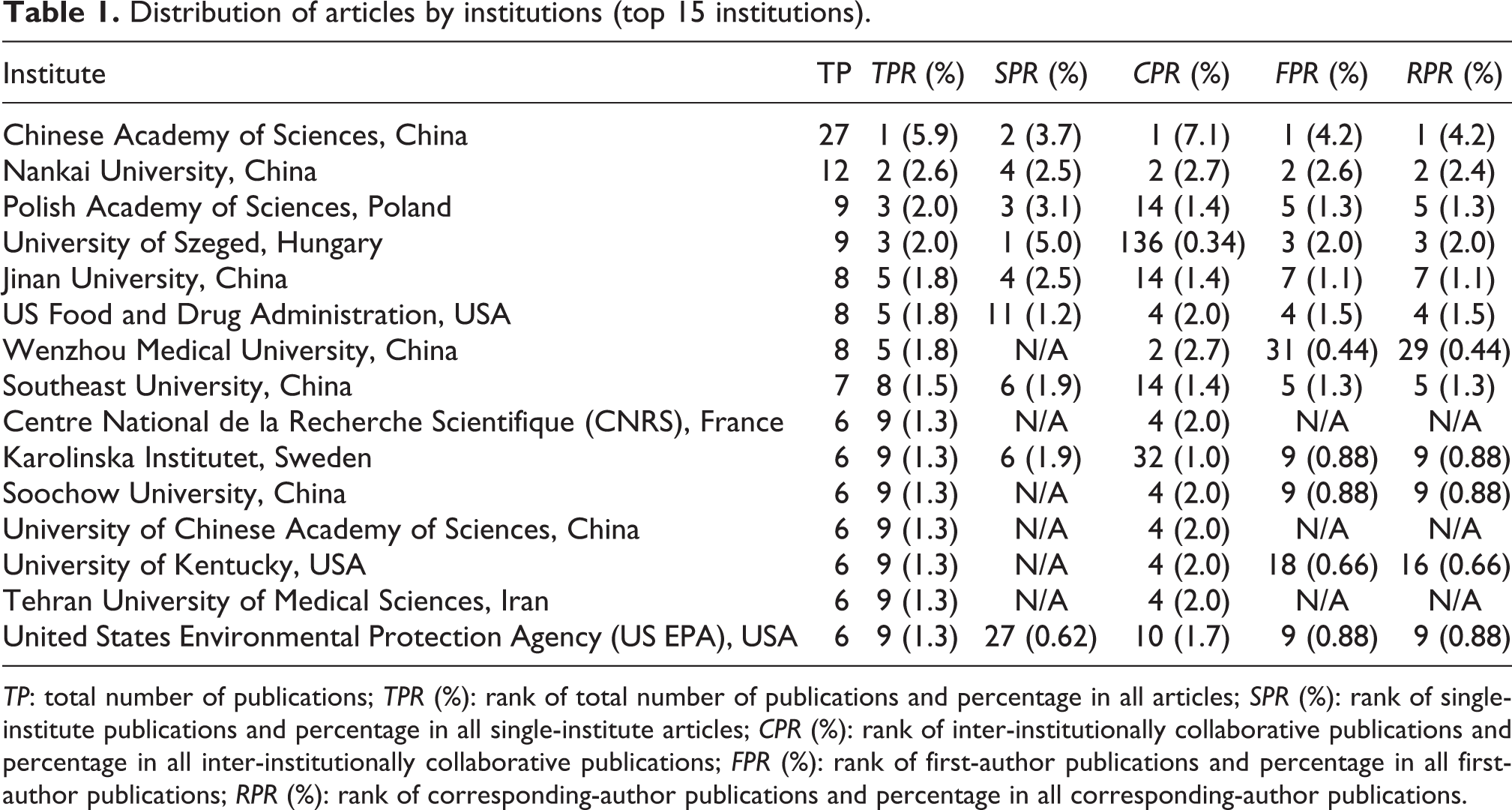
TP: total number of publications; TPR (%): rank of total number of publications and percentage in all articles; SPR (%): rank of single-institute publications and percentage in all single-institute articles; CPR (%): rank of inter-institutionally collaborative publications and percentage in all inter-institutionally collaborative publications; FPR (%): rank of first-author publications and percentage in all first-author publications; RPR (%): rank of corresponding-author publications and percentage in all corresponding-author publications.
Productivity of journals (top 20 journals).
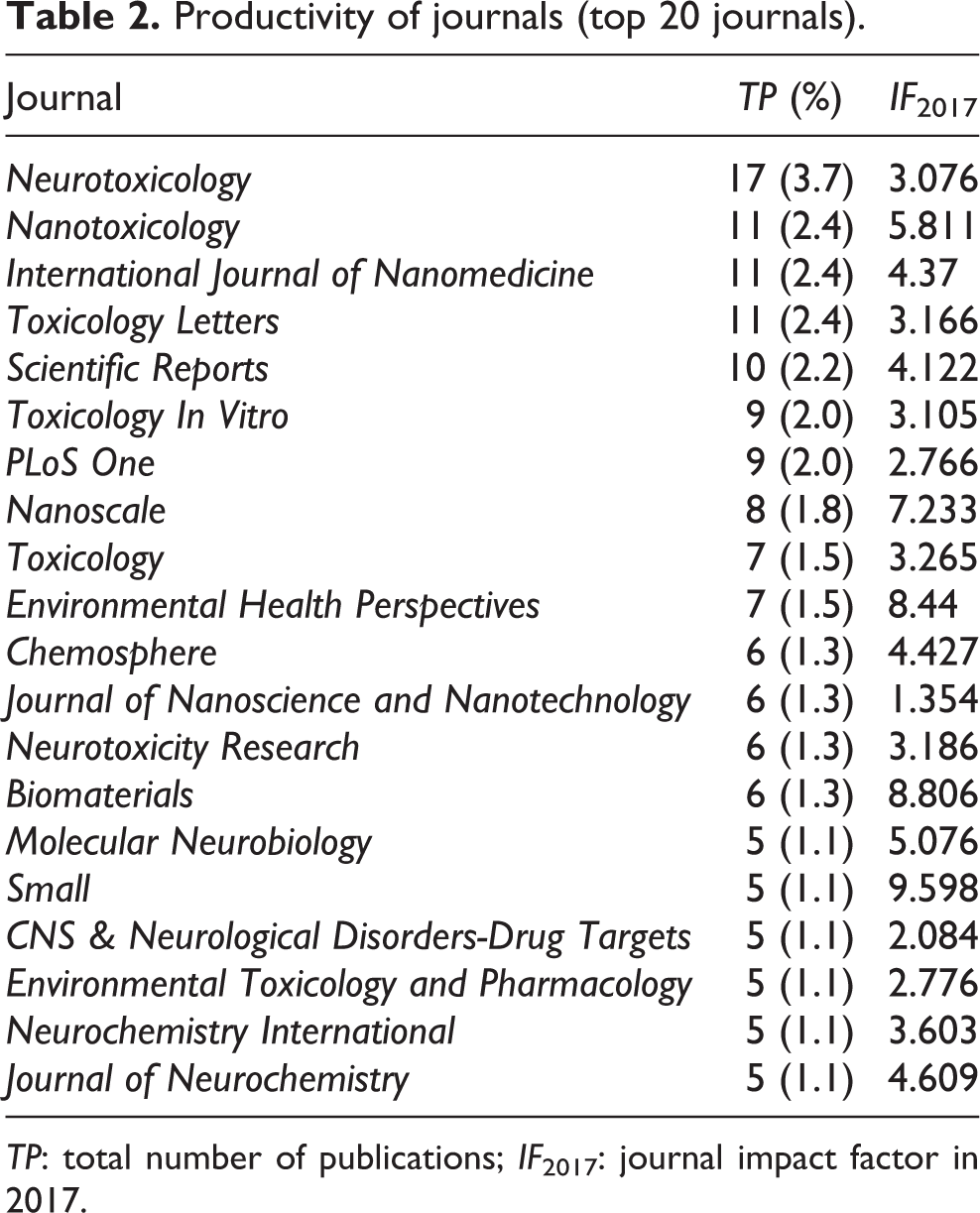
TP: total number of publications; IF2017: journal impact factor in 2017.
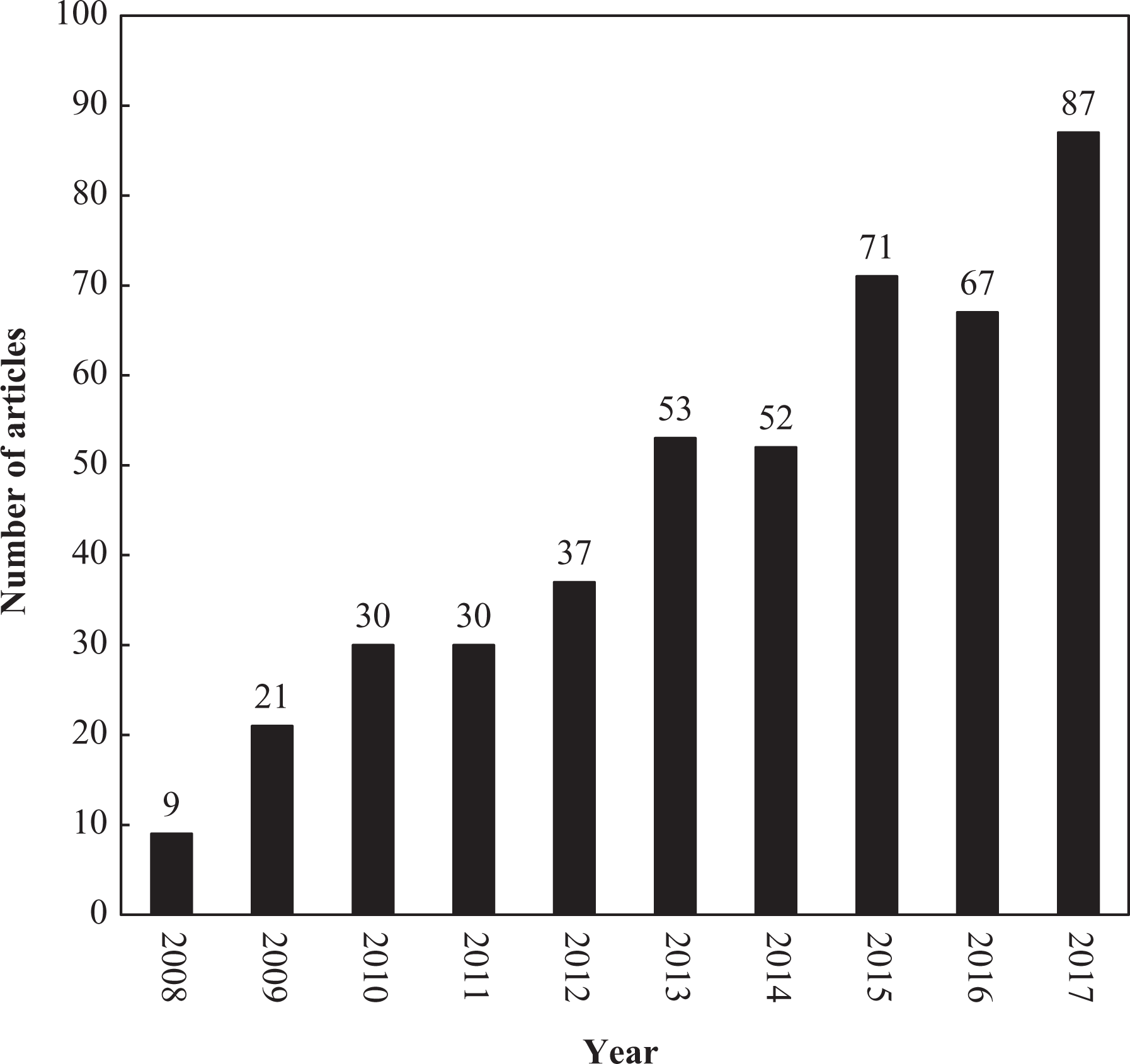
The number of articles on neurotoxicity of NPs published in the SCI-EXPANDED from 2008 to 2017. NP: nanoparticle.
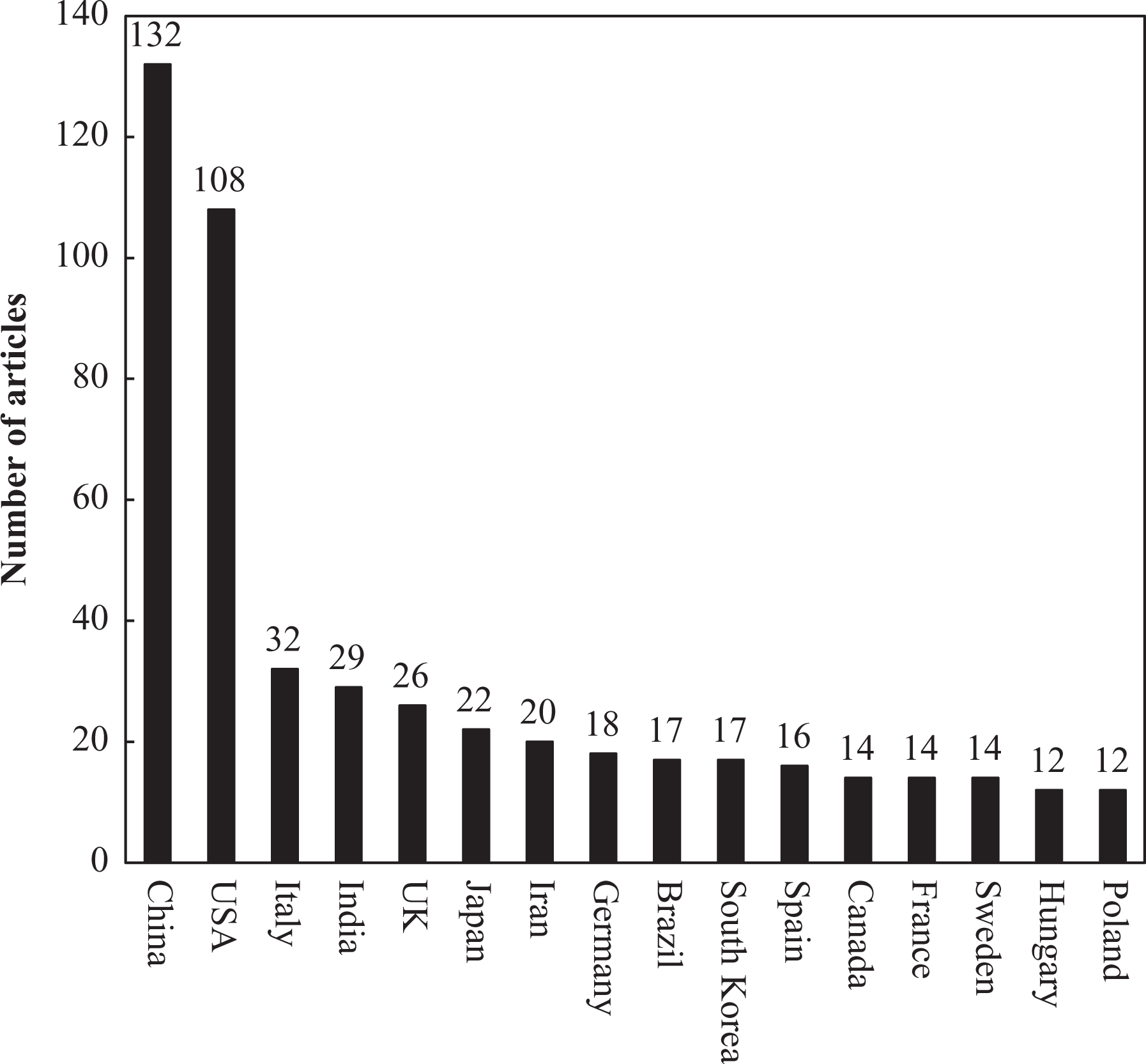
Distribution of articles by countries (top 16 countries).
Su et al. (2018) used inappropriate methods and data to publish bibliometric paper in Toxicology and Industrial Health, and this may result in misleading readers of the journal. From my point of view, Su et al. should have understood the Web of Science and thereby providing a greater accuracy and information about their data. Furthermore, Su et al. used limited 655 papers published in 10 years that is not appropriate from the statistics point of view for bibliometric studies.
