






Abstract
Lithium-ion batteries are indispensable in modern energy storage systems—including portable electronics, electric vehicles, and grid-scale applications—because of their high energy density, long cycle life, and low self-discharge. Among cathode materials, lithium-nickel-cobalt-manganese oxide (LiNiMnCoO2; NCM) is widely used because of its balanced electrochemical performance and strong commercial viability. With the rapid expansion of NCM production and recycling, concerns regarding occupational exposure and related health risks have increased. However, a comprehensive synthesis addressing the toxicological characteristics of NCM as a composite material—rather than its individual metal constituents—remains lacking. This review critically evaluates current evidence on the occupational health effects of NCM materials across their life cycle, with particular emphasis on inhalation exposure to NCM particulates in manufacturing and recycling settings. We integrated epidemiological data, in vivo and in vitro toxicological studies, and mechanistic research to characterize the health risks associated with NCM exposure. Following deposition in the respiratory tract, persistent particles initiate local inflammatory responses, while the gradual release of Ni, Co, and Mn ions within pulmonary and intracellular microenvironments drives sustained molecular and cellular toxicity. Major adverse outcomes include respiratory inflammation and fibrosis, neurotoxicity, hepatic and renal injury, and other systemic effects. We further summarized key toxicity mechanisms, including oxidative stress, inflammatory signaling, DNA damage, and related pathways, and discuss current occupational exposure limits and regulatory considerations for NCM-related metals. By consolidating multidisciplinary evidence, this review aimed to clarify knowledge gaps, inform future research priorities, support evidence-based regulatory decision-making, and promote safer manufacturing practices for next-generation energy storage technologies.
Keywords
Introduction
Lithium-ion batteries (LIBs) have become indispensable in modern energy storage, widely used in portable electronics, electric vehicles, and grid storage because of their high energy density, power efficiency, and long cycle life (Liu Y et al., 2021b; Reddy et al., 2020; Salgado et al., 2021). Their development has revolutionized multiple industries, playing a critical role in advancing sustainable energy solutions. The significance of LIBs technology was underscored when the 2019 Nobel Prize in Chemistry was awarded to John B. Goodenough, M. Stanley Whittingham, and Akira Yoshino for their pioneering contributions to their development (Manthiram, 2020).
Among the various cathode materials used in LIBs, lithium-nickel-cobalt-manganese oxide (LiNiCoMnO2, commonly known as NCM) has emerged as a leading choice owing to its superior energy density, stability, and overall electrochemical performance (Chang et al., 2023; Hu et al., 2023). NCM cathodes integrate the advantages of three transition metals—nickel (Ni), cobalt (Co), and manganese (Mn)—to optimize battery capacity, cycle life, and safety. However, this expansion has raised serious concerns regarding occupational and environmental health risks because of the toxicological profiles of Ni, Co, and Mn (Brown et al., 2024; Deng et al., 2024; Hanser et al., 2022).
Despite the rapidly growing literature on lithium-ion battery materials, several key limitations remain. Most toxicological studies focus on individual metals in isolation, providing mechanistic insights but failing to reflect NCM occupational exposures, which typically involve complex particulate mixtures. In addition, epidemiological data on battery manufacturing and recycling workers are scarce, fragmented, and largely regional, limiting robust risk assessment. Current regulatory standards also rely mainly on single-metal exposure limits and do not adequately address combined exposures or potential synergistic effects among transition metals.
Against this backdrop, a systematic and integrative synthesis of current knowledge is urgently needed. This review provides a comprehensive evaluation of the toxicological characteristics of NCM materials, with particular emphasis on occupational exposure pathways, associated health effects, and underlying mechanisms of toxicity. By critically consolidating multidisciplinary evidence, this work aimed to clarify existing knowledge gaps, inform future research priorities, and support the development of more effective regulatory strategies and safer industrial practices within the rapidly expanding lithium-ion battery sector.
Occupational exposure risks throughout the life cycle of NCM materials
Occupational exposure to NCM materials can occur throughout their entire life cycle, spanning material synthesis, battery assembly, and recycling processes (Liu Y et al., 2021b; Monu et al., 2022; Tao et al., 2023). The primary route of exposure is inhalation of airborne dust or aerosols containing NCM particles or their constituent raw materials Ni, Co, and Mn compounds.
During mining and refining, workers may be exposed to metal dust and fumes containing Ni, Co, and Mn. During the NCM material production phase—which includes raw material crushing and mixing, coprecipitation, high-temperature sintering, particle milling, sieving, surface coating, and drying—micron- and nano-scale particles of Ni, Co, and Mn compounds are generated and may become airborne. In battery manufacturing, particularly during slurry preparation and cathode coating, additional release of NCM-containing particles may occur, increasing the likelihood of worker exposure. Recycling of spent NCM-based lithium batteries also presents significant risks. Disassembly, crushing, and material separation steps generate composite dust that includes Ni, Co, and Mn compounds, as shown in Figure 1 Occupational exposure risks throughout the entire life cycle of NCM materials. This schematic illustrates the full life cycle of NCM materials—from raw material processing and NCM cathode material synthesis to NCM battery manufacturing, battery use, and end-of-life recycling. At each stage (including grinding, mixing, thermal treatment, slurry preparation, cell assembly, battery operation, dismantling, and recycling), workers may be exposed to airborne particulates containing Ni, Co, Mn, NCM compounds, or other hazardous by-products generated during these processes. The representative icons depict key industrial operations and highlight potential exposure scenarios across the production and recycling chain.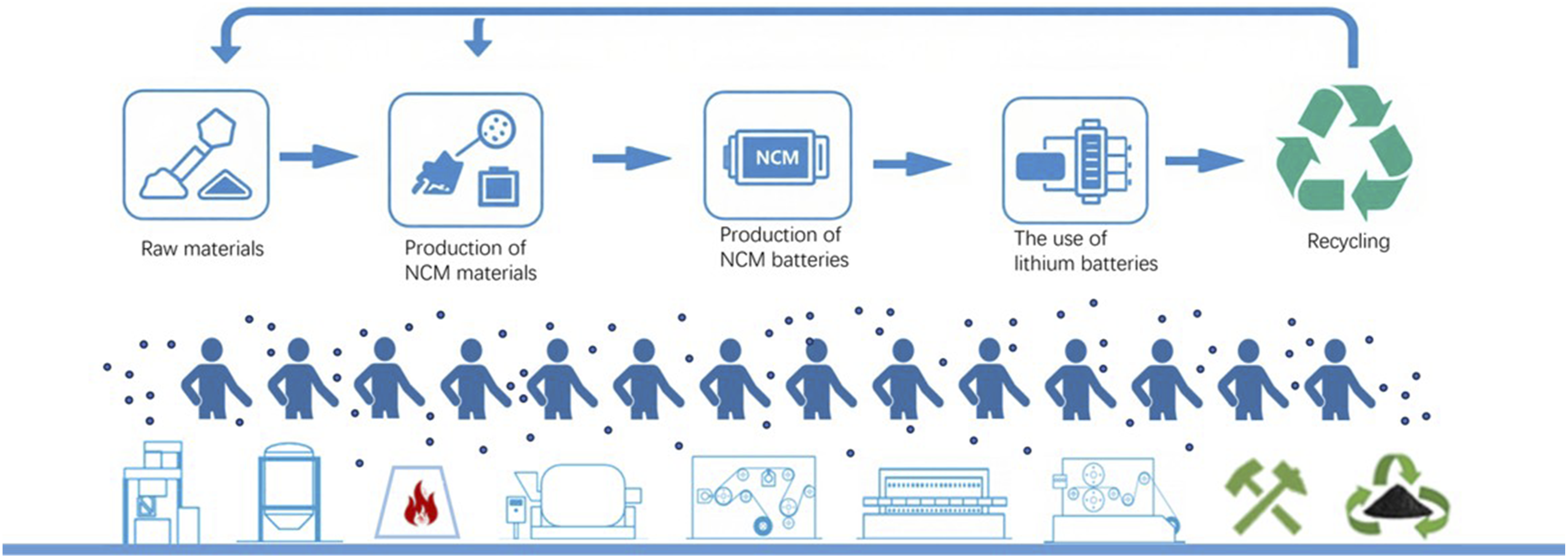
Beyond routine process-related exposures, thermal runaway (TR) events represent an emerging yet underrecognized occupational hazard. A substantial body of research has focused on the mechanisms, prevention, and mitigation of TR during the operational stage of batteries (Hmidi, 2026; Lai, 2022; Mohapatra, 2025). However, growing evidence indicates that TR incidents may also occur during non-application phases, including cathode material processing, battery testing, storage, and mechanical recycling. Under these conditions, rapid decomposition of electrode materials and electrolytes can generate large quantities of ultrafine metal-containing aerosols, along with toxic gaseous by-products such as hydrogen fluoride and phosphorus-containing species (Meister et al., 2025; Wang Z et al., 2025). In contrast to the chronic, low-level exposures typical of routine manufacturing operations, TR-related releases are characterized by acute, high-intensity, mixed-hazard profiles, which may substantially elevate the risks of respiratory injury and systemic toxicity among exposed workers.
Physicochemical properties and toxicological relevance of NCM materials
The toxicological behavior of NCM materials is fundamentally governed by their physicochemical characteristics, which determine their environmental reactivity, biological interactions, and potential health risks.
Particle characteristics and biological reactivity
Particle size, morphology, and surface properties are key determinants of NCM toxicity. Occupational exposure typically involves respirable micro- and nanoscale particles generated during material synthesis, mechanical processing, and recycling operations. Ultrafine NCM particles possess a high surface area-to-volume ratio, which enhances surface reactivity, catalytic activity, and interactions with cellular membranes.
Following inhalation, these particles can deposit deeply within the alveolar region and may persist because of limited clearance. Experimental evidence indicates that NCM particles induce pulmonary inflammation through macrophage activation, lysosomal destabilization, and oxidative stress generation. Moreover, the presence of redox-active transition metals capable of cycling between multiple oxidation states confers substantial intrinsic oxidative potential. These physicochemical features can amplify inflammatory signaling pathways, thereby contributing to chronic tissue injury.
Metal ion dissolution and secondary toxicity
In addition to particle-mediated effects, metal ion dissolution represents a critical pathway of NCM toxicity. Under physiological and environmental conditions, NCM particles can release Li2+, Ni2+, Co2+, and Mn2+ ions through proton-mediated lattice degradation and ligand-assisted dissolution processes. Dissolution rates are strongly influenced by environmental factors, particularly pH, organic ligands, and lattice stability, with acidic conditions markedly accelerating metal release (Liu, 2026).
These dual toxicity pathways operate at different biological levels: particulate properties primarily drive local respiratory inflammation and tissue injury, whereas released metal ions contribute to systemic toxicity, bioaccumulation, and long-term health risks.
Although lithium compounds can present occupational hazards, lithium differs fundamentally from Ni, Co, and Mn in its toxicological mechanisms (Bertollo et al., 2026; Bortolozzi et al., 2024; Sakrajda and Rybakowski, 2025). In addition, lithium generally exhibits lower bioaccumulation potential and reduced systemic persistence compared with Ni, Co, and Mn (Bertollo et al., 2026).
Importantly, evidence from mixture toxicology studies and epidemiological investigations consistently indicates that Ni, Co, and Mn are the principal contributors to the toxicity of NCM particulate mixtures, whereas lithium plays a comparatively minor role in driving adverse health outcomes (Brown et al., 2024; Zhang et al., 2026). Accordingly, the scope of this review intentionally prioritized Ni, Co, and Mn because these transition metals represent the dominant determinants of particle-mediated toxicity and long-term occupational health risks.
Although the toxicity mechanisms of NCM materials remain relatively underexplored (Sironval et al., 2019), their biological effects are, to a large extent, driven by the well-established toxicological properties of their constituent metals—Ni, Co, and Mn. This review therefore synthesized current knowledge on the toxicity mechanisms of these individual metals, with the aim of providing a mechanistic framework and comparative insights to inform future studies on NCM-related health risks.
Health effects of Ni, Co, and Mn exposure
During the entire life cycle of NCM materials, workers may be exposed to NCM particles as well as Ni-, Co-, and Mn-containing compounds. These particles can not only directly elicit inflammatory responses in the respiratory system but may also dissolve in the pulmonary fluid environment, releasing bioactive metal ions and secondary compounds. Once absorbed into the bloodstream, these dissolved species can be transported systemically, thereby affecting multiple organ systems beyond the lungs, as shown in Figure 2. Exposure and systemic toxicity of Ni, Co, Mn, and NCM particulate matter. This schematic shows the potential health impacts associated with occupational inhalation of fine particles containing nickel, cobalt, manganese, and NCM materials. Following respiratory deposition, these particles can induce local airway and lung injury. Subsequent systemic absorption and distribution may lead to toxic effects in multiple organ systems, including the cardiovascular, neurological, hepatic, and renal systems.
Health effects of Ni
Ni is a widespread occupational and environmental pollutant, extensively used in industries such as battery manufacturing, electroplating, and alloy production. Exposure to Ni is associated with diverse adverse outcomes, including allergic contact dermatitis, cardiovascular and renal diseases, pulmonary fibrosis, and cancers of the lung and nasal cavity (Genchi et al., 2020). The respiratory system is a primary target. Epidemiological studies consistently link Ni exposure to respiratory toxicity. Chronic inhalation of Ni-containing aerosols is associated with diminished lung function, airway inflammation, and elevated lung cancer risk (Wu et al., 2022; Lu H et al., 2024; Galarneau et al., 2025). Emerging evidence points to neurotoxic potential. An inverted U-shaped association was observed between urinary Ni and neural biomarkers (e.g., neurofilament light chain, dopamine) in welders, suggesting complex, non-linear neurotoxic effects (Wu et al., 2023). Ni exposure is also implicated in hepatic and renal toxicity, as well as gut microbiome dysbiosis. Urinary Ni has been non-monotonically associated with non-alcoholic fatty liver disease and liver fibrosis risk in men (Zhang K et al., 2025). Higher Ni exposure levels are linked to impaired kidney function (Nan et al., 2022), and occupational exposure correlates with elevated serum uric acid and altered gut microbiota (Yang J et al., 2023).
Toxicological studies corroborate these findings and elucidate underlying mechanisms. In the lungs, Ni can induce fibrosis via oxidative stress-mediated activation of the transforming growth factor-β/Smad pathway (Cao et al., 2024). In the liver, nickel nanoparticles disrupt lipid metabolism and cause inflammatory injury (Zhou et al., 2023). Reproductive toxicity is also significant: nickel nanoparticles impair male reproductive function in a dose-dependent manner in rats (Iftikhar et al., 2023) and induce ovarian inflammation, fibrosis, and reduced oocyte quality in female mice (Zhao et al., 2021).
Health effects of Co
Co is a well-established respiratory irritant linked to occupational asthma, pulmonary inflammation, and fibrosis (Chen and Lee., 2023). Cases of work-related asthma among co-exposed workers, some requiring hospitalization, have been documented (Al-Abcha et al., 2021). An exposure-response relationship exists between inhalable cobalt dust and Clara cell protein16, a biomarker of respiratory epithelial damage (Andersson et al., 2020). Severe outcomes include hard metal lung disease, an interstitial lung disease featuring fibrosis and giant cell interstitial pneumonia, reported among Chinese workers (Du et al., 2021). Beyond the lungs, Co is associated with neurotoxicity, indicated by a positive correlation between urinary Co and serum prolactin, a neural damage biomarker (Wu et al., 2023). Its nephrotoxic potential is evidenced by an increased risk of kidney stones with rising urinary Co levels (Lu et al., 2024).
Experimental studies revealed that cobalt chloride induce oxidative stress, inflammation, and histopathological damage across organs. In rats, it impairs cognition and induces anxiety-like behaviors, correlating with hippocampal and amygdala oxidative stress, neuroinflammation, and structural damage (Oria et al., 2022). Cobalt chloride also elevates liver enzymes and renal biomarkers, with histopathology confirming hepatocellular necrosis and tubular degeneration (Iji et al., 2023). Mechanistically, Co genotoxicity is attributed to its catalysis of reactive oxygen species (ROS), leading to oxidative DNA damage and potential carcinogenicity (Angelé-Martínez et al., 2023).
Health effects of Mn
Mn is an essential element but poses health risks at excessive exposure levels, primarily targeting the nervous, respiratory, hepatic, and reproductive systems.
Neurotoxicity is the most recognized effect. Welders exposed to Mn-containing fumes show an increased risk of neurocognitive impairments. MRI studies confirm Mn accumulation in the basal ganglia, cerebellum, and frontal cortex of exposed workers (Alici et al., 2022; Monsivais et al., 2024). Significant correlations exist between airborne Mn, blood Mn levels, and neurobehavioral symptoms (Abdel-Rasoul et al., 2024; Mehrifar et al., 2020). Mn exposure also impairs pulmonary function. Urinary Mn levels, even within reference ranges, are negatively associated with lung function parameters (Shu et al., 2021). Welders exposed to Mn levels above permissible limits exhibit a higher prevalence of respiratory symptoms and reduced spirometric measures (Abdel-Rasoul et al., 2022).
Toxicological evidence confirms multi-organ toxicity. Chronic neurotoxicity manifests as dopaminergic neurodegeneration, microglial activation, and motor deficits (Fan et al., 2020). In the liver, Mn exposure alters serum injury biomarkers, increases liver weight, induces cholestasis (Zhu et al., 2020), and causes hepatocellular degeneration with associated inflammation and oxidative stress (Fan et al., 2020). The male reproductive system is also vulnerable, with Mn exposure reducing the weight of androgen-dependent organs, impairing sperm quality, and causing testicular oxidative damage (Cen et al., 2022; Souza et al., 2020).
Toxicity mechanism of Ni, Co, and Mn
The toxicity mechanisms of Ni, Co, and Mn are complex, involving multiple interacting pathways, and exhibit notable mechanistic similarities—particularly in oxidative stress, inflammation, and mitochondrial dysfunction.
Oxidative stress and mitochondrial dysfunction
One of the key mechanisms by which Ni, Co, and Mn exert toxicity is through the generation of ROS. ROS are highly reactive molecules capable of inducing oxidative damage to lipids, proteins, and DNA, ultimately leading to cellular dysfunction and apoptosis.
Exposure to Ni, Co, and Mn inhibits mitochondrial electron transport chain complex, resulting in excessive ROS production and redox imbalance (Dorman, 2023; Tripathi et al., 2024; Martins et al., 2025). The elevated ROS levels directly damage mitochondrial DNA, proteins, and lipids, which disrupt mitochondrial dynamics and exacerbate mitochondrial dysfunction. This creates a self-sustaining cycle of oxidative stress and mitochondrial damage, which serves as a central mechanism driving cellular injury, inflammation, and apoptosis (Morcillo et al., 2021; Smith et al., 2017; Yin et al., 2024a).
Inflammatory response
The production of ROS by Ni, Co, and Mn particles not only induces direct cellular damage but also triggers a robust inflammatory response. Inflammation is a critical defense mechanism designed to eliminate harmful agents and facilitate tissue repair. However, chronic or excessive inflammation can lead to persistent tissue injury, fibrosis, and the progression of inflammatory diseases.
Ni exposure has been extensively linked to immunotoxic and pro-inflammatory effects. Ni activates inflammatory pathways through toll-like receptor 4 (TLR4), initiating nuclear factor-κB (NF-κB) and mitogen-activated protein kinase (MAPK) signaling cascades. These pathways upregulate the expression of pro-inflammatory cytokines, including tumor necrosis factor-alpha (TNF-α), interleukin-6 (IL-6), and interleukin-1 beta (IL-1β), thereby amplifying inflammatory responses (Guo et al., 2020). Mn exposure stimulates innate immune activation through the cyclic GMP-AMP synthase (cGAS)-stimulator of interferon genes (STING) signaling pathway, leading to the production of type I interferons and pro-inflammatory cytokines. This immune activation contributes to persistent neuroinflammation. Additionally, Mn exposure enhances the activation of the NOD-like receptor family pyrin domain containing 3 (NLRP3) inflammasome, promoting the secretion of IL-1β and IL-18, both of which further exacerbate neuroinflammatory processes. Notably, excessive activation of the cGAS-STING/NLRP3 axis has been implicated in Tau hyperphosphorylation, a key pathological feature of Mn-induced neurodegeneration (Liu J et al., 2022).
Oxidative stress and inflammation are intricately linked, with ROS acting as potent activators of inflammatory signaling. ROS can stimulate NF-κB and activator protein-1 (AP-1), transcription factors that drive the expression of pro-inflammatory cytokines such as TNF-α and IL-6. Moreover, the persistent activation of inflammatory pathways exacerbates oxidative stress by enhancing ROS production in immune cells, including macrophages and neutrophils. This self-perpetuating cycle of oxidative stress and inflammation contributes to tissue damage and is a key driver in the pathogenesis of chronic diseases, including fibrosis and cancer.
DNA damage and genotoxicity
DNA damage is a critical toxicological outcome of occupational exposure to Ni, Co, and Mn compounds, with implications for mutagenesis, carcinogenesis, and long-term health risks.
Ni induces DNA strand breaks and oxidative lesions, primarily through ROS generation and direct interaction with DNA. Importantly, Ni compounds inhibit multiple DNA repair pathways, including direct reversal, nucleotide excision repair, base excision repair, mismatch repair, homologous recombination, and nonhomologous end-joining. This suppression occurs both via direct enzyme inhibition and through transcriptional repression of DNA repair genes, exacerbating the genotoxic potential (Guo et al., 2019b). In addition to DNA lesions, Ni significantly affects chromatin architecture and epigenetic regulation. Ni exposure disrupts higher-order chromatin organization, impairing transcriptional homeostasis and facilitating gene silencing or aberrant activation. These epigenetic alterations—such as histone modifications and DNA methylation—are increasingly recognized as key contributors to Ni-induced carcinogenesis, even in the context of its relatively weak mutagenic properties. Thus, the interplay between genomic instability and epigenomic dysregulation is central to Ni toxicity (Gaspar and Cuddapah, 2022).
Cobalt-induced genotoxicity is similarly mediated by oxidative stress, DNA strand breaks, and disruption of redox-sensitive transcription factors. Co (II) ions can directly generate ROS and interact with DNA or DNA-binding proteins, disrupting replication fidelity and cellular stress responses. While the exact molecular pathways remain under investigation, current evidence supports the classification of cobalt compounds as genotoxic carcinogens with threshold-dependent effects (Lison et al., 2018).
Mn exposure, particularly in the form of MnCl2, has also been linked to DNA damage. In differentiated Lund human mesencephalic cells—an in vitro model of dopaminergic neurons—Mn exposure results in dose- and time-dependent increases in oxidative DNA lesions, including the formation of 8-oxo-7, 8-dihydro-2′-deoxyguanosine and single-strand breaks. This genotoxic insult triggers an enhanced DNA damage response, evidenced by elevated poly (ADP-ribosyl)ation activity, although without significant transcriptional activation of canonical DNA repair pathways (Nicolai et al., 2022). These findings suggest that Mn-induced genotoxicity may compromise neuronal genomic integrity, potentially contributing to neurodegenerative processes.
Autophagy
Autophagy and mitochondrial autophagy (mitophagy) are highly regulated catabolic processes that play essential roles in maintaining cellular homeostasis, particularly under conditions of toxic stress. Dysregulation of these pathways has emerged as a key mechanism underlying the cytotoxicity of Ni, Co, and Mn exposures.
Autophagy generally serves as a compensatory mechanism in response to environmental and pathological stress. However, when dysregulated, it may contribute to cellular dysfunction and disease progression, including neurodegeneration. Ni exposure induces autophagy primarily via oxidative stress-mediated activation of the AMP-activated protein kinase/Protein Kinase B/mammalian target of rapamycin (AMPK/AKT/mTOR) signaling pathway. In renal models, this autophagic response mitigates mitochondrial dysfunction and reduces apoptosis, suggesting a cytoprotective role in Ni-induced kidney injury (Yin et al., 2021, 2024b). In hepatic tissue, Ni disrupts mitochondrial homeostasis by impairing mitochondrial biogenesis and dynamics while simultaneously enhancing mitophagy through both the PTEN-induced kinase 1 (PINK1)/Parkin axis and receptor-mediated pathways. These effects are interpreted as compensatory responses aimed at limiting mitochondrial damage and preserving cellular viability (Guo et al., 2023b).
Cobalt toxicity is closely linked to impaired autophagic flux, particularly within the nervous system. Co exposure activates hypoxia-inducible factor-1α (HIF-1α), leading to excessive ROS production. This oxidative stress disrupts autophagic processing by perturbing the Protein Kinase B/mammalian target of rapamycin/Unc-51-like kinase 1 (AKT/mTOR/ULK1) signaling cascade, ultimately aggravating neuronal degeneration (Tang et al., 2023).
Mn exposure similarly impairs autophagy and mitophagy, with pronounced effects in neural tissues. Mn promotes α-synuclein oligomerization and abnormal protein S-nitrosylation, contributing to protein aggregation and neurotoxicity (Yan et al., 2020). Mechanistically, Mn triggers S-nitrosylation of PINK1), which inhibits the activation and mitochondrial translocation of Parkin. This disruption of the PINK1/Parkin pathway results in defective mitophagy, accumulation of damaged mitochondria, and subsequent induction of apoptosis (Liu K et al., 2022).
Collectively, these findings highlight autophagy and mitophagy as critical, yet vulnerable, defense mechanisms during occupational exposure to Ni, Co, and Mn. Their dysregulation not only compromises cellular resilience but may also serve as a mechanistic link to systemic toxicity and disease progression.
Apoptosis, pyroptosis, and ferroptosis
Ni, Co, and Mn exert toxicological effects through the activation of multiple regulated cell death pathways, including apoptosis, pyroptosis, and ferroptosis. These processes contribute significantly to the pathogenesis of tissue injury and organ dysfunction associated with occupational exposure to transition metal compounds.
Apoptosis, a form of programmed cell death characterized by caspase activation and DNA fragmentation, is a well-established outcome of Ni toxicity. In human astrocytic cells, Ni accumulation induces robust ROS generation, leading to activation of caspase-3/7 and suppression of the anti-apoptotic protein Bcl-2, thereby promoting apoptosis (Yubolphan et al., 2021).
Pyroptosis, an inflammatory form of cell death mediated by caspase-1 and the NLRP3 inflammasome, is increasingly recognized in metal-induced toxicity. Li et al. reported that Ni exposure activates the NLRP3 inflammasome and promotes the release of IL-1β and IL-18, contributing to renal inflammation and dysfunction. This pyroptotic response is exacerbated by inhibition of the nuclear factor erythroid 2–related factor 2 (Nrf2)-mediated antioxidant pathway (Li et al., 2024).
Ferroptosis, a regulated cell death modality driven by iron-dependent lipid peroxidation, has emerged as a critical mechanism in Ni-induced neurotoxicity and nephrotoxicity. In zebrafish models, environmentally relevant Ni exposure disrupted early neurodevelopment and immune homeostasis via ferroptosis (Wang et al., 2023). Moreover, ferroptosis mediates Ni-induced renal injury, linking oxidative stress with lipid peroxidation and cell death.
These cell death pathways do not operate in isolation but interact dynamically with other stress responses. For example, autophagy—typically cytoprotective—is activated in response to Ni-induced mitochondrial ROS via the c-Jun N-terminal kinase (JNK) pathway. However, excessive autophagy may shift toward apoptotic cell death, as observed with nickel oxide nanoparticles (Cho et al., 2020). Furthermore, autophagy-mediated ferroptosis plays a central role in NiCl2-induced renal toxicity, highlighting the convergence of autophagic and ferroptotic mechanisms (Yang Q et al., 2023).
Similarly, Mn-induced toxicity involves a delicate balance between protective and detrimental outcomes. Initially, autophagy and mitophagy function to counteract Mn-induced oxidative stress and endoplasmic reticulum (ER) dysfunction. However, persistent Mn exposure leads to sustained ER stress, disrupted protein folding, and eventual transition from protective autophagy to apoptosis (Liu and Ju, 2023). Mn-induced oxidative stress also activates mitophagy, which, while initially beneficial, culminates in mitochondrial dysfunction and apoptotic death upon prolonged activation (Huang et al., 2021).
Taken together, Ni, Co, and Mn disrupt cellular homeostasis through complex, interrelated death pathways involving apoptosis, pyroptosis, and ferroptosis. These mechanisms exhibit substantial crosstalk with oxidative stress, mitochondrial dysfunction, ER stress, and autophagy, as summarized in Figure 3 and Table 1. Possible mechanistic pathways underlying cellular toxicity induced by Ni, Co, and Mn in NCM materials. Occupational exposure to NCM particles results in cellular uptake and lysosomal destabilization, leading to excessive generation of ROS and oxidative stress, leading to mitochondrial dysfunction, inflammation and DNA damage. These upstream events activate downstream biological responses— including autophagy, apoptosis, pyroptosis, and ferroptosis—which collectively contribute to multi-organ and cellular injury. Mechanisms of Ni, Co, and Mn toxicity.

Most existing studies on the toxicity mechanisms of Ni, Co, and Mn are based on high-dose, acute exposure models. Although experiments using soluble metal salts may overestimate real-world exposure intensity, they remain valuable for elucidating fundamental toxicological pathways. However, substantial gaps persist in our understanding of chronic, low-dose exposures that more accurately reflect occupational conditions, highlighting the need for further research to evaluate long-term health risks.
Combined exposure and synergistic effects
Multiple real-world studies consistently demonstrate that LIBs workers are exposed to complex mixtures of metals and process-related chemicals. A nationwide field investigation across 32 LIBs workplaces in Korea reported concurrent occupational exposure to Li, Ni, Co, Mn, and other potentially hazardous agents, often in respirable particulate forms (Jang et al., 2025). Biomonitoring evidence further supports mixture-related health risks. In a large cross-sectional study of 1,298 workers, co-elevated urinary Ni and Co levels were independently associated with increased respiratory and dermatologic symptoms, with odds ratios approaching fourfold under real-world co-exposure conditions (Won et al., 2025). Exposome-based epidemiological research provides even stronger support for integrated mixture effects. Liu et al. demonstrated that combined exposure to NCM-related metals was associated with biological age acceleration and widespread metabolomic perturbations, with clear dose–response relationships identified using multi-exposure models (Liu, 2025). Consistent clinical observations also indicate that occupational dermatoses among cathode workers frequently arise from simultaneous exposure to multiple metal dusts rather than single agents alone (Lee et al., 2025).
Accumulating evidence indicates that co-exposure to transition metals relevant to NCM materials elicits toxicological responses that are qualitatively and quantitatively distinct from those induced by individual metals. Thiel et al. demonstrated that combined exposure to Ni and Co produces markedly amplified cellular responses compared with single-metal exposure. Using untargeted transcriptomic profiling in human HepG2 cells, the authors showed that co-exposure resulted in a substantially greater number of differentially expressed genes than exposure to either metal alone, providing clear evidence of synergistic toxicity. Pathway enrichment analyses revealed robust activation of Nrf2-regulated stress response networks, including pathways involved in glycolysis, iron homeostasis, glutathione metabolism, and sphingolipid metabolism. Notably, although both Ni and Co individually induced Nrf2 nuclear translocation, only their combined exposure led to significant disruption of iron and redox homeostasis, indicating that co-exposure overwhelms adaptive antioxidant defenses (Thiel et al., 2024). Consistent with these findings, Liu et al. further reported synergistic interactions between Ni and Mn, reinforcing the concept that mixed-metal exposure amplifies oxidative and metabolic stress beyond the compensatory capacity observed under single-metal conditions (Liu et al., 2026).
Recent studies further suggest that synergistic toxicity is an intrinsic characteristic of intact NCM particle exposure rather than a simple consequence of co-administered soluble metal salts. Zhang et al. demonstrated that inhaled NCM particles undergo sustained lysosomal dissolution following pulmonary uptake, resulting in the formation of a biologically transformed metal mixture whose elemental composition closely mirrors that of the parent cathode material. Crucially, this in vivo transformation gives rise to non-additive toxicological interactions, characterized by antagonistic effects between Ni and Co and a dominant synergistic contribution from Mn. By integrating mechanistic toxicological data with an Integrated Addition and Interaction modeling framework, the authors showed that conventional additive risk models substantially underestimate health risks associated with NCM exposure. These findings provide direct evidence that NCM toxicity cannot be adequately explained as the sum of individual metal effects but instead emerges from dynamic interactions within biologically generated metal mixtures (Zhang et al., 2026).
Collectively, these data indicate that combined exposure to Ni, Co, and Mn produces layered and interacting toxic effects across molecular, cellular, and tissue levels. Synergistic disruption of redox balance, iron metabolism, lipid signaling, and mitochondrial function is likely to accelerate inflammatory injury, compromise cellular resilience, and increase susceptibility to chronic disease. Such interactions are particularly relevant under occupational exposure scenarios characterized by chronic, low-dose inhalation, where repeated co-exposure may progressively erode homeostatic control mechanisms and contribute to long-term adverse health outcomes.
Future directions and regulatory implications
The rapid expansion of lithium-ion battery use, driven by the global transition to cleaner energy sources, has raised significant concerns regarding the safety of the materials used in their production.
Biomonitoring and exposure assessments
Systematic biomonitoring in occupational cohorts is essential to accurately quantify internal and external exposures to Ni, Co, and Mn. Future efforts should integrate multi-matrix biological monitoring (e.g., blood, urine, hair, and exhaled breath condensate) with high-resolution analytical techniques such as ICP-MS–based speciation and omics-enabled exposure profiling. Coupling biomonitoring with real-time personal exposure monitoring and task-based sampling would enable more precise reconstruction of exposure scenarios and better capture the temporal variability and mixed-metal nature of workplace exposures.
Identification of early toxicity biomarkers
The development of sensitive and specific biomarkers for early detection of toxicity is critical. Promising directions include biomarkers reflecting oxidative stress, mitochondrial dysfunction, epigenetic alterations, and regulated cell death pathways. Integrating traditional biomarkers with emerging multi-omics approaches—such as metabolomics, transcriptomics, and epigenomics—may facilitate the identification of early biological perturbations and susceptible subpopulations, thereby enabling preventive interventions before irreversible organ damage occurs.
Toxicokinetic and dose–response studies
Comprehensive investigation of the absorption, distribution, metabolism, and excretion (ADME) of NCM materials in occupationally exposed individuals is required to define toxicokinetic profiles and establish reliable dose–response relationships. Particular attention should be given to particle–ion transformation dynamics, pulmonary retention, systemic redistribution, and long-term tissue accumulation. These data are foundational for setting health-protective regulatory thresholds.
Development of integrated occupational exposure limits (OELs)
Existing OELs—such as those published by the Japan Society for Occupational Health (JSOH) (2024), National Health Commission of the People’s Republic of China (2019), Safe Work Australia (2019), UK Health and Safety Executive (2020), US National Institute for Occupational Safety and Health (2013); —are based primarily on individual metals assessed in isolation. However, workers are typically exposed to complex NCM mixtures rather than isolated metals. This discrepancy highlights the urgent need to develop next-generation, mixture-oriented OELs that incorporate cumulative exposure metrics, interaction-based risk models, and mechanistic evidence of additive or synergistic toxicity.
Protective strategies and regulatory development
Strengthening occupational protection requires a comprehensive, hierarchy-based control strategy. Priority should be given to engineering controls, including closed-system processing, local exhaust ventilation, dust suppression technologies, and prevention of thermal runaway. These measures should be complemented by optimized personal protective equipment, continuous health surveillance programs, and standardized training protocols. At the regulatory level, harmonized international guidelines and life-cycle–oriented risk management frameworks are needed to address emerging hazards associated with large-scale NCM production, use, and recycling.
Conclusion
The rapid expansion of lithium-ion battery technologies, driven by the global transition to clean energy, underscores the strategic importance of NCM materials. However, accumulating evidence indicates that these materials present emerging occupational and environmental health challenges throughout their life cycle. Mechanistic studies consistently demonstrate that Ni, Co, and Mn can induce oxidative stress, genotoxicity, inflammatory responses, and multiple regulated cell death pathways, with risks potentially amplified under real-world mixed-exposure conditions.
Importantly, the distinctive toxicological profile of NCM materials arises from the combined effects of particle characteristics, metal ion release, and complex exposure scenarios encountered in modern battery production and recycling environments. These features challenge conventional single-substance risk assessment paradigms and highlight the need for more integrated approaches to occupational health protection.
Ensuring the safe and sustainable deployment of lithium-ion battery technologies will therefore require the alignment of toxicological evidence, exposure science, and regulatory innovation. Addressing these challenges is essential not only for protecting workers but also for supporting the long-term sustainability and public acceptance of the global energy transition.
Supplemental material
Supplemental material - Occupational exposure to lithium-nickel-cobalt-manganese oxide materials in lithium battery: Health risks and mechanisms of toxicity
Supplemental material for Occupational exposure to lithium-nickel-cobalt-manganese oxide materials in lithium battery: Health risks and mechanisms of toxicity by Xiaoying Li, Ningning Li, Xiuzhi Zhang, and Shanfa Yu in Toxicology and Industrial Health
Footnotes
Declaration of conflicting interests
The authors declared no potential conflicts of interest with respect to the research, authorship, and/or publication of this article.
Funding
The authors disclosed receipt of the following financial support for the research, authorship, and/or publication of this article: This work was supported by The National Natural Science Foundation of China; Grant No: 82473609.

Supplemental material
Supplemental material is available online.
References
Supplementary Material
Please find the following supplemental material available below.
For Open Access articles published under a Creative Commons License, all supplemental material carries the same license as the article it is associated with.
For non-Open Access articles published, all supplemental material carries a non-exclusive license, and permission requests for re-use of supplemental material or any part of supplemental material shall be sent directly to the copyright owner as specified in the copyright notice associated with the article.
