







Abstract
Unsustainable consumption is an important cause of the continued deterioration of the global environment. The authors compare the ecological impact of anticonsumption lifestyles and environmental concern. Findings indicate that high scores on anticonsumption lifestyles (voluntary simplicity, frugality, and tightwadism) and environmental concern are associated with lower ecological impact. More precisely, the findings show that these lifestyles are not associated with a reduction in consumption, as their stereotypes would imply. Voluntary simplicity (β = −.286) and tightwadism (β = −.216) show a stronger association with lower ecological impact (i.e., are less harmful to the environment) than environmental concern (β = −.190), whereas frugality (β = −.089) is not associated with reduced impact after demographic variables were controlled for. The findings pertaining to voluntary simplicity and tightwadism suggest that resisting consumption is an alternative path toward more sustainable consumption. Public policy makers and marketers can build on these findings and include reduced consumption and sufficiency in their sustainability strategies.
Scholars have identified unsustainable consumption patterns as one of the main threats to the environment (Fischer and Sommer 2012; Jackson 2005a, b; Lorek and Fuchs 2013; Stern et al. 1997). Likewise, the United Nations has listed sustainable consumption and production patterns as key sustainable development goals (United Nations 1992, 2016). Consumption is a key issue in policies that can potentially lead us toward a more sustainable use of resources (Cohen and Murphy 2001). On an economic level, there is an increasing need to develop alternative, more resilient ecological macroeconomics that are no longer predicated on relentless growth of consumption to stabilize the economy and drive it toward a more sustainable path (Jackson 2009; Jackson and Michaelis 2003). However, policy initiatives by governments and nonprofit organizations have met with little success in shifting consumer behavior toward sustainability. An expanded agenda is needed that focuses on reducing consumption, considering the full consumption cycle, and expanding the scope of consumption research (Prothero et al. 2011).
Research has argued that anticonsumption lifestyles might contribute toward achieving certain sustainability goals (Black and Cherrier 2010; García-de-Frutos, Ortega-Egea, and Martínez-del-Río 2018; Nepomuceno, Rohani, and Grégoire 2017). Anticonsumption lifestyles are voluntarily adopted by individuals who want to reduce the acquisition, use, and disposal of commoditized goods and services (Lee et al. 2011). Because anticonsumption lifestyles are related to reduced consumption overall, the ecological impact of anticonsumers should also be considerably reduced (Nepomuceno and Laroche 2017b). However, to the best of our knowledge, there is no empirical evidence to support this claim. Thus, the goal of the present study is to investigate whether anticonsumption lifestyles lead to lower ecological impact and whether this impact is lower than one of environmental concern. We use the term “environmental concern” to describe an individual’s “awareness of the consequences of a given behavior, such as knowing that a particular behavior produces CO2” (Fujii 2006, pp. 262–63.). Environmentally concerned individuals believe in the need to sustain nature’s balance and believe there should be limits for economic growth to avoid human domination over nature (Dunlap et al. 2000).
Three reasons explain why it is important to determine whether anticonsumption lifestyles have a lower environmental impact than lifestyles of environmental concern. First, policy makers have focused on informing the public on the importance of the environment for sustaining human life. The hope was that by informing the public, people would take action and reduce their environmental impact. However, if anticonsumption lifestyles have significantly lower environmental impact, policy makers should instead disseminate and encourage anticonsumption lifestyles and values. For example, they could motivate people to reduce overall consumption by endorsing values of simplicity or restraint when buying goods and services. Second, understanding how each consumption profile affects the environment could help policy makers decide whether to discourage overall levels of consumption or craft programs that could stimulate the consumption of green products, as this would be sought by environmentally concerned individuals. If anticonsumption lifestyles have lower environmental impact than those of environmental concern, the former solution should be prioritized. Third, by testing whether anticonsumption has lower environmental impact, we advance knowledge in the field and test theories that have been developed but seldom examined empirically (García-de-Frutos, Ortega-Egea, and Martínez-del-Río 2018; Nepomuceno, Rohani, and Grégoire 2017).
The classic definition of sustainability includes not only an ecological dimension but also social and economic dimensions (Pope, Annandale, and Morrison-Saunders 2004). That is, a sustainable practice is one that respects the ecological limitations of our planet by preventing pollution and excessive degradation of natural resources and biodiversity. In addition, it considers the social and economic implications by allowing development to occur only when it improves human well-being (such as by achieving profits and prosperity). However, in this study we focus on the ecological dimension for the following reasons. First, current research on climate change and consumer culture is rooted in the ecological impact of consumption, and a focus on this dimension enables us to contribute to this literature. Second, prior research on anticonsumption has demonstrated the societal motivation of anticonsumption lifestyles (Cherrier, Black, and Lee 2011; Iyer and Muncy 2009; Ozanne and Ballantine 2010), suggesting that certain anticonsumption lifestyles are motivated by the positive societal consequences of consumption. Therefore, a focus on the social dimension of sustainability would provide only limited contributions to the field. Third, we are unable to consider the economic dimension of sustainability because we have no access to companies’ data that would allow us to test whether anticonsumers or environmentally concerned consumers are more profitable.
Given our focus on the ecological dimension, we designed an online survey to explore the relationship between anticonsumption, environmental concern, and ecological impact. Our survey used reliable scales for all constructs as well as detailed figures on the ecological impact of different product categories to compare the ecological impact and consumption patterns of anticonsumers and environmentally concerned individuals.
Our study provides four key contributions. First, we test whether anticonsumption lifestyles are associated with lower ecological impact. Authors have argued for this possibility (Black and Cherrier 2010; García-de-Frutos, Ortega-Egea, and Martínez-del-Río 2018; Nepomuceno, Rohani and Grégoire 2017), and our study is the first to test this assertion. Second, our study contributes to original literature testing the extent to which anticonsumption lifestyles reduce the consumption of products and services. Previous research has argued that certain anticonsumption lifestyles reduce overall consumption (Iyer and Muncy 2009), and we are one of the few studies in the field to provide quantitative evidence on this hypothesis. Third, we examine whether anticonsumption lifestyles lead to lower ecological impact than lifestyles of environmental concern. By exploring this question, we provide key insights for policy makers and theory development. Fourth, our findings offer empirical evidence for the argument that a path toward ecological sustainability might be to reduce overall consumption by adopting anticonsumption lifestyles.
Anticonsumption
For the purpose of this research, we adopt the definition of anticonsumption proposed by Zavestoski (2002a, p. 121): “a resistance to, distaste of, or even resentment or rejection of, consumption.” Anticonsumers are especially aware of and concerned about the effects that their purchasing, usage, and disposal choices have not only on themselves (e.g., going against the wish to live a simple life) but also on the world around them (e.g., concerns about harming the environment; Harrison, Newholm, and Shaw 2005). According to Cherrier, Black, and Lee (2011), a financially independent nonconsumption behavior can result from three different situations: intention, that is, the deliberate decision not to consume something; incident, when a preferred alternative is chosen (e.g., when a consumer chooses one brand over another, nonconsumption of the unconsidered brand occurs); and ineligibility, occurring when an individual is not able to act as a consumer for a specific product (e.g., due to age restrictions). For this study, we consider anticonsumption to be an intentional nonconsumption behavior; thus, anticonsumers are eligible to consume but, for one reason or another, deliberately choose not to.
Anticonsumption practices, just like consumption practices, enable consumers to express their desired identities and beliefs within the heterogeneous construct of consumer culture, in which each person can choose his or her own subculture or focus of consumption. This identity searching and forming by acts of anticonsumption does not take place outside the marketplace but, rather, in it (Cherrier and Murray 2007; Kozinets, Handelman, and Lee 2010).
People who choose a way of life in which they voluntarily reduce their consumption are adopting anticonsumption lifestyles (Lee, Fernandez, and Hyman 2009). By this definition, tightwadism, frugality, and voluntary simplicity are all anticonsumption lifestyles because they aim, in their own particular way, to reduce their consumption of marketplace objects (Nepomuceno and Laroche 2015). In our study, we consider these three anticonsumption lifestyles. We selected these specific lifestyles for two reasons. First, they have been extensively studied in previous research (Cherrier and Murray 2007; Iwata 1999; Lastovicka et al. 1999; Nepomuceno and Laroche 2015, 2017b; Prelec and Loewenstein 1998; Rick, Cryder, and Loewenstein 2008; Zavestoski 2002b), which makes us more confident in the reliability of the measures and enables us to compare our results to existing literature. Second, even if all three lifestyles lead to less acquisition, use, and disposal of goods and services in general, this reduction occurs for different personal motivations. Moreover, because previous research has already delineated the motivations behind the adoption of each of these lifestyles, we are able to use this literature to understand how particular motivations might lead to higher or lower ecological impact. Next, we briefly define and review the motivations behind each of the selected lifestyles.
Tightwadism
Tightwads are consumers who restrict their consumption and spending because spending money or paying for a good or service—especially consumables such as personal care, coffee, beverages, or entertainment outside home—causes them pain (Rick 2008; Rick, Cryder, and Loewenstein 2008). This immediate pain of paying can undermine the pleasure the consumer derives from consumption. At the same time, the pain of spending money also plays an important role in consumer self-regulation; people who impute the full cost of consumption in their mental accounting style are likely to be tightwads. Individuals who experience this pain of paying may behave as if spending the money (e.g., on a dinner out) entails having to give up similar spending (e.g., other nice dinners) for a certain period in the future (Prelec and Loewenstein 1998).
Spendthrifts, the opposite of tightwads, do not feel any pain of paying, which leads them to spend more than they would have preferred (Rick, Cryder, and Loewenstein 2008). In contrast to tightwads, who have trouble spending their wealth, spendthrifts might show a consumption behavior “as if there was no tomorrow”—they seem to have the capacity to push costs out of their minds (Prelec and Loewenstein 1998).
In addition, neuroscience research has closely examined the idea that purchase decisions involve a trade-off between the anticipated pleasure of the acquisition and the pain of paying. In an experiment in which participants decided whether to purchase an object, Knutson et al. (2007) observed that as soon as the participants saw the price, the activation in the insula—a region associated with painful stimuli—was greater for products that were ultimately not purchased than for the ones that were purchased. This immediate affective reaction in the form of pain of anticipating spending money hampers tightwads from making purchases.
Frugality
Frugal consumers resourcefully use material goods and services because they feel pleasure when saving (Lastovicka et al. 1999; Rick, Cryder, and Loewenstein 2008). This consumer lifestyle is characterized by consumers voluntarily restraining the acquisition of, resourcefully using, and thoughtfully disposing of economic goods and services (this especially pertains to goods, which are already owned). Often, there is an objective of achieving long-term goals (Lastovicka et al. 1999). Frugal individuals are very concerned about the “careful use of resources and the avoidance of waste” (De Young 1986, p. 285).
Witkowski (2010) finds that, historically, frugality has been regarded as an individual act of resistance by people looking for an alternative to the mainstream consumption lifestyle by forging a way of life that is more in line with their utopian beliefs. Today, frugality is a concept that applies to different kinds of commonplace activities, such as the items people buy, the activities they pursue, or the way they handle used or waste materials. Frugal individuals try to increase both their source reduction behavior and the recycling of household materials (De Young 1986). Research has found that, as a lifestyle, frugality is an independent and significant predictor of spending little on oneself, saving more money, engaging in positive environmental behaviors, and having high self-esteem (Kasser 2003).
Wilke (1991) suggests that people with a high concern about efficiency or a positive attitude toward frugality would largely save resources. When spending (i.e., consuming) fewer resources and reusing those resources, the impact of the consumption on the environment is expected to decrease, even though the environmental impact might not have been a motivation for consumers to live frugally (Elgin 2010).
Tightwads and highly frugal consumers consume less because they spend less, but they do so for different reasons. Frugals restrict their spending because they feel pleasure by saving, whereas tightwads save “involuntarily” because they are driven by a pain of paying and therefore do not want to spend the money (Rick, Cryder, and Loewenstein 2008).
Voluntary Simplicity
Voluntary simplicity is adopted by those who reduce spending on goods and services to live a simple life and to obtain satisfaction by cultivating nonmaterialistic values (Iwata 1999; Nepomuceno and Laroche 2017b). It is “the practice of reducing clutter in one’s life, eliminating burdensome time commitments, and creating peaceful personal space to enjoy life” (Zavestoski 2002b, p. 150). It comes from the realization that more material possessions do not get you closer to the “chief purpose of life” (Gregg 1936, p. 2). Alternative phrases describing a voluntary simplicity lifestyle are “soulful living, simple living, [or] conscious simplicity” (Elgin 2010, p. 13).
Voluntary simplicity is primarily motivated by the desire to find a more authentic identity rather than as opposition toward specific actors in the market. In this case, anticonsumption may still be ideological (Kozinets, Handelman, and Lee 2010), but it is not directed against a specific target of dominance, which it might actively confront (Lee et al. 2011). Cherrier (2009) argues that voluntary simplifiers who base their identity construction on discourses against exploitative consumption were also concerned with social and environmental issues. Overall, voluntary simplicity is an inner desire to live a good life. After having met their basic needs, voluntary simplifiers do not try to achieve this desire through means of consumption (Cherrier and Murray 2007; Zavestoski 2002b).
The essence of voluntary simplicity is to live “in a way that is outwardly simple and inwardly rich” (Elgin and Mitchell 1977, p. 255). This means a reduction of consumption and the desire to live in more human-scaled environments (“outwardly simple”) while striving toward the realization of greater human potential in a psychological and spiritual way (“inwardly rich”) (Elgin and Mitchell 1977). Voluntary simplifiers refuse to purchase items that do not promise to improve their level of happiness; they also reject all consumption activities that do not correspond to their desired self-concept (Craig-Lees and Hill 2002; Elgin 2010).
Although consumption obviously is not the only concern of voluntary simplifiers, it is a very important and visible element that has implications for related components, such as ecological impact, resource conservation, and waste (McDonald et al. 2012). The difference between voluntary simplicity and tightwadism and frugality is that the former is not primarily motivated by monetary aspects. Consumers who adhere to a simple life do not feel pain when spending money, nor do they feel satisfaction when saving money. The reduction of consumption is thus not a purpose for itself, but a means to achieve a “good life”—voluntary simplifiers might even feel joy when acquiring something that fits their self-concept.
Anticonsumption for Sustainability
A more sustainable consumption behavior is necessary to support the desired sustainable economic growth (Borgmann 2000). The Organisation for Economic Co-operation and Development (OECD 2002, p. 9) defines sustainable consumption as “the use of services and related products which respond to basic needs and bring a better quality of life while minimising the use of natural resources and toxic materials as well as the emissions of waste and pollutants over the life-cycle of the service or product so as not to jeopardise the needs of future generations.” The OECD (2002) suggests some options for consumers to reduce their environmental 1 impact. Consumers could purchase and use fewer resources, products, and services; choose more eco-efficient resources, products, and services; and produce less waste. Some of these options are in line with anticonsumption. In particular, adopting an anticonsumption lifestyle should reduce the purchase of products and services and use of resources. Whereas some anticonsumption lifestyles are motivated by environmental concerns (Iyer and Muncy 2009), others are driven by strong self-interest and identity seeking (Black and Cherrier 2010; Craig-Lees and Hill 2002; Iyer and Muncy 2009). In particular, tightwadism (Rick, Cryder, and Loewenstein 2008), frugality, and voluntary simplicity (Nepomuceno and Laroche 2017a) are motivated by self-interest goals. However, regardless of the motivation for anticonsumption, we expect it to lead to more sustainable consumption and a lower ecological impact. This should translate to a negative association between the scores in anticonsumption lifestyles and the ecological impact of consumption.
The communality between the three anticonsumption lifestyles studied is that they all should lead to overall reduction of consumption due to personal motivation. Tightwadism motivates reduction of consumption through a pain of spending, whereas frugality leads to a reduction of consumption through the pleasure of saving. In turn, voluntary simplicity motivates reduction of consumption because simplifiers aspire to live a simple life. We do not test specific hypotheses regarding whether any of these lifestyles are more strongly associated with ecological impact. Extant literature does not enable us to elaborate on these specific hypotheses, and it is difficult to assess a priori whether any of these motivations for reducing consumption plays a stronger role in reducing overall consumption. These three lifestyles have good reasons to do so. Thus, we explore these associations without specific hypotheses. However, it is possible to conjecture that tightwadism and voluntary simplicity are more strongly associated with ecological impact than frugality. The pain of spending experienced by tightwads should make them particularly resilient to buying, whereas simplifiers should not be tempted by consumeristic appeals. As for frugal individuals, it is possible that the pleasure of buying certain products or services might overcome the pleasure of saving, which in turn would lead them to a more modest reduction of consumption. Therefore, we test the following hypothesis: H1: The ecological impact of consumption is negatively associated with (a) tightwadism, (b) frugality, and (c) voluntary simplicity.
Environmental Concern
In our study, we compare the impact of anticonsumption lifestyles with the impact generated by environmental concern. We define environmental concern as one’s belief in the fragility of nature’s balance, in the need to impose limits to growth and human domination over nature (Dunlap et al. 2000). This definition is in line with Fransson and Gärling (1999), who define environmental concern as a positive attitude toward environmentally relevant behavior and as a value orientation that assigns great importance to concern with the ecosystem. Stern (1992) has identified four value orientations of environmentally concerned consumers: (1) environmental concern as a new way of thinking, called the “new environmental paradigm” (Dunlap and Van Liere 1978) or the “new ecological paradigm” (Dunlap et al. 2000), which includes limits to growth, anti-anthropocentrism, the fragility of nature’s balance, rejection of exceptionalism, and the possibility of an ecocrisis; (2) environmental concern tied to anthropocentric altruism (based on the belief that harming the environment poses a threat to people’s health); (3) environmental concern as an expression of self-interest; and (4) environmental concern as function of underlying beliefs or (postmaterialistic) values.
Any of these motivations can lead to increased environmental concern. While the areas and strategies of environmental concern are manifold, there is little agreement on what qualifies as “green” or “environmentally sound” behavior (McDonald et al. 2012; Moisander 2007; Moser 2015; Peattie 2010). The ecological consumer segment might therefore be best defined on a psychological basis in terms of lifestyles, in which the attitude toward a specific topic is expressed by the general way of life, including acquisition, consumption, and disposal patterns (Kinnear, Taylor, and Ahmed 1974; Takala 1991). Such lifestyles are then shaped by a combination of various proenvironmental attitudes and behaviors (Dunlap et al. 2000; Weigel and Weigel 1978).
Environmental concern and certain functional product attributes, environmental knowledge, and subjective norms turn out to be major drivers for green purchasing behavior, whereas high prices, low availability, and lack of consumer trust in green products emerge as barriers. Furthermore, emotions and importance of individual consequences as well as perceived power and capability moderate the attitude–behavior relationship for green purchasing. Individuals might show high environmental and social concern but fail to translate this into green buying behavior. Studies also remain divided on the prime motivators behind green purchasing behavior (Ertz, Karakas, and Arigöllü 2016; Joshi and Rahman 2015).
Environmentally concerned consumers often face the dilemma of what to do to reduce their ecological impact, as they base their decisions on sometimes-contradictory information, which might demotivate them from sustainable consumption (Moisander 2007). Prior research has found that environmentally concerned consumers are better informed about the ecological impact of consumption, but they also believe in some bogus causes of global warming (e.g., use of aerosols, which have a nonsignificant effect on global warming; Bord, O’Connor, and Fisher 2000). Similarly, Sharp and Wheeler (2013) show that consumers have a rather poor knowledge of the ecological impact of even supermarket products.
Although the degree to which environmental concern translates into environmentally friendly consumer behavior is questionable, we assume that high environmental concern will reduce consumers’ ecological impact. This should lead to a negative association between one’s score in environmental concern and one’s ecological impact of consumption. Therefore, H2: The ecological impact of consumption is negatively associated with environmental concern.
Anticonsumption Versus Environmental Concern
Environmental concern and the anticonsumption lifestyles considered in this study relate differently to consumption behaviors. The focus of environmental concern is on the motivation to reduce negative ecological consequences of consumption, such as hazardous waste or global warming. Thus, environmentally concerned individuals reduce consumption of products and services that they believe cause strong ecological impact (e.g., plastic made of crude oil), but not of all products and services. In turn, tightwads are not environmentally motivated but held back by the pain they feel when spending money (Rick, Cryder, and Loewenstein 2008). Only voluntary simplicity, among other self-centered motives, might be driven by a concern for society and the environment (Cherrier, Black, and Lee 2011; Craig-Lees and Hill 2002; Elgin 2010). Lastovicka et al. (1999) and Fujii (2006) also found evidence that resource-saving behaviors were better predicted by a positive attitude about frugality than by a high environmental concern. Environmentally concerned consumers would have to have good knowledge about the ecological impact of specific products to alter their choices, whereas anticonsumers voluntarily reduce their overall level of consumption, which would presumably affect all products and services. Anticonsumers have a different intrinsic motivation, and living in an environmentally sustainable way might just be part of their lifestyle and might not require the same additional and conscious effort one would have if (s)he were striving toward living in an ecologically friendly way.
As reported previously, an environmentally friendly attitude does not necessarily translate into environmentally friendly behavior. We posit that anticonsumption lifestyles might have an even lower ecological impact because overall consumption of products is reduced, whereas environmental concern might not reduce consumption of products and services harmful to the environment, because environmental concern (attitude) does not lead to consistent environmentally friendly consumption (behavior). Therefore, H3: (a) Tightwadism, (b) frugality, and (3) voluntary simplicity are more negatively associated with ecological impact than environmental concern.
Method
We collected the data using an online survey available in English and German. A sample of 245 European participants (68% female; nationality: German = 80%, French = 2.4%, Swiss = 2.0%) took part in the study. The sample represents a rather young population, with an average age of 26.3 years, of which 84% are 30 years old or younger. The income distribution shows that 18% of the respondents have no (own) income and 42% earn less than 1,000 Euro a month. Most of the respondents are single (33.9%), in a relationship (31.8%), or living with a partner (20%), while only 7.8% are married with children. More than half of the respondents (58%) hold a university degree, and approximately a third (34%) completed high school as their highest form of education. The questionnaire contained closed questions testing for anticonsumption, ecological concern, and the consumption frequency of the selected products and services from the Environmental Impact of Products (EIPRO) study (described subsequently). To measure the constructs related to the different anticonsumption lifestyles as well as their environmental concern, we used multi-item self-reported scales that have been tested and reviewed several times, which shows evidence for their reliability and validity. For tightwadism, we used the four-item scale by Rick, Cryder, and Loewenstein (2008); for frugality, the eight-item scale developed and tested by Lastovicka et al. (1999); and for voluntary simplicity, the nine-item scale used by Iwata (1997, 1999, 2006) as adapted by Nepomuceno and Laroche (2015). We measured environmental concern with the New Ecological Paradigm scale by Dunlap et al. (2000).
Participants reported the frequency of consumption of 27 products and services taken from a total of 283 products and services reported in the EIPRO study (Tukker et al. 2006), which considered the ecological impact of the entire life cycle of a product or service in terms of final consumption for the (as of 2006) 25 European Union (EU) member states. This includes all processes related to resource extraction, production (except production for export), the use of the product, and the product’s disposal and waste management, both inside and outside the EU member states, with a reference year around 2000. By taking data from seven existing studies and combining them with new research, Tukker et al. (2006) developed a model called the “Comprehensive Environmental Data Archive” for the 25 EU member states. Our study builds on the figures and numbers of their model.
Tukker et al. (2006) also considered different environmental impact categories such as global warming, acidification, and photochemical ozone formation. Their assessment shows that “most of the time, there is a correlation between the different categories of environmental impact for a specific product grouping” (Tukker et al. 2006, p. 14). However, for four categories of ecological impact, “there were greater methodological or data uncertainties, or else those categories featured less frequently” (Tukker et al. 2006, p. 11). This could lead to unwanted biases in our research, so to test our hypotheses, we calculated the average ecological impact for all product categories using only the categories of ecological impact identified as more reliable (for results, see Table 1). This led us to exclude the following categories of environmental impact: ozone layer depletion, human toxicity and ecotoxicity, land use and depletion of nonrenewable resources. To calculate the overall ecological impact of each participant, we multiplied the frequency of consumption of each product or service category by its average ecological impact.
Environmental Impact of Each Product/Service According to Type (Tukker et al. 2006).
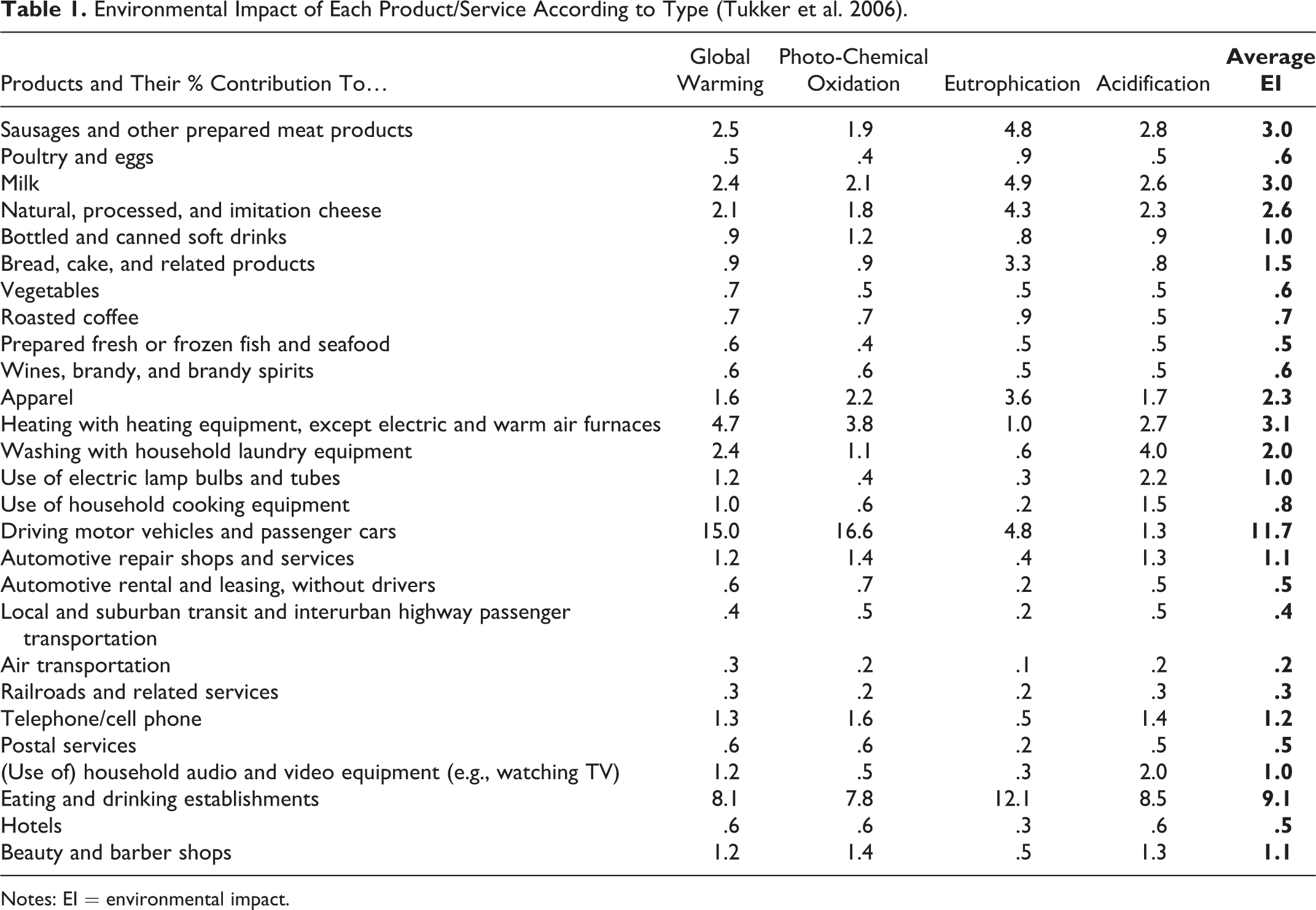
Notes: EI = environmental impact.
We chose the product and service categories using the following criteria: relevance of contribution to ecological impact (>.5%), feasibility of quantification, answerability for survey respondents, expected reliability, and comparability of answers. Although the average ecological impact of air transportation and railroads was only .3%, we added them as additional categories because they are frequently used modes of transportation, especially as alternatives to automotive transportation. Examples of products and services selected were sausages and meat products, apparel, driving with motor vehicles, and heating. Table 1 shows a full overview over the different environmental categories for each product or service.
Results
We found strong correlations among frugality, tightwadism, and voluntary simplicity (see Table 2). Therefore, we ran an exploratory factor analysis to ensure that the items loaded on the expected factors. We found that the items for voluntary simplicity loaded in its expected factor. However, for tightwadism, one item loaded in more than one factor, and for frugality, four items loaded in more than one factor. We used Fornell and Larcker’s (1981) method to further examine the convergent and discriminant validity of the factors. The average variance extracted for each factor accounts for .32 for frugality, .52 for tightwadism, and .35 for voluntary simplicity, which shows that frugality and voluntary simplicity fail to obtain convergence validity. However, discriminant validity was obtained, because the average variance extracted was larger than the squared correlation coefficients between factors (Fornell and Larcker 1981). These squared correlations ranged from .18 to .24. The Cronbach’s alpha obtained for each construct was equal to .69 for tightwadism, .68 for frugality, .77 for voluntary simplicity, and .78 for environmental concern.
Correlation Between Tightwadism, Frugality, Voluntary Simplicity, and Environmental Concern.
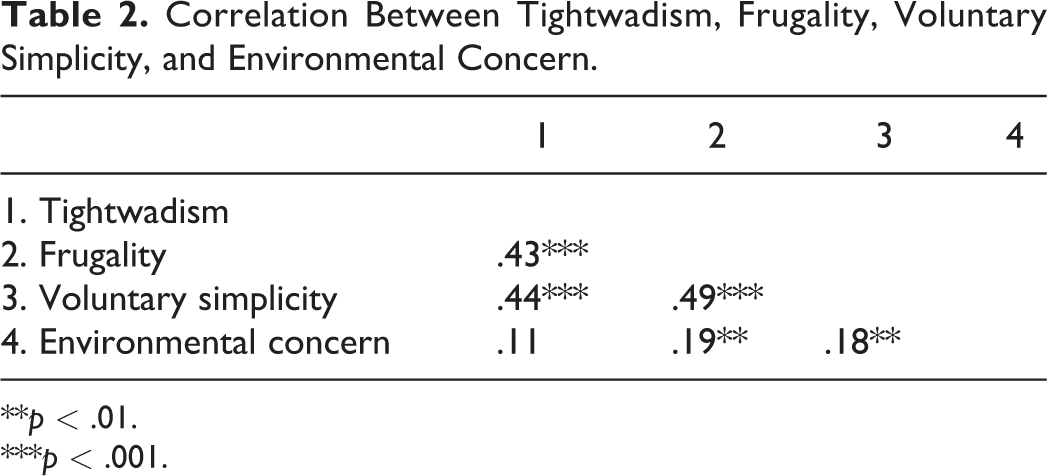
**p < .01.
***p < .001.
We tested for common method bias among our latent variables using Harman’s single-factor score. When forced to load on a single factor, our variables explained only 15.7% of the variance, indicating that common method bias does not affect our data. To further test for common method bias, we ran Lindell and Whitney’s (2001) test, which advocates for including a theoretically unrelated construct in the analyses. We included relationship status for this test because we had no other unrelated construct that could be used (we used few constructs to economize on survey items). For this construct, 1 = “single, never married,” 2 = “in a relationship (living separately),” 3 = “living with partner,” 4 = “married without children,” and 5 = “married with children.” Thus, the larger the score, the stronger was the relationship commitment. Four participants were removed from the analyses because they were either divorced or single parents. In this test, we correlated relationship status with the 36 items of our independent variables as well as the four composed scores (i.e., frugality, tightwadism, voluntary simplicity, and environmental concern). The average correlations between the items and relationship status was r = −.013 (average p-value of .52). Out of the 36 correlations with the items, relationship status was negatively correlated with only one item of voluntary simplicity (r = −.137, n = 232, p = .04). As noted by Lindell and Whitney (2001), negative correlations are not a source of concern for common method bias. The associations with the four constructs were all nonsignificant (average p-value of .60). This further suggests that there is minimal evidence for common method bias.
To test our hypotheses, we first conducted regression analyses in which the ecological impact of each product category (dependent variable) was associated with tightwadism, frugality, voluntary simplicity, and environmental concern (independent variables). We conducted one regression analysis for each product and service category and for each of the lifestyles. Table 3 presents the results of these regressions. In addition, we conducted similar regression analyses with the overall score on ecological impact as the dependent variable. In these latter analyses, we included the following variables as covariates: sex, age, education level, country of origin, country of residence, income, and relationship status. These are the results of overall ecological impact after controlling for covariates: tightwadism: β = −.216, p < .01; frugality: β = −.089, n.s.; voluntary simplicity: β = −.286, p < .001; environmental concern: β = −.190, p < .01.
Regression Analyses of Anticonsumption Lifestyles and Environmental Concern with Frequency of Purchase Product and Service Categories.
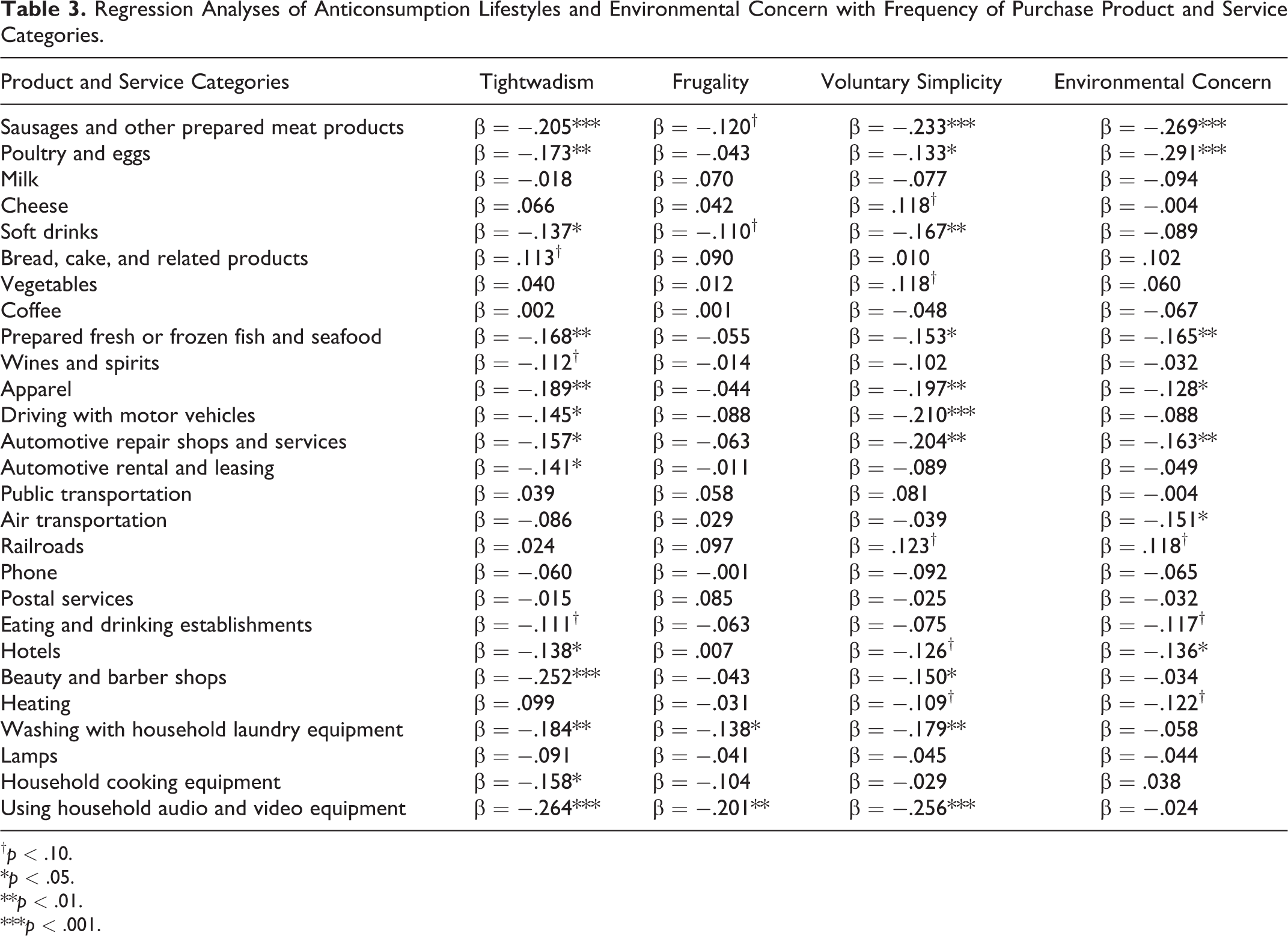
† p < .10.
*p < .05.
**p < .01.
***p < .001.
Afterward, we compared the overall ecological impact of high versus low tightwadism, frugality, voluntary simplicity, and environmental concern (see Table 4). Participants who scored higher than the mean plus one standard deviation were included in the high-score group. Participants who scored lower than the mean minus one standard deviation were included in the low-score group.
Ecological Impact of High and Low Scores on Various Lifestyles.

Table 3 shows that tightwadism correlated negatively with 13 categories. We found the strongest correlations for meat products (β = −.205, n = 241, p = .001), apparel (β = −.189, n = 239, p =.003), beauty and barbershops (β = −.252, n = 242, p < .001), and use of household audio and video equipment (β = −.264, n = 239, p < .001). In addition, in support for H1a we found a negative association between tightwadism and the overall ecological impact of consumption (β = −.216, p < .001) after controlling for the covariates.
Only two product categories showed a significant relationship with frugality: washing with household laundry equipment (β = −.138, n = 239, p = .033) and the use of household audio and video equipment (β = −.201, n = 239, p = .002). Meat products (β = −.120, n = 240, p = .062) and soft drinks (β = −.110, n = 240, p = .088) were only marginally significant (see Table 3). We found no support for H1b, given that frugality is not associated with overall ecological impact after controlling for the covariates (β = −.089, p = .20).
For voluntary simplicity, nine product categories were found to have a negative significant relationship with ecological impact, whereas five were marginally significant. The strongest associations were for sausages and prepared meat products (β = −.233, n = 237, p < .001), use of household audio and video equipment (β = −.256, n = 236, p < .001), driving motor vehicles (β = −.210, n = 238, p = .001) and automotive repair shops and services (β = −.204, n = 235, p = .002). For the remaining associations, see Table 3. In support of H1c, voluntary simplicity correlates negatively with overall ecological impact after controlling for the covariates (β = −.286, p < .001).
Environmental concern was negatively associated with seven categories and marginally associated with three others. The strongest relationships were for meat products (β = −.269, n = 241, p < .001) and poultry and eggs (β = −.291, n = 240, p < .001). Table 3 presents the remaining correlations. Notably, the product categories with highest ecological impact—namely, motor vehicles (13%), eating and drinking establishments (8.3%), and heating (4.4%) either did not correlate significantly or correlated only marginally significantly with environmental concern. Still, after controlling for the covariates, environmental concern is negatively related to ecological impact (β = −.190, p = .007), in support of H2.
To further explore the ecological impact of anticonsumption lifestyles and environmental concern, we compared the overall ecological impact of individuals scoring high versus low in the various lifestyles (see Table 4). In support of H1a, we found that low tightwadism has higher ecological impact than high tightwadism (F(1, 82) = 11.374, p = .001). In support of H1c, low-voluntary simplicity has higher ecological impact than high voluntary simplicity (F(1, 72) = 18.428, p < .001). H2 was also supported, given that low environmental concern has higher ecological impact than high environmental concern (F(1, 71) = 14.999, p < .001). These analyses provided no support for H1b, because high frugality and low frugality have similar ecological impact (F(1, 67) = .742, p = .39).
Given that tightwadism (β = −.216) and voluntary simplicity (β = −.286) are more strongly related to ecological impact than environmental concern (β = −.190), we found support for H3a and H3c. However, H3b is not supported, as environmental concern has a stronger negative association with ecological impact than frugality (β = −.089).
One might wonder the degree to which tightwadism, voluntary simplicity, frugality, and environmental concern explain the overall ecological impact. This can be inferred by considering the changes in the adjusted R-squares when the variables were included in each of the analyses. The adjusted R-square measures the proportion of the variance in the dependent variable that is predictable from the independent variable. When the model included frugality, the adjusted R-square increased by .003, which is nonsignificant given that frugality is not significantly associated with overall ecological impact. When the model included voluntary simplicity, the adjusted R-square increased by .078. For tightwadism, the observed increase was .042, whereas for environmental concern the increase was .031. As a reference, the increase in the adjusted R-square was equal to .044 for sex (wherein men have lower impact), .036 for age (wherein older age leads to higher impact), and .053 for income (wherein higher income has higher impact). Overall, these results suggest that the impacts of lifestyles are comparable, if not larger, than the demographic variables included in the study. More importantly, of all variables considered, voluntary simplicity has the strongest influence over overall ecological impact.
Discussion
Our study shows that some of the anticonsumption lifestyles we studied are negatively related to ecological impact, meaning that their consumption behavior might reduce their personal contribution to harmful impacts on the environment—though the extent of the reduction differs. In our study, the tightwadism (β = −.216) and voluntary simplicity (β = −.286) lifestyles are associated with lower ecological impact than environmental concern (β = −.199), while frugality (β = −.089) is associated with a higher impact on the environment.
Tightwadism: The Pain of Spending Is Green
Because we found no significant correlation between tightwadism and environmental concern, tightwads’ spending behavior is unlikely to be based on environmental concerns but, rather, on their perceived pain of spending (Rick, Cryder, and Loewenstein 2008). Interestingly, this pain of spending leads to a reduction in the ecological impact to a greater degree than environmental concern and frugality. Previous research has shown that tightwads are very price conscious and value conscious (Rick, Cryder, and Loewenstein 2008), leading one to conclude that the tightwads’ motivation to reduce consumption is linked to their motivation of getting products and services at a low price point. However, frugal consumers, whose overall consumption is not reduced as much, are also highly price and value conscious (Lastovicka et al. 1999) and thus motivated to buy when low prices are available. So, one cannot argue that tightwads reduce their overall consumption more so than frugal consumers because they purchase only when the cost–benefit ratio is advantageous. Given that the pain of spending is a key factor that differentiates tightwads from frugal consumers, we believe that this sensibility to spending and this attachment to money are what motivate tightwads to greatly reduce their consumption. In short, the psychological cost of spending is very high for tightwads, causing them to reduce their overall consumption.
Frugality: Ecological Materialism
In our study, frugality was the only lifestyle that was not related to ecological impact, meaning among the four lifestyles studied, it was the most harmful to the environment. Frugality’s limited reduction of ecological impact might be explained by frugal consumers’ motivation to resourcefully use goods they acquire, which might include buying in bulk or buying used goods, but not necessarily fewer goods (Lastovicka et al. 1999). Frugal consumers are not necessarily antimaterialistic; on the contrary, their saving behavior can even serve materialistic aspirations (Nepomuceno and Laroche 2017b). It would be worthwhile to ask frugal consumers about the intensity or length of time that these consumers used the purchased goods or what kinds of goods they purchase (organic food, recyclable packaging, etc.) to determine whether their environmental concern affects their consumption behavior more strongly after the acquisition of certain products. Yet neither their environmental concern nor their tendency to save money was enough to lower the ecological impact as strongly as for tightwadism or voluntary simplicity.
Voluntary Simplifiers: Simply Less
The lifestyle with the lowest ecological impact in this study is voluntary simplicity. The change in the adjusted R-square explained by voluntary simplicity is more than twice the one obtained by environmental concern and almost twice as much as the one observed for tightwadism. Previous literature has found a positive association between voluntary simplicity and ecological responsibility (Huneke 2005), echoed in our sample. In addition, previous research has noted the strong antimaterialistic nature of voluntary simplicity (Cherrier 2009). People who adhere to a simple lifestyle are intrinsically motivated to reduce material consumption to a minimum and to live more independently from the marketplace. The combination of concern for the environment with the desire to live a socially, financially, and ecologically sustainable life explains why voluntary simplicity is the lifestyle with the lowest ecological impact. In short, simplicity is related to a low ecological impact not only because of its relation to environmental concern but mainly because people who live a simplified life have decided to live outside the consumerist market culture.
The “Green Gap” of Environmental Concern
Environmental concern was defined as an awareness and knowledge about the ecological consequences of a given behavior (Fujii 2006). Environmental concern is less negatively associated with ecological impact than tightwadism and voluntary simplicity, suggesting that environmental concern has a stronger ecological impact. Three factors might explain this finding. First, the diverging information and lack of reliable information about the ecological impact of certain categories of products and services can be so confusing that environmentally concerned individuals are unable to follow a green consumption behavior because they cannot be sure of what is the right thing to do (Moisander 2007; Sharp and Wheeler 2013). In addition, if environmentally concerned individuals do not believe that their consumption behavior has a significant impact on the environment, they will not engage in green habits of consumption (Dunlap et al. 2000; Roberts 1996; Straughan and Roberts 1999).
Second, environmental concern might not lead to reducing consumption in general but, rather, opting for more environmentally friendly products. For example, environmentally concerned consumers might not be reducing the frequency in which they drive motor vehicles but rather driving vehicles that are more fuel efficient and that have a lower ecological impact. Likewise, they might be choosing products and services with reliable green labels or buying locally produced foods that have lower ecological impact than the industry average. Therefore, it is possible that the ecological impact of environmental concern is inflated by the method used in our current study. We are unable to test this hypothesis given that EIPRO’s report presents only the ecological impact of categories of products and services, as opposed to specific products and services (e.g., eco-friendly/green product alternatives).
Third, environmental concern can be understood more as a general attitude toward environmental issues and a mindset of caring for the environment (Takala 1991). The resulting gap between a mindset-related attitude and an activism-related behavior is not a new discovery; the findings of previous studies suggest that attitudes seldom explain more than 10% of behavioral variance and that factors such as home ownership or other proenvironmental behaviors better predict environmentally friendly consumption behavior (Mainieri et al. 1997; Wright and Klÿn 1998). In turn, anticonsumption lifestyles are more closely linked to behaviors. In other words, environmental concern is a more abstract construct than the anticonsumption lifestyles we investigate, which are more concrete and better describe people’s behavior. Given that we measured ecological impact using behavioral measures, it seems that the abstract nature of environmental concern might explain its stronger ecological impact.
Research Implications
Theory
Although the ecological impacts of tightwadism, frugality, voluntary simplicity, and environmental concern differ, all these lifestyles are associated with less ecological impact because of an overall reduction in consumption. The findings among the anticonsumption lifestyles are particularly revealing, as ours is one of the few studies in the field showing that the adoption of anticonsumption lifestyles is associated with reduced consumption of certain (but not all) goods and services. Even though tightwadism, frugality, and voluntary simplicity should lead to a reduction of all consumption, our findings demonstrate that this reduction is limited to certain goods and services. In particular, we show that for frugality, the reduction in consumption is rather limited and not significant. This finding has important theoretical implications because it tests the limits of current theories.
Our findings on environmental concern are in line with prior research highlighting the “green gap.” Like previous studies, we demonstrated that people concerned with the environment are often unable to behave according to their beliefs. In particular, even though environmental concern should lead to an obvious reduction of ecological impact, we found that consumers concerned with the environment perform poorly compared with consumers with simple or tightwad lifestyles. Although tightwadism is not motivated by ecological factors, it has a lower ecological impact than environmental concern. In addition, voluntary simplicity obtained the lowest ecological impact in this study. This is in part motivated by environmental responsibility but largely by resisting consumption to live a simple life. Overall, our study suggests that the motivation to resist consumption is a key factor in reducing one’s ecological impact.
Finally, our research supports previous literature that defended anticonsumption as a path to more sustainable societies (Black and Cherrier 2010; García-de-Frutos, Ortega-Egea, and Martínez-del-Río 2018; Nepomuceno, Rohani, and Grégoire 2017). Our data support this assertion and pave the way for future research that will further investigate the impact of anticonsumption lifestyles on the environment.
Practice: Sufficiency as New Strategy Toward a Degrowth Economy
Previous research has indicated that green consumption and increasing people’s environmental concern cannot be the only paths to ecological sustainability, in part because of the challenge of bridging the “green gap” (Black 2010). As our study suggests, high environmental concern is not the best path for reducing the ecological impact of consumption. Environmental protection will (albeit marginally) contribute to sustainability if it comes at the expense of current consumption (Solow 1991). Even though environmentally concerned individuals are viewed as role models for reducing ecological impact, we found that their contribution is limited compared with anticonsumers.
Promoting a simpler way of life could convince people to change their lifestyle toward a more environmentally friendly way of consuming, which is a crucial element for more sustainable development worldwide. Reducing private consumption in the form of a sufficiency strategy should be part of the official agenda for sustainable development (Von Winterfeld 2007). Combined with the previously stand-alone strategy of efficiency, and with a stronger focus on consistency, sufficiency can lead us toward a new and more effective path toward “real” sustainability (Belz and Bilharz 2005). Sufficiency should also be part of a transformation in the way we think and act. We need a new understanding of values and wealth, of satisfaction of needs, the freedom of “enough,” and the acceptance of the depletability of resources. Saving resources and increasing social satisfaction could thus be the double goal of a public sufficiency discourse (Linz 2013).
Two dilemmas must be overcome in creating a policy of sufficiency. First, the interpretation dilemma challenges people to change their perspective and understand abnegation (or nonconsumption) as a personal benefit. This is dependent on not only the personality of the individual consumer but also on his or her social environment. The second dilemma is a socioeconomical one. A policy of sufficiency would also require the economy to transform to a more sufficient one, inducing a multileveled structural change in both society and economy (Renner 2004). Public policy should support this transformation and encourage social acceptance of sufficiency as the new public and individual economic paradigm.
A sufficient economy is closely related to another macroeconomic sustainability strategy, proposed by Paech (2013). He claims that any strategy that does not dare to criticize current mobility and consumption habits will not solve any environmental challenges but, rather, represents the actual problem itself. These kinds of strategies will only admit solutions that are expansive in nature and focus on efficiency but will fail because of the well-known rebound effects (Polimeni et al. 2004). Like the sufficiency discourse, his alternative is the “degrowth economy” (Postwachstumsökonomie)—an economy that is free of the paradigm of unlimited economic growth and that respects natural boundaries to production and consumption (Latouche 2010; Paech 2013). The goal of a degrowth economy is to “build a society in which we can live better lives whilst working less and consuming less” (Latouche 2009, p. 9). This “less is more” mentality has long been a conviction shared only by a small group of people resisting the “consumer culture” and adhering to anticonsumption lifestyles (Craig-Lees and Hill 2002). Nonetheless, it has the potential to service as a new economic paradigm in a transition toward a more sufficient, and thus more sustainable, consumer culture.
Policies for Degrowth and Sufficiency
A way to achieve a degrowth economy and increased sufficiency is to motivate people to endorse anticonsumption lifestyles. Thus, policy makers and advocacy groups have an important role to play in this context. For instance, advocacy groups related to environmental issues could add degrowth actions to their agendas. Policy makers could communicate the benefits of such lifestyles through advertising campaigns or by creating education programs aimed at young people. Anticonsumption benefits are not limited to lower ecological impact, and recent research has provided strong arguments for convincing consumers. In particular, research has found that well-being is higher for thrifty consumers (Chancellor and Lyubomirsky 2011) and for consumers who spend money wisely (Dunn, Gilbert, and Wilson 2011). In addition, by refraining from consumption, people are better able to self-express (Black and Cherrier 2010), perceive a stronger sense of authenticity (Zavestoski 2002b), experience positive emotions and a sense of individuality (Cherrier 2009; Shaw and Moraes 2009), and are less likely to fall into debt (Nepomuceno and Laroche 2015). As Lee and Ahn (2016) note, anticonsumption is positively associated with consumer well-being because anticonsumers have a high sense of control over their consumption; focus on personal or societal concerns and the macro motivations for nonconsumption; have low desire for material possessions; and do not attribute their happiness to possessions but, rather, to intrinsically satisfying activities. Therefore, by motivating individuals to reduce consumption, policy makers will not only reduce the ecological impact of consumption but also improve consumers’ lives (Iyer and Muncy 2016).
Note that anticonsumption is not a new concept. In human history, saving resources was key for trading and for addressing difficulties in the environment. Practices related to frugality and anticonsumption were the norm before the industrial revolution and the introduction of the consumerist and materialistic cultures (Witkowski 2010). Indeed, frugality was desirable in Europe and North America until the end of World War II. However, practitioners and policy makers have largely overlooked the high cost of materialistic societies (Kasser 2003). Our research suggests that a return to values of frugality and simplicity is desirable to create more environmentally sustainable societies.
In addition to communicating the benefits of anticonsumption lifestyles, consumer policy can support more sustainable consumption by facilitating certain premises for sustainable consumption patterns. For example, by providing tax incentives, it could motivate consumers to repair products. Similar tax incentives could also be applied to products that last longer, reducing the need to constantly acquire new gadgets. In addition, policy could create mandatory disclosure of the environmental impact caused by the consumption of a specific product. This is already done in some countries, where manufacturers are required to inform the average CO2 emission of a given car. Similar disclosures should be made in other industries (primarily in the food industry, given its high environmental impact). This would make it easier for environmentally concerned people to reduce their environmental impact. Initiatives like this one have already been implemented successfully, such as by using color schemes to indicate the fat level of foods (Thorndike et al. 2012).
Research Limitations and Future Research
Hopefully, our study is a first step toward a new direction in sustainability and consumer research. Future studies should research possible moderators, such as trait variables, that might lead to anticonsumption behaviors and investigate their ecological impacts. Furthermore, studies on triggers that cause people to transition into and out of anticonsumption lifestyles would increase the understanding of how and why people choose to not to consume. A differentiation between countries of residence, age, and income groups with more respondents would test the generalizability of our findings. Further studies should also differentiate between more eco-friendly products and regular products. This would allow for the ability to test whether the consumption of environmentally friendly products leads to a significantly lower ecological impact for environmentally concerned consumers and anticonsumers. Including studies on public policy measures, motivational factors and social environments would allow for more concrete suggestions for policy makers and practitioners. Although anticonsumption seems promising for reducing ecological impact, future research needs to identify other factors that might lead to lower ecological impact. In particular, a promising avenue of research is to examine how regulators can reduce ecological impact at the supply side, as opposed to the demand side.
An important limitation of current research is that it is constrained to a single online sample of largely young and female German respondents. One should keep in mind that our results might not be generalizable to other countries and contexts. In addition, certain behaviors are highly dependent on the context (e.g., energy consumption for heating). The mainly European respondents (91.6% by country of origin, 93.6% by country of residence) are nevertheless representative for our study, as the calculation of ecological impact of products and services was based on a European study as well. The online survey might also have excluded some anticonsumers that tend to avoid online services such as email, blogs, social networks, or instant messaging, which were the channels used to distribute this study. Furthermore, we used a self-report measure of consumption. Such measures are greatly influenced by memory and possibly subject to common method bias, so future research would profit from measuring real buying behavior.
Anticonsumption might still be a niche movement, and most people in the Western societies are not willing to question their consumption habits for the sake of ecological sustainability. Our study shows that reducing consumption is one step in the right direction. As we have noted, research and initiatives in other fields suggest that there is potential for support of alternative approaches to a more ecologically sustainable world. Consumer research should join forces with policy makers, marketers, businesses, and organizations to promote the benefits of living a simple—and happy—life.
Footnotes
Associate Editor
Michael Lee served as associate editor for this article.
Declaration of Conflicting Interests
The author(s) declared no potential conflicts of interest with respect to the research, authorship, and/or publication of this article.
Funding
The author(s) received no financial support for the research, authorship, and/or publication of this article.