






Abstract
So-called pro-poor innovations may improve consumer well-being in subsistence marketplaces. However, little research has integrated subsistence marketplaces with the vast literature on innovation adoption. Using a questionnaire in which respondents were asked to evaluate a mobile banking innovation, this research fills this gap by providing empirical evidence of the applicability of existing innovation adoption models in subsistence marketplaces. The study was conducted in Bangladesh among a geographically dispersed sample. The data collected allowed for an empirical comparison of models in a subsistence context. The research reveals the most useful models in this context to be the value-based adoption model and the consumer acceptance of technology model. In light of these findings and further examination of the model comparison results, the research also shows that consumers in subsistence marketplaces are not motivated only by functionality and economic needs. If organizations cannot enhance the hedonic attributes of a pro-poor innovation and reduce the internal/external constraints related to adoption of that innovation, then consumers’ adoption intention will be lower.
Over the past two decades, management and marketing scholars have taken an increased interest in the world’s poorest consumers. These consumers, often termed the “bottom-of-the-pyramid” (BOP; see, e.g., Cañeque and Hart 2015; Prahalad 2004; Prahalad and Hammond 2002; Simanis, Hart, and Duke 2008), reside within subsistence marketplaces with unique characteristics (Viswanathan and Rosa 2007; Viswanathan and Sridharan 2009). Interest in this topic has led to a better understanding of consumers within these subsistence marketplaces, as illustrated by several recent special issues (Nakata and Viswanathan 2012; Viswanathan and Rosa 2010; Viswanathan, Shultz, and Sridharan 2014). Yet, despite these advances, important questions remain.
Increasingly, researchers have called for innovation in products and services to help provide solutions to challenges that consumers face within these markets (Hart 2005; Kaplinsky et al. 2009; Morales-Gomez and Melesse 1998; Prasad and Ganvir 2005). Numerous examples have been discussed within the literature, including sanitary latrines (Ramani, Sadre Ghazi, and Duysters 2012), solar-powered LED lighting (Altman, Rego, and Ross 2009), mobile banking (Berger and Nakata 2013; Maurer 2012), and fuel-efficient stoves (Khandelwal et al. 2017; Miller and Mobarak 2014). Such innovations have come to be known as “pro-poor” innovations (e.g., Ramani, Sadre Ghazi, and Duysters 2012) because they have developmental impact and may help improve the livelihoods of the poor (Cecchini and Scott 2003; Kaushik and Singh 2004). As such, questions have arisen as to what factors affect the speed of consumer adoption (Khandelwal et al. 2017; Lowe, Dwivedi, and D’Alessandro 2018; Prahalad 2004; Zainudeen and Ratnadiwakara 2011). On the one hand, consumers have rapidly adopted innovations in mobile banking (e.g., services such as Bangladesh’s bKash and Kenya’s M-Pesa). However, other innovations, which offer the promise of time saving, greater efficiency, and better economy have experienced resistance (e.g., fuel-efficient stoves). Though some comprehensive and context specific explanations exist (e.g., Khandelwal et al.’s [2017] study on the low adoption of fuel-efficient stoves), what explains these contrasting examples, and what do we know about innovation adoption in the BOP and subsistence marketplaces?
To begin to address this question more explicitly, this article aims to provide an understanding of the key determinants of pro-poor innovation adoption. The literature offers insight about innovation adoption in economically developed economies (e.g., Arts, Frambach, and Bijmolt 2011; Plouffe, Hulland, and Vandenbosch 2001) and can contribute to this question. However, research on innovation adoption within subsistence marketplaces and the developing world is sparse (notable exceptions include Khandelwal et al. [2017], Miller and Mobarak [2014], and Nakata and Weidner [2012]). Yet context is important (Sridharan and Viswanathan 2008; Sheth 2011; Viswanathan and Rosa 2007), and the degree to which existing theories are applicable is likely to be affected by this market’s unique characteristics (Prahalad 2004; Sheth 2011; Viswanathan and Rosa 2007). Following a highly cited model comparison approach from the information systems literature (Venkatesh et al. 2003), this research uses survey-based methods to generate empirical data about consumer innovation adoption models for a mobile banking product (bKash) in Bangladesh. This allows for an assessment of the applicability of these models and their antecedents in a BOP and subsistence context. In doing so, we provide guidance on which levers managers and policy makers can use to enhance adoption of pro-poor innovations in the spirit of the “bottom-up” approach espoused by subsistence marketplace scholars (Sridharan and Viswanathan 2008; Venugopal, Viswanathan, and Jung 2015). In this article, we take Rogers’s (1983, p.11) perspective that an innovation is new if it is perceived to be new by consumers in subsistence marketplaces (Lowe and Alpert 2015; Ramani, Sadre Ghazi, and Duysters 2012).
First, we review the subsistence marketplaces and BOP literature to assess the factors that are likely to be salient for consumers within this context. We then briefly review and critique extant literature in the area of consumer innovation adoption, which is typically conducted in economically wealthy countries. This helps assess the state of knowledge in the area and how applicable this knowledge is to the subsistence context (e.g., the diffusion of innovations model, the technology acceptance model, the consumer acceptance of technology model). We then justify the model comparison approach in this research and select the models to be tested using a systematic process, extending the methodology provided by Venkatesh et al. (2003). We explain the implementation of the method and follow this with data analysis using partial least squares (PLS). The article concludes with findings emphasizing implications for theory and practice within subsistence marketplaces and the BOP.
Consumer Buying Behavior in Subsistence Marketplaces
It has been widely acknowledged that the BOP and subsistence marketplaces require further study because the market environment is characteristically different from existing and more typical research contexts. For example, Prahalad (2004) notes characteristics such as infrastructural challenges (e.g., poor road networks, unreliable electricity, lack of connectivity), economic constraints (e.g., low income, high inflation), a low literacy rate, and more rigid social structures. Similarly, Sheth (2011) points to characteristics such as market heterogeneity, influential sociopolitical institutions, unbranded competition, resource shortages, and inadequate infrastructure. While acknowledging that these consumers are economically resource-poor and face unpredictable environments and literacy constraints, other research in the subsistence context takes a “bottom-up” view and points to the strong social capital and face-to-face interactions characterized by these markets. Viswanathan et al. (2012) develop a model based around the unique one-to-one interactional nature of such marketplaces to better understand consumption within this unique context. Work has drawn some parallels to low-literate consumers in other contexts, in which coping occurs through social interactions and delegating shopping responsibilities (e.g., Viswanathan, Rosa, and Harris 2005). The important roles of social networks and opinion leadership are reiterated in recent research (Miller and Mobarak 2014; Murendo et al. 2017). These characteristics are likely to have a strong influence on consumer motivation toward consumption, information processing strategies, learning, and subsequent behaviors.
For example, research on low-income women in India with low to moderate literacy has examined cognitive processing styles in subsistence contexts and finds evidence to suggest that women with a lower literacy level are more likely to believe in the notion of negotiable fate. Negotiable fate is a belief that acknowledges that although one’s ultimate fate cannot be changed, people do have some degree of ability to negotiate better circumstances for themselves (Chaturvedi, Chiu, and Viswanathan 2009). This might imply that those with lower levels of literacy have a greater belief in personal agency, which may affect product choices.
The subsistence marketplace literature also points to various sociocognitive characteristics of low-literate consumers such as concrete thinking. Concrete thinking means that consumers are more likely to process single pieces of information (e.g., price) when evaluating products rather than higher-level abstractions across multiple product attributes. Likewise, this literature highlights the distinct characteristic of pictographic thinking, whereby consumers interpret information pictographically rather than textually, often because of low literacy (Viswanathan, Rosa, and Harris 2005). There is evidence to show that product and service comprehensibility can be enhanced through the use of pictures and other visual stimuli within these markets and that pictographic product and communication elements are an important element of product learning (Hasan, Lowe, and Rahman 2017).
Other factors perceived to be important influencers on the purchase process include psychological needs (e.g., hunger, hygiene, acceptable performance), uncertainty of product availability, environmental hazards, and convenience (Chikweche and Fletcher 2010). These factors arise because of the unique conditions faced by consumers in these marketplaces. Authors have also discussed how consumers interact with innovations such as fridge-free margarine, multipurpose soap, and flavored soya food products. One key finding was that such consumers were receptive to these new products because of deteriorating economic conditions and declining incomes. Thus, necessity seems to force consumers to search for more useful and better-value alternatives in the marketplace.
Research in the subsistence and BOP contexts focusing on consumer innovation adoption decisions is sparse despite statements in the literature about the importance of innovation in this context. Typically, researchers might study innovation adoption by picking an existing model from the literature and applying it within this context. For example, Pick, Gollakota, and Singh (2014) use frameworks by Rogers (2003) and Davis (1989) to understand the influences on telecenter adoption in India. Although this approach is appealing because of the widespread use of such models, there is limited conceptualization to take account of these consumers’ unique situations. It is thus assumed that these models are relatively comprehensive in explaining product/service adoption, and that may not be the case.
As work in the subsistence marketplaces domain suggests, factors such as self-control, personal agency, social capital/influence, and visual comprehensibility become highly salient in consumer purchase decisions and ought to be explored further within consumer innovation adoption models in this context. Nakata and Weidner (2012) offer one of the only holistic consumer innovation adoption models conceptualized around the BOP and subsistence marketplaces. This has been termed the “contextualized bottom-of-the-pyramid model.” However, although this model takes account of some of these factors, it has not been empirically tested. In the next subsection, we cover how the relevant innovation adoption literature has evolved, discuss its applicability to the BOP and subsistence marketplaces context, and review key models explaining consumer innovation adoption.
Consumer Innovation Adoption
Innovation adoption research has considered how and why consumers adopt an innovation. Within this broad area of research, one stream of research has concentrated on consumers’ (vs. organizations’) adoption of product innovations (e.g., Arts, Frambach, and Bijmolt 2011; Rogers 2003). Research that focuses on consumers rather than organizations has had less attention in the literature. However, widespread accessibility of information and communication technology has led to an increase in interest about consumer innovation adoption of these technologies (e.g., Berger and Nakata 2013; Brown, Venkatesh, and Bala 2006; Mendoza and Thelen 2008). Models in this area tend to be based on sociological theories of diffusion, such as Rogers’s (2003) diffusion of innovations model, as well as on social psychology theories about consumer choice behavior, such as the technology acceptance model (Davis 1989) or the theory of planned behavior (Ajzen 1991). While insightful and intuitive, research evidence about the applicability of these theories within different contexts is mixed, and key drivers of adoption tend to be context specific. There is sparse literature on applying these models to the adoption of pro-poor innovations within subsistence marketplaces.
Rogers’ (2003) seminal work on the diffusion of innovations is arguably the most widely recognized academic work on innovation adoption, and it has been implemented across consumer and organizational domains. Rogers (2003) acknowledges the key characteristics of innovations that affect innovation adoption decisions of consumers. The diffusion of innovations proposes that innovation adoption is a function of key perceived product innovation characteristics, including a product’s perceived relative advantage, complexity, compatibility, trialability, and observability. Constructs within the diffusion of innovations framework have widespread appeal across a range of contexts. Yet, despite widespread use of the framework, results among studies have been inconsistent. A meta-analytic review by Arts, Frambach, and Bijmolt (2011) suggests that relative advantage, compatibility, and observability have a stronger effect on intention than complexity and trialability.
Research has also used social psychology theories such as the theory of reasoned action and the theory of planned behavior, which explain volitional choice more generally, to understand innovation adoption. The theory of reasoned action suggests that consumers’ behaviors are determined by their intentions, which are in turn determined by their attitudes toward the action and subjective norms. Extending the theory of reasoned action, the theory of planned behavior was developed to acknowledge the importance of an individual’s self-efficacy over a behavior through the inclusion of perceived behavioral control (Ajzen 1991). Several studies related to the theory of reasoned action and theory of planned behavior have been conducted to explain innovation adoption behavior, but results have been somewhat inconsistent (e.g., Armitage and Conner 2001).
The technology acceptance model is another model cited frequently in different contexts (see, e.g., the meta-analysis by King and He [2006]) and uses the theory of reasoned action as a guiding framework. One main contribution of the technology acceptance model is that it parsimoniously recognizes the key antecedents to attitudes and intentions toward using technology. Specifically, the technology acceptance model predicts that an individual’s adoption of an innovation is a function of its perceived ease of use and perceived usefulness. These constructs are similar to but distinct from Rogers’s notions of relative advantage and complexity. In their meta-analysis, King and He (2006) find the relationship between perceived usefulness and behavioral intention to be reliable but find the relationship between perceived ease of use and behavioral intention to be more variable, with less consistent results. However, as with the diffusion of innovations, the theory of reasoned action, and the theory of planned behavior, there is little consistency between the influence of the predictors on intention and behavior.
Although models such as the technology acceptance model have been shown to be useful in explaining adoption, a growing body of researchers have begun to extend the model with several new dimensions to account for its limitations. For instance, Lin, Shih, and Sher (2007) propose the technology readiness model, wherein technology readiness is integrated into the technology acceptance model. Technology readiness refers to a consumer’s tendency to accept and use new technologies for achieving goals at home or in work life (Parasuraman 2000), given that consumers are typically freer to choose among many available alternatives. The technology readiness model has been largely supported in the literature (e.g., Lin and Hiseh 2006; Walczuch, Lemmink, and Streukens 2007).
Other competing models, such as the consumer acceptance of technology model (Kulviwat et al. 2007), have also been developed to account for consumers’ affective reactions to new products. One might expect these affective reactions to be less important in the BOP context, which typically emphasizes the importance of affordability, social capital, and other marketplace-centric constructs. However, some research has suggested that affective reactions such as excitement may play a role in explaining reactions to microfinance services (Jebarajakirthy and Lobo 2015). The consumer acceptance of technology model integrates constructs such as pleasure, arousal, and dominance with the technology acceptance model in light of the latter’s focus on utilitarian and rational evaluation of innovations. Using the consumer acceptance of technology model, Kulviwat et al. (2007) find that relative advantage, perceived usefulness, pleasure, and arousal are significantly related to adoption behavior, and the addition of these constructs significantly enhances the explanatory power of the model. Although Kulviwat et al. did not find that dominance is significantly associated to adoption behavior, other researchers have found that it is (Nasco et al. 2008).
Another recent consumer-based innovation adoption model is the value-based adoption model proposed by Kim, Chan, and Gupta (2007). This model explains consumer adoption from the value-maximization perspective, showing that all belief antecedents (e.g., usefulness, enjoyment, technicality, perceived fee) are mediated through perceived value. Setterstrom, Pearson, and Orwig (2013) studied the adoption of mobile-enabled wireless technology using the value-based adoption model and found that usefulness, enjoyment, and perceived fee significantly influence perceived value and that perceived value significantly influences adoption behavior. Although Kim, Chan and Gupta found that technicality has a significant impact on perceived value, Setterstrom, Pearson and Orwig and Wang, Yeh, and Liao (2013) found that technicality has no significant impact on perceived value. As with other commonly used innovation adoption models, previous studies have led to inconsistent conclusions about the antecedents of the value-based adoption model.
The only dedicated model of consumer innovation adoption within the BOP and subsistence marketplaces is the contextualized BOP model developed by Nakata and Weidner (2012). The contextualized BOP model is derived from Rogers’s diffusion of innovations as well as theories about poverty adapted from the work of Amartya Sen (1999). In their model, Nakata and Weidner propose a range of contextual factors that influence a BOP consumer’s intention to adopt an innovation, including poverty, affordability, adaptability, visual comprehensibility, relative advantage, compatibility, collective need, social capital, assimilationist culture, interpersonal promotions, atomized distribution, and flexible payment forms. Although the contextualized BOP model is insightful and highly relevant to the BOP and subsistence context, it has not been empirically tested. Therefore, it is unclear whether it will improve on existing models that have been extensively developed and tested in other contexts.
The literature review indicates that a range of consumer innovation adoption models have been used to understand how consumers evaluate innovations. However, though useful in providing insight about the range of factors that are likely to affect innovation adoption more generally, the majority of these models (i.e., diffusion of innovations, technology acceptance model, theory of planned behavior, consumer acceptance of technology model, and value-based adoption model) have provided largely inconsistent results across different contexts and have not been extensively tested on consumers in the BOP context. The model developed for the BOP context (i.e., the contextualized BOP model) has not been empirically tested. This raises the fundamental question of how well these models will work in the subsistence context and which antecedents will be the most useful predictors of pro-poor innovation adoption. Furthermore, though there is some degree of overlap between models and their predictors, the numerous models that have been proposed include several unique constructs that may be relevant in the subsistence context. The literature on consumer buying behavior within subsistence marketplaces and the BOP reveals a heightened sense of importance for factors such as collective needs, comprehensibility (affected through a range of senses and enhanced through concrete, localized, and pictographic information), social or relational elements, and cultural compatibility. Likewise, more typical constructs, such as perceived utility, affordability and perceived ease of use, are likely to be important as well. When studying consumer innovation adoption in this context, picking one model can mean paying little attention to the contributions of other models. One way to address this issue is to leverage the collective wisdom of all relevant models by empirically comparing them in the BOP context.
Prior Empirical Model Comparison Studies
Model comparison studies are a common way for researchers to tackle research problems in mature research streams in which a range of relatively well-established and plausible models exist. For example, Venkatesh et al. (2003) empirically compare eight innovation adoption models in an organizational context. Taylor and Todd (1995) also use a model comparison approach to empirically compare the technology acceptance model and two variations of the theory of planned behavior for predicting use of information technology. Mathieson (1991) empirically compares two models (the technology acceptance model and the theory of planned behavior) to predict an individual’s intention to use a spreadsheet package in a Western university setting. Chau and Hu (2001) also empirically compare the technology acceptance model and the theory of planned behavior in a healthcare professional setting. Similarly, Davis, Bagozzi, and Warshaw (1989) empirically compare the ability of the theory of reasoned action and technology acceptance model to predict and explain user acceptance and rejection of computer-based technology. Such model comparison approaches are useful for assessing both the state of the literature on innovation adoption and the antecedents of innovation adoption in new contexts. Next, we outline the method used in the current study and explain our systematic approach for selecting models for analysis and testing.
Method
This study followed the procedure used by Venkatesh et al. (2003) to compare innovation models in the subsistence marketplace. Because we intended to use existing models of innovation adoption, one issue was identifying the models for comparison. For practical purposes (e.g., questionnaire length, respondent fatigue), we included only key models that were relevant to the context under investigation. Several articles in the literature have used a “horse race” approach to compare alternative models. Within these articles, the authors tend to choose models for comparison on the basis of personal judgment. Given the plethora of innovation adoption models that exist in the literature, it was important to systematically whittle down the list of possible models to test rather than rely on judgment and personal preference. To do so, we used the following four criteria for model selection:
Relevance to the consumer context. The majority of research into innovation adoption is based in an organizational context. Therefore, models that had previously been used to predict consumer innovation adoption were given higher priority than models that had been used to predict organizational innovation adoption.
Number of citations. Models with higher total citation counts were given higher priority than those with lower citation counts, reflecting impact and importance in the scientific community. However, this meant that newer models were penalized; therefore, we also accounted for number of citations within the first three years of publication.
Relevance to subsistence marketplaces and the BOP. The majority of research into innovation adoption has been undertaken within economically developed economies. Therefore, models that have previously been used in developing contexts were given higher priority, and we selected models specifically developed for the BOP and subsistence marketplaces.
Minimal similarity among constructs. Given that many innovation adoption models are variants and extensions of existing models, it was important to choose models that were characteristically different from each other. Therefore, models with a low level of similarity to other models were given higher priority.
Not all four criteria needed to be satisfied for a model to be selected, but we used these criteria as a guide to identify potential models. Table 1 summarizes the fit of each model with the criteria. For example, the contextualized BOP model (Nakata and Weidner 2012) does not have a high total citation count (perhaps because it was published more recently) and has never been empirically tested, but it is highly relevant to the subsistence/BOP context. Using the criteria, we selected seven models: the theory of reasoned action (Fishbein and Ajzen 1975), the theory of planned behavior (Ajzen 1991), the technology acceptance model (Davis 1989), the diffusion of innovations (Rogers 1983, 2003), the consumer acceptance of technology model (Kulviwat et al. 2007), the value-based adoption model (Kim, Chan, and Gupta 2007), and the contextualized BOP model (Nakata and Weidner 2012).
Criteria Used in Model Selection
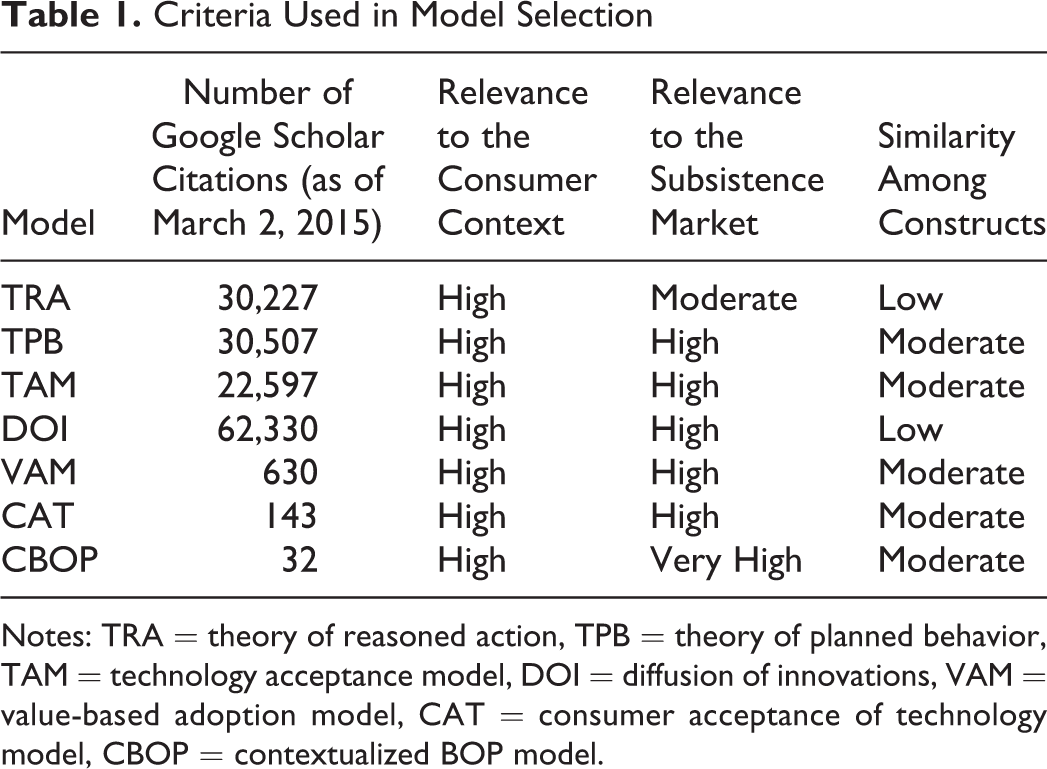
Notes: TRA = theory of reasoned action, TPB = theory of planned behavior, TAM = technology acceptance model, DOI = diffusion of innovations, VAM = value-based adoption model, CAT = consumer acceptance of technology model, CBOP = contextualized BOP model.
Research Context
We chose Bangladesh as the research context for this study because it has large segments of subsistence consumers. For instance, 31.5% of the population of Bangladesh was under the national poverty line in 2010 (World Bank 2013). Another reason for choosing Bangladesh was that it has primarily concentrated on infrastructure innovations and innovations useful for social development. Therefore, innovations such as sanitary latrines, mobile banking, and community information centers are beginning to diffuse in this largely subsistence market. Bangladesh has also been considered as a research context in other BOP or subsistence market–related studies (e.g., Kolk, Rivera-Santos, and Rufín 2014; Rahman, Hasan, and Floyd 2013). In addition, one of the authors is familiar with Bangladesh as well as fluent in Bangla (the national language of Bangladesh), and this facilitated the research process.
Selected Product
In this research, pro-poor innovations were the product category. A range of pro-poor innovations within Bangladesh were considered and evaluated for inclusion in this research. Potential new products for inclusion in the research had to satisfy the criteria outlined by Ramani, Sadre Ghazi, and Duysters (2012). At the time of the research, they needed to be relatively new to consumers but common enough that consumers had heard about them and even potentially used them. Thus, product selection was a delicate balancing act. The products and services considered included portable clinics, mobile phones, mobile banking, and community internet service centers, among others. Of these pro-poor innovations, we selected bKash mobile banking. bKash provides 24-hour mobile banking services to consumers within Bangladesh and is often used by subsistence consumers as a way to transfer money easily and quickly on conventional mobile phones. Specifically, it was an example of a successful innovation that was growing quickly at the time of the data collection and had reached a large segment of the population. It was relatively widespread because a large proportion of subsistence consumers live in rural areas, and mobile phone penetration is high (because of poor fixed-line telecommunications infrastructure and several alternative low-cost mobile providers). This allowed a wide geographic segment to be targeted and represented within the research (e.g., rural and urban consumers). Subsistence consumers in Bangladesh and other countries have had difficulty accessing conventional banking services efficiently (e.g., less than 15% of Bangladeshi consumers are connected to the formal banking system; bKash 2016) because of costs, transport constraints, social mores, and a range of other factors. Such services have diffused rapidly and are now more pervasive in the marketplace among subsistence consumers. They have also been shown to have multiple development impacts within such marketplaces (Govindarajan 2012; The Economist 2009; Maurer 2012). Therefore, the newness of bKash at the time, its high level of awareness in the marketplace, and its potential for impact within subsistence marketplaces justify our choice of mobile banking as an appropriate product category to investigate determinants of pro-poor innovation adoption intention in Bangladesh.
Questionnaire Design and Measurement
We developed a questionnaire to measure the constructs from each of the seven models. Because subsistence consumers have a lower literacy rate, several issues such as difficulty of reading and writing emerged during the administration of this questionnaire, as might be expected (Viswanathan, Gau, and Chaturvedi 2008; Viswanathan, Hastak, and Gau 2009). Therefore, face-to-face questionnaires administered verbally were used to assist respondents in answering the questions, given their reading and writing constraints. Some screening questions were asked to ensure that the respondents met our criteria. For example, respondents were asked whether they had heard about bKash mobile banking before. Then, respondents were asked about their responses to the measured constructs from the models. Again, given their literacy constraints, visual stimuli for the Likert scales were used in this study (i.e., pictographic symbols demonstrating level of agreement or various rectangle boxes), following Martini and Page (1996). These were pictographic symbols demonstrating level of agreement using a range of different visual stimuli depending on the nature of the question. Respondents were asked to rate their responses to Likert scale items along a continuum from “strongly disagree” to “strongly agree.” Finally, respondents were asked about their demographic characteristics.
Because this study empirically compares models of innovation adoption, we first reviewed previous literature to identify suitable measurement items. For all models (except the contextualized BOP model), prior measures were available for adaptation in the literature. Therefore, we adapted items validated in previous research for use and, in the case of the contextualized BOP model, we developed new measures. The list of these measures, their sources, and descriptive statistics appear in Table 2.
Measures Used for Existing Constructs
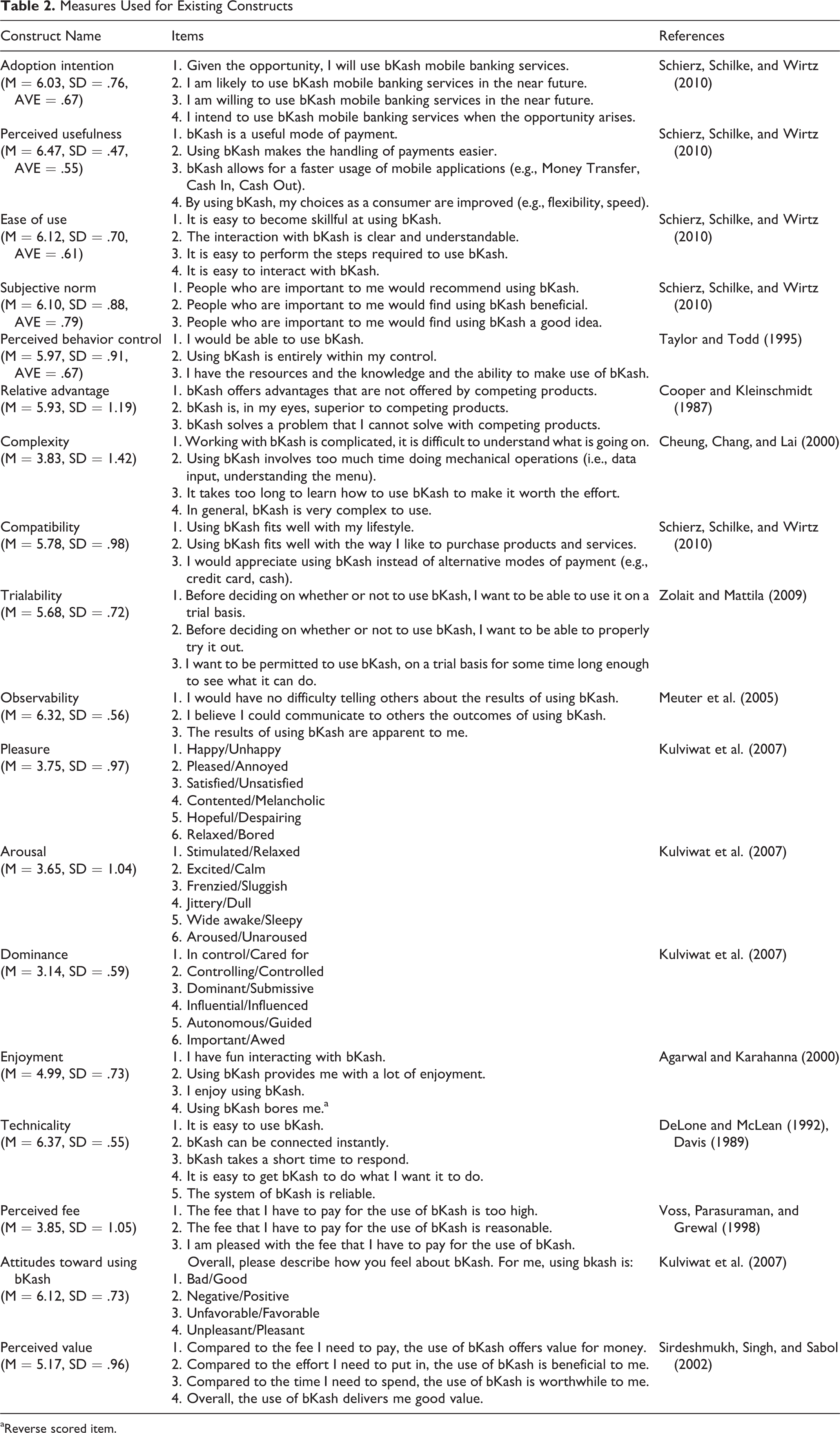
aReverse scored item.
To develop the items for constructs within the subsistence market, we followed the scale development procedures of Hsu, Chiu, and Ju (2004) and Moore and Benbasat (1991). This included (1) assessing content validity through expert evaluation, (2) careful pretesting and pilot testing, (3) testing internal consistency, and (4) testing construct validity through assessing convergent and discriminant validity. Table 3 provides the newly developed items and their descriptive statistics. We used expert judgments to justify the content validity of the items, and this was performed with a quantitative approach as in Hardesty and Bearden (2004). The expert panel consisted of ten experienced academics who had published in the innovation adoption area. This type of face validity study is consistent with previous research (e.g., Wang and Mowen 1997).
New Measures Developed for the Contextualized BOP Model
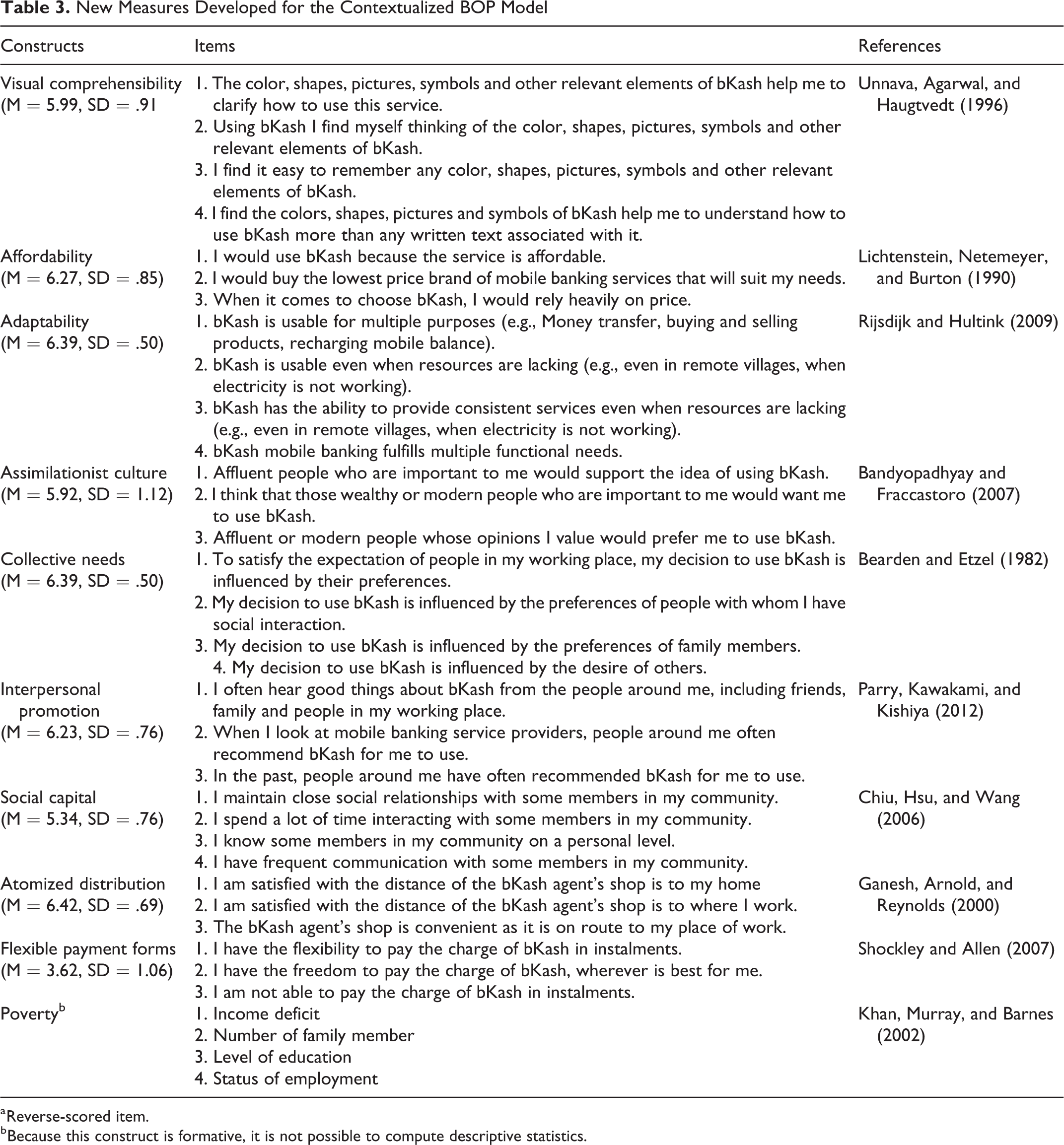
a Reverse-scored item.
b Because this construct is formative, it is not possible to compute descriptive statistics.
Sampling and Questionnaire Administration
In this study, 351 subsistence consumers with low income levels (i.e., those who earn less than US$5 in a day) were approached, and 320 responded to the questionnaire. This study used convenience nonprobability sampling to select participants. We used convenience nonprobability sampling because there was no reliable sample frame for the target population. Although this is not an optimal sampling approach, it is consistent with other studies in this context for pragmatic reasons (e.g., Wentzel, Diatha, and Yadavalli 2013). The response rate was high. Nine responses were considered invalid because of the extent of missing data, resulting in a final sample size of 311. The sample was skewed toward men (91%) but represented a range of age groups (18–25 years = 19%, 26–30 years = 35%, 31–35 years = 31%, 36–50 years = 13%, 50+ years = 3%) and respondents came from urban and rural areas (urban = 62%, rural = 38%). The sample may have been skewed toward men as a result of cultural issues such as the lower likelihood of female interaction with strangers in public places.
Respondents were approached in areas surrounding bKash agents, including tea stalls and marketplaces, at different times of the day (between 7
Questionnaire administration followed typical guidance from the literature (e.g., Zikmund et al. 2016) but was adapted to suit the context under investigation. Specifically, an initial meeting was arranged with community representatives (e.g., village chairperson, teachers, the target group) with whom the intention to conduct the survey was discussed. This process was about establishing trust, being visible within the community, and learning from locals how best to approach participants from the target population. However, it also assisted in refining the questionnaire to take account of language used and colloquialisms. For example, pretesting revealed some words were difficult for subsistence respondents to understand, leading us to replace these with words that were better understood by the target population. After significant changes were made to ensure greater understanding and interpretability, the questionnaire was tested once again on subsistence consumers, and no further revisions were deemed necessary. Pilot tests (n = 29) were conducted prior to launch to establish further confidence in the questionnaire on a larger sample of respondents. We did this to understand issues in identifying and approaching the target sample, the nature and duration of the interview, and the number of questionnaires that could be completed in one shift.
Data was collected by field workers who had training and experience in market research methods. The researcher briefed the field workers in detail about the questionnaire and its contents using a series of pretests and a pilot study. The researcher informed the field workers about the start and finish dates, the minimum number of completed questionnaires expected in one shift, the need to input responses daily, the length of interview, the importance of ensuring fully completed questionnaires, and eligibility of the respondents to take part in the study (e.g., the screening questions).
Common Method Bias
The effects of common method bias were minimized through following the procedural controls suggested by Podsakoff et al. (2003). This included careful reflection on the writing and format of the questionnaire and careful pretesting to avoid ambiguous and unfamiliar terms in the questionnaire. In this research, the pretesting phase carried out with subsistence consumers and local authorities enabled evaluation of the questionnaire, and this helped clarify any ambiguous and unfamiliar terms. Respondents were informed that the study was not conducted for commercial purposes but as a university research project. Moreover, respondents were assured that there were no right or wrong answers. Three sets of questionnaires were used to counterbalance the order of questions and reduce bias related to priming effects and item context–induced mood effects.
Data Analysis: Empirical Comparison of the Seven Models
Partial least squares was appropriate for testing the reliability and validity of the measures and analyzing the data, as our study consists of both reflective and formative constructs (Fornell and Bookstein 1982; Jarvis, MacKenzie, and Podsakoff 2003). Unlike covariance-based structural equation modeling, PLS was also appropriate to test theoretical models such as the contextualized BOP model. This is because this model has not previously been empirically validated and can be considered exploratory. Partial least squares uses standardized latent variable scores, and outputs, such as path loadings, are standardized. This is particularly helpful when comparing models (Henseler, Ringle, and Sarstedt 2012). The use of PLS to compare models is consistent with the procedure outlined in Venkatesh et al. (2003).
According to Compeau, Meister, and Higgins (1991), focusing on direct effects is appropriate when predicting behavior (in this case, between the innovation antecedents and behavioral intention). The approach to predicting behavioral intention we follow is in line with the procedure of Venkatesh et al. (2003). We compared the seven models to identify the key determinants of pro-poor innovation adoption intentions in the subsistence marketplace context using the following criteria: (1) explained variance (adjusted R2) of the endogenous construct, (2) percentage of the model’s statistically significant parameters, (3) theoretical interpretation of the paths, and (4) model parsimony. To compare models, Venkatesh et al. use only explained variance to assess the value of one model over another. We added the other three criteria to take account of theoretical meaningfulness and model parsimony.
Reliability and Validity
The reliability and validity of the reflective constructs were established through the use of PLS by running a bootstrap of the seven models using 5,000 resamples. First, we established convergent validity by identifying whether the items loaded significantly on their respective constructs. To assess reliability, PLS computes a composite reliability score, which is similar to Cronbach’s alpha in that they both measure internal consistency. In this research, each reflective construct represents a level of reliability well above the recommended threshold of .70 (Chin 1998). We also tested discriminant validity for each construct was also tested. To do so, we assessed the correlations of each construct with those of the other constructs and compared these correlations with the average variance extracted (AVE) square roots for each construct (Lowry and Gaskin 2014). The square root of the AVE for each factor was higher than the respective interconstruct correlations, which suggests strong discriminant validity between the constructs (see the Appendix).
Explained Variance of the Endogenous Constructs
Table 4 shows that the seven models explained between 26% and 40% of the variance in subsistence consumers’ intentions to use pro-poor innovations. The value-based adoption model appears to have the highest adjusted R2 (40%), followed by the consumer acceptance of technology model (adj. R2 = 38%), the theory of planned behavior (adj. R2 = 32%), the contextualized BOP model (adj. R2 = 30%), the technology acceptance model (adj. R2 = 30%), the diffusion of innovations (adj. R2 = 29%), and the theory of reasoned action (adj. R2 = 26%). The theory of planned behavior (adj. R2 = 32%) appears to be superior to the theory of reasoned action (adj. R2 = 26%), the technology acceptance model (adj. R2 = 30%), and the diffusion of innovations (adj. R2 = 29%) in explaining subsistence consumers’ intention to use pro-poor technology. The contextualized BOP model also has a relatively high adjusted R2 of 30%. However, when we use explained variance as a criterion, the value-based adoption model (adj. R2 = 40%) appears to be superior to the contextualized BOP model (adj. R2 = 30%) and the consumer acceptance of technology model (adj. R2 = 38%) in explaining subsistence consumers’ intention to adopt. Therefore, the value-based adoption model is able to explain the highest variance in predicting subsistence consumers’ intention to use pro-poor technology and the theory of reasoned action explains the lowest variance in predicting subsistence consumers’ intention to use pro-poor technology (see Table 4). Next, we compare the percentage of the models’ statistically significant parameters.
Model Comparison (Direct Effects)
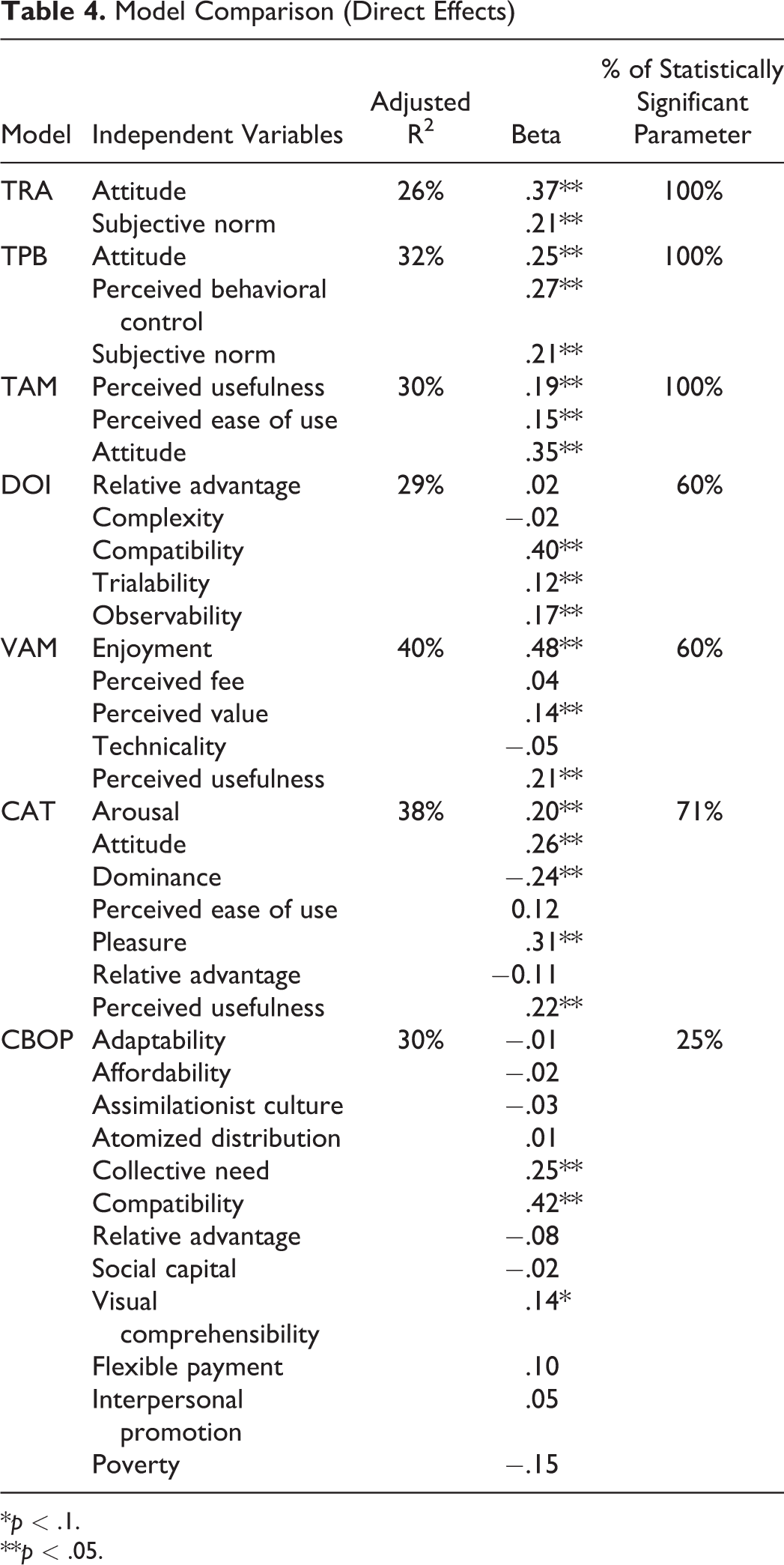
*p < .1.
**p < .05.
Percentage of the Model’s Statistically Significant Parameters
Table 4 also shows the percentage of each model’s statistically significant parameters. Although the contextualized BOP model had a relatively high adjusted R2, only 25% of the paths were statistically significant. This was less than the number of statistically significant paths for the other models, such as the theory of reasoned action (100%), the theory of planned behavior (100%), the technology acceptance model (100%), the diffusion of innovations (60%), the value-based adoption model (60%), and the consumer acceptance of technology model (71%). Only 60% of paths for the value-based adoption model were statistically significant, which is less than the percentage of statistically significant paths for the consumer acceptance of technology model (71%). Consequently, the consumer acceptance of technology model exhibited the highest percentage of statistically significant paths along with a relatively high adjusted R2, indicating good model characteristics.
Table 4 shows that the coefficients from each model behaved broadly as would be expected, except for those constructs that were statistically insignificant. This pattern in itself is not necessarily surprising, given the inconsistency displayed by antecedents in previous research. Consequently, Table 4 indicates that the theoretical interpretation of the paths was broadly consistent with what we would expect.
Discussion
In light of significant recent interest in innovation adoption at the BOP and subsistence marketplaces (Altman, Rego, and Ross 2009; Frykman 2013; Miller and Mobarak 2014; Nakata and Weidner 2012; Ramani, Sadre Ghazi, and Duysters 2012), this research set out to ascertain which consumer innovation adoption models best explain pro-poor innovation adoption and to identify the key antecedents influencing adoption. Despite insightful conceptual work that acknowledges the unique characteristics of the BOP and insights about consumer buying behavior from subsistence marketplaces (e.g., Chikweche and Fletcher 2010; Viswanathan, Rosa, and Harris 2005; Viswanathan, Rosa, and Ruth 2010; Viswanathan et al. 2012) little empirical research addresses the factors most likely to affect pro-poor innovation adoption. This research contributes by empirically comparing existing innovation adoption models within this context. Table 5 summarizes key findings from the research, the implications of which are elaborated on in the subsequent subsections.
Summary Findings from Model Comparison
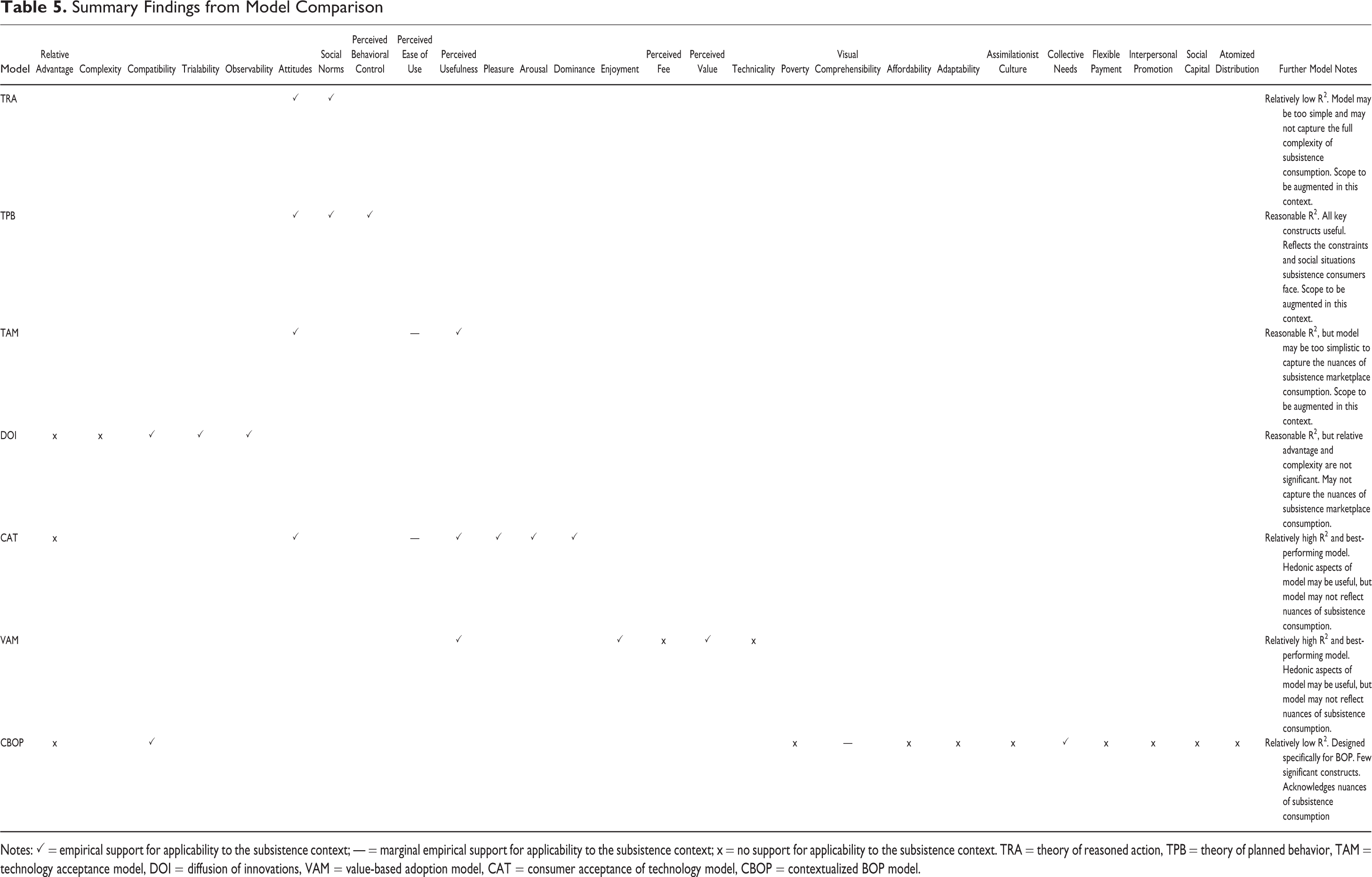
Notes: ✓ = empirical support for applicability to the subsistence context; — = marginal empirical support for applicability to the subsistence context; x = no support for applicability to the subsistence context. TRA = theory of reasoned action, TPB = theory of planned behavior, TAM = technology acceptance model, DOI = diffusion of innovations, VAM = value-based adoption model, CAT = consumer acceptance of technology model, CBOP = contextualized BOP model.
The Role of Affect for Subsistence Consumers
The first major finding from this research showed that the value-based adoption model and the consumer acceptance of technology model were the most useful models in explaining consumer adoption intentions. Interestingly, and most surprisingly, this could be attributed to the fact that both models captured hedonic and affective dimensions of a consumer’s evaluation, in contrast to the other models tested, which were predominantly based on utilitarian and cognitive evaluations. This is consistent with research in the subsistence marketplaces literature that has emphasized the affective dimensions arising from associated factors such as low literacy (Adkins and Ozanne 2005; Viswanathan, Rosa, and Harris 2005) and the importance of these elements in functional literacy in the marketplace or marketplace literacy (Viswanathan, Gau, and Chaturvedi 2008). In this regard, Jebarajakirthy and Lobo (2015) conclude that excitement and happiness have a strong influence on BOP consumer attitudes and intention to adopt microcredit in war-ravaged contexts.
Consistent with these findings about the inclusion of hedonic and affective constructs, the strongest influence on intention was enjoyment. Prior research has investigated the influence of enjoyment on perceived value, perceived usefulness, and ease of use (Kim, Chan, and Gupta 2007; Setterstrom, Pearson, and Orwig 2013) without observing a direct effect on behavioral intention (Koenig-Lewis et al. 2015). However, consumer research conducted by the mobile network company Smart Communications in the Philippines found that potential BOP consumers wanted to use their phone for both enjoyment and practical purposes (Anderson and Markides 2007)—that is, technology is not just a functional tool. Therefore, models of pro-poor innovation adoption should explore in more detail the ways in which affect influences purchase decisions in this context, and models should be updated to reflect this.
The Role of Utilitarian Evaluations for Subsistence Consumers
Notably, relative advantage did not have a significant direct influence on intention. This finding is contrary to the common consensus in the literature (e.g., Rogers 2003). In this regard, it should be noted that Arts, Frambach, and Bijmolt (2011) find that relative advantage has a weaker relationship for intention than for actual behavior. As might be expected, though, the majority of these studies did not consider subsistence consumers as the unit of analysis. Subsistence consumers, given their income constraints, cannot continuously update to new products and services even if these products and services offer an incremental benefit (unlike in economically wealthier countries, where new versions of products are the norm in a competitive marketplace). The concept of relative advantage takes account of a product’s incremental benefit over what currently exists, but a new product may also have an incremental cost that cannot be borne regularly. Therefore, concepts such as relative advantage may explain the success of subsequent versions of a new product in economically wealthier countries where a product’s cost is not as strong a deterrent to purchase as in subsistence marketplaces. For subsistence consumers to adopt a new product, its benefit-to-cost ratio is likely to have to be very high to justify the increased expense. Khandelwel et al. (2017) observe a similar phenomenon in relation to fuel-efficient stoves when analyzing their relatively slow diffusion. For many consumers, traditional wood-burning stoves might simply be “good enough.” This means that, in spite of the fuel-efficient stoves’ relative economic and environmental benefits, there will not be a compelling reason to go out and purchase one. However, mobile phones have a penetration rate close to 100% in many countries and have diffused rapidly. Perhaps pro-poor innovations need to have a significant relative advantage over existing products and services that fulfill a similar need to enhance adoption.
We found the related but distinct concept of perceived usefulness to be a significant predictor of intention in this study. Although perceived usefulness and relative advantage may be terms that are used interchangeably, they represent subtly different concepts. Relative advantage is the degree to which consumers perceive the innovation as offering an incremental improvement over existing alternatives, rather than the overall utility of the product to them. Needless to say, the two concepts are related, and this is captured within the consumer acceptance of technology model (Kulviwat et al. 2007), in which relative advantage affects intention through perceived usefulness and attitudes. From a subsequent analysis of the indirect paths (not reported here), the data showed a similar mediating relationship. Consequently, we believe that innovation adoption models within the BOP should include both relative advantage and perceived usefulness. However, these concepts and their interrelationships should be carefully conceptualized for a more in-depth theoretical understanding of how BOP consumers evaluate pro-poor innovations.
Behavioral Constraints and Social Networks
Our research also found that the theory of planned behavior explains adoption intention better than the theory of reasoned action, the technology acceptance model, the diffusion of innovations, and the contextualized BOP model. This is consistent with literature noting the unique internal and external constraints experienced by the BOP (e.g., Jebarajakirthy and Lobo 2015; Nakata and Weidner 2012; Viswanathan 2013). For example, BOP consumers may be more concerned about constraints such as interest rates, service charges, and collateral than a product’s usefulness per se (Li, Gan, and Hu 2011).
Perceived behavioral control has a significant effect on intention to use the new service. In light of prior meta-analysis findings from the broader theory of planned behavior literature, which indicate an inconsistent effect for perceived behavioral control (e.g., Armitage and Conner 2001), the results here suggest that it is an important variable in the adoption of new products for these consumers. This could reflect subsistence consumers’ unique circumstances, characterized by multiple internal and external constraints (Nakata and Weidner 2012; Prahalad 2004). In addition, consistent with prior research (Nakata and Weidner 2012; Viswanathan, Rosa, and Harris 2005; Viswanathan, Sridharan, et al. 2009, Viswanathan, Torelli, et al. 2009), this research suggests that visual comprehensibility was an important determinant of adoption intention. This could reflect BOP consumers’ constraints related to literacy and product comprehension. Visual comprehensibility might enhance perceived behavioral control for consumers through the use of pictographic symbols and other graphics to make brands more easily recognizable, understandable, and distinguishable from one another (Viswanathan, Rosa, and Harris 2005; Viswanathan, Sridharan, et al. 2009, Viswanathan, Torelli, et al. 2009). Consumers in these marketplaces need to be reassured that they can operate the new banking service. The functionality of such new services should be compatible with the cultural expectations, norms, and constraints (e.g., low literacy, environmental challenges) of these communities (Chikweche and Fletcher 2010). Consistent with typical consumer innovation adoption models, ease of use is also important (Ahlstrom 2010), and factors that assist in enhancing visual comprehensibility are likely to positively influence adoption (Hasan, Lowe, and Rahman 2017).
The theory of reasoned action points out that both attitudes and subjective norms are significant predictors of the intention to use bKash. New product claims from advertisers, shopkeepers, and retailers may be regarded with suspicion in subsistence markets where basic literacy is low (Viswanathan and Rosa 2007). Thus, claims should be clear to facilitate comprehension and fair to show an understanding of community welfare needs (Viswanathan, Sridharan, et al. 2009). Claims should also be substantiated, and information about the product benefits should be straightforward to reduce the need for additional information search. Given the influence of word of mouth, opinion leaders (Miller and Mobarak 2014), and other family and social connections (Murendo et al. 2017; Viswanathan et al. 2012), negative experiences are likely to spread quickly. Likewise, managers launching products and services can facilitate adoption by aiming to generate positive word of mouth among these networks and targeting opinion leaders in the community to boost self-efficacy (Miller and Mobarak 2014; Viswanathan, Sridharan, and Ritchie 2010). This requires developing significant knowledge of subsistence consumers and embracing a value frame and networks to establish formal and informal partnerships with them (Elaydi and Harrison 2010; Sethia 2005), leading to cocreation of products (Kolk, Rivera-Santos, and Rufín 2014). This may be best served by taking a bottom-up approach to interaction with subsistence consumers.
Compatibility with Existing Lifestyles
With respect to the diffusion of innovations, trialability, observability, and particularly compatibility were significant predictors of intention to use bKash. Yet complexity does not play a significant role, at least in this research. The role of compatibility in the intention to adopt pro-poor innovations is consistent with findings from Arts, Frambach, and Bijmolt (2011). Bottom-of-the-pyramid consumers tend to spend money on products that are consistent with their essential needs (Rangan, Chu, and Petkoski 2011), representing the compatibility of a product. Specifically, Stewart (1977) suggests that innovations designed for subsistence marketplaces should be compatible with income levels, resource availability, existing technologies, and costs. This may reflect the notion of compatibility and the need to overcome existing constraints and impediments. Understanding the lifestyles of subsistence consumers and creating tailored products compatible with their needs requires immersion in these marketplaces and a thorough understanding of these consumers’ needs and constraints (Viswanathan, Sridharan, and Ritchie 2010). Again, such understanding may best be served by a bottom-up approach, cocreating value with these consumers, as emphasized by the subsistence marketplaces research stream.
In addition, these BOP consumers seemed to be more collectivist in nature, and adoption intention seems to be influenced by collective needs. The literature suggests this influence is related to a lack of traditional assets (e.g., economic and political capital) and the uncertainty produced by unstable environments (e.g., food shortages, civil unrest) (Nakata and Weidner 2012). This research, therefore, corroborates the conclusions drawn by Nakata and Weidner (2012) in this regard. As Viswanathan et al. (2012) point out, subsistence marketplaces may be poor in disposable income but are characterized by pervasive one-to-one interactions, interdependencies, and richness in social capital.
The Role of Perceived Value
Our study reinforces the importance of perceived value as a strong predictor of adoption intention in the BOP and subsistence contexts. Given the severe financial constraints facing this market, new products and services must have a very compelling value proposition to be considered attractive. However, although perceived value was a significant predictor of intentions to use bKash, perceived fee and affordability were not significant. Considering that costs are sometimes covered by other actors (e.g., nonprofit agencies, aid agencies), affordability needs to be regarded in a broad sense, and calls have been made to work in coordination with government and nonprofit organizations to provide innovative products and solutions that are economically, socially, and culturally sustainable (Viswanathan and Sridharan 2009). Perceived value may embrace different forms such as the “right” price, pay per use, good value (Sethia 2005; Viswanathan, Sridharan, and Ritchie 2010) and reduced price points (Viswanathan, Seth, et al. 2009). This is critical in such marketplaces, where decisions in general and purchases in particular are planned with short time horizons (Viswanathan 2013).
Managerial and Public Policy Implications
The model comparison process we present has several implications for managers and policy makers aiming to facilitate adoption of their products and services in BOP markets. It may be common to assume that consumers in these markets search for cheaper and more functional products (Ahlstrom 2010; Anderson and Billou 2007), but the comparison of models in this study indicates that successful public policy innovations need to go beyond addressing a utilitarian need for such consumers. Although affordability was thought to be important in resource-constrained settings (Anderson and Markides 2007; Sethia 2005), the role of this factor was not as prominent as expected. Whereas perceived value was indeed a significant predictor in the value-based adoption model, the contextualized BOP model showed affordability to be nonsignificant.
In addition to personal needs, public policy makers and marketers should cater to collective needs through a deeper understanding of the networks and communities within which consumers interact. Notions of social acceptability and influence within such communities from friends, aspirational groups, or family members are particularly important in subsistence marketplaces (Viswanathan et al. 2012; Miller and Mobarak 2014). These distinctive characteristics are more likely to be apparent in such marketplaces than in typical economically wealthier contexts.
Similar to more advanced economies, adoption intention is also based on hedonism and affect, even though the constraints faced by the BOP are more significant. Across models, hedonism and pleasure have some of the strongest effects on adoption intentions. This implies that managers and policy makers ought to place a greater emphasis on communicating the affective consequences of adopting an innovation. To take an example used in this research, the mobile banking service bKash has a strapline stating that it is “the easiest and safest way to send or receive money.” Although ease of use and safety are clearly important dimensions within a mobile banking service, the ability to exchange money easily and safely may have a range of hedonic benefits as well (the enjoyment and happiness associated with, e.g., advancing the well-being of a loved one, generating social harmony). According to this research, these affective dimensions may be at least as important in communicating product benefits as the more utilitarian dimensions such as safety and ease of use. To quote Levitt, “People don’t want to buy a quarter-inch drill. They want a quarter-inch hole!” The service may be a means to an end in this case. Thus, practitioners need to understand what is really motivating consumers in the BOP to purchase a given product. Communications that cater to this motivation are likely to be more effective than relying on more utilitarian diffusion and technology adoption dimensions.
The design of public and business policy campaigns should aim to increase personal acceptability of innovations by communicating their usefulness and emphasizing their ease of use and compatibility with existing lifestyles. However, perceived usefulness may be best thought of as a mediating variable with key proximate antecedents, such as perceived ease of use and perceived relative advantage (Kulviwat et al. 2007). A product’s perceived usefulness may be a necessary but insufficient condition for adoption, likely influenced through enhancing perceived ease of use and consumer perceptions of a product’s relative advantage. This may take the form of marketing communications that emphasize these elements, or local product demonstrations such as Shakti Vani in India (women from local communities who perform a communication role for the products of Hindustan-Lever Ltd), which enables demonstrations of how the product satisfies a basic need beyond existing alternatives and how it is best used (Sridharan and Viswanathan 2008). Members of the community are likely to view this type of promotion as being more trustworthy than other forms of marketing communication, and it may also help overcome impediments in relation to perceived behavioral control.
Managers and policy makers also need to ensure visual comprehensibility of a pro-poor innovation through its design and packaging (e.g., colors, shapes, photos, physical package size) and restrain from textual descriptions that rely on abstract thinking. This ensures that numeracy and literacy constraints are able to be addressed given the tendency for concrete thinking and pictorial representations as also highlighted in other studies (Hasan, Lowe, and Rahman 2017; Viswanathan, Rosa, and Harris 2005; Viswanathan, Sridharan, et al. 2009, Viswanathan, Torelli, et al. 2009).
Marketers and policy makers can influence perceived behavioral control by ensuring that barriers to adoption are tackled and that consumers are reassured about using a novel product or technology for which they may not have the technical skills. This is particularly pressing in the context of the BOP and subsistence marketplaces, where there are multiple factors that impede the purchase and use of a new product. Typical constraints include a product’s cost, compatibility with existing infrastructure, social mores, basic literacy and numeracy, and marketplace literacy. Technical aspects of innovations may be simplified or redesigned, and some consumers may benefit from the opportunity to test the new product/service in a nonthreatening environment to avoid anxiety related to performance risk.
Marketers need to pay attention to factors that impede people’s ability to purchase and use the product and address them through product design, marketing communications, and the product’s ecosystem. The influence of these factors will vary for different products and in other contexts. However, the success of bKash may be partially due to allowing easier access to banking services for BOP consumers, enhancing their level of control over performing the behavior, and strengthening that social bonds that are so important in these marketplaces.
Conclusions
This study set out to identify the factors that were most useful in explaining consumer adoption of pro-poor innovations in subsistence marketplaces. As might be expected, social networks and internal/external constraints seemed to be important influencers, along with functionality and value for money. However, surprisingly, subsistence consumers are not just motivated by functionality and economic needs. Organizations may need to enhance the hedonic attributes of a pro-poor innovation to improve adoption. Even though we used a large-scale survey approach, our findings are nonetheless exploratory, given the specific context of the research (e.g., one product category, one country context). Thus, while we do not present conclusive evidence about the factors that are likely to enhance pro-poor innovation adoption in subsistence marketplaces, this research contributes to our understanding of this phenomenon in two ways. First, it shows that existing models of consumer innovation adoption do not capture the complexity and differences apparent within the subsistence context. Second, it highlights the range of factors that future researchers, practitioners, and policy makers may need to take into account to develop a more nuanced understanding of the adoption process. Consequently, there does not appear to be one “right” existing model that best predicts adoption intentions. This purpose may best be served by a hybrid model that is more relevant to the unique context of the subsistence consumer. New models for subsistence consumers are needed and can be developed through the bottom-up approach emphasized by the subsistence marketplaces literature, taking into account our findings. These models should then be tested and compared with existing models. Further research across different contexts and cultures is needed that uses a variety of methodological approaches. This article serves as an impetus to further our understanding about this socially rich, yet poorly understood, group of consumers.
Footnotes
Appendix: Interconstruct Correlations and AVEs
*p < .1. **p < .05. Notes: Boldfaced values on the diagonals represent AVEs. Att = attitude; PBC = perceived behavioral control; SN = subjective norm; PEU = perceived ease of use; PU = perceived usefulness; Complex = complexity; Compat = compatibility; Tria = trialability; Observ = observability; Arous = arousal; Dom = dominance; Pleas = pleasure; enjoy = enjoyment; PercFee = perceived fee; PercVal = perceived value; Adap = adaptability; Afford = affordability; AsCul = assimilationist culture; AtDist = atomized distribution; ColNee = collective needs; Compat = compatibility; RelAdv = relative advantage; SocCap = social capital; VisCom = visual comprehensibility; FlexPay = flexible payment; IntProm = interpersonal promotion.
A: Theory of Reasoned Action/Theory of Planned Behavior
Att
PBC
.43**
SN
.55*
.23**
B: Technology Acceptance Model
Att
PEU
.39**
PU
.41**
.46**
C: Diffusion of Innovations
RelAdv
Complex
.01
Compat
.56**
−.04
Trial
−.06
−.04
.01
Observ
.31**
−.04
.59**
.12*
D: Consumer Acceptance of Technology
Arous
Att
.49**
Dom
.36**
.05
PEU
.37**
.39**
−.07
Pleas
.85**
.47**
.30**
.34**
RelAdv
.66**
.42**
.41**
.32**
.57**
PU
.36**
.41**
.23**
.46**
.34**
.42**
E: Value-Based Adoption Model
Enjoy
PercFee
.08
PercVal
.29**
.30**
Tech
.23**
.02
.40**
PU
.23**
−.04
.28**
.50**
F: Contextualized BOP
Adap
Afford
.15**
AsCul
.34**
.25**
AtDist
.34**
.03
.20**
ColNee
.19**
.17**
.57**
.13
Compat
.30**
.10
.47**
.31**
.30**
RelAdv
.36**
.22**
.65**
.19**
.36**
.56**
SocCap
.18**
.13*
.40**
.08
.18**
.29**
.34**
VisCom
.47**
.11*
.34**
.24**
.47**
.44**
.49**
.32**
FlexPay
.22**
.06
.25**
.33**
.22, **
.47**
.26**
.06
.36**
IntProm
.33**
.22**
.65**
.25**
.33**
.55**
.59**
.35**
.37**
.26**
Associate Editor
Raed Elaydi served as associate editor for this article.
Declaration of Conflicting Interests
The authors declared no potential conflicts of interest with respect to the research, authorship, and/or publication of this article.
Funding
The authors received no financial support for the research, authorship, and/or publication of this article.