







Abstract
Patients use social media to report on medical care and rate their satisfaction with cosmetic procedures and providers. Currently, there are few studies that examine the satisfaction of nonsurgical rhinoplasty. This study aims to identify variables of patients’ choice and satisfaction of the nonsurgical rhinoplasty procedure through social media reviews. Data were extracted from 420 nonsurgical rhinoplasty reviews from RealSelf.com from March 2017 to April 2020. Recorded variables include patient demographics, price, nasal deficiency, patient-described improvement after injection, and physician characteristics influencing patients’ decision making. Of the data extracted from the reviews, 85% of reviewers were women, with a mean age of 27.4 years (SD, ±8.7 years). Eighty-four percent of reviewers had the procedure performed in the United States (84%). The mean cost was $1074 (SD, ±$733.20; median, $850). The most common patients’ deficiencies for this procedure include a “nasal hump” for 31.2% of reviewers and a “bump or dent” in the nose for 35.1% of reviewers. The procedure outcomes commonly noted were a positive change in “shape” of their nose (66.0%), improved confidence (44.4%), and improvement in profile (34.0%). The predominant reasons reviewers chose their injector were (1) favorable injector demeanor (63%) and (2) ability of the injector to provide emotional reassurance (49%). In all, 95.6% considered nonsurgical rhinoplasty “worth it.” Ninety-five percent of online reviewers stated that nonsurgical rhinoplasty was “worth it,” with an average cost of $1074, minimal post-procedure recovery time, and minimal pain. The most common nasal deficiency includes a bump, a hump, and a crooked shape. The most commonly stated improvement was in the shape of the nose. This demonstrates the utility of nonsurgical rhinoplasty for correction of a wide variety of nasal deficiencies. In the analysis of provider characteristics, the most important aspect was the provider’s demeanor. Patients used words like “warm,” “welcoming,” and “understanding of their desires.” They described feeling “comfortable” with the provider. The most important factor for selecting a provider was the emotional connection between the provider and the patient. Satisfaction of nonsurgical rhinoplasty is high, which corroborates reported satisfaction rates in the literature. Nonsurgical rhinoplasty exhibits significant versatility in the defects it can improve. Many patients chose their provider for their personality and emotional connection formed.
Introduction
Variations in nasal contour including humps, bumps, and crooked shapes are common complaints of patients presenting to a cosmetic surgeon. Until recently, surgical rhinoplasty was the primary option for patients seeking to improve nasal cosmesis. Roughly 725 000 surgical rhinoplasties were performed worldwide in 2018, placing it among the most common surgical procedures performed. 1 It is also one of the most technically challenging surgeries a cosmetic injector can perform. Despite the high demand, the satisfaction rates of rhinoplasty are far lower than other aesthetic procedures. Studies have estimated patients’ satisfaction of surgical rhinoplasty at around 70% to 80%.2,3 Comparably, an abdominoplasty has a satisfaction rate of ~93% and a rhytidectomy has a satisfaction rate of ~83%. 2 Furthermore, revision rates of surgical rhinoplasty are high, at an estimated 5% to 20%.4,5
With the emergence in the early 2000s of dermal fillers such as hyaluronic acid and calcium hydroxyapatite, clinicians began to develop in-clinic procedures for augmenting nasal shape and contour. Nonsurgical rhinoplasty, also known as injection rhinoplasty, has been used in clinics as an alternative to surgical rhinoplasty. Injections can be used to improve asymmetries, add volume to the nose, change rotation, adjust projection, and camouflage defects. 6 This procedure eliminates the need for anesthesia and provides patients a more gradual and discrete change with a shorter recovery. Nonsurgical rhinoplasty has the benefit of reversibility, with filler resorption by the body in 9 to 12 months, as well as the use of hyaluronidase which dissolves the filler and reduces volume of the injection. 7 Over the last few years, with increased manufacturing of high-quality fillers, nonsurgical rhinoplasties have become a staple procedure of cosmetic clinicians.
Nonsurgical rhinoplasty has not been as extensively researched and published as its surgical counterpart; there are many studies from single clinics to large social media databases that examine the satisfaction of surgical rhinoplasty. Recent studies on nonsurgical rhinoplasty have only been single clinic studies that look at the satisfaction rate of a small number of patients.8,9 Khansa et al performed a study in 2015 using RealSelf that examined thousands of surgical rhinoplasty reviews and demonstrated the importance of social media in understanding patients’ satisfaction after cosmetic surgery. 3 In the age of social media, more and more patients use social media to share their experience and results with other prospective patients. It is important for clinical practices to be aware of this feedback and sharing of information. The purpose of this is to identify factors reported on social media that influence the choice of the procedure, experience with clinician, and satisfaction with overall experience.
Methods
Data were extracted from a database of nonsurgical rhinoplasty online reviews from RealSelf.com, a public review Web site for aesthetic procedures. All open-ended text reviews for nonsurgical rhinoplasty from March 2017 to April 2020 were examined. A total of 516 reviews were available for analysis. Reviews were excluded if the patient was in the preoperative setting without follow-up after the procedure, if the patient did not undergo a nonsurgical rhinoplasty, or if they did not include any information about the procedure or the clinician. For example, reviews that simply comment “the procedure was great” without information of where or when the procedure happened were excluded. In total, 96 reviews were excluded.
Each online review was assessed for demographic variables including patient age, gender, and country of procedure. Data were recorded for cost of the procedure, pain associated with the procedure, post-injection recovery time, and whether the reviewer selected the “Worth It” option when writing the review. Online reviews were also examined to determine the patient-reported nasal defects, patient-reported improvement after injection, and clinician characteristics influencing patients’ decision making. Often, there were multiple nasal defects, multiple patient-reported improvements, and multiple notable clinician characteristics. Of note, multiple users noted a “hump” and a “bump” when discussing their nasal defects, and the decision was made to include both terms as individual and distinct defects.
Data were analyzed with STATA 14.0. Valid percentages and frequencies are presented excluding missing data.
Results
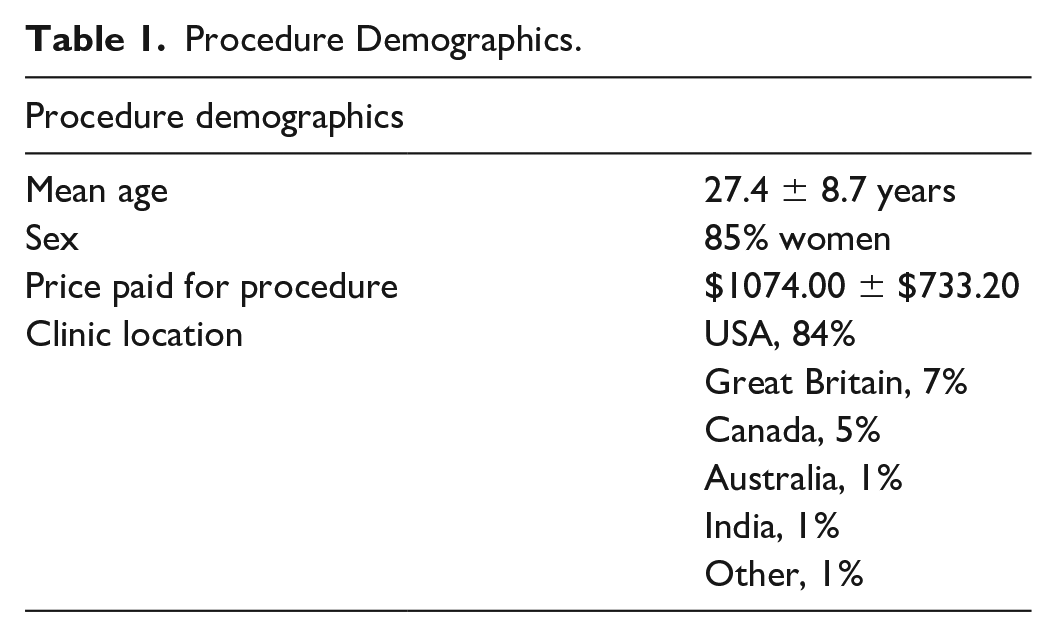
A total of 516 reviews on nonsurgical rhinoplasty were manually analyzed. Of the 420 reviews that were included, 118 patients reported their sex. One hundred reviews were left by women (Table 1). The mean age of reviewers who included this information was 27.4 years (SD, ±8.7 years). Eighty-four percent of reviewers had their nonsurgical rhinoplasty performed in the United States. In total, 56.5% of reviewers took approximately 1 to 2 years researching the procedure before having it done. The mean price of this procedure was $1074 (SD, ±$733.2; median price, $850).
Procedure Demographics.
Overall, 95.6% of reviewers expressed that the procedure was “worth it” and were satisfied with nonsurgical rhinoplasty. Forty-three reviewers were unsatisfied with a previous rhinoplasty and decided to pursue a nonsurgical rhinoplasty. Of the patients who had a surgical rhinoplasty and were dissatisfied with the end result, 95% went to a different clinician for their nonsurgical rhinoplasty.
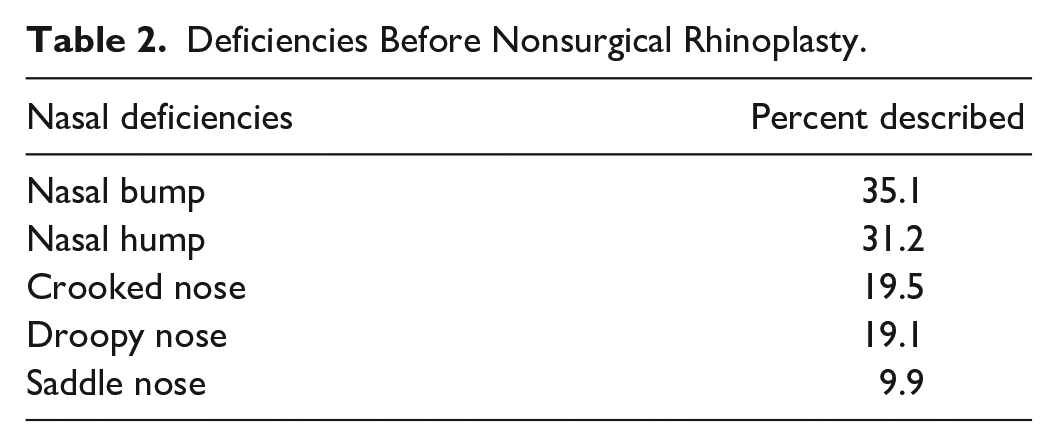
Of the patients who identified their nasal defects, the most common defect was a nasal bump, reported by 82 of 262 respondents who included preprocedure defects (35.1%). The next most common defect was a nasal hump by 31.3%, followed by a crooked nose by 19.5% of respondents (Table 2). Twenty-eight percent of respondents identified self-consciousness about their nose as the justification for nonsurgical rhinoplasty. In all, 17.9% of responders had nonsurgical rhinoplasty in combination with other procedures, including Botox, chin implants, and lip fillers.
Deficiencies Before Nonsurgical Rhinoplasty.
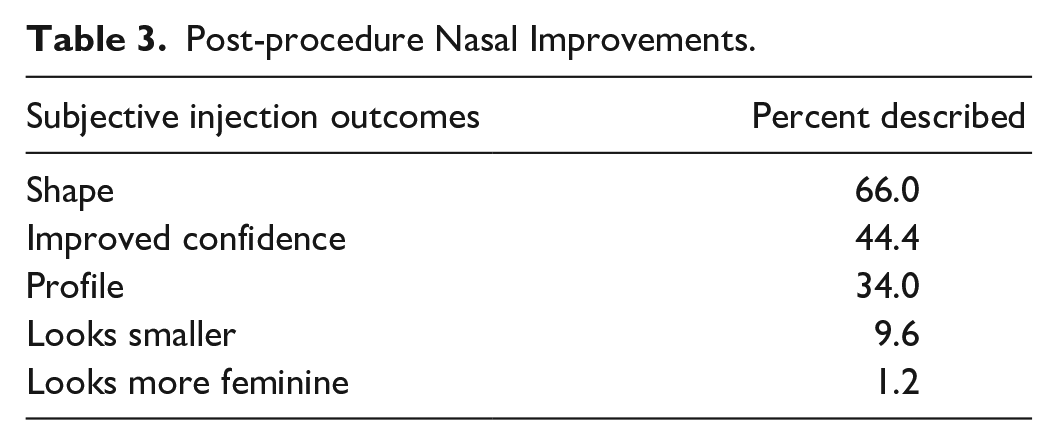
Patients also described post-procedure nasal improvements. Of the 250 respondents who included post-procedure improvements, 165 (66%) reported improved shape of the nose, 34% reported improved profile, 9.6% felt it made their noses appear smaller, and 1.2% felt the procedure made their noses more feminine (Table 3). Confidence was reported as improved in 44.4% of respondents, and 13.2% of reviewers mentioned that they preferred the procedure as it avoided surgery. Only 4.8% of respondents reported that they regretted getting the procedure done.
Post-procedure Nasal Improvements.
Seventy-two (90%) of 80 respondents who included a statement about pain stated that no pain was associated with the procedure. In all, 89% stated that they had less than 7 days recovery time from the procedure.
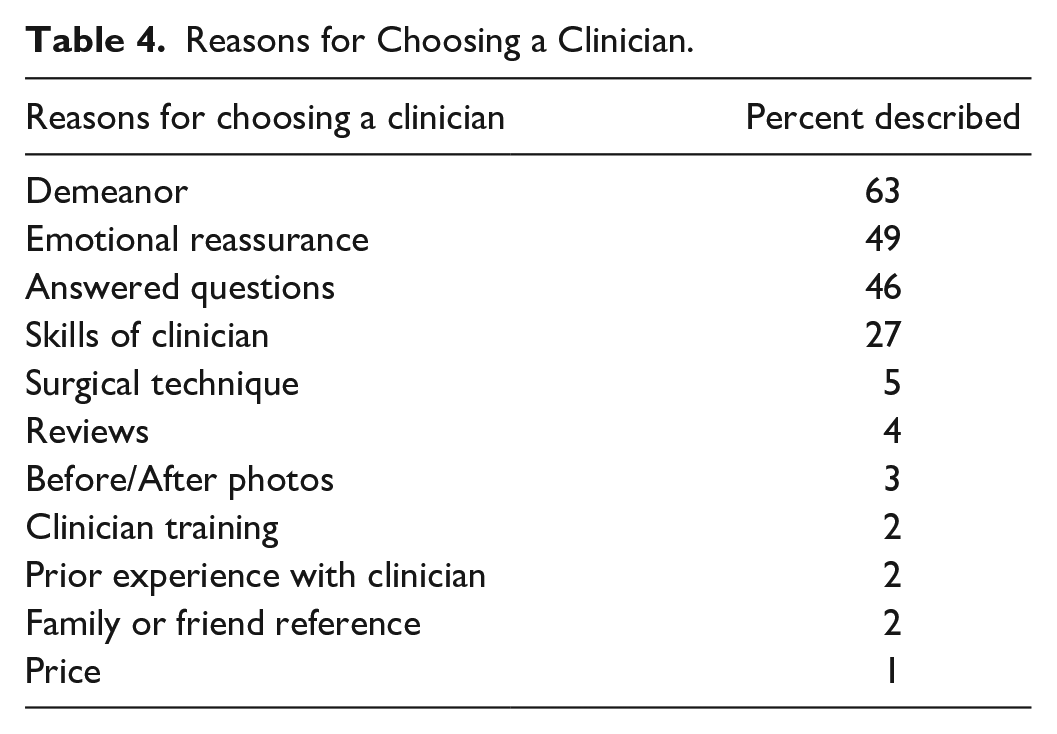
Regarding clinician attributes, the most important attribute patients cited for choosing a clinician was demeanor, mentioned in 190 of 304 reviews that commented on clinician attributes (63%). Forty-nine percent of reviewers spoke about how the clinician provided emotional reassurance (Table 4). Forty-six percent mentioned that the clinician took the time to answer all their questions. Only 1% of reviewers wrote that price factored into their choice of clinician.
Reasons for Choosing a Clinician.
Discussion
Our study demonstrates that 95% of online reviewers deem nonsurgical rhinoplasty to be “worth it,” with an average cost of $1074, minimal post-procedure recovery time, and minimal pain. Currently, there are very few studies that have analyzed the satisfaction of nonsurgical rhinoplasty and no other study that has used a social media database to examine public perception of nonsurgical rhinoplasty. RealSelf’s internal statistics for nonsurgical rhinoplasty (based on 516 reviews) include a 95% “Worth It” rating, an average cost of $1050, no downtime after procedure, and minimal to no pain. 10 These statistics were verified within this study and also align with previously stated ~95% satisfaction rating in the literature. 8
Based on this study, the most common self-reported nasal defects include a bump, a hump, and a crooked shape. A bump is defined as a convex irregularity of any area of the nose, and a hump most likely represents a traditional dorsal hump. These defects are very amenable to injection as they are caused by asymmetry of the boney structures or soft tissue. By injecting into the subcutaneous tissue superficial to the perichondrium or periosteum, 11 one can correct an asymmetry by increasing the volume opposite the bump. For a hump, volume can be added to smooth the ridge out. As expected, the most commonly stated improvement was in the shape of the nose (66%). Interestingly, about 10% of reviews commented that the nose appeared smaller. This would be unexpected as the procedure increases the volume of the nose, but it has been suggested that the contouring adjustments made by injection can create the illusion of a smaller nose. 10
Only 1.8% (4 of 250 respondents) of reviews mentioned price as a reason for pursuing this procedure. This is rather unexpected, as a surgical rhinoplasty is more than 7 times the price of a nonsurgical rhinoplasty. 12
In the analysis of provider characteristics, the most important aspect was the provider’s demeanor. Patients used words like “warm,” “welcoming,” and “understanding of their desires.” They described feeling “comfortable” with the provider. Patients also stated that they preferred someone who thoroughly answered all their questions, addressed their concerns, and allayed their fears. In this study, ~4% of responders regretted choosing their clinician, and almost all went on to comment on how the provider was inattentive of their needs, concerns, or questions.
The strength of this study lies in the high number of reviews examined; all 516 reviews available were analyzed. This study is limited in that RealSelf is not a standardized database: there are no required questions for every patient; the criteria and verbiage are not standard. Patients posted about their procedure at variable times after the procedure. The timing of the post is relevant as the amount of filler decreases over time. The authors of this study aimed to standardize the interpretation of subjective online comments as much as possible. Due to the intrinsic limitations of the database, including an incomplete data set for each review, strong guideline conclusions are difficult to make. However, due to the large number of reviews examined, this study reflects the best data set available to analyze nonsurgical rhinoplasty. Furthermore, this study highlights the current lack of large standardized data sets within the facial plastics community.
Conclusion
We found that nonsurgical rhinoplasty has an extremely high satisfaction score. The most common nasal defects were nasal humps and bumps, which combined made up 66% of all defects reported. The most important factors for selecting a provider include the provider’s demeanor, patients’ perception that the provider is emotionally reassuring, and patients’ perception that their questions were answered. Overall, this study highlights the subset of patients who would benefit from a nonsurgical rhinoplasty and the importance of the patient-provider relationship through the process of nonsurgical rhinoplasty.
Footnotes
Authors’ Note
This work was orally presented at the American Academy of Facial Plastic and Reconstructive Surgery; October 2019, San Diego, CA.
Declaration of Conflicting Interests
The author(s) declared no potential conflicts of interest with respect to the research, authorship, and/or publication of this article.
Funding
The author(s) received no financial support for the research, authorship, and/or publication of this article.
