







Abstract
Nasal tip shape and position play a major role in the aesthetic appearance of the nose. Cephalically oriented lower lateral cartilages (LLC) are associated with a broad boxy nasal tip. Reorienting cephalically positioned LLC with lateral crural strut grafts is a technique used to correct the nasal tip. An open approach surgical technique is described to evaluate the true orientation of the LLC and correct the boxy nasal tip. Five cases are shown with pre- and post-op pictures. The identical surgical technique is used in all cases with a variation in grafts necessary to create the desired esthetic result. All 5 described cases are on female patients. In all cases, reorientation of the lateral crura with lateral crural strut grafts were performed. In all, 4 of the 5 cases required a columellar strut graft, 3 cases required a shield graft to increase nasal tip projection and control the columellar-lobular angle, and 2 cases required spreader grafts for internal nasal valve support. All 5 cases required a variation of inter and intra-domal suture techniques to refine the nasal tip. A boxy nasal tip with supra-tip fullness is commonly associated with cephalically oriented LLC. Changing the orientation of the LLC to a more favorable angle and using lateral crural strut grafts can be used to not only correct the nasal tip deformity, but also facilitate projecting/de-projecting the nose, changing the rotation of the tip, and also supporting the external nasal valve. Reorienting cephalically oriented LLC is a versatile approach to reshaping the nasal tip. It is a technically demanding maneuver that when executed, allows complete control of the nasal tip complex. We have used this approach in many cases involving a boxy nasal tip with long ptotic tips and poorly supported external valves.
Keywords
Introduction
Rhinoplasty is one of the most complex procedures in aesthetic surgery. Each case requires a thorough analysis of facial symmetry and the nasal soft tissue envelope and skeletal anatomy. The surgical plan should be formulated based on a patient’s aesthetic and functional concerns, graft requirements, and skeletal construct.
Nasal tip shape and position play a major role in the aesthetic appearance of the nose. The hallmark signs of a parenthesis deformity is a broad nasal tip with widely spaced tip defining points that accompanies fullness to the supratip region and varying degrees of tip ptosis (Figure 1). In this article, we will explore reorienting cephalically positioned lower lateral cartilages with lateral crural strut grafts (LCSG) to correct this deformity. The normal (“orthotopic”) angle between the caudal margin of the lower lateral cartilages (LLC) and the midline septum is 45 degrees or greater. In cephalically oriented LLC, the described angle is 30 degrees or less.1,2 This can create a boxy nasal tip and lobular fullness. Reorienting these cartilages caudally can effectively improve tip shape and contour and obviate over-resecting and disrupting the integrity of tip supporting structures. This powerful technique is also used to correct retracted alae and alar base asymmetries, tip rotation, nasal length, and tip projection.
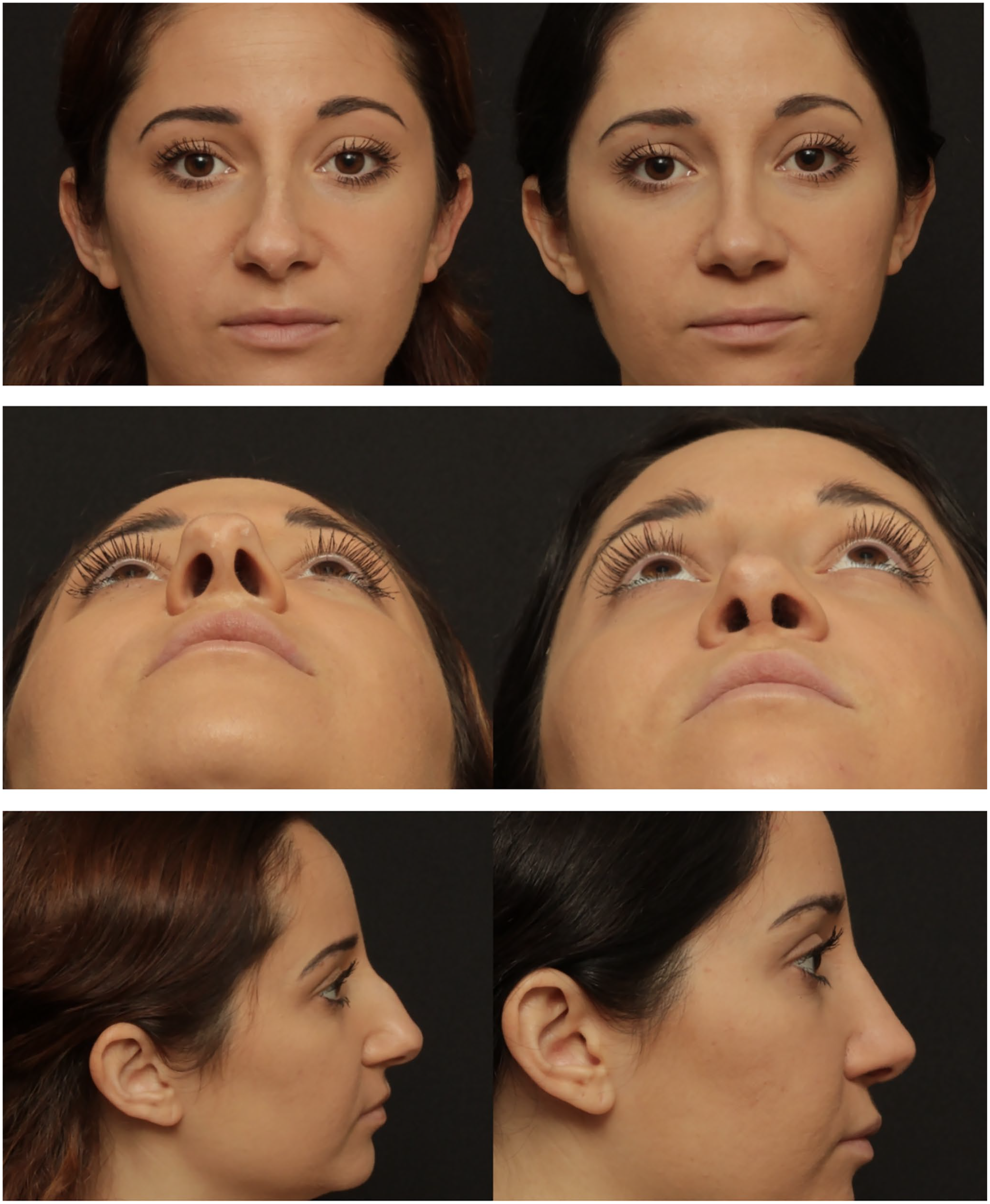
Boxy over-projected tip.
Material and Methods
Surgical Technique
An open approach is initiated with a mid-columellar inverted-v incision that is transitioned into a marginal incision. The skin and soft tissue envelope are elevated in a supra-perichondrial, subperiosteal fashion, exposing the entire nasal vault with its cartilaginous structures (Figure 2). If a dorsal hump is present it is resected at this point. If the plan is to further support the internal nasal valve, turn-in spreader flaps can be fashioned, or spreader grafts can be placed once cartilage is made available. If a dorsal resection is done, medial oblique and lateral osteotomies in a low-low-high fashion are then performed to close the open roof. The septum is then exposed and cartilage is harvested, being mindful to leave at least a 1 cm dorsal and caudal L strut in place to retain stability. Attention is directed to the LLC, where a goniometer is used to confirm the orientation of the LLC. An angle of 30 degrees or less from the midline to the caudal aspect of the LLC defines cephalic orientation. The LLC are then carefully dissected from the vestibular skin—first by hydro-dissection and then by sharp scissor dissection. Both cartilages are then mobilized from their lateral attachments to their accessory cartilages (Figure 3). This allows control of the tip by complete and unrestricted mobilization of the LLC. Cephalic trims may be performed as well, being careful to preserve at least 6 to 7 mm of width along each of the lateral crura. Lateral crural strut grafts are then fashioned from the harvested cartilage and secured to deep surface of each wing of the LLC, shaping and further strengthening the lateral crura. The grafts are generally 3 to 4 mm wide and 20 to 25 mm long, and are secured with 3 to 4 sutures of 5-0 PDS (Figure 4). If septal cartilage is not available, auricular or rib cartilage can be used.
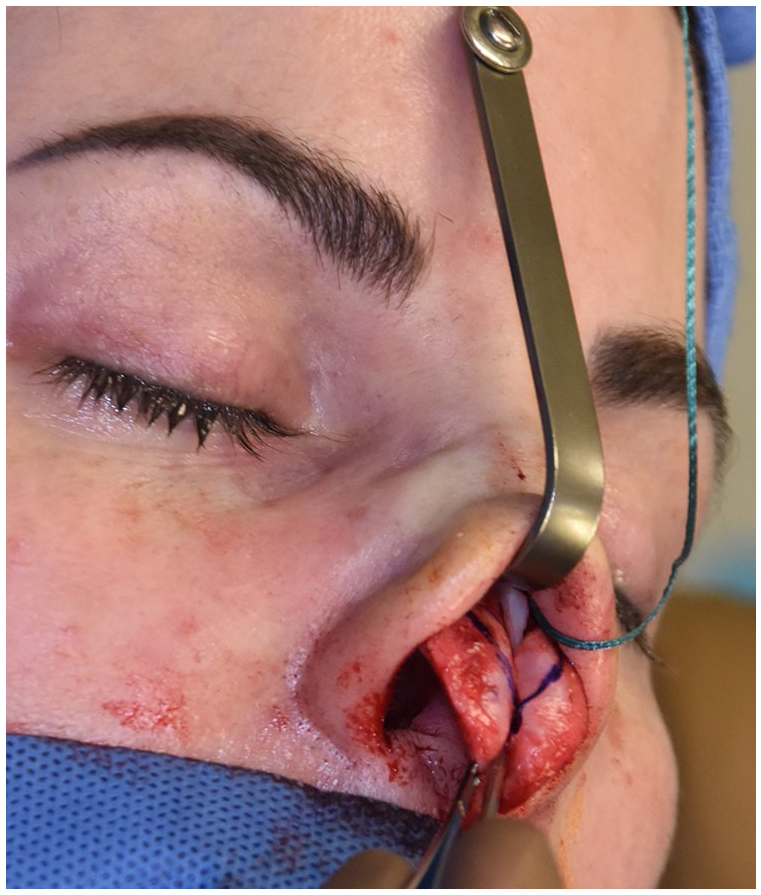
Cephalic orientation of lateral crura.
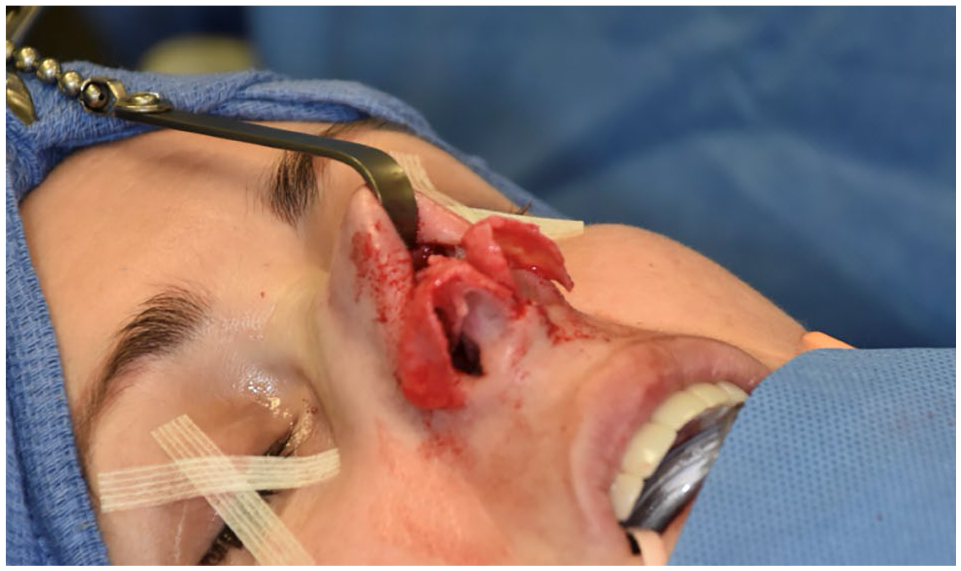
Lower lateral crura transected at their attachments to the accessory cartilages.
Precise pockets are then created in each nasal sidewall; using the tips of sharp scissors, undermining is initiated anterior to the caudal accessory cartilages and directed toward the lateral canthus. The lateral crura supported by LCSG are passively placed in these pockets. The lateral end of the strut is placed caudal to the alar groove, preventing postoperative visibility. In cases of severe alar retraction or valve collapse, the strut grafts can extend beyond the piriform aperture. This reorientation allows complete control of the nasal tip projection, diminishes the lobular or parenthesis appearance of the lower 3rd of the nose, and also reduces the supra tip fullness. A columellar strut graft can be secured at this time. The new dome angle can be determined by placing horizontal mattress trans-domal sutures between the medial and lateral crus. Septal-columellar sutures are then performed to control the desired rotation and projection. Finally, additional tip suturing and tip grafting is performed to achieve the final aesthetic result.
Results
Consent was obtained for the use of all photos presented in this paper.
Case 1
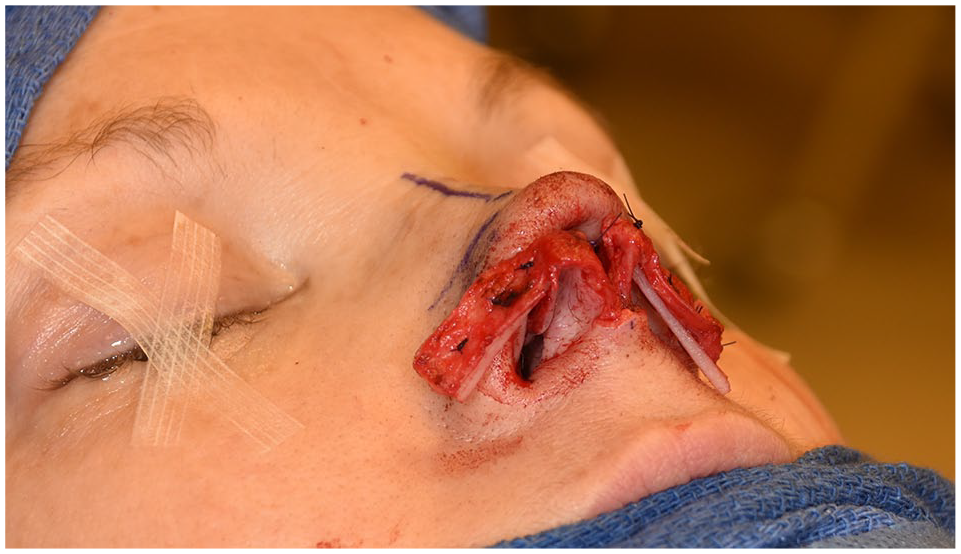
Mobilized lateral crural with strut grafts sutured to deep surface.
Case 2
McCollough and English described the horizontal mattress transdomal suture to create a more acute dome angle in patients with a boxy nasal tip. The suture runs from the lateral crus to the medial crus, and when tightened, shortens the distance between the tip defining points. 3 Performing this maneuver medializes the lateral crura at their junction with the accessory cartilages, potentially compromising the nasal airway. 4 Mobilizing and reorienting the lateral crus and/or securing a LCSG before placing transdomal sutures prevents this potential obstructing effect by removing the tension laterally (Figure 5). Reorienting the lateral crura also diminishes the supra-tip fullness without having to over-resect the cephalic margins of the lateral crura. 5 Mobilizing the lateral crus from their lateral attachments avoids medial displacement of the lateral crus-accessory cartilage junction 16 . The same rationale can be applied when performing a lateral crural steal to increase nasal tip projection. Unrestrained lateral crura easily allow for this maneuver to be performed. Principles of the tripod theory and the study by Ilhan et al 6 support the mechanics of this maneuver.
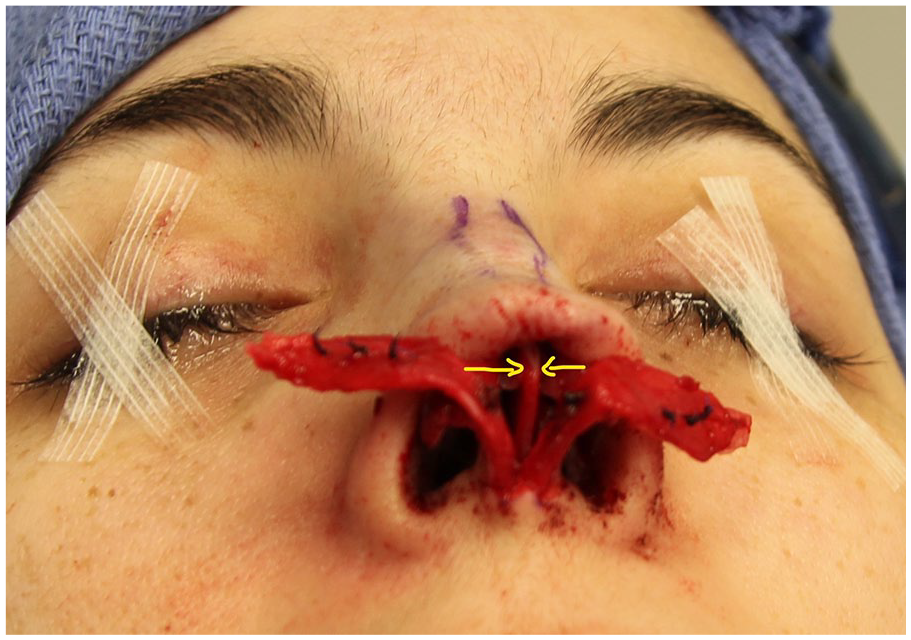
Mobilized lateral crura prior to recruiting lateral crura to increase projection.
Case 3
Small changes in rotation can certainly be achieved by simply repositioning the medial crura. Setting the medial crura more cephalically in a nose with an obtuse nasolabial angle or bringing the medial crura out caudally in a nose with an acute nasolabial angle can easily accomplish minor rotation changes. 1 When a greater degree of repositioning of the medial crura is performed to achieve larger degrees of rotation, lower lateral cartilages that are restricted undergo bowing or stretching. The key to freely reposition the medial crura and obtain the necessary rotation is to release the lower lateral cartilages. 4 By releasing the LLC from the lateral attachments, as supported by Toriumi and Asher, one can achieve the necessary cephalic tip rotation (Figures 6 and 7).1,14
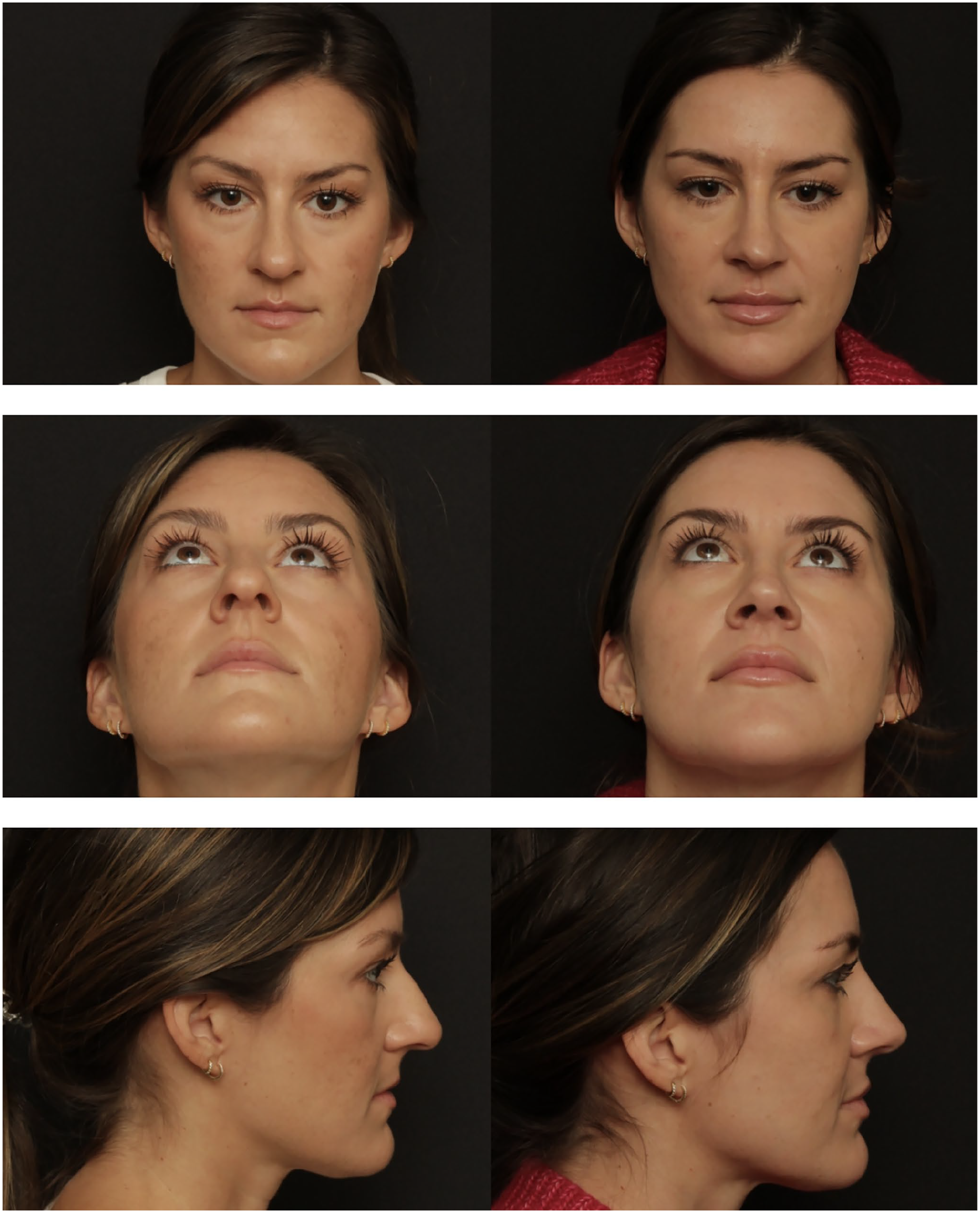
Amorphous, round and ptotic tip.
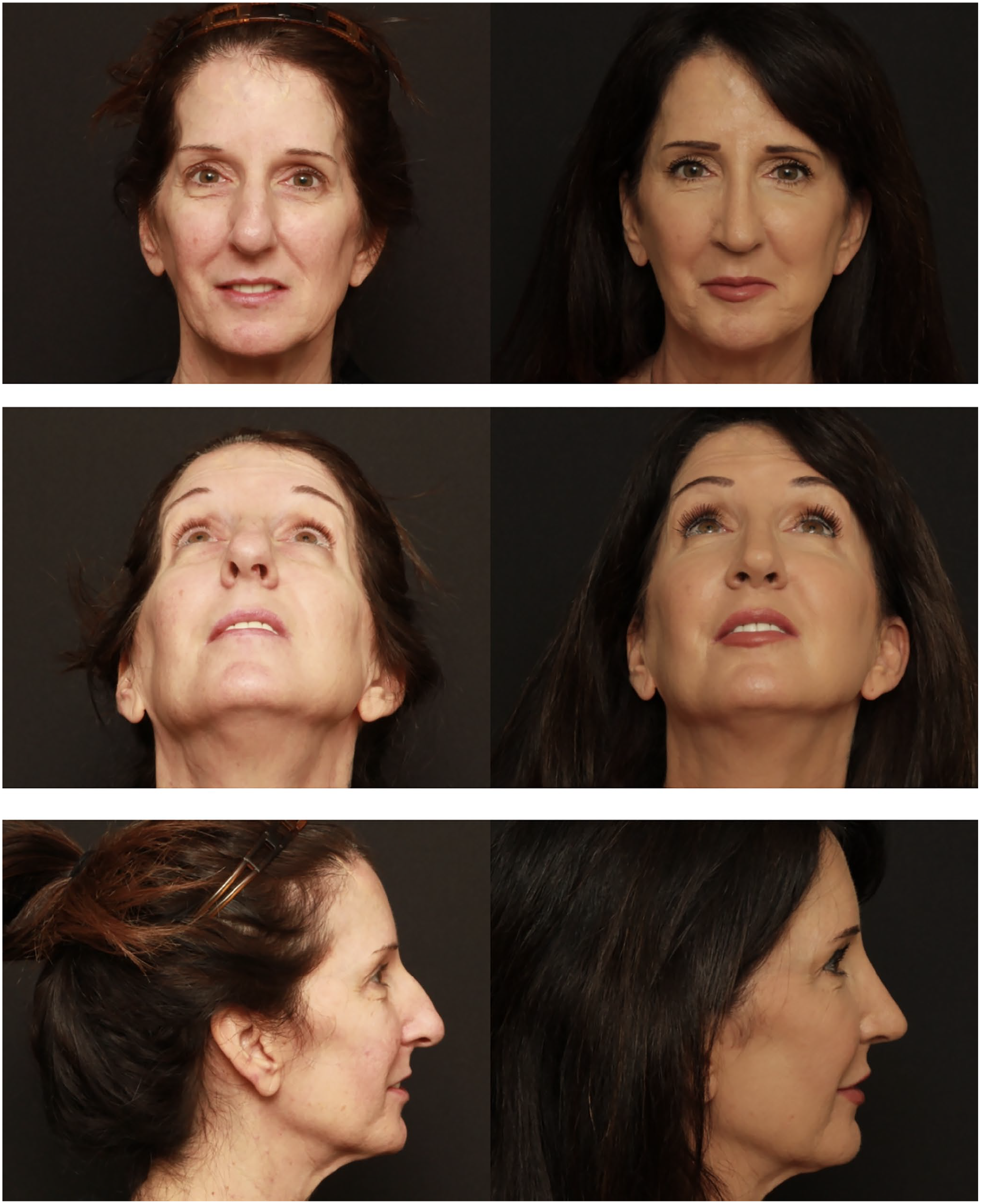
Asymmetric lower nasal third with associated amorphous ball shaped nasal tip.
Case 4
It is also well documented in the literature the relationship between the LLC and external nasal valve function (ENV).7,8 In cephalically positioned LLC, the lateral ala are poorly supported, leading to ENV collapse on inspiration. The discontinuity in the contour of the alar rims also contributes to retracted and asymmetric alae. 7 Constanian confirmed in his study using rhinomanometry that 50% of 60 consecutive patients with external nasal valve incompetence had cephalically positioned alar cartilages. Once the external nasal valve was supported, either with alar rim or alar batten grafts, the geometric mean airflow almost doubled.7,12 In Ilhan et al study in 2015, a statistically significant decrease in symptoms of nasal obstruction was demonstrated with lateral crura caudal repositioning and LCSG (Figures 8 and 9). 6 This supports Toriumi and Asher’s statement that re-orienting the alar cartilages caudally with LCSG provides adequate support to the ENV. 1
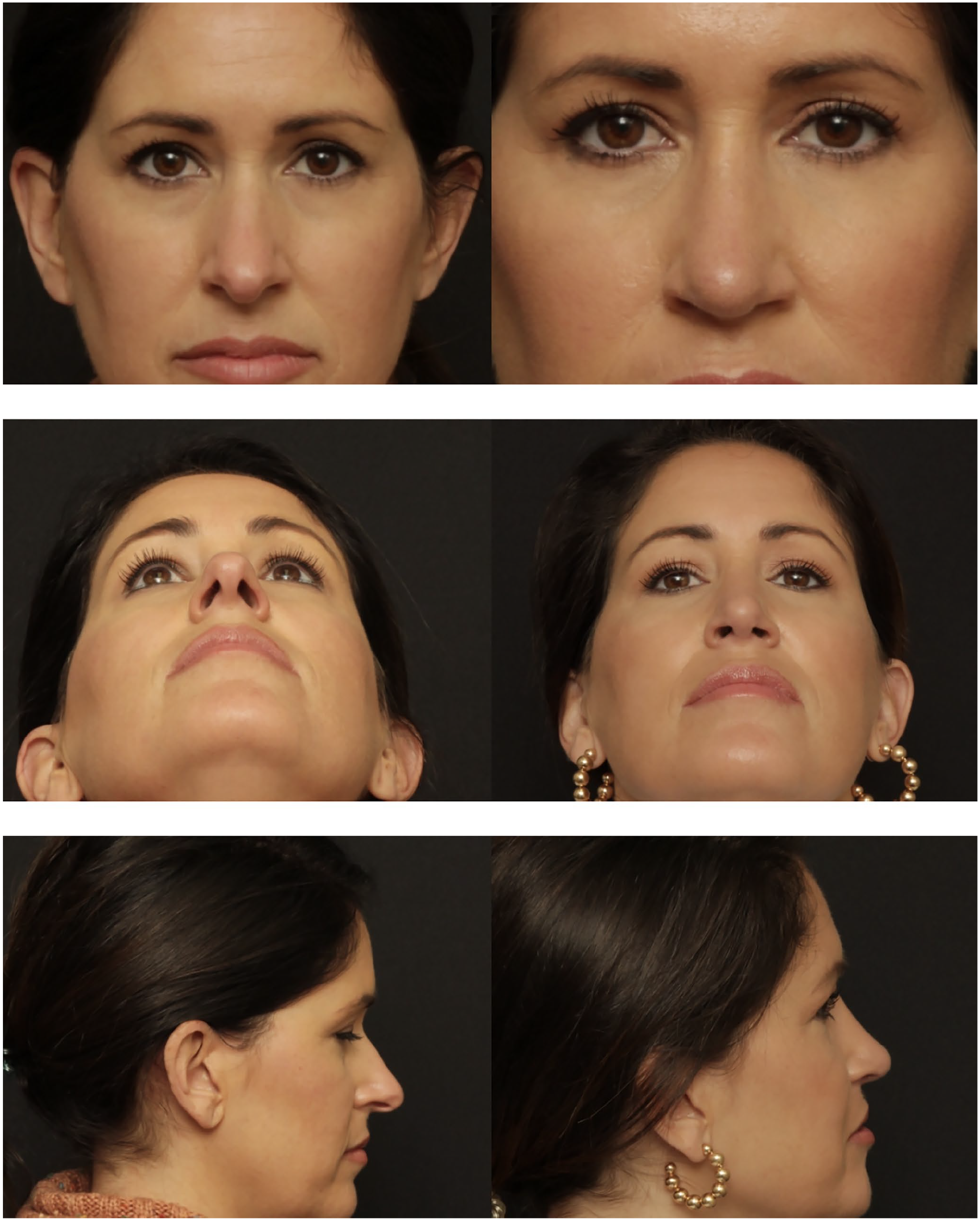
Long appearing nose, boxy tip with tip ptosis.
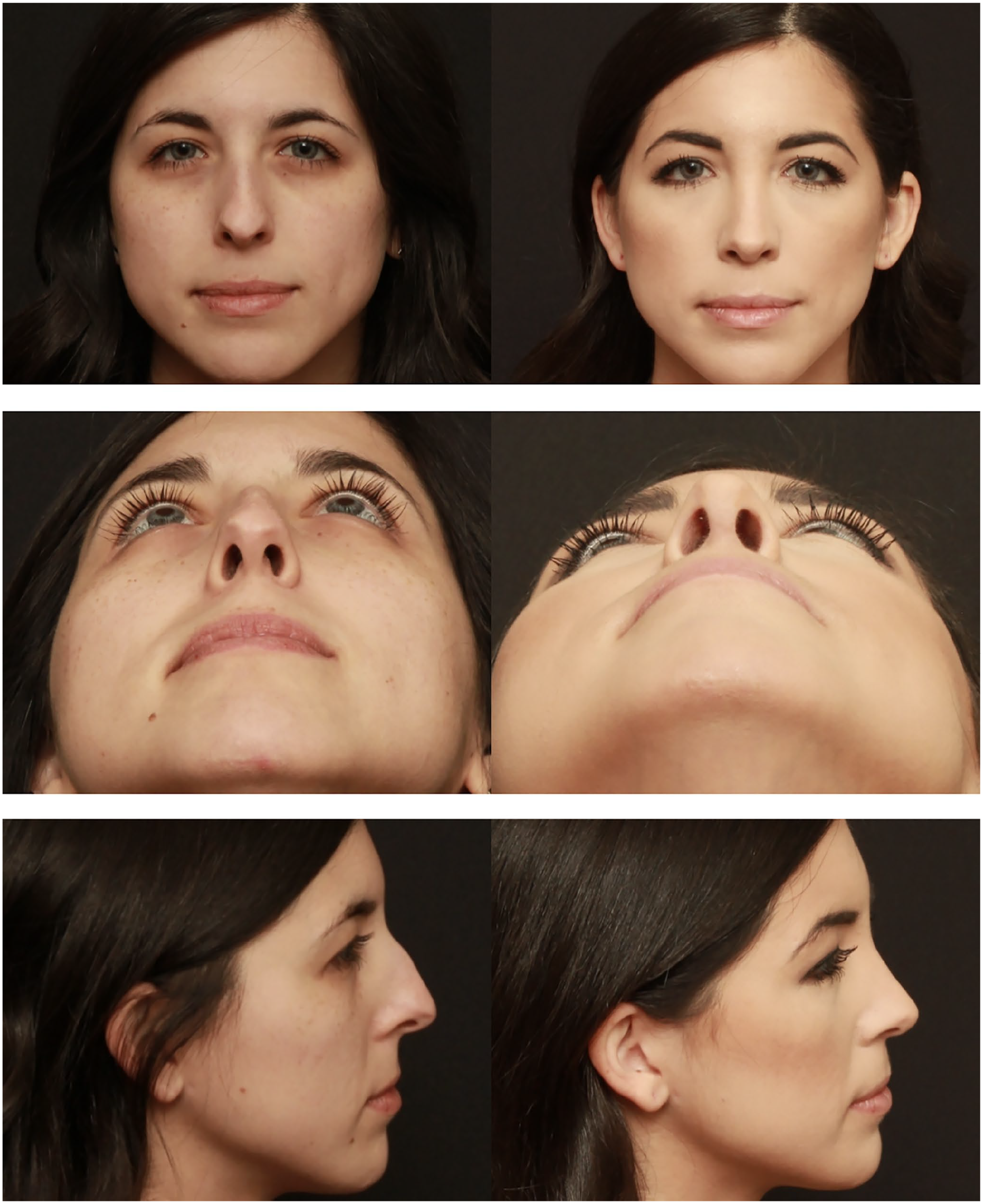
Classic parenthesis deformity, boxy tip, and widely spaced tip defining points.
Alar rim retraction is defined as a distance of greater 2 mm between the alar rim and the long axis of the nostril rim. 4 It follows that if the alar rim is adjacent to the alar cartilage, moving the alar cartilage caudally effectively lowers the alar rim.8,15
Case 5
Discussion
The concept of mal-positioned LLC was first described by Sheen over 40 years ago. He found, in patients with a boxy nasal tip, the long axis of the LLC was directed toward the medial canthus, instead of laterally toward the lateral canthus. This acute angle between the septum and the alar cartilage created nasal tip bulbosity and supra tip fullness which he termed a parenthesis deformity. 9 Toriumi and Asher’s work delineated this angle to be 30 degrees or less in cephalically oriented lower lateral cartilages. 1 The literature supports that most boxy nasal tips are associated with cephalically oriented alar cartilages.5,11
Constantian further supported these findings. Most of his patients with cephalically oriented alar cartilages had boxy or ball nasal tip complexes. His published data also showed that cephalically positioned LLCs were more common than originally thought. In a case series of 200 patients, he identified mal-positioned alar cartilages in 67% of his primary rhinoplasty cases, and 87% of his secondary rhinoplasty cases. The increased frequency of mal-positioned LLC in secondary rhinoplasties was thought to be due to the original surgeon not correcting the boxy tip complex by addressing the orientation of the alar cartilages during the first operation, leading patients to seek secondary procedures for a residual boxy nasal tip and nasal obstruction. 5 Conventional teachings at the time relied on camouflaging techniques along with dome resection, lateral crural tail resection and, inter-domal soft tissue removal to change a boxy or broad nasal tip. 13 While these techniques served to re-contour the nasal tip, they also weakened the entire tip construct. 10 Reorienting cephalically positioned alar cartilages with LCSG is a refined approach to addressing many esthetic concerns of a boxy nasal tip as well as functional concerns related to mal-positioned LLC.
Conclusion
Reorienting cephalically oriented LLC is quite a versatile approach to reshaping the nasal tip. It is a technically demanding maneuver that, when delivered precisely, corrects multiple issues associated with malpositioned alar cartilages. We have used this approach in many cases involving a boxy nasal tip with long ptotic tips and poorly supported external valves.
Footnotes
Declaration of Conflicting Interests
The author(s) declared no potential conflicts of interest with respect to the research, authorship, and/or publication of this article.
Funding
The author(s) received no financial support for the research, authorship, and/or publication of this article.
