







Abstract
Contemporary inequality is progressively shifting to a “classless” form of discrimination (Pakulsky and Waters, 1996; Wright, 2007), not only deriving from individual and collective differences in economic dimension, but more and more relying on multiple, hybrid and cross-cutting generators (social networks, education, gender, age, ethnicity), rather than on traditional class stratification structures. However, the social system still produces structural effects reflecting typical class advantages or disadvantages between individuals (Sørensen, 1996). Exploring such complexity, this article focuses both on methodological matters regarding the exploration of contemporary inequality and provides a cross-national comparison on such topics through the application of the Theil index as an entropic measure of inequality.
A Rough Synthesis of the Theoretical and Methodological Complexity behind Contemporary Inequality
Considering the debate on inequality in contemporary society, we can outline, even if very generally, a distinction between matters regarding the theoretical approaches on class analysis (mainly focusing on the modifications occurred in social stratification patterns) and the methodological aspects (essentially regarding classifications and scaling measurement of inequality itself). Naturally, such generic distinction has to be conceived having in mind that the two dimensions are inevitably deeply related.
The main focus of the theoretical debate is based on the contrast between a) those approaches supporting the resistance of traditional class structure, underlining how, according to the Marxist tradition, even in contemporary society (maybe in a less evident form) the incidence of property and means of production is still decisive in shaping social inequalities (Wright, 1985, 1997, 2007); and b) those approaches considering a de-structured pattern of stratification, where, for instance, the class belonging itself, such an influent identity factor for many representatives of older generations, seems nowadays to decline in a generalized disembedding (Giddens, 1990), becoming mostly blended in with the “non sticking” sense of fluidity characterizing the contemporary individualized and liquid identities (Bauman, 2000, 2001).
Indeed, the post-fordist work restructuring patterns, increasing differentiation in professional contents, have turned class in something nearer to postmodern lifestyles, while social inequalities, even still subsisting, are no more able to produce class consciousness (Hall, 1988; Harvey, 1989). In such situation the traditional structural variables seems often insufficient (almost in their interpretations according the classic antagonism between functionalist or conflictualist approaches) to properly describe contemporary individual behaviors, attitudes and values (Bottero and Prandy, 2003).
Moreover, the shift toward a classless inequality (Pakulsky and Waters, 1996; Pakulsky, 2005) is more and more evident and confirmed by the hybridization of concurrent multiple generative factors (like the educative credentialism, the imbalanced access to citizenships and rights, as well the genderization and ethnicization of labor market) reproducing, according to Weberian social closure theory, as determinants behind different strategies of exclusion and usurpation (Parkin, 1979; Murphy, 1988).
Even if the aforesaid summarization would undoubtedly deserve a deeper treatise, passing to the methodological dimension still permits further theoretical consideration. Indeed, beyond the speculative approaches, nowadays the consciousness of re-tuning methodological tools for measuring contemporary inequality is widely recognized.
If the traditional class concept on its own, mainly based on income and occupied positions within the production relations, is recognized as heuristically insufficient to explain stratification, also socioeconomic classifications show lesser and lesser direct deducibility of attitudes, behaviors and values of social actors (Palumbo, 1993a, 1993b).
Partly, this reminds the so called “paper classes” problem, where socioeconomic classification are inevitably derived as theoretical reproduction of idiosyncrasies and cultural paradigms in the mind of the researchers (Bourdieu, 1985, 1987).
Nonetheless, it has to be reminded that the origin of most of actual socioeconomic classifications (SECs) derives from the tradition of the French CSP, i.e. the catégories socioprofessionnelles, both scholarly as well secularly diffusely applied, and conceived during the Fifties, in a context where Marxism deeply marked social sciences (Mercklé, 2012). Nowadays, even if the SECs have evolved in decades, we are assisting to the decline of occupational classification, exactly in front of the raise of social inequality and of the reduction of social mobility (Pierru and Spire, 2010). Moreover, such decline depends on the fact that occupational classifications are often administrative construction of social reality (Boltansky and Cappello, 1999).
The aforesaid problem is strictly related to the way data are gathered and, consequently, to the available variables in inequality datasets. Indeed, often official statistical surveys, in the effort to provide standardized data for international comparisons, focus only on some essential dimensions (mainly income, education and occupational condition, besides vital statistics), but lack in exploring other dimensions (like lifestyles, consumes and attitudes), which are more and more important in defining contemporary social stratification patterns.
Lastly, utter methodological problems emerge when looking for synthetic statistical measures of inequality (Barbut, 2007). First of all, the statistical observation of inequality presents sometimes comparative problems when shifting between absolute or relative measures or when applying values ratios and distances, often leading to different interpretations (see, for instance, Combessie, 1984).
The aforesaid matters lead to the needs of standardized tools to statistically interpret inequality and compare it between different contexts. Nevertheless, even the choice between several standardized measures it’s not easy. When speaking of measure of unequal distribution (mainly economically conceived in terms of income), the most diffused tool is the Gini coefficient, easy to interpret and to use, being a ratio analysis method useful to compare income distribution between different subgroups in a given system and in different times. Nevertheless, being a relative measure of wealth, its simplicity of interpretation can turn in misleading limitations when comparing different distributions (see, for instance, Mellor, 1989; Deltas, 2003; Cowell, 2007; Barbut, 2007). This leads to alternative or complementary entropic measures of inequality like the Theil index, the Atkinson or the generalized entropy index, all of them basically conceiving inequality as a different distribution of information in each group.
Exactly following an entropic approach, this contribution will provide an empirical demonstration, by combining class and status dimensions in a distributive perspective based on different scaling tools converted in Theil measures.
An “Entropic” Perspective on Inequality
In order to shift the previous theoretical and methodological matters to an empiric level it seems necessary to present a short formalization of “inequality” itself. Basically, the concept of inequality is based on the unequal distribution of resources between different subjects or groups. At a higher theoretical level, as briefly introduced till now, this refers to social stratification, where different strata show reciprocal privileges or disadvantages on resources depending on their position on the social scale.
Shifting a bit from the theoretical implications toward some more empiric applications, we would like to focus mainly on the essential fact behind stratification that is the distribution or different allocation of resources or of the access to them.
This introduces a new question that is what makes a resource. Very generally speaking, a resource should be both as materially and as non-materially conceived, involving, on the one hand, the “substantial” resource, typically like income or, generally, like any form of property, but also the “symbolic” resource, for instance, social capital, knowledge, prestige, skills or entitlements. Needless to say that the examples can be various, but what has to be considered is that the access or the possession of these resources explicates different social positions between individuals.
Similarly, the idea of resource can be considered in a less “economic” way. For instance, following Sen’s capabilities’ approach (Sen, 1973, 1999), resources can be generally seen in a projective sense as the means at disposal for individuals to achieve functionings, i.e. those achievements that, at different stages in life, they may value in terms of wellbeing or doing. Consequently, resources imply also the dimension of agency, concerning people’s ability to pursue and realize valued goals, or refer to transition factors, that is those situations or events leading to agency chances. This approach seems quite distant from a standard economic utilitarian perspective, otherwise it heads for the capability, that is the various combinations of functionings (beings and doings) that the person can achieve. Capability is, thus, a set of vectors of functionings, reflecting the person’s freedom to lead one type of life or another and, consequently, the resources at disposal undoubtedly produce effects on such chances.
Given these short preliminary basis, we can say that inequality reflects different distribution of resources not only in the descriptive sense of their material allocation, but also in a probabilistic sense, that is, once given a certain amount of resource, concerning the individual probability that one unit of those resources could effectively go to a certain individual rather to another.
In other terms, the reproduction of inequality depends not only on the fact that individuals differently possess in sense of amount (the observed inequality in certain moment), but also have different chances of access to the possession itself (the potential reproduction of inequality over time). In other words and even if from a simplified perspective, those occupying highest positions of social scale usually enjoy better chances in terms of probabilities to obtain resources to the detriment of those relegated in lower positions.
Here is where an entropy measures becomes handy and the Theil index (Theil, 1967: 91-134) shows its properties.
The Theil’s index can be defined as a sort of entropy measure, indeed is derived from Shannon’s measure of information entropy (Shannon, 1948; Shannon and Weaver, 1963). In Shannon’s approach the entropy is a probability measure of an event occurring; in Theil index the entropy can be seen as the likelihood that a unit of a resource drawn at random came from a specific individual, indeed:

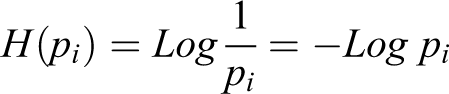


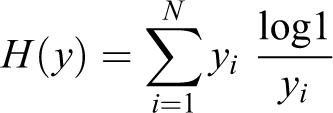
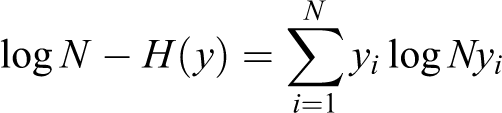
Still the Theil index seems to show itself particularly useful because it permits the shift from a mere descriptive dimension for the individual dimension to a probabilistic dimension regarding the individual condition, in other words, the expression of the individual contribution to the index concerns the individual probability that a unit of measure of a particular resource (material or nonmaterial) would be assigned to that specific individual over the whole population.
The same process can be applied to groups of individuals observing the “group” contributions, for instance, by gender or by age class, consequently, the amount of contribution to the Theil index by all the components (or members) of that group (or sub-aggregate) will express the redundancy in terms of likelihood that a unit of resource, drawn at random, came from that specific group (or sub aggregate).
On the base of the aforesaid, any property regarding a resource, a level of choice, or a functioning in term of wellbeing could be analyzed in this way, of course, only once having scaled it through appropriate quantitative indicator. In this sense, the different class and status variables till now mentioned can be read in terms of quantities (of income, of professional prestige, of level of education achieved, et cetera) and observed as disposable resources for each individual through the Theil index procedure, giving back specific measures in terms of relative inequalities.
Generally, one of the advantages of the Theil index is that it can be distinguished between strata or sub-populations (Conceição et al., 2000), considering age, social categories, life conditions, geographical situations, etc. but it also easily permits the elaboration of the internal inequality in each sub-aggregate (intra) as well of the inequality between sub-aggregates (inter). In our following elaborations the data are disposable at individual level, so the analysis has been conducted according to Conceição and Ferreira’s formula (2000) considering the application of Theil index with samples of individual data. Consequently, applying the Theil index to individual data would mean the following expression:
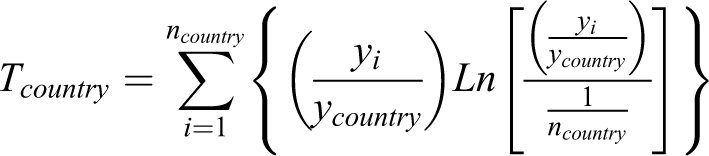
yi = the amount of resource for each individual i
ncountry = the country’s population (the number of individual of each country in the sample)
ycountry = the country’s total amount of resource (the sum of all individual amount of resource in the sample)
European Class and Status Inequality in a Gender and Age Perspective
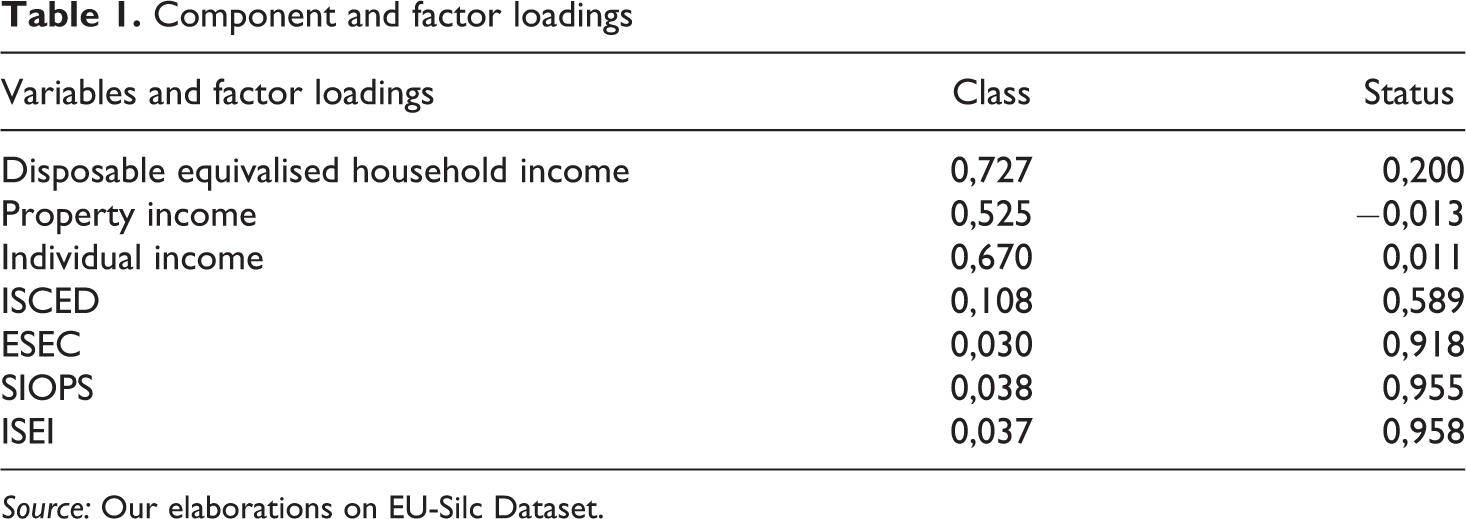
In this analysis we have adopted the 2008 Eu-Silc survey, using the available income variables (regarding individual level, property and disposable equivalised household income) and reworking the dataset in order to obtain different individual scores of education (ISCED levels), as well of status and prestige measures on recognized international socioeconomic classifications4, like ISEI, SIOPS and E-SEC (Ganzeboom and Treiman, 1996, 2003; Harrison and Rose, 2006). All of the variables have been considered in terms of probabilistic allocation of substantial and symbolic resources and, consequently, transformed in Theil index contributions. Lastly, we have reduced the data complexity through a factor analysis resulting in a “two components” model, showing (as in table 1) the latent dimensions of “class” (more related to income levels) and of “status” (more tied to prestige and education).
Component and factor loadings
Source: Our elaborations on EU-Silc Dataset.
Once having obtained the two class and status axis, it is possible to observe the inequality levels in the various European national contexts, underlining the effects of other inequality’s possible key-elements, for instance gender and age, which can be considered as important hybrid generative factors of classless inequality.
Observing the gender perspective at country level, Graph 1 shows evidence of the different explicative structures of inequalities between men and women.
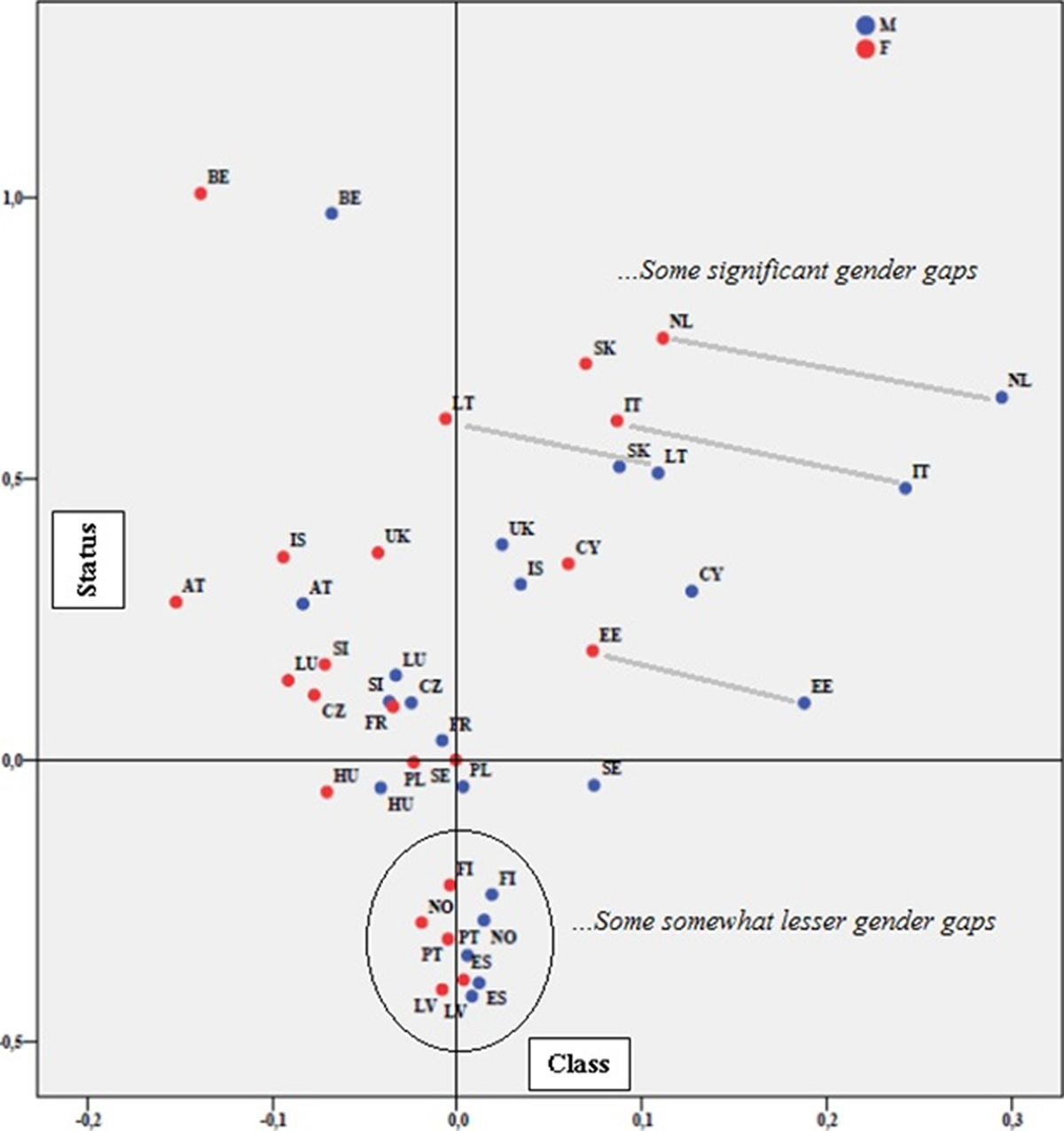
Class and status inequality dimensions by gender across Europe, 2008. Source: Our elaborations on EU-Silc Dataset
In the figure, every country’s red dot (describing the female conditions) appears horizontally placed on the left of the correspondent blue dot (describing the male position), precisely expressing the class privileges of the male component of population. On the other hand, most of female positions are vertically set slightly higher from the corresponding male references, because in terms of status differential, often, women, especially the young ones, show higher education levels, but are less paid.
Indeed, gender class distances can be very marked, like in Netherland or Italy, describing essentially a larger gender income gap. Otherwise the ranges can be very short, especially in Iberic and Northern Europe countries, where status’ influence is lesser and the class factor is more contained. Elsewhere, even where status dimension is more determining then the class factor, like in Belgium or in Austria, the gender class gap is still present and clearly observable.
Another strong inequality factor is the different distribution of class and status dimension considering the age classes (Graph 2).
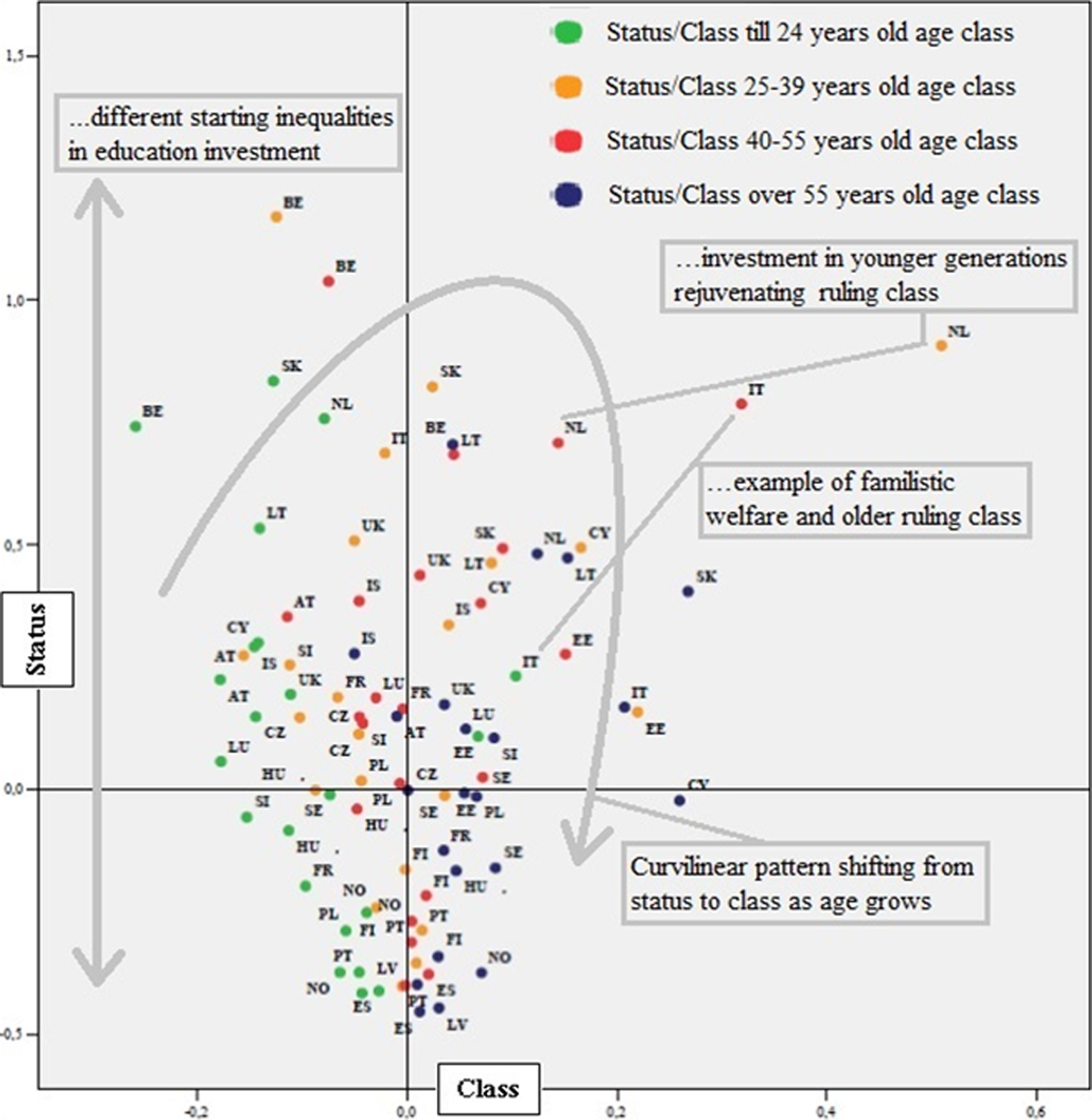
Class and status inequality dimensions by age classes across Europe, 2008 Source: Our elaborations on EU-Silc Dataset
The figure shows an implicit curvilinear pattern, starting with younger generations, generally showing a good status level (especially considering higher education when compared to older age classes), but paying a lower starting position in class dimension. This derives as the consequence of several aspects, mainly based on the biographical paths: many youngster are inserted in the job market, but with flexible contracts; others could still be investing in human capital through education. Very particular is the situation of the Italian till 24 years old class, reflecting higher levels on class dimension. This is mainly a result of a typical familistic welfare system, where younger generations abandon lately the parental home and count for longer on the parents’ economic sources through the household disposable income. The retarded career path (partly derived by scarce opportunities in job market, partly by cultural late emancipation), accompanied by conservative power structure, produces, consequently, an older ruling class.
On the other hand, European younger generations seems to be commonly classifiable in two major status groups, those showing an higher educational investment (like in Belgium, Netherlands and Slovak Republic) and generally reflecting higher status conditions (with an expectable future rendering in terms of income and class) and those placing at the bottom of status levels (like in Spain and Portugal) where exactly education plays a major role on inequality levels.
The successive age class, the young adults between 25 and 39 years old, reflects all over Europe the same aforesaid pattern. Once fully entered in job market, even if suffering from flexible contracts, young adults start expressing increasing income levels growing in the class factor. Naturally, also professional development starts showing its effects and, commonly, also the status level reflects major advancements. Some countries show also the results of a major investment in younger generations, for example status level for young adults is higher in Belgium and in Netherland where they show proportionally higher class and status levels. Such different investment in younger generations produce implicit different effects on the rejuvenation of the ruling class. Other countries, instead, reflects more conservative power patterns, where, commonly, class and status levels are higher in adults generation (40-55) and maintain progressively.
The curvilinear trend shows a reduction in proximity of those who are ending their working career. In this case, the status factor starts declining because of the lesser educational level of older generations and of the emerging presence of retired people that lose naturally their professional status entering the inactive population. Anyway, the class dimension is always maintained also in case of retirement, ensuring a stable income level through the pension benefits (generally proportional to the precedent professional status). This means inevitably that an higher professional status before retirement could imply a reproduction of the class dimension during the inactive part of life, while a lower exiting professional status lead to a major exposition to the poverty risk, especially for that part of the population that cannot count on better retirement benefits. This is evident if we observe the case of Iceland, where, once having the higher pro capite GDP in Europe, the country has deeply suffered the economic recession in 2008 and the most exposed seem exactly the over 55 age class, showing itself very lowly positioned in the class factor.
Final Observations and Conclusions
First of all, we would like to stress on some implicit limitations of the present work. Indeed, the dataset, apart from its relative obsolescence, suffers the lacking of a more detailed set of dimensions, especially those helpful to get individual perceptions in class positioning (like behaviors and attitudes in terms of lifestyles, consumptions, relational networks or political orientation), which could be very helpful in understanding the stratification processes beyond a mere “paper classes” approach.
However, the analysis permits to give evidence of specific inequality factors ongoing in different contexts since the starting of the contemporary international crisis.
Indeed, simply by adding gender and age to the traditional class and status dimensions, inequality turns clearly toward complex hybrid forms of social stratification, where no single system of inequality predominates and where life chances realize around complex patterns of class, status and authority positions (Pakulsky, 2005: 172-176). In this sense, class, on its own, is heuristically insufficient, because non exhaustive. Nevertheless, class still “counts” and still determines individual horizons, complicating the scenario between “structural” and “non-structural” factors of inequality (Sørensen, 1996).
The presented international comparison reflects how such hybrid generative complexity of inequality is more and more recognizable in every national system and interacts with structural factors of inequality raising the level of disparity between citizens.
Moreover, given the class fragmentation and individualism in contemporary identity patterns, defining and placing positions in class structure does not necessary means that such positions correspond effectively to people themselves, that are interested by life trajectories and are gifted of history and memory influencing their behaviors (Palumbo and Poli, 2007). This shows the obsolescence of the functionalist approach, as well of the Marxist model privileging macro dimension and political valor of class consciousness.
Secondly, recognizable positions are only traces, left by individuals on analytical plans defined by researcher, nevertheless, lesser these plans do not correspond to factors lived by people, lesser these traces are good predictors especially considering contemporary reflexive modernity.
Lastly, people apply action strategies, very different also on equal terms and commonly depending a) on the aforesaid occupied positions and moreover on the paths and causes behind them; b) on which positions are considered most relevant for each individual and all along her/his lifetime; c) on the often changing interpretation of such positions given by subjects; d) on the influence of such perceptions on individual behaviors through which, more or less consciously, individuals reproduce meso and macro levels (ibidem).
On this basis, it becomes nowadays more and more evident one of the main challenge for contemporary sociology that is the reconstruction of social structure and processes, but starting from the real actors and avoiding to read their behaviors through categories borrowed from the analysis of social structure itself.