







Abstract
Based on fieldwork undertaken with Muslim communities in Dublin, Ireland, this article adds new insights on media reportage as received by Muslim audiences. Utilising agenda setting theory, we evidence how dominant representations of otherness are constructed and received. Participants reveal their perspectives on the perceived dominant discourses of racialised media representations of Muslimness and Islam, and their impacts on both Muslim and non-Muslim communities. While focussing on the ‘media' writ large, this article concludes with original insights on online hate and harassment and how Muslim audiences in Ireland, like elsewhere, receive and are subjected to online anti-Muslim hostility that is replete with, and legitimised, by dominant racialised representations of ‘Muslim as Other', underscoring the relationship between ‘old' and ‘new’ media.
Introduction
The role of media actors in the production and dissemination of racialised representations of Muslim communities and Islam is well established in published literature (Lewis et al., 2011; Morey and Yaqin, 2011; Rane and Ewart, 2013; Said, 1997). Over the past 10 years and more international researchers have provided interesting insights on the experiences of Muslim communities as audiences; illuminating the manner in which they are represented by media in various contexts and how these representations have been interpreted by these communities (Ahmad, 2006; Banaji and Al-Ghabban, 2006; Güney, 2010; Kabir, 2008; Mahtani, 2008). However, studies which engage with Muslim communities as media audiences and their perspectives on media reportage of Muslims/Islam remain in the minority. Ahmed and Matthes’ (2017) analysis of 345 studies pertaining to media representations of Muslims and Islam evidenced that ‘only a small percentage of studies explored both media and audience perspective (N = 35, 10.14%). Out of the studies exploring the media audience relationship, only a few focused on the role of media discourses in Islamophobia’. The Irish experience is no different. Despite the rapid growth of Muslim communities in Ireland, and evidence of problematic media reportage, we know nothing of the experiences of Irish Muslims as media audience members when it comes to their experiences of mass media reporting of Muslims and Islam. This article addresses this shortcoming. Based on original fieldwork undertaken with Muslim communities in Dublin, Ireland during the summer and early autumn of 2015, the findings presented in this article add new insights on media reportage of Muslim communities. Resonating with the international context, the findings detailed below engage with Muslim audiences to gain an understanding of their perspectives of ‘traditional’ media, across genres, coverage of Muslims/Islam. What is striking about the evidence presented here is that despite calls for change, 1 the manner in which Muslim communities are represented in the media remains largely the same. In this context, participants provide insights on how they feel racialised media representations of Muslims and Islam impact upon Muslim individuals as well as broader Muslim and non-Muslim communities. While focussing on ‘traditional’ mass media, this article concludes with original insights on the increasingly important area of online ‘hate’ and the way Muslim audiences in Ireland, resonating with international research, are subjected to online anti-Muslim hate and hostility (Awan and Zempi, 2015; Gallagher and O’Brien, 2024; Williams and Burnap, 2016).
Literature on the topic of racialised representations of Muslim communities and Islam evidence the manner in which media actors are important sources for the dispersal of discourses that co-locate Islam and Muslim communities with tropes of terrorism, extremism etc. (Ahmed and Matthes, 2017; Bleich et al., 2015). How Muslim communities and Islam are represented in the media is well documented in the scholarly literature (Ahmad, 2006; Said, 1997). It would be erroneous to reductively homogenise all media actors; there certainly is nuance in terms of the ideological underpinnings of a given media actor (Bleich et al., 2015); nonetheless, the literature demonstrates a consistency in terms of themes that can easily be identified in media representations that cohere around the stereotypical construct of ‘the Muslim’. Drawing at times from a well of Orientalist tropes, historically (mis)informed homogenising discourses marry the past with the contemporary to present Muslim communities as the threatening ‘other’ in ‘our’ midst.(Harb and Bessaiso, 2006). The construction of Muslim as threatening has been repeated so often now that it is just accepted as ‘truth’ (Eid and Karim, 2011). Negative, stereotypical media representations of Muslim communities also contribute to feelings of being marginalised and alienated amongst the communities themselves (Güney, 2010). These feelings are compounded by a failure of media actors to disseminate positive or simply ‘normal’ representations of Muslim communities that could serve to challenge the dominant stereotype (Morey and Yaqin, 2011).
In this article the ‘Muslim’ audience in Ireland – constituted as an active audience is the focus of attention. Research on media audiences has developed over the last number of decades to move from a perspective wherein the audience was perceived as passive unified mass to a position wherein those receiving media texts are now recognised as diverse communities (Gillespie, 1995; Mahtani, 2008). Gillespie explains, in relation to research on the impact of television that audiences were invariably misconceived as a mass of atomised individuals vulnerable to its persuasive and potentially harmful effects (1995). This effects approach focused on the manner in which audiences were essentially media ‘dopes’ influenced by the media messages they received (Banaji and Al-Ghabban, 2006; Gillespie, 2006). Researching media audiences’ challenges perspectives from the ‘effects’ school wherein audiences are: ‘passive victims … ideological dupes of transnational media corporations’ (Gillespie, 2006).
Matar (2006) notes that media audience engagement is an active process; audiences do not just simply and hypodermically accept the dominant narrative that they are exposed to. Güney's (2010) Güney, 2010 study with Muslim youth is just one example of such critical engagement with the mass media ‘from below’ (Miladi, 2006). Audience research studies such as that presented here are crucial if we are to reveal how media texts are critically received by individuals and communities. By directly engaging with audiences, we bring them to the fore in the media research. There is an abundance of studies that engage with the way racialised communities are constructed in the media but very little research with those same racialised groups, as audience members (Mahtani, 2008; Lewis et al., 2011). A range of studies, in this case primarily qualitative, have engaged with Muslim audiences to ascertain their perspectives on how they are presented in media discourses (Banaji and Al-Ghabban, 2006; Matar, 2006). The research discussed here, based on a qualitative methodology, engaged with Muslim men and women in Ireland to gain an original insight into how they ‘read and respond to media texts’ (Devroe, 2004).
Methodology
Rationale
The research findings upon which this article is based derive from fieldwork undertaken with Muslim communities in Dublin, Ireland during the summer and early autumn of 2015. While we acknowledge the temporal distance from data collection, this study captures Muslim audience perspectives at a critical juncture in Ireland's media landscape – just before the explosion of social media dominance and during a period of significant demographic change in Irish society. This timing provides valuable baseline data for understanding the evolution of Muslim media experiences in Ireland.
Participants were asked, inter alia, to share their perspectives of ‘traditional’ mass media reporting of Muslim/Islamic issues and the effect of such reportage. The rationale for this line of investigation was in part premised on extant international academic debates on the role of media actors in stigmatising Muslim communities and the paucity of such work in Ireland (Ahmed and Matthes, 2017). The impetus for this study was also the result of previous research undertaken by the research lead wherein Muslim men and women frequently, and unprompted, made recourse to the media as a central actor in the representation of Muslims as ‘Other’ and in effect, their experiences of anti-Muslim racism (Carr, 2016b).
Research design and ethics
This study employed a qualitative research design utilising both focus group discussions (FGDs) and semi-structured interviews to gain deep, rich understanding of participants’ perspectives. The research followed ethical standards outlined by the Sociological Association of Ireland (SAI, 2026). All participants provided written informed consent, were assured of confidentiality and anonymity, and were informed of their right to withdraw at any time without consequence. Pseudonyms have been used throughout to protect participant identities. Given the lack of diversity within the Muslim community in Ireland and the population size (see CSO, 2023), in the interest of protecting the identity of participants, we are not providing further information on personal characteristics as doing so could compromise anonymity and confidentiality of participants.
Sampling and participant demographics
A purposive sampling strategy was utilised to recruit participants from different ethno-national groups, genders, ages, aspects of Islam, and locations across Dublin. This approach ensured maximum variation in perspectives while maintaining focus on the Muslim community's experiences. Participants were accessed through: Key community gatekeepers known to the researcher through previous engagement Islamic women's groups (three organizations) Islamic student societies (two universities) Various mosques and cultural centres (five locations) Snowball sampling for individuals unaffiliated with formal organizations
In total, 66 Muslim men and women participated in the study, with an even gender split (33 men, 33 women).
Ethical rationale for withholding participant demographics
Detailed demographic characteristics of participants are intentionally not reported in this article due to ethical considerations relating to identifiability and participant safety. The Muslim population in Ireland is small and unevenly distributed, and many participants are embedded within closely connected community networks. Thus, the disclosure of demographic attributes – such as age, gender, ethnicity, national background, profession, or geographic location – could permit individuals to be identified indirectly, even where pseudonyms and standard anonymisation procedures are applied.
Given the sensitive nature of the research topic and the heightened potential for social, professional, or personal repercussions for participants, the decision to omit demographic details adheres to institutional ethical approval requirements and GDPR-aligned principles of data minimisation and confidentiality. This approach reflects qualitative research standards for working with minoritised, potentially vulnerable, or easily identifiable groups, where the protection of participant anonymity is prioritised over descriptive precision.
Broader contextual information relevant to the analysis is incorporated in aggregate form throughout the findings, ensuring interpretive clarity while safeguarding participant confidentiality.
Data collection procedures
Data collection occurred over a four-month period (June–September 2015) using two primary methods:
Focus group discussions
Fifteen focus groups were conducted with the following composition: Mixed gender groups: 5 (conducted in public spaces with cultural sensitivity) Women-only groups: 6 (conducted with cultural sensitivity) Men-only groups: 4 (conducted in mosques or community centres)
Group sizes ranged from 3 to 10 participants (mean = 5.3). Each FGD lasted between 60 and 120 min (mean = 85 min). The variation in group composition was intentional, recognising that gender dynamics might influence discussions about media representation and discrimination.
Semi-structured interviews
Four one-to-one interviews were conducted (two men, two women) lasting 45–75 min each. These participants were selected for individual interviews either because they held particular insights as community leaders or because scheduling conflicts prevented focus group participation.
Interview schedule
The semi-structured interview guide explored five key themes: Media consumption patterns: Types of media consumed, frequency, preferred sources Representations of Muslims/Islam: Perceptions of how Muslims are portrayed across different media Impact of media representations: Personal experiences, community effects, societal implications Responses and resistance: How participants respond to negative representations Suggestions for change: What participants would like to see different in media coverage
Questions were open-ended to allow participants to raise issues important to them. The guide was piloted with two community members and refined based on feedback.
Data recording and transcription
All focus groups and interviews were audio-recorded with participant consent using digital recorders. Two researchers were present at each focus group – one facilitating discussion, one taking detailed field notes on non-verbal communication, group dynamics, and contextual factors.
All recordings were transcribed verbatim by the research team within two weeks of collection. Transcriptions included notation for: Pauses and hesitations Emotional expressions (laughter, sighs) Overlapping speech in group discussions Non-verbal agreements/disagreements noted by the observe
This resulted in approximately 400 pages of transcript data.
Analytical framework
Data were subjected to thematic analysis following Braun and Clarke's (2006) six-phase approach: Familiarization: All transcripts were read multiple times by the research team Initial coding: Line-by-line coding of all transcripts using both inductive and deductive approaches Theme generation: Codes were collated into potential themes through team discussion Theme review: Themes were checked against coded extracts and entire dataset Theme definition: Ongoing analysis refined specifics of each theme Reporting: Final themes were selected for their relevance to research questions
NVivo 11 software was used to manage the coding process. To ensure rigour, 20% of transcripts were independently coded by two researchers, achieving an inter-coder reliability of Cohen's kappa = 0.84, indicating substantial agreement. Discrepancies were resolved through discussion and contributed to refining the coding framework.
Researcher reflexivity
Acknowledging that researcher(s) positionality influences data collection and interpretation is crucial. The primary researcher has previous engagement with Muslim communities from a professional and research capacity. This positioning provided both advantages (existing community trust, cultural sensitivity) and potential limitations (possible assumptions, insider/outsider dynamics).
To address these considerations: Debriefing sessions were held with the research team A reflexive journal was maintained throughout data collection and analysis Preliminary findings were shared with five participants for member-checking Critical feedback was sought from community advisors
The research team included members with diverse backgrounds to bring multiple perspectives to the analysis. We acknowledge that different researchers might interpret the data differently, but we have endeavoured to ground our interpretations firmly in participants’ own words and meanings.
Limitations and temporal context
We acknowledge several limitations of this study: Temporal distance: Data collection in 2015 preceded significant changes in Ireland's media landscape, including the dominance of social media platforms and algorithm-driven news consumption. However, this provides valuable baseline data for understanding the trajectory of Muslim media experiences. Geographic focus: Limiting the study to Dublin may not capture experiences of Muslims in rural Ireland where community dynamics and media exposure differ. Language considerations: All discussions were conducted in English, potentially excluding recent immigrants with limited English proficiency. Self-selection bias: Participants willing to discuss media representations may have stronger opinions than the general Muslim population.
Despite these limitations, this study provides crucial insights into Muslim audience perspectives at a formative period in Ireland's multicultural development, offering a foundation for understanding contemporary challenges and changes in media representation.
Media and Islam in Ireland
As noted, there is a wealth of international research on the way media discourses racialise Muslim communities. Ireland is no different as analysis of media reportage in Ireland undertaken for the European Islamophobia Report demonstrates (Carr, 2016b). Focusing on articles relating to Muslim communities, the 2015 Report noted: ‘a consistency in the manner in which … Muslims/Islam [are presented] as a threat in the context of “us” versus “them” discourses’, such discourses remain present in reports almost a decade later (Carr, 2016a: 251).
Double standards
This article focuses on the perspectives of Muslim communities in Ireland as critical members of a media audience(s). Extant audience research studies demonstrate how media actors are perceived by Muslim communities as key protagonists of homogenising and ‘othering’ discourses (Devroe, 2004; Kabir, 2008). Irish participants in this study evidence a similar awareness to that of their international counterparts when it comes to perceptions of Muslim communities constructed as ‘other’ in the media. Salah's contribution here is particularly interesting in that he presents an awareness of the way media discourses about Muslim communities inform popular opinion to negative effect. What really annoys us, [is] what they [uncritical audiences] hear from source, could be … let's say the Fox news, they love to talk about anything anti-Muslim or anti-Islam … without just processing it, without just giving it a second thought … listen man there's nearly 1.6 bn people with this faith on this planet and they’re spread all over every single corner of the world. (Salah)
Frustrations at how Muslims and Islam are portrayed with negative effect is evident. Chiming with Devroe' (2004) research with ethnic minority audiences, the belief is that Muslim communities only ever receive coverage in the media when something negative occurs. Reductive, negative representations of Muslims and Islam abound in the contemporary context wherein Muslimness is constructed as embodied as the threat de jour; conversely, ‘good news’ stories relating to Muslim communities and the faith of Islam remain in the minority (Morey and Yaqin, 2011).
In addition to feelings of frustration there is also a distrust of media (Harb and Bessaiso, 2006; Mahtani, 2008). Participant perspectives are also informed by a belief that Muslim lives seem to be worth less in media coverage of international events. Rane et al. (2014), drawing on Galtung and Ruge, refer to media editors’ decisions regarding the newsworthiness of an international incident, and the increased likelihood of coverage if those affected are ‘more like us’; particularly if the ‘us’ are members of an ‘elite nation’. In this context, ‘Western’ media outlets construct Muslimness and belonging in the ‘West’ as mutually exclusive. Where they said it was you know Taliban or the ISIS … doing the acts of terrorism, the coverage is much more even than it was of the children killed in Peshawar …. Like they just went in and bombed and shot them and slaughtered those children and the coverage of that was much less than the Boston bombing, the Charlie Hebdo, the 9/11…. (Mona)
Mona's contribution echoes with those audience perspectives evident in the available literature who proffer that ‘Western’ media actors engage in double standards when it comes to reporting conflict. There is a perceived duplicitousness when it comes to media reporting about the deaths of people in the ‘West’ when compared to tragedies that occur elsewhere with the former afforded more attention while the latter is largely neglected (Güney, 2010). Such practices of double standards also buttress the hegemonic racialising narratives of the ‘other’. Tragedy and conflict are presented as a ‘normal’ part of daily life for Muslim majority societies, part of their ‘natural’ environment. Instead of being extraordinary: ‘readers and viewers are being fed stereotypical images to reinforce their impression that violence and chaos are familiar in Muslim environments’ (Kabir, 2008). Interestingly, as media racialise communities at home they also bring them ‘closer to … external Others’ all the while building a distance between the ‘us’ that really belongs in the ‘West’ and those deemed unworthy of our attention and sympathy (Güney, 2010: 171).
Not all the same – Receiving a text
It is important to underscore the research participants, as a critical audience, did not perceive all media in a negative light. Not all journalists or media outlets are implicated in the systematic production of racialising discourses of Muslim communities and Islam. There are those perspectives in the media that go against the grain and shed light on experiences of anti-Muslim hostility and discrimination and provide a critique on the manner in which Muslim communities are in the crosshairs of securitisation policies and discourse. However, Poole (2011) argues that this ‘counter discourse’ remains in the minority. Maryam (although in the extreme minority amongst participants) gives names to exemplars of good practice; that is, perceived as impartial and critical when engaging with Muslim communities.
‘There are some newspapers. Like Irish Times, Mary Fitzgerald … she's written really good articles…’. (Maryam)
Receiving the agenda: Setting the sensational
As noted above, agenda setting refers to how media actors give particular stories a prominent place in their reports (Rane et al., 2014). In doing so, the audience is alerted to ‘how much importance to attach to that issue from the amount of information in a news story and its position’ (Ibid.: 8). According to Rane et al., ‘agenda setting theory helps explain why Western audiences associate Islam with terrorism and see Muslims as violent oppressors of women’ (Ibid). Morey and Yaqin (2011) argue that no individual media actor can set the media agenda; indeed, various agendas, including those that may be critical of the perceived dominant discourse, may be at play. For Morey and Yaqin, there is no conspiracy between politicians and the media to restrict the way Muslims are represented and treated … it is, rather, the habitual workings of mainstream press and news media that lead to a sometimes inadvertent complicity with power agendas. (2011: 77)
According to Van Dijk (cited in Harb and Bessaiso, 2006: 1066) media actors engage in a ‘…joint production [of popular knowledge] with other elites, primarily politicians, professionals and academics’. However, Van Dijk continues to indicate a greater degree of ownership on the part of media, that ‘given the freedom of the press, the media elites are ultimately responsible for the prevailing discourses of the media they control’.
Some participants in this study firmly believed in the existence of a definite media agenda wherein Muslims were being constructed as ‘other’ to meet particular ends. Indeed, the at times explicit refrain to the term ‘agenda’ in discussions was striking. This is concurrent with international research that evidences a belief within these communities that media representations of Muslims/Islam were being utilised to legitimise political ends (Ahmad, 2006; Kabir, 2008). Participants here implied that media ostensibly have an ideological/political agenda in constructing Muslims as ‘Other’. …the media is just here as if targeting, just want to spread this idea of Muslims [as] worse people … I think that some people [general public] they don’t have time to search about this, they just take from them [the media]; so, the media has something to achieve … they have something they want to bring to the people's idea…. (Farhid)
What media want to achieve in communicating such racialising representations of Muslim communities was perceived as ideological/political. Media producers have several practical imperatives that inform their practice which include meeting deadlines, attaining targets vis-à-vis reader/viewer/listenership (Morey and Yaqin, 2011). For some participants here, media actors deployed sensationalist tropes about Muslim communities, regardless of the social impact, with the simple agenda of selling copy. Abdul and Adil succinctly sum up this perspective on perceptions of media agendas:
‘Most of them is interested in selling in[to] audience, whether its TV or selling papers, newspapers … they’re not going to be telling that “this guy is a nice guy”, that doesn’t sell’ (Abdul).
Various research has pointed to the manner in which media utilise the sensational for their own ends; and relatedly the negative impact this can have on Muslim communities.(Poole, 2011). Participants in this study were no different: Media highlights always the sensational, that what is you know very negative and unfortunately people then what they do is they assume that you know all Muslims are like that, so there is a rise of Islamophobia, anti-Muslim sentiment. (Adil)
The notion of the ‘sensational’ also arose in relation to the question of who gets to speak for Muslim communities in Ireland on national/local media platforms. Muslim communities diverge across multifarious facets of identity, belief, class, politics, religious perspectives, etc. (Carr, 2016b; Scharbrodt et al., 2015). Bearing this in mind, the problematic issue of who can be deemed as the holder of ‘hegemonic authority’ within Muslim communities becomes apparent (Ahmad, 2006: 963). The way disproportionate media space is provided for certain Muslim ‘representatives’ and ‘leaders’, who may not be perceived as such at large, is a frequent point of consternation within Muslim communities (Ibid.). Resonating with Kabir's (2008) research, participants here were critical of how particular individuals are held-up as representatives of Muslim communities. Salah's frustration is palpable; not only is he aware of this practice but he also recognises the logic behind the use of these spokespeople.
‘They pick up those people deliberately because they know that these are the people that … kind of have that radical kind of things going on in their mind…’.
This criticism does not detract from the fact that certain individuals, Muslim or otherwise, can and do make problematic statements in the media (Carr, 2019; Kabir, 2008). However, repeated recourse to particular outspoken individuals serves to amplify reductive representations of Muslimness (‘good’ or ‘bad’) and further racialises Muslim communities as a homogenous and ‘problem community’ (Ahmad, 2006; Devroe, 2004; Mahtani, 2008).
This problem of sensationalist spokespeople was recognised by ‘X’ who is frequently positioned as a media ‘go to’ person for Muslim/Islam stories. ‘X’ does not satisfy the criterion of controversial ‘sensationalist’ Muslim ; however, s/he feels a great deal of unease being repeatedly contacted by various media outlets to discuss ‘Muslim issues’ and held as a representative of diverse communities: I have to go over again and again saying I'm not representing some groups, I'm here just as my own person … it's an insult I think to the mosque if I say I'm representing them … I don’t go to the mosque. How do you represent a group that you know you're not that connected to….
These contributions demonstrate how media reportage of Ireland's Muslim communities resonates with the international context (Ahmed and Matthes, 2017; Haq, 2025; Ryan and Carr, 2024). As a critical media audience, participants recognise the homogenising, reductive construction of Muslim as ‘Other’. What is striking about the evidence presented here, arguably resonating with other international contexts, is that in the 17 years since the National Consultative Committee on Racism and Interculturalism reported the stigmatising effects of negative media reportage of Muslim communities in Ireland, nothing has meaningfully changed (NCCRI, 2006). The effects of this failure to change are real and lived by Muslim communities in Ireland.
Intensification of mediated Islamophobia
The period since our data collection has witnessed significant transformations in Ireland's demographic composition, media landscape, and the manifestation of anti-Muslim racism. These changes do not invalidate our participants’ 2015 perspectives but rather demonstrate their prescience. What participants identified as emerging patterns have intensified into systematic structures of exclusion.
Ireland's Muslim population grew by 29% to 81,930 between 2016 and 2022 (CSO, 2023). This growth coincides with what the European Islamophobia Report describes as Ireland becoming ‘a more hostile environment for Muslims’ (Ryan and Carr, 2024: 412). The intersection of increased visibility and intensified hostility validates participant Tasmina's observation that media attention on Muslims occurs ‘in a really, really bad way’. Significantly, the Muslim community's youth profile (average age 26.0 years vs 37.4 nationally) means those most affected by contemporary Islamophobia were children or teenagers when our data was collected. This demographic reality underscores the importance of our baseline data in understanding the conditions that shaped their formative experiences.
The Irish media landscape has undergone fundamental restructuring. Social media as a primary news source increased from 51% (2015) to 72% (2024), while trust in traditional news media declined 7 percentage points since 2022 alone (Newman et al., 2024). This created what researchers’ term ‘hybrid media systems’ where mainstream framings provide material for algorithmic amplification (Chadwick, 2017).
The Institute for Strategic Dialogue's analysis of 13 million posts (2020–2023) reveals how this hybrid system operates: traditional media's ‘sensationalist headlines and tweets lend themselves to further exploitation by right wing accounts’ (Gallagher et al., 2023). This mechanism directly validates participant Farhid's insight that media actors ‘have something they want to bring to the people's idea’ – though the vehicles for that transmission have multiplied exponentially.
Official statistics document dramatic increases in anti-Muslim hostility. Hate crimes rose 51% from 448 incidents (2021) to 676 (2024), with discriminatory motives reaching record highs (An Garda Síochána, 2024). The Irish Network Against Racism reports that these figure's (INAR 2023) represent severe undercounting, with their data showing 2–3 times more incidents than official statistics (INAR, 2023). Muslim women experience discrimination at twice the rate of Muslim men – a gendered pattern participants anticipated in discussing hijab visibility.
Online spaces have witnessed even steeper escalation. Far-right Telegram activity increased 7438% between 2019 and 2020, establishing infrastructure for coordinated harassment (Institute for Strategic Dialogue, 2023). The November 2023 Dublin riots – sparked by misinformation spreading within 45 min on social media – resulted in €20 million in damage and demonstrated how digital incitement translates to street violence (Gallagher and O'Brien, 2024). These developments transform what participant Ibrahim described as media ‘flashed in front of their faces’ into coordinated mobilisation with material consequences. The ‘sensationalist spokespeople’ problem participants highlighted has evolved into algorithmic amplification where it is possible for 50 accounts generate 35% of anti-Muslim content, creating artificial consensus that can validate prejudice. Platform dynamics have intensified rather than transformed the agenda-setting processes our participants critiqued.
Institutional responses remain inadequate. Despite An Garda Síochána appointing 586 Diversity Officers, the Policing Authority's ‘Still Not Heard, Still Not Safe’ report documents continued racial profiling and community distrust (Policing Authority, 2024). The National Action Plan Against Racism, expired since 2008, was only renewed in 2023 after 15 years without coordinated anti-racist strategy – a gap during which our participants’ fears materialised into documented crisis.
These developments reveal our 2015 participants as remarkably prescient analysts of their media environment. Their identification of agenda-setting, double standards, and legitimation of hostility have proven not only accurate but understated. What they experienced as emerging patterns have crystallized into systematic structures that younger Muslims must now navigate as normalised reality.
The trajectory from our participants’ concerns to contemporary crisis demonstrates that mediated Islamophobia is not merely representational but constitutive – media framings create material conditions of exclusion. As participant Adil predicted, sensationalist coverage has indeed led to ‘a rise of Islamophobia, anti-Muslim sentiment’. The question is no longer whether media representations affect Muslim communities, but how communities develop resilience amid intensifying hostility – a question our baseline data helps contextualise for future research.
Perception of media impact
The contributions of participants in this study underscore the manner in which audiences critically engage in media content. Yet, media play an important role in informing the popular perception of Muslim communities (Banaji and Al-Ghabban, 2006). While justifiably being careful not to generalise, Morey and Yaqin (2011) argue that media actors play ‘a key role in shaping attitudes … quite often, confirming prejudices about Muslims’; prejudices underpinned by an understanding of Muslims and Islam as synonymous with terrorism, misogyny, atavism which are reaffirmed in ‘each recurring story’ (Poole, 2011: 57). It is important to acknowledge that, while media actors may not be the mainspring of racist discourse (e.g. vis-a-vis BREXIT) (Chakraborty, 2016), they ‘certainly can reinforce it’ through discursive productions that lack nuance and alternative perspectives of particular groups (Harb and Bessasio 2006: 1066).
The impact of racialising media discourses, national and international, was understood by participants here. For Ibrahim, repeated exposure to stereotypical representations of Muslimness, in a context of what is perceived as less than critical mass media audience engagement informs a broad public perception of Muslim as terrorist. …that's what they hear on the news like … it's just easier to not think about it and just go “well I’ve seen the news a hundred times Muslims equal terrorist – every one's a terrorist.” … It's just the way it's been flashed in front of their faces for so long. (Ibrahim)
Aalia explicitly recognises the impact of repeated negative representations of Muslimness in the media, that adhere to all Muslims, colour the broader public perception
‘…even if I tried to be open minded about it there's going to be something at the back of it that yeah that this (Muslim/Islam) is “iffy” you know…’.
Media reportage serves not only to (mis)inform but at times ‘legitimise’ prejudicial perspectives which in turn may manifest as lived experiences of hostility and discrimination among those racialised as ‘other’ (Ahmed and Matthes, 2017). Participants here also demonstrate the perceived impact of media representations as increasing anti-Muslim sentiment and associated fears of hostility and discrimination. The following contributions reflect feelings of internalised exclusion and marginalisation; for her anti-Muslim abuse is the ‘norm’. The media has it's lights on Muslims but in a really, really bad way and that's what makes people think we’re bad … if I receive abuse of physical or verbal I don’t really take offence anymore because it's become the norm … they are obviously gonna assume we’re those people that they see on the media … because how we are portrayed on the media. (Tasmina)
The findings presented thus far affirm that of earlier international studies on media representations of Muslim communities. While nothing has changed in the representations of Muslim communities in the media, the platforms through which these representations can be disseminated have.
Muslim audiences and digital hate: Traditional to networked Islamophobia
While our 2015 data collection focused on traditional media, participants consistently referenced digital harassment, necessitating systematic examination of online developments. We analysed published research reports (2020–2024), platform-specific incidents, and official statistics. Selection criteria included: verification by multiple sources, documented metrics, thematic relevance to participant concerns, and cross-platform representation.
Network concentration and amplification
Institute for Strategic Dialogue analysis of 13 million posts (2020–2023) reveals the structured nature of Irish online Islamophobia. Just 50 accounts generate 35% of anti-Muslim content, with the top 10 producing 14% (Gallagher et al., 2023). This concentration validates Farhid's 2015 observation about how media targets Muslims with ‘something they want to bring to the people's idea’ (Table 1).
Platform characteristics in Irish digital Islamophobia (2020–2024).
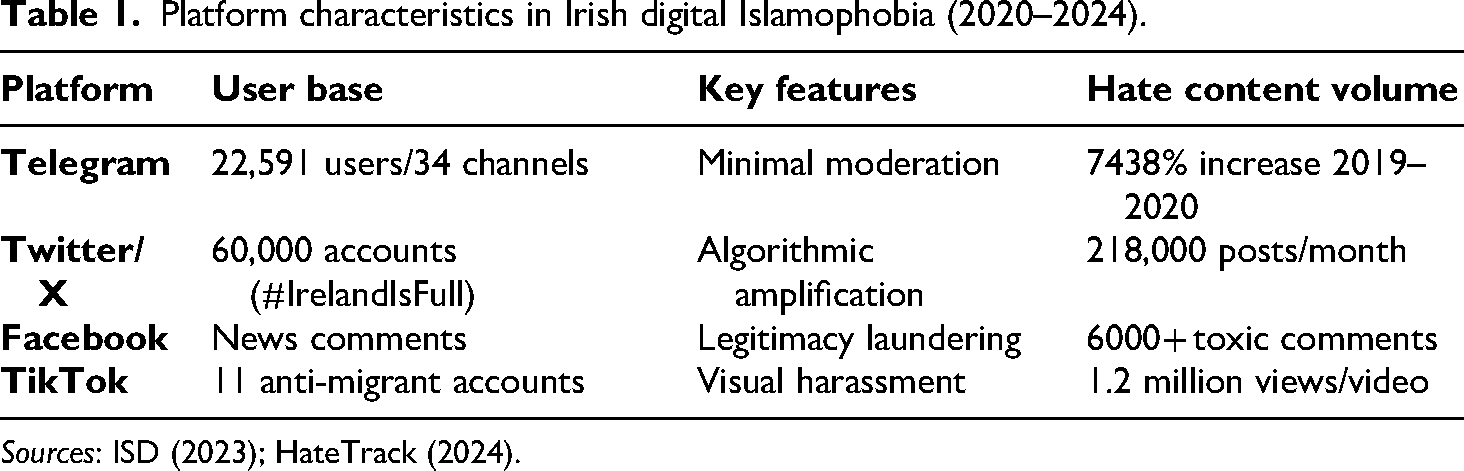
Sources: ISD (2023); HateTrack (2024).
Gendered hypervisibility
Muslim women experience double the targeting rates of men, with hijab serving as ‘primary identifier’ (Ryan and Carr, 2024: 409). TikTok videos show hijabi women confronted publicly, achieving 4000–1.2 million views (Institute for Strategic Dialogue, 2024). This amplifies what participant Dunia experienced: ‘people assuming things about me … based on my name’.
Trigger events and cascades
Three events demonstrate escalating impact: COVID-19 (2020-2021): 334 hate incidents recorded, creating “epistemological vulnerability” exploited by far-right networks (Michael, 2021). Gaza Conflict (October 2023): 422% global increase in anti-Muslim language affecting Ireland (EU FRA, 2024). Dublin Riots (November 2023): Timeline reveals digital acceleration—30 min from incident to false “Islamist terrorism” claims, mobilizing 200 demonstrators within 4 hours, causing €20 million damage (Gallagher and O’Brien, 2024).
Traditional-digital nexus
HateTrack analysis of 5725 news comments found articles about Muslims generate racism ‘irrespective of context’ (DCU, 2024). Sensationalist headlines provide material for extremist amplification, creating ‘legitimacy laundering’ – extreme content appearing normalised through mainstream platforms. This validates Adil's prediction: ‘Media highlights always the sensational … there is a rise of Islamophobia’.
Material consequences
Hate crimes increased 51% (448 in 2021 to 676 in 2024), yet only 20% are reported to police (INAR, 2024). The February 2024 assault on Sheikh al-Qadri demonstrated the continuum: physical attack followed by online denial campaigns garnering thousands of views. This validates Tasmina's 2015 observation: ‘if I receive abuse … I don't take offence anymore because it's become the norm’.
Theoretical implications
Digital platforms transform rather than replace agenda-setting. Where McCombs and Shaw assumed scarce channels, contemporary ‘attention economies’ feature algorithmic curation replacing editorial selection and pseudo-participation masking coordinated campaigns (McCombs and Shaw, 1972; Tufekci, 2017). Our participants’ media critiques prove prescient – the same 50 accounts creating artificial consensus validates Ibrahim's observation about repetition: ‘seen the news a hundred times Muslims equal terrorist’.
Enforcement failures
Despite Dublin hosting Meta, Google, and Twitter/X headquarters, platform enforcement remains inconsistent. Conviction rates under hate speech legislation: 11.4% (five convictions from 44 prosecutions, 2000–2024). This creates ‘permission structures’ enabling continued harassment (Courts Service, 2024).
The evolution from traditional to digital Islamophobia represents intensification, not rupture. Processes our participants identified – agenda-setting, sensationalism, othering – now operate through algorithmic amplification and coordinated networks. Small groups masquerade as grassroots movements while traditional media provides raw material for digital hate. Future research must examine how Muslim communities develop ‘resistant capital’ in digital spaces (Yosso, 2005). Our 2015 baseline captures the threshold moment before current crises, providing essential context for understanding how contemporary hostility emerged from patterns participants presciently identified.
Networked Islamophobia and audience agency
The transformation from traditional media Islamophobia to networked digital hate represents not rupture but intensification. The same processes our participants identified in 2015 – agenda-setting, sensationalism, othering – now operate through algorithmic amplification, platform affordances, and coordinated networks. Yet audiences retain agency. As 90% of people reporting incidents included information about negative psychological impact (Ewart et al., 2017). Muslim communities continue critically engaging with and resisting these representations (Ewart et al., 2017).
Australian scholarship on Muslim media experiences provides instructive comparative insights that illuminate the distinctive features of the Irish context. Both Ireland and Australia present anglophone settler societies with predominantly white, Christian-heritage majorities where Muslims navigate minority status amid varying degrees of multicultural policy frameworks (Ibid.). However, significant demographic and historical differences shape divergent audience experiences. Australia's Muslim population of approximately 604,000 (2.6% of population) dwarfs Ireland's 81,930 (1.6%), potentially offering greater community resources for media resistance and counter-narrative production (Australian Bureau of Statistics, 2022; CSO, 2023).
Kabir's findings that Australian Muslim youth perceive media as ‘one-sided’ mirrors our participants’ critiques of agenda-setting and sensationalism (Kabir 2008). Yet the Australian context benefits from longer-established Muslim communities and more developed ethnic media infrastructure, as Ewart et al. note in their survey of 113 Australian Muslims who reported accessing diverse alternative media sources unavailable to Irish Muslims (Ewart et al., 2017). Giotis's recent analysis of Australian Muslim women's digital ‘fightback’ against right-wing media demonstrates organised resistance strategies that remain nascent in Ireland's smaller community (Giotis, 2021). While Australian Muslim women created coordinated social media campaigns and alternative platforms, our Irish participants described more individualised ‘defensive media literacy’ responses. This difference may reflect not only population disparities but also Australia's more developed multiculturalism framework versus Ireland's recent and rapid demographic transformation. Nevertheless, both contexts reveal how Muslim audiences in white-majority anglophone societies must navigate what Rane and Ewart (2013) term the ‘double bind’ of being simultaneously hyper visible yet voiceless in mainstream media.
The implications extend beyond individual platforms or incidents. As Wacquant argues, understanding contemporary racism requires examining the ‘institutional matrix’ that produces and reproduces inequality (Wacquant, 2008). In Ireland's case, this matrix includes: Traditional media that provides raw material for digital amplification Platforms that profit from engagement regardless of harm Legislative frameworks inadequate to digital acceleration Small coordinated networks masquerading as popular sentiment
Future research must examine how Muslim communities navigate these digital landscapes, developing what Yosso (2005) calls ‘resistant capital’ – the knowledge and skills cultivated to oppose inequality. Our 2015 participants demonstrated such resistance through critical media literacy. Understanding how these strategies have evolved in response to platformed racism remains crucial for developing effective interventions.
Conclusion: Muslim audiences in Ireland's media ecology
According to Ahmad (2006) ‘the need for critical self-reflection and responsibility on the part of the media is more urgent than ever’; but this self-reflection cannot happen in a vacuum. The value in audience research studies cannot be overstated in aiding this process. The ability for audience members to speak of their perspective on media reportage and the realities impacted most by such reports is of immense importance. The manner in which media report on topics and communities has a profound impact on feelings of marginalisation and exclusion while also legitimising, for some, lived experiences of hostility and discrimination. Media are not the only source of racializing discourses; nor do all media outlets engage in their dissemination. However, the role the media play in informing the public ‘common sense’ about the ‘Other’ should not be underestimated. Neither should the ability for audience members to critically engage in the reception of media texts. The findings presented here evidence the way audience members critically read media texts and make sense of what they are being told is true; they are not simply dupes subject to media effects.
While international scholarship has extensively documented media representations of Muslims, this study makes distinct theoretical and empirical contributions through its focus on Muslim audiences as critical interpreters within Ireland's specific media ecology. Our findings challenge the ‘effects’ paradigm that positions audiences as ‘passive victims … ideological dupes of transnational media corporations’, instead revealing sophisticated media literacy among Irish Muslims who actively decode and resist racialising narratives (Gillespie, 2006: 910).
The Irish case demonstrates how audience criticality develops within particular structural conditions. Unlike Muslim communities in Britain or France – with populations of 3.9 million and 5.7 million respectively – Ireland's 81,930 Muslims (1.6% of population) navigate visibility as a ‘hyperminority’ (Carr, 2016b). This demographic reality shapes distinctive audience experiences. As participant X noted: ‘I have to go over again and again saying I'm not representing some groups … How do you represent a group that you're not that connected to…’. 2 This forced representativeness, emerging from small community size, creates unique pressures absent in larger Muslim populations.
Our participants demonstrate what we term ‘defensive media literacy’ – a specific form of critical engagement developed in response to persistent misrepresentation. This extends Hall's encoding/decoding model by revealing how marginalised audiences develop interpretive strategies not just to resist dominant readings, but to protect psychological wellbeing (Hall, 1980). Tasmina's observation – ‘I don't really take offence anymore because it's become the norm’ – represents not passive acceptance but active psychological defence against relentless othering. This defensive literacy constitutes a form of what Yosso (2005) calls ‘resistant capital’, though developed under conditions of extreme symbolic violence.
Ireland's hybrid media landscape: Post-colonial echoes and transnational flows
Ireland's media ecosystem presents unique characteristics that shape Muslim audience experiences differently than in former imperial powers. The persistence of British media consumption – with U.K. newspapers maintaining significant Irish readership and BBC/Sky News commanding substantial viewership – creates what we identify as ‘cascading othering’. Irish Muslims face racialising narratives designed for British audiences but consumed in Ireland, where Muslims lack the demographic weight to challenge these representations effectively.
This transnational media flow intersects with Ireland's post-colonial positioning to create distinctive dynamics. Unlike Britain or France, where Muslim populations largely derive from former colonies, Ireland's Muslims come from 51 different nationalities without colonial relationships to Ireland. This absence of historical obligation narratives (the ‘we are here because you were there’ framework available in other contexts) leaves Irish Muslims particularly vulnerable to ‘undeserving outsider’ constructions.
The ‘double standards’ participants identified acquire specific meaning in Ireland's context. When Mona contrasted coverage of ‘children killed in Peshawar’ with ‘Boston bombing, the Charlie Hebdo, the 9/11’, she highlighted how Irish media, despite Ireland's own colonial history and contemporary neutrality, reproduces imperial hierarchies of grievability. This contradiction – post-colonial nation reproducing colonial media frames – demonstrates what Hage (2017) calls ‘white colonial continuity’ operating through media rather than direct governance.
Implications: Beyond recognition to transformation
Our findings extend beyond documenting problems to revealing how Muslim audiences in Ireland develop agency despite structural constraints. Participants’ critical media literacy, their recognition of agenda-setting, their analysis of double standards – these demonstrate sophisticated understanding that challenges deficit models positioning minorities as requiring education about discrimination they experience daily.
The Irish case demonstrates how mediated Islamophobia operates even in contexts without significant Muslim populations, colonial relationships with Muslim-majority countries, or historical Christian-Muslim conflicts. This suggests that contemporary Islamophobia functions as what Tyrer (2013) calls ‘floating signifier’, attaching to Muslim bodies regardless of local specifics. Yet our participants’ responses reveal this is not totalising – Muslim audiences actively resist, reinterpret, and survive within hostile media environments. Future research should build upon these findings through longitudinal investigation of evolving audience responses. As Rane and Ewart demonstrated through their comparative analysis of Australian Muslim responses 10 years after 9/11, temporal perspectives reveal how communities develop increasingly sophisticated media literacy and resistance strategies (Rane and Ewart, 2013). Such research would illuminate whether Ireland's Muslim communities follow similar trajectories to their Australian counterparts in developing organised counter-narratives, or whether Ireland's specific post-colonial context and smaller demographic base produce distinctive patterns of audience agency.
Understanding these dynamics in Ireland – where Muslims navigate hypervisibility as hyperminority, where post-colonial history doesn't prevent colonial media frames, where small numbers amplify rather than diminish scrutiny – provides crucial insights for anti-racist media practice. Our participants’ perspectives, captured at a pivotal moment, offer not just critique but foundations for transformation. As Ibrahim observed: ‘It's just the way it's been flashed in front of their faces for so long’. Changing this requires recognising Muslim audiences not as passive victims but as critical analysts whose perspectives should inform media reform.
Footnotes
Ethical approval
Qualitative research carried out for the Irish Human Rights and Equality Commission (2015) with ethical approval to standards/guidelines set by the Irish Sociological Association.
Consent to participate
Informed consent provided in writing by all participants as required by guidelines set by above organisations.
Funding
The research upon which this article is based was funded by the Immigrant Council of Ireland and the Open Society Foundations.
Declaration of conflicting interests
The authors declared no potential conflicts of interest with respect to the research, authorship, and/or publication of this article.
