






Abstract
The tree of bixad (suffering) in the Kesajaan tea plantation stands as a powerful symbol of both the cultural memory of struggle and resistance. This representation emerges from complex cultural formations and the historical relationship between colonial powers and plantation labourers. The construction of cultural memory illuminates a specific modality of power relations that persists into postcolonial times. This article examines how these cultural memories evolved into forms of resistance politics that challenge the plantation authorities. The tree holds profound cultural significance for the residents of the Kesajaan plantation. According to the residents, during the colonial period, the punishment inflicted on labourers by planters sometimes resulted in death, and the deceased were subsequently to have transformed into ghostly entities. In contemporary times, residents categorise these dead as protective guardians of the plantation. This article further explores how plantation residents maintain cultural memories of colonial and postcolonial violence through ghostly entities. Through this examination, my central argument emphasises the importance of recognising these previously undocumented cultural memories and their role in shaping resistance politics.
Introduction
Southern trees bear a strange fruit, Blood on the leaves and Blood at the roots.
Black bodies swinging in the southern breeze, strange fruit hanging from the poplar trees. 1
‘Strange Fruit’ powerfully chronicles the horrific history of African American lynchings, using the metaphor of strange fruit hanging from trees to represent the victims of racial violence within and beyond the plantations. The song stands as a haunting testament to the racial violence perpetrated by white supremacists against African American plantation labourers. Throughout this history, the trees emerge as perhaps the most potent symbol of trauma and violence in the African American experience. James H. Cone (2011) examines trees as embodiments of racial oppression in America, beginning his analysis with a personal connection to Arkansas, which he characterises as a ‘lynching state’. Similarly, Jared Farmer (2019) investigates America's trees as repositories of painful histories that scholarly discourse has often overlooked or marginalised. Both Cone and Farmer theorise plantations as spaces of racialised violence, where trees function not merely as elements of the landscape but as material and symbolic repositories of historical trauma. While their analyses emerge from the context of slavery and racial violence in the United States, they also offer a scholarly framework for examining different plantation worlds shaped by colonial exploitation and coerced labour. Extending this line of inquiry to the context of Assam's tea plantations, this article examines the tree of bixad (suffering) as a symbol through which histories of violence, suffering, and resistance are remembered and articulated. It further demonstrates how such symbols provide a nuanced understanding of collective memory and resistance.
In the Kesajaan
2
tea plantation, the tree of bixad functions both as a witness to the torture endured by adivasi
3
labourers and as a symbol of their resistance against plantation authorities. This dual symbolism of suffering and resistance emerges from the cultural formations and power dynamics established between colonial authorities and plantation workers. In the purona (old) labour lines of the plantation, residents described the tree as embodying both plantation violence and collective resistance. Kamala Majhi,
4
a woman aged 79, whose family has lived in the labour lines for three generations, explained the tree's significance in the following words: The tree knows our pain. It has seen everything: the beatings, the deaths, the tears. Now it protects us. Even the manager sahib does not come near this tree alone.
5
The article is organised as follows: the ‘The tree of bixad and the labour lines’ section examines how the tree of bixad, situated in the old labour lines of the Kesajaan plantation, acquires historical significance as a site of suffering and resistance. The ‘Theoretical context: Cultural memory, trauma, and ghostly matters’ section engages with theoretical scholarship on cultural memory, historical trauma, and ghostly presences, exploring the ways in which marginalised communities narrate and embody historical violence through spectral forms. The ‘Research methods’ section outlines research methods, detailing fieldwork approaches used to document previously undocumented narratives of plantation violence and collective memory. The ‘Cultural memories and narratives of the adivasi “past” and “present”’ section analyses cultural memories and narratives of the adivasi past and present, examining how residents of the Kesajaan plantation construct historical consciousness through oral accounts and everyday practices. The ‘The postcolonial tea plantations: Violence, ghosts, and haunting in the Kesajaan tea plantation’ section focuses on the postcolonial tea plantation as a site of violence, ghosts, and haunting, demonstrating how the tree of bixad illuminates both the persistence of colonial power dynamics and residents’ ongoing strategies of resistance.
The tree of bixad and the labour lines
The tree of bixad is situated in the purona (old) labour lines of Kesajaan plantation, occupying a space that reveals the entrenched spatial hierarchies of plantation life. Although introduced earlier as a site of suffering, haunting, and resistance, the tree's significance becomes clearer when situated within the wider geography of the plantation. Upon entering the plantation, one encounters a carefully orchestrated geography of power that reflects both colonial legacies and contemporary adaptations. The tea factory stands as the first and most prominent structure, commanding immediate attention as the economic lifeline of the plantation. The manager's bungalow occupies an elevated position both literally and symbolically within the plantation landscape. Built during the colonial era, this sprawling single-story structure is characterised by its sloping roof and wide verandas. 6 The colonial image of the sahib astride his horse, whip in hand, has evolved into the postcolonial sahib navigating the plantation in his jeep, surrounded by a retinue of domestic staff who maintain his household and facilitate his authority. The contemporary sahibs present themselves as mai-baap, a benevolent ‘mother-father’ figure that positions patronage and paternalism as the organising logic of plantation life. As Borah and Robinson (2021) argue, this mai-baap figure fundamentally shapes the identity and practices of postcolonial planters in Assam, allowing them to justify hierarchical control while simultaneously claiming responsibility for workers’ welfare. Such an identity captures how the postcolonial manager has adapted, rather than abandoned, the colonial sahib figure; the whip and horse have been replaced by the jeep and rhetoric of welfare, but the fundamental structure of domination through paternalism remains intact.
The labour lines occupy the geographical and social periphery of the plantation, deliberately positioned at its margins. This arrangement reflects the social stratification of the colonial plantation: the factory as the site of capital accumulation, the manager's residence as the seat of colonial control, and the labour lines as zones of containment for the indentured workforce (Chatterjee, 2001). The journey from the manager's bungalow to the labour lines involves a noticeable transition: paved roads give way to dirt paths, manicured gardens yield to cramped quarters, and the spacious colonial architecture to the modest single-room dwellings. At the Kesajaan plantation, these single-room houses, constructed in long rows with shared walls, were designed to provide minimal shelter while ensuring that workers maintained their daily productivity. The labour lines were not merely residential quarters but an entire spatial and temporal system designed to maximise productivity while minimising worker autonomy. They consisted of elongated rows of identical single- or two-room structures, typically measuring 10 to 15 feet by 10 feet, built in rigid geometric patterns on the plantation's periphery. Each structure housed an entire family, with workers, spouses, and children crowded into spaces with minimal ventilation, a single door, and perhaps one small window.
The term ‘labour lines’ refers not simply to housing, but to a segregated social world created by plantation management to organise, monitor, and discipline labour. Historically, these lines emerged as part of the plantation's colonial infrastructure, where workers were settled in tightly controlled spaces separated from managerial bungalows and factory areas. Sarah Besky's (2017) analysis of plantation housing may be applied to the Kesajaan context, where labour accommodation functioned less as a dignified living space and more as an instrument of plantation management designed to sustain and regulate the labour force. The arrangement of the labour lines made workers permanently available for plantation work while simultaneously restricting mobility and reinforcing hierarchies of race, class, and authority (Kaur, 2014). Even after the end of formal colonial rule, the labour lines continued to structure everyday life through inherited patterns of dependency, surveillance, and economic control. It is equally important to understand how the labour lines functioned in everyday life at the Kesajaan plantation. Workers’ days began before dawn, around 5 a.m., with the sounding of a bell or siren from the factory. Women and men filed out to the plantation in organised groups, returning 10 to 12 hours later, often in darkness. Within these labour lines, residents engaged in multiple forms of labour: women worked as tea pickers, moving through the gardens in organised groups; men worked as pruners, weeders, and factory labourers; and some residents took on additional work as housekeeping staff, cooks, or domestic staff in the manager's bungalow.
Within this spatial hierarchy, the tree of bixad emerges as a potent entity that disrupts conventional power relations. Unlike other plantation landmarks that reinforce hierarchical structures, this tree serves as a site through which residents negotiate with and resist plantation authorities. The tree's significance transcends its physical presence; in the words of residents, it functions as the most important entity within the labour lines. While the manager's bungalow stands as an enduring symbol of colonial authority and managerial control, the tree embodies a fundamentally different relationship to power and place. Similarly, although the tea factory represents the industrial heart of plantation production and economic extraction, the tree operates according to entirely different logics of meaning-making. The tree's significance lies not merely in its capacity to preserve painful cultural memories but in its ability to anchor alternative forms of memory that challenge dominant plantation authority. These counter-memories are rooted in workers’ lived experiences and collective practices. Through its role as a repository of community knowledge and resistance, the tree articulates a politics of memory that prioritises solidarity and resistance over the commemoration of colonial and postcolonial forms of exclusion (Figure 1).
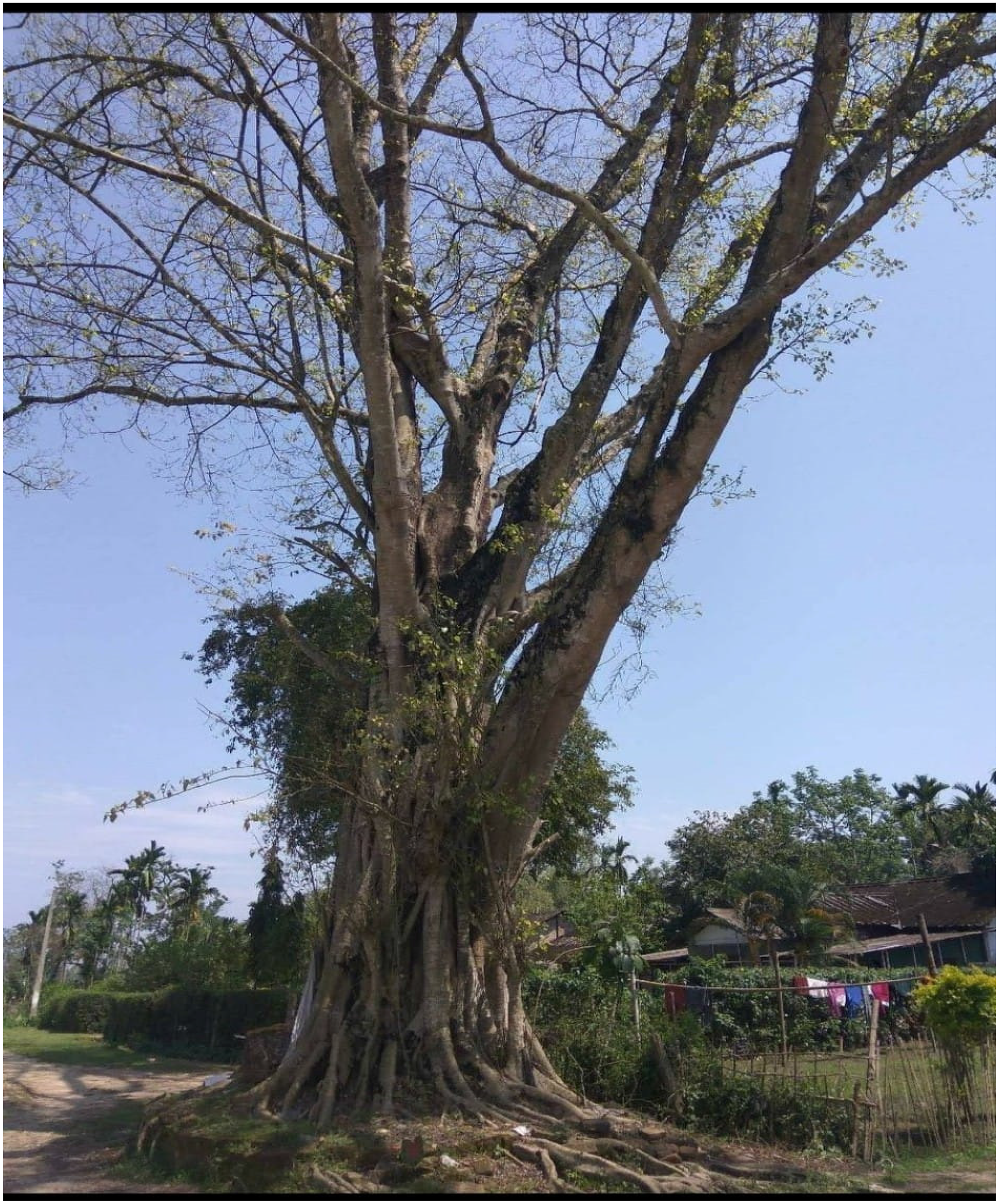
Bixador gos (The tree of suffering) in the Kesajaan tea plantation, it is a jori gos, a species of the Fig tree (photographed by the author on 12 August 2021).
During my fieldwork, I encountered numerous narratives concerning the tree's protective powers. Residents described the tree as a living witness to the brutalities of plantation life, particularly the violence inflicted during the colonial period. Over time, those who suffered and died became associated with the tree. These spirits are not regarded as malevolent presences; rather, they are understood as protective guardians who continue to watch over the labour lines and unsettle plantation authority. Kamala Majhi
7
spent her working life as a tea picker, a position she held for over 50 years until her body could no longer sustain the demanding work of plucking leaves in the gardens. Her mother had also worked as a tea picker on the same plantation, as had her grandmother before her, reflecting a lineage of labour that reveals the intergenerational continuity of plantation work. She said: The sahibs may control the plantation work, but this tree belongs to us because it carries the voices of those who suffered here. When we gather near the tree and speak about the past, the sahibs become uneasy because they know we have not forgotten what happened to our people.
8
The dynamics of violence, resistance, and trauma may be situated within the broader plantation literature on South Asian. Plantations in South Asia, established during the nineteenth and twentieth centuries, precipitated extensive labour migrations to satisfy the demands of capitalist production and profit maximisation (Breman, 1989; Guha, 2006; Jayawardena, 1985). These extractive systems frequently relied upon coercive labour recruitment practices, including indentured servitude and forced conscription of workers from marginalised communities (Chatterjee, 2001; Sharma, 2011). Tea plantations in Assam developed in the nineteenth century. According to Sharma (2006), the Europeans identified the plantations as sites of empire and tea as a commodity of desire and luxury. The colonial project depended upon the recruitment of suitable coolies, 9 commonly referred to as tea coolies within colonial vocabulary. The suitable coolies were the adivasi communities from Bengal, Orissa, Chota Nagpur, the United Provinces, the Central Provinces, Nepal and even as far as Madras and Bombay. Low wage rates and high profits encouraged European planters to invest further in the tea industry, contributing to its rapid expansion. The history of the planters’ brutality and repression has been repeatedly mentioned in the social history of Assam. Earlier studies examined the colonial plantation economy and the combination of authoritarian and coercive power exercised by planters (Behal, 2014; Bhowmik, 1996; Das Gupta, 1992; Guha, 2006; Varma, 2017). However, these studies were largely confined to the colonial period, leaving research on post-independence and contemporary plantation politics comparatively underdeveloped. Plantations are spaces of constant transformation and negotiation between regional political processes and broader structures of power. They evolve through histories of colonialism, migration, assimilation, and contestation, all of which continue to shape plantation societies and identities. This article examines the cultural memories of Adivasi communities that have transformed the tree of bixad into a potent symbol of resistance within the plantation. These narratives reflect the complex cultural formations that emerged from the power dynamics between colonial authorities and plantation labourers – dynamics that continue to persist, albeit in modified forms, within the postcolonial context.
Theoretical context: Cultural memory, trauma, and ghostly matters
Cultural memory represents a specific dimension of community life that transmits shared understanding to the future generations. Paul Connerton (1889) explores cultural memory as an ‘act of transfer’ (p. 39). This process of transfer occurs when present generations actively establish individual and collective identities through the recollection of a shared past. Jan Assmann (1995) suggests that cultural memory maintains ‘the store of knowledge from which a group derives an awareness of its unity and peculiarity’ (p. 130). The intersection of collective memory and collective trauma has emerged as a critical framework for understanding how communities process and transmit experiences of violence, displacement, and marginalisation across generations. Collective memory, conceptualised as the shared pool of knowledge and information held by a group (Halbwachs, 1992), becomes particularly significant when examining how traumatic events are remembered, narrated, and integrated into group identity. Cultural memories of trauma and violence significantly shape social and political identities in South Asia by influencing narratives, group cohesion and political mobilisation (Hanif and Ullah, 2018). These memories are not merely reflections of the past; they actively construct present identities and future aspirations, often becoming politicised in the process (Robben and Suarez-Orozco, 2000). Cultural memory thus serves as a framework through which societies remember and interpret past traumas, establishing continuity between past, present and future (Eyerman et al., 2011).
Building on this theoretical foundation, the transmission of collective trauma operates through various mechanisms, including embodied memory practices, oral narratives, and symbolic representations, enabling communities to maintain a connection to past experiences while negotiating present realities (Faber, 2005; Hirsch, 2012). Contemporary trauma studies emphasise that collective memory is not merely a passive repository of past events but an active process of meaning-making that shapes group identity and resistance strategies (Caruth, 1996; LaCapra, 2014). Indigenous and postcolonial contexts have provided particularly rich sites for examining how collective trauma becomes embedded in cultural practices and symbols, with communities developing sophisticated mechanisms for processing historical violence while maintaining cultural continuity (Visweswaran, 1994). In South Asia, this process fosters a shared identity among communities, as seen in the Tamil community in Sri Lanka, where cultural memories of ethnic violence have galvanised a renewed sense of identity and purpose (Ramanathapillai, 2006). Further, cultural memory plays a crucial role in shaping identity and resistance politics by fostering solidarity among marginalised communities. Madhu Parmar (2020) argues that memory is essential for understanding and explaining human relations, interactions, and identity formations. Niro Kandasamy (2021) explains how cultural memory manifests through various forms of activism, storytelling, and the reclamation of historical narratives, all of which challenge dominant power structures and promote social justice. Cultural memory therefore encompasses a body of reusable texts, images, narratives, folklore, and ritual practices specific to particular societies and historical periods.
These theoretical insights are further substantiated by contemporary scholarship in South Asia, which demonstrates that cultural memory functions both as a process of meaning-making and as a mechanism of community-survival in contexts of historical trauma. Soibam Haripriya establishes memory as an active process, arguing that ‘there is no past that exists at all without the act of remembering’ (Haripriya, 2020: 76). This framework illuminates how marginalised communities transform traumatic experiences into collective identity and resistance. Rowena Robinson demonstrates how ‘painful memories of communal riots link with life trajectories’, thereby revealing memory's enduring influence on identity formation (Robinson, 2005: 61). Her focus on Muslim women further reveals the gendered dimensions of traumatic memory. Jabeen Yasmeen's study of the 1983 Nellie massacre illustrates the political dimensions of memory by documenting how survivors preserve intimate details, such as ‘the memory of the last meal together’, transforming individual loss into collective remembrance (Yasmeen, 2020: 20). The massacre occurred during the Assam Movement (1979–1985) against the so-called ‘illegal immigrants’, demonstrating how communal violence emerges from contested identities. Together, these perspectives converge in understanding memory as a dynamic force that enables marginalised communities to construct meaning, maintain identity, and mobilise resistance against structural oppression.
However, despite extensive studies on South Asian plantation contexts, scholarship on cultural memory and trauma within plantations remains significantly underexplored. This article addresses this critical lacuna by examining how cultural memory operates as a constitutive force in both identity formation and the development of resistance politics. Through this analysis, the article demonstrates how traumatic experiences become embedded within collective consciousness, subsequently shaping group identities and informing political strategies that challenge dominant plantation hierarchies. The article further examines the tree of bixad and ghost stories as emergent sources of resistance within Kesajaan tea plantations, while simultaneously functioning as mechanisms through which hegemonic plantation power structures are contested. Ghost stories and cultural memory play a crucial role in preserving history and identity among marginalised communities by serving as mediums through which fragmented pasts may be reclaimed and reconstructed (Gordon, 2008). 10 According to Matsuoka and Sorenson (2001), the expression of collective trauma and the reconstitution of cultural identities are often disrupted by historical events such as colonisation, slavery, and immigration. They further demonstrate that engaging with ghost stories enables marginalised groups to maintain a connection to their heritage and assert their identity.
While cultural memory and ghostly narratives form a central focus of this article, it also highlights the ongoing struggles of plantation labourers against dominant plantation authorities. By engaging with the dead – whom residents describe as ‘ghosts’ – workers foster a sense of connection with their ancestors. These ancestors become ghostly protectors who play a crucial role in shaping resistance politics. Candi K. Cann (2014) contends that the dead and practices of memorialisation are increasingly disappearing from contemporary society. She examines how grief has become disenfranchised and detached from everyday social life. Cann further argues that grief, mourning, and remembrance can forge unique relationships that allow the living to move forward alongside the dead. Cann (2014) identifies the resurgence of tattoos, bumper stickers on cars and bikes, and memorial clothing as important objects that express ‘afterlife as an extension of life (and denial of death) and the acceptance of death as final’ (p. 130). Vinciane Despret (2021) offers a compelling critique of scientific objectivity in death studies by combining personal narratives with philosophical inquiry into the impact of death on those who remain alive.
Personal accounts and stories are central to Despret's (2021) philosophical investigation into how the dead continue to matter in everyday life. For Despret, the dead remain active participants in the social world even after death. She writes, ‘doing research on the ways the dead come into the lives of the living, in our society, and how they make them act’ (p. 18). Despret argues that the living often fail to recognise the extent to which the dead continue to influence and act within the world. She suggests that the agency of the dead is frequently underestimated, particularly in shaping memory, experience, and forms of guidance in everyday life. The tree of bixad emerges as a compelling parallel to Despret's and Cann's recognition that individuals maintain connections with the deceased through memory, conversation, and ritual. Rather than functioning as a passive object of memory, the tree remains active in shaping the resistance politics of the Kesajaan tea plantation. This dynamic addresses key concerns within plantation scholarship by demonstrating how colonial plantation systems continue to generate ongoing forms of resistance and agency. The article further examines how, through the tree, adivasi communities sustain forms of memory and resistance that persist beyond the control of plantation authorities. The tree serves both as a witness to colonial violence and as an active participant in contemporary resistance, illustrating that plantation landscapes are not merely sites of domination and exploitation. Instead, they are also spaces through which the dead continue to nurture, resist, and challenge structures of power.
Research methods
The article examines the significance of the tree of bixad within the Kesajaan plantation through narratives and collective memory. Primary data were collected through comprehensive 15-month fieldwork at the Kesajaan tea plantation in Tinsukia district, Assam, from July 2021 to September 2022. Assam, located in northeastern India and bordered by Bhutan, Bangladesh, and Myanmar, is one of the world's largest tea-producing regions, contributing over half of India's total tea output. 11 The state's unique geography, characterised by the fertile Brahmaputra River valley, tropical monsoon climate, and rich alluvial soil, creates ideal conditions for cultivating the robust, malty black tea that has made ‘Assam tea’ globally renowned. Tinsukia district, situated in the upper reaches of Assam near the borders with Arunachal Pradesh and Myanmar, represents the easternmost frontier of India's tea belt and serves as an important hub for tea production and cross-border trade. Many of the district's tea gardens, established during British colonial rule in the 19th century, continue to employ thousands of workers, primarily descendants of migrant labourers whose families have worked on these plantations for generations.
This article employs an ethnographic methodology to examine how cultural memory, ghost narratives, and everyday forms of resistance are constructed around the tree of bixad in the Kesajaan tea plantation. Drawing on D. Soyini Madison's (2011) ethnographic approach, the research combines participant observation, semi-structured interviews, focus group discussions, and oral histories to understand how plantation residents narrate historical violence and negotiate contemporary power relations. The study is particularly concerned with how spectral narratives function as practices of collective memory through which adivasi communities articulate experiences of suffering, protection, and resistance within the plantation world. During the fieldwork, I carried out 35 in-depth semi-structured interviews, six focus group discussions, and sustained participant observation. The fieldwork involved in the everyday life of the plantation, including labour routines, community gatherings, informal conversations, and cultural practices through which references to the tree emerged organically. In several instances, however, I positioned myself primarily as a non-participatory observer, observing interactions, rituals, and everyday activities from a distance in order to minimise disruption to community life and allow social interactions to unfold naturally. Following Robert M. Emerson, Rachel I. Fretz, and Linda L. Shaw's (2011) ethnographic approach, I maintained detailed field notes documenting interactions, non-verbal gestures, emotional responses, and the broader social contexts surrounding narratives of the tree.
The article utilised purposive and snowball sampling strategies to identify participants with knowledge of the tree's history and significance. This approach was particularly important because trust and community relationships were central to accessing narratives of cultural memory and ghost stories. Elderly participants frequently directed me toward other residents regarded as important knowledge holders within the labour lines, allowing the research to develop through existing social networks rather than through extractive forms of inquiry. The 35 participants included 12 men and 23 women between the ages of 27 and 80 years. Participants comprised retired plantation labourers, chowkidars (watchmen), tea garden workers, supervisors, domestic workers, and individuals employed in informal sectors such as construction and industrial labour. The generational diversity of participants provided important historical depth to the study. Elderly participants, particularly those between 60 and 79 years, offered accounts of colonial and early postcolonial plantation life and explained how memories associated with the tree were transmitted across generations. Middle-aged participants described the continued relevance of the tree within changing plantation conditions, while younger participants reflected on how such narratives remain meaningful within contemporary social life. Drawing on Margie Lachman's (2004) framework on adulthood helped situate these generational experiences and temporal shifts in cultural memory.
My relationship with the community predates this research and began during my Master's studies several years earlier. Having grown up in the Tinsukia district, I witnessed the social and political marginalisation of adivasi communities, which shaped both my interest in plantation life and my commitment to documenting these narratives. At the same time, this proximity required constant reflexivity regarding my own positionality within existing structures of power and representation. Building long-term relationships within the community was therefore crucial for conducting ethical fieldwork grounded in reciprocity and shared mutual trust rather than short-term extraction. The interviews, which lasted between 60 and 90 minutes, focused on oral histories, ghost stories, labour experiences, and participants’ understandings of the tree's symbolic significance. Interviews were conducted in Sadri 12 and Assamese, audio-recorded with informed consent, and later transcribed and translated for analysis. In addition, six focus group discussions involving six to eight participants each explored collective memories and shared interpretations of the tree's role within plantation life. The combination of interviews, focus groups, and participant observation enabled the study to capture both individual experiences and the collective processes through which cultural memory is produced, negotiated, and sustained around the tree of bixad.
Cultural memories and narratives of the adivasi ‘past’ and ‘present’
In July 2021, I was accompanied by veteran trade unionist Shakila Patnaik,
13
a woman aged 55, who served as both a guide and a research participant. It was a rainy day, as July marks the monsoon season in Assam. As the rain drizzled steadily, Shakila baidew (elder sister in Assamese) paused near a tree situated in the old labour lines and began to share its history and significance, revealing its name bixador gos (tree of bixad). She said: This tree carries many haunting stories; the boga (white) sahibs used to tie our ancestors to this tree and punish them for laziness. They were cruel to us, and some labourers even died because of the harsh treatment. We all came to Assam in search of better living conditions, only to face cruel punishments. Many died inside the plantations because of the harsh working conditions. Such punishment continued even after independence; in many instances, local planters tied labourers to the same tree. Our grandmothers passed these memories on to us. Just imagine living with such painful memories.
14
The tree is not only a site for remembering the painful history, but it also carries stories across the generations. My grandparents and parents laboured in these plantations, and the tree has evolved into a memorial space where our collective past is preserved and honoured.
15
The intergenerational transmission of these memories is particularly evident in the narratives of Tiriki Munda,
16
a 69-year-old plantation worker who has spent three decades engaged in the demanding labour of tea cultivation at Kesajaan plantation. Her husband, having completed his working life, retired from his position as chowkidar, a role that positioned him within the plantation's security hierarchy and granted the family a certain social standing within the worker community. Her son currently works as a driver at the sahib's bungalow. She said, My mother told me many stories about punishment and pain, which I am now purposefully sharing with the next generation. I want the younger generations to know their painful and horrific past so that they can resist the plantation authorities.
17
The present generation continues to resist plantation authorities as long as the memories of pain and suffering remain alive and active.
18
The tree's status as a site of memory becomes most palpable in the everyday practices through which it is encountered and narrated. During one field visit, I observed a small group of women, returning from plucking work in the late afternoon, pause almost instinctively as they approached the bixador gos. Their conversation, which until then had focused on wages and household concerns, shifted noticeably in tone. One of the older women began recounting how her grandmother had warned her never to take the tree for granted. The others listened intently, occasionally interjecting with fragments of stories from their own families; accounts of punishment, bodies restrained, and suffering that resisted articulation. No formal ritual was being performed, yet the simple act of stopping, recalling, and collectively inhabiting this narrative moment transformed the site into a lived mnemonic practice. The tree is therefore not simply remembered as a historical site. Rather, it actively produces memory through these embodied pauses and everyday narrative exchanges. The women's actions reveal that memory is neither passive nor static, but continuously created through bodily presence and oral testimony.
The adivasi communities of Assam carry a history spanning more than 150 years of systemic exploitation, racial discrimination, and caste-based violence (Behal, 2014). Despite enduring such prolonged injustice, they have demonstrated remarkable resilience while continuing to assert their cultural and linguistic identities (Das, 2025). Within the Kesajaan plantation, memories of colonial-era punishment remain active within community discourse, functioning not merely as recollections of the past but also as catalysts for contemporary resistance. As Rothe and Salas (2001: 5) observe, ‘narrative is present from beginning to end, providing the framework through which experiences can be had – as well as come to terms with’. The tree represents a complex narrative assemblage constituted through multiple events, stories, and recollections across generations. It serves both as a repository and as an organising principle of collective memory. During fieldwork, both Tiriki Munda and Shakila Patnaik provided detailed accounts of how memories surrounding the tree have permeated the consciousness of communities across the plantation, reinforcing its significance as a living archive of suffering and resistance.
The postcolonial tea plantations: Violence, ghosts, and haunting in the Kesajaan tea plantation
The extensive scholarship on violence and resistance in postcolonial tea plantations in South Asia reveals a complex interplay among gender, labour, caste, ethnicity, and socio-political dynamics. Mythri Jegathesan's (2019) ethnographic work examines the lives of tea-plucking women and their families as they navigate labour both within and beyond Sri Lankan plantations, providing a nuanced account of their struggles for a dignified life within plantation spaces. Jegathesan's research stands out for its innovative approach in deliberately rejecting what she calls ‘killer stories’ that portray plantation women workers as helpless subjects crushed by oppressive systems or as silent carriers of traditional conformity (Jegathesan, 2019). Instead, she adopts methodologies that foreground their agency, complexity, and strategies of survival. Her feminist ethnographic approach centres on the agency, resistance, and creative survival strategies of plantation workers while never minimising the structural constraints they face. Although labour relations and systems of domination within Assam's tea plantations remain deeply rooted in colonial structures, they continue to perpetuate oppressive paternalistic relationships that shape everyday life. The paternalistic relationship between planters and workers operates through the deeply entrenched concept of mai-baap, a term that extends far beyond its literal translation of ‘mother–father’. Within the plantation context, this concept encapsulates the hierarchical relationship between managers and labourers, functioning both as a cultural idiom and as a structural mechanism of control. The mai-baap relationship creates a framework in which authority is legitimised through familial metaphors, positioning the planter and manager as a benevolent patriarch responsible for the welfare of dependent workers, while simultaneously obscuring the exploitative nature of labour relations. Rani Topno,
19
a woman aged 31, explained that the tea plantations continue to operate through mai-baap relationships that sustain colonial-era notions of authority and subordination. Rani herself entered plantation labour at the age of 19, following a trajectory established by her mother, who worked as a daily wage labourer on the same plantation. She told me, The mai-baap is still considered one of the most important person, and the labourers must follow his hukum (orders). If not, he has the power to cut our daily wages and even suspend us for a week or more.
20
Alongside scholarship examining everyday violence and exploitation, several studies have also focused on labour resistance within plantation spaces. These works demonstrate how workers develop strategies to challenge and negotiate systems of domination. Piya Chatterjee (2001) examines ethnographies of everyday resistance among tea labourers, showing how they navigate plantation hierarchies through daily practices and networks of solidarity among women workers. Mythri Jegathesan's (2021) theoretical intervention brings Black feminist analyses of racial capitalism, gendered violence, and plantation temporalities into conversation with South Asian contexts. She demonstrates how optimism and political possibility coexist with structural violence and patriarchy, rejecting the binary between agency and structure that often shapes discussions of plantation labour. By moving beyond this dichotomy, she highlights the complex ways workers navigate and transform conditions of domination while remaining embedded within systems of structural constraint. Upasana Borthakur (2023) examines how women labourers in Assam's tea plantations exercise agency through subtle forms of resistance, including gossip, jokes, name-calling, and foot-dragging. These practices are sustained through collective support and expressed through Jhumur folk songs, which articulate hardship and solidarity while avoiding direct confrontation with plantation authority.
While existing studies of everyday resistance in tea plantations, influenced by James C. Scott's (1990) framework, focus on workers’ negotiations within immediate plantation structures, this article extends the analytical frame beyond the workplace and labour. By examining ghost narratives and the continuing presence of the deceased in plantation memory, it argues that resistance also operates through spectral and cultural forms that transcend the physical and temporal boundaries of plantation labour itself. Ghost stories function as mechanisms that disrupt dominant exclusionary practices and enable critical re-examinations of power, resistance, and agency through alternative perspectives (McEwan, 2008). Shyam Kurmi,
21
a man aged 72, a retired chowkidar, offered a compelling narrative about the tree. He recounted how accidents became commonplace in the old lines, with labourers stating that these incidents were acts of retribution carried out by the deceased. Shyam Kurmi said, For over a century, our community has worked on plantations while managers have constantly cursed us as lazy. Although brutal punishment has ended, management still harasses our workers. The tree has become our protector – management fears crossing the old labour quarters at night. My father spoke of colonial-era accidents in which boga sahibs were injured, and labourers knew ghosts were taking revenge. These spirits do not harm the workers; they are our protectors and heroes. Even today, management avoids our labour lines after dark because they know the spirits watch over us.
22
The ghosts serve as witnesses who refuse to allow plantation violence to be forgotten or normalised. This preservation of cultural memory constitutes a crucial form of resistance that ensures traumatic histories continue to shape contemporary political consciousness and collective action. Vinciane Despret (2021) demonstrates that the interaction between the living and the dead operates as forms of mutual exchange rather than unidirectional communication. She also argues that the deceased play a vital role in the lives of the living by encouraging them to embrace life and resist stagnation. She writes, ‘the stories of the dead are endless stories, deliberately endless, they can always be reopened, begun again’ (Despret, 2021: 26), suggesting that the deceased maintain dynamic rather than static presences that continuously generate new possibilities for the living. Despret positions the dead as ongoing participants in social life. In Kesajaan plantation, the spectral presences function not merely as a memorial to past suffering but as active social actors who continuously remind living workers to persist, resist and maintain hope despite ongoing exploitation. Shyam Kurmi further said, Because of the ghosts, who are also our fellow labourers and protectors, the managers sometimes keep quiet (mone-mone thake); otherwise, they used to dominate the women labourers for a very long time.
23
Research participants explained that these ghosts were once labourers who came to Assam during colonial rule and endured brutal treatment under European planters. Despite such exploitation, they continued to resist the oppressive plantation system, leading planters to tie them to the tree as punishment. This examination of ghostly narratives illuminates complex power dynamics embedded within the tea plantation system. Such understanding of spectral resistance parallels broader patterns of Dalit and adivasi storytelling, which have historically mobilised marginalised communities against dominant social groups (Narayan, 2011; Sharma, 2021). While focusing on ghosts and ghost stories, this article also seeks to foreground the broader dynamics of struggle and resistance within the tea plantation. Ghost stories may be understood within the wider context of plantation politics, particularly the unequal power relations between women labourers and managers. Women labourers constitute the dominant workforce in tea plucking operations and account for more than 50% of the total workforce in Assam's plantations (Borthakur, 2023). Yet, they remain subject to intensive surveillance and control by managers and male supervisors who closely monitor their daily activities (Chatterjee, 2001). The intervention of spectral presences becomes particularly significant within the Kesajaan plantation, as these ghostly entities actively seek to challenge and disrupt the patriarchal norms that structure workplace relations and labour control. During fieldwork, several women spoke about managerial fears surrounding the ghosts. Rosoki Tanti,
24
a woman aged 27, a plantation labourer, said: The sahibs (managers) are afraid of the ghosts. One day, a newly joined sahib shouted at one of our fellow women labourers. That same night, while passing through the old lines, he met with an accident near the tree. We were all surprised. He was admitted to the Garden Hospital. When he returned to work after a week, and learned about the ghost story, he stopped shouting at us.
25
My central argument emphasises the importance of recognising these previously undocumented cultural memories. The spectre of patriarchy and exploitation continues to haunt female plantation labourers; however, through the sharing of ghost stories, they assert themselves as subjects rather than objects within the plantation life. Roskoi Tanti further said, We are grateful to our family members for telling us these stories. They have become part of our daily lives. Even the managers and plantation authorities know about the ghosts, and because of such accidents, they sometimes refrain from shouting at the women workers.
26
The tree of suffering at Kesajaan plantation encapsulates the ongoing colonial relations that continue to structure plantation labour while simultaneously becoming the locus through which adivasi communities assert their own forms of agency and resistance. When a newly appointed manager shouted at a woman labourer, he enacted the routine patriarchal domination that characterises daily plantation hierarchies: a continuation of the coercive authority systems established during the colonial period. Yet that same night, as he passed the old lines, the manager met with an accident near the tree, an incident that Rosoki Tanti and her fellow workers interpreted as a spectral intervention. The manager's subsequent behavioural change – his decision to stop shouting at women workers – reveals how the spectre of the tree's violent history haunts contemporary power relations, making plantation authorities acutely aware that their domination may provoke supernatural consequences. For adivasi communities who have inherited traumatic memories of unnatural deaths at this tree across generations, ghost stories function as a resistance: they encode histories of suffering while simultaneously asserting that ancestral presences continue to mediate labour relations in the present. By transmitting these narratives, women such as Rosoki Tanti and her mother reclaim narrative authority over plantation history and position themselves as subjects who control meaning-making rather than merely as exploited objects of management control.
The tree of suffering embodies cultural and political memory, transmitting the labourers’ struggle across generations. Shakila, Tiriki, and Shyam mediate painful and traumatic memories to future generations, thereby preserving their community's history. Similarly, the ghosts associated with the tree of bixad actively rebel against garden authorities; as labourers said, these spirits exact revenge against the sahibs. Sasanka Perera (2011) examined ghost narratives in post-war southern Sri Lankan villages where residents had directly or indirectly experienced violence. According to Perera, the ‘innocents’ who died violent or unnatural deaths during the conflict were supposed to transform into spirits. He argues that ‘experiences of unnatural and violent death and the narratives of experiences such as ghost stories, have to be understood in the context of a language of incompleteness, suddenness, darkness and endless unfulfilled continuity’ (Perera, 2011: 166). Perera suggests that ghost stories provide survivors with a medium through which grief and traumatic experiences of war may be processed. In this article, the narratives I documented centre on ghosts inhabiting the tree of suffering. These accounts are specifically connected to the exploitative plantation system. Historically subjugated, the adivasi communities within Assam's tea plantations seek connection with their ancestors while simultaneously resisting plantation authorities. It is widely accepted among labourers that the ghosts are the spirits of workers who were executed at the tree. Plantation managers driving through the old labour lines reported hearing screams at night and refused to work during evening hours because of these spectral manifestations. The old line have thus identified as a site of painful memories, with the tree recognised as an instrument of labourers’ torture. These memories and narratives remain significant because exploitation and unnatural deaths continue to be embedded within the collective consciousness of adivasi communities. Tiriki Munda and Shyam Kurmi explained that the tree gradually transformed into a sacred space where ancestors watched over and protected labourers. Such cultural memories empower labourers to resist oppression on their own terms. I argue that these cultural memories of torture and suffering, together with ghost stories and narratives of haunting, are essential in helping adivasi communities negotiate their relationships with powerful plantation authorities.
Conclusion
This article explores how ghosts and the tree of bixad are intertwined with the cultural memory of a tea plantation. Within this setting, spectral presences function as social agents of resistance, shaping power relations between plantation managers and women labourers. The sahibs, aware of the ghosts that watch over and protect the labourers, are unable to subject them to humiliation and abuse with complete impunity. It therefore becomes crucial to understand the conditions under which these ghostly memories have been produced and reproduced over time. Ghosts are not merely supernatural entities but active social actors emerging from histories of oppression and resistance. They function both as reminders of past injustices and as disruptive forces that continue to influence contemporary power structures. During fieldwork, I encountered vivid recollections of pain and exploitation – memories of past events that continue to shape the everyday experiences of labourers in profound ways. Workers articulate these histories of suffering through the symbolic presence of the tree and through ghost stories that honour ancestors killed during colonial rule. In the Kesajaan tea plantation, managerial dominance over labourers remains inseparable from the spectral presence of the plantation's past. The ghostly figures of deceased labourers haunt managers’ imaginations precisely because they exist beyond managerial control. Unlike living workers, who may be disciplined and coerced, ghosts resist authority in intangible and unsettling ways. For the adivasi labourers, these spectral presences are not simply figures of fear but symbols of protection, resistance, and collective memory.
The conceptualisation of ghosts as social actors fundamentally challenges conventional boundaries between the living and the dead, revealing how spectral presences maintain active membership in plantation communities through ongoing relationships with the living workers. Their social agency manifests through their capacity to influence material conditions – preventing managerial authority, causing accidents to supervisors, and creating spaces of protection that alter power dynamics within the plantation. The ghosts, therefore, function as important entities whose presence must be acknowledged and negotiated by both workers and management. Within the Kesajaan tea plantation, ghost stories serve as expressions of both trauma and defiance. These narratives, passed down through generations, represent attempts to seek justice for ancestors who suffered and perished under colonial rule. The memories embedded in these ghost stories do not simply recount past suffering; they actively shape the present by reinforcing collective identities of resistance. The plantation's oppressive history is therefore not forgotten but continually resurrected through spectral memories. The ghost stories of the Kesajaan tea plantation thus function as a counter-hegemonic force, challenging managerial authority while affirming the dignity and agency of plantation labourers.
Footnotes
Acknowledgements
The author sincerely thanks the two anonymous reviewers for their thoughtful and insightful comments, which greatly strengthened and improved the manuscript. The author is also deeply grateful to the editors of the Irish Journal of Sociology for their continued support, encouragement, and guidance throughout the submission and review process. Special thanks are extended to Prof. Rowena Robinson for her invaluable feedback and critical engagement with the formative draft of this article. The author further expresses heartfelt gratitude to all the research participants of the Kesajaan tea plantation, who generously shared their narratives, memories, and lived experiences with remarkable patience, trust, and openness.

Funding
The author received no financial support for the research, authorship, and/or publication of this article.
Declaration of conflicting interests
The author declared no potential conflicts of interest with respect to the research, authorship, and/or publication of this article.