






Abstract
Objectives:
To consider the impact of juvenile Huntington disease (JHD) from a biomedical, symptom burden, and total pain palliative care perspective.
Methods:
This case report was informed by a narrative review of the literature with inclusion of expert opinion from pediatric palliative care, an adult and pediatric neurologist, and a child psychiatrist. Audio-recorded qualitative interview and coauthorship with the pediatric patient’s primary caregiver (his mother).
Results:
The JHD impacts all domains of child and family function.
Significance of Results:
Application of the concept of total pain to JHD informs and guides care for this complex, challenging condition.
Introduction
Huntington disease (HD) is an autosomal dominantly inherited disorder caused by an expansion of the CAG trinucleotide repeat on the gene encoding huntingtin protein. Disease onset most commonly occurs in the fourth to sixth decade of life. Juvenile Huntington disease (JHD), affecting fewer than 10% of all HD diagnosis, is defined as symptom onset occurring before age 20. 1 Symptoms begin subtly with relentless developmental deterioration occurring over years. Due to the JHD impacting musculoskeletal, neurologic, sleep, nutrition, psychiatric, caregiver, and existential domains, the palliative care principles of total pain could be applied in caring for children with JHD. 2
Case Report
Our palliative care team was consulted for “complex pain management” for an animal-loving, football-playing 6-year-old boy. His father had recently died from HD and his half-sister died from JHD. Our patient had insomnia, texture sensitivity intolerant of clothing (would cover in soft blankets only), dysphagia progressing into gastrostomy tube dependence, advancing psychosis with hallucinations, intractable seizures, and painful spasticity. At age 12, family goals with the inclusion of child voice shifted toward comfort care with attentiveness to symptom management and compassionate discontinuation of artificial nutrition.
Care Interventions
Musculoskeletal
The juvenile form of HD is more likely to have rigidity/dystonia, with less chorea (Table 1). Our patient presented with rigid spasticity despite scheduled clonazepam, diazepam, and baclofen with tizanidine available as needed. The extent of hip spasticity required his family to carry him to the bathtub for toileting since his hips were too tight for abduction. Botox injected every 3 months improved hip movement for hygiene ability. Gabapentin and amitriptyline were added for the spasticity-induced neuropathic pain. A baclofen pump was successfully implanted with the goal of decreasing systematic medications to maximize times of relational interaction. By targeting the patient’s spasticity and neuropathic pain in a systematic approach, scheduled opiates were successfully weaned off but available as needed. Passive stretch and massage were the prioritized forms of care.
Symptoms Requiring Treatment in HD Versus JHD and their Common Therapies.
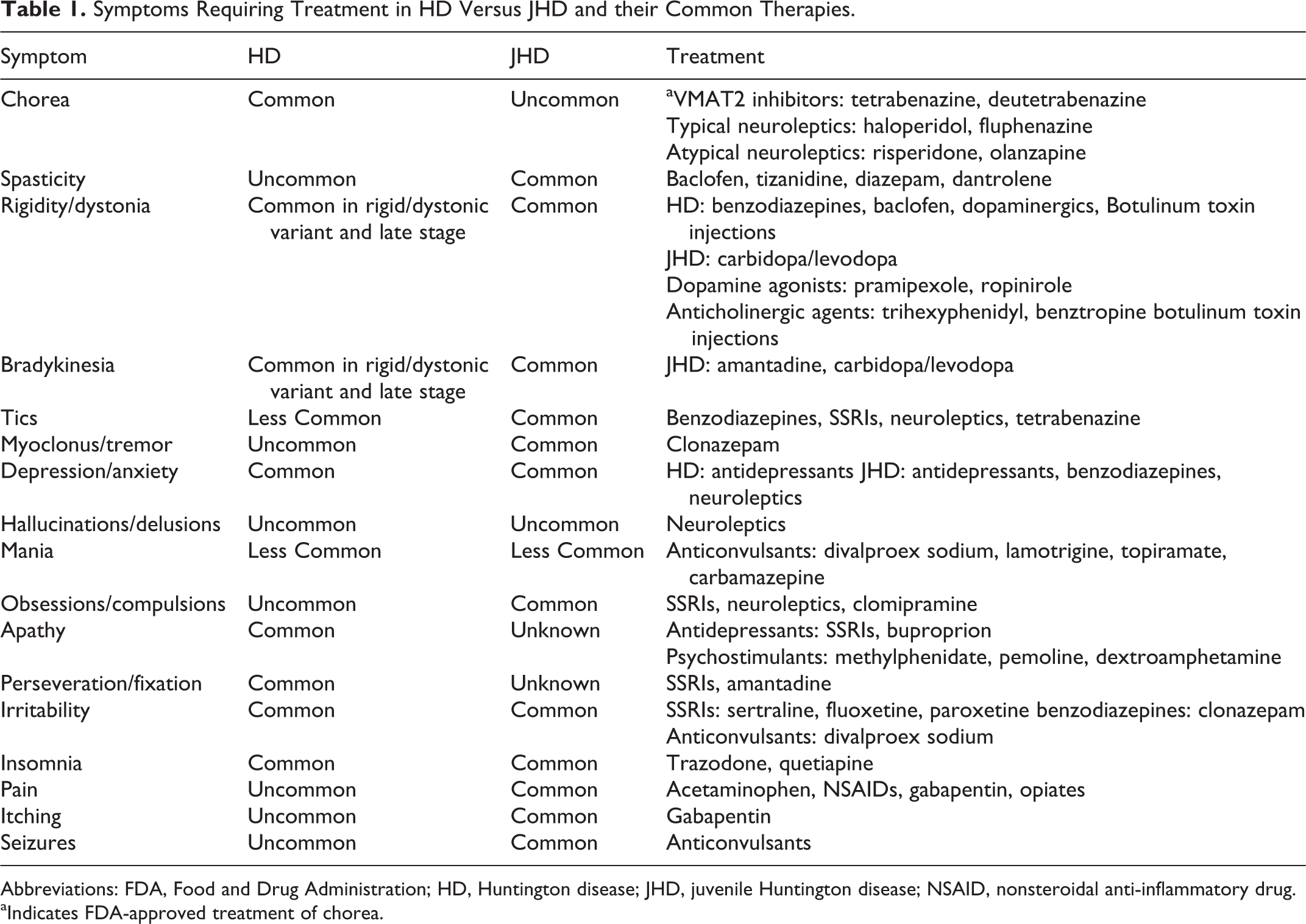
Abbreviations: FDA, Food and Drug Administration; HD, Huntington disease; JHD, juvenile Huntington disease; NSAID, nonsteroidal anti-inflammatory drug.
aIndicates FDA-approved treatment of chorea.
Neurologic and Sleep
The patient experienced intractable pruritis as has been underreported in JHD. 3,4 The itching was not responsive to antihistamines and did not appear to be bile salt related. This neurologically mediated pruritis was most responsive to gabapentin. Grand mal seizures were intractable at the end of life despite therapeutic levels of scheduled phenobarbital, valproic acid, fosphenytoin, lacosamide, and oxcarbazepine. Melatonin was initiated and increased for unrelenting insomnia. Soft music and blue lighting were encouraged.
Nutrition
Feeds transitioned to gastrostomy tube due to dis-coordinated swallowing and aspiration risk. Tastes of favorite flavors remained available. Gut mobility was enhanced with erythromycin scheduled. With transition to comfort care, artificial nutrition and hydration were compassionately discontinued.
Psychiatric
Hallucinations and delusions, common in JHD, 5,6 were initially benign. As hallucinations became more distressing, scary, and frequent, risperidone was initiated and increased. Haloperidol was then available for breakthrough hallucinations and distressing delusions/agitation.
Family Caregiver
Although allocated 90 hours of home nursing per week, only 8 hours were covered due to home health nursing shortage. With history of paternal death from HD, his mother and maternal grandparents served as his primary hands-on caregivers. This required maternal sacrifice of professional identity and finances as she left employment. The child’s mom shared a message of complex care coordination to attend an out-of-state graduation for her other son: “It’s going to take about 25 people helping in order to do what I do every day. Despite 5 days of allowed respite, there are zero providers able to accept my son in our state for his level of respite and so actual professional respite days are not a reality.” The family experienced relationships: “Because people don’t know much about HD, and it scares them, they kind of just start to drift away.…A lot of times it’s just easier for people just to kind of give you their thoughts and prayers and then just not really be around.” Relational abandonment and isolation are common themes in degenerative neurologic conditions in childhood, 7 warranting palliative care team attentiveness to longitudinal therapeutic relationship with patients and families.
Existential
The child’s family does not self-identify as religious but finds spiritual meaning in relationships, caring well for one another, and the universal principles of loving-kindness. Integrative therapies, such as Healing Touch, massage therapy, and aromatherapy were incorporated in the family’s holistic palliative care plan.
Conclusion
Juvenile Huntington disease is a rare and devastating disorder with impact on all life domains for child and family caregivers. 8 When our pediatric palliative care team was introduced to this patient, his monotherapy plan was high-dose scheduled opiates. Early use of targeted delivery systems, such as injecting Botox and implanting a baclofen pump, decreased systemic opiate need. Targeting not just the physical pathways of suffering but the social domains such as tangible caregiver respite and sibling communication needs were essential care interventions. Lack of home nursing coverage compelled our team toward legislative advocacy for improved care for caregiver programs in our state. Attending to bereavement in the setting of 2 prior family deaths from HD and anticipatory grief for this child’s trajectory were necessary in approaching total pain. Early integration of the child’s voice in the form of developmentally informed advance care planning allowed the family to honor the child’s preferences in longitudinal goals of care. The chronic and degenerative nature of JHD afflicts the patient and family with what Dame Cicely Saunders defined as total pain, a suffering that encompasses all of a person’s physical, psychological, social, spiritual, and practical struggles. 2 Without a cure for JHD, palliative care teams have the opportunity for skilled symptom targets and inclusion of total pain principles in this complex condition.
Footnotes
Declaration of Conflicting Interests
The author(s) declared no potential conflicts of interest with respect to the research, authorship, and/or publication of this article.
Funding
The author(s) received no financial support for the research, authorship, and/or publication of this article.
