







Abstract
Background:
In the setting of critical illness, life preservation may come at the expense of limb as increasing concentration of vasopressors causes peripheral ischemia. When goals of care specify comfort measures, clinicians are faced with the difficult task of mitigating already present distal malperfusion while abiding to wishes of patient and patients’ families. Physical changes post vasopressor use, such as mottling of appendages or cooling of skin, can limit meaningful physical interactions with grieving family members.
Case Presentation:
We describe a case series of successful utilization of intravenous nitroglycerin to improve postvasopressor digital ischemia for comfort care measures to assist patient’s families in the grieving process.
Conclusion:
Following decision for comfort care measures, management for patient care goes beyond the realm of pain control. Dignified dying is an active process that requires clinicians to navigate care for both patient and patients’ families. By reversing the digital ischemia associated with vasopressors, patients’ families have the opportunity to give meaningful touch in setting of which it may be needed most.
Background
Caring for the critically ill patient with hemodynamic instability requires the use of vasopressors and inotropic medications. 1 The use of these life-preserving medications does not come without its own adverse effects; increasing vasopressor use causes a dose-dependent digital ischemia and decreased end-organ perfusion. 2 This cost is a necessary evil to preserve life over limb. For the patients who do not recover from their insults or whose management no longer aligns with their goals, the discussion of end-of-life (EOL) treatment prioritizes limb over life. When patients are no longer able to speak for themselves, surrogate decision makers often come in the form of family members. With a limited medical knowledge and the responsibility to make major life decisions, more than two-thirds of family members involved in medical direction experience anxiety and depression. 3 These feelings, which can ultimately affect decision-making capacity, may be exacerbated with any change in patient’s appearance: darkening of skin or mottling of extremities, stiffening of appendages, cooling of the skin. To the general public, these changes may signify physical death, or “rigor mortis,” despite evidence of systemic vasopressor effects. To preserve limbs in EOL care, we present a case series describing the novel use of nitroglycerin (NTG) to mitigate shock-induced skin ischemia at the EOL for palliative support. Nitroglycerin may have a therapeutic role for improving microvascular circulation in appropriate shock states, 4 as it exerts dose-dependent vasodilation of vascular beds by increasing soluble cyclic guanylate monophosphate to mediate smooth muscle cell relaxation. The hemodynamic response to this vasodilator is dose dependent. Intravenous infusion range for NTG for hypertensive management is between 5 and 100 µg/min. At a low dose infusion (5 to 10 µg/min), vasodilator effects reside primarily in the venous capacitance vessels with minimal effect in the arteriolar system. This uniquely selective venodilator has demonstrated some utility in improving impaired tissue perfusion in acute heart failure. In a small sample size of 20 patients suffering from acute heart failure, low-dose NTG infusions improved microvascular perfusion with no significant alternations to cardiac index. 5 Through improving microvascular circulation, limb perfusion can be returned to offer patient’s family members the opportunity to hold their loved ones during a dignified death.
Case Series
Case 1
A 52-year-old female was transferred to our institution after failed percutaneous intervention for an acute myocardial infarction in cardiogenic shock. Lack of myocardial viability precluded her from high-risk surgical revascularization and a lack of social support prevented her from consideration for long-term ventricular assist device implantation. On hospital day 6, she continued to further decompensate requiring inotropic and vasopressor support in addition to reinstitution of invasive mechanical ventilation. An EOL discussion with family members determined no further escalation of care; the goal to transition toward comfort measures would be made after the arrival of all family members.
While waiting for family arrival, the patient’s overall condition progressively worsened to multisystem organ failure (MSOF) with mottled, cyanotic fingers. Within hours, the mottling extended from her hands to involve her bilateral upper extremities. Family members became increasingly more distressed due to the perceived appearance of “rigor mortis.”
In an attempt of decrease the family’s apprehension, NTG was started at 5 µg/min to decrease peripheral vasoconstriction causing this patient’s appearance. In the following 2 hours, mottling decreased while hemodynamics were unchanged. After increasing the NTG infusion to 10 µg/min, mottling and cyanosis resolved and her skin returned to a normal tactile temperature. The remaining family arrived to a patient with a warm, pink appearance; she died without signs of distress hours later (Figure 1).
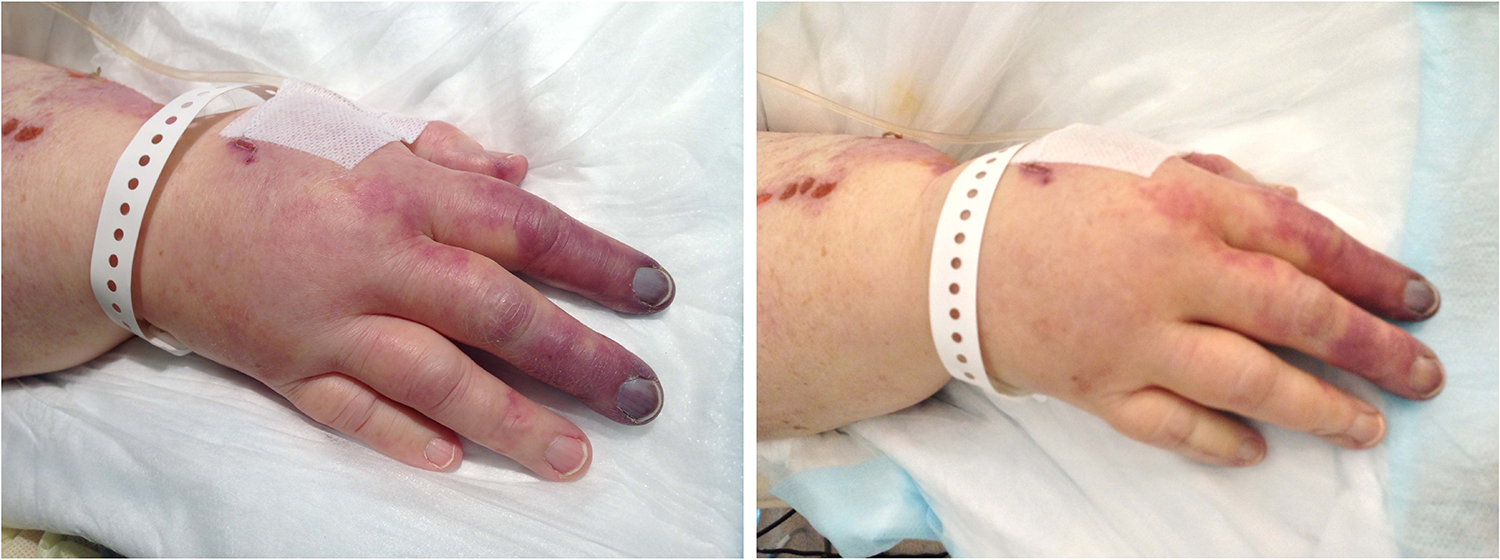
Right hand of patient before initiation of nitroglycerin (left) compared to following initiation of nitroglycerin 10 µg/minute (right).
Case 2
A 69-year-old female was transferred to our institution in cardiogenic shock after aortic valve replacement. The patient arrived in biventricular failure with a right ventricular assist device, in addition to an intra-aortic balloon pump. The patient was further supported with mechanical ventilation, renal replacement therapy, and pharmacological support that included epinephrine, dobutamine, vasopressin, and milrinone.
Despite aggressive therapeutic maneuvers, the patient developed MSOF over the following days. As a result of her ongoing cardiogenic shock and inotrope/vasopressor requirements, the patient developed acute ischemia of the left upper extremity. Radial and ulnar pulses could not be obtained by Doppler ultrasound on hospital day 4. Vascular surgery concluded that this limb would ultimately require amputation. On hospital day 6, her right hand also became cyanotic and mottled, despite confirmation of preserved flow by Doppler ultrasound. On hospital day 7 (postoperative day 8), following recurring family meetings with palliative care, patient care was transitioned to comfort care. The decision was made to start NTG 10 µg/min, as family members repeatedly endorsed distress from the change in the patient’s appearance. The cyanosis of right hand dramatically improved. The patient’s family members were at her bedside during the EOL, with her hand in theirs.
Discussion
As seen in our patients and other patients with shock, skin mottling and digital ischemia are common findings, with an incidence as high as 6.5%. 6 Nitroglycerin has been used for a myriad of reasons in the critically ill, including improving microvascular shutdown in patients with septic shock or mitigating dopamine-induced peripheral ischemia. 5 -7 We applied these pharmacodynamic principles of increasing microcirculatory flow by utilizing the venodilator properties of NTG in our patients with MSOF to successfully induce visible increases in skin perfusion.
The therapeutic intent of the NTG infusion was to decrease our patients’ family subjective perception of death and “rigor mortis” in our patients at the EOL by decreasing signs of malperfusion. Our patients’ families were hesitant to express final sentiments to their loved ones via touch due to the perception of the patient death prior to the state of physiologic death. In a survey of family, physicians, and nurses, when asked the importance of a patient being “touched and hugged by loved ones” at the EOL, this question was more important to physicians and nurses than any other aspect of dying, including control of pain and breathing comfortably. 8
Key factors in managing family distress in the intensive care unit (ICU) and at EOL include communication and symptom management. There is increased awareness of the importance of mitigating family distress at EOL as this reduces the likelihood of affective disorders of the family members after patient death in the ICU. 9 Since touch is not only important to care providers but also families, their voiced concern of “rigor mortis” prompted our decision to institute a palliative treatment to address and mitigate their distress as well as increase the perception of a dignified death. Abating the distorted body image of mottled limbs, and alleviating the feeling of cold extremities by restoring microcirculation, improved the interaction of these families with the patients at the time of death. While this intervention was not intended to change the patient’s outcome, it may provide improved psychological outcomes for family members coping in subsequent weeks to months.
Even when life-prolonging care has ceased, there are still appropriate and necessary medical interventions to accomplish dignified death for both patient and their family members. The shift in care from prioritizing heroic measures to practicing EOL comfort care is a delicate process requiring tact and communication between all care teams. 10 The palliative and ICU care teams bring unique and different approaches to the management of the symptoms. The open communication triangle between the ICU team, palliative team, and the patient’s family allowed the development of a novel yet successful treatment to mitigate perception of pain and discomfort. The importance of communication in optimizing a patient’s care plan at any point in their trajectory cannot be overemphasized.
Footnotes
Declaration of Conflicting Interests
The author(s) declared no potential conflicts of interest with respect to the research, authorship, and/or publication of this article.
Funding
The author(s) received no financial support for the research, authorship, and/or publication of this article.
