







Abstract
This study investigated the effectiveness of a combined academic and personal counselling initiative on student performance and emotional well-being outcomes of 289 at-risk students at a Canadian University. Criterion for risk included academic struggles, mental health distress, or both. The program was developed to be tailored to individual needs, and students participated in weekly counselling sessions over the course of 1 academic year. Results showed significant overall increases in student grade point average (GPA), academic functioning, and mental health well-being, demonstrating the program’s effectiveness in addressing the differential needs of students. Implications of the results are discussed.
Persistently, high drop-out rates in North American universities have kept student retention efforts at the forefront of stakeholder priorities for decades (Bettinger, Boatman, & Long, 2013; DeBerard, Spielmans, & Julka, 2004; Gerdes & Mallinckrodt, 1994; Lau, 2003; Porter, 1990). In Canada, estimates of post-secondary student drop-out rates are at 21% (Shaienks, Gluszynski, & Bayard, 2008). These high rates have important implications for individuals, universities, and for society as a whole. Research indicates that college graduates contribute more financially and consume fewer public services than non-college graduates (Mortenson, 1997; Tinto, 2004). Furthermore, researchers have highlighted the high cost of attending college as well as the high cost of recruitment and potential financial losses for institutions, making successful completion of post-secondary education an important preoccupation for students, parents, educators, administrators, and legislators alike (Araque, Roldán, & Salguero, 2009; DeBerard et al., 2004; Dobele, Gangemi, Kopanidis, & Thomas, 2013; Lau, 2003).
Despite all of these consequences, however, high drop-out rates continue to persist (Bettinger et al., 2013; Kirby & Sharpe, 2001; Porter, 1990), and researchers are calling for further research into developing strategies for retaining students once they have enrolled in post-secondary institutions (Clark & Halpern, 1993; DeBerard et al., 2004).
Factors Related to Student Retention
Theoretical models in the field of student retention have identified the importance of individual factors, coupled with social and academic integration as key ingredients to student performance and retention (Astin, 1993; Bean & Eaton, 2000; Parker, Summerfeldt, Hogan, & Majeski, 2004; Tinto, 1993). It is the complex interplay of both pre-entry characteristics and post-entry experiences that are thought to influence student successful completion of post-secondary education (Finnie, Childs, & Qui, 2010).
Individual factors related to pre-entry characteristics such as age, gender, socioeconomic status, and high school grade point average (GPA) have been found to be associated to student post-secondary retention. Indeed, students who are younger (Araque et al., 2009; Glynn, Sauer, & Miller, 2005), who are female (Glynn et al., 2005; Mills, Heyworth, Rosenwax, Carr, & Rosenberg, 2009), who enter with higher high school GPAs (DeBerard et al., 2004), and whose parents have higher socioeconomic status and education (Araque et al., 2009; Glynn et al., 2005) have been found to be more likely to persist in their post-secondary education. Conversely, students who come from single parent households with poorer family functioning have been found at greater risk of dropping out (Pidcock, Fischer, & Munsch, 2001).
Individual factors related to emotional and social competencies have also been linked to post-secondary persistence after the first year of university. In a study of students transitioning from high school into university, Parker, Hogan, Estabrook, Oke, and Wood (2006) found that students with higher scores on adaptability, stress management, and interpersonal abilities were more likely to persist through their first year of university. These findings align with previous research reporting significantly higher scores of emotional intelligence and social competence for academically successful versus unsuccessful students after their first year of university (Parker, Austin, Hogan, Wood, & Bond, 2005; Parker et al., 2004).
Furthermore, research on individual coping styles and resourcefulness found that individuals who coped with university stress in an active and social way were more likely to stay enrolled (Shields, 2001), while students who felt overwhelmed (Glogowska, Young, & Lockyer, 2007) or had poor coping strategies (Shields, 2001) were at greater risk of dropping out.
There is also growing body of evidence linking student mental health to academic performance and retention (American College Health Association, 2008; Araque et al., 2009; Beiter et al., 2015; Eisenberg, Golberstein, & Hunt, 2009; Stewart, Moffat, Travers, & Cummins, 2015; Turner & Berry, 2000). Indeed, there is a well-documented and significant increase in the number of university and college students suffering from psychological problems (Beiter et al., 2015; Stewart et al., 2015). More specifically, research suggests that more than a third of university and college students are psychologically distressed, with less than a third of this group receiving any form of counselling (American College Health Association, 2008; Eisenberg, Gollust, Golberstein, & Hefner, 2007; Harrar, Affsprung, & Long, 2010). Anxiety and depression are among the most prevalent afflictions plaguing university students (Beiter et al., 2015; Eisenberg, Hunt, & Speer, 2012), and several studies have linked these directly to academic performance and student attrition (Beiter et al., 2015; DeBerard et al., 2004; Eisenberg et al., 2009; Gerdes & Mallinckrodt, 1994; Kumaraswamy, 2013). Although difficulties with mental health can presumably stem from or are augmented by the localized stress of academic pressure to succeed and/or lack of appropriate emotional or coping mechanisms (Kumaraswamy, 2013; Misra & McKean, 2000), it has also been noted that the late onset nature of these disorders coincides with the typical age of entry (late adolescence or early adulthood) into college and university (Eisenberg et al., 2009; Kessler et al., 2005), suggesting this may be a variable worth attending to in programs aimed at student retention.
Individual factors are thought to affect student goal commitment and achievement motivation (Tinto, 1993), which have in turn been linked to post-entry academic and social integration and success rates (Araque et al., 2009; Simon, Aulls, Dedic, Hubbard, & Hall, 2015). Specifically, academic integration markers such as low GPAs and weak academic strategies have been linked to risk of dropping out (Araque et al., 2009; Glynn et al., 2005). Similarly, academic strategies related to executive functioning skills such as time management and organization have been linked to academic success in student self-reports (Stelnicki, Nordstokke, & Saklofske, 2015). Furthermore, research has established clear evidence of a positive relationship between academic performance and retention (DeBerard et al., 2004; Kirby & Sharpe, 2001; McGrath & Braunstein, 1997; Ryland, Riordan, & Brack, 1994). Empirical research into social integration factors has also provided evidence for the importance of social integration for student retention. Specifically, research has linked support from faculty members and fellow students to academic persistence (Baker & Robnett, 2012; Christie, Munro, & Fisher, 2004; Glogowska et al., 2007; Shelton, 2003) and has also linked student use of campus support services to higher rates of academic persistence from first year to second year of post-secondary studies (Mills et al., 2009).
The literature on factors influencing post-secondary retention highlights a multitude of variables that seemingly influence student decisions to persist in their post-secondary studies. Although some research focuses on student ability to integrate academically, others focus on the importance of social support or individual attributes. Out of this body of research on student retention has grown a surge of initiatives aimed at increasing student retention and subsequent graduation. These have mostly taken specific focuses such as mentoring, academic advising, academic support initiatives, and orientation programs (Dobele et al., 2013; Gaughf, Foster, & Williams, 2014; McEvoy, 2012; Saltiel, 2011). Although these initiatives have been found to be somewhat effective in retaining students, their narrow focuses have allowed for only small proportions of outcome variance to be accounted for.
The complex interplay of social, individual, and academic variables leading to student retention highlights the need for colleges and universities to be innovative in their attempts to develop programs that will meet the various needs of students. The literature suggests that there is a wide range of factors that may influence student retention. This suggests that it may be worthwhile for intervention programs to aim a wide spectrum of intervention variables to meet the differential needs of their students. In response to this, the program From Intention to Action (FITA) was developed and piloted at a Canadian university. It aims to help a broad spectrum of vulnerable students bring more stability to their lives as they grapple with life issues and with issues related to integrating into college and university. Although some students succeed in spite of these challenges, many of them require extra support to successfully navigate their experiences in post-secondary studies.
FITA: A Two-Pronged Approach to Increasing Student Retention
The FITA program is a comprehensive and cost-effective approach utilizing graduate students who have completed a year of post-graduate study in counselling to provide a combination of personal and academic counselling to students. The program, which is available at no charge, services vulnerable students who can self-refer and shortly thereafter receive an intake appointment following an email or telephone request.
FITA uses an integrative, eclectic intervention model that, when necessary, combines a more directive advising role within a traditional collaborative counselling model. Along with personal counselling, participants can also be provided with support in implementing learning strategies, coping skills, and healthy lifestyle habits. FITA uses a 12-session model designed as an “intrusive intervention,” which has been found particularly effective in increasing retention and academic performance of at-risk students (Abelman & Molina, 2002; Schwebel, Walburn, Jacobsen, Jerrolds, & Klyce, 2008). Intrusive interventions involve individualized attention and personalized accommodation grounded in a preventive approach and relying on regular one-on-one collaborative sessions. Emphasis is placed on student engagement over time and on accountability. Counselling plans are developed for each student based on individual assessments of student strengths and challenges (Abelman & Molina, 2002; Desjardins & Jie, 2002; Heisserer & Parette, 2002).
FITA has its roots in an academic support program for students with disabilities (Learning Opportunities Task Force Program [LOTF], Ontario, Ministry of Training, Colleges, and Universities), which evidenced its effectiveness by significantly lower failure and drop-out rates compared with the national average (Harrison, Areepattamannil, & Freeman, 2012). This demonstrated that the latent academic potential of students with learning disabilities could be manifested with a relatively small investment (McCloskey, 2011). Key elements from the LOTF program were incorporated into the development of the FITA program. These included (a) an emphasis on the central role of a coordinator providing a therapeutic alliance that gave students confidence in receiving support from a “go to” person, (b) commitment on the students’ part to engage in the intervention process, (c) an assessment component at intake to identify students’ strengths, weaknesses, and goals, creating greater student self-awareness and direction, and (d) careful course and program advising support to ensure that students had a road map to graduation. The success of the LOTF program in boosting achievement and graduation rates at relatively low cost with historically vulnerable students raised the question of whether a similar model might be developed for students facing challenges who did not qualify for services from a disability service office.
The FITA Process
FITA participants are self-referred students who are either at Academic Risk (AR) in that they fall generally below or within 1 point above the GPA requirement of 5.0 for a 4-year degree but are not significantly distressed; identify as being overwhelmed (OW), that is, not at academic risk but experiencing significant distress that is self-reported or based on below-average range scores on the Short-Form Health Survey–36 (SF-36) Mental Health Composite; or both at risk and overwhelmed (AO). Prior to being admitted to FITA, potential students are invited to take part in a 1-hr intake interview with the FITA team leader, where they are screened for eligibility and commitment. To be deemed eligible, students must express commitment to attending FITA sessions and are screened to see whether another resource is more appropriate. For example, students can be referred to Health and Counselling Services or to the Centre for Students With Disabilities. If deemed eligible for FITA, students can then apply to the program and are invited to complete a more comprehensive assessment session composed of screening and academic performance instruments as well as a personality measure and socio-demographic questionnaires. Students are assigned a counsellor at intake and begin their minimum 12-session counselling program. All students attend a 1-hr feedback session with FITA’s registered psychologist to review their assessments and participate in developing related initial goals for their counselling. Student goals include academic-related goals (e.g., increasing grades, study skills habits, time management, course management) and/or personal well-being goals (e.g., issues related to mood, relationships, family, motivation, and personal goal clarification). The counsellors who work with the majority of FITA students are unpaid graduate-level counselling interns taking part in a two-term practicum placement to meet their graduate program requirements. The involvement of interns contributes to the cost-effectiveness of the FITA program and provides essential supervised clinical experiences required to earn a graduate degree in counselling.
Research Objectives
The primary objective of this study was to examine the overall effects of the FITA program on student retention in a broad spectrum of at-risk students through the effects of academic performance and mental health well-being. Academic performance and mental health well-being have both been linked to student retention and were therefore used as primary outcome measures. Given that the nature and severity of problems could influence outcomes, we examined differences between the three types of students who made up the FITA sample: OW, AR, and AO. As the objective of the FITA program is to service a wide spectrum of at-risk students, we hypothesized that the following results would demonstrate positive intervention effects:
The OW group would show a significant increase in mental health well-being.
The AR group would show a significant increase in academic performance and academic habits.
The AO group would show significantly increase in academic performance, academic habits, and mental health well-being.
Method
Study Design
This study is designed as a single-group pre–post intervention with data collected at baseline and at post intervention over the course of 2 academic years (Year 1: 2013-2014; Year 2: 2014-2015).
Participants
All participants were university students (with the very large majority enrolled as undergraduates) who were either in the AR, OW, or AO categories. All participants underwent a pre-entry screening interview (described above) prior to being admitted to the program and a comprehensive assessment. Participants came from a variety of different programs in the sciences, social sciences, arts, and law. In the 2 years covering this study, 76.1% of students who were interviewed were admitted to FITA and 17.5% of the students admitted chose not to participate. The remaining 23.9% were referred elsewhere.
Counsellors
The 20 counsellors (18 women and 2 men) were mostly master’s level counselling interns completing their internships at the FITA program. Five of the 20 counsellors were recent graduates who had completed their internships at FITA but were now staff. The counsellors ranged in age from 23 to 55 years with a mean age of 28.8 years. Interns took part in FITA over two consecutive semesters working 3 days a week.
Data Sources and Measures
Demographic data
Baseline demographic information was obtained during the intake interview. Data concerning age, sex, and international student status were gathered.
Academic performance
Overall, GPA data were gathered with the cooperation of the university’s Registrar’s Office. Data have been gathered from two time periods for each academic year: September 2013 and 2014 (pre-program) and June 2014 and 2015 (post program). The grading system at the university is framed on a 12-point scale. To graduate, students must meet major GPA requirements that vary by department and a minimal overall GPA of 5.0 for a 4-year degree.
Academic habits
The Academic Functioning Questionnaire–Revised (AFQ-R; Bilodeau, 2015) is a revised measure of the AFQ measure developed by Thompson (2011) and designed to examine the factors associated with the likelihood of remaining enrolled in a post-secondary institution. The AFQ originally included 32 questions measuring seven factors related to academic retention: study habits, academic resource use, social supports, motivation, self-efficacy beliefs, expectations, and goodness of fit. The seven identified factors were developed following a systematic literature review on factors related to post-secondary retentions. The seven factors formed the table of specifications for item development. These factors were later revised and grouped into four factors: study habits, integration (use of social and academic resources), academic self-esteem (motivation and self-efficacy), and fit (how well students felt they fit in at school). Items were reviewed by content experts following this regrouping, and four items were dropped. The latest version of the AFQ was named the revised version (AFQ-R) and is made up of 28 Likert-type scale questions on a scale of 1 to 5 with 1 representing strongly disagree and 5 representing strongly agree. Our data using the questionnaire suggest a high level of internal consistency, with alpha coefficients ranging from .79 to .84 for overall measure and a good to acceptable level of internal consistency for the individual scales ranging from .60 to .85.
Mental health well-being
Mental health was assessed via the 18-item SF-36, which is a composite score of the 36-item SF-36. It is broken down into the Mental Health Composite Summary (MCS) scale and the Physical Health Composite Summary (PCS) scale (J. E. Ware, Snow, Kosinski, & Gandek, 2000). The SF-36 assesses general subjective dimensions of physical and mental-health-related quality of life. The MCS scale assesses general mood, dysphoria, mood-related physical dysfunction, and social function. For criterion-based interpretation of scores, average scores of 50 with SD of 10 can be considered falling in the normal range with higher scores indicating increased quality of life. Research has supported the use of the SF-36 MCS as an effective screening tool for identifying depressive symptoms in youth (Kristjánsdóttir, Olsson, Sundelin, & Naessen, 2011). High internal consistency reliability for the MCS has been reported at .84 (E. W. Ware & Gandek, 1994). Evidence of construct validity has also been established through significant correlations with psychiatric and chronic disease samples (E. W. Ware & Gandek, 1994).
Procedure
The study was evaluated and approved by the university’s Research Ethics Board, and informed consent procedures were used for all participants in this study. Participating students completed the following measures prior to or during their first session: (a) consent to participate in counselling, (b) consent to participate in research, (c) SF-36, and (d) AFQ-R. The SF-36 and AFQ-R, as well as the exit interview, were conducted within a week following each student’s last session. Other instruments were also administered during the assessment, but have little scientific overlap with the constructs investigated in this study. All counsellor interns participated in various orientation, training, and development sessions throughout the first several weeks of the semester, with an emphasis on the importance of a strong working alliance. The training also aimed the development of skills related to goal setting, assessment, and access to a range of intervention resources.
Analysis
Data were analyzed with SPSS Version 23. Only the participants for whom we had pre and post data were included in each of the analyses. Preliminary independent samples t test analyses were conducted to investigate differences between pre and post GPA, academic functioning, and mental health scores for each of the pilot years. Initial t test analyses demonstrated similar outcomes for both years in the study, and the data were therefore pooled. The primary objective of the study was to examine the effects of FITA on the outcome variables and to determine associations between risk group and outcome measures.
To address this, a series of repeated-measures ANOVAs with between-participants factors were conducted. The independent variable was time (pre–post FITA participation), and the dependent variables were the outcome measures (GPA, AFQ-R, SF-36). Pre and post measures of the outcome variables were therefore included as repeated factors, and significant effects of time were interpreted as intervention effects. The Group variable was included as a between-participants factor. As our sample demonstrated a high percentage of women participants and given the research implicating sex in retention, we also included sex as a between-participants factor in the model. Both Time × Group interaction and Time × Sex interaction were evaluated. Effect sizes (eta squared; η2) were calculated to examine the magnitude of intervention effects and group interactions. The assumptions of repeated-measures ANOVA were evaluated, and the pooled data revealed that pre and post scores for SF-36 as well as for AFQ study habits and AFQ fit were skewed, and analysis was performed on both untransformed and logarithmically transformed data. As the analysis revealed comparable findings, untransformed results are reported herein. Significant interactions for groups resulted in three subsequent t test analyses to determine individual group effects. To correct for multiple comparisons, we used Bonferroni-corrected alpha equal to 0.05/3. Accordingly, to be interpreted as statistically significant, p ≤ .016 was required. In addition, effect sizes (Cohen’s d) were calculated to determine the magnitude of the difference.
Results
Sample Characteristics
Participants were 289 (203 females and 86 males) university students who met the inclusion criteria had an average age of 21.18 (SD = 3.5) years and participated in a mean of 11.7 (SD = 5.4) sessions. A total of 12 (5.8%) students identified as international students.
Main Effects
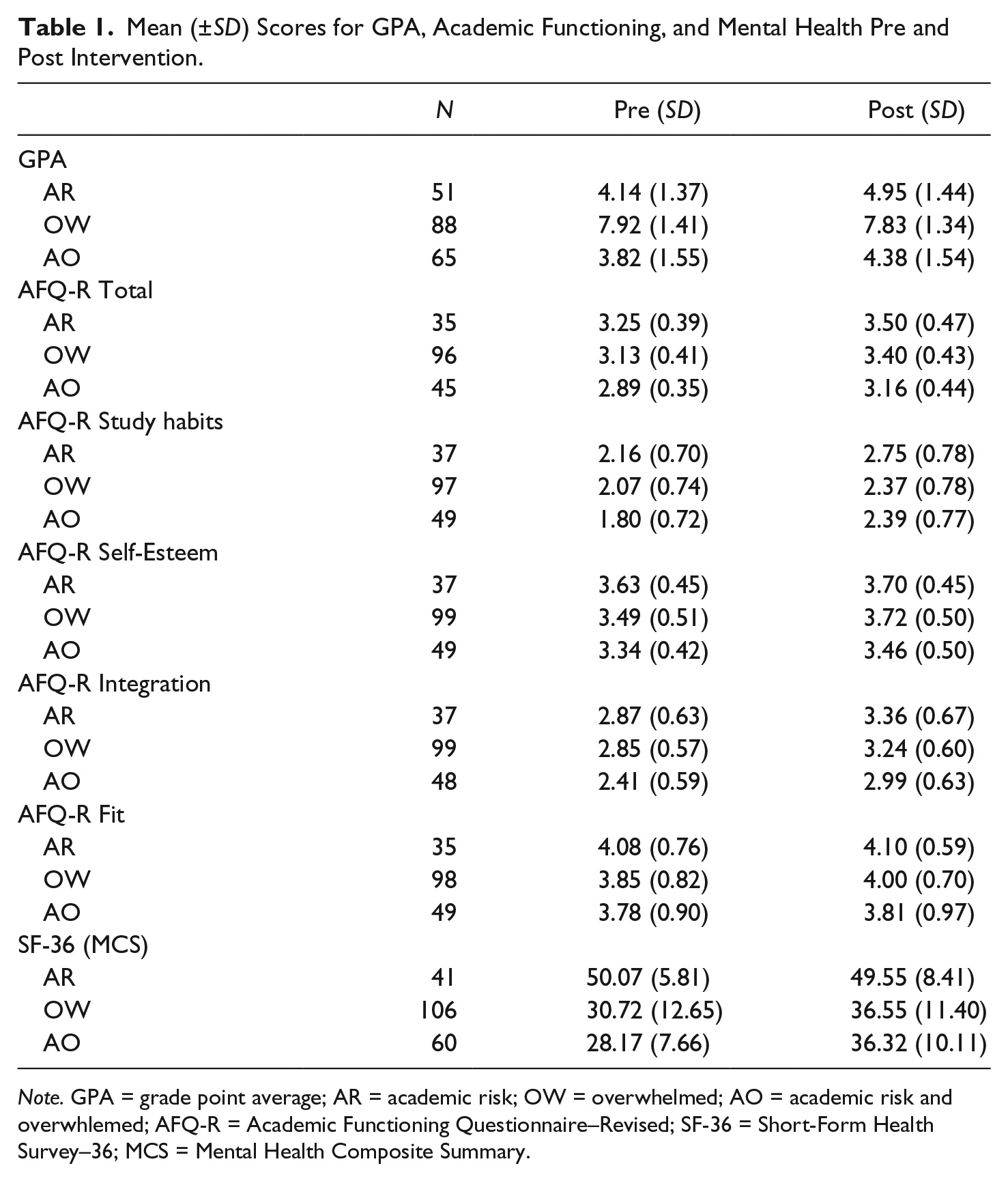
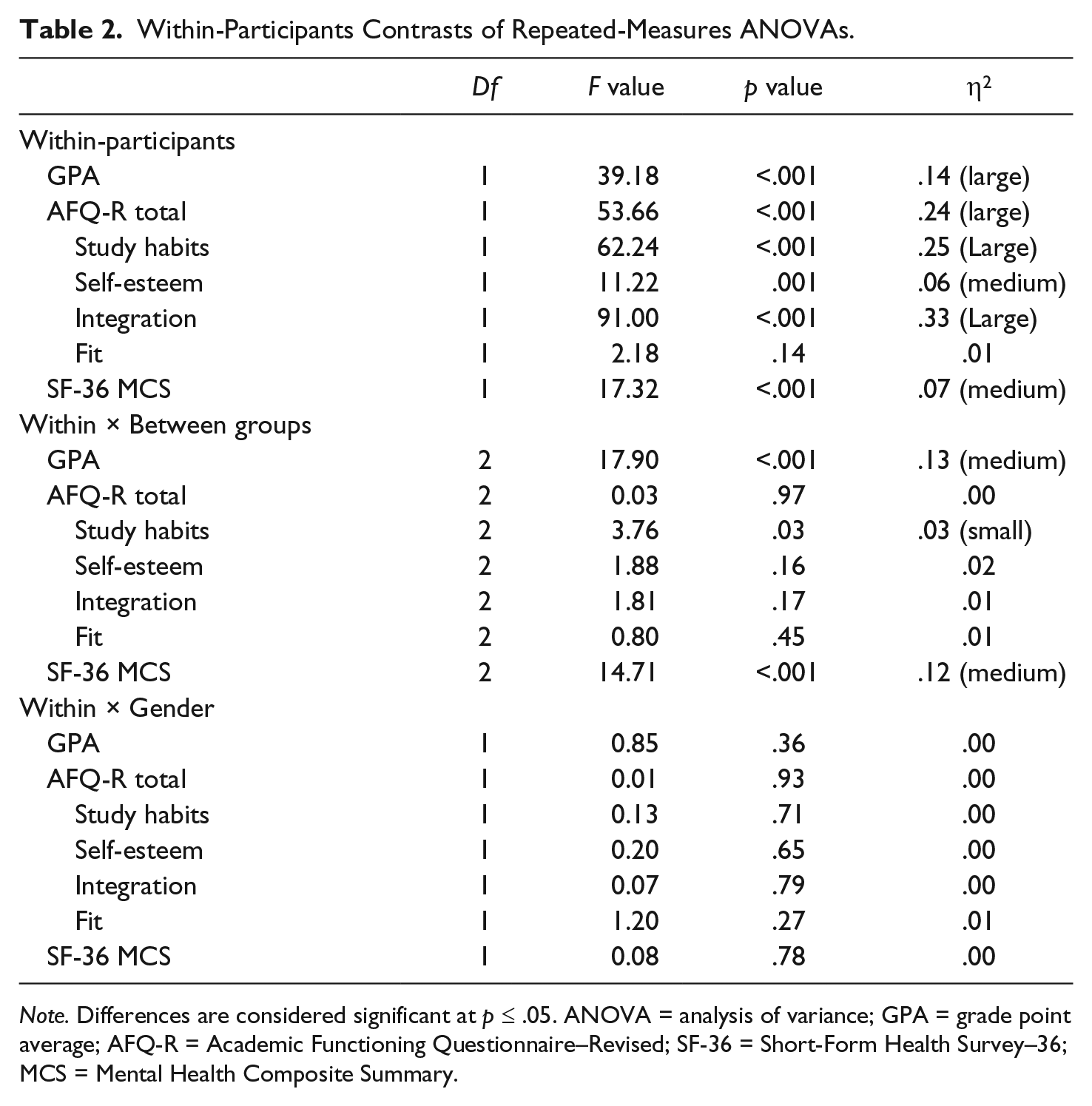
Pre and post mean and SDs for GPA, Academic functioning, and mental health well-being can be found in Table 1, and detailed results of ANOVAs can be found in Table 2.
Mean (±SD) Scores for GPA, Academic Functioning, and Mental Health Pre and Post Intervention.
Note. GPA = grade point average; AR = academic risk; OW = overwhelmed; AO = academic risk and overwhlemed; AFQ-R = Academic Functioning Questionnaire–Revised; SF-36 = Short-Form Health Survey–36; MCS = Mental Health Composite Summary.
Within-Participants Contrasts of Repeated-Measures ANOVAs.
Note. Differences are considered significant at p ≤ .05. ANOVA = analysis of variance; GPA = grade point average; AFQ-R = Academic Functioning Questionnaire–Revised; SF-36 = Short-Form Health Survey–36; MCS = Mental Health Composite Summary.
Academic performance
Repeated-measures ANOVA determined that mean overall GPA scores differed statistically between pre and post measures F(1, 200) = 39.18, p < .001, η2 = .14. Analysis of the means showed that these results were characterized by increases in overall GPA between pre and post-test. The analysis also revealed a significant Time × Group interaction, F(2, 200) = 17.90, p < .001, η2 = .13. Subsequent paired samples t test analyses revealed significant increases in mean GPA for the AR group, t(50) = 6.19, p < .001, d = 0.87, and for the AO group t(64) = 4.77, p < .001, d = 0.59, but not for the OW group, t(87) = 0.94, p = .35, d = 0.09. More specifically, 13 students in the AR group and 15 students from the AO group went from below the minimum 5.0 GPA for a 4-year degree to above 5.0. This represents a percentage rate of 24 for the AR group and 22 for the AO group.
Academic habits
Repeated-measures ANOVA determined that mean scores for AFQ-R total, F(1, 172) = 53.66, p < .001, η2 = .24; AFQ-R self-esteem, F(1, 181) = 11.22, p = .001, η2 = .06; AFQ-R integration, F(1, 180) = 91.00, p < .001, η2 = .33; and AFQ-R study habits, F(1, 179) = 62.24, p < .001, η2 = .25, differed statistically between pre and post measures. Analysis of the means showed that these results were characterized by increases in all of these subscales between pre and post-test. Furthermore, a significant Time × Group interaction, F(2, 179) = 3.76, p < .003, η2 = .03, was found for the AFQ-R Study scale. Subsequent paired samples t test analyses revealed significant increases in mean GPA for the AFQ-R study habits on all three groups AR, t(37) = 4.51, p < .001, d = 0.75; OW, t(97) = 4.36, p < .001, d = 0.44; and OA, t(49) = 5.82, p < .001, d = 0.83. No significant results were found for the AFQ-R Fit subscale.
Mental health well-being
Repeated-measures ANOVA determined that mean SF-36 MCS scores differed statistically between pre and post measures, F(1, 203) = 17.32, p < .001, η2 = .07. Analysis of the means revealed that these results were characterized by increases in mental health scores pre and post FITA. The analysis also revealed a significant Time × Group interaction, F(2, 203) = 14.71, p < .001, η2 = .12. Subsequent paired samples t test analyses revealed significant increases in SF-26 MCS scores for the OW, t(105) = 5.41, p < .001, d = 0.53; and the OA group, t(59) = 5.91, p < .001, d = 0.76; but increases for the AR group were not significant after adjusting for Bonferroni correction, t(40) = 2.09, p = .04, d = 0.33.
Discussion
Strategies for increasing student retention are among the most pressing needs facing universities. We predicted changes based on the differential needs of the student groups. Our results confirm all three of our hypotheses, suggesting that a single service broad spectrum program such as FITA may be a viable approach to assisting a variety of vulnerable students in addressing their differential needs. These results provide further support for previous findings that college intervention programs can be effective mechanisms for increasing academic performance and retention (Pan, Guo, Alikonis, & Bai, 2008) and support theoretical models that implicate academic and social integration as well as mental health well-being as important factors influencing student attrition rates (Astin, 1993; Bean & Eaton, 2002; Parker et al., 2004; Tinto, 1996).
In terms of academic performance, both of the groups having an academic risk factor were found to increase significantly in overall GPA. For these groups, the practical implications of this suggest that almost one quarter of the students making up these two groups were able to increase their GPAs from below the minimal 5.0 to above 5.0, allowing them the strong prospect of graduating with a 4-year degree. As for the OW group, they met university requirements for graduation prior to taking part in FITA, and no significant pre–post changes in grades were observed nor were they required.
Our findings that the total score of academic functioning and more specifically, the subscales of Academic Self-esteem, Integration, and Study Habits significantly increased across all groups suggest that participation in the FITA program had positive effects across groups on students’ academic habits. Although the effect sizes range from medium to large, observation of the means suggest that these increases are quite small, and it is possible that results could be influenced by measurement error inherent in measures using Likert-type scales. Further research with other groups of students and in other universities is needed to establish whether these results can be replicated, whether they are a direct cause of FITA interventions, and whether they can be maintained over time.
Also aligned with our hypotheses, we found that both groups with the mental health risk factors significantly improved in terms of their mental health well-being. Although it is notable that the OA group showed significant increases on both academic and mental health well-being outcomes, it is unclear whether these increases are due to a possible direct focus on mental health counselling, as a side effect of the increased academic performance, or simply a side effect of engaging in a quality relationship with a university employee. Further investigation into the nature of this increase would shed important light on the possible fundamental needs of post-secondary students across the board.
Our sample was composed of more than twice as many women than male participants. This aligns with previous findings that women typically make up the larger proportion of service users (Cockerham, 1997). However, due to previously reported sex differences to treatment response in psychotherapy settings (Kornstein, 1997) as well as research that has found gender to influence academic persistence (Glynn et al., 2005; Mills et al., 2009), we expected to find significant gender interactions in our sample. Our results, however, did not find sex to interact with any of our outcomes. One explanation to this finding may lie in the combined academic and personal counselling elements in FITA’s approach. Previous research has suggested that problem-solving approaches may be a means of increasing men’s commitment to counselling (Crisp et al., 2000). It is possible that the FITA program’s focus on both personal counselling interventions as well as concrete problem-solving approaches to academic struggles may have affected our outcomes, and further research is necessary.
The outcomes of this study may have also been influenced by the fact that students are required to demonstrate commitment to the program before entering. In light of previous research on student academic integration linking motivation, goal commitment, persistence, and academic strategies to student performance and retention (Pascarella & Chapman, 1983; Simon et al., 2015; Stelnicki et al., 2015; Tinto, 1996), it is possible that the required commitment from students keeping them accountable to their goals is an important ingredient to the program outcomes. This aligns with previous research on individual coping styles and resourcefulness that found individuals who coped with university stress in an active and social way were more likely to stay enrolled (Shields, 2001), while students who had poor coping strategies were at greater risk of dropping out (Shields, 2001). FITA’s individualized approach to student counselling may also play a key role. Previous research has found individualized and personalized accommodations to be particularly effective with at-risk students (Abelman & Molina, 2002; Schwebel et al., 2008). Individualized counselling plans based on individual assessment of student strengths and challenges and the establishment of realistic objectives may serve as motivating factors for students and facilitate their commitment to the program.
Furthermore, research on student social integration has found that the absence of a quality relationship with a university employee is an important risk factor for attrition (Heisserer & Parette, 2002), and positive correlations between engaging in counselling sessions and retention have been reported (Bishop & Brenneman, 1986; Wilson, Mason, & Ewing, 1997). The FITA program is designed to provide students with a consistent alliance-based relationship with a university counsellor, which may serve to strengthen the social integration of at-risk students.
Overall, these findings suggest that the FITA program and its accessible, flexible, and individualized approach to student struggles may be a promising approach to assisting students at risk of dropping out. It is possible that programs aimed at retaining students may benefit from taking a broader, holistic, and more integrative approach to assisting students who are struggling to adapt to school. Further research is needed to investigate whether our observed impacts are due to the mechanisms of social support, academic support, mental health support, or a combination of all three.
This study is limited in that significant increases in academic performance, academic functioning, and mental health cannot be unambiguously attributed to the FITA program because of threats to internal validity inherent in single-group designs; however, these data do suggest that an integrative counselling approach can have positive effects on both academic performance and mental health of students, presumably affecting retention.
Another limitation is that this program was offered at a single Canadian University, and it is not known whether similar results would be obtained at another institution. Further research comparing findings from different institutions and populations with those in the present study to look for common effects and/or differences in improving grades and mental health would be necessary to understanding the effects and examining the transferability of the program.
Footnotes
Authors’ Note
For correspondence regarding the FITA program or for a copy of the FITA Manual: Translating Institutional Mental Health Intention Into Program Action.
Declaration of Conflicting Interests
The author(s) declared no potential conflicts of interest with respect to the research, authorship, and/or publication of this article.
Funding
The author(s) disclosed receipt of the following financial support for the research, authorship, and/or publication of this article: The co-authors of this study wish to acknowledge the generous support of the Ontario Ministry of Training, Colleges and University’s fund for Innovative Initiatives in Mental Health.