







Abstract
Numerous studies have explored the relationship between parent–child attachment and peer victimization, a problem for many Canadian children and youth; however, research in this area has been mixed. The present study utilized meta-analytic procedures to clarify the relationship between parent–child attachment and peer victimization. A random effects model was used to complete these analyses. Following extensive database searches, 16 studies were found to be eligible for inclusion. A significant relationship was found between attachment security and peer victimization, r = −.14, 95% confidence interval [CI] = [−.18, −.10], p < .001. Sample ethnicity was the only significant moderator; samples with higher proportions of White participants had a stronger relationship between attachment and peer victimization. Although the results of this study highlight the existence of a relationship between attachment relationships and peer victimization, modest effect sizes suggest that this relationship is likely indirect, with other key variables mediating this relationship.
Bullying is a growing topic of concern, with studies finding that approximately 10% to 30% of children and youth are affected (Molcho et al., 2009; Nansel et al., 2001; Solberg & Olweus, 2003). Although bullying is a worldwide issue (Nansel, Craig, Overpeck, Saluja, & Ruan, 2004), the rates in Canada are particularly concerning. Molcho et al. (2009) found that while most countries have seen decreases in bullying since 1997, Canada’s rates have increased on most measures of bullying; for example, prevalence of chronic victimization for girls increased by 13% from 1993 to 2006. Furthermore, a large study conducted with Canadian youth found that 75% had been involved in bullying at some point in the last 2 months—this included 12% who had bullied others, 22% who had been victimized, and 41% who had both bullied and been victimized (Craig & Edge, 2010). Among adult Canadians, 38% of males and 30% of females experienced bullying during their school years (Kim & Ieventhal, 2008).
Given the continued impact of bullying on the lives of Canadian youth, there is a need for strategies to support victims and prevent instances of bullying. This can only be accomplished with an understanding of the factors that influence bullying. Recent literature has indicated that bullying does not occur in isolation, and an ecological perspective needs to be considered; this is a perspective that encompasses not just individual characteristics but also familial, peer, school, and community factors (Espelage & Swearer, 2003). Parents play a critically important role in children’s environment and in their development, and, as such, when studying peer victimization and bullying, it is essential to consider familial factors. This meta-analysis seeks to clarify the link between peer victimization and an integral part of the parent–child bond, the attachment relationship.
Peer Victimization
A lack of operational definitions and discrepancies in terminology plague the bullying literature. This lack of standardization is a gap, which affects the quality of research done in this area. However, bullying is often defined as repeated “unwanted aggressive behaviour” that is perpetrated by peers—not siblings or dating partners—and “involves an observed or perceived power imbalance” (Gladden, Vivolo-Kantor, Hamburger, & Lumpkin, 2014). Bullying can be direct or indirect and can include physical, verbal, emotional, relational, and/or cyber aggression (Cook, Williams, Guerra, Kim, & Sadek, 2010; Gladden et al., 2014). Peer victimization is a related term. It is often defined as “being exposed, repeatedly and over time, to negative actions on the part of one or more other students” (Olweus, 2001), and is characterized by “repeated, unprovoked verbal, physical, or psychological attacks or intimidation intended to cause fear or to otherwise harm a victim” (Olweus, 1993). Victims of bullying and peer victimization are at an increased risk for experiencing physical health problems, conduct problems, loneliness, peer rejection, withdrawal, anxiety, depression, suicidal ideation, and later suicidal attempts (Cook et al., 2010; McDougall & Vaillancourt, 2015; Rigby & Slee, 1999). Research has also found peer victimization to be associated with increased negative affect and decreased self-esteem (McDougall & Vaillancourt, 2015). School performance is also impacted; children who are victimized are more likely to avoid school out of fear, resulting in a decline in academic performance and potentially eventual dropout (Fried & Fried, 1996).
Attachment
Attachment refers to the exclusive relationship developed between a child and his or her primary caregiver(s). This bond shapes infant development and becomes a foundation for later relationships through infants’ development of internal working models of their experiences (Bowlby, 1982). These models are resistant to change with attachment remaining moderately stable from infancy to adulthood (Ranson & Urichuck, 2008). For example, when an infant is distressed, they engage in behaviours indicating a need for comfort from their caregiver. The manner in which their caregiver responds to their needs will influence how they interpret the reliability of their caregiver, consequently affecting how they view other people. The working models developed through the parent–child attachment relationship allow individuals to make predictions about future events, and dictate how they interpret interpersonal interactions and react to conflict with others.
Attachment styles can be classified as secure, or as insecure-avoidant, -ambivalent, or disorganized (Ainsworth, Blehar, Waters, & Wall, 1978; Main & Solomon, 1990). Secure attachment forms from sensitive, responsive, and consistent parenting. In contrast, insecure-avoidant attachment results from unresponsive and emotionally detached parenting, insecure-ambivalent attachment results from inconsistent parental responses, and disorganized attachment results from unpredictable and erratic parental responses in times of a child’s stress (Ainsworth et al., 1978; Main & Solomon, 1990). Attachment orientations have been linked to many different outcomes in children’s development. Nonsecure attachment styles have been linked with decreased self-esteem, internalizing and externalizing problems (Guttmann-Steinmetz & Crowell, 2006), and poor peer relationships (Groh et al., 2014).
Infant attachment security is often measured by the Strange Situation Procedure (Ainsworth et al., 1978) or the Attachment Q-Set (Waters, 1995), while attachment security in school-aged children is often measured using self-report questionnaires, such as the Inventory of Parent and Peer Attachment (IPPA; Armsden & Greenberg, 1987). The IPPA explores a child’s self-reported attachment to their mother, father, and peers—each explored separately—through three domains: their level of mutual trust (Trust), quality of communication (Communication), and extent of alienation felt by the child (Alienation; reverse scored).
Attachment and Victimization
The relationship between attachment and peer victimization becomes apparent when considering the internal working models that an infant develops and carries forward into childhood and adolescence (Powell & Ladd, 2010). Children with secure attachment orientations have positive expectations about their social interactions, and may therefore be less likely to engage in bullying or to become a victim (Walden & Beran, 2010). In contrast, children with insecure attachment orientations have negative expectations about social interactions, seeing others as unreliable, which may make them more prone to bullying or to becoming a victim (Walden & Beran, 2010). These negative expectations may cause children to interpret social interactions in a negative way, such as construing a neutral conversation in a hostile manner, and they then may react accordingly, such as with withdrawal or shyness, resulting in a greater likelihood of being victimized.
Children with insecure attachment orientations have also been found to have lower self-esteem (Guttmann-Steinmetz & Crowell, 2006), which may make them appear vulnerable to peers, thus increasing their risk of becoming the target of bullying (Georgiou, 2008). Troy and Sroufe (1987) were among the first to demonstrate a relationship between attachment insecurity and an increased likelihood of experiencing peer victimization. Since this time, research on this subject has rapidly advanced. For example, Walden and Beran (2010) explored the relationship between attachment quality and level of peer victimization with students in Grades 4, 6, and 8, and found a strong positive relationship between lower quality attachment relationships and level of being victimized by peers. One study found that teenagers classified as having insecure/dismissive attachments were more likely to be identified as victims of bullying and were less likely to be socially accepted by peers (Dykas, Ziv, & Cassidy, 2008). Furthermore, children with a more secure attachment to their mother have been found to have more secure attachments to their peers (Booth-LaForce & Kerns, 2009), making them less likely to be victimized. While these studies highlight an association between attachment security and peer victimization, other research has not supported this relationship (e.g., Coleman, 2003; Monks, Smith, & Swettenham, 2005). Some of the potential limitations of these studies that may account for the lack of supporting evidence include the use of small samples which results in relatively low statistical power, and the addressing of only specific forms of aggression. To date, no quantitative consensus on this relationship has been reached. Given that bullying continues to be a reality for many Canadian children and youth, it is important to clarify this relationship to better understand the impact of attachment security as a protective factor against peer victimization.
The Current Study
A series of meta-analyses were conducted to clarify the relationship between parent–child attachment security and peer victimization. The main analyses addressed the following research questions:
To gain further insight, several sample and study variables were analyzed as potential moderators of this relationship.
In terms of sample variables, age was explored as a moderator. While attachment security remains relatively stable over time, research on bullying suggests that prevalence rates, predictors, and outcomes can vary with age, as bullying behaviour and victimization experiences tend to increase during the middle school years (see Cook et al., 2010; McDougall & Vaillancourt, 2015; Nansel et al., 2001). Gender was considered as a potential moderator, given that boys and girls often experience different types of bullying, which may impact this relationship. A study among Canadian youth found that girls reported being bullied more than boys—particularly in instances of social and cyberbullying; although, in instances of physical aggression, more boys reported being bullied (Craig & Edge, 2010). Other research has found similar gender differences in bullying and victimization behaviour (e.g., Zhang, Gu, Wang, Wang, & Jones, 2000). Another moderator that was explored was the ethnic composition of the sample. Research is inconclusive regarding the relationship between ethnicity and peer victimization. In a national sample of U.K. youth, aged 10 to 15 years, ethnic differences in bullying roles were only found for bullying, not victimization; ethnic minority youth were no more likely to be victims than White majority youth (Tippett, Wolke, & Platt, 2013). Other research, however, has demonstrated that immigrant children are more likely to be bullied than native-born children (e.g., Fandrem, Ertesvåg, Strohmeier, & Roland, 2010). A study in the United States found that African American children were less likely to be victimized than children from other ethnic groups (Carlyle & Steinman, 2007).
Study quality was also considered within this manuscript. Card (2012) recommends coding various aspects of quality individually—instead of making an overall judgment of quality—and evaluating the moderating impact of each separate quality factor. This approach to quality analysis was adopted within the present study. Although many quality protocols relevant to treatment research are not applicable to a correlation-based analysis (e.g., use of random assignment, blinding, attrition, inclusion of control group, treatment fidelity, inclusion of follow-up data), other relevant aspects of quality were considered. Publication type (e.g., published vs. unpublished, journal vs. thesis/dissertation) was explored to determine whether unpublished studies—which, without peer review, may have involved poorer quality methodological approaches—differentially impacted the results in comparison to published studies. This moderator analysis was also intended to rule out the potential influence of publication bias, where studies are more likely to be published if they have significant or more interesting results (Sutton, Duval, Tweedie, Abrams, & Jones, 2000). Publication year and country were also explored as moderating variables to assess the generalizability of these results over time and across countries. Unfortunately, study measure was initially coded for but a measure-based meta-regression could not be run due to overlap in measurement methodology across studies, where all but one study used self-report measures of peer victimization and parent–child attachment.
Method
Criteria for Study Inclusion and Exclusion
Studies were eligible for inclusion if they were reported in English. Both published and unpublished studies were eligible, reducing the potential for publication bias to influence the results (Sutton et al., 2000). Furthermore, studies were eligible if (a) the mean age of the sample was between 6 and 18 years; (b) the study measured the extent to which participants’ were victimized by peers through bullying behaviours (i.e., relational aggression, physical aggression, teasing, alienation, cyberbullying, and/or other forms of peer harassment); (c) the study measured parent–child attachment; and (d) the study addressed one or more of the specified research questions through quantitative comparisons of the relationship between experiences of peer victimization and attachment. Studies considering the relationship between peer victimization and Reactive Attachment Disorder were excluded given the far greater severity present in this disorder, potentially resulting in a qualitative shift in the findings.
Literature Search Procedure
The Preferred Reporting Items for Systematic Reviews and Meta-Analyses (PRISMA) guidelines were followed when identifying, screening, and determining the eligibility of studies (Liberati et al., 2009). Relevant articles were obtained through a comprehensive search of PsycINFO, ERIC, Dissertations & Theses (ProQuest), Scopus, and Google Scholar using the following search terms: attachment, bully, teasing, victimization, peer victim, bully victim, relational aggression, physical aggression, cyberbully, and cyber bully. All search terms were expanded using appropriate wild card characters. To determine study eligibility, studies uncovered through these database searches were first screened based on their titles and abstracts. Those articles passing this first phase were next screened based on a full manuscript review to ensure that they met all inclusion criteria. In instances where multiple reports were available on the same research study the manuscript with the most comprehensive data was deemed eligible. Following the primary database searches, eligible studies were used to find additional studies through PsycINFO and Google Scholar citation indices, which allowed for the identification of articles citing the eligible studies. The reference lists of all studies meeting inclusion criteria were also explored to search for additional research. Two Master’s students in clinical and school psychology—with thorough training and extensive experience conducting meta-analyses—determined study eligibility by completing the search strategies outlined above; one student conducted the primary database searches while the other was responsible for the secondary searches. In instances where eligibility was uncertain, the study was reviewed by all coauthors until a consensus was reached and a decision was made regarding inclusion. After determining study eligibility, each manuscript underwent careful screening to ensure that the included studies did not overlap with each other and contributed independent effects to the analyses. This examination procedure was based on suggestions made by Wood (2008), where studies sharing one or more authors and demonstrating parallels in methodological and sample characteristics are assumed to involve the same sample. In these instances, the most comprehensive manuscript (based on sample size and reported measures) was retained.
Coding and Reliability
Eligible manuscripts were coded to gather and organize all relevant information and data. To assess inter-coder reliability, a second coder coded 100% of the eligible studies. Primary coding was conducted by a Doctoral clinical psychology student and secondary coding was conducted by a master’s clinical psychology student. Both students were trained thoroughly in coding procedures and had extensive experience conducting meta-analyses. Perfect agreement (100%) was found between the coders. Both the primary and secondary coder used a coding manual to assist in this process and to ensure that all necessary information was attained (e.g., publication information, sample characteristics, statistical findings). If essential information was not available in the manuscript, the author was contacted and asked to provide further clarification on the subject. In instances where no response was attained and the necessary information could not be accessed, the study was excluded from all analyses requiring this data. Following the completion of this coding process, the coded data were inputted into Comprehensive Meta-Analysis Version 3.0 (CMA; Borenstein, Hedges, Higgins, & Rothstein, 2014), a software program used for meta-analysis.
Computation of Effect Sizes
All analyses were weighted using a random effects model as it was anticipated that variation would exist across studies (Borenstein, Hedges, Higgins, & Rothstein, 2010). In instances where a study provided multiple relevant outcome variables for a given analysis, the findings were averaged within CMA to create one overall effect size for that study; this allowed for the inclusion of all available information without violating statistical independence (Borenstein, Hedges, Higgins, & Rothstein, 2009).
Given variations in the type of data provided by eligible studies, six separate analyses were conducted to explore the relationship between peer victimization and parent–child attachment security. The primary analysis explored the relationship (correlation) between parent–child attachment security and experiences of peer victimization. Three additional analyses looked more specifically at the association between each of the three subscales of the IPPA (i.e., Communication, Trust, Alienation) and experiences of peer victimization. In each of these analyses, Pearson’s product–moment correlation was used to analyze the results; however, these correlation-based effect sizes were transformed to the Fisher’s z scale, and the analyses were performed on these transformed values, given that variance is directly related to correlation (Borenstein et al., 2009). Results were transformed back for reporting and interpretation. Two additional analyses explored the amount of peer victimization in children with a secure pattern of attachment compared with children with an (a) insecure-avoidant pattern of attachment, or (b) insecure-ambivalent pattern of attachment. In both of these analyses, the standardized mean difference, Cohen’s d, was used to compute the weighted mean effect size.
In addition to the six meta-analyses addressing our primary research question, six meta-regressions were conducted to analyze the impact of each moderating variable on the effect size. The correlational data from the primary meta-analysis (exploring the association between peer victimization and total attachment security) was used for each meta-regression as it provided the largest database for these moderator analyses. Only studies that contained sufficient information regarding each moderator variable were included in the corresponding analysis.
Results
Characteristics of Eligible Studies
A total of 645 unique studies were identified through the primary database searches. Only three additional studies were uncovered through secondary search strategies, suggesting that the primary database search strategy was strong and comprehensive. There were 16 studies (five theses/dissertations and 11 journal articles) that were eligible for the meta-analysis. For a full summary of the systematic review process, see Figure 1.
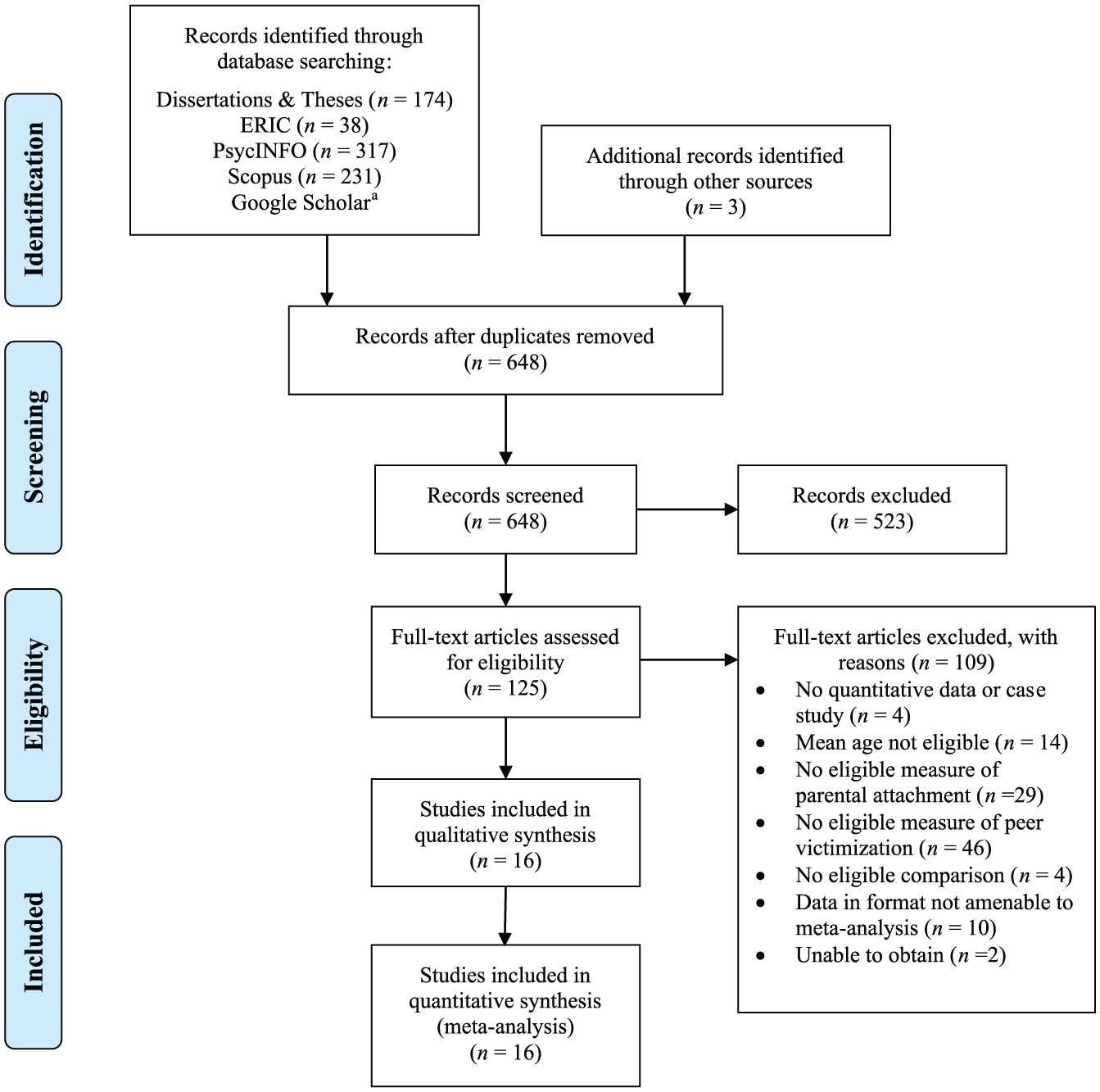
PRISMA flow diagram of information through the different stages of the meta-analysis.
Studies included in the meta-analysis were published between 2003 and 2014, representing a total of 9,967 children and youth. The majority of the studies (eight) were conducted in the United States; two were conducted in Canada, one in Cyprus, one in Ghana, two in Greece, one in South Korea, and one in Australia. The gender composition of the samples was fairly evenly split between boys and girls. The mean age of the participants when the data collection took place ranged from 9 to 17 years. Parental attachment was primarily measured by self-report questionnaires; the IPPA, used in eight studies, was the most common questionnaire utilized (Coleman, 2003; Earl & Burns, 2009; Leenaars, Dane, & Marini, 2008; Nikiforou, Georgiou, & Stavrinides, 2013; Papafratzeskakou, Kim, Longo, & Riser, 2011; Walden & Beran, 2010; Weingold, 2010; Zdanis, 2011). There were four studies that did not use a self-report questionnaire to measure attachment: Seibert and Kerns (2015) and Seibert (2009) used the attachment classifications from the strange situation paradigm when the participants were 3 years of age to measure attachment, Dykas et al. (2008) used the Adult Attachment Interview, and Wilson (2005) used a separation anxiety test. Peer victimization was most commonly measured using a self-report questionnaire. Two studies used peer nominations to measure peer victimization (Dykas et al., 2008; Wilson, 2005). See Figures 2 through 4 for detailed information on the effect sizes for the individual studies in each analysis, the characteristics of the studies, and a forest plot displaying the findings.
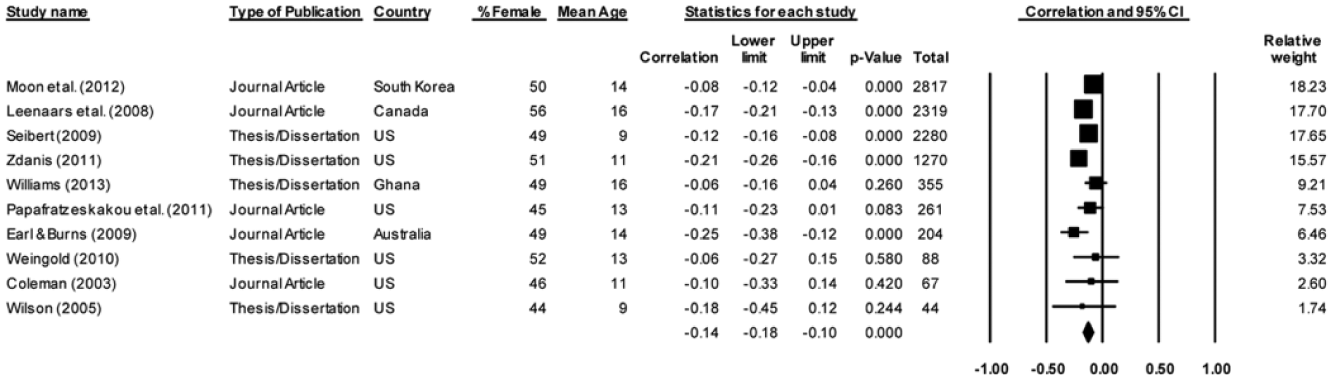
Correlation between total parent attachment score and peer victimization.
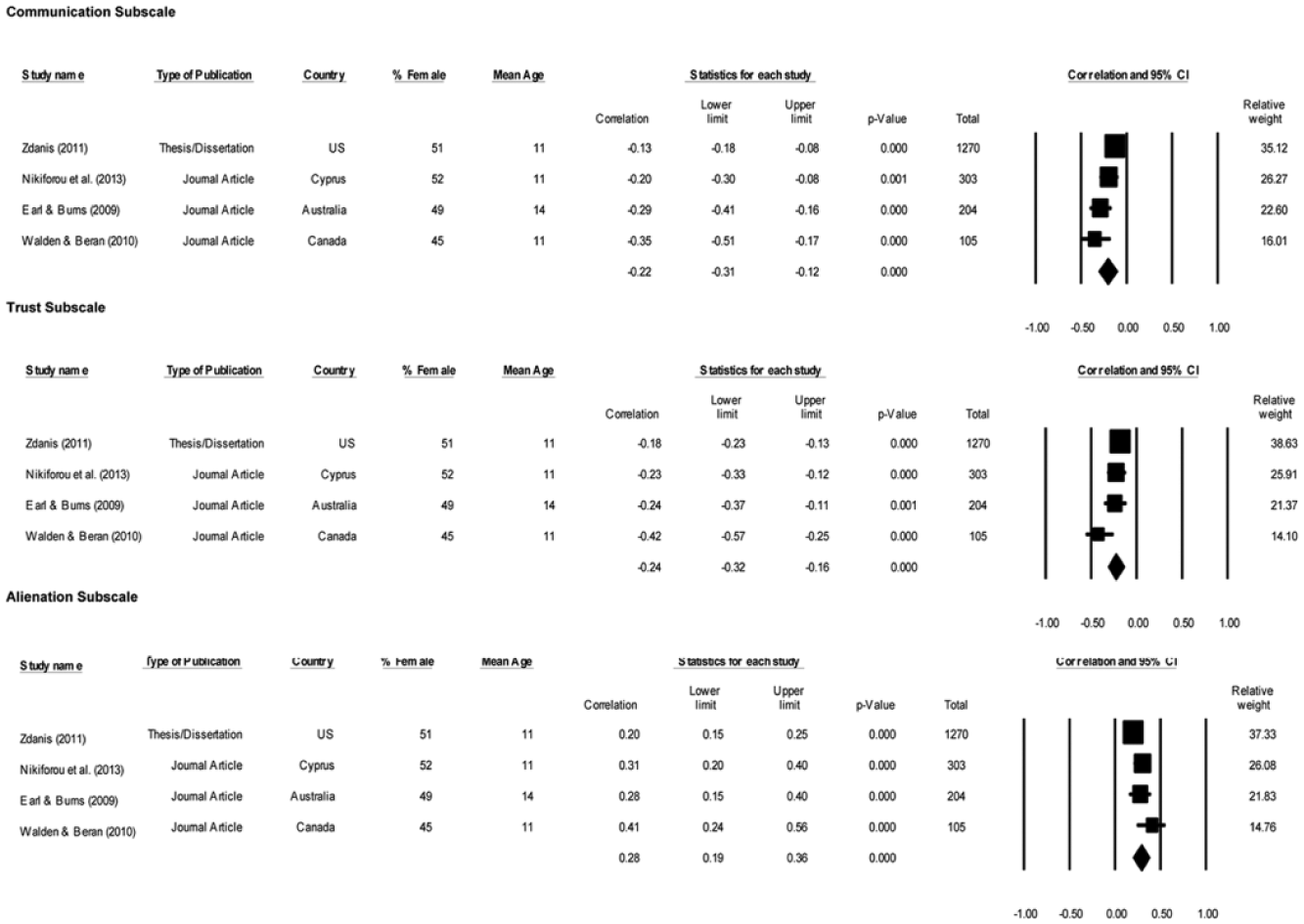
Correlation between parent attachment subscales (communication, trust, and alienation) from the Inventory of Parent and Peer Attachment and peer victimization.
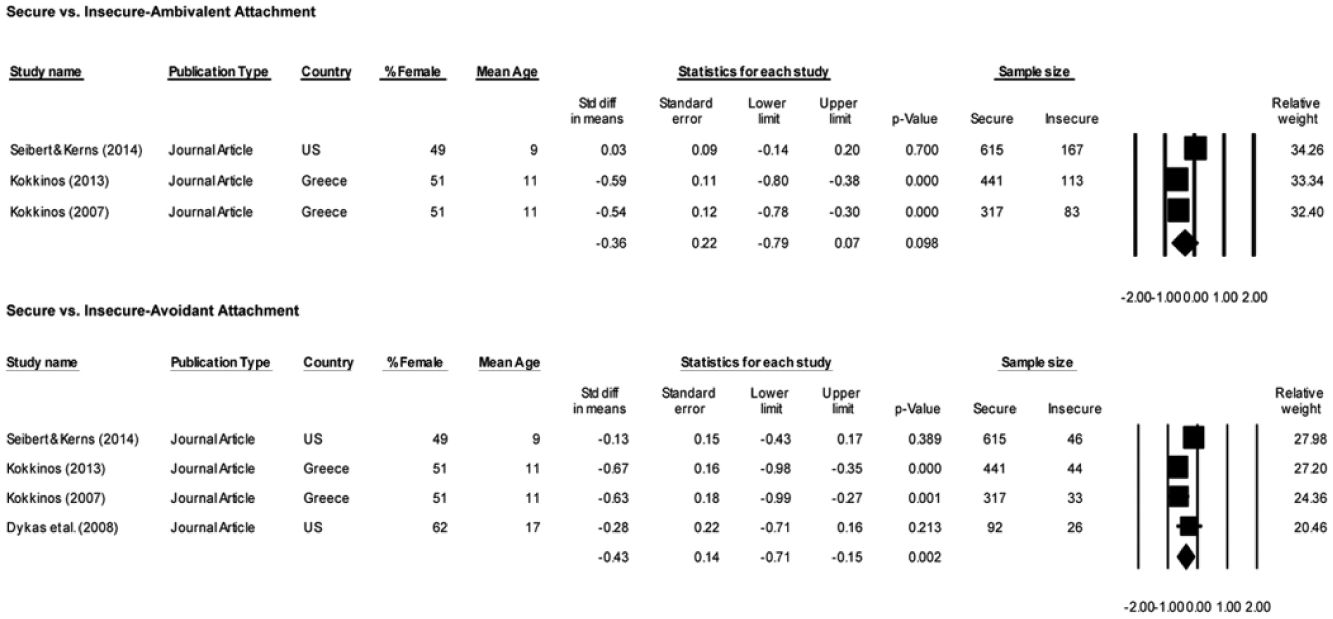
Mean peer victimization scores in secure versus insecure children.
Relationship Between Attachment and Peer Victimization
The correlation between total attachment security scores and experiences of peer victimization was statistically significant (Figure 2). The weighted mean effect based on 10 studies was r = −.14, 95% confidence interval [CI] = [−.18, −.10], p < .001, Q(9) = 22.65, p = .007, I2 = 60.27%. There were four studies that also provided data on the correlation between peer victimization and the subscales of the IPPA. The weighted mean correlation for the Communication subscale was r = −.22, 95% CI = [−.31, −.12], p < .001, Q(3) = 9.34, p = .025, I2 = 67.87%. The weighted mean correlation for the Trust subscale was r = −.24, 95% CI = [−.32, −.17], p < .001, Q(3) = 7.11, p = .068, I2 = 57.82%. The weighted mean correlation for the Alienation subscale was r = .28, 95% CI = [.19, .36], p < .001, Q(3) = 7.78, p = .051, I2 = 61.44% (Figure 3).
Four studies looked at the mean amount of peer victimization in children classified with a secure pattern of attachment compared to those classified with an insecure-avoidant pattern of attachment (Figure 4). The results were statistically significant; the weighted mean effect size was d = −.43, 95% CI = [−.71, −.15], p = .002, Q(3) = 7.63, p = .054, I2 = 60.69%. Three studies looked at the amount of peer victimization in children classified with a secure pattern of attachment compared with those classified with an insecure-ambivalent pattern of attachment. The results were not statistically significant; the weighted mean effect size was d = −.36, 95% CI = [−.79, .07], p = .098, Q(2) = 25.57, p < .001, I2 = 95.18%. There was one study that provided data on disorganized attachment (Seibert & Kerns, 2015); the effect size for this study was statistically significant, d = −.33, 95% CI = [−.50, −.15], p < .001.
Moderator Analyses
Six moderator analyses were conducted to determine whether they would be able to explain any of the variance in the results of the meta-analysis. The data from the analysis investigating the correlation between total attachment security and experiences of peer victimization were used for the moderator analyses. The graphs of the moderator analyses were also examined visually to determine whether a curvilinear line would better fit the data. This was not deemed necessary for any of the variables. Five of the moderator analyses were not statistically significant: type of publication (thesis/dissertation versus journal article), Q = 0.01, R2 = 0.00%, p = .914; year of publication, Q = 1.12, R2 = 6.24%, p = .291; country of publication, Q = 6.04, R2 = 28.56%, p = .196; percentage of girls in the sample, Q = 0.41, R2 = 0.00%, p = .522; and mean age of the sample Q = 0.12, R2 = 0.00%, p = .733. The finding that publication type does not moderate the relationship suggests that the results of this meta-analysis have not been impacted by publication bias.
The moderator analysis on percentage of the sample that was White was statistically significant (Q = 6.00, R2 = 100.00%, p = .014). That is, a greater percentage of White participants in the sample was associated with a larger correlation between attachment and peer victimization. Not all studies reported data for this moderator analysis, and so this analysis was based on the effect sizes of four studies: in Seibert (2009), 83% of the sample was White, Weingold (2010) 29.5%, Wilson (2005) 0%, and Zdanis (2011) 3%.
Discussion
Overall, a small significant relationship was found between attachment security and experiences of peer victimization, where greater attachment security was associated with lower rates of peer victimization. Accordingly, each subscale of the IPPA (i.e., communication, trust, alienation) was significantly correlated with reports of being bullied by peers; higher scores on communication and trust subscales and lower scores on the alienation subscale were each associated with lower rates of peer victimization. Furthermore, a significant difference in victimization was found between children with secure and insecure attachments, where securely attached children were found to have fewer experiences of peer victimization than children classified with an insecure-avoidant attachment. This same pattern was also found when comparing securely attached children to children classified with an insecure-ambivalent attachment, although the results were not significant. Given that only three studies were eligible for inclusion in this particular analysis, it is likely that there was simply not enough power to obtain significance.
Although the results of each analysis align with the anticipated association between parent-child attachment and peer victimization experiences, the modest effect sizes suggest that this relationship is likely indirect, with other key variables mediating this relationship. More specifically, a child’s style of attachment to their primary caregiver may help them to form an internal working model that guides their level of trust in social situations and impacts their expectations regarding their own self-worth (Bowlby, 1973, 1982). Indeed, attachment insecurity has been found to correlate with greater levels of mistrust in others and more negatively biased social expectations, perceptions, and attributions (see Dykas & Cassidy, 2011). Research has also supported self-worth as a mediator between parent-child attachment security and social competence (Booth-LaForce et al., 2006). A child with greater mistrust may enter social situations expecting to be a victim of their peers or may interpret social situations from a victim’s perspective. Individuals reporting an insecure parental attachment have been found to perceive greater threat in ambiguous social situations and to suggest more aggressive or avoidant responses or solutions to such situations in comparison to individuals with a secure attachment (Barrett & Holmes, 2001). In other words, individuals with insecure attachment relationships may be viewing social situations through a biased lens that makes them more likely to view themselves as victims of bullying. Furthermore, these biases could result in behaviours or mannerisms that align with these beliefs (e.g., timidity, avoidance, aggressiveness), which may increase the likelihood of actually being victimized—essentially establishing a self-fulfilling prophecy. In summary, the small effect sizes found in this meta-analysis suggest that the relationship between parent-child attachment security and peer victimization is likely reliable, but indirect, with variables such as negative cognitive biases, social expectations, and low self-worth mediating this relationship.
In addition to exploring the strength of the relationship between parent-child attachment security and peer victimization, numerous publication and study sample variables were explored as potential moderators. No publication variables were found to moderate this relationship—a finding that provides greater support for the generalizability of the results, as the effect size was not impacted by publication year or country of origin. Further, given that no significant differences in effect sizes were found to emerge across publication types (dissertation/thesis or journal article), greater confidence can be held in the decision to include both published and unpublished research.
Across study sample variables, the only variable found to impact the size of the effect was the percentage of participants in the sample that were White. While this finding was significant, it cannot be conclusively determined that parent-child attachment security is more strongly linked with peer victimization in White populations than in minority populations. Instead, it is possible that cultural biases are impacting the results. For example, criticisms have been raised regarding the cross-cultural use of attachment measures, suggesting that they are culturally biased. Mother-child dyads have been the main focus of attachment research—and have been foundational in the development of attachment measures—yet outside of middle-class White Western culture, shared caregiving and multiple attachment relationships are more common (Howes & Spieker, 2008; van Ijzendoorn & Sagi-Schwartz, 2008). Indeed, research has found that Black families are more likely to live in multigenerational homes than White families (Cohen & Casper, 2002; Pilkauskas, 2014). Given that all of the studies eligible for inclusion in this moderator analysis were conducted within the United States, and that the majority of studies involved samples predominantly composed of White and Black participants, it is important to consider how cultural differences in family composition may be biasing this result. In addition, only four studies were eligible for inclusion in this moderator analysis, further emphasizing the importance of taking caution when drawing conclusions regarding differences in the strength of this relationship across ethnic groups.
Strengths and Limitations
The predominant limitation of this meta-analysis was the number of studies eligible for inclusion. That said, it should be noted that this constraint is not surprising given that the research in this area is still in its infancy. In fact, the oldest study eligible for inclusion was published in 2003, demonstrating that the exploration of the impact of parent-child attachment security on child bullying and victimization experiences is only just gaining momentum. This meta-analysis was also limited by certain methodological aspects of the included studies. More specifically, the majority of eligible studies assessed parent-child attachment through self-report measures—an approach that is not considered to be ideal within the attachment literature as it does not address unconscious mental representations (Crowell, Fraley, & Shaver, 2008). This finding further limited our ability to assess study quality based on measure type (e.g., strange situation paradigm vs. self-report), as the lack of variability limited our ability to determine whether or not the method of measurement moderated the effect size. Unfortunately, this issue is difficult to avoid within this area of research; the population under study (i.e., school-aged children and adolescents) is too old to complete the strange situation, a gold standard measure of attachment, and there is no consensus in the literature on measurement of attachment after the preschool years until adolescence when the Adult Attachment Interview becomes appropriate (Kerns & Braumariu, 2016). Lack of variability was also found across study measurement of peer victimization, with most studies using self-reports; again, this limited our ability to assess measurement type as a moderator relating to study quality. An additional limitation to consider is the lack of standardization in the literature around definitions of bullying and peer victimization, which may have affected the retrieval of studies.
Although it is evident that there were several limiting factors for this meta-analysis, there were also a number of notable strengths. Most importantly, although small to moderate in strength, the anticipated relationship between parent-child attachment and peer victimization was consistently confirmed across each meta-analysis incorporating various types of data. This uniformity helps to bolster the argument that a relationship exists between these two variables, although it is likely that other factors are acting as mediators. Further confidence in these results can be gained from the high interrater reliability that was attained and the comprehensive literature search that was conducted. Another strength to note is that this is the first known meta-analysis in this area, and as such, these findings are positioned to provide greater clarity on this growing topic of interest.
The finding that publication country did not significantly impact the results of this meta-analysis offers yet another important strength as it better supports the generalizability of the results across countries. Essentially, the effect sizes were not found to differ significantly across samples from different countries. Beyond this finding, the results can further speak to the Canadian context, as two eligible studies were conducted with Canadian populations (Leenaars et al., 2008; Walden & Beran, 2010). Indeed, both studies align with the overall results of this meta-analysis, supporting a small to moderate positive relationship between peer victimization and attachment. That said, it should be noted that neither study explicitly outlined the ethnic composition of their sample and so it remains unclear whether or not these findings represent diverse cultural backgrounds or predominantly White populations.
Implications and Conclusion
In conclusion, this meta-analysis has provided an overview of the current body of research examining the association between parent-child attachment security and peer victimization experiences, and has established the existence of a small but significant relationship. These findings have practical implications, as they illustrate the necessity of considering the family context as a risk factor in peer victimization. When considering the results of the current study in the context of past research, there is evidence to suggest that parent-child attachment impacts later social outcomes for children and youth; however, given the small to moderate effect sizes revealed in this study, intervention and prevention efforts primarily targeting parent-child attachment are likely not the most effective approach to reducing peer victimization experiences. Instead, future research should investigate possible mediating factors (e.g., feelings of self-worth, cognitive biases, and social expectations) through longitudinal studies to intervene more effectively. In particular, cognitive variables addressing internal working models may be fruitful areas for inquiry. It is also recommended that future research further explore variations in this relationship across ethnic groups, as moderator analyses revealed that this relationship is stronger in White populations than minority populations; although, it is unclear if ethnicity is truly moderating the findings or whether cultural, measurement, or other factors are responsible. Future research should also focus on determining and relying on a more standardized definition of “peer victimization” to maximize the compatibility and replicability of research results. Finally, it would be beneficial for researchers in this area to explore differences in attachment security across various types of bullying.
Footnotes
Declaration of Conflicting Interests
The author(s) declared no potential conflicts of interest with respect to the research, authorship, and/or publication of this article.
Funding
The author(s) received no financial support for the research, authorship, and/or publication of this article.