







Abstract
Traditionally, the roles of patients and their families in healthcare have been passive. Despite claims of patient centredness, care design and decision-making often reflects the provider's perspective. Within Island Health, we knew that the challenges we faced were common to many healthcare organizations. We recognized that we would not be successful in changing to a patient-centred culture unless we had organizational support at the executive level for a patient and family experience strategy.
Introduction
The voices of patients and families often are inadvertently unheard or silenced. Despite claims of patient centredness, care design and decision-making in acute care often reflect the provider’s perspective. There are a number of reasons for this: healthcare systems are highly complex; government and other funders demand benchmarks, measurements, and efficiency, thereby encouraging standardized practices that enhance predictability but may decrease responsiveness to individual patient needs; and care providers seek significant degrees of influence, advancing an implicit but false conclusion that the system of care delivery reflects what is best for patients.
In Island Health, we knew the challenges we faced in understanding patient and family experiences were common to many healthcare organizations. The literature pointed to a growing body of research showing that an engaged approach with patients and families positively impacts patient care outcomes and safety. 1,2 In addition, studies show that this approach positively impacts a patient’s trust of clinicians, adherence to treatment recommendations, and the quality of their experience. 2 We saw evidence of changes made by organizations such as Kingston General Hospital 3 in care processes at all levels of their organization. We had our own experience, supported by data, to indicate there were significant opportunities for improvement. We knew we needed to find our own path and start a journey of consistently and intentionally including patients’ voices in all that we do.
Organizational context
Island Health is a network of more than 150 facilities, including hospitals, clinics, health centres, health units, and long-term care facilities, providing a variety of services on Vancouver Island, the Gulf Islands, and part of the British Columbia mainland. We are also responsible for home care, mental health and substance use services, and child, youth, and seniors’ services. With an annual budget of approximately US$2 billion, Island Health employs or contracts approximately 18,000 healthcare staff and 2,200 physicians. We serve over 770,000 residents across 56,000 km2 of widely varied geography. Island Health is self-reliant, with 95% of residents served in their island-based home region.
Concerns influencing this research journey
Several factors came together that prompted the need for this research. From 2008 to 2010, the organization undertook observational studies to understand how staff spend time in patient care in acute care units. The results identified a significant gap in understanding what was important to the patients in the context of their illnesses. Shortly after, a patient complaint corroborated the studies’ findings and the story of Mrs G became a focal point for the organization. A key deficiency identified in Mrs G’s hospitalization was the failure of our care team to understand who Mrs G was at her best (prior hospitalization), to seek out her wishes for her care, and to work with her and her family to restore her to her best possible functioning.
There were other indications that we had an opportunity to work with our patients and families in a new partnership. Our 2012 British Columbia Ministry of Health Patient Reported Experience Measures survey revealed that only 48% of our patients felt that they had enough to say about their treatment, barely over 50% had spoken to their doctors and nurses about their fears and anxieties, and less than 50% had discussed when they could resume normal activities. We also knew from our Patient Care Quality Office (PCQO) that “lack of communication” was fourth in the top 15 categories of complaints (after “care,” “attitude,” and “accessibility”), consistent with provincial PCQO data.
Supported by the literature
Wanting to enrich our understanding of these interrelated challenges facing Island Health, we initiated a qualitative study in 2013 while participating in the Canadian Foundation for Healthcare Improvement EXTRA Fellowship Program. To begin, we conducted a literature review of the concept of patient-centred care.
Ensuring a positive patient experience has always been important for healthcare professionals. In recent years, the concept of patient- and family-centred care has received broader, more intense recognition in Canada, the United States, and beyond. Organizations recognized for their work in this area include the Australian Healthcare Collaborative, The European Network for Patients Empowerment (Belgium), King’s Fund (United Kingdom), the Institute for Patient and Family Centered Care (United States), the Beryl Institute (United States), and Planetree (United States), among others.
Many organizations use the Institute for Patient and Family Centered Care’s 4 principles of respect and trust, information sharing, collaboration, and participation to guide their strategic work. The Beryl Institute defines the patient experience as “the sum of all interactions, shaped by an organization’s culture, that influence patient perceptions across the continuum of care.” 5 This definition raises key elements that should be considered for any organization wanting to define what the patient experience means for them as it can create a basis for action and focus. The importance of adopting a definition to define the patient experience is noted, but few organizations have done so. 6
The International Global Centre for Nursing Executives has compiled an extensive review titled Elevating the Patient Experience. 7 Although this research is geared for nursing, it has application for all healthcare providers. Coupled with their research is a tool kit for cultivating caregiver empathy, overcoming process barriers to the patient and family experience, and diagnosing institution-specific barriers. The important message in their work and that of the Beryl Institute 5 is that while tools and tactics are helpful, they must be supported by an overall organizational patient experience strategy.
Our research process
Exploration of the literature fueled our passion and sense of urgency to undertake a critical inquiry. We shifted to a mixed method design, given our research aims to gain further insight into current patient engagement experiences, to identify gaps and explore supportive interventions, and to gain a sense of readiness for practice changes. Methods used to gather narrative data included interviews and facilitated focus groups. Patients, families, care staff, and physicians on three medical units in urban, regional, and community hospitals were asked about their individual experiences of being involved in and/or of involving patients in care decisions. Findings were analyzed to yield a greater understanding of our issues (Figure 1).
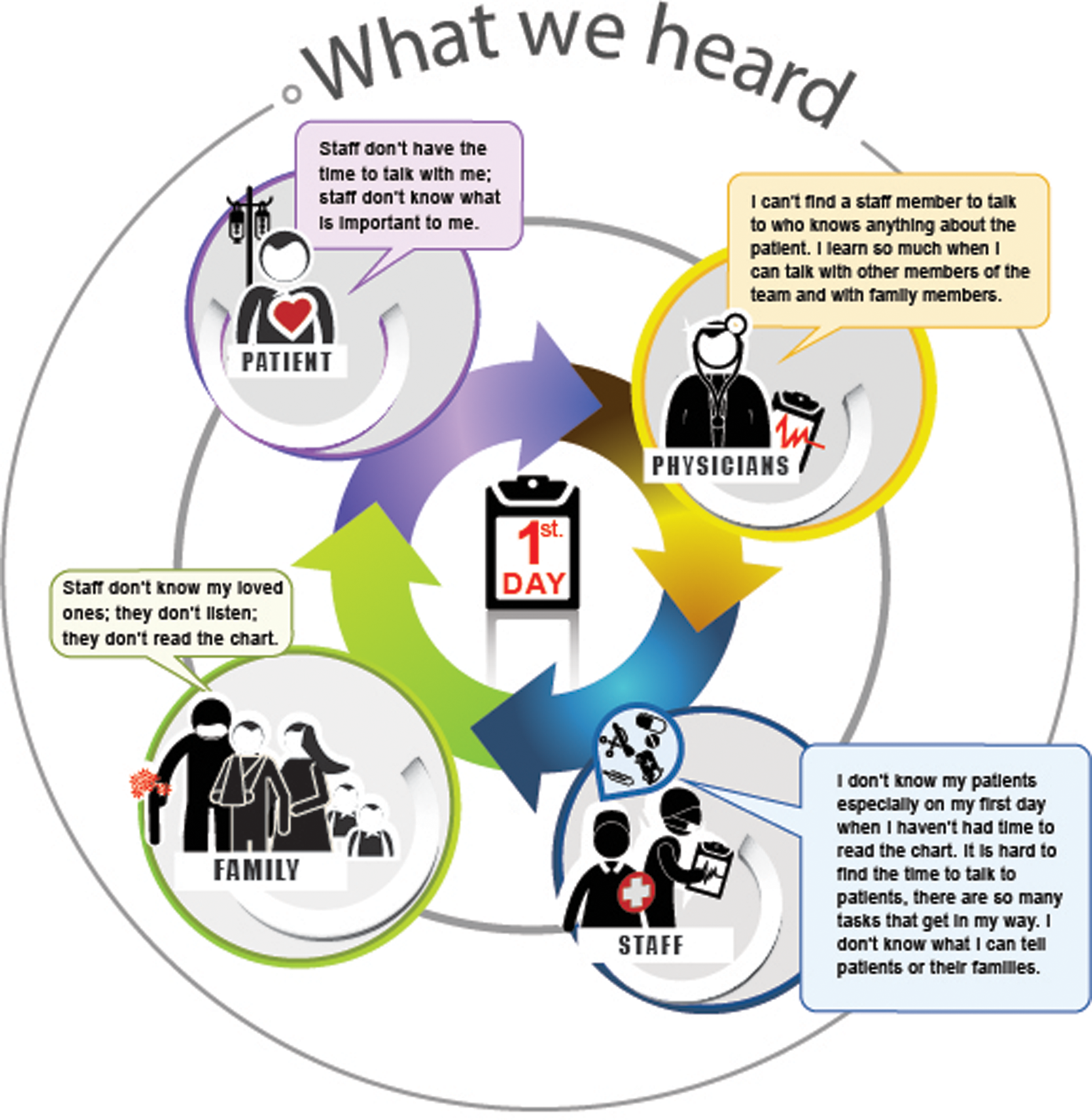
Themes from the focus groups
Discussion: Where we are going?
Pressures within our system to reduce lengths of stay, improve patient flow, and provide care for increasingly complex, aging patients have led us, like others, to rely more and more on standardized care to improve quality and focus on tasks of care and system efficiencies. We recognized that our changing healthcare environment required us to shift focus to achieve a better understanding of patients and what is important to them and their families, and to look to different, more responsive care delivery models. This requires a different relationship with our patients and their families and calls upon us to put asidetraditional, expert, and paternalistic care approaches, driven by clinician needs, values, and opinions, in favour of a model where patients’ needs are articulated holistically and responded to compassionately and individually.
Conventional wisdom surrounding cultural change in this magnitude compels us to ensure there is an urgent reason to change, that leaders and staff are fully engaged in the process, and metrics are used to measure progress. 8 The strategy needs to reflect that cultural change takes time, and the journey is rarely straight forward. Most importantly, it needs committed leadership, whether an organization is large like ours or small.
We believed we had a “burning platform” for change and a compelling vision supplemented by our research data. We also had an engaged group of staff and physicians who had participated in our focus groups and the support of our Patient Advisory Council. Consensus arising from the focus groups was to implement interdisciplinary care rounds at the bedside. This strategy would build on our 2010 to 2013 Structured Learning Collaborative work that focused on improving patient function and promoting patient involvement in setting care goals and making care decisions with an interprofessional care team. 9
As two of the three care teams who participated in the focus groups moved forward to establish rounds at the bedside, an organizational imperative arose that diverted care leaders and middle management attention away from engaging patients at the bedside. In response, we shifted our focus to developing a strategy that would guide an organization-wide patient experience cultural change.
Aligning leadership actions to support culture change
Pursuing this type of culture change has implications for process changes throughout the organization, from practice areas to top leadership. Senior-level support is essential for a shift in culture to happen. We recognized we would not be successful in changing to a patient-centred culture unless we had organizational support at the executive level for a patient and family experience strategy. This strategy had to align with our organization’s strategic direction and that of the BC Ministry of Health. Island Health recently completed a strategic plan renewal process that identified four organizational priorities that will enable us to continue to address the complex healthcare challenges of today while positioning us for the future. By defining our commitment and learning approach to advance patient- and family-centred care throughout the organization, we will achieve an “Exemplary Patient Experience” 10 —one of our mandated areas of focus.
Our organization’s draft patient experience strategy includes a Staff Handbook for Patient Advisor Recruitment and a Handbook for Patient Advisors. The Island Health Patient Advisory Council, while in existence since 2008, revised their terms of reference to align with the strategy. Membership now includes Island Health providers who will influence this work throughout the organization. Our executive is seeking to better understand the research and learn from other organizations across Canada and internationally. Two think-tanks with senior executive and patient representatives, held in May and June 2014, informed a subsequent leadership retreat focused on building empathy for the patient and family experience.
Change happens: Patient voices heard
We wish to emphasize that the culture is shifting, and patients are now more fully engaged in a variety of activities throughout Island Health. Patient advisors participated in the development of our new strategic plan. Other patient advisors are engaged, along with care providers, in validation sessions for the development of our electronic health record. Patient advisors have also participated in interview selection panels for senior-level leaders. As requests for patient advisor participation in Island Health initiatives and committees grow, it has become necessary to increase our recruitment of advisors from across the island.
These activities at the senior level signal the beginning of our culture change. Although we need to continue to support the senior-level changes, we can now renew our efforts where care happens, focusing on fulsome assessments and care planning; and engaging innovative strategies such as whiteboards, structured team reports, situation, background, assessment, and recommendation for hand-offs, purposeful hourly rounding, and interdisciplinary care rounds at the bedside; and advancing interprofessional collaboration.
We are also leveraging provincial directives, such as care of the elderly individuals in acute care, pay-for-performance, and care-sensitive adverse events, which seek to better identify and address the care needs of our patients.
Conclusion
This research adds to a growing body of knowledge, illuminating the need for an intentional approach to patient-centredness. We trust our process may inform others embarking on such a journey. Attention to patient experience remains a top priority for healthcare organizations, yet many have to develop a clear, formal definition of what this means. Although mandates and processes may be in place, actions remain tactical and are often isolated versus being systemic. Our organization is no different. We have good work going on in many areas; however, we need to push out an organizational strategy to ensure everyone is aware of the importance of patient- and family-centred care. Addressing patient experience is harder than many thought and requires greater rigour than many anticipated. 5 The unfolding journey continues to help our organization understand the need to articulate what we are focusing on, what we are trying to achieve, and how will we know when we get there.