







Abstract
To inform future strategy development in Canada and other jurisdictions, we undertook an Internet search to identify existing national and Canadian provincial dementia strategies and their major themes. Twenty-two dementia strategies were identified through an Internet search, supplemented by hand searches of reference lists of retrieved documents. Thematic analysis identified 17 strategic themes; common themes included improved diagnoses and assessments, increased access to care, and improved education of the healthcare workforce. This review reinforces the importance of a multi-faceted response to dementia and illustrates that, despite variation in needs across populations and geographies, there are many common priorities. The strategic themes identified in this review may provide a useful starting point for the development of new national strategies or, alternatively, as a check to determine if important priority areas have been missed in strategy development.
Introduction
Dementia is a global health and societal challenge affecting nearly 50 million people worldwide, and with an estimated economic impact of $818 billion globally in 2015. 1 National strategies have been recommended to support a coordinated and effective response to dementia, 1 and these have now been developed in many countries. A national strategy has not yet been developed in Canada, despite the increasing prevalence of dementia and widespread support for such a strategy.
To inform future strategy development in Canada and other jurisdictions, we undertook an Internet search to identify existing national and Canadian provincial dementia strategies and their major themes.
Methods
Governments and associated agencies/societies create most dementia strategies, but the resulting documents may not be reported in peer-reviewed journals. To identify grey literature in which national and provincial dementia strategies are documented, we conducted an Internet search using the Google and Google Scholar search engines. Search terms included “dementia strategy,” “dementia framework,” “national dementia strategy,” “national dementia framework,” “international dementia strategy,” and “international dementia framework.” Documents and resources identified through the search were reviewed for relevance by two reviewers. Reference lists were hand searched to identify any frameworks or strategies that had not been identified initially. Strategies were excluded if they did not have a version published in English, were still in development, or were not the most recent strategy to be released in the jurisdiction. The completion of the search resulted in the identification of 22 unique national and provincial dementia strategies/frameworks for review.
Documents describing the 22 strategies were analyzed using QSR NVivo 10 software based on Thomas and Harden’s thematic synthesis method for qualitative systematic reviews. 2,3 The first stage of the theming process consisted of a line-by-line review of the main strategy documents to identify descriptive themes (concepts that closely follow the analyzed text); the second stage involved translating the “descriptive themes” into “analytical themes” (a combination of similar descriptive themes that become unique themes). 3 Analytical theming was conducted independently by two analysts to support reliability, with disagreements resolved by discussion. Resulting themes were then reviewed by other members of the research team.
As this project involved analysis of secondary sources, ethics clearance was not required.
Results
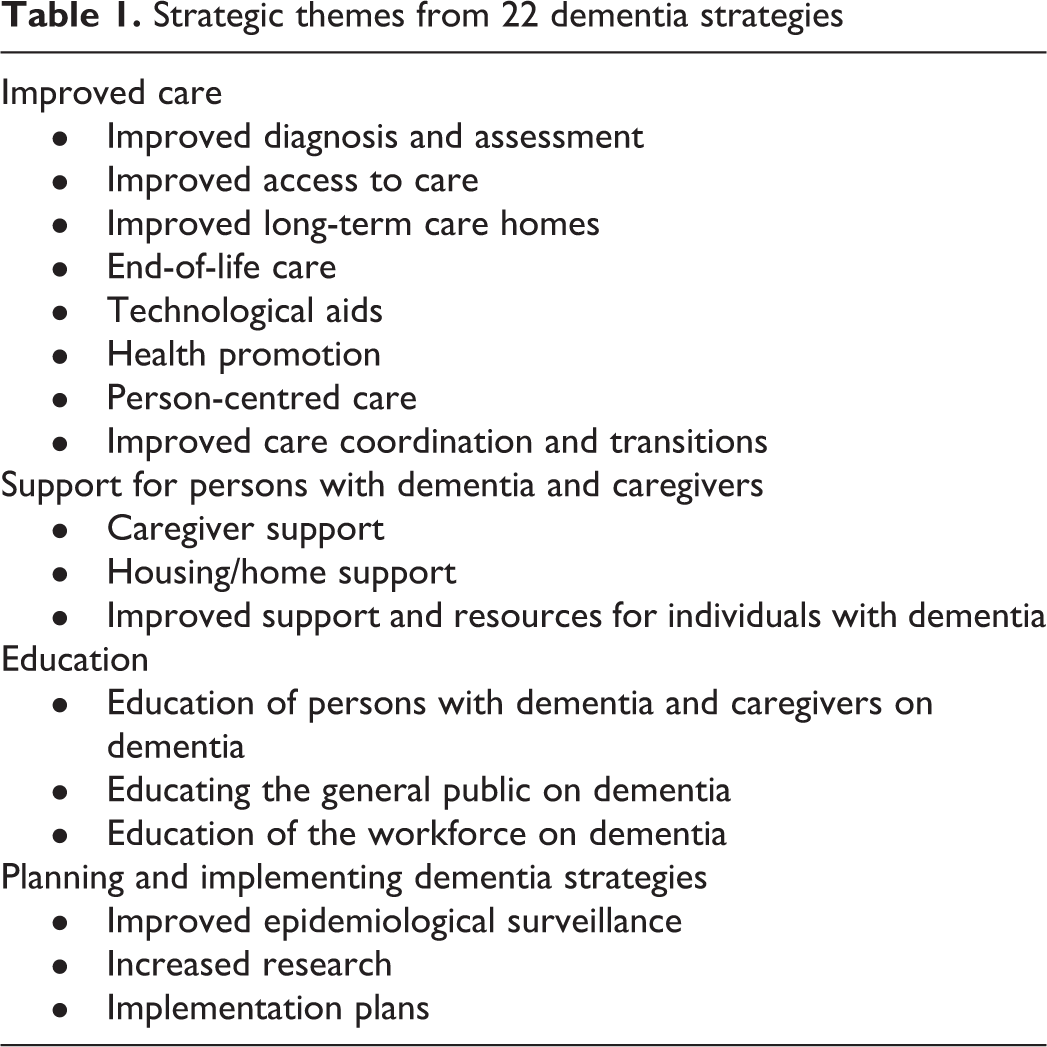
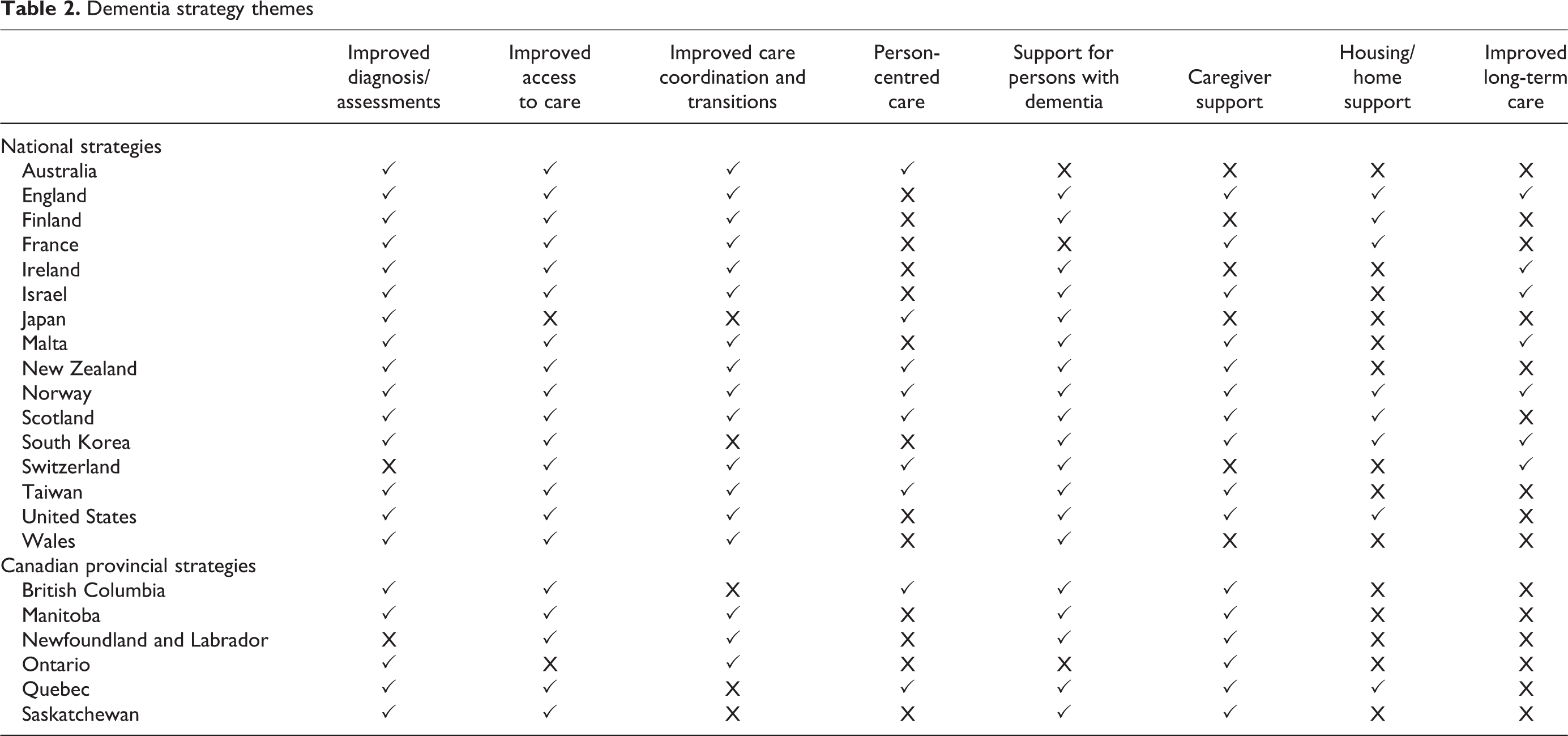
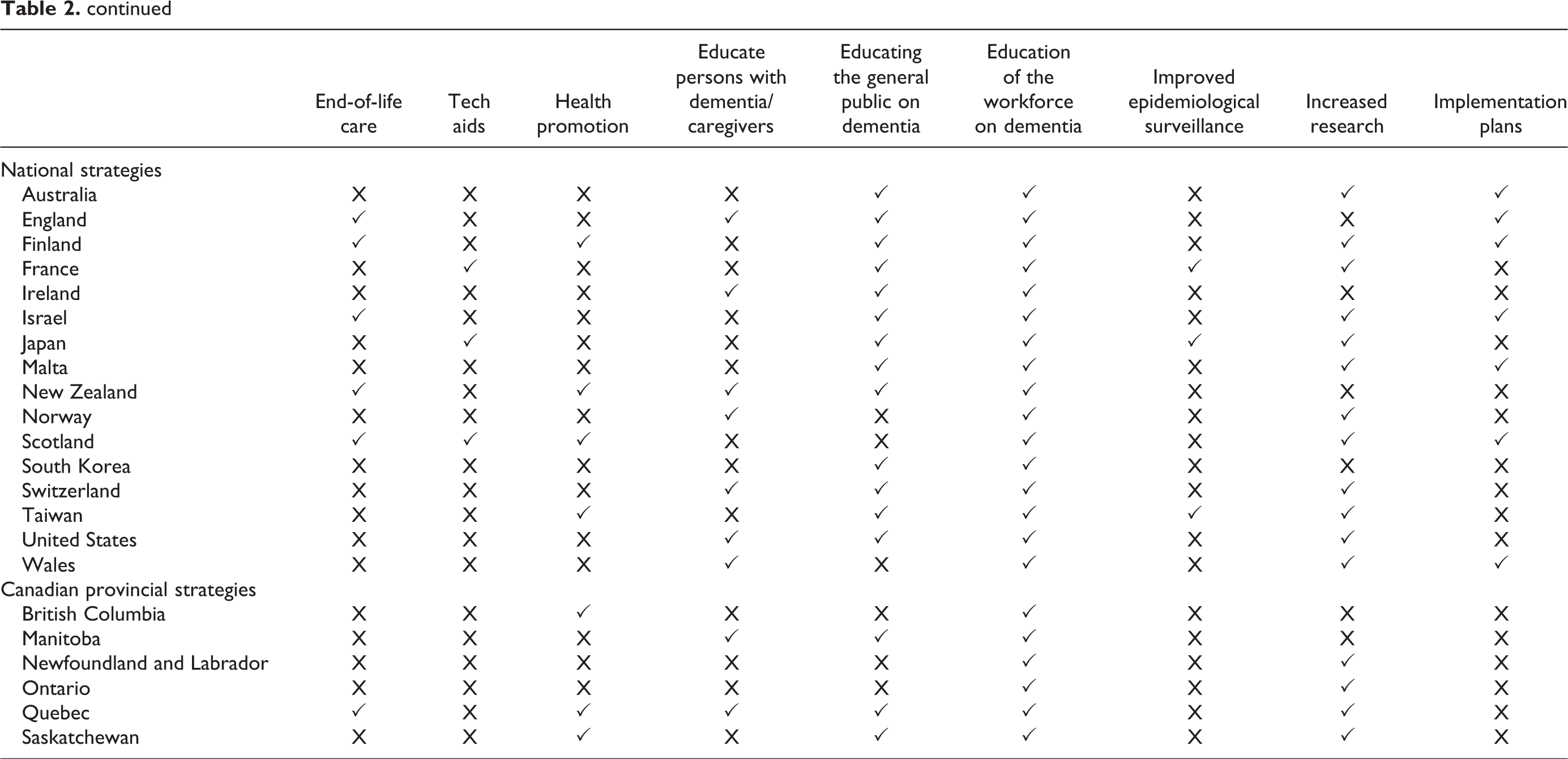
Dementia strategies from 16 countries (Australia, England, Finland, France, Ireland, Israel, Japan, Malta, New Zealand, Norway, Scotland, South Korea, Switzerland, Taiwan, the United States, and Wales) and 6 provinces (British Columbia, Manitoba, Newfoundland and Labrador, Ontario, Quebec, and Saskatchewan) were reviewed, analyzed, and themed. Analysis identified 17 strategic themes. Table 1 provides a listing of the themes in broad categories; Table 2 shows the countries and provinces for which each theme was highlighted. These themes are discussed in the following sections.
Strategic themes from 22 dementia strategies
Dementia strategy themes
Improved diagnosis and assessment
The theme of improved diagnosis and assessment occurred frequently, with only 2 of the 22 strategies not directly referencing the theme (1 national and 1 provincial). 4,5 The strategies described the importance of diagnosis and assessment to timely, efficient, and accurate interventions and for care to be better tailored to an individual’s specific needs. 6 –9 The actions proposed to improve diagnosis varied and included memory clinics or mandatory and specific training.
Improved access to care
Supporting easier access to needed care was a theme that occurred in all but two of the reviewed strategies (one national and one provincial), however, the suggested ways to improve access varied. 10,11 Proposed directions included single-point access, improved access for minority groups or rural areas, or equal care opportunities for persons with dementia compared to those with other chronic conditions. 6 –9,12,13
Improved care coordination and transitions
Care coordination was a theme in 17 of the 22 strategies (14 national and 3 provincial); these emphasized ensuring that all care providers and settings communicated with each other following an interaction with a person with dementia, allowing for seamless transitions between care settings and a less stressful care journey. 4 –9,11,12,14 –23
Person-centred care
Tailoring care to the specific needs and preferences of persons with dementia or their caregivers was highlighted in 9 strategies (7 national and 2 provincial). 4,8,10,12,18,19,24,25 –28 These strategies suggested an increased focus on including patients in their healthcare decisions, making them the central focus of care. 4,8,10,12,18,19,24,25 –28
Improved support and resources for persons with dementia
Nineteen of the 22 (14 national and 5 provincial) strategies discussed the importance of stronger community supports for persons with dementia that could provide practical and emotional support, reduce social isolation, promote self-care, and provide a source of information for future healthcare decisions. 4 –7,9,10,12,15 –30 Improving the support and resources available for individuals with early-onset dementia was a theme in 4 of the national strategies. 10,18,21,22,29 These frameworks stressed the importance of having resources and services available for individuals early in the course of the illness to better prepare them for future challenges and to inform them of services available. 10,18,21,22,29
Caregiver support
Improving support for caregivers was highlighted in 10 national and all 6 provincial strategies, recognizing that individuals with dementia are not the only ones affected. Many of these strategies suggest supports, such as access to respite services, coping strategies, and peer supports. 5,6,11,12,14,16 –20,23 –30
Housing/home support
Keeping persons with dementia at home for as long as possible and out of the healthcare/long-term care system was highlighted in 8 strategies (7 national and 1 provincial) that recommended increased home-based supports, including home modifications and a wider range of home care and rehabilitation services. 10,12,13,18 –20,23,29
Improved long-term care homes
Better accommodation of persons with dementia and their needs in long-term care homes was a theme that arose in 6 national strategies. 4,15 –18,25,26 These strategies stressed the importance of ensuring that long-term care homes were appropriately equipped to care for persons with dementia at all stages of the disease progression. 4,15 –18,25,26 Other proposed directions included increased hiring of specialist staff, dementia training for existing long-term care staff, improved design of facilities for safety and comfort; increased bed availability; and the addition of dementia-specific care units. 15 –17
End-of-life care
Appropriate end-of-life care for persons with dementia was a focus of 6 strategies (5 national and 1 provincial). 6,9,12,16,19,28 These strategies pointed to the importance of developing end-of-life care plans early in the course of the illness so that persons with dementia are actively involved in their care planning while they are still mentally capable. 6 The strategies also highlighted the importance of ensuring that their care at the end of life is appropriate for persons with dementia, as their needs may differ from those of individuals with other life-threatening chronic conditions. 6,9,12,16,19,28
Technological aids
Three national strategies supported the use of innovative technological aids for persons with dementia. 10,14,19 Assistive technologies within and outside the home were seen as having potential to enable persons with dementia to perform tasks they might otherwise be unable to do. 19 It was also noted that technology could be used to continuously monitor the changing needs of a person with dementia and to provide alerts and information to care sources that allow for informed and rapid response to risks. 19
Health promotion
Promoting healthy lifestyles and regular checkups with primary care practitioners was included in 7 of the reviewed strategies (4 national and 3 provincial). All of these strategies discussed their interest in health promotion initiatives to improve awareness of the benefits of healthy lifestyles and to reduce the risk of developing dementia. 9,12,18,25 –30
Education for persons with dementia and caregivers
Ten strategies (8 national and 2 provincial) supported education of persons with dementia and their caregivers on the syndrome and its progression and on the care best suited to their needs. 4,6,12,14,15,18,21 –23,28,29
Educating the general public on dementia
Fifteen (12 national and 3 provincial) strategies discussed the topic of educating the general public on dementia. 4,8,9,10,12,14 –17,23 –25,28,30 These recommendations were a response, in part, to significant stigma still surrounding dementia, often leading to isolation of persons with dementia and a decreased likelihood that the disease would be reported by family members or friends. 17
Education of the workforce on dementia
Increased education of the workforce on dementia was included in all 21 of the reviewed strategies. 4 –12,14 –30 Frameworks frequently cited the importance of informed and effective workforces; the goal of this theme was to promote and build a workforce with skills to care and support persons with dementia, their carers, and families throughout their care journey. 6 –8
Improved epidemiological surveillance
Improved epidemiologic surveillance was proposed in 3 national strategies to monitor prevalence and to identify priority needs for healthcare. 10,14,24
Increased research
Increased commitment to research on dementia was included in 16 strategies (12 national and 4 provincial), with the aim of supporting best practice, informing treatment, and finding possible cures. 4,5,8 –11,14,16 –22,24,28 –30
Implementation plans
Seven national strategies included implementation plans and steps. 6 –9,16,17,19 –22 These plans aimed to ensure that the strategies were seamlessly integrated into existing chronic care models and implemented in a way that ensured all goals had the best chance of being achieved.
Discussion
This review identified many recurring themes and found 17 themes that were reflected in at least 3 strategies. This illustrates the need for a multi-faceted response to dementia. It also illustrates that despite variation in needs across populations and geographies, there are many common priorities.
Two themes—improving diagnoses and assessments, and increasing access to care, were highlighted in 21 of the 22 reviewed strategies; all 22 strategies recommended some version of a third theme, improved education of the healthcare workforce. These themes have also been supported in other chronic disease strategies. 31 –33 Aside from the three most common themes, the frequency of other themes varied greatly (from 3 to 19 strategies). This reflects differences in national priorities, which may in turn reflect international variation in the needs of persons with dementia, and in the readiness of healthcare systems and societies to respond to the needs of persons with dementia. There thus remains a need for countries to undertake their own research, consultation, and priority setting processes in developing their national dementia strategies. We recognize that the health and social care delivery systems in each jurisdiction would have a significant bearing on dementia strategy development, however, a description and analysis of these themes are beyond the scope of this article. In terms of guidance from other national strategies, Canada’s efforts might be best informed by work done in countries with the most similar populations and health systems, such as Australia, England, New Zealand, and Scotland. A potential reservation for dementia strategy development is that this may be seen as providing too narrow a focus for policy and planning efforts, that is, it focuses on one chronic illness while older adults often experience multiple comorbid conditions. Without aiming to be comprehensive, we reviewed a number of other strategies relevant to older adults but not specific to dementia. We found that these strategies 34 –47 contained many similar themes, including prevention, early detection, and diagnosis; care coordination; educating the public; use of research; patient-centred care; and caregiver support. This is encouraging in that it suggests that efforts to improve care and support for persons with dementia should be consistent with efforts to improve care for other chronic illnesses.
This review has several limitations. First, only strategies published in English were incorporated, meaning some national strategies that could have influenced or introduced multiple themes were omitted. Second, documents retrieved for the review may have not contained all information or plans created for the strategy—supplemental or unpublished information may have suggested additional priorities. Third, the themes identified reflect our analysis of text found within the various strategies; although we made efforts to support reliability in our analyses, other reviewers may have made different interpretations. Finally, we have not undertaken primary research with the jurisdictions involved to learn about their implementation experiences, outcomes, or long-term impact; this would be a useful area for future research.
We found that few countries reviewed dementia strategies from other countries as part of their process. The strategic themes identified in this review may provide a useful starting point for the development of new national strategies or, alternatively, as a check to determine if important priority areas have been missed in strategy development.
The prevalence of dementia is increasing; this review found that many countries have responded with national dementia strategies, although the countries that generated the strategies represent only ∼10% of countries globally. 48 Although no national strategy has yet been developed in Canada, promising signs include Canada signing a G8 declaration supporting an international response to dementia and initiation of a dementia research strategy. 49 –52 It is likely that many other countries will develop dementia strategies in the near future; it is to be hoped that Canada will be among them.
Footnotes
Acknowledgments
The authors are grateful to project advisory group members Elizabeth McCarthy, Dr. Michael Borrie, and Dr. Lisa Van Bussel and appreciate the support of other members of the Geriatric Health Systems Research Group. The authors thank Mia Papasideris for her assistance in editing the manuscript.
Funding
This work was supported, in part, by a grant from St. Joseph’s Health Care London (funded by Behavioural Supports Ontario) to develop a dementia strategy for the South West Local Health Integration Network in Ontario.