







Abstract
Mentorship plays an important role in supporting the career development of health leaders. An examination of mentorship programs in different organizational settings provides a frame of reference to discuss and explore personal and professional mentorship experiences. Specifically, between October 2015 and April 2016, the Emerging Health Leaders (EHL) National Health Leadership Conference (NHLC) working group collaborated on an environmental scan of mentorship programs and activities to understand innovations in mentorship. In April 2016, EHL Toronto developed a mentor feedback survey using the LEADS in a Caring Environment framework to capture the varied experiences of mentors engaged in EHL Toronto’s past mentorship events. A summary of this data presented at the 2016 NHLC situates a discussion on the highly interconnected and iterative nature of mentorship and leadership development in career progression. Mentorship is seen as a continuous journey of discovery, shared learning, and personal and professional development to achieve leadership excellence.
Introduction
The context for the mentorship imperative in health
A new perspective on leadership excellence and career development in health is gaining momentum as health leaders at all levels become valued 1 from emerging to existing and from seasoned to newly graduated leaders. One recognized Canadian leader highlighted the importance of health leaders who can balance self-management and personal health, resilience, optimism and curiosity to face today’s leadership pressures and landscape of change and uncertainty. 2 By sharing fundamental lessons learned and providing guidance from past experience and expertise, leaders can build a solid cultural foundation that spurs personal and professional development and drives people to take the necessary initiative to create change and enjoy the benefits of effecting improvement. 3
This article examines how mentorship can support leadership development and leadership excellence in health and healthcare. It reflects formal and informal conversations regarding mentorship with emerging and established leaders and draws on the authors’ experiential knowledge of mentorship as well as work with the Canada-wide Emerging Health Leaders (EHL) network. The discussion begins with a summary of mentorship data presented at the 2016 National Health Leadership Conference (NHLC) then draws on the authors’ experiences as emerging and experienced leaders and mentors and mentees to present mentorship and leadership as a highly interconnected, iterative process. Selected literature is included to further extend these reflections. Throughout the discussion, readers are invited to reflect on their own careers and consider how their engagement in mentorship has informed or may continue to have an impact on their leadership growth.
In this article, mentorship is defined as the development of emerging leaders by established leaders. It is seen as uniquely effective in informing an understanding of how organizations operate and supporting individuals to maximize opportunities for growth and development. 4 Through engagement in mentorship for career guidance and support, the literature shows that both mentors and mentees find it greatly rewarding, further boosting motivation. 4 This differs from a coach, whose focus is on performance improvement and skill development using clear performance-based goals. 5 A mentor could include coaching in how they model, teach, advise, motivate, and inspire as they provide psychosocial support for personal and professional development. 5
EHL’s assessment of mentorship activities
In preparation for the panel discussion on mentorship at the 2016 NHLC, EHL nodes collaborated to share, discuss, and assess different aspects of mentorship programs and activities. Seven EHL network leaders came together in October 2015 to form the EHL NHLC Working Group (WG) and conduct an environmental scan of organizations offering mentorship programs and EHL-led mentorship activities. In April 2016, feedback was solicited from mentors previously engaged in the EHL Toronto node’s (EHLTO) past mentorship events. What follows is a summary of the findings from this work, which informed the NHLC panel session.
Environmental scan: Methods and findings
Between October 2015 and April 2016, the WG conducted an environmental scan of mentorship programs to understand innovations in mentorship. As part of the scan, EHL sought to identify and summarize key features of organizations offering mentorship programs as well as mentorship-oriented activities organized by EHL nodes. Organizations were identified by the WG based on personal and professional experiences and knowledge of specific mentorship programs.
Recognizing that mentorship was not unique to health or healthcare and innovation in mentorship could come from anywhere, the WG considered programs from many industries and sectors. The scan reviewed a total of 18 mentorship programs, 8 within healthcare and 10 from outside the health sector. The settings included 3 government divisions, 5 academic institutions, 4 professional associations, 4 not-for-profit organizations, 1 hospital, and 1 private for-profit organization. Geographically, 15 programs were Canadian-based (2 Western provinces, 5 Ontario, 3 Maritime provinces, 1 territory, and 4 national) and 3 were internationally-based (2 United States, 1 United Kingdom). The target audience for these programs included students (7), individuals early in their careers (2), mid-career professionals (1), self-identified peers (2), young female entrepreneurs (2), and all leaders or anyone looking for mentorship (5).
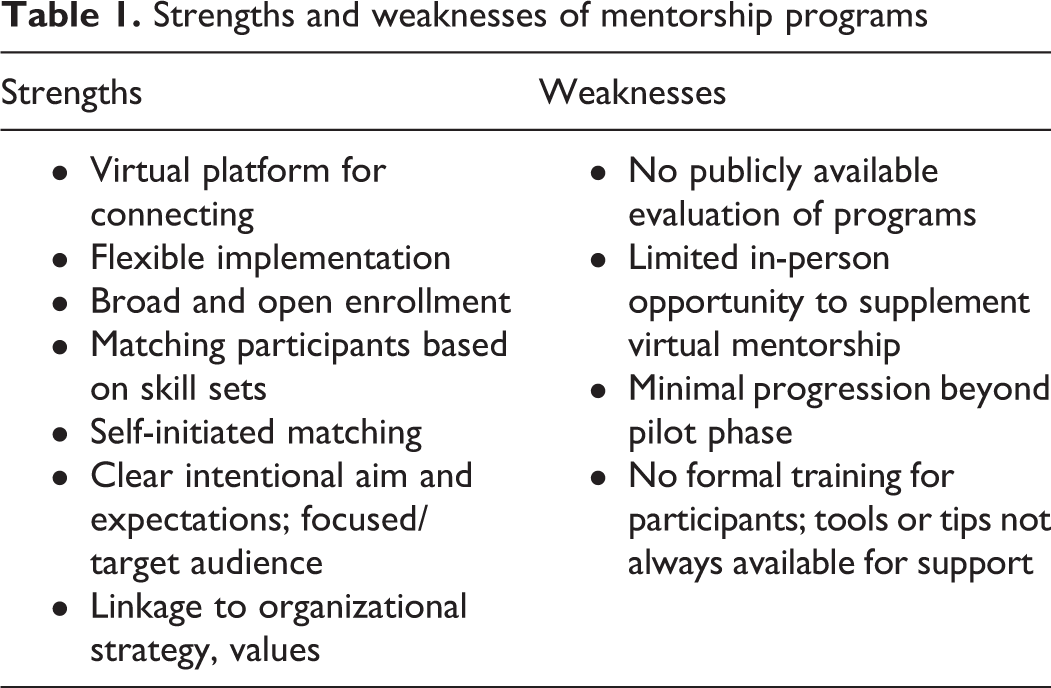
Each identified organization was assessed by the WG for strengths and weaknesses in their program objectives, target audience(s), activities, and reported impact. Overall, common objectives included affecting program change (38.9%), ensuring development of inter-professional competencies (50%), and connecting the target audience with alumni or experienced professionals (38.9%). The WG found no single mentorship program was better than the others, but strengths and weaknesses were helpful to understand mentorship innovations (see Table 1).
Strengths and weaknesses of mentorship programs
Following the scan, EHL-led mentorship activities were examined in March 2016. The existing 7 EHL nodes at that time (i.e., Toronto, Montreal, Calgary, Edmonton, Vancouver, Ottawa, and Nova Scotia) were assessed using open-ended survey questions to understand mentorship-oriented events and activities offered across Canada.
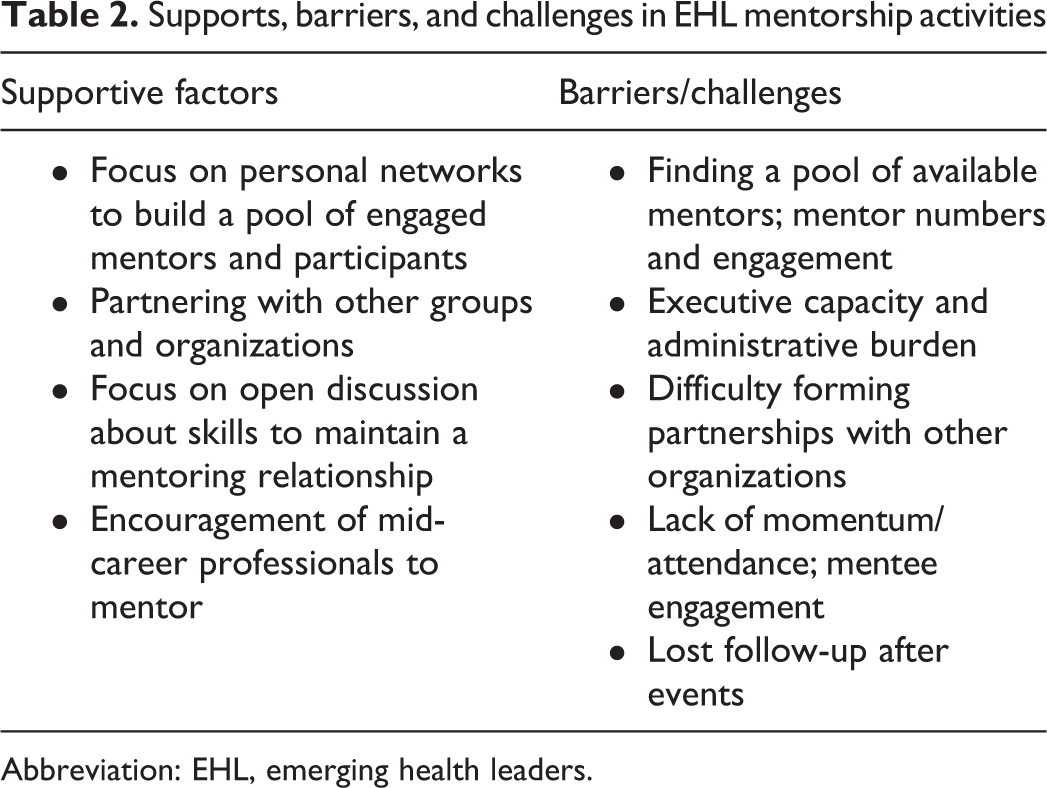
Mentorship initiatives varied at different stages of development as each node had evolved their approach to meet local membership needs while considering capacity constraints and resources. Four nodes (57.1%) had undertaken formal mentorship programs or repeated mentoring activities wherein 2 (29.6%) formally matched participants, 2 (29.6%) facilitated opportunities for self-matching through mentorship-focused events, and 2 (29.6%) developed resources to guide or enhance the mentoring relationship. One node (14.3%) experimented with a national, on-line program but reported low participation and reverted back to locally based connections. One node (14.3%) was working towards peer-to-peer mentoring. None of the nodes had a formal mentorship strategy. The reported factors supporting the activities of the nodes actively engaged in mentorship activities as well as barriers and challenges in starting and sustaining them are summarized in Table 2.
Supports, barriers, and challenges in EHL mentorship activities
Abbreviation: EHL, emerging health leaders.
Overall, the WG found models of mentorship varied considerably and accessing the model of choice engaged individuals differently throughout their career. Mentorship required reciprocity in the relationship where mentors and mentees were equally engaged. Innovation and creativity in how the mentorship relationship unfolded depended on mentor preparedness to mentor and mentee expectations in being mentored.
The EHLTO mentor survey
In April 2016, EHLTO developed a mentor feedback survey informed by the LEADS in a Caring Environment framework, 6 specifically including one question related to the domains for Leading Self and Engaging Others. The survey had nine questions whereby five used a 5-point Likert scale to assess the effectiveness of mentor’s participation in enabling their own leadership growth, preparedness and ability to engage participants, expectations and comfort throughout the experience, and assessment of the overall organization of the events. The remaining questions were open-ended questions regarding the participant’s experience as an EHLTO mentor. A total of 21 mentors who had participated in past EHLTO mentorship events were sent the survey with no identifying or demographic information collected. Of those, 10 responded for a response rate of 47.6%.
Overall, mentors reported their participation in mentoring events contributed to their own leadership development (9, 90%). All (10, 100%) were comfortable sharing their experiences to foster the development of mentees, reported being prepared and able to engage mentees, and had their expectations met throughout their experience. Themes from the open-ended questions were that mentors valued opportunities to participate in developing tomorrow’s leaders and the pace and organization of speed mentoring events offered an excellent opportunity to meet a variety of mentors and participants. Mentors offered ideas for improvement including the use of themes or specific topics and suggested other forms of mentorship events including on-line tools and as part of other conferences and seminars.
Summary
Findings from EHL’s environmental scan and feedback from EHLTO’s past mentors suggested engagement in mentorship was beneficial throughout one’s career. Many ideas for innovation in mentorship exist (e.g., different virtual platforms and flexible implementation). Although emerging leaders actively pursued professional development opportunities, commitment from senior leaders was necessary. The EHL nodes have sought to translate mentorship theory into practice with some success; however, barriers in senior leadership engagement and node capacity limited activities. The EHLTO mentors reported that mentorship provides access to networks of learning where leadership development can occur for mentors and mentees. Considering this, the authors draw on their own experiences with mentorship to discuss how mentorship can practically drive leadership excellence and career development.
Examining the mentorship and leadership development relationship
To understand the relationship between mentorship and leadership development, the authors examined formal and informal mentorship experiences at different stages in their careers. For example, engaging in speed mentorship events provided unique opportunities to meet with multiple mentors and connect with a variety of emerging leaders. By facilitating opportunities for initial connection in this way, emerging leaders were supported in overcoming self-doubt and networking fears and building confidence to subsequently develop longer lasting mentoring relationships. Providing support, as described in the literature, through access to events such as workshops, seminars, or conferences or less formal education through committee involvement, working groups, and special projects were also excellent strategies for education, equal participation, and expansion of professional networks. 7 Effective leadership development further occurred by participating in mentorship programs that included intra-organization or external secondments, internships, or residencies. 2 One extra-organizational mentorship pilot led to the development of a national mentorship program in Canada and extended the reach of a wide organizational development strategy at a major hospital in Toronto. 4
Reflecting on past mentorship experiences, personal leadership abilities and capacity were highlighted through one author’s experience observing a 4-day organizational event as an external volunteer. With no accountability or affiliation at the time, the experience made it possible to see when participants started to feel unsafe, look for when conversations became crucial, 8 recognize potential personality conflicts, and watch the bigger picture unfold. By working to ensure people felt safe and secure in sharing personal reflections and testing assumptions, the aim was to provide the help necessary for team members to grow and evolve as the literature recommended. 1 Personal leadership growth occurred in practicing how to influence the culture and environment while learning to let go of control and hold back the urge to take any direct action on the part of the individual.
That experience led to actively seeking opportunities for leadership development by focusing on leadership competencies through cross-training. 5 This is an approach described in the literature where individuals who delved deeper into technical manuals may limit their growth whereas those who focused on complementary skills such as communication reinforced their technical expertise to others. 5 Although leadership competencies can be identified in many ways, how others view leadership competencies was important because of the effect a leader can have on individual, team, and organizational performance. 5
Mentors and mentees
The authors’ reflections of past mentorship experiences indicated that the most encouraging mentoring relationships had more equal sharing of experiences between the mentor and the mentee. This is reiterated in reports that an emerging leader may feel comfortable moving into top management and greatly expand the reach and impact of senior leadership when both parties recognize a mutually beneficial alliance. 5 The literature also suggests relationships with mutual purpose, where all parties believe the other person truly cares about their goals, interests, and values, provide a healthy climate for dialogue and good reason to continue a mentoring relationship. 8 Staying in a mentoring dialogue requires mutual respect, which was described in the literature as something most do not consider until it is taken away. 8 Productive mentoring furthermore demands candor in admission of mistakes and revelation of fears, doubts, and limitations with an explicit covenant of confidentiality. 5
The literature maintains that finding a mentor or mentors is just the beginning of each mentorship experience because the relationship(s) must be consistently nurtured and periodically refreshed. 5 This responsibility often falls on the recipient. 5 In reflection, this onus of responsibility and sense of ensuring value for the mentor without knowing how best to carry it out in the relationship was uncomfortable and perplexing. As a mentee, it was difficult to know whether the relationship was going well and if not, how to improve on it. The literature supports the authors’ experiences in stating this responsibility rests with the mentee when it comes time to re-evaluating a relationship, 9 which the authors argue either the mentor or the mentee could initiate. The literature also notes there should be no feelings of guilt in wanting to end a relationship as not every mentoring relationship would last forever, but exercising diplomacy with confidence, humbleness, and gratefulness was paramount. 9
Leadership development occurred in one mentorship experience focused on the skills used as a mentor and as a mentee such that both parties moved back and forth between the two roles within one relationship. As an emerging health leader, engagement in mentorship morphed into being both a mentor and a mentee. The literature supports this development as it argues the best demonstration of leadership ability is to harness and grow emerging talent. 5 The most outstanding Chief Executive Officers (CEOs) in the reported literature valued emerging leaders who asserted genuine concern for what was best for the organization. 5 These CEOs reported that doing the right thing was reward in itself, both psychologically in the short run and professionally in the longer run. 5
Emerging and established leaders
Today’s emerging leader does not suffer from a lack of choices in career goals but rather an overabundance of options and a desire to pursue all possibilities. This can be challenging for an individual who does not want to choose between goals and has difficulty picking the right goal and working towards it. At the same time, attempting to do everything can cause disorientation and lead to disengagement. This act of choosing the right career goal is, inherently, a key component of leadership.
At each stage of a career, the patience and generosity of mentors can provide an instrumental vision and nurture leadership development. Continuous reflection at different points along a career path reveals health leadership as a journey where partnership is imperative and mentorship, an iterative art. The seemingly simple act of reflection and sharing presented new challenges for the authors’ personal growth and professional development that would not have been possible without mentorship. By engaging purposely in mentorship, individuals enrich their own leadership experience at every stage of their careers and can reach their highest potential for success.
The mentorship imperative for health leadership—A call to action
Mentorship is about relationship building and that is of utmost importance in the health sector. Whether working with patients to provide healthcare or collaborating with colleagues for the improvement of an organization or health system, the ability to build strong relationships lies at the heart of success. Engaging in mentorship consistently and purposely throughout one’s career is a necessary imperative for leadership development.
It is critical for all leaders to broaden their perspective of mentorship and create a network of mentors and mentees through formal and informal learning opportunities, practice, and self-reflection. The keys to effective mentorship are mutuality in purpose between mentor and mentee, commitment to shared learning, and ongoing review and calibration of career goals and learning objectives. Organizations should support mentorship activities with a focused approach for leaders at different stages of their careers and partnerships with networks like EHL. This can be enhanced with ongoing evaluation of mentorship programs and sustained investment of time and energy in leadership development activities. Through mentorship, leaders can thrive personally, help strengthen leadership capacity across the system, and contribute to leadership excellence.
Footnotes
Acknowledgments
The authors wish to thank Georgia Carstensen, Caroline Marshall, Melisa Foster, Lindsay Burke, Jennifer Pougnet, Theresa Tang, Ian Wombwell, and Janet Law who graciously formed the working group and panel on Innovative Pathways to Mentorship for the 2016 National Health Leadership Conference. We are grateful to the Emerging Health Leaders network, in particular Alexandra Harris and Robert Fraser, for their eagerness to engage in mentorship, the willing partner organizations providing opportunities for mentoring, and the generosity of mentors who have and continue to mentor emerging leaders. The discussions and experiences with all of these have contributed to the development of this article.