







Abstract
The aim of this article is to present the early history of Hyundai Heavy Industries, currently the world’s largest shipbuilder. The company was established by the prolific South Korean entrepreneur Chung Ju-Yung in the early 1970s. Due to limited experience in shipbuilding, the establishment relied heavily on foreign assistance. This article sheds new light on the crucial relationship between Chung and two British companies: the Newcastle-upon-Tyne-based consulting firm A&P Appledore International Limited, and the Lower Clyde shipbuilders Scott Lithgow Limited, during the beginnings of large-scale South Korean shipbuilding. The article is based on a combination of British and South Korean archival sources, as well as secondary literature and the oral and written testimony of consultants and workers involved in the project.
Few, if any, commentators in the 1960s and early 1970s would have predicted that South Korea would become a major player in world shipbuilding. By the mid-1990s, however, the country held twenty-five per cent of the shipbuilding market, with the Hyundai Heavy Industries (HHI) facilities at Ulsan having become the world’s largest shipyard. 1 This feat bore testimony to a nexus of private entrepreneurship and timely government support. The role of shipbuilding in South Korea’s economy in its early growth phase, and the industry’s subsequent success, has been the subject of some academic enquiry in English. 2 Still, the initial years, when world-class shipbuilding facilities were established at Ulsan through the entrepreneurship of Chung Ju-Yung (1915–2001), the founder of the Hyundai group and HHI, are not as well documented. 3
In addition to his entrepreneurial spirit and the backing from the South Korean authorities, Chung’s venture into shipbuilding relied on assistance from abroad. This article sheds new light on the role of the consulting firm A&P Appledore International Limited of Newcastle-upon-Tyne, and the Lower Clyde shipbuilders Scott Lithgow Limited, during the crucial early stages of large-scale South Korean shipbuilding at Ulsan. 4 It is based on British and South Korean archival sources, as well as secondary literature and the oral and written testimony of consultants and workers involved in the project. 5
The South Korean economy in the 1960s
During the 1950s, and for much of the 1960s, South Korea’s leading manufacturing sector was labour-intensive cotton spinning, weaving and apparel production, aided by tariffs, quotas, export subsidies and subsidized credit. Following the 1961 military coup d’état, the avowedly anti-communist Major General Park Chung-Hee (1917–1979) ruled as Head of the Supreme Council for National Reconstruction, until his election and inauguration as President of the Korean Third Republic in 1963. 6
Under Park, South Korea introduced its first five-year economic development plan (1962–1966), which focused on import substitution. The next five-year plan (1967–1971) was designed to develop the steel, heavy engineering and chemical sectors as the main engine for growth and the expansion of exports. The government’s ownership and control of the banking sector allowed the provision of domestic loan capital on declared policy lines, and the provision of repayment guarantees to foreign financial institutions on loans extended to Korean firms. These measures, inter alia, allowed the state to exercise discipline over private enterprise. Park also envisaged the promotion of a small cadre of entrepreneurs to drive large-scale industrialization forward. Crucially, this took place through state oversight, forward planning and co-ordination, without stifling entrepreneurial activity. 7 State development of infrastructure, construction and power were key to the expansion of industry.
South Korea’s economic performance was impressive. From 1966 to 1971 the annual growth rate of gross national product (GNP) averaged eleven and a half per cent, while exports increased at an average rate of thirty-three per cent annually. 8 Rapid industrial growth had been achieved largely at the expense of agriculture, whose contribution to GNP declined from forty to twenty-six per cent from 1966 to 1971. In terms of international competitiveness, with an abundant and relatively cheap labour force, exports were crucial, and therefore investment and trade policies were interlinked. Industrial, rather than primary, products came to symbolize the fast development of the South Korean economy.
The first two five-year plans laid the platform for South Korea’s impressively rapid industrialization in the 1970s. The third five-year plan (1972–1976) highlighted shipbuilding and five other industries: iron and steel, petro-chemicals, non-ferrous metals, machinery production and electronics. All of these industries had upstream and downstream linkages, contributing to the development of other sectors. In shipbuilding, the plan envisaged South Korea being in the top ten shipbuilding countries by 1980. Indeed, the country was geographically endowed with sites favourable to the development of shipbuilding and ancillary industries. Government policy was to build five or more large-scale shipyards, each with an annual capacity of one million gross tons, two-thirds of which would be for export, in addition to two small and medium-sized shipyards, by 1980. 9
The protracted birth of Hyundai shipbuilding
Chairman Chung’s first attempt to establish shipbuilding facilities in South Korea occurred in the mid-1960s, before the government’s decision to promote the industry. The basis for his interest was a business trip to Japan, where he, with his associate C. R. Lee, visited the facilities of shipyards in Yokohama, Kawasaki and Kobe. 10 His experience there convinced him to pursue this project.
At first, Chung’s efforts to construct a shipyard at Ulsan faced seemingly insurmountable hurdles. Korean shipbuilding, although it had a long history, had barely registered on the international output tables, and the country had only one shipbuilder of any note, the formerly state-owned Korean Shipbuilding and Engineering Company (KSEC). 11 Although Hyundai was experienced in civil engineering projects and had ambitions to be a major manufacturer of motor vehicles, it had no track record in shipbuilding, a capital-intensive industry with high entry barriers, particularly for sophisticated ships. This was not necessarily fatal to Chung’s ambitions to construct a shipyard from scratch and to build simpler ships such as very large crude oil carriers (VLCCs). Clearly, his company could construct the shipyard and sundry facilities, and import the necessary Western human resources, technological knowhow, and plant and equipment to build ships. However, domestic capital was limited and high interest rates on loans prevailed. Before he could even begin to realize his ambitions, Chung therefore required overseas loan capital and access to expertise. He faced the unenviable tasks of borrowing money for an as yet unproven enterprise, and, if he achieved this unlikely target, he needed to secure sufficient orders to make it viable.
Chung’s early attempts to raise the necessary capital through a joint venture approach with Mitsubishi of Japan, and North American interests, foundered over management control. 12 Chung then focused on Middle Eastern and European sources of capital, linking up with representatives of the Israeli reefer line Maritime Fruit Carriers (MFC) and the Norwegian yard Aker. According to Hyundai’s official history, negotiations got off to a good start and a joint venture agreement, whereby Hyundai was guaranteed profits, was signed. However, the insistence of the foreigners on managerial control of the proposed shipyard proved unacceptable to Chung, although the Korean Government urged him to accept. 13 Accordingly, after some legal manoeuvring, Chung had withdrawn from the joint venture by the summer of 1970. The collapse of the deal was a blessing in disguise for Hyundai, because in the 1970s both MFC and Aker had serious financial problems, and their assurance of guaranteed profits would have been worthless.
Chung again visited Japan in an attempt to re-engage Mitsubishi, but to no avail. He also initiated talks with Kawasaki. The fact that Chung persisted in talks with Japanese firms has to be seen against a tide of Japanese scepticism (largely for nationalistic reasons) that large-scale shipbuilding in Korea was a viable proposition. In 1969, with the co-operation of the Korean Government, the Japanese Government had dispatched a team of experts to test the feasibility of large-scale shipbuilding in South Korea. The team, headed by Bureau Chief Akasawa of the powerful Ministry of International Trade and Industry, had reported that shipbuilding would not be viable. On this basis, the Shipbuilders Association of Japan rejected any idea of a joint venture with a Korean company. 14 The Japanese refusal was another blessing in disguise for Hyundai. If the company were to have been tied up with a Japanese shipbuilder under a joint venture agreement, it would probably have ended up as a subcontractor of the latter without being allowed to compete.
Chung nevertheless remained determined and switched his business strategy from a joint venture approach towards attracting foreign loan capital to raise the necessary funds to build the shipyard. Although his initial plan was to construct crude oil tankers up to 200,000 dwt, Chung revised this upwards to 500,000 dwt, which would require the provision of much larger building facilities. He was well aware of market trends towards the deployment of larger ships to further reap economies of scale, and the fact that seventy-five per cent of all new ship orders were for oil tankers. Chung, who had first planned the construction of a shipyard in 1967, then took the plunge and bought the land for his proposed shipyard at Ulsan in 1970. 15 At the same time, his focus switched to Europe to attain the bulk of funding necessary for its construction. His original plan stipulated $63 million for start-up costs, of which he would require $43 million in overseas loan capital. The remaining $20 million would be met by domestic financing – $10 million from Hyundai Construction and an identical amount from government. 16
Chung opened a London office in March 1971 and realized that the best approach to obtaining the necessary loan capital would be through a consortium of lenders rather than an individual institution or bank. In the following months, he found it difficult to persuade risk-averse institutions that he could in fact build ships. However, he was successful in raising funds in France and Spain, on the basis that he would purchase plant and equipment from companies based in these countries, a form of sellers’ credit backed by banks. Later, on the same basis, he persuaded banks in West Germany and Sweden to do likewise. 17 Chung’s efforts to obtain loan capital in the United Kingdom were eventually enhanced by an unlikely concatenation of happenstance, perseverance and shrewdness. After the severed alliance with the Israeli–Norwegian interests, Chung met with representatives of the West German shipbuilding giant A. G. Weser, who demanded $5.8 million for design and consulting, as well as a commission on ship sales of five per cent of the ship price. These terms were not acceptable to Hyundai. 18 He then met with Charles Brook Longbottom (1930–2013), a former Conservative Member of Parliament, and then chairman of the Sunderland shipbuilders Austin & Pickersgill. Longbottom was an important man in British shipping; he was also chairman of a newly formed shipyard design and shipbuilding consultancy firm based in Newcastle-upon-Tyne, A&P Appledore International (APAI), as well as a board member of the tanker specialist ship-broking firm Seascope Holdings Limited from 1970 to 1982. 19
A&P Appledore International Limited
The antecedents to the formation of APAI began with a meeting at Malta Dry Dock between Anthony Mackesy, who was in charge of the overseas ship repair interests of the river Tyne shipbuilders Swan Hunter, and Peter Nash, PA to the Chairman of the Maltese government-administered dock. As a result, Nash joined Swan Hunter and was involved in the management of its overseas yards. Mackesy then joined the fast-growing conglomerate Court Line to develop their ship repair interests and also their overseas interests. 20 Mackesy and Nash subsequently developed the concept of a consultancy company, which attracted investment from two companies. The first was London and Overseas Freighters, the owners of the Sunderland shipbuilders Austin & Pickersgill. The second was Court Line, owners of the North Devon-based Appledore shipbuilders.
A&P Appledore International was formed on 15 January 1971 as a private limited company with a share capital of £20,000, fifty per cent of which was owned by the Court Line conglomerate, forty-five per cent by London and Overseas Freighters, and the remaining five per cent by Stanley Sedgwick, a director of London and Overseas Freighters. With Austin & Pickersgill’s chairman, Charles Longbottom, as President and Anthony Mackesy as Managing Director, the first employees of APAI were Peter Nash, and Michael Makin of Court Line as Company Secretary. Court Line also gave the company a small space for administrative purposes at its London office in Theyer Street. 21 Consultancy work was enhanced through the participation of Jim Teasdale, senior lecturer in shipbuilding technology at Newcastle University and formerly Chief Designer and Naval Architect at Furness Shipbuilding. Another driving force was James Venus, head of Court Line’s shipbuilding division, who became a director.
The Hyundai connection was first established by an advertisement placed by APAI in the trade newspaper, Lloyd’s List, which caught the attention of Chung, who at that stage was in the process of negotiating the Israeli–Norwegian joint venture. 22 Following the collapse of this deal, Chung and his technical staff, suitably impressed by APAI’s credentials, visited Newcastle and met with APAI directors at the Gosforth Park hotel. Among those present were Roger Vaughan and Melvin Hargroves, who both worked for Swan Hunter’s development department, and who were keen to join APAI once a major contract had been won. 23 During this visit, Chung was dissuaded from visiting APAI’s technical office as it did not yet exist, although the hosts picked him up at the airport in a rented limousine to try to convince the Koreans that they were serious contenders for the contract. By the time of his next visit, however, office space had been rented at Bulman House in Gosforth. Consequently, in September 1971, Chung signed a consultancy agreement for design, technical support and sales with APAI. 24
APAI’s remit covered market research and marketing through the ship brokers Seascope, 25 project development, shipyard design and detailed engineering, operating systems development and implementation, recruitment of top management from overseas for limited periods, and training of the workforce. As Hyundai had no ship design capability, APAI approached the Lower Clyde shipbuilders Scott Lithgow Limited, to provide technical drawings and training support to Hyundai personnel for the construction of VLCCs to a Scott Lithgow design. Scott Lithgow built a series of four VLCCs in two halves, later to be joined up by welding the fore and aft sections of the ship together afloat. 26 Any alteration of the design was the responsibility of Hyundai. 27 According to Hyundai’s official history, the contract with APAI cost $1.7 million, with a commission on ship sales of 0.5 per cent of the ship price. 28 This agreement would become effective on the date of its approval by the Korean Government. However, before this was obtained, APAI’s negotiations with Scott Lithgow were leaked to the British press, with Hyundai anxious that its name was not mentioned. 29
The Hyundai contract is illustrative of the range of services APAI was able to offer at that time. Market research established the types of ships to be built and the shipyard was designed around these types. The facility design related very closely to the block breakdown of the ships, which determined sizes and weights of components to be assembled at each stage of production. Equipment was specified and procured, largely in Europe. APAI participated in the development of operating systems for the yard and provided experienced expatriate managers to help the yard through the start-up phase.
With most practicalities solved, the remaining key issue was finance. Earlier, Chung had asked Charles Longbottom to recommend the Ulsan shipyard project to Barclays Bank International. Longbottom was initially unconvinced, but travelled to Korea and formed a good impression of Hyundai’s capabilities. On the back of the consultancy agreement signed by Chung and Longbottom on 10 September 1971, 30 which would in time make and enhance the reputation of his nascent consultancy firm, he agreed to recommend Chung’s project to Barclays Bank, who, in turn, saw Hyundai as being creditworthy and able to repay loans. Barclays resolved to lend Hyundai Construction the requisite amount needed on 27 October 1971. In the same month similar loans were signed with Spain and France, and in November with West Germany. All of these loans were validated by the Korean Government in December 1971. 31 Later, a loan agreement was validated and signed in Sweden in March 1972 (see Table 1).
Details of the consortium of international loans for the Hyundai shipyard.
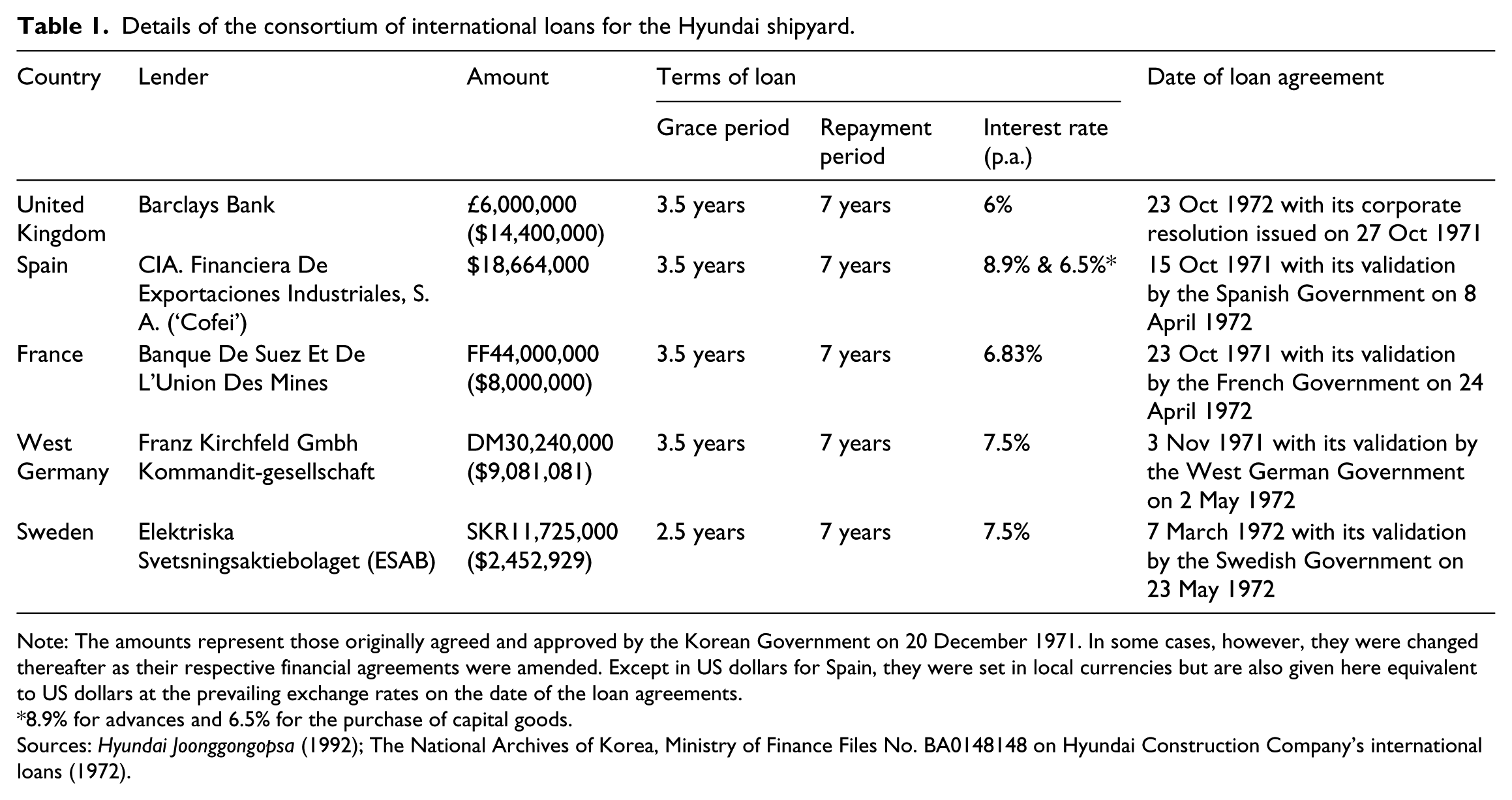
Note: The amounts represent those originally agreed and approved by the Korean Government on 20 December 1971. In some cases, however, they were changed thereafter as their respective financial agreements were amended. Except in US dollars for Spain, they were set in local currencies but are also given here equivalent to US dollars at the prevailing exchange rates on the date of the loan agreements.
8.9% for advances and 6.5% for the purchase of capital goods.
Sources: Hyundai Joonggongopsa (1992); The National Archives of Korea, Ministry of Finance Files No. BA0148148 on Hyundai Construction Company’s international loans (1972).
The Export Credit Guarantee Department and a search for a shipowner
Barclays Bank understandably required a financial guarantee against loan default by Hyundai. The bank therefore approached the appropriate government agency, the Export Credit Guarantee Department (ECGD), to guarantee its proportion of the consortium’s loan. 32 The ECGD expressed reservations over how Hyundai, with no experience in shipbuilding, with no real domestic demand, and an inability to offer suitable credit packages to attract orders from foreign ship owners, could hope to prosper. ECGD approval was therefore predicated on Chung confirming and producing contractual evidence that a reputable ship owner or firm was willing to pay Hyundai to build ships at Ulsan. 33
To this end, Charles Longbottom introduced Chung to a ship broker friend, Hugh Sykes, of Seascope, who, in turn, informed Chung that the Greek ship owner George Livanos was looking for a low-priced oil tanker. Chung, who was in a weak bargaining position, met the latter in St Moritz, Switzerland, in mid-October 1971. With Sykes in attendance, Chung opened the negotiation process with an offer to build two super tankers (260,000 dwt each) to the Scott Lithgow design, for a combined price of $72 million. According to Hyundai’s history, Livanos offered $62 million on the proviso that both ships were delivered within two years and six months of the signing of a contract, and if they were not delivered in the stipulated time then Hyundai would repay the already paid instalments with interest. 34 The contract was signed between Chung and Livanos on 10 April 1972 in St Moritz. The terms of the initial payment were five per cent paid respectively on signing, commencement of prefabrication, when the keel was laid, and launching. Thus, Hyundai would only receive twenty per cent of the purchase price before delivery. 35 Livanos, through his North Ocean Shipping Co. Ltd subsidiary of Monrovia, Liberia, paid the first instalment of five per cent agreed in the contract on 28 April 1972. He also required Hyundai to open a letter of credit to provide security for repayment of the instalments in the event of their default in the performance of the contract. 36
Apprised of the contract, the ECGD eventually offered a financial guarantee to Barclays and a loan agreement was finally signed on 23 October 1972 for £18,423,530. 37 That a financial guarantee on this scale was offered was indicative of the ECGD’s positive attitude to the prospects of the South Korean economy. By this stage, the country was already the ECGD’s largest market in Asia. Nonetheless, the UK share of South Korea’s imports was under three per cent, compared with sixty-seven per cent supplied by Japan and the USA combined. Clearly, in the matter of export guarantees as a matter of trade policy, the ECGD was keen to further grow its business with South Korea and with Hyundai in particular. 38
Scott Lithgow Limited
Located at Greenock and Port Glasgow on the lower reaches of the River Clyde, Scott Lithgow Limited, which employed around 8000 men at the height of production, was the result of a merger officially concluded in February 1970 between Scott’s Shipbuilding and Engineering of Greenock (est. 1711) and Lithgows Limited (est. 1874) of Port Glasgow. 39 Lithgows’ relatively new Glen Yard was the locus of the merged firm’s VLLC tanker building operation. However, owing to the proximity of a major road, the firm was unable to build VLCCs in one operation, and elected to build in two halves on a sloping concrete mat straddled by a 225-ton Goliath gantry crane, and to join the fore and aft sections by welding them together on the water.
Although Scott Lithgow had grandiose plans to build a giant dry dock to allow a better method of construction, the expense of doing so had been considered prohibitive, and without government support in funding it was beyond the resources of the firm. 40 In comparison to Hyundai, Scott Lithgow had a far greater product mix and technological capability, but its approach to building VLLCs in two halves ultimately proved commercially unsuccessful.
Scott Lithgow was one of only three United Kingdom shipyards capable of constructing VLCCs of 250,000 dwt and over, but the others – Swan Hunter and the Belfast firm Harland & Wolff – did not have to resort to building in halves. Still, the VLCC market was dominated by Scandinavian, continental European and, in particular, Japanese yards. Indeed, taken together, the three UK yards did not have the combined annual capacity of a single Japanese shipbuilder, Mitsubishi. 41 British shipbuilding had long been in serious trouble relative to its competitors, especially Japan. 42
Practical problems and pragmatic solutions: Hyundai comes to Scott Lithgow
From the outset, the UK advisors found Chung’s timescale in constructing Hyundai’s first VLCC unrealistic, referring to it as an ‘incredibly ambitious production programme’. 43 Steelwork preparations were scheduled to start at the beginning of March 1973, the keel would be laid in October 1973, the ship would be floated out of dock in the late spring of 1974 and delivered at the end of July 1974 – less than eighteen months after the building had commenced. 44
Nevertheless, from the end of March 1972, Scott Lithgow prepared to train some twenty Hyundai middle managers and thirty-four foremen over twenty-six weeks, originally in four groups (of nine + eleven and seventeen + seventeen), after obtaining the necessary work permits from the Foreign Labour Division of the British Department of Employment. 45 All twenty-seven (half of those to be trained) of the first batch of trainees were university educated to first degree level with an average age of thirty-two years. All were qualified mechanical or electrical engineers, some were naval architects and some had experience at sea. Five trainees had previous experience of shipbuilding, but most worked for other companies in the Hyundai group and had transferred to Ulsan. 46 When they arrived in Scotland, they were accommodated for the duration of training at Eldon House, a large two-storey grey sandstone mansion in Greenock’s then fashionable west end. 47 Their stay was aided by the inclusion of a Korean cook. 48
When Hyundai personnel arrived to study shipbuilding at Scott Lithgow’s Glen Yard at the end of March 1972, they bought the largest Rank Xerox photocopying machine that they could find. The technical assistance contract with Scott Lithgow allowed them to copy not just the ship drawings but anything related to the ship being built, such as planning documentation, shop floor work instructions, etc. They copied everything. 49 Daily reports to Hyundai’s London office and to Ulsan were compiled in triplicate. These were not superficial and provoked responses and requests for more data from Ulsan. 50
Shipbuilding technical drawings – unlike engineering drawings, which are highly detailed, condensed and close-tolerance – are indicative and broad in scope and in size. For those long experienced in shipbuilding construction this did not present a problem, but for Hyundai’s technical personnel, who mainly had engineering backgrounds, a steep learning curve awaited them. As a future HHI president, K.S. Choi, later related: ‘I still remember the design from Scott Lithgow and the steel plate from Britain were in imperial measurements, but we worked in metric’. 51 Indeed, a subsequent contract for a bulk carrier design specifically noted that the drawings and technical documentation supplied to Hyundai should be ‘using English language and metric units’. 52 According to Choi, poor inventory control of steel plates and other teething problems at Ulsan resulted in a degree of plate wastage, which would never have been the case today. 53
Another problem was language. Only a few of the Koreans spoke English, or were competent in reading and writing the language. This problem was further exacerbated by the rather incomprehensible (to most) Lower Clyde dialect spoken by the vast majority of Scott Lithgow workers. When construction eventually began at Ulsan, the lack of foreign-language proficiency was still much in evidence and conversing or corresponding with foreigners was, according to Hyundai’s official history, ‘extremely difficult for virtually everyone’. 54
The Ulsan shipyard
With loan capital arranged at interest rates far more favourable than in Korea and a grace period of three and a half years after which Hyundai would have another seven years to repay the overseas loan, Chung began the construction of the Ulsan shipyard. 55 On 23 March 1972, a groundbreaking ceremony was held, with President Park and 5000 others in attendance. Scott Lithgow’s Ross Belch, who was invited but unable to attend, sent ‘the very best wishes from all at Scott Lithgow for a very successful ceremony and a very satisfactory future for your new shipyard’. 56 Chung and Park simultaneously pressed a button that set off an initial blast in the construction of a dry dock. Chung’s intention was to build the shipyard and simultaneously construct the two 260,000 dwt tankers for Livanos, assembling in blocks as the dock was excavated, a completely different method to that of Scott Lithgow. His view was that the major construction projects of the shipyard – the dock, quay and basin – would cost about half of what it would have cost in developed countries.
According to Hyundai, a figure of $129 million was estimated as the total cost of the first expansion phase of the shipyard. This was around 3.8 times the total assets ($34 million) of Hyundai Construction at the end of 1971. 57 However, if the entire project was to succeed, Hyundai had to make the delivery dates for the two Livanos tankers or suffer punitive financial damages. Crucially, the yard also had to gain new orders to ensure liquidity – the single most important factor in shipbuilding – and to maximise the recovery of the substantial overhead costs involved in the project.
Although the original plan stipulated one dry dock – its excavation began in December 1971 – the plans were soon altered to accommodate the excavation of two docks. No. 1 Dry Dock was 400m x 80m x 12.7m and No.2 Dry Dock was 500m x 80m x 12.7m. With foundation work for the docks and quay almost completed by September 1972, construction of various fabrication shops began and up-to-date equipment was installed. Pumps and six presses came from the UK, nine automatic welding machines from Sweden, welding machines and equipment from Spain, oxy-acetylene cutting machines and plant, including jib cranes (two thirty-ton and one twenty-ton) from France, two 450-ton Goliath Gantry cranes came from West Germany – the two most expensive pieces of equipment in the shipyard. 58 As Table 1 indicates, the countries delivering the technology were identical to the lending countries, illustrating that to a large extent the initial financing of the yard was accomplished by means of supplier credits. As soon as the concrete base in the middle part of the building dock had solidified, the keel of the first Livanos VLCC was laid. 59
Western European shipbuilding and technical expertise through APAI and Scott Lithgow was critical to Hyundai’s future prospects. By October 1972, Kurt Schou, then Technical Director of the Danish VLCC specialists Odense Steel Shipbuilders, had been recruited. 60 Schou became the first President of Hyundai Shipbuilding and brought four Danish engineers with him, who were put in charge of production scheduling, hull production, fitting-out and design of electrical machinery. 61
It was telling that the first building constructed at the Ulsan yard was an in-house vocational training centre, which opened on 11 September 1972. APAI recruited an Englishman, Robert L. Wilson to be its first Director of Training. 62 The training process lasted for six months, and eleven subjects were taught, including gas cutting, pipe work, sheet metal work, electrical installation, mechanical engineering, technical drawing, welding and management. Lloyd’s Register provided superintendents on loan, as it was tasked with classifying the first Livanos VLCC. 63
The Hyundai training centre in part mirrored best practice in British shipbuilding yards, where training centres had been established in the larger shipyards in co-operation with the Shipbuilding Industry Training Board. The major difference was the length of time devoted to training. Against Hyundai’s six months, training in British shipbuilding yards was by apprenticeship lasting five years, the first year being spent in off-the-job training at a training centre and the remaining four spent learning the trade specified in the strictly job-demarcated shipyard. The long UK apprenticeship period can partly be explained by the fact that apprentices were underpaid relative to their skills and relative to fully-qualified tradesmen, thus providing shipyards with a means of keeping labour costs low.
Hyundai’s first VLCCs
Foundation work on the production facilities and the dock was mostly completed by March 1973, and on 20 March work on the first VLCC for Livanos (subsequently named Atlantic Baron), began. As the giant Pohang integrated steelworks (POSCO) had not yet been completed, shipbuilding plate and sections were imported from Japan, then the world’s most efficient producer. 64 By June, a fifty-ton bow block (fabrication of which had begun before the completion of the first building dock) of the first VLCC had been completed. The problem was that the first Goliath crane was three months from completion, and this presented many difficulties in moving the fabricated bow section to the floor of the twelve-metre-deep building dock. Owing to its weight, tractor trailers could not be used. Chung, using his construction experience, solved the problem by loading the block on a trailer and easing it down a ramp with a bulldozer holding it from behind. 65
However, this and other problems in construction delayed the launch of the first VLCC, Atlantic Baron from October 1973 to early February 1974, while problems in machinery installation delayed delivery to October. 66 By this stage, the full consequences of the OPEC price hikes were beginning to be felt in Western economies. The launching ceremony took place on 15 February after extensive dredging work had taken place, with a foreign pilot in control of the ship to move her to the outfitting quay. Such was the stress of production deadlines that the second Livanos VLCC, Atlantic Baroness, was launched without her propeller attached – the hole in the hull being stopped-up, and prime coated for rust prevention only. However, the side of the hull facing the naming ceremony platform was painted the same colour as Atlantic Baron. 67 As Amsden noted, learning by doing notwithstanding, Atlantic Baroness was also launched later than anticipated, by which time the contract deadline for the vessel had passed. 68 Both ceremonies, attended by some 50,000 people in total, were broadcast live across the nation. 69 Chung was embarrassed, however, as a significant number of foreign dignitaries failed to arrive as their bus driver had taken them to the KSEC shipyard in Busan by mistake! The naming ceremony went ahead regardless, with the President’s wife naming Atlantic Baron, while the daughter of Shell Oil’s Chairman named Atlantic Baroness. 70 Although the schedule for the construction of the two vessels proved to be too optimistic, it remains remarkable that the shipyard, with its two building docks, outfitting quay, breakwater, and some 462,000 square metres of shop space, was built and completed in two years and three months, during which Hyundai also built its first two VLCCs.
During 1973, at the top of the market, Hyundai secured orders for eight VLCCs when prices for these vessels were at an all-time high, bringing the total on its order book to ten. Another two VLCCs were ordered by Japan Line in March 1974, before construction of the shipyard was completed in June 1974. Table 2 provides details of these vessels.
Very large crude oil carriers (VLCCs) built at Ulsan, 1974–1978.
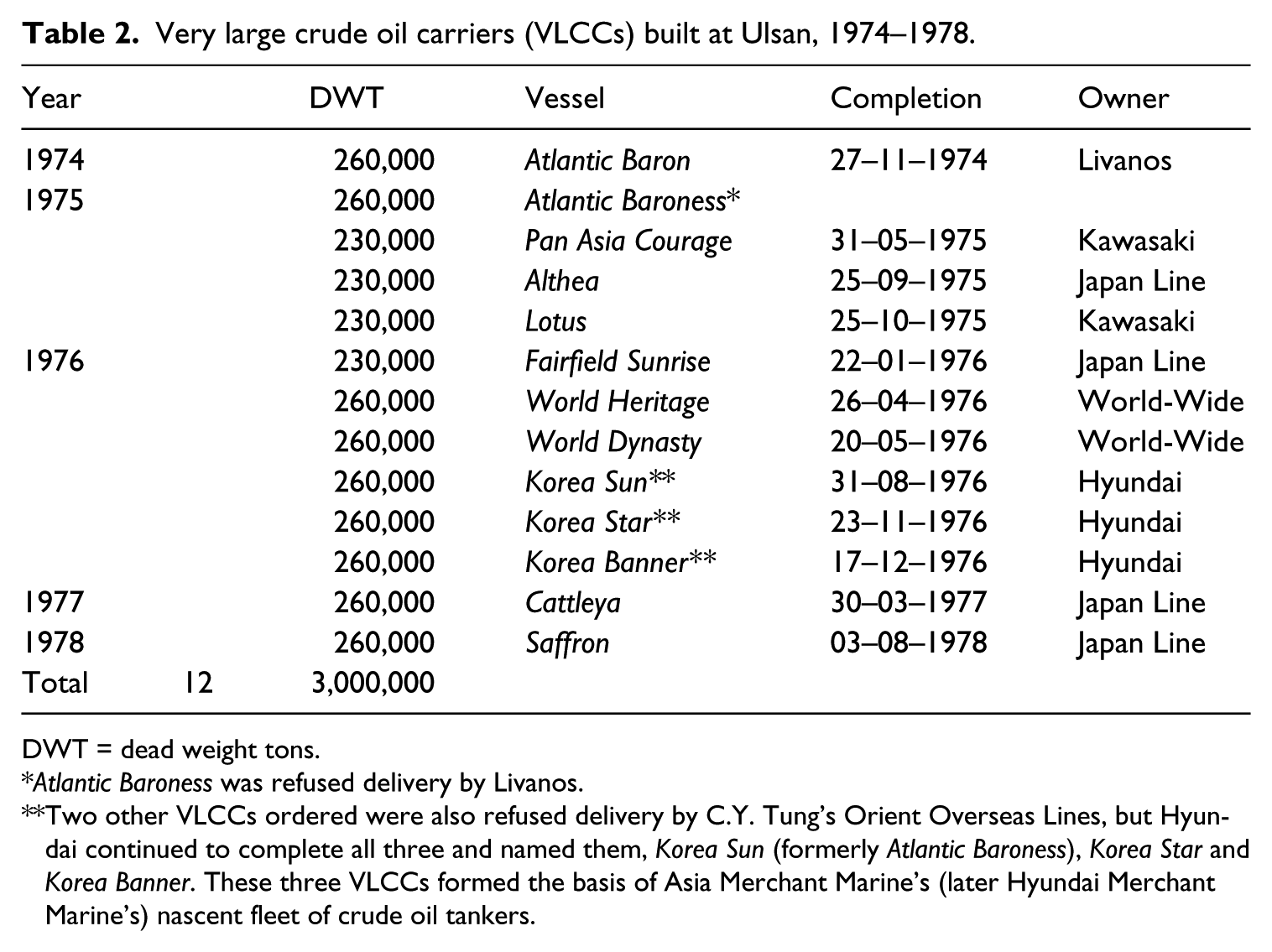
DWT = dead weight tons.
Atlantic Baroness was refused delivery by Livanos.
Two other VLCCs ordered were also refused delivery by C.Y. Tung’s Orient Overseas Lines, but Hyundai continued to complete all three and named them, Korea Sun (formerly Atlantic Baroness), Korea Star and Korea Banner. These three VLCCs formed the basis of Asia Merchant Marine’s (later Hyundai Merchant Marine’s) nascent fleet of crude oil tankers.
Although Chung’s enterprise had got off to a good start, there were many obstacles to overcome. The excellent prices obtained for VLCCs at the top of the market in 1973, and stage payments thereon, gave Hyundai breathing space. However, the first two VLCCs, which had been built at lower prices to drawings and specifications supplied by Scott Lithgow, proved to be the most difficult of the run of tankers ordered. Although a training centre had been established, the harsh practicalities of ship construction through acquired technology were faced outside it. There were as many as 104 cases of large and small on-site experiments before the first and second VLCCs were built. 71
Hyundai’s financial situation was compounded by the worldwide recession in shipping in the wake of the OPEC price hikes of 1973–1974, which really took effect from late 1974 onwards. Ship owners in recessions are prone to cancel orders; and, dependent on contractual terms (penalty clauses for late delivery, faulty equipment, etc.), are also likely to find faults in existing contracts to delay delivery or to force late cancellation. Unknown to Chung and Hyundai, Livanos had been negotiating a lucrative three-year time charter party agreement at Worldscale 80 with the oil major Shell, which was signed on 22 May 1973. This agreement would be cancelled if the vessel (Atlantic Baron) failed to be delivered before December 1974. 72
Problems with the construction and fitting out of Atlantic Baron had jeopardized its eventual delivery. Moreover, the Livanos Chief Technical Superintendent, Anastasso Poulus, interfered greatly in the fitting-out of the vessel, so much so that the original technical specifications of Scott Lithgow had been changed five times by delivery. Poulus insisted that all the ship’s machinery and electrical equipment should have a spare part, and there were many problems and disagreements over the design of the engine room, in which Stal Laval steam turbines were housed. 73 As in all shipbuilding contracts of some complexity, the learning curve was steep, and it would have been miraculous had Hyundai, with no experience of shipbuilding, met all its build milestones on this vessel.
A major problem occurred when Hyundai attempted to marry up the fore and aft sections of the ship, as these did not fit. 74 Scott Lithgow, an experienced shipbuilder on whose designs the ship was based, had no such problems in this regard. Their first attempt to marry up the bow and stern sections of the VLCC Nordic Clansman, despite being undertaken in tidal waters and not in a dry dock, had resulted in a perfect fit. 75
Livanos, like Chung, now had an overwhelming economic case to see Atlantic Baron completed and delivered. However, with the second VLCC (Atlantic Baroness) the situation had changed dramatically as a result of the drastic effects of the shipping recession. Livanos – for whom the ship would be a guaranteed loss-maker – refused to take late delivery of the vessel. For Hyundai, with its concentration on building VLCCs, the shipping sector worse hit than any other during the recession, delivery on time of the rest of the VLCCs on its order book was now critical. The two VLCCs ordered by Japan Line in March 1974 were the last VLCC orders that Hyundai would receive for twelve years.
With the two VLCC contracts for Livanos now completed to Scott Lithgow designs, Hyundai could concentrate fully on block assembly techniques in its building docks, using Japanese methods and training from Kawasaki. Nevertheless, as Amsden and Jonsson noted, four of the next scheduled VLCC orders were late: two for Japan Line and two for Y. K. Pao’s World-Wide Shipping of Hong Kong. Consequently, the owners refused delivery. 76 According to Amsden, there were no other refusals of delivery, but there were still repeated delays. Had both Amsden and Jonsson adequately checked the delivery programme, they would have discovered that all four VLCCs were completed and delivered. No doubt the two owners invoked penalty clauses for late delivery. Their acceptance of these vessels in the midst of the tanker shipping recession surely meant that recompense must have been substantial. What is not mentioned by Amsden or Jonsson, and which is also omitted from the official history of Hyundai, is that another Hong Kong ship owner, C. Y. Tung’s Orient Overseas Line, also refused delivery of two VLCCs. 77 There is no doubt that, taken together, these cancellations and reinstatements to the order book must have had really harmful effects on the liquidity of the shipyard.
Labour
At Ulsan, workers were initially hired on the basis of tests, and engineers from other Hyundai affiliated companies were also hired, as well as personnel from KSEC. By July 1973, Hyundai had 580 engineers, 280 administrative personnel and 4800 workers. The initial aim of the Ulsan training centre was to train 1200 personnel per year. By 1975, 2172 personnel had completed the full training programme, with another 1464 having completed short courses. 78 Hyundai’s training capacity had been further augmented by the signing of a technical support arrangement with Kawasaki Heavy Industries in December 1972, which led to an order from Kawasaki Kisen Kaisha for two 230,000 dwt VLCCs. The deal specified that Kawasaki would provide the design drawings, and training for Hyundai personnel in Japan.
A major difference between Hyundai and British shipbuilding firms was the lack of an effective trade union to establish reasonable (by Western European standards) terms and conditions for the workforce. Nationally, the Park government had become increasingly interventionist in workplace relations. From the outset, workers at the Ulsan shipyard worked sixteen-hour days and were subject to militaristic labour controls, with strict supervision and invariable recourse to work intensification methods by management, and payment of low wages. 79 As the shipyard developed, labour was the one direct cost that Hyundai could control to maintain its low-cost competitive strategy. Thus, its harsh supervisory regime attempted to maximize labour productivity at minimal cost. As Kwon and O’Donnell have noted, in 1973 a total of 1894 industrial accidents occurred, leaving 841 workers seriously injured and thirty-four dead from welding accidents and collapsing scaffolding. 80 Accidents and fatalities on this scale would have resulted in huge fines and/or imprisonment of managers and/or owners in Western European shipyards.
The training agreement with Kawasaki had led Hyundai to emulate the growing emphasis on the extensive use of subcontracted, rather than direct, labour in Japanese shipyards. By late 1973, Hyundai increasingly relied upon subcontracted workers. It is hardly surprising that this engendered a strong sense of resentment among the established direct workforce in that they felt that their jobs were ultimately at risk. Throughout 1974, the sense of grievance among the direct workforce intensified, and on 19 September 600 workers staged a protest demanding an end to subcontracting and issued a series of demands. In the event, the protest lasted three days, becoming increasingly violent, with a 1200-strong police task force confronting the protestors. Some 200 workers were arrested and eighteen formally charged with rioting. Recognizing the seriousness of the situation and no doubt its potential impact across the Hyundai group and in the wider economy, Chung promised to accept the demands of the workers, and mediation of the dispute was undertaken by Hyundai’s labour department. In subsequent negotiations, it was agreed that employment conditions for subcontract workers would mirror those of direct workers, and that any increase in hourly wages would be tied to increased productivity and staff levels. Nonetheless, as Kwon and O’Donnell further noted, during the course of the negotiations most of the workers’ demands were rejected, including the right to organize their own trade union. 81
In the challenging economic conditions precipitated by the continuing shipping recession, Hyundai remained able to subcontract labour, and the company successfully established a labour subcontracting system. According to Hwasook Nam, ‘[t]he union-free environment of the 1970s and early 1980s, guaranteed by extensive state intervention in labour affairs, was another important factor in the success of the Hyundai yard’. 82
Challenges
With the original yard facilities completed in record time – and a third one million dwt building dock added in 1975 – Hyundai faced two major challenges. First, the company had large facilities, but limited activity. The business for which the yard had been tailor-made, the construction of VLCCs, had more or less evaporated as a result of the tanker crisis. The volume of new tanker orders in 1975 was more than ninety-five per cent lower than in 1973, and the market was simply no longer there. 83 Second, the company was in possession of three VLCCs, which the original owners had refused to accept.
The first challenge was solved by a change in the product strategy. An order for ten dry cargo ships of 24,000 dwt from Kuwait Shipping Company, signed in November 1974, was gradually increased to twenty-four ships in total. A twelve-ship order from the Nigerian National Shipping Line was another high-volume contract. Moreover, the company built an assortment of other vessels; for instance, dredgers, barges, tugboats, multi-purpose ships, ro-ro (roll on-roll off) vessels and forest product carriers. As the 1970s drew to a close, the company also ventured into the offshore market and secured naval orders. In addition to diversifying its order book, the company ventured into ship repair and engine production.
The second challenge – what to do with the three undelivered VLCCs – was solved by the establishment of a shipping company, Asia Merchant Marine Co. Limited (later renamed Hyundai Merchant Marine Co.). The company’s first business as a ship owner was a contract to transport crude oil to South Korea’s largest oil refinery – Daehan Petroleum Corporation – shared with Gulf Oil. 84 Hyundai Merchant Marine would later grow to become a profitable operation in its own right.
Conclusion
In April 1976, Hyundai’s President, Kurt Schou, left Korea, bringing to an end a tumultuous period of foreign involvement in shipbuilding at the yard. He was replaced in August by the shipyard’s vice-president, Young-Joo Kim, leaving the shipyard’s future trajectory solely in Korean hands. However, foreign financial, technical and managerial assistance had been critical in establishing Hyundai’s shipyard at Ulsan, as was Chung Ju-Yung’s drive and entrepreneurial verve. The efforts were aided by the tacit, if occluded, and at other times overt support of the Korean Government, which prioritized the establishment of South Korea as a major shipbuilding nation, with Hyundai as its standard bearer. That the shipyard – geared initially for VLCC construction, but facing the collapse of the tanker market and cut-throat competition from established and new entrant shipbuilding countries so soon after its establishment, and then following a diversified product strategy – survived to become the world’s biggest shipyard, is testament to the ingenuity, skill and drive of all concerned.
While South Korea’s expansion within shipbuilding was an undeniable success, the British midwives were less fortunate. A&P Appledore International built its reputation on Hyundai, and when faced with nationalist criticism at home, as one senior APAI executive later put it: ‘South Korea had just as much right as any other country to establish a shipbuilding industry’. 85 A&P Appledore International went on to perform a similar role in the establishment of Daewoo’s giant Okpo shipyard in 1978, and also performed similar work in South America, Gibraltar and Poland.
Scott Lithgow, under-capitalized from its inception, struggled throughout the 1970s and only completed its second VLCC, Nordic Commander, in January 1976. In July 1977, the company was nationalized, with twenty-six other major shipbuilding and marine engine building companies, under the umbrella of the government-owned British Shipbuilders plc. Neither APAI nor Scott Lithgow survives today, but Hyundai remains the world’s largest shipbuilder.
Footnotes
Funding
The research for this article was supported financially by the Institute for Asan Studies, University of Ulsan, South Korea.
1.
Shipbuilding at Ulsan was first organized under the umbrella of the Hyundai Construction Company, but renamed the Hyundai Shipbuilding and Heavy Industries Company (1973) and Hyundai Heavy Industries Co., Ltd (1978). From 1972 to 1984, the shipyard at Ulsan produced ten million dead weight tons (dwt) and by 1988 had doubled that. The company reached the fifty million dwt milestone in 1997 and doubled that by 2005. Today Hyundai Heavy Industries is the world’s largest shipbuilding company.
2.
See for example, Alice H. Amsden, Asia’s next giant: South Korea and late industrialization (Oxford, 1989), 269–90; Gabriel Jonsson, Shipbuilding in South Korea: A comparative study (East Asian Monographs No. 8, Stockholm, 1995); Lars Bruno and Stig Tenold, ‘The basis for South Korea’s ascent in the shipbuilding industry, 1970–90’, Mariner’s Mirror, 97, No. 3 (2011), 201–17; and Dong Sung Cho and Michael E. Porter, ‘Changing global industry leadership: The case of shipbuilding’, in Michael E. Porter, ed., Competition in global industries (Boston, 1986), chapter 17. See also Daniel Todd, The world shipbuilding industry (London, 1985), and Industrial dislocation: The case of global shipbuilding (London, 1991).
3.
In 1947, Chung formed Hyundai Togun, a civil engineering and construction firm and the initial company of Hyundai Group, in 1950 renamed Hyundai Construction. In the 1950s and 1960s, the company undertook a series of large infrastructure projects, both in South Korea and abroad. For two Western views of Chung and the Hyundai group, which are heavily reliant on Chung’s own recollections of his early years, see Donald Kirk, Korean dynasty: Hyundai and Chung Ju Yung (Armonk, New York, 1994); and Richard M. Steers, Made in Korea: Chung Ju Yung and the rise of Hyundai (London and New York, 1999).
4.
For a company history in Korean, see Hyundai Joonggongopsa [History of Hyundai Heavy Industries] (Ulsan, 1992). For a shortened company history published in English, see Traditions of excellence: Hyundai shipyard, yesterday and today, a quarter century of unparalleled achievement in shipbuilding (Ulsan, 1998). Amsden, Asia’s next giant, 276, has just three short paragraphs on the establishment of HHI involving Appledore and Scott Lithgow. She erroneously states that A&P Appledore International was a Scottish naval architecture firm and misspells Scott Lithgow as ‘Scotlithgow’. Jonsson, Shipbuilding in South Korea, 80–1, following Amsden, makes the same errors.
5.
The authors are grateful for the recollections of former A&P Appledore consultants, Roger Vaughan, John Craggs and Michael Makin (Company Secretary), and former Seascope ship broker, Hugh Sykes.
6.
From the ‘end’ of the Korean War in July 1953, South Korea had been subject to the increasingly autocratic presidency of Syngman Rhee.
7.
Amsden, Asia’s next giant, 50, makes this point, citing Park Chung-Hee’s book, Our nation’s path: ideology of social reconstruction (Seoul, 1962), 228–9. See also Park’s modestly titled book, The country, the revolution and I (Seoul, 1963), 224–5.
8.
England, Kew, The National Archives (hereafter, TNA), Archives of The Export Credit Guarantee Department, ECG/148 35th Meeting, 18 July 1973.
9.
Dong Shik Shin, ‘Enormous expansion planned for Korean shipbuilding industry by 1980’, The Motor Ship Far East Shipbuilding Survey (1973), 43–6.
10.
Chung Ju-Yung, Yi ddange teonaseo [Born in this land] (2nd edition, Seoul, 2011), 162.
11.
Korean Shipbuilding and Engineering Company was founded by Mitsubishi in 1937 during the Japanese colonial period and was privatized in November 1968. The first export ‘successes’ of KSEC were the delivery of thirty barges to South Vietnam and twenty fishing vessels to Taiwan in the late 1960s. This was followed by an order from Gulf Oil for two 20,000 dwt product tankers in 1970–1971; see Hwasook Nam, Building ships, building a nation: Korea’s democratic unionism under Park Chung Hee (Seattle, 2011).
12.
Traditions of excellence, 40.
13.
‘JY Chung’s Bid for Shipbuilding’, The Weekly Economist 874, 6 February (2007), Joongangilbo, Sisamedia Co., Ltd, Seoul [in Korean].
14.
Traditions of excellence, 40–1.
15.
Ulsan was just a small remote fishing village at this stage. By 1982, Ulsan’s population had increased to 450,000. 100 A1 [Lloyd’s Register of Shipping], April 1982.
16.
These figures are taken from Traditions of excellence, 43.

18.
Hyundai Joonggongopsa, 362.
19.
Longbottom was MP for York from 1959 to 1966, and in 1961 married Anita Trapani, stepdaughter of the Greek shipping magnate, Basil Mavroleon (London and Overseas Freighters). He was chairman of Austin & Pickersgill 1966–1972, and chairman of APAI 1970–1979.
20.
Personal communication, 26 September 2014, Michael Makin, APAI Company Secretary. Makin came to APAI from Court Line. Originally a shipping line, Court Line developed into a sizeable conglomerate of some fifty companies involved in shipping, shipbuilding, ship repairing, aviation and package holidays.
21.
Personal communication, 26 September 2014, Michael Makin, APAI Company Secretary.
22.
An alternative version is that Chung was introduced to APAI through a German-based American banker: Chung Ju-Yung, Yi ddange teonaseo, 171–2.
23.
Subsequently, Vaughan and Hargroves left Swan Hunter, as did a number of others, including John Craggs, who had developed Swan’s Tyne Steelwork facility. Accordingly, APAI’s relationships with Swan Hunter became strained.
24.
Personal communication, 26 September 2014, Michael Makin, APAI Company Secretary.
25.
Glasgow, University of Glasgow Business Archives Centre, Scott Lithgow Papers (hereafter GD 323) GD 323/13/3/17, Telex of Draft Agreement, memo from Anthony Mackesy to Alexander Ross Belch, 10 September 1971 and Ship Sales Agreement 24 September 1971. APAI undertook to obtain orders for the shipyard and were given exclusive export sales representation for the first twelve vessels produced by Hyundai. This included international promotion of the shipyard, the provision of brokers for sales of vessels and market research. Remuneration would be 0.5 per cent of the sales value of the vessels. However, if Hyundai approached oil companies etc. independently and obtained orders, no commission would accrue to APAI.
26.
GD 323/1/1/3, (5) Minute of Meeting of Directors, 1 October 1971: ‘We have recently concluded an agreement with A&P Appledore International Ltd for the training of staff and supply of drawings to HC Ltd. Agreement still subject to approval by the Korean Government and within three months of that approval being given we should receive payment of our share of the contract price, i.e., £80,000. We would also receive further monies as and when ships are built and we are also considering starting up a purchasing agency through which we would receive commission on the purchase of shipbuilding materials’.
27.
GD 323/13/3/17, Memo from W. Ferguson to Hugh Currie, 6 September 1971.
28.
The figure of $1.7 million is given in Traditions of excellence, 43. GD 323/13/3/17, Telex of Draft Agreement, 10 September 1971, Mackesy to A. R. Belch. The agreement gave A&P Appledore exclusive export sales representation for the first twelve vessels constructed at Ulsan.
29.
GD 323/13/3/17, Memo from Anthony Mackesy (APAI) to Alexander Ross Belch (Scott Lithgow), 27 September 1971. A press statement appeared in the Times Business Supplement of 27 September 1971. Mackesy was very upset about this, but understood that the leak of information came from Korean sources in London; probably their commercial delegation.
30.
GD 323/13/3/17, Ship Design and Technical Agreement between Hyundai Construction Co., Ltd, and A&P Appledore (London), Ltd, 10 September 1971.
31.
GD 323/13/3/17, ‘Agreement to become effective on date of approval by Korean Government. It shall last until the completion of the second vessel or the end of 1974, whichever is the earlier’.
32.
The ECGD, formed in 1919 and now termed UK Export Finance, is the UK’s national export credit agency.
33.
This is reliant on Hyundai’s version of events as no record of this appears in ECGD files. See Traditions of excellence, 45.
34.
Traditions of excellence, 46.
35.
Hyundai Heavy Industries Museum, Ulsan Shipyard, copy of Memorandum of Agreement between Hyundai Construction Company Ltd (Ulsan shipyard) and North Ocean Shipping Company of Monrovia, Liberia, signed 2 February 1972.
36.
These details are contained in the judgement of Mocatta, J., in North Ocean Shipping Co. Ltd v Hyundai Construction and Another, The Atlantic Baron, All England Law Reports, 3 All ER [1978], 1170. The actual price agreed for the first VLCC, Atlantic Baron, was US$30,950,000.
37.
TNA, ECG 5/121 Appendix B, 15 October 1973, South Korea, Department Experience 1972 (£000s) Financial Guarantee £18,423. Surprisingly, this is the only reference in the ECGD files, which are largely concerned with internal administration. Moreover, there are no records surviving regarding the Hyundai loan in Barclays Bank Archives, Wythenshawe, Manchester.
38.
TNA, ECG 1/49, 336th Meeting, 17 October 1973; ECG, 337th Meeting, 21 November 1973. South Korea, Shipyard equipment, contract value £3,500,000, amount guaranteed including interest, £4.588,262, seven years from estimated completion.
39.
For Scott Lithgow, see Lewis Johnman and Hugh Murphy, Scott Lithgow: Déjà vu all over again! The rise and fall of a shipbuilding company (International Maritime Economic History Association, Research in Maritime History, No. 30, St John’s, Newfoundland, 2005).
40.
Johnman and Murphy, Scott Lithgow, 216.
41.
See Dong Shik Shin, ‘Enormous expansion’.
42.
By this stage, British ship owners had long deserted the industry. In the early 1970s, for example, the British oil major BP ordered thirteen VLCCs from abroad: eight from Japan, four from the Dutch shipbuilders Verolme, and one from France, all for delivery between 1973 and 1976. Harland & Wolff, Swan Hunter and Scott Lithgow were all given the opportunity to tender but could not match their foreign competitors; see James Bamberg, British Petroleum and Global Oil 1950–1973: The challenge of nationalism (Cambridge, 2000), 297.
43.
GD 323/13/3/18, Letter from A&P Appledore, dated 17 February 1972.
44.
GD 323/13/3/18, Letter from A&P Appledore, dated 17 February 1972.
45.
GD 323/13/3/17, A&P Appledore Contract, memo from W. Ferguson to Hugh Currie, 6 September 1971.
46.
All information on the workers is from GD 323/13/3/18, Letter from Hugh Currie to Hee Yung Chung, European Resident Director, Hyundai Construction Company, 22 March 1972, training of Hyundai staff, CVs from Claude Abrahams, Personnel, Scott Lithgow.
47.
Sung Hyuk Hwang, Let there be a shipyard: Memories of a shipbroker (Livingston, Scotland, 2008), 14. The rental paid for the whole property was £250 per month; GD 323/13/3/18, Letter from Neill Clerk & Murray, Solicitors, to Hugh M. Currie, 14 March 1973.
48.
Interview with Jeong Je Kim, Professor Emeritus in the Department of Naval Architecture, University of Ulsan, 4 December 2014. Professor Kim had been one of the original Korean trainees, but came to Scotland one month after his compatriots after being personally recruited by Chung.
49.
Personal communication, 16 September 2014, Roger Vaughan, APAI.
50.
Hwang, Let there be a shipyard, 15.
51.
GD 323/13/SL19, Agreement between Lithgows Limited and Hyundai Shipbuilding & Heavy Industries Company Limited, 3 September 1974.
52.
Lloyd’s List, May 2002, Supplement Hyundai Heavy Industries 30th Anniversary, 9.
53.
Lloyd’s List, May 2002, Supplement Hyundai Heavy Industries 30th Anniversary, 9.
54.
Traditions of excellence, 53.
55.
56.
GD 323/13/3/14, Undated telex from Ross Belch. It should be no surprise that Belch was unable to attend due to other commitments, because the formal invitation from Korea had arrived in Scotland six days before the groundbreaking ceremony.
57.
Traditions of excellence, 46–7.
58.
The two Goliath cranes standing eighty-two metres high and spanning 140 metres were manufactured by PHB Jucho of West Germany by January 1973. They were capable of transporting pre-assembled blocks at twenty-five metres per minute. Costing $6.5 million each, both were operational by April 1974.
59.
Hwang, Let there be a shipyard, 5.
60.
Odense Steel Shipbuilders, established in 1918, was owned by A. P. Möller-Maersk. Through the 1960s and 1970s it concentrated production on VLCCs, before specializing in container vessels of increasing size. Schou left Hyundai in April 1976.
61.
Hwang, Let there be a shipyard, 21.
62.
In addition to the five Danes and Wilson, two Englishmen, Messrs Kinraid (machinery design), and Smith (Lloyd’s Register) and a French national, Monsieur Semery, from Chantiers de Atlantique (manufacturers of the Stal Laval steam turbines, and responsible for Engine Room design) were the key foreign workers in the shipyard. See Hwang, Let there be a shipyard, 21.
63.
Nigel Watson, Barbara Jones and Louise Bloomfield, Lloyd’s Register: 250 years of service (London, 2010), 44, 271 and 332.
64.
For the establishment of POSCO, see Amsden, Asia’s next giant, chapter 12. Construction at POSCO began on 1 April 1970, with the first phase dedicated on 3 July 1973, and the second phase commenced in December.
65.
Traditions of excellence, 53.
66.
Amsden, Asia’s next giant, 278.
67.
Hwang, Let there be a shipyard, 9.
68.
Amsden, Asia’s next giant, 278.
69.
Traditions of excellence, 55.
70.
Hwang, Let there be a shipyard, 9.
71.
Hyundai Joonggongopsa, 357.
72.
North Ocean Shipping v Hyundai, The Atlantic Baron.
73.
Hwang, Let there be a shipyard, 6–8.
74.
Amsden, Asia’s next giant, 278; Jonsson, Shipbuilding in South Korea, 81.
75.
The operation took thirteen days in total to complete. For a comprehensive description of how this was achieved, see GD 319/25/2/11–12. See also J.Y. Kang, Song Kim, Hugh Murphy and Stig Tenold, ‘Old Methods Versus New: A comparison of Very Large Crude Carrier Construction at Scott Lithgow and Hyundai Heavy Industries, 1970–1977’, Mariner’s Mirror 101:4, 426–457.
76.
Amsden, Asia’s next giant, 278, refers to World-Wide as ‘Hong Kong Inc.’, as does, Jonsson, Shipbuilding in South Korea, 81.
77.
78.
These numbers are given in Traditions of excellence, 50.
79.
Traditions of excellence, 53–5.
80.
Seung Ho Kwon and Michael O’Donnell, Chaebol and labour in Korea: The development of management strategy in Hyundai (London, 2001), 73.
81.
Kwon and O’Donnell, Chaebol and labour in Korea, 95.
82.
Nam, Building ships, 205.
83.
Lloyd’s Register, Statistical tables.
84.
Traditions of excellence, 68.
85.
Personal communication, 16 September 2014, Roger Vaughan, former CEO APAI.