







Abstract
This article considers the early history of bottom trawling in England. It demonstrates that trawling – and, in particular, beam trawling – has a very long history stretching back to at least the fourteenth century. Over the following two centuries it spread from the Thames Estuary along the south and south-east coasts, and by 1600 its use was widespread and it was being pursued some distance from shore. The article also shows that bottom trawling has always been a controversial practice, and that by the early modern period it was highly unpopular, not only among non-trawling fishermen (who viewed it as a threat to their livelihood), but with many in positions of power who sought to limit and even prohibit its use. Finally, the article considers the contemporary significance of this newly exposed history, given that historical complaints about bottom trawling were framed in remarkably similar terms to those used by its modern opponents.
Among all the fishing methods, bottom trawling … is the most destructive to our oceans … Bottom trawling is unselective and severely damaging to seafloor ecosystems. The net indiscriminately catches every life and object it encounters.
Bottom trawling is now, as it has always been, a controversial fishing practice. Despite a recent upsurge in concern over its impact on marine ecosystems and the world’s fisheries, there is nothing new in the kind of analysis quoted above. From the earliest days of industrial (steam-powered) trawling, important questions were asked about its impact on the marine environment and on the long-term viability of commercial fish stocks. In late-nineteenth-century Britain, two wide-ranging and extensive parliamentary commissions were established, in 1863 and 1882, which listened to fishers’ complaints about the impact of steam trawling on fisheries around the United Kingdom. The latter was specifically convened to look into ‘Trawl Net and Beam Trawl Fishing’. The commissioners gathered 350 pages of evidence from 49 fishing stations, and published 156 pages of written appendices, the majority of which pointed to the destructive impact of bottom trawling in terms very similar to those of the Marine Conservation Institute, cited above. Yet, despite the weight of evidence, the 1882 commission refused to recommend widespread action against beam trawling, and instead concluded that trawling was ‘not destructive’, and that there was no evidence that it was to blame for falling catches of flat fish and haddock off the east coast of Britain. 2
Further to these, and other, investigations into early industrial trawling, particularly in the North Sea, analysis of its impact became central to the work of the world’s oldest and most influential scientific marine research body, the International Committee for the Exploration of the Sea (ICES). The first chair of ICES Committee B, which was specifically convened to look into the problem of overfishing, was Walter Garstang, who also developed the first statistical methods to estimate stock level changes using the landings and fishing power data of the North Sea trawl fleet. 3 Between the 1930s and the 1970s, debates over the impact of fishing effort on stock abundance turned increasingly towards abstract models of what was achievable in terms of ‘productive sustainability’ rather than focusing on specific fishing methods. But with growing concern that single species models (or, at least, management strategies based on their predictions) had failed to predict some apparently catastrophic collapses in commercial fish stocks in the 1980s and 1990s, particularly in the North Atlantic, scientists, politicians and conservationists began looking again at the actual fishing methods and gear by which such fish were being caught. 4
By the start of the new millennium, the clouds that were gathering over the world’s fisheries collided with a growing environmental storm over the wider impact of fishing methods beyond single species stocks. As a result, the debate over bottom trawling became more highly charged than ever, and every aspect of its environmental influence was placed under renewed scrutiny. For example, a series of technical papers published by the United Nations’ Food and Agriculture Organization (UNFAO) between 2002 and 2005 looked in great detail at issues such as the benthic impact of dragged gear, discards (or by-catch) in fisheries, the mortality of fish escaping trawl gear, and the benefits of an approach to fisheries management which was then in its infancy, the ‘ecosystem approach’. Although not all of these papers focused exclusively on the issue of trawling, it is clear that bottom trawling was of most concern in terms of what were identified as problematic fishing methods. 5
Recently, the debate over the impact of bottom trawling has taken what might be described as an ‘historical turn’. Fisheries scientists have begun to look again at the evidence relating to industrial trawling from its earliest days (particularly in the North Sea), this time under the auspices of marine environmental history and marine historical ecology. 6 For example, in 2009 Georg Engelhard published the first comparative study of changes in the fishing power of the English trawl fleet from the first days of steam to the present day. He concluded that modern twin-beam trawlers have 100 times the plaice-fishing power of their 1880s sailing counterparts, but that fisheries have become far less profitable, because ‘everything points in the direction of great overcapacity of the current … North Sea trawling fleet’. In 2010, by placing evidence relating to modern landings and catch rates alongside data gathered for early steam trawl fleets, Thurstan et al. found that landings per unit of effort – the amount of fish caught for a specific, measurable unit of fishing effort – in Britain’s demersal fisheries declined by over 90 per cent between 1889 and 2009. In 2013, Thurstan again tackled the environmental impact of the United Kingdom’s early trawl fleet, this time placing the anecdotal evidence of fishermen to the nineteenth-century parliamentary commissions noted above alongside data relating to landings and fishing power from across the twentieth century. She and her fellow authors demonstrated that ‘swift and dramatic [environmental] transformations … took place as a result of early trawling activities’ from the 1860s onwards, and they described these transformations as ‘a turning point in British fisheries’. 7
This ‘historical turn’ has begun to reach beyond marine biology and fisheries science, too. In recent years, various studies have noted that complaints about trawling’s impact on fishery ecosystems and the benthic environment go a long way back – as far back, in fact, as the fourteenth century. References to the existence of what was described in a petition to Edward III of England, in 1377, as a ‘wondyrchoun’ – which was, to all intents and purposes, a small beam trawl – are now common in conservation fisheries-related literature. 8 Yet, the history of this most destructive, and divisive, method of fishing between its first (and, by now, relatively well known) description in the Plantagenet state papers and the modern era has largely escaped academic attention. 9 Robb Robinson, in his otherwise superb history of trawling in Britain, devotes only two paragraphs to its development between the fourteenth and late eighteenth centuries. 10 Kennelly and Broadhurst, in an overview of historical measures taken to reduce by-catch, merely state that ‘[t]he 14th century outcry against [the wondyrchoun] began a battle that was repeated in the 1620s’, before going on to emphasise that ‘[t]he 19th century saw a dramatic increase in the use’ of the beam trawl. 11 Others have ignored, or are unaware of, the early history of bottom trawling, dating its earliest significant usage to the late eighteenth century. 12 Overall, the historiography tends to reflect Robinson and Starkey’s conclusion that, prior to the late eighteenth century at the earliest, the evidence relating to trawling is ‘[i]ncidental, qualitative and uncorroborated’, and is therefore of little value. The following discussion demonstrates for the first time that, contrary to this view, there is abundant evidence of relatively intensive bottom trawling on the east and south-east coasts of England from its earliest development in the fourteenth century through to at least the middle of the seventeenth century. Moreover, it reveals that we can find clear echoes during the early modern period of the controversy over bottom trawling that is now at its height in scientific and conservation circles. 13
The origins of bottom trawling in England
[W]hereas in many places within your said realm, in creeks and harbours of the sea, where there used to be good and plentiful fishing before this time, to the great profit of the realm, which is almost destroyed and ruined for a long time to come, some fishers for seven years now past have cunningly invented a type of instrument which they called a ‘wondyrchoun’, made in the manner of a drag for oysters, which is immeasurably long, to which a net is attached which is so thick that no manner of fish which enters can escape, however small it may be, but is forced to stay and be caught. And further, the great and long iron of the said wondyrchoun lands so evenly and forcefully on the river-bottom, that it destroys the slime growing and flourishing on the land above the water there, and also the spawn of oysters, mussels and other fish, on which the great fish usually live and are nourished there. Using these instruments called wondyrchouns the aforesaid fishers catch so many of the aforesaid small fish in many of the aforesaid places that they do not know what to do with them, but annually feed their pigs with them, and fatten them right through; to the great damage of the whole commonalty of the realm and to the detriment of fishing in similar places. Wherefore they pray remedy.
14
So runs the full text of that petition from the commoners of Essex to Edward III. At the outset, it is important to note that it is written in the form of a complaint: the net was ‘so thick that no manner of fish … can escape’, and the ‘great and long iron’ of the wondyrchoun was adjudged to be highly destructive to the seabed and to everything which lay upon it. These complaints were taken seriously enough by the Crown that a commission was appointed to look into the matter, consisting of a number of Essex notables and led by Walter FitzWalter. The productivity of this ‘cunning instrument’ was never in doubt; it caught so many small fish that no other use for them could be found than to fatten the pigs. Nonetheless, it was clearly and explicitly blamed for spoiling the fishing in creeks and harbours, where previously ‘there used to be good and plentiful fishing … to the great profit of the realm’. 15
When one compares this ancient account with modern complaints against bottom trawling, the similarities are striking. Even the UNFAO acknowledges that beam trawling ‘result[s] in removal or damage of sedentary living organisms (including seaweed and coral)’ on the seabed, and that ‘[t]he major potential detrimental impact of bottom trawling on species can be the capture and removal … of small sized organisms and non-target species’. In fact, wherever one looks, protests and objections are now being raised which mirror almost exactly those of the Essex petitioners in 1377. All of which makes it even more remarkable that, having known of this ancient petition for many years, those who have had cause to complain about bottom trawling in the modern era have looked no deeper into its history. 16
Despite the fine detail contained in the Essex petition against the wondyrchoun, it is not the first historical mention of bottom trawling per se. Thirty years before it was submitted to the English king, a proclamation was issued against a similar piece of equipment, the ‘wonderkuil’ (clearly from the same etymological root as the wondyrchoun), which was towed between two boats off the coast of the Netherlands. Here, fishermen complained because, just like the wondyrchoun, it had a mesh so small that it swept up all the immature fish and spawn to the detriment of the fishery as a whole. Nonetheless, following that 1377 petition, references to the wondyrchoun disappear from English sources to be replaced with the much more familiar ‘trawl net’. In these early references – and in contrast to the description of the wondyrchoun – it is difficult to know precisely what is meant by the term ‘trawl net’. In 1394, for example, an ordinance was passed demanding that ‘trawl-nets be removed’ from the Thames as high as Woolwich and Greenwich, suggesting that these may have been static nets. At this point, it seems that the term ‘trawl net’ did not have a fixed or specific meaning: it appears to have been applied to a shifting category of gear, the most common characteristic of which was that it maintained significant contact with the river or sea bed, statically or upon being dragged. In the fourteenth century ‘trawl nets’ were often placed in the same category as trinck (or trink) and kiddle (or keddle, or kettle) nets. Prohibitions against trincks and kiddles, both of which were static nets used in sandy bays at low tide, went back further even than those relating to the trawl. In 1236, for example, two London sheriffs ‘seized all the sailors found in the kidels standing in the Thames, and brought them with their nets, to London, and imprisoned them in Neuwegate’, later burning their nets as a punishment. In 1320, Estmar Coker and John Wychard were brought before the Mayor and Aldermen of London for using ‘twelve nets called “tromekeresnet”, a species of kydel’. 17
It is clear that the wondyrchoun, and any other bottom trawl gear against which action may have been taken (however it was described at the time), were viewed as part of a wider problem that was already perceived as having an impact on the estuarine ecology of the region, as well as on the economy and food supply of the capital: namely, the taking of large quantities of small and immature fish. In the fourteenth century, prosecutions were brought against the use of trinck and kiddle nets by fishmongers, in particular, who complained that the taking of small fish in such numbers was having a major impact on their trade. In 1386, a number of fishermen ‘of the country eastwards of London bridge’ were sworn by the mayor to explain, in their view, ‘how and by whom the fish in the Thames were so destroyed that hardly a seasonable fish could be found in it’. Again, they pointed directly at ‘trenkes’ and weirs, ‘whereby all fish, great and small, being unable to pass, were destroyed’. Complaints against the use of such ‘engines’ to indiscriminately catch fish affected the whole of the Thames and Medway region, so that the authorities in Kent and Essex were also given powers to ban them and to prosecute offenders. 18
Given the weight of evidence, it is more than likely that the development of the bottom trawl in medieval England, in the shape of the wondyrchoun, was related to the increasing popularity of longstanding problematic gear such as kiddle and trinck nets. Indeed, though neither was itself a form of dragged gear, both shared crucial characteristics which seem to have found their way into the make-up of the wondyrchoun. The trinck, for example, was a net which was attached to a weir, and was made up of detachable parts, one of which was an ‘unreasonable length of … hose’, also known as the ‘pridde net’. Presumably, this net was similar in shape to the net of the later wondyrchoun and to other trawl ‘bags’, but rather than being dragged along the bottom it was placed across the mouth of a weir, where fish were simply swept into it by the force of rushing water. Of course, it is impossible to know exactly how, when and where the very earliest bottom trawling gear was developed: the most likely explanation is that it evolved in different places, at different times, and from different versions of existing static or drag nets. It is therefore very likely that the fishermen who used it off the coast of Essex in the 1370s used a combination of local and foreign intelligence to perfect their ‘cunning instrument’. 19
It has already been noted that references to the wondyrchoun disappear from the official papers following that first petition in 1377. Intriguingly, references to ‘trawling’ and ‘trawl nets’ also vanish in the records after the early years of the fifteenth century; but so, too, do those relating to trincks, kiddles and other forms of problematic fishing gear. There is no clear indication why this should be the case, but it certainly should not be taken as proof that the use of such nets declined, let alone disappeared. For example, in 1523 an inquisition at Hythe, in Kent, into an ‘[a]ffray between fishermen on the high sea’, noted that officers of the law had recovered a quantity of stolen goods from a boat, including a topsail, shrouds and pulleys, but they also marked down as: ‘stolen, a net called a “trawle”’. In Flanders, the use of beam trawl gear was prohibited in 1499, and in France and Holland it was subject to strict regulation by the late sixteenth century. Indeed, there is some indication that a form of bottom trawling was relatively widespread on the east coast of England by the same time. In his preface to the 1561 English language edition of Martin Cortes’s work, The Art of Navigation, Richard Eden mentioned, in passing, ‘certayne Fyshermen that goe a trawling for fysh in Catches … and Dradgies for Oysters about the sandes, between South Furland and Wyntertonnesse, and the sandes about Temmes mouth’. The implication is that, by this date, some form of trawling was common on a stretch of coast over 100 miles long, between Winterton Ness, just north of Great Yarmouth, and South Foreland, near Dover. If so, it also suggests that trawling technology had spread a long way to the north and south of the Thames Estuary in the two centuries since the wondyrchoun was first prohibited by Edward III. Again, Eden’s reference to ‘trawling’ is tantalisingly vague, and it is impossible to know precisely what type of gear he was referring to. But evidence that bottom trawling, in the sense that we would understand it today (and that would have been immediately recognisable to the Essex petitioners in 1377), had spread far beyond the Thames Estuary soon emerges in the state papers of the Stuarts. 20
Trawling in the seventeenth century
As early as 1602, the Corporation of Rye noted that: the trawl nets, commonly used by the fishermen of Hastings and other foreigners and fishermen, were reputed to be great destroyers of the fry and food of fish and should therefore be utterly prohibited and damned as altogether inconvenient.
As a result of this proclamation, it was ordered that such nets ‘be no more used within the Cinque Ports under pain of forfeiture … and twenty shillings fine’. The seventeenth century saw many such proclamations, and many punishments enforced, for the use of bottom trawls in the south east of England. John Farsby, of Hythe, Kent, was arraigned in March 1617 for unlawfully using ‘trail nets’; but he was defended by none other than William Angel, the King’s Fishmonger, who confirmed that Farsby was licensed to ‘trail for plaice and soles on the coast of Kent, on condition of bringing them to London’. Shortly after this, the fishermen of Hastings complained about that same prohibition on trawling, which prevented them from using trawl nets without a license. In February 1622, the Hythe men applied: for license to go to sea forthwith, being unable … to supply the increased demand for the fish occasioned by the Proclamation for strict keeping of fish days, as the soles which are now in season will meanwhile be swept up by trawlers.
In addition, the Mayor and Jurats (justices) of Rye sent word to the Admiralty, that ‘[a]ccording to [its] order for apprehension of strangers destroying the fry of fish with trawling nets’, they had remonstrated with ‘some fishermen of Rochester and Stroud [who] said they would continue to trawl, and would answer any accusation at London’. The authorities at Rye declared: ‘[t]he town is ruined by such proceedings’. In 1631, the Admiralty Court further confirmed that these measures against trawling were directed towards what we would now describe as a beam trawl, noting, alongside a transcription of the 1377 Plantagenet petition, that ‘a wondrychon … is the same as a trawl now is’. 21
There is also evidence, however, of a growing tension between the Cinque Ports and the state as far as trawling was concerned. Despite the proclamation from 1602 (above) that claimed trawling was a destructive practice, by the 1620s its use was so widespread that prohibitions against it appear to have been working against the interests of local fishermen. In April 1624, a memorandum was sent to the Admiralty Court setting out documents concerning their right of trawling ‘in answer to the bill against it last Parliament’. Later the same month the authorities at Rye appealed to the court, stating that six ‘English trawlers’ were spotted fishing within two leagues of the town and reaffirming that ‘if they are permitted to trawl, and the Rye fishermen being restrained, the town will be impoverished, and the fishing trade overthrown’. Local men faced considerable danger in trying to prevent trawling by outsiders. On being confronted by the men of Rye, those six ‘English trawlers’ shot off 20 muskets ‘of purpose to affrighte and terrifie them’; and in a separate incident, John Browne, another Rye fisherman, was wounded by a Rochester man for cutting his trawling nets. 22
Such was the scale of the problem that measures against bottom trawling on the south-east coast of England increased considerably under Charles I. Under James’s rule, proclamations had been made and prohibitions enforced locally, so that while it was made illegal to trawl without license around the Cinque Ports in the 1620s, in the Thames Estuary some trawling was permitted at certain times of the year depending on the mesh size of the nets. In March 1631, however, the Council of the Lords noted that ‘among other abuses, the using of nets, called trawls, is a principal cause of the destruction of fish’, and, as a consequence, they issued an order to the Admiralty that ‘no trawls at all are to be used’ from Long Sand Head in the middle of the Thames Estuary, to Beachy Head in Sussex. In May, a further, and even more explicit, proclamation was issued, this time by the King himself at Greenwich. A summary of it reads: 1. ‘A proclamation for the better ordering of Fishing upon the Coasts of his Majesty’s Dominions.’ Dated at Greenwich, May 24, 1631. THE Preamble takes notice of the Abuses committed by the Fishermen, who had so far destroy’d both the Fish-Fry and Spawn, that they were forced to seek other Business for a Livelihood; that the Fish-days were not observed as they ought; and that the Court was often unprovided of their necessary Diet, by reason of the Scarcity and Dearness of Fish. 2. Another against the Use of a Trawl-Net in Fishing whereby not only small and unsizable Fish, but even the Fry and Spawn were utterly destroy’d.
23
Thereafter, the details of an increasing number of those whose nets had been confiscated and whose boats were impounded appear in the Admiralty papers. In June 1631, nets were taken from six boats at Rye and eight at Barking. In March 1633, 44 nets were ordered to be publicly burnt on the common at Rochester, and the lead and lines of the fishermen sold to pay for a room which was used exclusively for storing confiscated trawls. Nonetheless, at the same time as this show of strength, the Council of Lords remained concerned that, ‘Notwithstanding his Majesty’s proclamation, and the directions given by the Lords of the Admiralty, fishermen at sea still use trawls, and thereby destroy the fry of fish’. As a result, a further order was issued ‘to cause search to be made for trawls as well on shore as at sea, seizing all that are found, and taking bond of all fishermen not to use trawls any more’. 24
Fishermen continued to be pursued, prosecuted and bound over for bonds of up to £100 sterling. Yet, notwithstanding the Admiralty’s most recent proclamation, some confusion still remained over whether or not trawling was prohibited outright. Five fishermen from Barking, examined in July 1633, maintained that they had previously been allowed to fish with trawls within harbours, as long as the meshes were of ‘a particular size’, and that, as a result, they had continued to fish with trawls in the Medway and on the coast as far north as Winterton. In August the same year, John Vaughan and George Russell, also of Barking, again insisted that trawls were allowed by statute, and that the king’s proclamation only applied to ‘unlawful’ nets. Despite the efforts of the Admiralty to prevent bottom trawling in the south-east of England, many local fishermen who had once condemned it as destructive to the fisheries now saw it as their only chance of making a living. In August 1633, fishermen from Barking gave evidence that most of their townsmen, ‘bound or not’, continued to trawl; and in the same year even the water bailiff of Rochester stated to the Admiralty officer who came to question him that he often trawled, and ‘if they come to molest him he will with stones and “libits” beat them’. In response to rising tensions, a further proclamation was issued in April 1635, prohibiting the use of: the net or engine called a Trawl, whereby not only small and unsized fish but even the fry and spawn are utterly destroyed, so that fish formerly taken upon the coasts of this kingdom in great plenty are in most places now wholly destroyed.
25
The response of the fishermen was swift: a petition was sent from Barking a month later, bearing the signatures of 500 fishermen and complaining (as the men of Rye had a decade earlier) that, despite the actions of the Admiralty, the fishermen of East Mersea, West Mersea and Burnham-on-Crouch, along with those of Faversham and Whitstable in Kent, continued to ‘catch fish with the said engine’. As a result, the Barking men, again demonstrating great ambivalence towards bottom trawling, ‘prayed to the Lords to allow them to use the said engine or restrain all others’. Their petition met with a renewed effort to put down trawls. On receipt of it, Sir Henry Marten sent an officer to Barking ‘to seize such trawls as he should find contrary to the proclamation’, who ‘there seized the 36 trawls which are here enumerated with the names of the owners’. 26
The final, and most decisive, act against trawling under Charles I came, once again, from the king himself. In December 1635, a further proclamation was drafted ‘against the use of the net called a trawl’. This proclamation was the most explicit and detailed condemnation of the many deleterious effects of bottom trawling since the men of Essex sent their petition to Edward III in 1377. It read: Whereas the said net has been of great injury to fishing, by reason of the straightness of its meshes, the speedy sailing of the vessels to which it is annexed, and its closeness to the ground, causing it to take all the small fish, and to move the slime, fry and spawn, as well as the brood of oysters, mussels and other fish, and whereas in the reign of Edward III, a similar net called a wondrychon, which did the like harm was forbidden, it is his Majesty’s pleasure that from the 1st of November next, no more use shall be made of the instrument or engine called a trawl, and that up to that date, it shall be used only in deep water.
Importantly, and in contrast to all the other prohibitions and proclamations against trawling going back to the fourteenth century, this was the first and, on the evidence available, the only absolute nationwide ban imposed on bottom trawling, not only in inshore waters, but also further offshore. 27
Following this final, decisive prohibition, the trail of the beam trawl once again goes cold. In February 1642, Thomas Rabnet, the Captain of the Admiralty cutter Henrietta, was given instructions to ‘ply between Tilbury Hope’ and the mouth of the Thames, in order ‘to take care the fishermen use no trawls, contrary to the King’s proclamation’; and in 1667 a brief reference was made to ‘Wivenhoe trawlers’ who reported seeing a large fleet of foreigners ‘standing towards the Buoy of the Nore’. But other than this, nothing more is heard of the ‘lost’ beam trawling controversy under the early Stuarts. So, what are we to make of this relatively short, but intense burst of legislative activity against trawling on the south-east coast of England? No doubt James and Charles Stuart’s measures against bottom trawling were stimulated, in part, by a need to ensure that the royal court was well provisioned with good quality fish for the table. Since the Elizabethan reinstatement of ‘fish days’ – days of culinary observance when no animal flesh was to be eaten – pressure on fish stocks in the London markets had grown considerably. In 1564, Wednesday was added to Fridays and Saturdays as a fish day, and James I strengthened their observance with a number of proclamations between 1619 and 1621. It has already been noted that the King’s Fishmonger, William Angel, was empowered to issue licenses for trawling despite harsh punishments aimed at its general suppression. In 1620, the authorities at Rye were specifically cautioned by officers of the royal court to ‘provide a better supply of fish for the King’s Household during Lent, and to prevent the sale of it in open market, until the choicest is taken at moderate prices for the King and Prince’. 28
Nonetheless, despite this obvious self-interest there was also an implicit recognition under the Stuarts of the potential environmental, and even ecological, impact of trawling on important fisheries close to London. At that stage, the most urgent concern about its use related to the impact on young fish and fry and the fact that it was both indiscriminate and overly productive. It is also clear, from the wording of many of the proclamations against bottom trawling, that there were genuine concerns about the long-term viability of those valuable fisheries, and the economic impact if indiscriminate trawling was permitted. These concerns were exacerbated by the rapid spread of bottom trawling in the east Channel fisheries during the fifteenth and sixteenth centuries. By implicating ‘English trawlers’, who shot at them with muskets, the Rye fishermen in 1624 pointed specifically to a developing problem of overexploitation around the Cinque Ports. It is clear from the sources that fishermen from outside the locality, and even the region, were keen to take advantage, not only of the rich fishing off the southern Kent and Sussex coasts, but also the mature market links with London, including the royal court itself. The very first Stuart prohibition against trawling around the Cinque Ports in 1602 explicitly objected to ‘the trawl nets, commonly used by the fishermen of Hastings and other foreigners’, and it is clear that fishermen from Rochester, Barking and other fishing centres in the Thames Estuary were drawn to the region. But the problem did not end there. 29
The main attraction of the area around the Cinque Ports appears to have been a particular bank which, according to Fulton at the beginning of the twentieth century, extended ‘about one-third across the channel between Rye and Dieppe’, and was known as the Sowe or Zowe Bank (see Figure 1). Fulton noted that in 1630 it was described as ‘3 leagues long and 3 broad, and 26 and 28 fathoms deep’, and that it was also described as the ‘chief nursery for turbetts, hollibatts, pearles (brill), soules, weavers and gurnetts’ – flatfish and ground fish ideally targeted by beam trawls. The Sowe was clearly under the jurisdiction of the English crown, but such was its productivity that French fishermen had also long been attracted to it and, by custom, a few French boats each year had been licensed to fish there, ostensibly for the French king’s table. Fulton, again, suggests that licenses had been issued since Norman times; but clearly, by the early seventeenth century the situation had changed dramatically. By 1616, Admiralty patrols reported that many French boats were fishing there under counterfeit licenses, and by 1620 the fishermen of Rye were complaining that ‘there is great destruction of fish in the Sowe … by means of unlawful nets and engines, especially by the French fishermen, only thirteen of whom are allowed [licensed], but forty or fifty [of whom] fish boldly’. 30
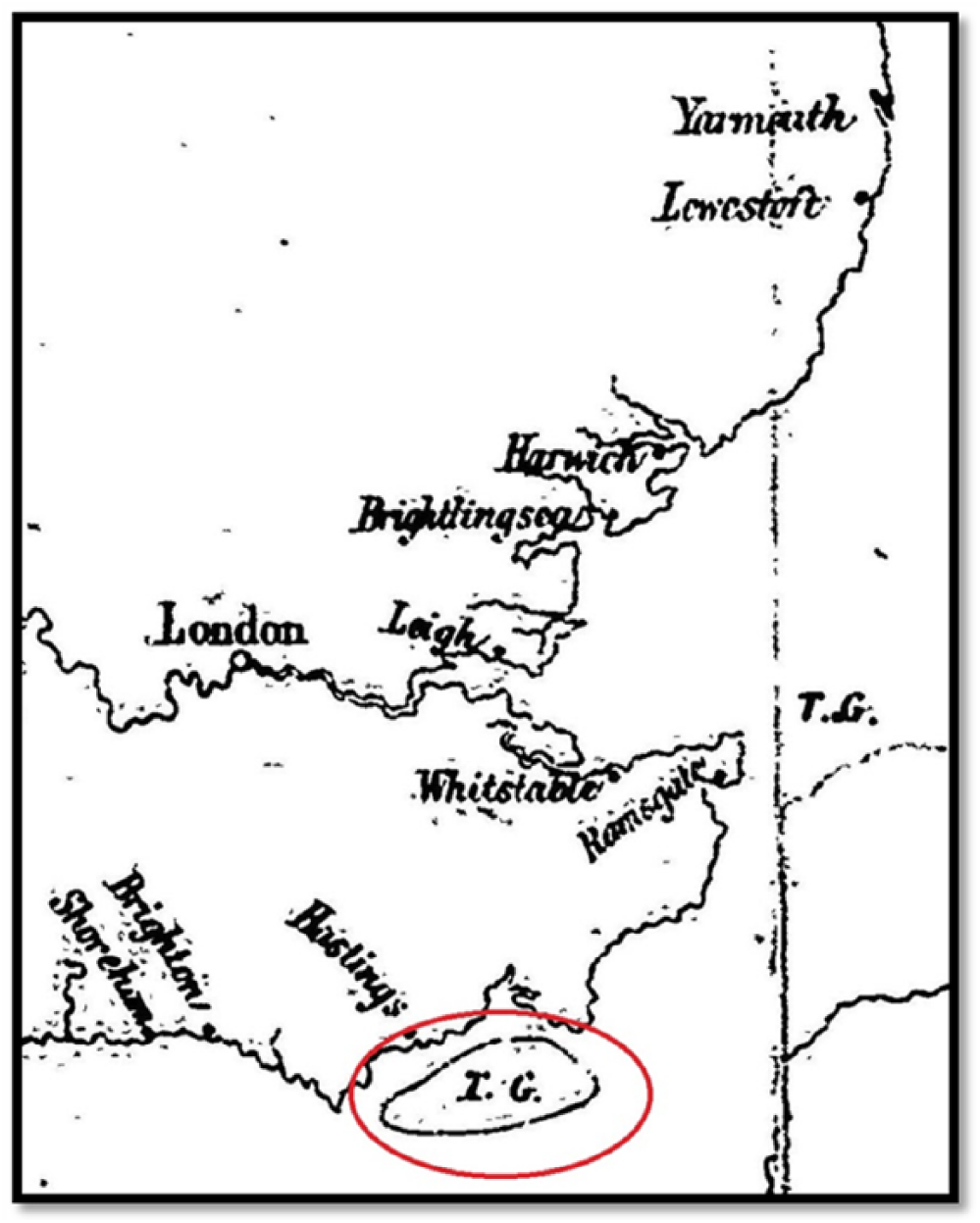
Probable location of the Sowe Bank.
In many ways, the situation around the Cinque Ports and the Sowe Bank appears to have been a classic case of the irresistible impact of growing market demand on a common resource – something like Garret Hardin’s ‘tragedy of the commons’. It appears that fishing pressure had increased dramatically by the beginning of the seventeenth century, and its impact was exacerbated by the added productivity (as well as the indiscriminate nature) of bottom trawling. Hardin’s original thesis on the inevitable degradation of common resources over time has come in for considerable criticism over the years, and a better model for the exploitation of the fisheries of south-eastern England in the seventeenth century might be Christopher Smout’s revision of it. In his 2011 article on the Firth of Forth in Scotland, Smout suggested that, whilst ‘mere population growth may add to the pressure’ on a common resource, ‘at least as significant in respect of resource use is likely to be the growth of an external market … [because] rising profits will enable [fishermen] to increase their capital inputs, improving the productivity and intensity of their exploitation’. In this case, the growth of external markets relates to London, especially taking into account the increased observance of fish days, and the likely expansion of the market for English fish in northern France. Trade routes to these markets had opened up substantially and this, in turn, led to increased demand, which inevitably attracted capital and intensive fishing activity (in the shape of new trawling gear) from outside local communities. As a result of increased fishing pressure, it was perhaps inevitable that any customary controls local fishermen had previously been able to exert, such as resisting unpopular or over-productive fishing methods, were compromised. Increased competition for a limited (common) resource led to the widespread adoption of the most productive gear – bottom trawls – so that, not only were local fishermen unable to prevent its spread, at a certain economic tipping point they were forced to plead to be allowed to use it themselves, as evidenced by their petitions to the Admiralty and the king. 31
Serious attempts were made by the authorities to restrict the use of what were deemed to be overly destructive fishing methods, and to control the numbers of fishermen working in the most productive areas (such as the Sowe Bank) by means of proclamations, patrols, punishments and the judicious use of licenses. But these measures were ineffective in the face of a growing tide of fishermen using prohibited gear. By the mid-1630s, the Admiralty papers are full of accounts of punishments meted out to trawling fishermen, including the seizure and destruction of nets and gear, the impounding of boats (including 36 in one day, in June 1635), and the arrest and binding over of men found using trawls (34 in July and August of 1633 alone). Yet, despite all the activity aimed at suppressing trawling, there is a note of exasperation in the officers’ accounts of men who ‘trawl as freely as though they had never been prohibited’, and who ‘rail … and curse’ at the officials who intervened. Furthermore, there is something disturbingly familiar in this account of the rapid growth of bottom trawling against the wishes of local fishermen, and the failure of local – and even national – measures to resist it. This is something that has been repeated again and again in developing fisheries worldwide, particularly over the last few decades, and still the pattern repeats itself. It is therefore remarkable to see the origins of this pattern, not in the Indo-Pacific in the 1970s, nor off the coast of Gujarat in the 1950s, nor even in the North Sea in the 1880s, but on the south-east coast of England as far back as the early 1600s. 32
Conclusion
This study demonstrates for the first time that bottom trawling on the east and south-east coasts of England has a long and troubled history stretching back more than six centuries. 33 Contrary to the orthodox view (established in the late nineteenth century and subsequently adopted by most of those who have commented on it since then) it was neither restricted to inshore waters during the early modern period, nor was its impact insignificant, either in economic or environmental terms. As Callum Roberts noted in 2007, ‘most of what we know about the early history of trawling comes from measures taken to ban or restrict its use’. But the scale and continuity of that opposition in the seventeenth century is remarkable, as is the willingness of local and central administrators to take action against those who persisted in trawling against popular opinion. All of which raises very important questions about why the history of early modern bottom trawling has been neglected, especially at a time when its impact on fish stocks and on the benthos more generally is under renewed and intense scrutiny. 34
In terms of modern discussions about the overexploitation of marine resources, there is a sense that pre-industrial trawling by sail has been viewed as being of little importance simply because it was assumed to have been practised on a relatively small scale and only in inshore – and even nearshore – waters. 35 Even avowedly historical accounts of commercial fishing tend to dismiss the potential importance of pre-modern trawling. For example, having acknowledged that ‘[t]rawling was, of course an ancient activity’, Robinson and Starkey echo the orthodox view that ‘until the late eighteenth century the practice had been largely restricted to the ports of Brixham and Plymouth … and the approaches to the Thames’, 36 and, in common with those few others who have looked into its history, their discussion of the commercial (and, by implication, the environmental) impact of trawling really only takes off in the 1840s, when ‘the railways … created the environment for the rapid expansion of the activity … by providing marketing opportunities for the large catches of cheap fish taken in the trawl’. 37 Many similar examples could be cited. 38
Clearly, it would be foolish to deny the rapid expansion of trawling in Britain, first in the 1840s and 1850s with the coming of the railways, and then in the 1880s and 1890s with the rapid introduction of steel-hulled, steam-propelled trawlers. Nonetheless, it can convincingly be argued that the fact that historians and fisheries scientists have so comprehensively overlooked the scale and spread of trawling before the nineteenth century has had the effect of trivialising its impact on nearshore fisheries in the past. In many ways, it is a classic case of shifting environmental baselines: even the most committed marine historical ecologists and environmental historians have been unable to countenance the possibility that trawling could have fundamentally affected fisheries and marine ecosystems in the early modern period. Yet, this is clearly what contemporaries believed was happening in the seventeenth century; and not just local non-trawling fishermen, but Admiralty officers and legislators, too. Tales of scarcity, mostly as a result of taking large quantities of immature fish, bedevil the early history of trawling, and both the Plantagenets and the Stuarts complained of the impact of dragging heavy gear across the surface of the seabed.
The authorities in London were preoccupied with ensuring the supply of cheap protein to the growing population, and the Stuart court was clearly keen to guarantee a plentiful supply of fresh fish for its table. Part of the reason local communities opposed trawling so vehemently was that it was a relatively capital-intensive method of fishing, particularly in its earliest years, and was therefore largely out of their reach. Most fishermen and small fishing communities operated on a relatively small scale, relying on static nets and hook-and-line technology, both of which could be pursued from small craft. Trawling, on the other hand, required much greater capital input than they were able to realise: not only did the gear (beams, trawl-heads, nets, weights or chains, dragging ropes, etc.) require considerable investment, but the boats required to drag it had to be much larger than most inshore fishing craft, and in almost all cases required sail power. Hence, in part, the opposition of the Cinque Ports fishermen to ‘outsiders’ who came in with their larger, more efficient and more expensive trawling gear in the early seventeenth century.
But neither of these self-interested explanations should blind us to the fact that fishermen, and the authorities which often supported them, were acutely aware of the environmental implications of trawling. Even though they objected, first and foremost, on economic and market-supply grounds, they knew from the earliest days that trawling potentially lessened the stocks of fish for all, and even that it was possible to jeopardise the sustainability of particularly vulnerable fisheries in sheltered inshore areas by taking too many immature fish. Indeed, these concerns – the economic and the environmental – were two sides of the same coin. But no matter what local successes they achieved, and no matter how much sympathy they had from the authorities, local fishermen were unable to will the beam trawl out of existence. Like an unwanted marker buoy, it seems that whenever trawling was forced beneath the surface in a particular place or at a particular time it simply popped up again later on or elsewhere. No matter how successfully it was suppressed or prohibited, such measures were always temporary; it was simply too productive and far too profitable to go away for good.
Footnotes
1.

2.
Report from the Commissioners Appointed to Enquire into the Sea Fisheries of the United Kingdom, with Appendix and Minutes of Evidence (London, 1866); Report of the Commissioners Appointed to Inquire and Report upon … the use of the Trawl Net and Beam Trawl, with Minutes of Evidence and Appendix (London, 1885). The quotation is from the Trawl Net and Beam Trawl Commission, xliii.
3.
H. M. Rozwadowski, The Sea Knows no Boundaries: A Century of Marine Science under ICES (Washington, DC, 2002), 50–4.
4.
The most famous – or infamous – example of recent stock collapse, which occurred against all official predictions and management advice, is that of the Newfoundland and Labrador Atlantic cod stocks in Canadian waters. The literature is extensive, but see, for example, C. Walters and J.-J. Maguire, ‘Lessons for Stock Assessment from the Northern Cod Collapse’, Reviews in Fish Biology and Fisheries, 6 (1996), 125–37; R. A. Myers, J. A. Hutchings and N. J. Barrowman, ‘Why do Fish Stocks Collapse? The Example of Cod in Atlantic Canada’, Ecological Applications, 7 (1997), 91–106; and, more popularly, D. Bavington, Managed Annihilation: An Unnatural History of the Newfoundland Cod Collapse (Vancouver, 2010); and M. Harris, Lament for an Ocean: The Collapse of the Atlantic Cod Fishery: A True Crime Story (Toronto, 1998).
5.
6.
The literature relating to marine historical ecology and marine environmental history is extensive and expanding rapidly. It is global in its coverage and impressive in its reach, and it would be impossible to do it full justice here. However, two recent collections which offer new work alongside excellent overviews of the field are: K. Schwedtner Máñez and B. Poulsen, eds., Perspectives on Oceans Past: A Handbook of Marine Environmental History (Dordrecht, 2016) and contributions to the ‘Marine Forum’ special edition of Environmental History, 18, No. 1 (2013), 3–126.
7.
G. H. Engelhard, ‘One Hundred and Twenty Years of Change in Fishing Power of English North Sea Trawlers’, in A. I. L. Payne, J. Cotter and T. Potter, eds., Advances in Fisheries Science: 50 Years on from Beverton and Holt (Oxford, 2009), 1–25; R. H. Thurstan, S. Brockington and C. M. Roberts, ‘The Effects of 118 Years of Industrial Fishing on U.K. Bottom Trawl Fisheries’, Nature Communications, 1 (2010), doi: 10.1038/ncomms1013: 1; R. H. Thurstan, J. P. Hawkins and C. M. Roberts, ‘Origins of the Bottom Trawling Controversy in the British Isles: 19th Century Witness Testimonies Reveal Evidence of Early Fishery Declines’, Fish and Fisheries, 15 (2013), doi: 10.1111/faf.12034: 15.
8.
For example, L. Airoldi and M. W. Beck, ‘Loss, Status and Trends for Coastal Marine Habitats of Europe’, Oceanography and Marine Biology: An Annual Review, 45 (2007), 353; C. M. Roberts, The Unnatural History of the Sea: The Past and Future of Humanity and Fishing (London, 2007), 136–7; S. J. de Groot, ‘The Impact of Bottom Trawling on Benthic Fauna of the North Sea’, Ocean Management, 9 (1984), 178; N. Haggan and B. Neis, ‘The Changing Face of Fisheries Science and Management’, in N. Haggan, B. Neis and I. G. Baird, eds., Fishers’ Knowledge in Fisheries Science and Management (UNESCO Coastal Management Sourcebook series, Paris, 2007), 354; S. J. Kennelly and M. K. Broadhurst, ‘By-catch Begone: Changes in the Philosophy of Fishing Technology’, Fish and Fisheries, 3 (2002), 342.
9.
See A. R. Michell, ‘The European Fisheries in Early Modern History’, in E. E. Rich and C. H. Wilson, eds., The Cambridge Economic History of Europe, Volume IV (Cambridge, 1967); Wendy R. Childs and Maryanne Kowaleski, ‘Fishing and Fisheries in the Middle Ages’, in David J. Starkey, Chris Reid and Neil Ashcroft, eds., England’s Sea Fisheries: The Commercial Sea Fisheries of England and Wales since 1300 (London, 2000), 19–28.
10.
Robb Robinson, Trawling: The Rise and Fall of the British Trawl Fishery (Exeter, 1996), 15. See also, Robb Robinson, ‘The Line and Trawl Fisheries in the Age of Sail’, in Starkey, Reid and Ashcroft, eds., England’s Sea Fisheries, 73–4; Robb Robinson, ‘The Fisheries of Northwest Europe, c.1100–1850’, in David J. Starkey, Jón Th. Thór and Ingo Heidbrink, eds., A History of the North Atlantic Fisheries, Volume 1: From Early Times to the Mid-Nineteenth Century (Bremerhaven, 2009), 162–3.
11.
Kennelly and Broadhurst, ‘By-catch Begone’, 342.
12.
For example, J. MacLaughlin, Troubled Waters: A Social and Cultural History of Ireland’s Sea Fisheries (Dublin, 2010), 282; E. S. Russell, ‘Trawling and the Stocks of Fish’, Journal of the Royal Society of Arts, 91 (1943), 198; E. P. Symes, ‘The Torbay Fishermen in Ringsend’, Dublin Historical Record, 53 (2000), 139; Thurstan, Hawkins and Roberts, ‘Origins of the Bottom Trawling Controversy’, 2.
13.
R. Robinson and D. J. Starkey, ‘The Sea Fisheries of the British Isles, 1376–1976: A Preliminary Survey’, in P. Holm, D. J. Starkey and J. T. Thór, eds., The North Atlantic Fisheries, 1100–1976: National Perspectives on a Common Resource (Studia Atlantica, 1; Esbjerg, 1996), 122–3.
14.
15.
Given-Wilson, Brand, Phillips, Ormrod, Martin, Curry and Horrox, eds., Parliamentary Rolls, Vol. II, Edward III, Appendix, January–March 1377 (electronic version); D. Allen, ‘A Fourteenth-Century Divorce in Stoke-by-Nayland’, Proceedings of the Suffolk Institute of Archaeology and History, 38 (1993), 3–4. Sadly, no record remains of the commission’s conclusions, nor of any further action taken by the Crown at this stage.
17.
D. Sahrhage and J. Lundbeck, A History of Fishing (Hamburg, 1992), 104; Robinson, Trawling, 16; Given-Wilson, Brand, Phillips, Ormrod, Martin, Curry and Horrox, eds., Parliamentary Rolls, Vol. III, Richard II, January 1394 (electronic version; my emphasis); H. T. Riley, ed., Chronicles of the Mayors and Sheriffs of London, A.D.1188 to A.D.1274 (London, 1863), 8.
18.
H. T. Riley, ed., Memorials of London and London Life in the 13th, 14th and 15th Centuries. Being a Series of Extracts Local, Social, and Political from the Early Archives of the City of London, A.D. 1276–1419 (London, 1868), 133–42; R. R. Sharpe, ed., Calendar of Letter-Books of the City of London: H, 1375–1399 (London, 1907), 87, 147–61; A. H. Thomas, Calendar of Plea and Memoranda Rolls Preserved among the Archives of the Corporation of the City of London at the Guildhall: A.D. 1381–1412 (Cambridge, 1832), 116.
19.
L. Wright, Sources of London English: Medieval Thames Vocabulary (Oxford, 1996), 71 and 78.
20.
J. S. Brewer, ed., Letters and Papers, Foreign and Domestic, of the Reign of Henry VIII, Vol. 3, Part 2 (London, 1867), 1290; F. P. Bennema and A. D. Rijnsdorp, ‘Fish Abundance, Fisheries, Fish Trade and Consumption in Sixteenth-Century Netherlands as Described by Adriaen Coenen’, Fisheries Research, 161 (2015), 396; R. Eden, ‘Preface’, in M. Cortes, The Arte of Navigation: Conteyning a Compendious description of the Sphere … (London, 1589), vi.
21.
Capt. Loder-Symonds and E. R. Wodehouse, The Manuscripts of Rye and Hereford Corporations (Historical Manuscripts Commission, Thirteenth Report, Appendix, Part IV: London, 1892), 133; M. A. Everett Green, ed., Calendar of State Papers, Domestic Series, of the Reign of James I, 1611–1618 (London, 1858), 456. For the importance of the fisheries in Sussex, and in particular those close to Winchelsea, for provisioning the king’s table, see M. Kowaleski, ‘The Seasonality of Fishing in Medieval Britain’, in S. G. Bruce, ed., Ecologies and Economies in Medieval and Early-Modern Europe (Boston, 2010), 133; M. A. Everett Green, ed., Calendar of State Papers, Domestic Series, of the Reign of James I, 1619–1623 (London, 1858), 345–6 and 457; J. Bruce, ed., Calendar of State Papers, Domestic Series, of the Reign of Charles I, 1631–1633 (London, 1862), 243.
22.
M. A. Everett Green, ed., Calendar of State Papers, Domestic Series, of the Reign of James I, 1623–1625 (London, 1859), 208 and 228; Loder-Symonds and Wodehouse, The Manuscripts of Rye, 171.
23.
J. Bruce, ed., Calendar of State Papers, Domestic Series, of the Reign of Charles I, 1633–1634 (London, 1863), 126–7; J. Bruce, ed., Calendar of State Papers, Domestic Series, of the Reign of Charles I, 1629–1631 (London, 1860), 559–60; this version reproduced in R. de Thoyras, Acta Regia. Being the Account which Mr. Rapin de Thoyras Published of the History of England … (London, 1733), 800.
24.
Bruce, ed., Calendar of State Papers Charles I, 1631–1633, 4, 78, 303, 316, 324, 329, 338, 351, 380 and 544.
25.
Bruce, ed., Calendar of State Papers Charles I, 1631–1633, 126–7 and 170; Bruce, ed., Calendar of State Papers Charles I, 1635, 130; J. Bruce, ed., Calendar of State Papers, Domestic Series, of the Reign of Charles I, 1635 (London, 1865), 3.
26.
Bruce, ed., Calendar of State Papers Charles I, 1635, 92 and 124–5.
27.
W. D. Hamilton and S. Crawford Lomas, eds., Calendar of State Papers, Domestic Series, of the Reign of Charles I, Addenda: March 1625–1649 (London, 1897), 515.
28.
W. D. Hamilton, ed., Calendar of State Papers, Domestic Series, of the Reign of Charles I, 1641–1643 (London, 1887), 442; J. Whittle, Consumption and Gender in the Early Seventeenth-Century Household: The World of Alice Le Strange (Oxford, 2012), 97; Everett Green, ed., Calendar of State Papers, James I, 1619–1623, 133.
29.
Loder-Symonds and Wodehouse, The Manuscripts of Rye, 133.
30.
T. Wemyss Fulton, The Sovereignty of the Sea: An Historical Account of the Claims of England to the Dominion of the British Seas … (Edinburgh, 1911), 64–5, see also Appendix C, 749–50, where Wemyss Fulton reproduces a license issued to a French fisherman in 1615; Everett Green, ed., Calendar of State Papers, James I, 1619–1623, 133.
31.
G. Hardin, ‘The Tragedy of the Commons’, Science, 162 (1968), 1243–48; for criticism of Hardin’s original thesis see, for example, F. Berkes, ‘Fishermen and the “Tragedy of the Commons”’, Environmental Conservation, 12 (1985), 199–206; D. Feeny, F. Berkes, B. J. McCay and J. M. Acheson, ‘The Tragedy of the Commons: Twenty-Two Years Later’, Human Ecology, 18 (1990), 1–19; J. Kurien, Ruining the Commons and Responses of the Commoners: Coastal Overfishing and Fishermen’s Actions in Kerala State, India (United Nations Research Institute for Social development, Discussion Paper 23, Geneva, 1991), 1–2; F. van Laerhoven and E. Ostrom, ‘Traditions and Trends in the Study of the Commons’, International Journal of the Commons, 1 (2007), 19–20; T. C. Smout, ‘Garrett Hardin, The Tragedy of the Commons and the Firth of Forth’, Environment and History, 17 (2011), 359.
32.
Bruce, ed., Calendar of State Papers Charles I, 1635, 125; Bruce, ed., Calendar of State Papers Charles I, 1631–1633, 350 and 395; for modern examples of this trend see, for example, C. Bailey, ‘The Political Economy of Marine Fisheries Development in Indonesia’, Indonesia, 46, October (1988), 34–6; J. Christensen, ‘Unsettled Seas: Towards a History of Marine Animal Populations in the Central Indo-Pacific’, in J. Christensen and M. Tull, eds., Historical Perspectives of Fisheries Exploitation in the Indo-Pacific (Dordrecht, 2014), 27–31; O. Bin Jee, Development Problems of an Open-Access Resource: The Fisheries of Peninsula Malaysia (ASEAN Economic Research Unit, Occasional Paper No.86: Singapore, 1990), 27–9; D. Johnson, ‘Wealth and Waste: Contrasting legacies of fisheries development in Gujarat since 1950s’, Economic and Political Weekly, 36 (2001), 1095–7 and 1099–1101.
33.
The evidence suggests strongly that bottom trawling around Britain’s coasts has an unbroken history reaching back to the fourteenth century. See P. Jones, ‘Technological Innovation and Resource Management in the Fisheries of the British Isles, ca.1400–1900’ (unpublished PhD thesis, University of Strathclyde, 2016), 20–77.
34.
Roberts, Unnatural History, 138.
35.
See, for example, Engelhard, ‘One Hundred and Twenty Years’, 1–2, 4 passim; Thurstan, Hawkins and Roberts, ‘Origins’, 2.
36.
The orthodox view dates back to J. W. Collins, The Beam-Trawl Fishery of Great Britain, with Notes on Beam-Trawling in Other European Countries (Washington, DC, 1889), 293–4. See also, W. L. Holt, ‘An Examination of the Present State of the Grimsby Trawl Fishery, with Especial Reference to the Destruction of Small Fish’, Journal of the Marine Biological Association of the United Kingdom, 4 (1897), 363–7; Russell, ‘Trawling and the Stocks of Fish’, 198–9.
37.
Robinson and Starkey, ‘Sea Fisheries’, 135. See also, Robinson, Trawling, 17–22 passim; Robinson, ‘Line and Trawl Fisheries’, 73–4; Robinson, ‘Fisheries of Northwest Europe’, 162–3.
38.
De Groot, ‘The Impact’, 179; Kennelly and Broadhurst, ‘By-catch Begone’, 342–3; Roberts, Unnatural History, 141–2.