







Abstract
This review essay appraises the first online exhibition in the world on gendered maritime labour. The 23-panel exhibition addresses the subject from a UK perspective and deals specifically with P&O’s women seafarers from the company’s earliest times to today. Initially the essay outlines the contents of each panel and its accompanying ‘treasure chests’, making wider points about P&O’s position compared to other UK shipping operators. Then it tackles four key questions. How typical of women’s progress in the maritime world is this representation of P&O women? How productively and fairly does this exhibition represent the subject: a marginalised group’s progression from the periphery to the mainstream? How does this exhibition about a particular marginalised group illuminate the company’s growing understanding of the need to embrace diversity? Fourth, what is not there that should there? The essay concludes that the exhibition is, remarkably, of global value.
Seeing enables change
‘You can’t be what you can’t see’ goes the civil rights slogan, which is often used when activists press for role models to help excluded people imagine breaking the chains, for example, in accessing non-traditional jobs. 1 Visibility is especially necessary when it comes to the matter of women being barely evident in maritime work at the higher and more technical ends of the spectrum. Museums are one of the public spaces where better visibility can be achieved. However, women seafarers in the past have received little attention from maritime museums in any country; certainly there have been few dedicated exhibitions. 2 Consequently, this raises the question: ‘to what extent have women not become seafarers just because it was not possible to see that women already were seafarers?’
Many maritime museums are now trying to adjust their permanent displays to be more inclusive. They do so while deploring the absence of evidence that might enable them to reveal much more of that past. 3 Faced with such a deficiency, any shipping company that took – and kept – pictures of its female labour force is welcome, especially if it will freely share its images. This online exhibition, WOW – Women on the Waves. P&O’s Pioneering Women Seafarers: Past, Present and Future, is therefore useful in its own right. But furthermore it will be an indicative template to help museums steaming towards staging their own material exhibitions about seafaring women’s pasts.
Before discussing any representation of women on ships in the nineteenth and early twentieth centuries, it is useful to understand the following main features of their gendered, raced and classed situation: they were few, and marginalised in low-grade domestic roles until the 1970s; they suffered distressingly bigoted and sexualised behaviour from some male shipmates; and they had to choose between pursuing an offshore career and having a family. 4 Some of those structural challenges still exist. As members of a minority in a white male workforce, female seagoing workers were to a slight degree similarly situated to the Black and Minority Ethnic Seafarers represented in Merseyside Maritime Museum’s Black Salt: Britain’s Black Sailors exhibition. This is the other recent key exhibition about maritime labour minorities.
The factors in common are that they were exceptionally mobile and motile members of their minority; to a greater extent than ashore, usually, they had a stigmatised identity in this workforce, one effect of which was that their skills were under-recognised; they had the constant additional informal tasks of proving that they were respect-worthy human beings, and of handling bullying within a multi-level hierarchy in a very confined and therefore emotionally intense 24/7 residential workplace. 5
However, women at sea on western ships before 1970 had the advantage of mainly being white Anglophones, fluent in the language of the dominant class. Many had the complex benefit of being the romantic partners of high-ranking officers, which gave them some privilege and power, if only vicariously. And women were much more part of the hotel, not vehicle, side of shipboard life. This enabled them to have a range of closer – and less-unequal relationship – with passengers than did their BAME counterparts, meaning that voyages could be somewhat pleasant.
It was on International Women’s Day, 8 March 2020, that P&O Heritage took the invaluable step of moving in where bricks-and-mortar museums have not. It created an online exhibition about its women seafarers. P&O Heritage is owned and operated by trading giant DP World. It exists to ‘preserve and celebrate’ part of that P&O history (not the separate P&O Cruises), and does so via mainlining a collection and archive, a website, online exhibitions and shop selling prints. 6
The mighty P&O, in all its iterations, has been one of the UK’s biggest shipping companies for over 180 years. It is far more than a transport operator. The 40 companies that have come under the P&O umbrella – such as British India Steam Navigation Company, Orient Steam Navigation Company, and New Zealand Shipping Company – have had an immeasurable (and controversial) effect on imperial and colonial development, especially in the Pacific (see Figure 1). So a global story from a UK angle is being represented here.
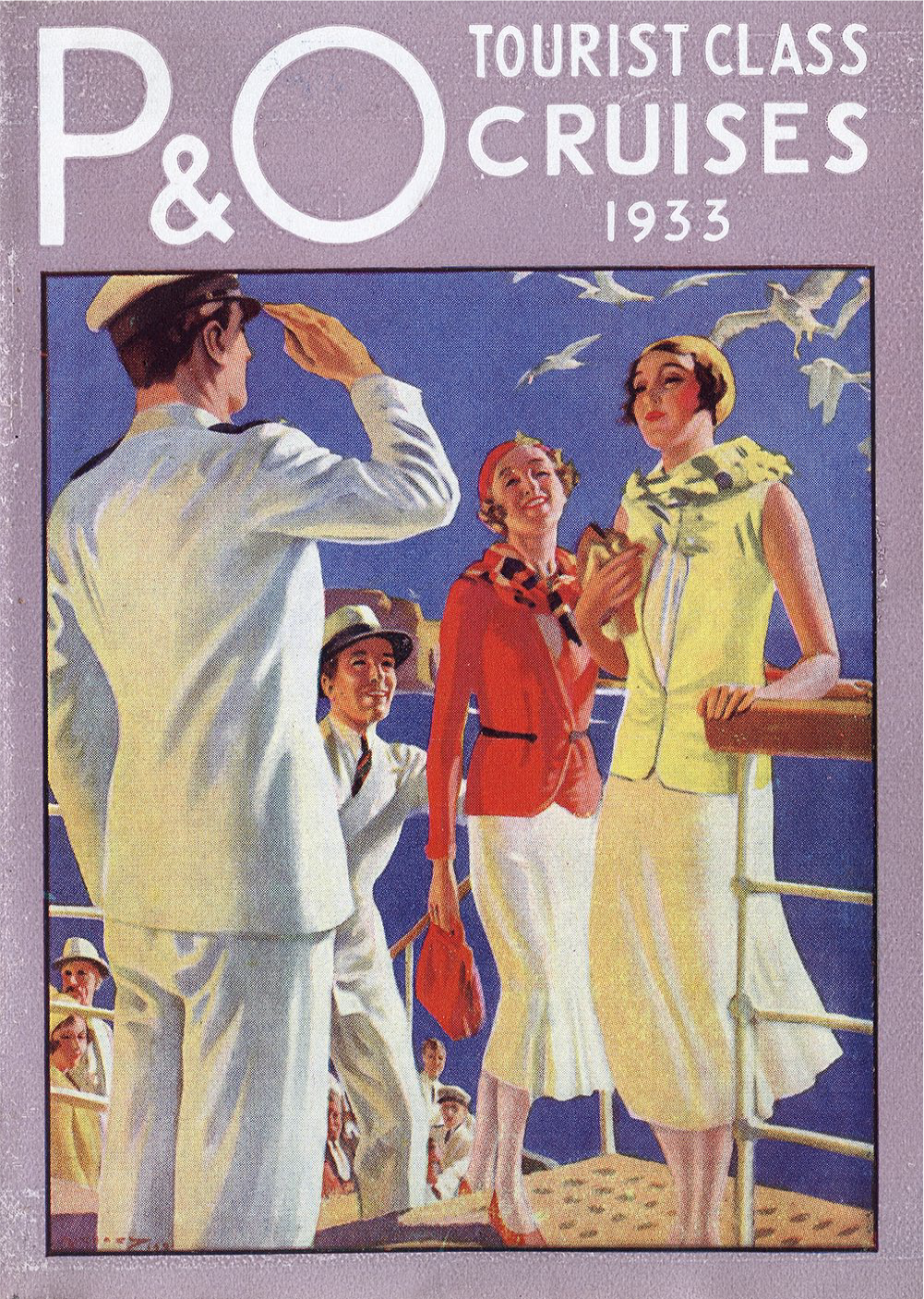
Tourist Class brochure for Viceroy of India cruise in 1933. P&O has had a major impact on global passenger and cargo transport, including the motility of the women who served such passengers. Image courtesy of P&O Heritage (AC/06100/00).
Any exhibition about any marginalised sort of labour in the transport industry has to be a valuable illumination about the hidden processes of production and exchange. But WOW – Women on the Waves goes a step further. It does not just offer a wider understanding of women seafarers and therefore an occluded aspect of the histories of maritime, labour and carceral institutions, as a history of disabled or LGBTQ+ seafarers might. Because of its curators’ insights, WOW – Women on the Waves also reveals the gendered nature of life behind the green baize doors on some of the fanciest floating hotels in the world. That makes the exhibition a significant addition to tourism and travel history, gender history and that new field, the history of affective (non-material) labour 7 (see Figure 2).
The exhibition’s keynote image. Image courtesy of P&O Heritage. 8
WOW – Women on the Waves. P&O’s Pioneering Women Seafarers: Past, Present and Future is the most important exhibition on the subject in the world so far. It is not the first about seafaring women. But no exhibition has before been available in capital cities. And it is the first to have global reach: as it online it can be viewed anywhere there is internet connectivity – including on ships captained by women out at sea – at the instant they seek it. The exhibition was created and launched just days before the Covid-19 lockdown, which brought new understandings about how to live a physically distanced life. So this is one of the first new virtual exhibitions, and it heralds innovative exhibition styles to come. The curators are Senior Curator Susie Cox, with Digital Curator Beth Ellis doing the design and digital production.
Their exhibition would take up substantial space in a real museum. It comprises 23 of what might, in a physical space, be called ‘boards’: seven-foot high panels with explanatory words and pictures. Most of this virtual exhibition’s ‘boards’ are rich with extras, including supporting photographs, germane stories and videos. By clicking on the symbolic pointing hands you can access another ‘room’, a relevant treasure chest to the side. For example, clicking on the board about Captain Louise Sara, currently the senior master on Pride of Canterbury, enables visitors to go the ‘treasure chest’, or sub-board, and watch a video of her introducing us to her ship as she tours round it, explaining the job.
The problem with a virtual exhibition, of course, is that the visitor cannot stroll to the other side of the room at whim: linear browsing is imposed. Also in this case there was no way to ‘take out a magnifying glass’ or reach for the search menu to find key words, say, ‘radio officers’ or ‘pregnancy’. But among the many assets are: these doors never close against shift workers limited by unsocial hours; travelling to the venue is no problem; and no entrance fee is needed. A visitor in slippers can even drop in with a drink in hand and pet parrot on their shoulder.
Progress
Captain Sara is a symbol of the progress made by seafaring women, or rather by the employers who have finally let women into STEM areas of the workforce. Women have risen from marginal stewardess in the early nineteenth century to captain in the twenty-first century. To put it another way, they have moved from the silo of women’s below-deck domestic enclave to the mixed-sex and mixed-gender spaces, including bridge and engine room; in doing, so they have gained more prestigious status as well as interesting formal and informal opportunities. Exhibition boards show women’s trajectory from being can-can dancing CODs (Central Office Dollies) and captain’s floozies (the arch term for his secretary) in the 1960s to becoming senior figures from 2000.The first one of these captains, Barbara Campbell, who was on P&O Scottish Ferries St Sunniva, has just retired after 43 years at sea, the exhibition tells us. She is, in a sense, the proof that the pudding is edible.
By contrast, the exhibition’s central image is a 1920s cartoon showing what was then thought to be a hilarious fantasy: a woman captain. The joke then was that a puss wearing thigh-high boots was similarly improbable. The final boards are about women today – and not only white women – such as Captain Ade Puspitaloka of P&O Maritime (Figure 3). She is the first, and only, female tug master in DP World’s Jebel Ali Port, Dubai, the largest port in the Middle East.
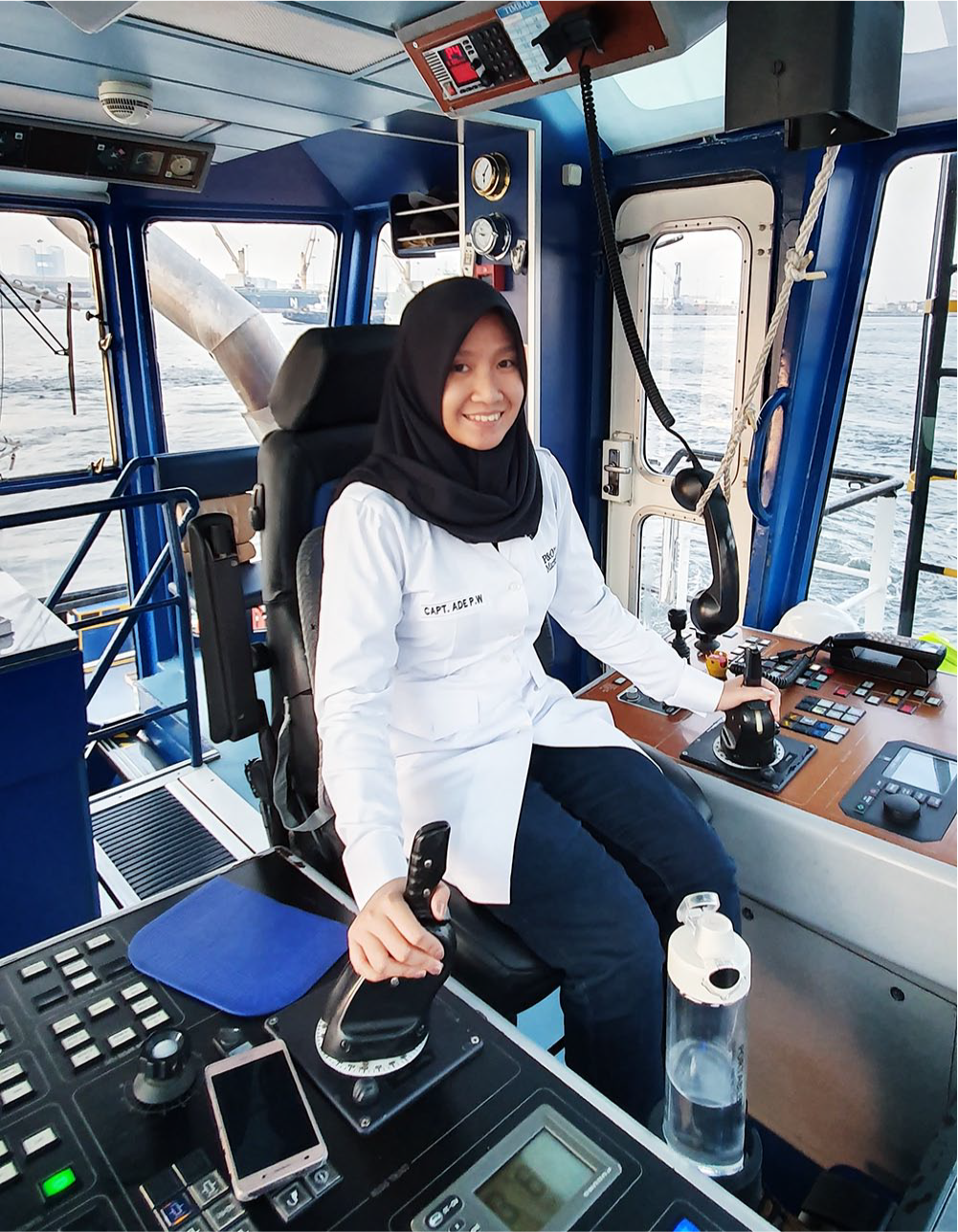
Captain Ade Puspitaloka of P&O Maritime. Image courtesy of P&O Heritage.
Starting the tour
If this reviewer could walk you, the reader-visitor, through the ‘exhibition space’ – commenting on where P&O was typical and atypical – the tour would go something like this:
The Introductory board celebrates the fact that ‘the glass bulkhead has been breached by some remarkable women. We hope to highlight some of them here and to inspire our next generation of P&O pioneers to come on board!’ This affirms the welcome the maritime industry in general is now giving to women. That welcome is especially a consequence of the worldwide officer shortage forcing shipping lines to recruit other than white European males.
Then the Looking after the Ladies board makes it clear that women shipboard personnel began because steam-powered shipping began. New technology in the late nineteenth century coincided with increased awareness of women’s rights. More women passengers began to see that they could safely travel long distances by sea. And shipping lines profitably assured passengers that they would barely notice the difference from their boudoir at home. To assist this illusion, white females were employed in the floating hotels and boarding houses to look after that dependent category described by militarism critic Cynthia Enloe as ‘womenandchildren’. 9 In the early nineteenth century, that work was done in the communal Ladies Cabins. Ships’ plans here show the positioning of this segregated space, sometimes seen as a harem, on the new P&O steam and sail ship Bentinck in 1845. They show that stewardess’s many mistresses were tellingly quartered just a few doors away from her small personal place.
Shipping lines promoted the availability of a maternal stewardess, forever ready to meet the inmates’ needs. 10 In the servicing family, the stewardess was presented as being as reassuring a figure as the avuncular surgeon and the paternal master. Such figures were proof that a voyage would not only be safe, healthy and as orderly as the photographs of the formal, ranked ship’s company infer (see Figures 7 and 8), but also propriety would be assured, just as ladies-only compartments and waiting rooms on trains sought to guarantee moral travel.
Partly a stewardess’s work was like a hotel room-maid, but she was doing what scholars now call affective labour: managing other’s emotions in that potentially volatile place, a ship on a long and boring voyage, especially in bad conditions. William Whitlock Lloyd’s sketches in the famous P&O Pencillings (c1891–92) are one of the main lens through which potential passengers saw a P&O passage. His images here show his politely ironic versions of the passenger-figures whom stewardesses tactfully handled, including ‘One of Our Flirts’ and ‘Two of the Captain’s “Wives”’. It seems he never drew the classic ‘Demanding Fuss-pot’.
The board labelled Stewardess: Maid to One & All explains that the role of stewardess was the only one open to women at sea until after the First World War. The human beings occupying these ultra-feminised positions were a complex issue for males used to male-dominated workplaces. This board’s extra ‘treasure chest’ gives a brief outline of stewardess Alice Brewster’s tricky relations with shipmates in 1911. In the Red Sea’s unbearable heat, a Goan bath attendant on the China stabbed her to death with a porthole key. Brewster’s story helps us to understand white women crew’s relations with Asian men. It was mainly on ships that became ‘P&O’ that so many stewards were non-white, meaning there were many tensions on race as well as gender and status grounds. The murder is also rare proof that not only men on ultra-dangerous vessels such warships and whalers experienced what maritime labour historian Jonathan Hyslop characterises as ‘life trajectories of a “catastrophic” character’. On ships that some ruggedly masculine sea artisans saw as effete poodle-parlours, women were prone to life courses that included ‘serious injury and early death’. 11 Misogynistic attitudes and rivalries could breed a kind of domestic violence even within such alleged homes-from-homes. The exhibition does a service to such occluded history in bringing the matter out. 12
Relatedly, the exhibition’s extra information about stewardess Edith Maberley enables us to glimpse both the motility and mobility of these – usually unmarried or widowed – women who risked the seas despite the odds. New Zealand-born Maberley’s story shows some stewardesses’ dedication in war. Typically stalwarts did not want to be excused on the grounds that they were not members of the warrior sex. They were prepared to risk death as part of their professional duty as a member of the ship’s company. Maberley (54 years old) was one of the three stewardesses who died when the Maloja struck a mine in 1916. 13 The exhibition points out that together with the loss of P&O’s Persia and Cunard’s Lusitania, ‘the loss of all three liners accounted for the greatest number of female crew casualties in World War 1’. 14
Moving on to the inter-war years, the board Our Very Capable Stewardess discusses some of the other roles now opening up for women too. Such jobs included laundresses (whom employers paid less than male counterparts), as shown in the board on Steam Queens, and nurses (who obviated the need for expensive extra ship’s surgeons) at a time when cruising increasingly meant dealing with many elderly passengers who demanded much of these services. Nurses appear on a later board, Care and Conflict.
Among the 18 additional items in the ‘treasure chest’ is one of the first autobiographical statements. It is important because it reveals that stewardesses – and this is true in any company – did not necessarily accept the abjectified position of mere housemaid or the intimidating, male-led, hierarchal discipline, including bullying, in their 24/7 residential workplaces. Being middle class helped. OM Osmond (later Mrs Roberts-Pate) was an Ormonde stewardess in 1933: It wasn’t long before I learned that life at sea was ruled by a rigid code of ‘what you may not do’ and of finding the best way of doing it without being caught out by the Chief Steward. . . . the most inhuman man I have ever met. I was carpeted several times for such trivial offences that I plucked up the courage to reason with the Chief. But the only reply I ever got was ‘get out’!
15
In the Second World War, stewardess Elizabeth Plumb (59) can be seen as one P&O’s counterparts to Mrs Maberley in the 1914–1918 conflict. Admitting to being in her 50s, she too sailed despite danger. Women often did because they were loyal to their ship, habituated to seafaring and needed the income, especially as so many were the family’s main breadwinners. Luckily Plumb survived the sinking of the Rangitane in November 1940. Her valour meant she was awarded the BEM, which can be seen here. She was also ‘one of only five women to receive the Lloyds War Medal for Bravery at Sea during WW2’. At least 42 women crew died in that war, proportionately fewer than in the First World War.
One of the interesting sidelights to this exhibition is that it alludes to the new (but small) role that women began playing in interior design, on ships as in splendid Mayfair sitting rooms, in the 1920s and 1930s. Structural design was coded as a masculine occupation. But ship’s upholstery and furnishings were a suitable matter for a lady, as designers Anna and Doris Zinkheisen found in Cunard. The wayward Elsie Mackay had the most advantageous position of any such woman bidding for such work with any shipping line: she was daughter of P&O chairman Lord Inchcape. She, and her mother, not only designed cheery public spaces on the Cathay and Ranchi in the 1920s, which are pictured, but also arranged for the installation of ironing rooms for passengers’ use. On the longer voyages on ‘Strath’ class ships to Australia the budget passengers needed to tend their own clothes rather than rely on the expensive laundry facilities. Elsie Mackay thereby gave agency to thousands of transpacific women passengers (ironing tended to be a female task as the picture shows). Laundries were operated by women, lascar and West African men, and latterly non-mainland Chinese men, depending on the shipping line and period. The board Steam Queens discusses such women’s working lives on the Orient Line.
The Nursing Sisters board discusses the women who, from the 1930s, were routinely part of the sick-bay teams. As honorary officers they had high status. But the display also notes their assigned extra-curricular position in shipboard social life: ‘Nursing sisters in the Orient Line were the darlings of the crew’ remembered one purser. Very interestingly, the exhibition juxtaposes real photographs of diligent professional women in ship’s hospitals (see Figure 4) with many bright images of what might be called freewheeling ship’s nurse-ettes on the covers of Mills & Boon-style romantic paperbacks. 16
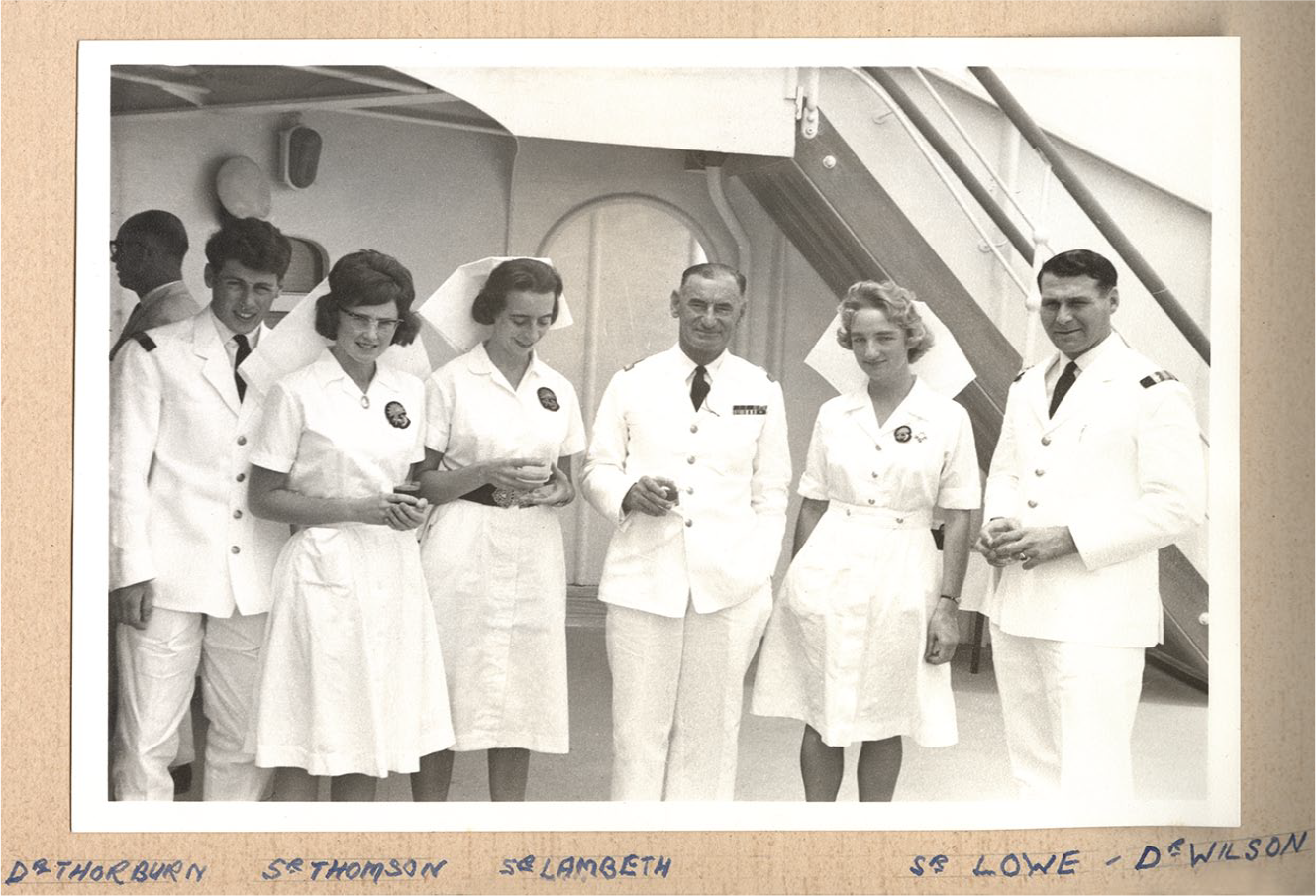
Nursing sisters flank the ship’s main officers in Captain’s Dunkley’s album, 1930s. Image courtesy of P&O Heritage (PH/08395/17).
Care and Conflict focuses on the appearance of female surgeons on P&O ships in the 1970s, which was late by comparison with other lines, such as Blue Funnel. The most famous was Dr Susie West, who sailed on Canberra in the 1983 Falklands War. The assistant surgeon felt ‘I was a doctor and it didn’t matter what sex I was’, whereas the Royal Navy would not take women medical officers to war. Among the treasure chest images are many of the 15 women on board what became, said the captain, ‘a front line assault ship’, not a liner that took tourists on world cruises.
One of the main developments of post-1945 shipping was that children were increasingly catered for in every shipping line, but particularly on the ships making long voyages to Australia, such as the Strath ships. The Chilly Ho Children board reveals something of the Children’s Hostesses. Often widely experienced teachers or occupational therapists, these officers took charge over nursery stewardesses (see Figure 5). For several decades before, the latter had been in sole charge. They had aptitude and experience with babies but lower qualifications, such as Nursery Nurses Examination Board diplomas.
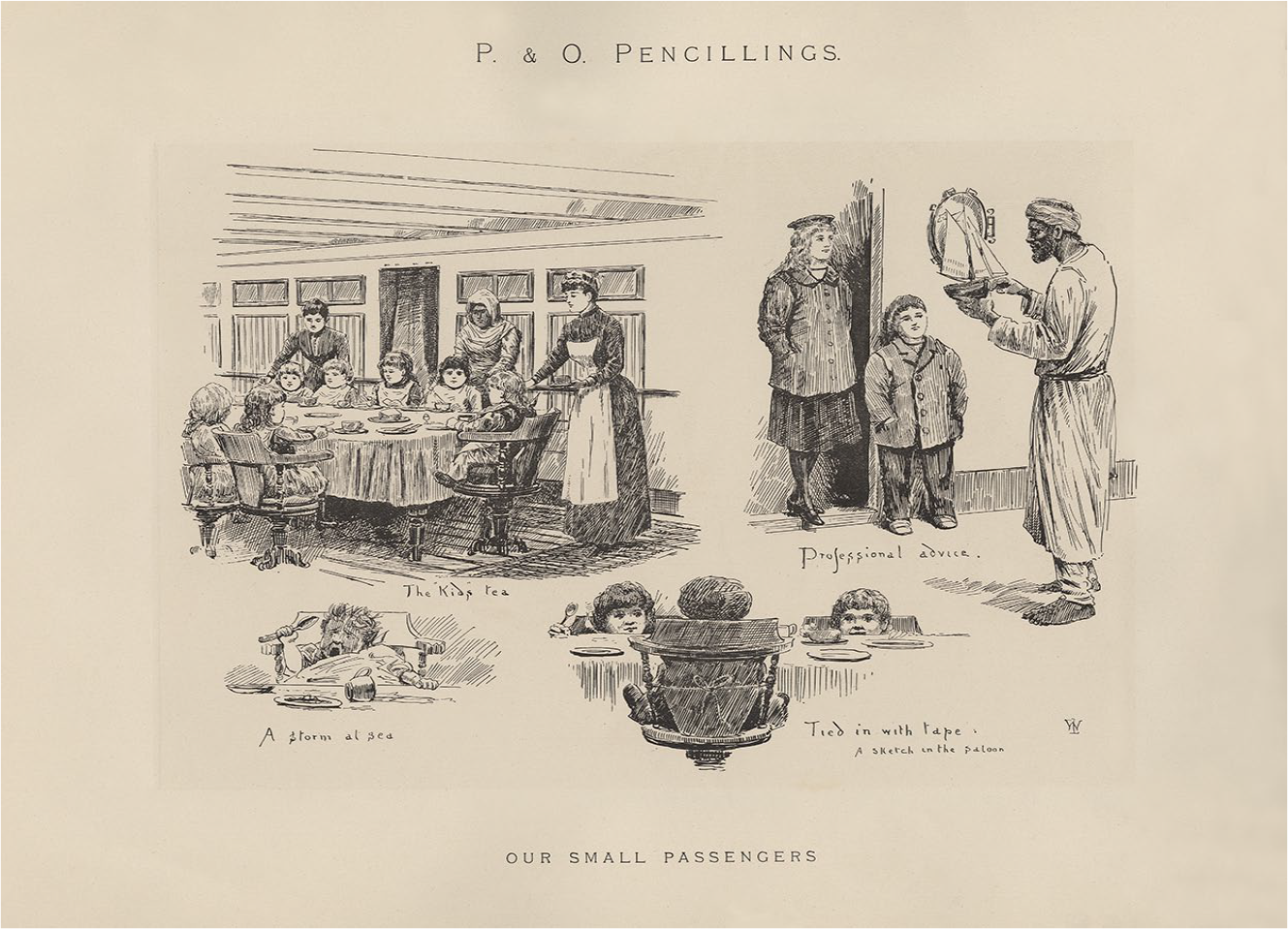
A nursery stewardess and an ayah are among those serving at that institution, ‘Children’s Tea’, P&O Pencillings by W. W. Lloyd, 1892-3. Image courtesy of P&O Heritage (AC/02169/42).
Rather than suppressing children, as in the past, P&O advised in P&O Regulations, Instructions and advice from Commanders, Deck Officers and Cadets (1952) that ‘Children can only be controlled by attraction, not by regulation . . . the essence of preventing them from being a nuisance must therefore be to offer them such interests as well keep them happy.’ The many promotional images show P&O’s new nurseries including gendered play activities: boys climbed ropes. But also ‘Elaine’ designed the children’s menus, inventing ‘P&O Pups’, dogs in sailor collars who danced hornpipes. The welcome given by these waged ‘Aunties’ to children is revealed in a standard letter from Stratheden hostess Ann Thomas in 1949. She wrote to all young passengers: I hope you will enjoy your voyage as much as the ‘P&O pups’, Henry, Victoria and George . . . with them will be their companion, Sinbad, the Ship’s cat . . . [W]atch each day at dinner time for their adventures on board and when they go ashore. Hoping that we will have many happy times together.
Not only children were managed in a charming way by women workers. So too were adults. The board Hostess with the Mostest shows the role of hostess was usually first taken on by women who were pursers’ assistants, that is, already officer-level. Ruth Griffin on the Orsova in 1972 wrote of the sailing day: ‘I’ve just farewelled about 1,200 passengers and I have to make friends with 1,200 more in a few hours’ time.’ Shipping companies knew that organising a sense of being be-friended could lead to happy passengers becoming repeat customers and giving delighted word-of-mouth publicity. Diana French, later Borcherds, was a female assistant purser (FAP) on the Oriana and then became the Chusan’s Tourist Class Social Hostess from 1961 (see Figure 6). The use of French’s statements is one of the great strengths of the exhibition. For example, it does not accept simplistic glamourized views of crew as working vacationers but recognises with French that ‘the job was all hours, all-encompassing and not all play . . . a man even complained that the ships’ hostess had refused to sleep with him . . . I explained that she was not a “call girl”.’ 17
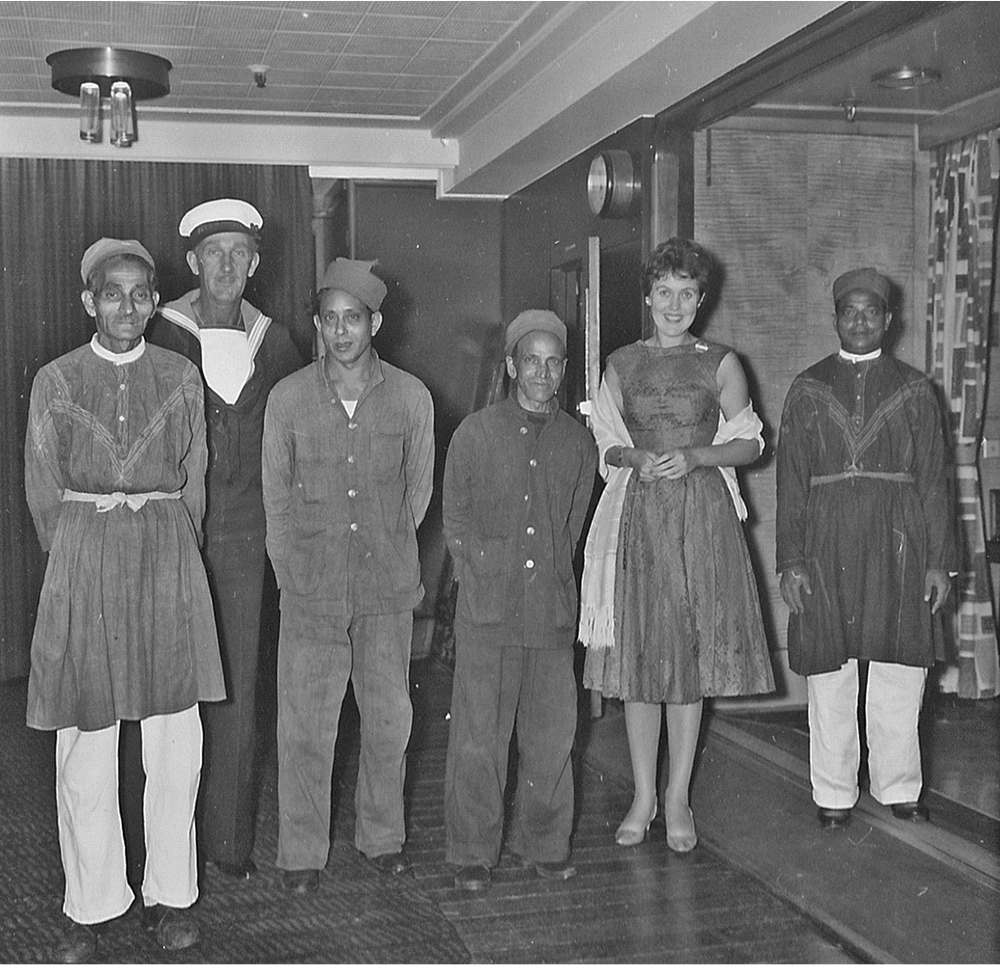
Diana French with her ‘Trusted crew’ on the Chusan in 1962. Image courtesy of Diana Borcherds/P&O Heritage (PH/08710/00).
The Office At Sea board shows assistant pursers. In every shipping line they were officers, and the women were often former Wrens. P&O sought to attract the right kind of applicant with an advert in 1955: ‘Still smiling, Miss?. . . six Marconigrams . . . a list of victualling stores to copy . . . the crew’s National Insurance Records to check . . . and the Captain wants to dictate some letters. Still smiling?’ Diana French was the ‘Captains’ Floozy’ on the Oriana in 1960 and found the task ‘somewhat daunting’. It was not the workload, but – as was so often the case – the extra work of managing unwanted sorts of attention: ‘. . .he teased me a lot by insisting I relax in his presence – remove my hat, undo my jacket and joining him in a drink before work . . . not my scene!’
Gillian Angrave was a junior WAP (as women assistant pursers were renamed) in 1967. She did not like having to retire at 40, as all female officers did under Shipping Federation protocols. When she left, ‘They almost had to drag me kicking and screaming from the ships’ side,’ she said. It was a few years before the anomaly was ended. Three filmed interviews with Angrave give much welcome information in the ‘treasure chests’. She mentions that men, not women, in the purser’s department paid out the crew wages in her day. ‘A few of the older white deck crew [thought] that having a woman on board was bad luck, so at times my dealing with them were a bit tricky and I didn’t take part in distributing the money.’ She points out that women were rare below decks and ‘had to be escorted by a male officer for their own safety’. This unusual practice will be a fruitful area for future scholars to investigate further, and is certainly not apparent from the ship’s company displays of rectitude (see Figures 7 and 8).
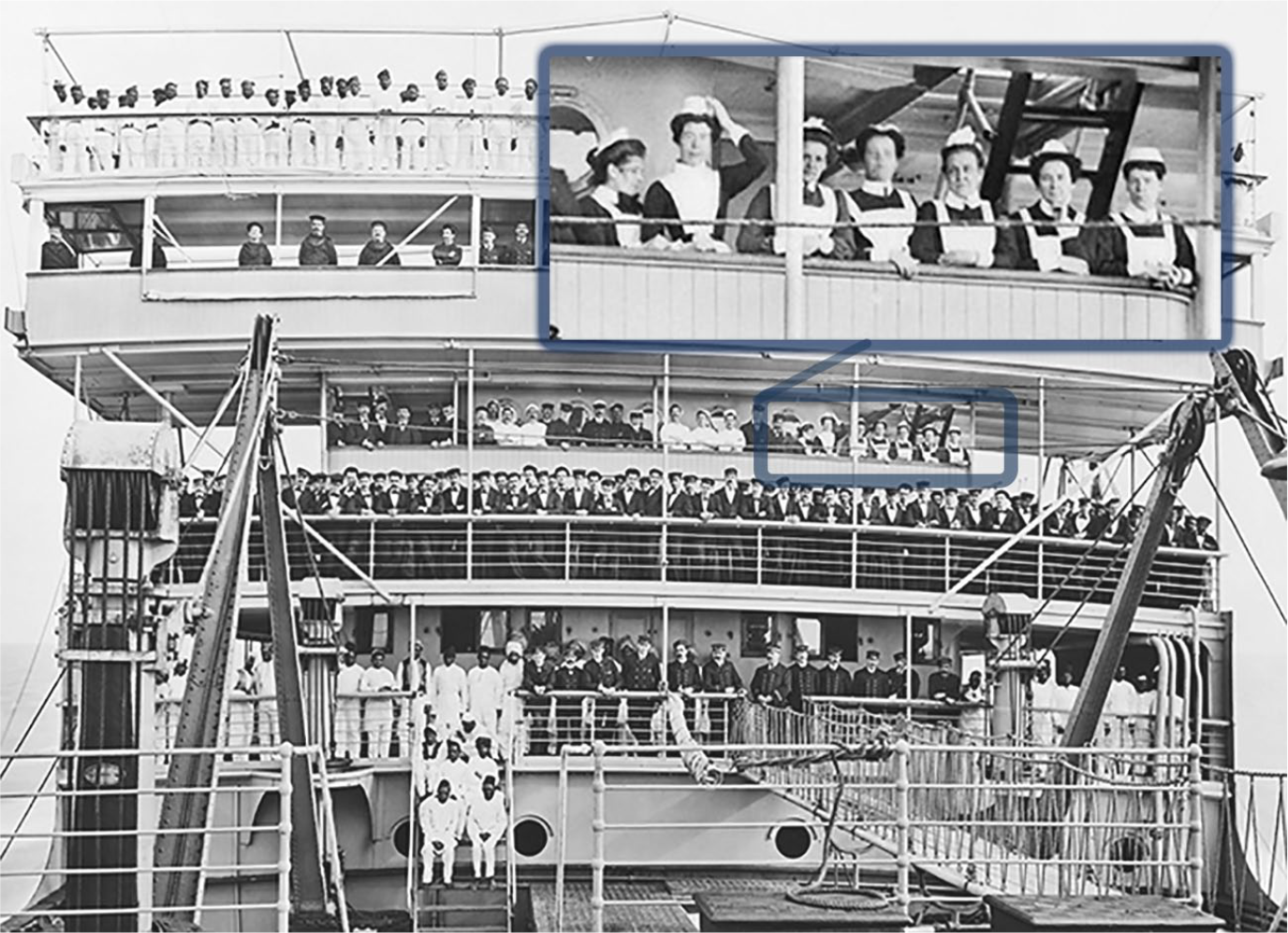
P&O’s Mongolia carried seven stewardesses, and no female officers, out of 300 crew in 1903. Image courtesy of P&O Heritage (PH/02779/00).
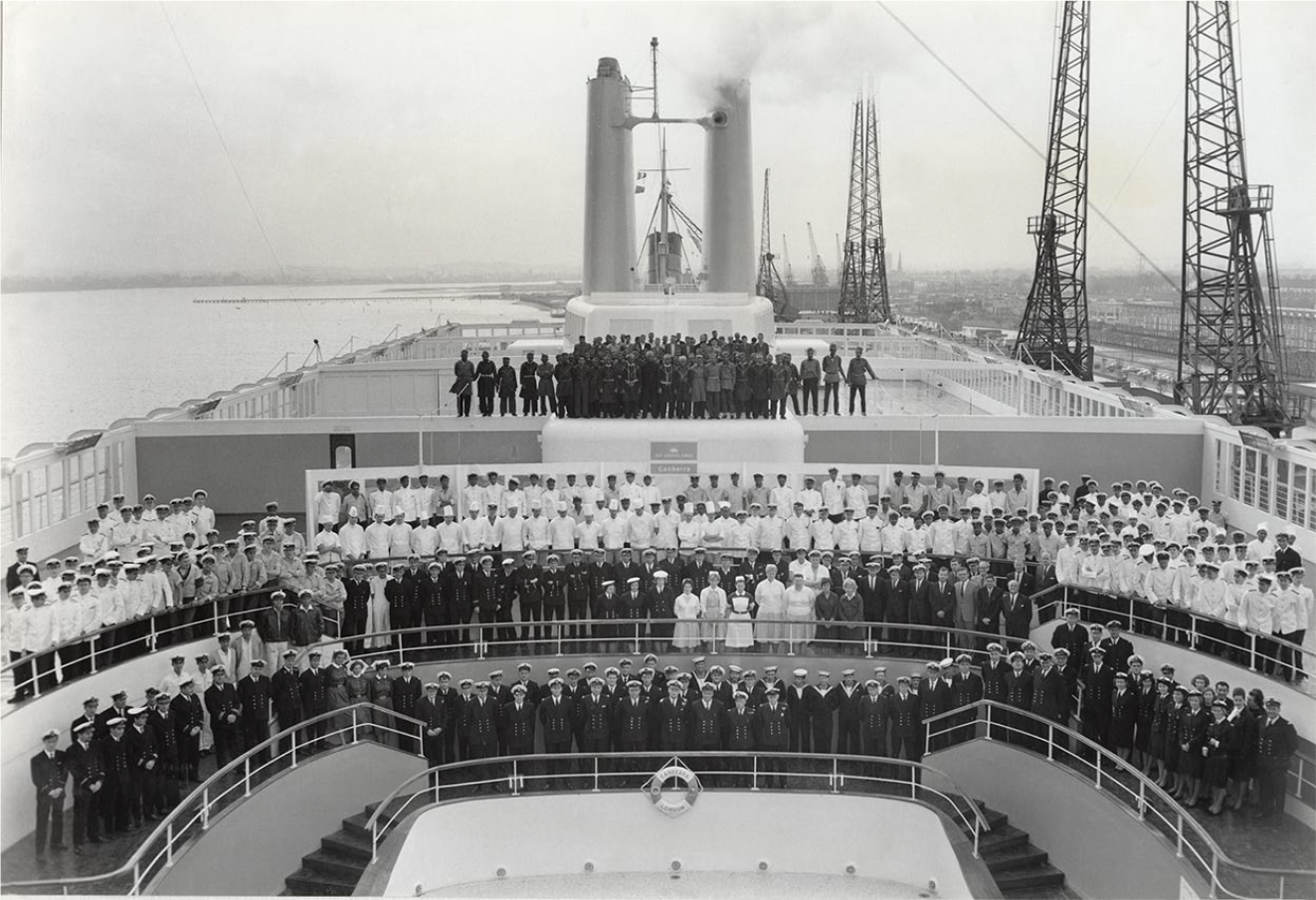
P&O’s Canberra, April 1965, showing ten female officers to the fore. Image courtesy of P&O Heritage (PH/08394/00).
On the Yes We Can Can board, Gillian Angrave explains that women in the purser’s office were expected to take part in entertaining the passengers, including dancing, in the days before professionals were flown out to perform. By contrast to this girly levity, the Pioneering Purser board shows a very determined Judy Smyth (1939–2009). Hats are still taken off to this ex-Wren who rose to become Purser in 1990, the only one in any UK fleet.
Equal opportunities legislation in the 1970s brought many pioneering women into STEM careers, including radio officer roles. ‘The female voice had been welcomed on the on the ship’s switchboards,’ explains the Calling Girls board. But the sound of a female ‘Marconi man’ across the radio waves set sparks flying, according to Radio Rarities. Radio was seen as a very responsible job, so could a ship afford to rely on a mere female to help it survive in an emergency? P&O appears to be the only company that can name the pioneers it entrusted with such power: Elisabeth Rait, then Debbie Rex, and Waleria Kosarew, who joined P&O’s Bulk Shipping Division for their practical training at sea in 1974. Theirs was only a brief window of opportunity as new technology ended the role very quickly.
Marine engineering was the acme of unthinkable STEM work for women seafarers. The Exceptional Engineer board features Victoria Drummond, the path-breaker whose P&O voyages from 1924 to 1927 were on the TSS Mulbera. Remarkably, Lord Inchcape himself agreed to her becoming one of their engineers. Aboard the British India ship she found ‘there was quite another feeling about the company. They all seemed quite superior sorts of people.’ 18 Several unusual pictures of Drummond in the treasure chest make this a fresh-seeming homage to this feted pioneer in women’s maritime history.
It took decades after Drummond’s rise before women moved into becoming deck and engine officer ‘cadetesses’ in British shipping lines. P&O was not among the first to comply with the new laws but was preceded by BP, Denholm Ship Management and the Athel Line from 1972. The board Shifting Gear – Women Cadets makes the point that the company’s officer cadet training scheme began in 1907, but women were only taken on in 1974. They were put to work ‘as all cadets do – with the dirty jobs’, said P&O.
19
No privileges for ladies was the line, although in fact the gents often behaved with outdated chivalry. Barbara Sampeys (later Campbell) was one of the first three, along with Sara Miller and Sara Stuart. The board Cadet to Captain details Barbara’s: trailblazing journey from cadet to captain . . . From cargo vessels, Barbara moved to P&O’s cruise fleet gaining her master’s certificate in 1986, before transferring to P&O Scottish Ferries . . . [later]Trading up to tall ships . . . becoming the first female master of the Sailing Training Association . . . [and] one of first three women admitted into Trinity House . . . [She] was awarded the . . . Victoria Drummond Award in 2015.
Next in the exhibition’s sequence is a slight digression from the story of women workers’ progress in two boards: Life Aboard the Last Liners and United in Uniform. If this was a physical exhibition perhaps these would appear in a break-out relaxation room, with sofas. But actually this is part of the story of linear advance. After the 1950s, P&O chose to shift the image of its ships and personnel. Photographs show that once women officers were dressed like Wrens. But then they were issued with fashionable clothing that was more like that of those chic new symbols of modernity, air hostesses, who worked for shipping’s competitors. As the board explains: Liner Life in the 1960s was a curious mix of absolute control and fearless freedom . . . Strict rules governed the conduct of women on board . . . breaking them, without being caught, was half the fun . . . Successfully navigating life at sea meant braving the banter, teasing and tormenting and, wherever possible, seizing the adventure.
Sage women knew when not to rock the boat. Those who could not stomach it had to leave sea life; changing companies would not work because the problem was cultural, not company-specific.
Drawing towards a conclusion, the board Sea Change makes a general point that even though: Today, the number of women seafarers is still surprisingly low . . . at the highest ranks . . . just 4% of “Certified Officers” are female. But, the education and opportunities for girls and women to succeed at sea are now available . . . the myths, sexism and superstition of the past have no place in our present.
Nevertheless, recent reports indicate that industry-wide prejudice is still too common. 20
The two boards about modern times show that women can now get jobs that were unthinkable once. Pioneers of Today – P&O Maritime outlines the careers of Captain Ade Puspitaloka and Louise Sara, referred to above. There is also a video of Stacey Gregory and Marnie Ross, P&O deck apprentices, who explain how the apprenticeship works for them: it is ‘fun, family and educational’.
Will you be our next recruit? asks the final board, offering links to P&O Ferries, P&O Maritime, DP World and Careers at Sea. The many useful sub-links are quite an innovation in an exhibition about history. But it is appropriate that past and present are shown to be connected. Sea-minded girls may well want to know that starting off as a Sea Ranger or Sea Cadet is a useful way in, as is looking at the ‘Maritime and Me’ case studies. In taking this approach, the exhibition espouses the ‘You can’t be what you can’t see’ principle. Now you can see it.
Assessing from an armchair
If this reviewer was indeed walking the reader round this exhibition, the time has now come to sit down in the imaginary P&O lounge (ideally on Elsie Mackay-designed armchairs), stomach a cup of Sir Jeffrey Sterling-brand tea, and evaluate the content. Four key questions might be discussed.
First, how typical of women’s progress in the maritime world is this representation of P&O women? Very much so, in this reviewer’s opinion. These boards do not display P&O as exceptional in its practices; they show trends common to most UK shipping companies. This largely because that umbrella entity, ‘the P&O group’, became so huge that it can barely be called one company. It incorporated so many companies, which kept their identity (to some degree) for some time. Their slightly different ways are sometimes revealed here and ideally these distinctions would be made clearer. But also the exhibition succeeds as a general account because of the curators’ apparent starting point: to create a summary of one company’s women seafarers built upon the skeleton of a deep and broad understanding of many companies’ patterns, including Cunard’s.
Second, how productively and fairly does this exhibition represent the subject: a marginalised group’s progressions from margins to mainstream? To show evidence of change it is necessary to name some of the obstacles in the early days. This is a difficult for an essentially public-relations-originated exhibition to do without attacking the company’s past practices. But the exhibition bravely tackled several areas of unfairness. This was aided by evidence from two main living informants, French and Angrave. Fortunately they worked in pursers’ departments, meaning they had an excellent overview of ships’ business.
Third, how does this exhibition about a particular marginalised group illuminate the company’s growing understanding of the need to embrace diversity? (In this case the focus is women, but the question would apply to exhibitions about BAME, disabled and LGBTQI people too). The WOW – Women on the Waves exhibition makes clear that several industry-wide factors brought change: ship technology, equal opportunities legislation and a growing public awareness that lack of the Y chromosome did not mean that half the population – women – were barely employable.
Fourth, what is not there that should there? Any curator has to decide what to omit. That heart-breaking task is always demanding. Additionally, any in-house exhibition necessarily has to exclude some of the trickier parts of its company’s history. The curator’s in-built imperative has to be that she selects evidence that presents the company in a favourable light, including representing voyages as joyous, and personnel-passenger relations as unproblematic. Ships’ photographers were on board glamorised ‘sweatships ships’ in every company to act as, in effect, informal spin doctors. 21
So no realist could expect an employer-originated exhibition to display the complex and less creditable account of labour relations aboard. There is no visual record, anywhere in shipping historiography, of seafarers of any line protesting on-board about the job’s precarity. Nor is there any image of women looking at their pregnancy test result, somewhere in the bowels of the ship, and realising this may mean an end to their hard-won career.
But reviewers are outsiders who can usefully compare representations of an organisation with similar organisations and add context. They are able to offer bigger perspectives. Newcomers browsing casually may be helped by knowing that the elephant in the room of P&O women workers’ history is that their employer was the most destructive of all the UK’s shipping companies in its labour relations. Always anti-union, the P&O group was the company that brought an end to the seafarers’ union. P&O’s European Ferries division did so in a slew of other attacks on workers’ rights including the News International group’s destruction of print unions from 1986 and the Thatcher government’s 1984–1985 onslaught on miners’ rights. 22 In 1988, the National Union of Seamen collapsed because a major dispute with P&O led to the union’s funds being sequestered. NUS staff were shut out of their headquarters and the NUS went into liquidation. 23 This history means that viewers of this exhibition are looking at the story of women in a particularly unhelpful shipping company, as regards labour practices.
Whether they knew it or not, later women pioneers were somewhat helped by the Equal Opportunities Commission taking P&O to court, and winning. P&O is the only shipping line to be involved in a test case about gender. The important decision that resulted arose because cinema projectionist Lucy Wallace was turned down for a job. She was excluded because the usual on-board residential space for a projectionist was in an all-male area of the ship, in literally a two-man cabin. The projectionist ‘had’ to be a man, for the sake of seemliness.
Lucy Wallace’s challenge to this was marshalled in the very early days of 1970s equal opportunities legislation, in order to explore the limits of the new term ‘Genuine Occupational Qualification’. The issue being tested was whether it was genuinely essential that a post-holder should be male. The answer turned out to be yes, in the case of someone measuring up customers for trousers in a gentleman’s outfitters. But was being male a Genuine Occupational Requirement for someone showing films on a ship? No. The employment tribunal in 1979 told P&O to alter its shipboard accommodation so that in future projectionist could be a job open to women and men alike. (Lucy Wallace did not go back). 24
In the story of women workers in P&O, the significant figures are not only high-profile STEM pioneers Drummond and Campbell, as in this exhibition. They are also Lucy Wallace, the protesting Miss Osmond, and the many backroom men in personnel offices who, in the 1970s, fought women’s corner, against the institution’s unfairness. 25 WOW – Women on the Waves enables us to at least glimpse the personal dramas of individuals. So the exhibition is a valuable ‘extra room’, and addendum to the available formal macro-histories of P&O. 26
Conclusion
As we stroll out of the virtual doors of the exhibition space and ask ourselves ‘was it a good one’, this reviewer’s answer is undoubtedly ‘Yes, it is a great one, a great step forward.’ WOW – Women on the Waves particularly succeeds as a lively voice not impeded by focusing on one company or being a product of necessarily partisan public relations world. It is an even-handed as any exhibition curated by museologists and academics.
Would a visitor come away understanding much more about seafaring women? Definitely – and they would have learned enjoyably too; the tone was attractive. Might they go back? Yes, because appreciating any exhibition can benefit from returning reflectively, with new eyes. And this particular subject is so fresh that it merits much new pondering. The joy of a virtual exhibition is that revisits are easily achieved. So it is to be hoped that WOW – Women on the Waves remains on the internet for decades, and inspires successors.
Footnotes
Acknowledgements
The reviewer declares an interest in this exhibition as someone whose book is recommended in it. However she was in no way party to the curatorial process, and she only saw the exhibition after completion. Before 2015, she had interviewed or studied some of the people who appear in this exhibition. The images from the exhibition included in this review are presented with the permission of P&O Heritage.
1.
2.
Exceptions are Sheila Jemima’s exhibition Women at Sea at Southampton Maritime Museum in 1999, and Tehmina Goskar’s Mermaids: Women at Sea at the National Maritime Museum, Cornwall in 2015–16. Honourable mention must be given to the website created in 2000 by the Mariner’s Museum, Newport VA, https://www.marinersmuseum.org/sites/micro/women/timeline/ [accessed 18 April 2020]. Lindl Lawton at Port Adelaide Maritime Museum has prepared an exhibition of Pamela Bourne Eriksson’s photographs from her time on Gustave Erikson’s sailing ships, Pamela and the Duchess: Life on the last Windjammers (forthcoming).  [accessed 18 April 2020].
3.
Jo Stanley, ‘Putting Gender into Seafaring: Representing Women in Public Maritime History’, in Hilda Kean, Paul Martin and Sally Martin, eds., Seeing History: Public History Now (London, 2000), 81–103.
4.
See Phillip Belcher, Helen Sampson, Michelle Thomas, Jaime Veiga and Minghua Zhao, Women Seafarers: Global Employment Policies and Practices (Geneva, 2003).
5.
Jo Stanley, ‘Review of “Black Salt”’ International Journal of Maritime History, 30 (2018), 747–59.
7.
Affective or emotional relations and practices include those dealing empathy, finding solutions, seeking fulfilment. Affective labour means work involving influencing others’ emotions, such as novelist, priest, funeral director or public relations designer. Such labour produces something immaterial, but valuable, such as ‘happy passengers’. The term is similar to the earlier term ‘emotional labour’, which is somewhat more fuzzily defined and means that the worker, such as nurse or flight attendant, manages her own emotions but often, too, those of the human units she works with, such as patients and passengers. See Michael Hardt, ‘Affective Labour’, Boundary 2, 26 (1999), 89–100, [accessed 23 April 2020].
8.
This is based on a cartoon image from a rival, Cunard; ‘When Ladies Become Skippers’, Cunard Magazine, April 1923. Liverpool, Special Collections & Archives at the University of Liverpool Library, D42/PR5/42.
9.
Enloe coined the term ‘womenandchildren’, conflating adult women and small children into one category, as a way to highlight the discursive reduction of women as innocents who merited special protective behaviour and had no real power of their own. Cynthia Enloe, ‘Womenandchildren: Making Feminist Sense of the Persian Gulf Crisis’, Village Voice, (25 September 1990), 29.
10.
11.
Jonathan Hyslop, ‘British Steamship Workers c. 1875-1945: Precarious Before Precarity’, Labour History, 116 (May 2019), 6.
12.
The main other known death of a stewardess at the hands of another crew member is Christine Granville, although she was murdered in a hotel room, not on their ship. See Clare Mulley, The Spy who Loved (London, 2013).
13.
Tellingly, white victims, including Mrs Maberley, were interred in individual graves. Eighteen of the twenty lascars were put in a group grave, according to ‘Mohammedan’ rites.
14.
Stewardesses were usually only present on hospital ships at that point, looking after the nurses. Mrs Maberley was unusual in being on a normal passenger ship; one that only carried a fifth of its normal capacity and which was wastefully over-staffed on this voyage. P&O’s female losses, from the Maloja and Persia, were less than Cunard’s; the total female crew fatalities in all companies were 53. This amounts to c3 per cent of the estimated total of 1,700 at sea in that war. Statistics are the reviewer’s own addition here, compiled from multiple sources, including the Registrar of Shipping and Seamen, and Commonwealth War Graves Commission.
15.
About Ourselves (P&O magazine), 28 June 1969, 39.
16.
In such fiction, a voyage was a prelude to marriage to the surgeon, captain or first officer. In reality, it was from the ranks of nursing sisters (and later dancers) that captains in every company usually selected their girlfriends. It was not unusual for seafarers to quietly have on-board pro-tem ‘wives’ and to regard adultery through amoral filters.
17.
Diana French’s words are from the curator’s communications with her, and her unpublished draft memoirs.
18.
19.
Editor, P&O Wavelength, November 1975.
20.
See, for example, Nautilus Telegraph, April 2020, where several pages mention problems that still need tackling. For example, page 20 describes the setting up of a support site, Safer Waves, for those suffering bullying and harassment: saferwaves.org.
21.
The term ‘Sweatships’ was used by Celia Mather in Sweatships: What it’s Really Like to Work on Board Cruise Ships (London, 2002). It derives from Leon Fink’s use of the term: Leon Fink, Sweatshops at Sea: Merchant Seamen in the World’s First Globalized Industry, from 1812 to the Present (Chapel Hill, NC, 2011). For information about ship’s photographers, see John Graves, Waterline: Images from the Golden Age of Cruising (London, 2004).
22.
24.
Wallace v Peninsular and Oriental Steam Navigation Company Limited, ET case no. 31000/79; Genuine Occupational Qualifications (GOQs) the Cases of Wylie v. Dee & Co (Menswear) Ltd.; Mutch v. Knightsbridge Sporting Club; Wallace v. P & O Steam Navigation Company (Manchester, 1985). Author’s conversation with Maurice Onslow, who represented P&O at her tribunal, 6 July 2012. Wallace, like many who endure prolonged court cases, did not go back; they usually feel too demoralised and wary of stigma to do so.
25.
These personnel officers include Peter Cutmore and John H. Clark.
26.
Most notably there is David Howarth and Stephen Howarth, The Story of P&O (London, 1986).