







Abstract
Over the years, the international community has ensured the peaceful resolution of conflict among states. This is reflected in the Charter of the United Nations, where peaceful resolution of international disputes is promoted to ensure global peace and security. The use of diplomacy and pacific settlement of international dispute has been promoted among conflicting states due to its perceived inherent merits. This research explores the significance of diplomacy in resolving maritime boundary disputes in West Africa, placing emphasis on the disputes between Ghana and its neighbours. It does this by looking at secondary data, as well as the unpublished meeting minutes of the parties, to assess diplomacy and other pacific channels of conflict resolution as opposed to third-party dispute processes. The paper highlights diplomacy as the most appropriate means to resolve maritime boundary disputes in West Africa, particularly those confronting Ghana and its neighbours.
Introduction
As human interactions with the ocean space are becoming more intense and complex in the twenty-first century, so have maritime boundary disputes gained significance for states. 1 This significance stems from the fact that a secured maritime domain is a critical part of a country's security and economic well-being, as unresolved maritime boundary disputes are bound to impair efforts to promote maritime security and sustainable economic development within states. 2 African states are characterized by a number of maritime boundary disputes, which, unless curbed, will jeopardize the implementation of maritime policies, 3 as well as the fight against maritime crimes. 4 Maritime conflict resolution in the subregion is key to the creation of the ‘blue economy’, as outlined in the 2050 Africa's Integrated Maritime Strategy. 5
In terms of existing disputes, Nick Newman posits that, globally, there are 512 maritime boundary disputes, of which half have been resolved, 6 but only 30 per cent of Africa's borders are demarcated and this naturally creates tension among countries that are seeking to lay hold of the continent's natural resources, triggering territorial disputes over maritime domains. 7 States are distinct from each other, with boundaries or lines that divide their territories, and these are formed through demarcations, delimitation or delineation. Demarcations are easily identified on land through fences or physical markers, but such demarcations are hardly possible at sea, generating maritime boundary disputes.
Extensive literature exist regarding boundary dispute resolution on land due to the clear-cut boundary lines of states, but the same cannot be said about maritime boundary issues, which are fraught with technical difficulties, leading to boundary disputes among states. 8 Given the importance of maritime boundary disputes, the international community has taken a keen interest in the peaceful resolution of such disputes. International conventions, such as the Geneva Conventions on the Territorial Sea and the Contiguous Zone, 9 the Continental Shelf, 10 and the High Seas, 11 and the United Nations Convention on the Law of the Sea, 12 are recognized as the global legal regimes on the seas. These international regimes provide a framework that guides and drives the pursuit of state interests. 13
The 1982 United Nations Convention on the Law of the Sea (UNCLOS), for instance, adopts both diplomatic and third-party processes in the resolution of maritime disputes. UNCLOS makes provision for parties to settle disputes through negotiation or other diplomatic measures, but when they fail to agree on a settlement, a complaint can be made to the court or tribunal having jurisdiction over their issues. 14 Furthermore, Article 2(3) of the United Nations Charter enjoins member states to settle international disputes through peaceful means and in a manner that does not compromise or prejudice international peace and security. Article 33 of the Charter also gives a range of dispute resolution channels – namely, negotiation, enquiry, mediation, conciliation, arbitration, judicial settlement, resorting to regional agencies or arrangements, or other peaceful means of their choice. 15
At the continental level, the African Union's Constitutive Act of 11 July 2000, under Article 4, also encourages member states to resolve conflict by peaceful means. As part of the objectives of the African Union, member states are expected to work together under Article 3 to ‘encourage international cooperation, taking due account of the Charter of the United Nations and the Universal Declaration of Human Rights’. 16 The Economic Community of West African States (ECOWAS) also aligns with this position, and has played a significant role in conflict prevention and management within the subregion.
Regarding delimitation between opposite or adjacent states, Article 83 of UNCLOS states that delimitation should be effected by agreement on the basis of international law, as referred to in Article 38 of the Statute of the International Court of Justice, so as to achieve an equitable solution. UNCLOS adopts these channels of dispute resolution in Articles 279 and 280, and encourages parties to seek the interpretation or application of the Convention in that spirit. It also gives parties to a dispute the opportunity to settle by any means of their choice – thus, ‘nothing in this part should impair the right of any State parties to agree at any time to settle disputes between them concerning the interpretation or application of this Convention by any peaceful means of their choice’. 17
In this light, this research note explores some of the non-adjudicative channels of dispute resolution, emphasizing negotiation as key to achieving an equitable and speedy resolution of maritime disputes. It focuses on the disputes between Ghana, Togo, Benin and Nigeria to the east, as well as the dispute between Ghana and Côte d’Ivoire, which was resolved by the International Tribunal for the Law of the Sea. Aside from the dispute resolution channels outlined in UNCLOS, the article considers other internationally recognized channels, such as inquiry and good offices, 18 as parties have the freedom to choose any method they prefer.
Inquiry
Inquiry is the simplest procedure that is used in diplomatic conflict resolution. Its importance lies in its ability to allow parties to institute an inquiry when they are not ad idem regarding facts within a conflict situation. The findings from such an inquiry help settle issues of doubt.
From the meetings held between Ghana and Côte d’Ivoire in the attempted pacific resolution of their maritime disputes, the two countries did not agree on the methodology to be used for delimitation. In view of this, on 3 December 2014, both parties agreed and submitted their boundary dispute to the Special Chamber of the International Tribunal for the Law of the Sea for settlement.
19
Lawrence Apaalse posits that the determination of the outer limit of the continental shelf of Ghana beyond 200 m is a straight function of the 1 per cent sediment thickness line (which depends on the foot of the continental slope (FOS) ) and the 350 nautical miles constraint line.
20
Accordingly, instead of an international adjudication, as was utilized by the two countries, Ghana and Côte d’Ivoire could have commissioned an inquiry by international experts to determine the 1 per cent sediment thickness of their coastlines and the position of Boundary 55+, which would have formed a basis for the establishment of the methodology for the delimitation (equidistance, angle bisector or meridian line). Malcolm Shaw, however, cautions that this technique is limited in that it can only have relevance in the case of international disputes, involving neither the honour nor the vital interests of the parties, where the conflict centres on a genuine disagreement as to particular facts which can be resolved by recourse to an impartial and conscientious investigation.
21
Conciliation
The parties to a maritime boundary dispute may resort to conciliation through a third party, which examines the claims of the parties and proposes an agreement or settlement. When the parties accept the proposed solution, it constitutes a binding settlement between them.
22
Conciliation is provided under Article 33 of the United Nations Charter and Article 284 of UNCLOS in accordance with the procedure under Annex V. The Convention allows for two types of conciliation that parties can pursue to settle their disputes. The difference lies in the fact that the procedure under Article 284 is very flexible and non-compulsive, whereas the procedure under Section 3 of Part XV is compulsory and does not depend on the voluntary cooperation of the parties. The conciliation referred to in this article is the non-compulsory type under the Convention. Article 284 of the Convention provides the following: 1. A State Party which is a party to a dispute concerning the interpretation or application of this Convention may invite the other party or parties to submit the dispute to conciliation in accordance with the procedure under Annex V, section 1, or another conciliation procedure. 2. If the invitation is accepted and if the parties agree upon the conciliation procedure to be applied, any party may submit the dispute to that procedure.
23
Parties in territorial disputes usually do not resort to this device due to the sensitive nature of such disputes and the fact that they impinge on the sovereignty of states. Conciliation therefore may not be the preferred channel for the resolution of disputes, and it was not chosen as a method of settlement for the western boundary dispute and is not likely to be the preferred tool for the eastern boundary dispute.
Mediation
Mediation involves a third party (state, individual or organization) of high standing and experience in the amicable resolution of such disputes. 24 The success or otherwise of mediation depends on whether or not both parties see the mediator as neutral and able to bring a fair solution to the problem. Looking at the role that ECOWAS has played, and continues to play, in bringing about peaceful settlements of the maritime disputes between Ghana and its neighbours, it may be apt for the organization to actually participate in the negotiations as a mediator to bring about a speedy resolution of the problems. In spite of this possibility, the resources of the continental shelf are so crucial to the economies of the parties that a mediation effort might not be considered prudent and a preferred channel for the resolution of the disputes.
Good offices
Good offices involve the use of persons and institutions of good standing that have a special relationship with the parties, so their views will be highly respected. The aim here is to encourage the parties to negotiate, as opposed to the disruptive nature of conflicts or stalemates. The United States, for instance, enjoys and plays the role of good offices in the international system. Others, like the United Nations and its secretary generals, have significant experience that has been useful in getting parties to resolve their disputes using the diplomatic route. 25
The role of international institutions in maritime dispute resolution
UNCLOS is a good example of an international regime that has a very useful multi-tier framework for the settlement of international disputes, limiting the actions of states in the international system. It reinforces the legal character of international organizations and makes provisions for how they will be useful in the search for a peaceful settlement of maritime disputes. Article 1 thereof provides that: For the purposes of article 305 and of this Annex, ‘international organization’ means an intergovernmental organization constituted by States to which its member States have transferred competence over matters governed by this Convention, including the competence to enter into treaties in respect of those matters.
Article 2 states that: An international organization may sign this Convention if a majority of its member States are signatories of this Convention. At the time of signature an international organization shall make a declaration specifying the matters governed by this Convention in respect of which competence has been transferred to that organization by its member States which are signatories, and the nature and extent of that competence.
Although ECOWAS and the African Union may qualify to be members of UNCLOS, neither of them has seized the opportunities presented. This may be due to states being reluctant to hand over the determination of maritime boundary issues to third parties or international institutions. According to Shaw: ‘African states were historically unwilling to resort to judicial or arbitral methods of dispute settlement and in general preferred informal third-party involvement through the medium of the OAU [Organisation of African Unity]’. 26 Empirical evidence shows how the African Union and ECOWAS have been instrumental in resolving various maritime boundary disputes in Africa, and it may be appropriate for these organizations to aver their legal personality to impart the resolution of maritime boundary disputes owing to the critical nature of the resources of the sea.
The role of the African Union in maritime dispute resolution
The African Union's recent contribution to the resolution of maritime boundary issues in Africa dates back to 2007, when it adopted the Declaration on the African Union Border Programme at a conference of ministers in charge of border issues in its member states. Article 5(a) of the declaration notes: The delimitation and demarcation of boundaries depend primarily on the sovereign decision of the States. They must take the necessary steps to facilitate the process of delimitation and demarcation, where such an exercise has not yet taken place, by respecting, as much as possible, the time-limit set in the Solemn Declaration on the Conference on Security, Stability, Development and Co-operation in Africa (CSSDCA). States are encouraged to undertake or pursue bilateral negotiations with a view to delimiting and demarcating their borders and finding appropriate solutions to the problems related to this exercise.
This clearly sets the tone for African states to use diplomacy for the delimitation of their boundaries. In furtherance of this, the declaration states: The AU [African Union] Commission should conduct a comprehensive inventory of the state of African boundaries and coordinate the efforts of the regional economic communities (RECs), and launch a large-scale initiative aimed at sensitizing the international community on the need to mobilize the required resources and any other necessary support, including, as far as the former colonial powers are concerned, the submission of all information in their possession regarding the delimitation and demarcation of African borders.
27
Most African states, like Ghana and its neighbours, face daunting challenges in respect of the documentation required for their submissions to the Commission on the limits of the continental shelf because of their colonial legacies. Additional challenges include financial and technical constraints that are prerequisites for the processes. The Declaration recognizes the involvement of the African Union and various regional economic groupings as platforms for promoting the peaceful settlement of maritime claims among the member states.
Some of these regional economic communities have been instrumental in this regard, and ECOWAS has had success in assisting Ghana, Côte d’Ivoire, Togo, Benin and Nigeria in the development of a common position to resolve their maritime disputes.
The role of ECOWAS in maritime dispute resolution
ECOWAS was established in 1975 with the primary aim of accelerating the economic integration of the West African subregion. ECOWAS is renowned for conflict management and prevention, as seen in its role in Liberia, Sierra Leone and Guinea Bissau through the Economic Community of West African States Monitoring Group initiative. The ECOWAS strategy for conflict management in West Africa has, over the years, metamorphosed into the adoption of more pragmatic strategies owing to the pervasive nature of conflict in the subregion. Globally, emphasis is now placed on conflict prevention and diplomacy rather than peacekeeping, thereby avoiding and reducing the prevalence of conflict in the subregion.
The ECOWAS Conflict Prevention Framework in West Africa.
The ECOWAS Conflict Prevention Framework is underpinned by the Early Warning Mechanism, which was developed to identify possible threats early so that decision-makers can act to mitigate the consequences of the threatened outcome. 28 ECOWAS has achieved remarkable success in containing violent conflicts and embarking on conflict prevention interventions through preventive diplomacy – fact-finding missions, quiet diplomacy, diplomatic pressure and mediation under the Protocol Relating to the Mechanism for Conflict Prevention, Management, Resolution, Peacekeeping and Security of December 1999. 29
However, the subregion is plagued with conflicts and political instability stemming from border and territorial conflicts. The ECOWAS Conflict Prevention Framework is structured as follows:
a comprehensive operational conflict prevention and peace-building strategy that enables the ECOWAS system and Member States to draw upon human and financial resources at the regional (including civil society and the private sector) and international levels in their efforts creatively to transform conflict; a guide for enhancing cohesion and synergy between relevant ECOWAS departments on conflict prevention initiatives in order to maximize outcomes and ensure a more active and operational posture on conflict prevention and sustained post-conflict reconstruction from the ECOWAS system and its member States; a reference for developing process-based cooperation with regional international stakeholders, including the private sector, civil society, African RECs, the AU and UN [United Nations] systems, as well as development partners, on conflict prevention and peace-building around concrete interventions.
30
Some conflicts in West Africa are triggered by discernible events, implying that they are hardly spontaneous. Therefore, the ECOWAS Conflict Prevention Framework has to make situation-specific judgements from factors suggested by security-related data through monitoring and information-sharing. This institutional framework under ECOWAS has been instrumental in developing a cooperative arrangement for resolving maritime boundary disputes among Ghana, Côte d’Ivoire, Togo, Benin and Nigeria. In this regard, it has provided several platforms for the disputant states to discuss and negotiate a common agreement.
These ECOWAS initiatives had a modicum of success, and an ECOWAS-led meeting in Accra on 24 February 2009 on the potential boundary conflicts between Ghana, Benin, Côte d’Ivoire, Nigeria and Togo resolved that issues of the limit of adjacent/opposite boundaries shall continue to be discussed in a spirit of cooperation to arrive at a definite delimitation even after the presentation of the preliminary information/submission. Member states would therefore write a ‘no objection’ note to the submission of their neighbours.
31
All five states respected the agreement brokered by ECOWAS and made submissions to the Commission on the Limits of the Continental Shelf within the framework of the agreement. However, Ghana, displeased with the continual threats and warnings issued against its oil concessionaires at the Jubilee and Tweneboa Enyenra Ntomm oil fields, filed an application for the determination of the maritime dispute with Côte d’Ivoire on 22 September 2014; a judgement was passed in 2017. 32
Negotiation
Negotiations, according to Susan Patterson and Grant Seabolt, can be distributive, interest-based or competitive. 33 A distributive negotiation is where there exists a fixed amount of resources to be shared among the parties. 34 The aim here is to encourage the parties to compromise and arrive at a mutually accepted common ground. Interest-based negotiation is where the interests underlying the claims of each party are ascertained with the aim of satisfying the identified interests. 35 A competitive negotiation involves a situation where both parties see the process as a zero-sum game and use intimidation to gain concessions. 36 The last model identified by Patterson and Seabolt is cooperative negotiation, which proposes several alternative solutions to a dispute, and the parties are willing to compromise on their demands. 37
A conflict between states must be viewed as a shared problem, and negotiations regarding that problem must recognize the competitive as well as cooperative aspects.
38
The art of negotiation involves formal exchanges between parties to a dispute in an attempt to bring about a compromise solution. According to Nana Addo Dankwa Akufo-Addo, negotiation involves getting what others have that we want without harming ourselves in the process or endangering our relationship. In short, negotiation at the heart of diplomacy involves the skilful management of relations with other members of the international community in pursuit of national interest.
39
Article 283 of UNCLOS provides that, when a dispute arises, the parties are to proceed expeditiously to an exchange of views regarding its settlement by negotiation or other means. The resolution of maritime disputes between opposite or adjacent countries according to UNCLOS must be carried out on the basis of an agreement between the parties.
41
Ghana is adjacent to Côte d’Ivoire on its western boundary and Togo, Benin and Nigeria on its eastern boundary. In pursuance of UNCLOS, a resolution of the maritime boundary dispute must be performed on the basis of agreement between these states. The mandatory nature of Article 83 of UNCLOS means that disputant countries can only reach resolutions by an agreement via negotiation. In the North Sea Continental Shelf Case, the court emphasized the obligation of the disputing states in negotiations by indicating that parties are obliged to enter into negotiations with the view of arriving at an agreement, and not merely going through a formal process of negotiation as a sort of prior condition, but they are obliged to conduct themselves so that the negotiations are meaningful, which would not be the case when either of them insists upon its own position without contemplating any modification of it.
42
Negotiations offer states the opportunity to settle their dispute in a confidential and friendly manner. Accordingly, it has been argued that ‘the confidential nature of the pre-panel stage seems to make it easier for those governments to come to a settlement’. 43 Also, once the parties have agreed to the existence of a stalemate and have resolved to use negotiation to settle their disputes, they are assured of a quick, authoritative process that is transparent and fair, as well as a guaranteed resolution, the maintenance of friendly relations and a realistic implementation scheme. 44
There are arguments that alternative dispute resolution mechanisms, including negotiations, compared with litigation, are generally quicker, simpler and less expensive for litigants. 45 In addition, they also promote positive-sum-game results. Thus, the outcome has a high propensity to satisfy the disputing parties. 46 According to Steven Hoffman, ‘another benefit in negotiations is that parties may involve an independent legal expert early in the process so that he/she can provide an initial opinion on the matters in dispute and provide at least one neutral perspective on legal ambiguities’. 47 Such an approach could be particularly helpful in situations where there are disputes over differing interpretations of the law or legal issues involving an agreement's implementation. 48
Challenges to the use of diplomacy in maritime boundary dispute resolution
Notwithstanding these laudable strengths in negotiations, and the overall usefulness of diplomacy in the resolution of international disputes, particularly maritime disputes between Ghana and its neighbours on the eastern boundary, they have their own challenges. G. R. Berridge, for instance, recognizes various challenges to negotiation and divides negotiation into three stages: pre-negotiations, formula and details. He identifies several pitfalls and challenges relating to each stage of the negotiations, which might derail the whole process. These challenges include technical limitations, political realities and commitment, lack of good faith and the duration of the negotiation process. 49 Therefore, any attempt to negotiate a settlement of the maritime dispute between Ghana and its neighbours must be guided by these realities to ensure that the parties come out as winners and guarantee a sustained cooperative relationship between the countries.
Technical limitations
Parties to a negotiation may face technical challenges depending on the composition of the team responsible for dealing with the issues. Most boundary negotiations are handled at the highest levels of diplomacy, since boundary issues go to the core of the existence of the state itself. With boundary disputes, most states are unwilling to lose territory when it concerns core values and even survival. It is obvious that there will be an enormous reluctance to accept another party's ability to block the achievement of one's aspirations or permanently threaten an otherwise satisfactory status quo. 50
In Ghana, for instance, public opinion regarding the discovery of oil expresses hope and that it will be an avenue to set the country on the desired developmental path that has eluded it since the attainment of independence. The general view of Ghanaians is that the oil discovery must be protected at all costs, and they find it difficult to appreciate that Ghana might have to cede or share some of the resources with its neighbours, leaving political leaders with difficult choices. This means that whilst various technical committees may be constituted to drive negotiations, the real power to take decisions in terms of authoritative statements and concessions lies with the executive or the presidency, which might not be technically conversant with the issues involved in maritime boundary delimitation.
Ghana and Côte d’Ivoire started negotiating their maritime boundary delimitation on the western border at the technical and ministerial levels. Ghana, for instance, established the Ghana National Continental Shelf Delineation Project, with the mandate to make recommendations with respect to the delineation of the outer limits of the continental shelf beyond the 200 nautical miles currently established by Ghana. 51 The inability of the negotiations to technically locate Boundary 55 led to the submission of the dispute to the International Tribunal for the Law of the Sea.
The consultation on the eastern boundary between Ghana, Togo, Benin and Nigeria has so far been at the political level. The data indicates limited technical data and information to assist the countries in the negotiations, and this may account for the joint and separate submissions for preliminary information documents made by Togo and Benin. According to Apaalse: the potential extended continental shelf area to the east probably overlaps with an extended continental shelf area to which a neighbouring state, especially Nigeria, may want to lay claim under UNCLOS. More work is required to ascertain this which would be processed as part of the submission.
52
However, there are varying views. Maurice Kamga, for instance, considers that Benin and Ghana are located in the Gulf of Guinea, whereas there exists a stricter conception restricting it to the geographical space comprising Nigeria south to Angola. According to Kamga: Les principaux champs pétrolifères offshore de la côte africaine sont concentrés dans le golfe de Guinée, notamment sur le plateau continental du Nigeria, du Gabon, de l’Angola, des deux Congo, du Benin et du Ghana [The main oil fields off the coast of Africa are concentrated in the Gulf of Guinea, particularly on the continental shelf of Nigeria, Gabon, Angola, Benin and Ghana].
54
Nevertheless, there is a Gulf of Guinea Commission with the primary mandate to assist member states in resolving maritime disputes, but Nigeria and, recently, Ghana are the only members among the disputing states. Considering the current lack of information, it may well be a missed opportunity to resolve the maritime dispute between Ghana and its neighbours expeditiously.
Political realities and commitment
Boundary issues cannot be discussed in a vacuum since they may have political and social implications. According to Berridge: ‘when parties to a conflict start exploring possibilities of a negotiated settlement they do not do this in a political vacuum. A variety of circumstances, at home and abroad, affects the likelihood that negotiations will be launched successfully’. 55
With issues regarding instability at home, an unpopular or destabilized government might not be in a position to negotiate effectively and may lack the necessary commitment to sustain the momentum of negotiations. In terms of commitment, changes in government may sometimes mean changes in focus, which can be a huge setback to negotiations. The recent past of Ghana and Côte d’Ivoire cannot be ignored in terms of the effect it has had on their relationship. The two countries began a series of negotiations until, in the case of Ghana, a change in government from the New Patriotic Party to the National Democratic Congress in 2008, and, in Côte d’Ivoire, a change in leadership from President Laurent Gbagbo to President Alassane Quattara. These political dynamics stalled the negotiation process. This challenged the momentum of the negotiations, given the strategic importance of oil in the region and the issues of sovereignty at stake. Obviously, neither of the countries wanted to be seen as having ceded territory to the other, and this contributed to the breakdown of negotiations and the initiation of arbitration and judgement at the International Tribunal for the Law of the Sea.
Accordingly, Herbert Kelman posits that political support at home is significant for leaders to make concessions in negotiations: Political leaders themselves, important segments of the political elites and the general population must have the sense that a negotiated settlement of the conflict is feasible, that it is in the society's interest to pursue it, that it will not jeopardize the society's security and independence and that the other side can be trusted to negotiate in good faith and to deliver on their commitments.
56
Lack of good faith and duration of the negotiation process
Negotiations are affected by a lack of good faith and the duration of the negotiation process. During negotiations, it is critical for the parties to open up to each other in terms of information and communication. Any breach in trust and communication derails the negotiation process. Article 2(2) of the United Nations Charter dictates that member states shall discharge their obligations in good faith. 57 Accordingly, ‘state parties shall fulfill in good faith the obligations assumed under this Convention [UNCLOS] and shall exercise the rights, jurisdiction and freedoms recognized in this Convention in a manner which would not constitute an abuse of right’. 58
The importance of good faith in international relations has culminated over the years in the principle of pacta sunt servanda, as adopted by UNCLOS. It enjoins members to fulfil their obligations in good faith, including dealings with other state parties. 59 According to Shaw, this constitutes an indispensable part of the general rule of international law. 60 However, when parties lose trust in each other, it impedes negotiations and no amount of information can move the process forward. Commenting on the importance of good faith, William Wood states that ‘[t]erritory is often just one aspect of a bilateral dispute and GIS [a geographical information system] by itself cannot resolve any territorial problems. GIS tools can only be useful when implemented in a political atmosphere of good-faith negotiations’. 61
Negotiations are often lengthy and time-consuming. States sometimes engage in negotiations as propaganda so that they can be seen as seeking peaceful settlements, or to buy time in a given situation. 62 David Ong sums up the requirement to negotiate in good faith to avoid delays by indicating that ‘the duty to negotiate in good faith is widely recognised as a general principle well founded in international law and arguably precludes any state from prolonging the negotiation period unnecessarily and unjustifiably’. 63
Negotiations between Ghana and Côte d’Ivoire were affected by a lack of good faith between the parties, culminating in the lengthy nature of the process and its eventual breakdown. Negotiations between Ghana, Togo, Benin and Nigeria have not progressed further than the ECOWAS meetings and recent meetings after the International Tribunal for the Law of the Sea’s decision, and if no attempt is made to speed up the process, it will protract the uncertainties regarding the maritime boundaries in the subregion. Although UNCLOS does not impose any time limit, it would be useful for the parties to agree on a timetable against which progress could be measured. In the absence of an agreed time limit, the measure of a reasonable time should be adopted and the parties must remain interactive to ensure that they ‘make an active effort to find solutions that maximise selfless benefit, in other words, to find ways in which both parties can win’. 64
Challenges faced by Ghana and Côte d’Ivoire in resolving their maritime boundary dispute
Although Ghana and Côte d’Ivoire had formal negotiations regarding their maritime boundary delimitation, the process was delayed until the dispute was filed at the International Tribunal for the Law of the Sea in 2014, and there were subsequent interim measures preventing Ghana from further exploration activities in 2015.
65
This prescription by the Tribunal conforms to the spirit of Article 83(3) of UNCLOS: Pending agreement as provided for in paragraph 1, the States concerned, in a spirit of understanding and cooperation, shall make every effort to enter into provisional arrangements of a practical nature and, during this transitional period, not to jeopardize or hamper the reaching of the final agreement. Such arrangements shall be without prejudice to the final delimitation.
While experts view interim arrangements as unnecessary, provisional arrangements pending delimitation are essential in avoiding clashes over disputed territories. The benefits come in two kinds: the first is averting the escalation of dispute into violence; the second is to ensure that the disputing states are not deprived of benefits in terms of potential investments that might be deferred if investors are not comfortable in staking their money in disputed waters.
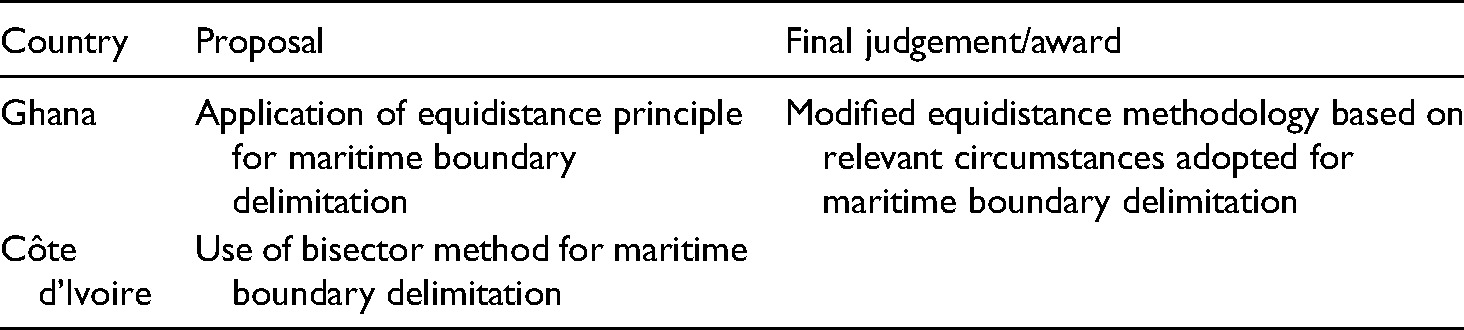
At the maiden meeting of both countries subsequent to the submission of their proposals to the United Nations Commission on the Limits of the Continental Shelf, Ghana proposed that the existing international boundary, used by the international petroleum company PETROCI and Ghana National Petroleum Corporation as partners, be formalized and signed as a common maritime boundary. Côte d’Ivoire rejected this and proposed that the delimitation must be done by consensus using a geometric approach and the meridian 2o52, 11W; in addition, Côte d’Ivoire protested at the unilateral exploration and evaluation by Ghana, which began in the 1980s, and insisted that a permanent maritime boundary was required under a treaty – a position that Ghana rebutted because its acceptance may lead to the loss of towns like Ekpu, Half Assini and Nzimitianu in Ghanaian territory. 66 The Special Chamber judged that Côte d’Ivoire could have proposed the establishment of a ‘provisional arrangement of a practical nature 67 , which would have triggered the requisite negotiations.
The Special Chamber, in its 2017 judgement, redefined the single maritime boundary beyond 200 nautical miles starting at Boundary 55+ ‘with the coordinates 05° 05’ 23.2’ N, 03° 06’ 21.2’ W in World Geodetic System (WGS) 84 as a geodetic datum 68 (Table 1). The Chamber noted that the obligation under Article 83, Paragraph 1 of the Convention to reach an agreement on delimitation necessarily entailed negotiation. After the judgement, both countries issued a communiqué and have come out with guidelines and timelines to carry out the implementation. The implementation is not a unilateral decision but a bilateral arrangement ensuring that the parties adhere to their national responsibilities. The continuing importance of negotiations can be seen from the Bakassi Peninsula case, where Nigeria and Cameroon promised to respect and implement decisions taken by the International Court of Justice. Nigeria was not satisfied with the judgement, stating that it did not consider ‘fundamental facts’ about the Nigerian inhabitants of the territory, whose ‘ancestral homes’ the Court adjudged to be in Cameroonian territory. 69
Delimitation methodology proposed by Ghana and Côte d’Ivoire and final judgement/award.
Challenges to resolving the maritime boundary dispute between Ghana, Togo, Benin and Nigeria
Although Togo, Benin and Nigeria have engaged in negotiations with Ghana under ECOWAS, these opportunities have not been fully utilized to resolve their disputes. While it is not likely that the maritime boundary dispute between the above countries will be resolved by adjudication and other third-party processes due to the constraints of the institutional framework and the peculiar circumstances, it cannot be completely ruled out.
Togo and Benin are yet to make submissions to the Commission on the Limits of the Continental Shelf for an extension of the continental shelf, but have participated in meetings held under ECOWAS to resolve their disputes with adjoining states. Following the International Tribunal for the Law of the Sea’s decision regarding Ghana and Côte d’Ivoire, renewed engagements with Ghana on a negotiated solution have taken place.
In respect of Nigeria, Aldo Chircop and others indicate that 'several west coast states are located within the concavity of the Gulf of Guinea, and though some (Nigeria) are able to claim significant marine areas, others (Benin, Cameroon, Equatorial Guinea and Togo) have more limited claims constrained by similar claims from neighbouring states’. 70 Chircop's position is confirmed by Tim Daniel as follows: ‘the configuration of Nigeria's coastline to the east of the Nigeria/Benin line means that there is a stretch of the line which goes out to the full 200 miles where Nigeria and Ghana have a common maritime boundary’. 71 Regarding Ghana, Apaalse concludes that an examination and analysis of the available public and proprietary data sources indicates that Ghana can meet the test of appurtenance to extend the outer limit of the continental shelf beyond 200 nautical miles. 72 The extent to which this becomes a reality depends on the final outcome of the Benin negotiations and on any action taken by Togo to prevent itself from being shut in, as Germany was in the North Sea by Denmark and the Netherlands back in the 1960s. Clearly, resolving Ghana's eastern maritime boundary with Togo, Benin and Nigeria is a complex issue, which requires much more focused and sustained action from all the relevant stakeholders to negotiate a workable solution that will be acceptable to all.
Conclusion
Ghana and its neighbours, particularly Côte d’Ivoire, missed an opportunity to settle their maritime boundary dispute by pacific means. However, the boundary disputes to the east offer a chance for dispute resolution through pacific means. As coastal states continue to discover the socio-economic importance of their maritime spaces, without clear and acceptable demarcated boundaries it is likely that these issues will continue to generate disputes and research interests. Although various avenues exist for the settlement of maritime-related disputes under UNCLOS, the best approach for African states to adopt is one that is cost-effective and at the same time encourages the spirit of brotherliness. In this regard, the diplomatic means of dispute resolution, particularly negotiation, holds the key to African's maritime dispute resolution. It is worthy of note that, given the opportunities inherent in diplomatic channels of dispute adjudication, Ghana and Côte d’Ivoire on the western boundary, as well as Ghana and Togo, Benin and Nigeria on the eastern boundary, will greatly benefit from the use of diplomatic channels in resolving their maritime disputes and the implementation of the International Tribunal for the Law of the Sea’s decision accordingly. However, as negotiated settlements of disputes do not happen overnight, all parties may have to work harder to overcome some of the stumbling blocks to the diplomatic resolution of conflict. A strong political will is essential if Ghana and its neighbours are to use diplomatic channels successfully.
Footnotes
Declaration of conflicting interests
The author declared no potential conflicts of interest with respect to the research, authorship and/or publication of this article.
Funding
The author received no financial support for the research, authorship and/or publication of this article.
