







Abstract
This article explores how a focus on commodities, and associated ‘follow-the-thing’ methodologies, might help nuance and deepen traditional historical narratives of the natural-ice trade between Norway and Britain in the 1850–1920 period. The article outlines these approaches and their potential to prompt richer understandings of the broader social impacts of the extraction or production of commodities, and their sale and consumption. This approach suggests that a more extensive, encompassing engagement with commodity flows and their wider social and cultural imprint could allow a clearer sense of how commodities helped to constitute the modern world. In turn, more fine-grained appreciations can be generated of the entwined historical processes and social impacts that shaped the rise and fall of natural ice as a commodity.
Recent research on contemporary commodities has explored the idea of ‘following’ their flows and circulation around the modern world. Much previous research focused on their production and supply chains, while other work addressed the various sites where commodities are consumed, and the forms and nature of this consumption. By contrast, ‘follow-the-thing’ research has sought to reconceptualise ‘commodity chains’ within the more complex, multiple contexts wherein commodities are enmeshed and through which they travel and help to constitute an increasingly connected contemporary world. These studies expose the value that is generated by the movement of commodities and, in addition, the economic, social and environmental costs that they may also produce. Traditional research into historical commodity flows would routinely mention the eventual destination and use of the things being transported and traded, but the developing ‘following’ debate suggests that we focus more intently on their journeys and impacts.
This forum article suggests that the trade in natural Norwegian ice to Britain in the late nineteenth and early twentieth centuries offers a distinctive case study that reveals how our established conceptualisations of commodities might be problematised and nuanced by this approach. This contribution therefore outlines how ‘following’ methodologies offer new and more encompassing ways to comprehend the natural-ice trade in this period. By extension, these approaches also seek to enhance our representations of commodity flows by making them denser and richer. While this approach may undermine clear, clean narrative histories, it does reflect the messier realities of social and economic worlds, and, as such, advances our methods and debates.
Developing natural ice as a commodity in nineteenth-century Europe
As the articles in this Forum reveal, the harvesting and trade of natural ice enjoyed growing importance across nineteenth-century Europe. Above all, ice was used to preserve various fresh foods – allowing the production and storage of these commodities in greater quantities for the growing European population. Ice also enabled high-value perishable commodities like fish, meat and dairy products to be transported across greater distances than previously. All of this offered improved economies of scale for producers and suppliers, and more reliable and consistent supplies, choice and quality assurance for consumers. Ice also became an increasingly prized luxury commodity in this period; it was particularly popular for cooling drinks and making ice cream and refreshing desserts. Therefore, as the century progressed, ice itself became an increasingly important commodity. At the same time, and crucially, it was also an essential element for cooling and preserving a wide range of other commodities amidst the developing consumer economies of nineteenth-century Europe.
Many continental European regions had previously accessed ice from nearby mountain ranges, or taken it from lakes and rivers in winter and stored it in insulated ‘ice houses’ or cellars to minimise melting. Yet local supplies were often unreliable due to variable climatic conditions, and ice houses were not always effective. For these reasons, ice remained expensive and supplies could be inconsistent. By contrast, the natural-ice resources of Scandinavia were more reliable and, some believed, purer than the ice harvested and stored in warmer climates. In addition, the natural-ice resources of south-eastern Norway were relatively well located to supply Britain and its large and growing economy. Norwegian ice was first imported to Britain in 1822 by a London confectioner, and by a merchant needing ice to preserve salmon on the journey from Scotland to London. 1 Thereafter, this market accelerated from the 1860s to 1899, before declining due to the emerging competition from artificial ice. 2
The Norwegian ice exported in the earliest years of this trade was often cut from glaciers, frozen ponds and lakes. Yet, because Norwegian ice was consistently available, and because it was imagined to originate in the comparatively pristine fjords, this commodity secured and expanded demand from the British market from the mid nineteenth century. In turn, Norwegian suppliers developed purpose-built ice ponds, ice fields and storage facilities nearer to quaysides to ease transhipment. As Britain's industrialising economy grew, the value of this ice trade, and the increased efficiency of its transportation, enabled ice exporters to expand their market reach beyond elite consumers to wider middle-class markets in Britain and the other growing economies of northern Europe. With time, the technology and economics of their ice business even made exports to North Africa, central Africa and the Indian peninsula feasible. 3
At their peak in 1899, Norwegian ice exports totalled over a million tons. 4 Around 50 per cent of this production was shipped to Britain, where it constituted 99 per cent of this key market. 5 Accessing Norwegian supplies was more efficient and cost-effective than importing ice from New England (which had been an ice supplier previously). Its locational advantage over American merchants allowed the Norwegian industry to develop markedly on its southern coast, and especially around the Telemark and Oslofjord regions. 6 As Table 1 shows, there was a sharp increase in British imports of Norwegian ice across this period, accompanied by a decline in the price per ton. Norwegian ice was increasingly central to the supply, transportation and storage of food in Britain.
British imports of Norwegian natural ice, 1855–1900 (at five-year intervals).
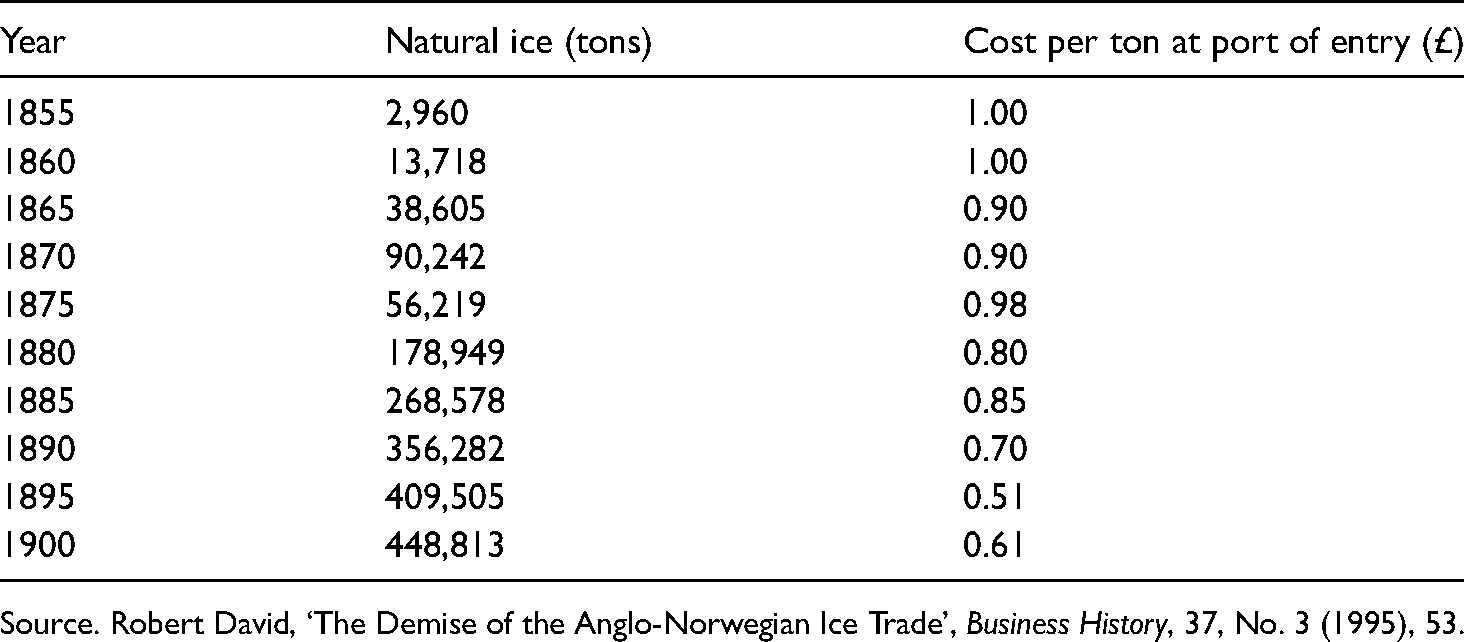
Source. Robert David, ‘The Demise of the Anglo-Norwegian Ice Trade’, Business History, 37, No. 3 (1995), 53.
Although this trade grew at pace in the later nineteenth century, it collapsed still more quickly with the advent of mechanical refrigeration in the first two decades of the twentieth century. 7 The relatively thin literature on Norwegian ice exports to British and European regions in the nineteenth century is augmented by ‘The Last Ice Age’ project (represented in this Forum). My contribution suggests that our contemporary interdisciplinary approaches to assessing the flows, agency and impacts of commodities in the twenty-first century could also cast light on the commodity flows of the past – including the Norwegian–British nineteenth-century natural-ice trade. These pages therefore propose additional ways of assessing this trade as it expanded and shrank over seven decades. Such additional foci might also help us to broaden our understanding of the various social and cultural roles of natural ice in this period, and their impacts on modern society.
‘Following’ things and commodities
‘Following’ and ‘follow-the-thing’ research and its methodologies have prompted interest and debate in various academic fields across recent years. 8 Rather than study commodities as relatively stable entities – with their production, transportation, sale and consumption readily traceable – ‘following’ approaches view commodities as mobile units that also, and importantly, reveal their deeper, more entwined connections, relationships and impacts as they travel. Hence, for its proponents, ‘following’ reveals more than was previously appreciated about the flows and nodes of these ‘things’, and the social and cultural impacts they might prompt. Recent work on ‘following things’ – especially in sociology, cultural studies and human geography – has explored some of these richer meanings that accrue when commodities are traded.
Researchers have always traced commodity extraction, production, flows and consumption, but a revived concern for the nature of commodities, and for their active roles in constituting elements of the modern world and its unequal relations, was signalled by critical Marxist thinkers in the late twentieth century. David Harvey, a leading human geographer, argued that researchers should recognise and defetishise the commodities that surrounded them in their daily lives. 9 Instead, they should acknowledge the origins of these ‘things’, their routes to market and the social costs to the communities that produced, transported and sold them. Telling the fuller stories of these commodities, he argued, would help consumers to recognise their role in wider global trade and its inequities. Similar sentiments drove Arjun Appadurai to develop an ‘anthropology of things’, which conceptualised commodities as having ‘social lives’ as they circulated through western consumer societies, accruing (or losing) value and reshaping those societies as they travelled (again, often involving varying degrees of exploitation). 10 Both approaches traced commodities as they moved from production into their subsequent ‘lives’. For some authors, stories of origins and authenticity are co-opted by capitalism still further – such as when self-declared ‘authentic’ high-quality foods are sold by promoting their distinctive ‘traditional’ production in particular nations. 11 While supposed links to particular places might attract some customers to buy the visible commodified thing, this sale may not benefit the wages and conditions of the less visible workers at the sharper end of ‘authentic’ food production. This debate grew quickly in the 1990s–2000s, and addressed traditional commodities and some less traditional commodified ‘things’. These various debates continue and, as a result, critical academic traditions have developed more complex understandings of where our commodities come from and the social costs of their ‘social lives’.
These influential theoretical shifts prompted additional debate. Some researchers responded to the increasing focus on commodities by conceptualising ‘commodity chains’ or ‘value chains’ that trace commodities from their extraction or manufacture through to their sale and consumption, as value is added en route. 12 This geographical conceptualisation of production – stretched across an ever more connected world economy and the various, and sometimes multiple, sites where commodities are produced, sold or consumed – contradicted some more celebratory accounts of an imagined ‘seamless’ world economy. Rather, this approach emphasised the relations between the different people, communities, and corporate and legislative interests that are involved in the journeys of these commodities. For example, Cook et al. use the ‘following’ metaphor to discuss the messier, ‘undisciplined geographies’ of food production as they follow commodities through the human and non-human contexts and communities that make up these networks. 13 Their earlier work on the journeys of papaya fruit demonstrates the detail and depth of research required across multiple sites as a thing is followed. 14 They remind us that these complex connections of production and consumption are often shifting and fluid, and that it is never clear where the chains start and stop. In this respect, ‘follow-the-thing’ methodologies cannot assume that a commodity is simply produced, then travels, and is finally consumed. It is seldom that straightforward. Rather, it is important to expect and recognise more complex journeys, and the researcher has to be ready to follow the thing wherever it goes – even if this involves ethnographic methods of engaging with sites of production, travel and consumption across the social lives of commodities. 15
The potential of ‘following’ research has seen this method extended to ‘things’ that are not traditionally viewed as commodities, including money and financial products, information and data, and the waste processes for things beyond their productive life. 16 If we are persuaded that commodities exist in this complex, fluid state in our contemporary world, we should be prepared to rethink the production and consumption of commodities in the late nineteenth century, and to trace the disciplined (or undisciplined) ‘social lives’ that these commodities evolved as they travelled through, and sometimes reshaped, regions. And while our historical records might not offer sufficient evidence to follow these commodities easily, 17 extending and deepening our appraisal of ‘things’ and their impacts surely makes them worthy of this kind of closer attention. So, how can we follow natural ice through the later nineteenth century, especially as some commodities that emerged in this period remain ubiquitous, whereas others, like natural ice, have largely melted away?
So, how do we follow the icy thing?
Following natural ice as a commodity
The trade in natural ice between Norway and European markets shifted in scale and frequency over time. Table 1 demonstrates that British imports increased significantly from 1850 to 1899, but declined slowly until 1910, and collapsed during the First World War. By contrast, in the early twentieth century, artificial-ice production increased steadily in Britain. It faced initial consumer scepticism about its purity in contrast to Norwegian ice, but supplies were reliable and production costs were lower. Artificial ice was also guaranteed during warmer winters when natural-ice supplies waned. In time, the rise of artificial ice, and the disruption to international trade caused by the 1914–1918 war, prompted the demise of natural ice as a major commodity. But prior to these events, what else do we know of the economic and social contexts of natural-ice supplies and its production, transportation, sale and use? Who owned the ice ponds? Who harvested the ice and who saw the profits? Who owned the ships and who paid the crews (if they were paid sufficiently), or did producers sell their ice to a shipowner or broker, or buy their own ship and risk the transportation costs themselves? Or were various different practices established – differentiated by port, by region or by labour relations? Finally, did these practices evolve and adapt as the trade developed, and how did they respond to changing market demands and the rumbling debates about the purity and aesthetic quality of Norwegian ice? In short, how usefully can we follow the natural Norwegian ice of this period?
Fortunately, other articles in this Forum reveal much about how Norwegian natural ice was mobilised as a commodity. Per Norseng explains that, by 1900, Norwegian ice production was at its peak, and technical innovations included freshly cut ice blocks being transferred on elevated wooden railways or slides, sometimes over a kilometre long, to waiting ships. Elsewhere, the creation of artificial ice ponds near to bespoke storage and dock facilities made the trade less dependent on fluctuations in the climate. 18 Eyvind Bagle focuses on human factors by tracing three different models of the ice trade in late-nineteenth-century southern Norway. He reveals how the contexts and primary occupations of three entrepreneurs prompted different approaches to the ice business – with commercial merchants, farming families and an established shipowner balancing investment, risk, profits and priorities in different ways as they tried to anticipate and exploit shifting market conditions. 19 This level of detail is a clear step forwards in our ability to follow Norwegian ice. Yet, even though some of these people left archives that expose the workings of the trade, as Norseng reminds us, we still know too little about the ‘[t]housands of people and hundreds of ships’ that exploited this ephemeral commodity. 20 And as Effie Dorovitsa and Ingo Heidbrink also demonstrate in this Forum, there remains much to learn about the diffusion and reception of this ice in different overseas markets. 21 These are some of the challenges of following natural-ice production through the rise and fall of this industry in Norway.
Following natural ice as it facilitated other commodities
Ice was a key commodity itself, but it also preserved other important commodities. Therefore, when Norwegian ice preserved other commodities, it became embroiled in these additional commodity chains too, with their wider impacts and consequences. This brief section outlines how Norwegian ice underpinned the growing fishing industry of northern England and how, in turn, the popularity of fish and chips lets us follow the impact of Norwegian ice across other aspects of late-nineteenth-century England's economy and society.
Hull was developing as a leading British port in the nineteenth century in part due to its location. It stood on the banks of the sheltered Humber estuary that opened onto the North Sea and connections to northern Europe. Its site offered plenty of space for docks and industrial development. It was also well connected by river transport and, from the 1840s, the growing railway network that linked the port to the industrial cities of the English north and Midlands. Hull developed rapidly as an important cargo port and transhipment point for England's accelerating economy. From the mid nineteenth century, it also became a leading fishing port, and a fleet of wooden sailing trawlers exploited the rich fishing grounds off the Yorkshire coast. 22 As these fishing grounds became overfished in the 1880s, the fleet sailed further eastwards towards Germany and Denmark, and northwards into the ocean off Norway. These longer journeys meant that the fish had to be stored in ice to keep them fresh. The ice was sourced initially from nearby coastal fields in Yorkshire, but far more reliable supplies were soon brought from Norway (hence, in part, the growth in British imports evident in Table 1). 23 Fishing in these new waters brought great success. The Hull fleet grew to over 400 larger steam-driven trawlers through the 1880s and 1890s; their trips were longer and their catches were still larger. The fishing port of Grimsby developed in parallel on the southern banks of the Humber estuary and built a fleet of a similar size. For both ports, fish were a valuable commodity and the ice was essential to sustaining this value. 24
Once landed in Hull, the fish, still in ice, were sold at fish markets and despatched across the English north and Midlands by rail. From the 1880s, as the trawlers landed increasing large catches, fried fish and chips became increasingly popular as a cheap, hot and nutritious meal for working people. John Walton's social histories highlight the economic, social and political significance of ‘fish and chips’ to British society in this period. 25 He argued that this popular fast-food industry grew rapidly once the steam trawlers could keep their catch fresh using ice. A new market, with a growing reach across society, developed. Contemporary estimates claimed that there were 10,000 to 12,000 fish-and-chip shops in Britain by 1888, 26 and growing industrial centres like Preston, in Lancashire, even totalled one chip shop for every 1,533 citizens. 27 By 1935, as the industry had swept across the country, a trade paper estimated that 70,000 people worked in the fish-and-chip trade directly, with 200,000 more in associated trades and businesses. 28 By extension, other associated commodities – such as potatoes and peas, cooking oil, salt, vinegar and frying equipment – were also swept up in the demand for this hugely popular fast food. And throughout the development of this trade, the fish could be caught in sufficient quantities and preserved while transported to market by the ice, which kept them fresh on trawlers, trains and into the shops, where they were eventually sold.
Hull had its share of fish-and-chip shops too, but the city enjoyed many additional and profitable consequences of the fisheries. Around one in six people depended on trawling directly or indirectly for their income. 29 Besides the trawlermen, associated employment spanned shipbuilders, fitters and marine engineers, and those provisioning and administering the fleet. Other related jobs included the dockers who dealt with the fish onshore and the traders of the wholesale fish markets. Fish-processing industries developed in the city, and others found work in transporting fish across the country. All these industries relied, in part, on the wider capacity facilitated by ice. In addition, Hessle Road, a district close to the fish dock, became the centre of Hull's tightly connected trawling community. The social and gendered impacts of fishing on this community were also distinctive. Distant-water trawling was a dangerous occupation with regular fatalities that left families bereaved. By the twentieth century, as the trawlers became more sophisticated, their fishing patterns developed and they fished further north towards Arctic waters. The trawlermen were normally away for three weeks at a time before a three-day break back home. This time ashore often involved significant socialising and spending, which sustained the various shops, pubs and restaurants of Hessle Road; it also punctuated the weeks when women parented the fishing families on their own due to the schedules of the trawling. 30
In sum, the commodities of fish and natural ice – connected and enmeshed while making their way through late-nineteenth-century Hull – underpinned the growth of the fisheries and other ancillary industries in the city. When artificial-ice production superseded natural ice in the early twentieth century, the fishing business became still more efficient, as ice was manufactured in Hull. The fixed infrastructure and supply industries of the city and port, and the traditional fishing cultures, continued to shape Hull until the sharp decline in the late 1970s and 1980s, after disputes over British access to Icelandic fishing grounds. The decline continued, and the last Hull trawler was sold in early 2022 after Britain's departure from the European Union meant that British trawlers could no longer access Norwegian fishing waters. The remaining legacies of distant-water fishing in Hull are now fragile, but ice, and the fish it preserved, transformed this city and its activities.
Conclusion
In contemporary ‘following’ research, the core work is done by multi-site, place-centred ethnographies that explore how the commodity is produced, transported and consumed along the chain. This process can often be challenging and the results can be partial. Alison Hulme argues that ‘a fragmented and constantly shifting just-in-time globalised economy' its flow made up of numerous micro psycho-social, geographical and economic ruptures’, does not make for conclusive research results. 31 Pursuing similar research in previous historical periods means locating and exploring archival sources, or constructing oral histories, to unpick the relevant histories of commodities, communities, people and places, and the complex flows that entangled them. The numerous points of production, transportation, sale and use in these histories mean that not everything can be traced and followed, and a partial ability to follow icy things is perhaps the best we could hope for. Nevertheless, recognising the roles of a commodity such as natural ice in nineteenth- and twentieth-century society, and following its journeys across space and its impacts on places en route, may offer ways – however partial – of appreciating the wider presence and impact of the ice.
Footnotes
Declaration of conflicting interests
The author declared no potential conflicts of interest with respect to the research, authorship and/or publication of this article.
Funding
This work was supported by the Research Council of Norway (grant number: 275188).