







Abstract
Following the end of the Napoleonic Wars in 1815, many Royal Navy warships were laid up before being sold into merchant service or for breaking up. Large numbers of sloops, schooners and cutters had been built for war service between 1803 and 1814, mostly in private shipyards. The versatility of these smaller classes of vessels was evident in their diverse and demanding wartime roles and subsequently in mercantile trading or whaling. One such vessel, the Cruizer-class brig-sloop HMS Pilot (1807), was commissioned in 1808, served until 1816 and, after an extended period in reserve, was sold out of naval service in 1828. As a commercial whaling bark, the Pilot made five voyages in the British Southern Whale Fishery between 1830 and the early 1840s before being condemned in 1845. This article provides a case study of one vessel's career in naval and mercantile service, which was typical of the period.
Between 1793 and 1815, Britain was engaged in numerous campaigns during the French Revolutionary, Napoleonic and American Wars. In actions around the world, much of the burden at sea was borne by ships of the Royal Navy. The range and scale of Britain's maritime assets changed during these years, supported by a growing defence-industrial base and network of domestic and international suppliers of war materiel. These capabilities helped facilitate the introduction of new classes of warship and an increase in fleet numbers. A feature of this era was the variety of smaller warships introduced, with their reduced manning requirements and ability to be employed in a wider range of operational roles than larger warships.
This article examines one such vessel, the Cruizer-class brig-rigged sloop HMS Pilot, in Royal Navy service and subsequently in merchant service as the whaling bark Pilot. Salient features of the class are highlighted, together with the wartime operations of HMS Pilot between 1808 and 1816 in the regional seas of the Mediterranean Basin and in north-west Europe. After the Napoleonic Wars, HMS Pilot was placed in reserve, like many similar vessels, before being sold and then converted for commercial whaling, retaining the name of Pilot. The context of the British Southern Whale Fishery is outlined, together with the ship's career as a whaling bark from 1829 to 1845, including a tragic incident in the Nicobar Islands in December 1840. This article thus provides an illustrative case study of the design and employment of a small vessel, first at war in naval service and subsequently in mercantile service, together with the contexts and issues involved and principal events that took place.
The Napoleonic War context
During the Revolutionary and Napoleonic Wars between 1793 and 1815, Britain's large and capable fleet, extensive network of naval bases and dockyards, and large merchant fleet gave it almost complete maritime supremacy. 1 While major fleet or squadron engagements helped to maintain command of the seas, many of the Royal Navy's actions in this period were smaller in scale, involving only a few or individual vessels. These included shallow-water naval operations in the Adriatic, Baltic and Ionian Seas, along European and Mediterranean coasts, as well as in more distant waters, attacking enemy coastal convoys, fortifications and shore installations, maintaining blockades, and protecting British and friendly trade from enemy warships and privateers. This was ‘dirty and dangerous’ work, but crucial in disrupting enemy seaborne supplies. 2 Such widespread and varied operations required larger numbers of smaller warships with correspondingly smaller crews – an important factor given the Royal Navy's wartime manpower shortages.
Until the 1790s, most British warship building and repair had been concentrated in the main naval dockyards and in established private shipyards on the Thames, Medway and Solent situated close to a supervising Royal Dockyard. However, wartime demands on these yards led to many brig-sloops and similar classes of warships being built in smaller private shipyards, from Cornwall and Devon in the west, along the south coast, to the east coast as far north as Berwick. This large-scale initiative saw the Admiralty Board establishing closer relationships with private shipyards, sending more warships for repair and placing continuing orders for new vessels. By the end of the Napoleonic Wars in 1815, over 80 per cent numerically and more than 70 per cent by tonnage of the Royal Navy's new and predominantly smaller ships had been built in private shipyards. 3 From an active strength of some 33 brig-sloops in 1804, by 1810 a third of the 692 warships in commission were sloops or similar unrated vessels, and Britain was able to maintain some 150 such vessels in commission throughout most years of conflict. 4
One novel approach taken by the British Admiralty to the development of smaller warships in the 1790s was a design competition. Designs for 2 two-masted brig-rigged and 2 three-masted ship-rigged sloops were produced, with one of each type being designed by John Henslow and by William Rule, the joint Surveyors of the Navy at the time. 5 Three of the four different preliminary designs produced were then ordered in December 1796 and built in 1797–1798. After trials, Rule's design for a two-masted brig-sloop was selected for volume production as the Cruizer class of vessel from 1802 onwards (Figure 1). 6
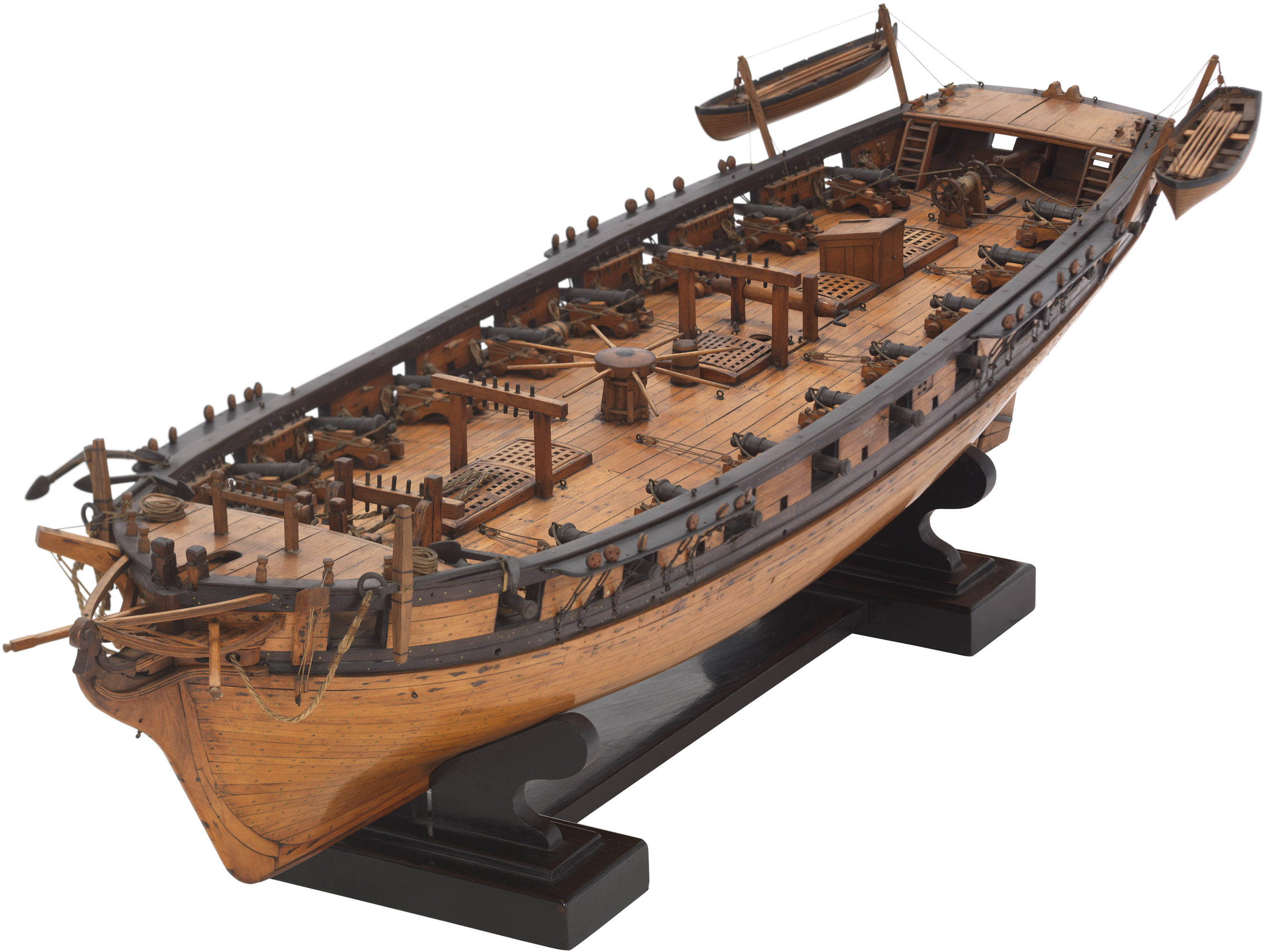
Hull model of an 18-gun Cruizer-class brig-rigged sloop circa 1810.
The Cruizer class of brig-sloops became the largest single class of warships built by Britain during the Napoleonic Wars, with over 100 being built between 1803 and 1814. 7 These unrated flush-deck vessels proved to be seaworthy and were said to ‘sail like the devil’. 8 Armed with 16 carronades (32-pounders) and two bow-chaser guns (6-pounders), their considerable short-range firepower met the Royal Navy's preference for close-quarter action. 9 The sloops’ smaller gun crews and two-masted rig resulted in a crew of 121 men – many fewer than a contemporary frigate with a larger number of conventional ‘long’ guns and a larger sail area. 10
HMS Pilot was ordered by the Admiralty Board in October 1806 from the shipyard of Robert Guillaume at Northam, Southampton; it was one of 10 vessels ordered from private shipyards at the same time in the fourth batch of Cruizer-class vessels. Launched in August 1807, HMS Pilot was completed and fitted out at Portsmouth Dockyard and commissioned for war service in the Mediterranean in January 1808. 11
HMS Pilot at war
The naval commissions of HMS Pilot coincided with the final three of seven allied coalitions formed during the wars with France – namely, the fifth (April to October 1809), sixth (March 1813 to May 1814) and seventh (March to July 1815) coalitions – as well as the intervening periods of continuing conflict. Between 1808 and 1816, the ship spent most of its career in the north-west and central Mediterranean, including the Adriatic, with short interludes in north-west European waters.
During this period, Britain's naval dispositions in the Mediterranean were shaped by two main factors: first, the British bases at Gibraltar and Malta – the former a British possession since the 1713 Peace of Utrecht and the latter retained by Britain after the 1802 Treaty of Amiens – and, second, the physical and political geography of the western and central Mediterranean. As Napoleonic France extended its rule over territories in Italy, including the Kingdom of Naples, the position of Bourbon Sicily became more important, with the potential to use Messina, Palermo and Syracuse as operational bases for the Royal Navy. Malta, while remaining important as a rear base, was too far from the operational areas of the Tyrrhenian and Adriatic Seas and too small in the internal resources it could provide. 12 Sicily provided safe harbours for British warships and closer proximity to enemy-occupied territory, as well as a large, productive hinterland from which supplies could be drawn. 13
A key element of Britain's Mediterranean strategy was to thwart Napoleon's ambitions to strike eastwards through the Balkans and Bosphorus into Asia Minor. Naval power helped curtail French activities in the Adriatic and to blockade Corfu, then, between 1807 and 1814, under its second French occupation. 14 British warships helped counter the threat of an invasion of Sicily by disrupting French and Neapolitan supply lines and attacking coastal convoys and their escorts, as well as coastal fortifications and batteries. The Royal Navy was active also in preventing enemy warships and privateers from interfering with British trade.
In June 1809, Admiral Cuthbert, Lord Collingwood, the British commander-in-chief in the Mediterranean from 1805 until 1810, characterized such operations in a letter to Rear Admiral Thomas Sotheby: We are carrying on our operations in the Adriatic and on the coast of Italy with great éclat … All our frigate captains are generals, and some of the brigs are good brigadiers. They have taken seven forts, garrisons, or castles, within the two last months; and scaling towers at midnight, and storming redoubts at mid-day, are becoming familiar occurrences … It is really astonishing; those youths think that nothing is beyond their enterprise, and they seldom fail of success … This activity and zeal in those gallant young men keep up my spirits.
15
The first commanding officer of HMS Pilot was Commander the Honourable William Walpole, from August 1807 to July 1809. 16 The ship saw active service in the western Mediterranean and Ligurian Sea, during which two prizes were taken: the American ship Harriot in May 1808 and the French xebec privateer La Princesse Paulina (three guns) in November 1808. 17 HMS Pilot having by then returned to Portsmouth, in July 1809, Lieutenant Charles Sotheby became acting commanding officer, with the vessel serving in the Scheldt expedition in August 1809. 18 Sotheby was succeeded in January 1810 by Commander Edmund Waller, who had only a short tenure in home waters until April 1810. 19
Returning to the Mediterranean
In August 1809, Commander John Toup Nicolas had been appointed to HMS Pilot, only receiving news of his promotion in December 1809 while serving in the Mediterranean. He joined his ship at Portsmouth in April 1810, with HMS Pilot then leaving Britain as one of the escorts accompanying a merchant convoy to Lisbon, Gibraltar and Malta. 20 On returning to the Mediterranean, for four years the ship was actively employed, often independently, along the western and eastern coasts of Calabria in southern Italy to annoy the enemy's trade, destroying large numbers of coastal trading and supply vessels in the process and attacking fortifications. 21
In many actions, small local vessels such as settees, scampavias and trabaccolos became the target of the ship's guns and of landing parties. 22 In July 1810, HMS Pilot, together with sister sloop HMS Weazle (Figure 2) and the frigate HMS Thames, was involved in an energetic action. An enemy convoy of 31 coasting vessels en route from Naples to Scylla, with an escort of seven large gunboats, an armed pinnace and four scampavias, was driven ashore under two batteries and destroyed or captured by the three British warships and the ships’ boats. 23 Through its Calabrian operations, HMS Pilot participated in the capture or destruction of some 130 enemy vessels. Considerable quantities of powder, of round, grape and case shot, and of shells were expended, with effective use made of carronades in dislodging the bodies of defending troops assembling onshore, and of captured French shells. 24

Undated painting by Nicholas Cammillieri of HMS Weazle (1805), a Cruizer-class brig-rigged sloop and sister ship of HMS Pilot, leaving Malta (1806–1814).
In July 1812, HMS Pilot moved to Lissa in the Adriatic in company with the frigate HMS Alcmene. A number of guns were destroyed on the island of Brazza, some 15 miles south of Spaleto (now Split), and others at Almezza. After serving in the Adriatic, HMS Pilot was sent to Malta for maintenance, later patrolling between the coasts of Tunis and Sicily. From late 1812 and into 1813, the ship was engaged on the Tunisian coast, taking the British merchantman Constantia, suspected of running contraband, as a prize in January 1813 and the French armed brig Le Hart (16 guns) in June of the same year. 25
The end game
During a period of peace with France in 1814, Nicolas was sent by his commander-in-chief, Lord Exmouth (formerly Sir Edward Pellew), to Naples after an alleged insult had been offered by a Neapolitan vessel to a British warship; this matter was resolved as having ‘arisen from a mistake’. 26 After four years of operations, in June 1814 HMS Pilot left the Mediterranean to return to Britain, arriving in early October in a convoy from Oporto. 27
Suggestions were made at this time by Nicolas to modify the ship's internal layout in order to deal better with battle damage sustained ‘between wind and water’; these changes were agreed by the Admiralty and adopted generally, with all Cruizer-class vessels under repair directed to be so modified. 28 Still under Nicolas’s command, HMS Pilot returned to the Mediterranean, sailing from Plymouth in April 1815 following Napoleon's escape from Elba. One of Nicolas’s first tasks was to open communication with French Royalist forces at Marseilles and to convey Royalist staff officers from Barcelona to Genoa, afterwards being sent to keep watch off Porto Ferrajo in Elba. 29
During renewed hostilities, HMS Pilot encountered the French warship Légère (22 guns; Figure 3) off Cape Corso on 17 June 1815 in what proved to be the last action of the war between British and French warships. 30 The two vessels engaged each other at short range for nearly two hours, with the Légère being badly damaged and the British warship losing much of its running gear and having spars shot away. While HMS Pilot was unable to manoeuvre to force the Légère to strike colours, the French vessel no longer posed a threat. 31 As a result of this action, Nicolas received an Admiralty letter of commendation and was shortly afterwards promotion to post-captain, having already been made a Companion of the Order of Bath in June 1815. 32

Engraving of the French ship Légère (left) and HMS Pilot (right) in action on 17 June 1815.
Subsequently, HMS Pilot took part in Lord Exmouth's diplomatic missions to Tripoli, Tunis and Algiers in March–April 1816, seeking, as were many maritime nations, the cessation of piracy and slavery by the three Barbary States. 33 Some success was achieved by Exmouth in securing treaties with the ruling Beys, with many British seamen and Corsican, Sardinian, Sicilian and Maltese captives under British protection being freed. The treaty with Algiers was later broken, leading to the Bombardment of Algiers in August 1816; by this time, however, the warship had returned to Britain. After arrival in Plymouth from Algiers in July 1816, HMS Pilot paid off into reserve. 34
From war to peace
The end of the Napoleonic Wars saw extensive reductions in the numbers of ships and crew, heralding widespread unemployment and related social difficulties during the 1820s. 35 While Britain initially retained a greater number of large warships than its main European and US American combined, its dockyards came under increasing post-war pressure in undertaking necessary repairs and new constructions to replace losses and vessels at the end of their useful naval life. 36 Between 1814 and 1820, over 550 warships were sold or broken up, with more following over the next two decades. Smaller vessels, such as the ubiquitous sloops of war, saw the sharpest decline within the overall numbers. 37
While some ships were kept in reserve, sometimes for many years, others were soon sold for breaking up. However, the nature and characteristics of smaller warships, such as the Cruizer class of sloops, also saw a ready demand from merchant owners. Some vessels sold initially to shipyards for breaking were refitted and resold into merchant employment, while others were sold directly into merchant service. 38
After 12 years in reserve, HMS Pilot was one of several surplus vessels offered for sale in March 1828. An advertisement in the London Gazette was published one day before tender submissions closed, although the official sale notice was dated three weeks earlier. 39 With vessels lying in distant dockyards, and difficulties in arranging inspections and surveys before making a bid, this suggests that interested ship builders, repairers, breakers, brokers, managing agents or owners were in close touch with purchasing opportunities emerging from the Admiralty. 40 The Pilot, lying at Plymouth, was purchased on 26 March 1828 for £1,010 by Adam Gordon of Gordon & Co, ship builders, repairers and breakers of Deptford, London. 41
Buying a warship and converting it for whaling entailed considerable work by a shipyard, and thus costs. 42 Shipping register entries and survey reports indicate that some vessels were ‘raised’ to provide deeper holds and more storage, seen in the generally larger tonnages for a vessel as a whaler than as a warship. 43 Internal strengthening could be provided by extra frames and beams, and by fitting iron knees and riders, although similar work was undertaken also in naval service. 44 The hull needed to be sheathed and coppered for service in tropical waters. 45 Special fixtures and fittings were required, including a greater number of ship's boats for whale catching and thus more davits than required by naval vessels, and equipment for handling and processing whale carcasses. All such work was well within the capabilities of Gordon & Co, with some, such as sheathing and coppering, being conducted in 1829 in preparing the Pilot for whaling. 46
It is not known when the former HMS Pilot passed from Gordon's ownership, but the vessel was registered formally on 24 December 1829 as the bark Pilot, 418 tons, with E. Harris as master. 47 The new owner was Stewart Marjoribanks – a name confirmed by the ship's first Register of Shipping entry in 1831 – which indicates also that the ship was engaged in the South Seas Fishery. 48
The whaling bark Pilot
By this time, the southern whaling trade was well established. It had commenced from London in 1775 when the oil supplies from the American colonies halted in the American War of Independence. With a political desire to make Britain independent of foreign-caught oil, the trade attracted financial support from the government and developed into one of economic importance. 49 Starting in the Atlantic fishing grounds previously exploited mainly by American whalers, British southern whaling had spread throughout the Indian and Pacific Oceans by the early nineteenth century.
After 1793, growth was checked by wars with France and damaged further when war broke out with the Americans in 1812, with increased risks from enemy warships and privateers. However, after 1815, it began to recover and, in the post-war years, appeared to present profitable opportunities, encouraging new owners to enter the trade. Many entrants were experienced and well-capitalized shipowners, well placed in the depressed shipping market of the post-war period to make opportunistic purchases of second-hand tonnage or to divert existing ships into the whaling trade. 50
Stewart Marjoribanks was one such owner, long involved with East India Company trading and shipping and in settler and convict transportation. 51 The Pilot was acquired as his first whaleship in 1829, together with a second, the Frindsbury, in early 1831. 52 Marjoribanks was able to send the Mellish into whaling from within his existing fleet, departing from London in early 1832, and commissioned a new vessel, the Folkstone, which was launched in August 1833. 53 There were substantial costs in outfitting and insuring whaleships for each voyage and, with no guarantees about the price that oil would fetch when a ship returned, the commercial risks were high. 54 Marjoribanks wasted little time in sending the newly registered whaling bark Pilot to sea in January 1830 in the first of five voyages the ship was to make in the ‘South Seas’ trade under his and subsequent ownerships (Table 1). 55
Voyage particulars of the whaling bark Pilot from 1830 to 1845.
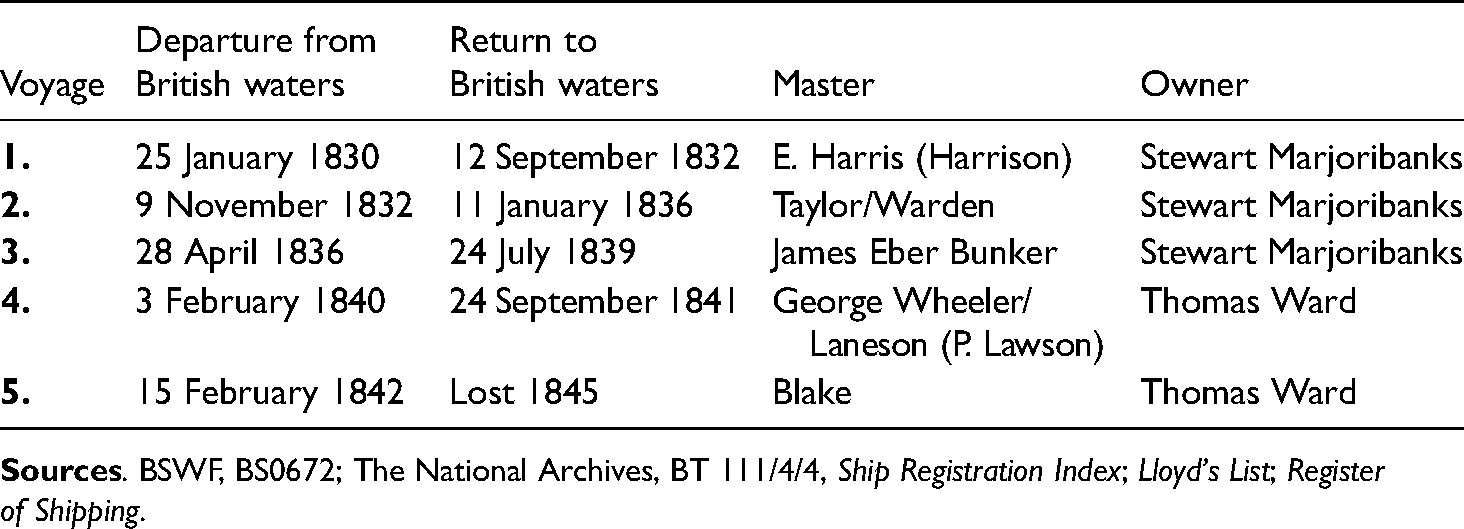
It can be difficult to uncover details of the routes taken by British whaleships, as few primary records have survived and details of this first voyage are sparse. The Pilot was ‘spoken-to’ by the whaleship Sarah of Nantucket on 8 March 1830 when they passed in the southern Atlantic Ocean and then reported at Mahé, Seychelles, on 16 March 1831, before returning to London in September 1832 after a voyage of 32 months. 56
After two months, the Pilot was re-equipped and sailed on a second whaling voyage in November 1832, with the master being named Taylor. 57 When ‘spoken-to’ by the British whaler Reliance near the Seychelles on 4 June 1833, the Pilot was reported to be 7 months out with 300 barrels of oil. 58 The Pilot was reported next at Timor in mid 1835 by the Argus, another ex-Cruizer-class sloop that was sold into whaling at the same time as the Pilot. 59 On returning to London in January 1836, the former first mate, named Warden, was in command, with such a change usually indicating that the original master had died during the voyage. 60 The Pilot then remained in London for three and a half months, being repaired, refitted and surveyed during this time in the yard of Wigrams, Green & Co. at Deptford. Work included the fitting of new pumps, additional internal strengthening, new rigging, the hull doubled in part, recaulking, and the vessel being ‘wood sheathed, felted and coppered’. 61
In April 1836, the Pilot departed on a third voyage with another new master, James Eber Bunker, a member of an extensive whaling family originating in America. 62 This voyage is better documented, and it is possible to trace a passage to the Cape Verde Islands by May and to Saldanha Bay, South Africa, by September 1836. The following year, the vessel was reported at Ternate in the Moluccas in mid May and at the Bashee Islands in June. 63 On 13 February 1838, the Pilot arrived in Sydney and remained almost two months before leaving on 5 April. 64
The diversion to Sydney took the Pilot some distance from the usual whaling grounds. It was reported as being necessary to obtain ‘stores and refreshments’ and to refit and undergo repairs, with one report stating that the vessel was to be recaulked. 65 There may, however, have been another reason for the visit. The master, James Eber Bunker, had grown up in Sydney, where he had been taken as a child by his father, Eber Bunker, also a whaling-ship master, who settled there in 1806. His father died in September 1836, and it seems possible that James made a family-related visit in 1838. By mid July 1838, the Pilot was back at Ternate, reportedly having 1,700 barrels of oil by September that year. After heading homewards, the vessel was reported in the Seychelles in February 1839, then at St. Helena, a common anchorage for returning whalers, in April and May. The Pilot reached London in July 1839 after a voyage again lasting over three years. 66
The Pilot then remained in London for an unusually lengthy period of six months. By this time, the profitability of whaling was in decline and many owners began leaving the trade. Stewart Marjoribanks was one of these and, by the end of the year, he had sold the Pilot and withdrawn from the trade completely. His stay had been brief, with the Frindsbury being lost after striking a coral reef north of the Solomon Islands in February 1832 on its first whaling voyage, and the Mellish and Folkstone undertaking only two whaling voyages before being sold in 1838 and 1840, respectively. 67 Marjoribanks appears to have given up his maritime interests around this time and concentrated on his political career after re-election as a Member of Parliament for Hythe, Kent, in 1841. 68
A fateful voyage
The Pilot was then bought by Thomas Ward, an experienced owner engaged in various shipping trades for over two decades and believed over time to have owned as many as 14 whaleships. 69 With another new master, George Wheeler, the Pilot left London in late January 1840, heading once more for Timor. 70 On this voyage, the Pilot was ‘armed with four guns, besides muskets, cutlasses etc., in addition to having some muskets for sale to the natives at the ports she intended to visit’. 71 The crew was 33 strong and, as usual on British whaleships, the Pilot carried a surgeon on board. 72 On this voyage, he was named Blackwell, aged 32, who later described his experiences in newspapers, and such accounts provide much of the following information. 73
The Pilot arrived at Copang, Timor, on 10 June 1840. 74 By this date, the area was becoming overfished and few whales were found, so, in July, the ship moved to cruise off Sandal Wood Island for three months and then to the coast of Java. The move met with little success and when ‘spoken-to’ by the American whaler Japan on 17 October, the Pilot reported that only 80 barrels of sperm oil had been obtained. 75 In November, the Pilot continued north and steered a course for the Poggy Islands off Sumatra. A few whales were taken but, as the weather was proving unpropitious and some crew members were showing signs of scurvy, the master decided to move to the Bay of Bengal and seek supplies. By the beginning of December, the ship had made Chowry Island in the Nicobar Islands but, with the weather remaining poor, the captain sought the shelter of a harbour. On 22 December, Nancowry Island was approached and, when the rain stopped and visibility improved, the Pilot entered what was thought to be Nancowry Harbour and anchored a cable's length offshore.
Several canoes visited the ship throughout the evening and many natives went on board; they appeared friendly, left of their own accord, and promised to return to trade the next day. The next morning, numerous canoes came to the vessel to trade, and all appeared well. By the end of the day, 40 to 50 natives were on board and, from Horsburgh's account of the friendly disposition of these people, nothing hostile was suspected. 76
Towards late afternoon, some men were given permission to go ashore, and Blackwell joined the second and third mates and nine of the crew to visit a village. As they left, they noticed another boat leaving the ship and heading towards a different village. Shortly after landing, Blackwell's group sensed that the natives were unsettled and appeared to be arming themselves. Realizing that they had no weapons, they hurriedly left; almost immediately, a yell was heard from the ship and suddenly natives came running from behind the huts and attacked them with spears. The second mate and one other man were killed, two men were struck but managed to escape, and the remaining party scrambled into the boat and succeeded in pushing off from shore amidst a hail of spears.
As they approached the ship, they found more natives in possession of it, with every one armed with the ship's cutting spades, lances and harpoons. They realized that they had no chance against such superior numbers and began to row hard to get out to sea. Natives pursued them in canoes but, after rowing through the night, they managed to get away. In the morning, they sighted an island and, after pulling hard against a heavy sea, came close at about midday. They dared not land but, when they saw natives fishing, managed to buy about 26 coconuts etc in exchange for the few handkerchiefs, tobacco, razors, knives and one rupee they had among them.
The survivors then put back to sea without anything further for 10 men to subsist on, in an open boat, without a sail or compass, and 1,000 miles from Ceylon (now Sri Lanka). They cut off their trouser legs and tore boards from the bottom of the boat, then tied them together using handkerchiefs to make a sail, with an oar used as a mast. They agreed to live on two coconuts a day, if possible, but their thirst was so great that they were obliged to use more and, for five days, existed on three coconuts daily, the milk of the nuts and a teaspoonful of water that they occasionally saved during the night.
Rescue and retribution
On the morning of 29 December, a sail was spotted and, at about half past eight, they were sighted and rescued by HMS Cruizer, commanded by Captain Henry Wells Giffard. 77 This rescue took place ‘about two hundred miles west of the Nicobars’. 78 The exhausted men were taken on board and ‘immediately given sago, etc.’, with Giffard noting in his diary: ‘When I picked them up they could not have lasted much longer’. 79 In the afternoon, Giffard asked them for their story and, on hearing the account of the massacre, wasted little time and altered course for the Nicobars, determined to exact retribution. On 31 December, the Pilot was found in the Bay of Ho-Ho, sometimes called ‘False Harbour’, which had been mistaken for Nancowry Harbour. None of the crew could be found but the blood on the decks left little doubt about their fate. 80
The Pilot had only the masts, yards and standing rigging remaining. Blackwell described how every article of clothing and all the bedding, nails, rope, blocks, lances, harpoons, muskets, guns and cutlasses, spirits, wine, ale, porter, meat and bread had been plundered. Every piece of iron had been cut out from the bulwarks and davit heads, and the copper bottom stripped off as deep as could be reached. Such destruction had been committed in the space of one week, and Blackwell felt ‘no person could accurately describe it’. 81 Giffard himself estimated that ‘not less than five hundred men, and probably many more, must have been at the work of destruction’. No one was near the ship, and canoes had been seen fleeing the island as the HMS Cruizer approached. Giffard felt that many natives were still around and watching, but later recorded, apparently regretfully, that he could not ‘succeed in shooting or capturing any’. 82
For four days, men from the HMS Cruizer went into villages in the vicinity, finding looted plunder in every place. Giffard later wrote that ‘not being able to remain long I burned the villages, destroying about seventy huts which had plunder in them and destroyed the canoes’. 83 One eyewitness later stated that the men of the Cruizer destroyed 12 villages in the vicinity of Ho-Ho and were so ‘exasperated by what they found’ that ‘if they could have got at the population of the Nicobar Islands they would have cut them all to pieces’. 84 In some huts, marine items were found that did not belong to the Pilot, and Giffard was in no doubt in his own mind that this was not the first vessel to be attacked in this manner. 85 He later strongly recommended that the whole island should be ‘overhauled’, notwithstanding Danish protests over his actions and prior claims to sovereignty of the islands that were reasserted after the incident. 86
In the meantime, a working party from HMS Cruizer had been employed in repairing the Pilot with all the materials they could find. With men from Giffard's crew and under the command of the second lieutenant, the Pilot put to sea again on 5 January 1841 in company with the Cruizer, and both arrived in Singapore on 23 January. 87 Giffard immediately presented a petition in the Court of Judicature requesting the payment of salvage and, after consideration, the Court decided that one-eighth of the value of the vessel, stores and cargo should be adjudged as salvage and that his expenses should be defrayed. 88 The only surviving officer of the Pilot, the third mate, James Clark, acting in conjunction with Mr Brennand of Messrs. Syme & Co., Lloyd's agents in the Straits Settlements, undertook to cover the amount awarded and the Pilot was turned over to them. 89 After undergoing what was described as a ‘complete repair’ in Singapore, the Pilot advertised for cargo and, carrying freight and a few remaining barrels of oil, sailed back to London via Batavia under a master named Laneson, departing from Singapore in mid April and arriving at the end of September. 90
Blackwell, the surgeon, obtained help from well-wishers in Singapore and took passage on the Lady Grant to Bombay (now Mumbai) and from there to London. 91 His vivid accounts of the massacre appeared in newspapers around the world, and subsequently vessels visiting the Nicobars were recommended to employ an armed watch during their stay. There were widespread suspicions that the crew of the Pilot must have provoked the attack, with Giffard noting: ‘I asked if they had given any provocation, they assured me not’. 92 However, such suspicions appeared to be confirmed when a group of Malay men who had been working on the island reported that natives had told them that the crew had interfered with their women. 93 Despite his ordeal, Blackwell signed on with another whaleship, the Alert, owned by Daniel Bennett and another ex-Cruizer-class brig-sloop, for a 150th share of the voyage proceeds and a £15 advance, and departed for Timor in October 1841. 94 This time, he had better fortune and, after almost four years away, the Alert and Blackwell returned safely to London. 95
The Pilot also returned to whaling and, within four months, had been re-equipped. At the end of January 1842, the vessel departed on a fifth whaling voyage under a master named Blake. 96 Over the following three years, there were sightings of the Pilot around the Timor area. In November 1844, the Pilot arrived at Algoa Bay, South Africa, where the almost 40-year-old ship was found to be ‘leaky’; it was then condemned and the cargo offloaded. 97 The ultimate fates of the ship, cargo and crew are unknown.
Conclusions
The naval aspect of the Napoleonic conflict was a long-running attritional process waged by Britain and its allies against the forces of France and its continental allies. As well as many well-documented, larger-scale actions, the Royal Navy's role was to disrupt, damage, deny, degrade and destroy enemy shipping, fortifications and shore facilities, supply lines and stores, and to protect British and allied trade from predation.
As Collingwood's correspondence makes clear, in the Mediterranean, this war was fought largely by numerous smaller warships taking the war to the enemy wherever encountered, ashore and afloat, and often making use of ship's boats, boarding or landing parties, and embarked marines. 98 This was the operational environment in which HMS Pilot served in the Mediterranean and adjacent seas between 1808 and 1816, only returning to Britain for the Scheldt expedition in 1809 and for dockyard work in 1814. The ending of more than two decades of almost continuous warfare in 1815 had a profound impact on the Royal Navy, with many ships being consigned to the reserves before being sent to the breaker's yard or sold into merchant service. 99
This latter category included those vessels that were sold into the whaling trade, some, as HMS Pilot, after an extended period in reserve. Among several classes of smaller warships, the Cruizer-class vessels proved adaptable and attractive to these commercial owners, with at least 16 of this class of vessel estimated to have taken up employment in whaling between 1815 and 1836. 100 The period the Pilot spent in the British Southern Whale Fishery coincided with a rise in the profitability of this trade, attracting new owners, such as Stewart Marjoribanks, with diverse trading and shipping interests. The trade then declined from the mid to late 1830s and ended in 1859, the aspects of the decline being illustrated in this account by the frequent changes of owners and masters, and the ever-lengthening voyages necessary to return home with a full ship. 101 The Nicobar incident in 1840 involving the crew of the Pilot was a tragic example of the impact of visiting whalers on indigenous societies.
The career of HMS Pilot as a warship, and its transition from naval to merchant service as the whaling bark Pilot, provides a ‘biographical view’ over more than three decades. This single-ship perspective allows the wartime and the peacetime aspects of a versatile type and class of vessel to be examined as an illustrative case study through the different environmental and situational contexts involved. It highlights the intersections between seapower and naval warfare and the broader realms of mercantile affairs and maritime history that often are considered separately. Also, in this period, the ‘separateness’ of functional designs between warships and merchant vessels, their differences and similarities and the transitions between the two domains, arguably were less marked than in subsequent generations on account of developments in technology.
Footnotes
Acknowledgements
The authors would like to thank Rachel Blackman-Rogers and Jane Bowden-Dan for their helpful observations on a draft of this article. Thanks also to the British Southern Whale Fishery project for the use of voyage data relating to the Pilot and other whaling contexts; the Lloyd's Register Foundation Heritage & Education Centre for the use of material from periodic Lloyd's Survey Reports and annual Register of Shipping publications; and the National Maritime Museum, Greenwich, London, for permission to reproduce material from its collections.
Declaration of conflicting interests
The authors declared no potential conflicts of interest with respect to the research, authorship and/or publication of this article.
Funding
The authors received no financial support for the research, authorship and/or publication of this article.
