







Abstract
John Minor Maury was a young US navy midshipman, who was found on the South Pacific island of Nuku Hiva by the USS Essex, on 25 October 1813. Decades after the incident, a biographical sketch of Maury appeared which purported to illuminate his adventure, in an account provided by his son. For over 130 years thereafter, the tale of John Maury was based on his son's recollection. In 2020, letters written by Maury and others were discovered and studied, revealing a complex and multi-layered enterprise of which he was a part: it is this new information to which this effort is directed, with the wish to provide a complete and verified account of John Maury and the sandalwood enterprise which brought him to the Marquesas.
The Marquesas Islands, as drawn by the author. Letters by John Minor Maury, written on the island of Nuku Hiva in 1813, have been hiding in plain sight since at least the 1930s, when they were cataloged in the Conway Whittle Collection, at the College of William & Mary. The author “discovered” these letters in 2020, and they rewrote a narrative that had stood as Maury's biography for over 130 years.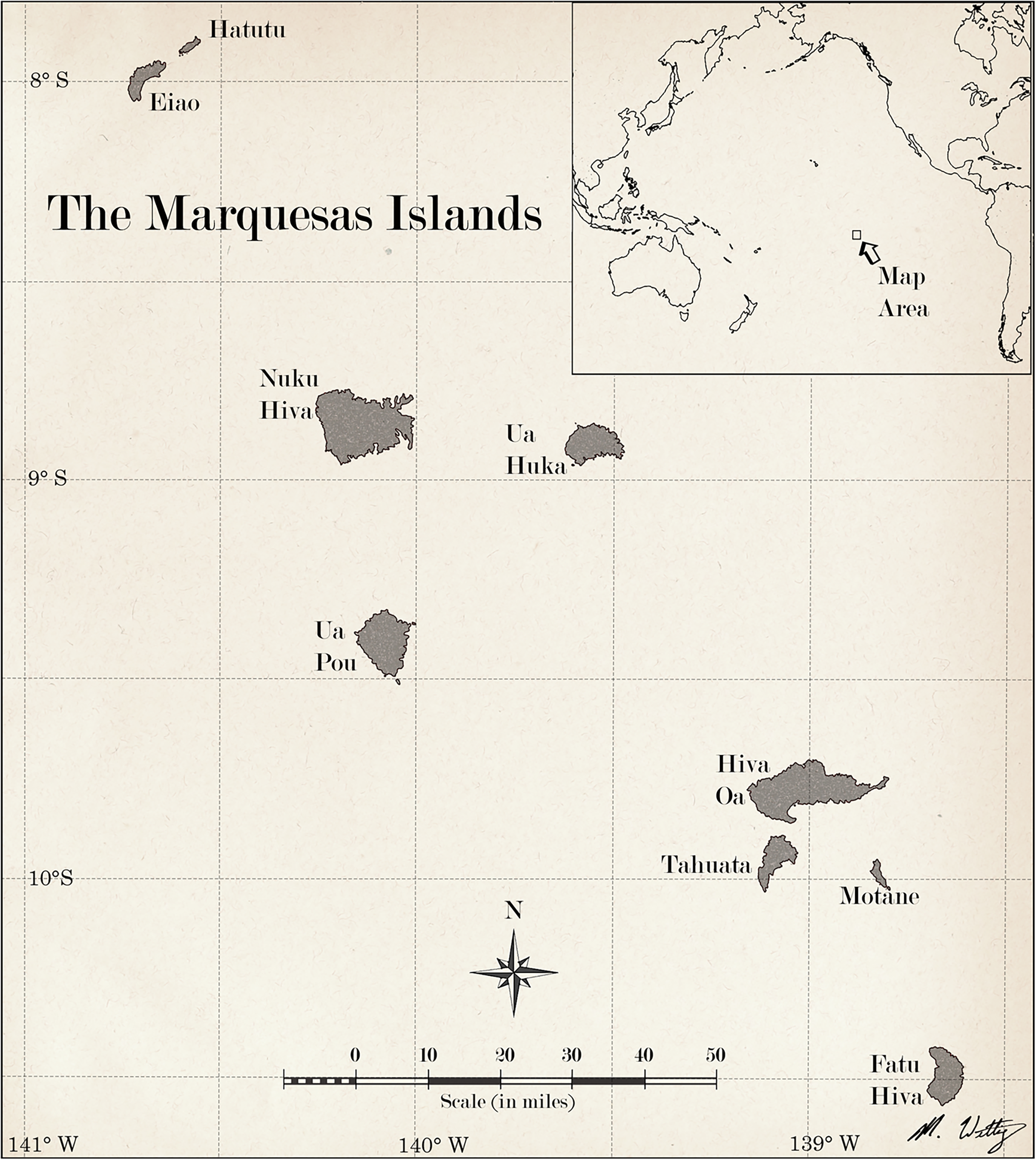
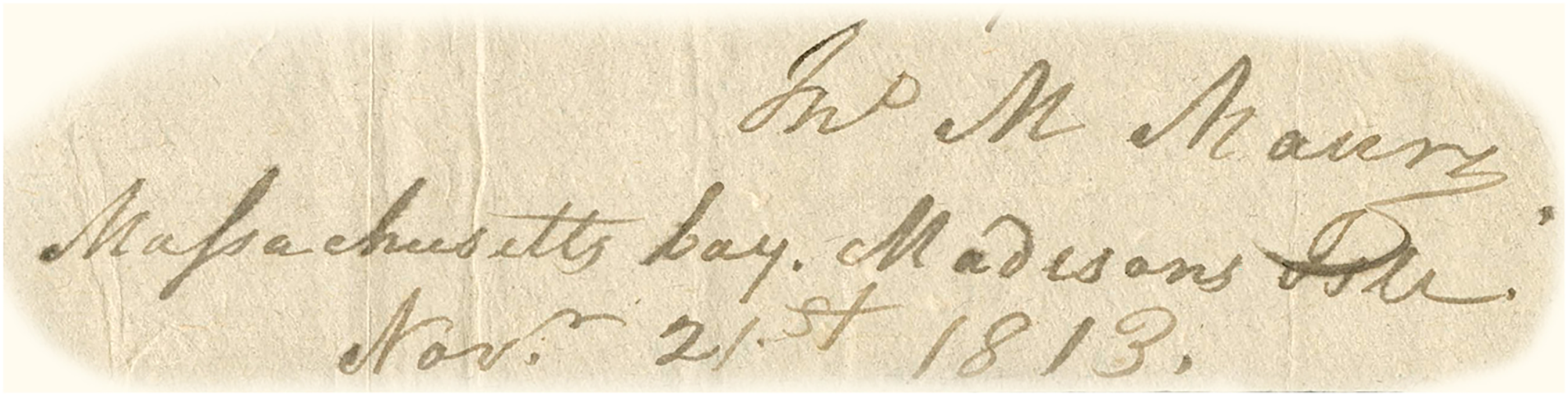
On 25 October 1813, the USS Essex anchored outside Taiohae Bay, on Nuku Hiva's southern coastline. When US navy captain David Porter went ashore he was met by Maury, and Porter recorded a brief account of Maury's circumstances. When he returned to America, Porter included the account within his Journal of a Cruise Made to the Pacific Ocean, and Maury's name became forever linked with the history of the island.
Little more was known about Maury until 1888, when his son, Dabney Herndon Maury, shared a biographical sketch of his father with James Saunders, who published the piece in the Alabama newspaper, The Moulton Advertiser. 2 In that same year, a biography of John’s youngest brother, Matthew Fontaine Maury - by then heralded as the father of modern oceanography - appeared in print, and within that biography was an account of John’s life, a life which had served as an inspiration for Matthew. 3 The two publications contained almost identical details concerning the Marquesas adventure.
In both of these 1888 accounts, Maury and six other men were left on Nuku Hiva when the Packet departed for China with a cargo of sandalwood. The ship was subsequently blockaded in a Chinese port by the British during the War of 1812, causing Maury and his men to become stranded. While they were stranded, tribal warfare broke out on the island, and five of the men were slaughtered. Maury and the other survivor, a man identified as Baker, were compelled to build a house in the tops of four coconut trees for survival. Two years reportedly went by without seeing a sail, before the USS Essex appeared.
Many decades passed after these details of Maury's adventure were published, and they were repeated numerous times by several reputable authors. Then, in 1963, a new biography of Matthew Maury was published, which referenced a letter from Dabney Maury. The letter was written in 1873, several years before Dabney shared his father's account with Saunders, and its details were different. Instead of six men, there were only four. Instead of two years, it was at least 18 months, during which ‘John lost hope of ever being rescued’. 4
Two years? Eighteen months? The War of 1812 was declared on 18 June 1812, and it took months for news to travel around the globe in the age of sail. It would take even longer for Britain to respond. The chronology did not match up. The contradictory number of men with Maury – four vs. six – was another indication that perhaps the ‘story’ as told by Dabney Maury was more fabrication than fact.
Until the present, the tale of John Maury on Nuku Hiva has been told by the 1888 and 1963 accounts, and these have been largely accepted as biographical. The problem is that they are almost wholly fictional, and for over 130 years, Maury's actual experience has been grossly misrepresented. His real story is far different, and fortunately, with the assistance of the World Wide Web, it has become possible to gather together details that were scattered long ago, and reassemble them to offer a more accurate account of Maury's Marquesan adventure.
A voyage to South America and China
In 1809, at the age of 13, John Minor Maury was issued a midshipman's warrant by the US Navy, and for two years thereafter he served aboard the frigate USS United States. In late May 1811, he secured a furlough from the navy to sail on a trading voyage to Canton aboard the merchant ship Pennsylvania Packet, with his friend, navy lieutenant William Lewis (also on furlough), as captain.
5
For Lewis, the opportunity was the fulfillment of an ambition he first wrote about in 1806, when he witnessed the extent of American merchant traffic in the Mediterranean and determined to join their ranks as a merchant captain, as a means to achieve a greater measure of financial success and security. Maury went along for the adventure, and for the experience, as he later wrote: I considered the merchant service a much better situation for a young officer to become proficient in seamanship than on board one of our ships of war as they, in time of peace are more in port than at sea.
6
In late November the Packet sailed east. The plan was to stop along the northwest coast of Timor, at the European enclaves of Kupang, Lifau and Dili, where the opium on board could be traded for pepper and other spices available on the island. 8 Again, wind and weather were uncooperative, as the northwest monsoon was still active when they arrived, and they could neither lay off nor come in to any of the ports along the exposed coast. After passing Timor they briefly dropped anchor in Kayeli Bay, on the eastern shore of Pulau Buru, but they stayed for less than 48 hours, just long enough to get fresh water and provisions. From there they continued on a north-northeast course as far as Palau before turning north, then northwest, and finally west through the Luzon Strait into the South China Sea. Almost within sight of their destination they were struck by a series of violent storms, which kept them at sea for nearly a week more. Four months after leaving Rio, the ship anchored at Macau Roads, on 12 April 1812. 9
The supercargo (the person in charge of the cargo) during the voyage to Macau was Benjamin Chew Wilcocks, who was also part-owner of the Packet. 10 Wilcocks disembarked at Macau, then proceeded up the Zhujiang River to Whampoa Harbor and Canton, where he met with his cousin, James Smith Wilcocks, to determine the next destination for the Packet. 11 As luck would have it, James had recently come upon what appeared to be a very lucrative opportunity.
The sandalwood trade
Sandalwood is a dense, aromatic wood which has long found many uses in China, in furniture and for decorative purposes, for religious rituals and practices, even for medicinal uses. As such, it had considerable value in the China Trade. For many years, much of the Chinese demand for sandalwood was satisfied by British plantations in India, and delivered by the East India Company, which held a monopoly on trade within the British empire.
Around the turn of the nineteenth century, sandalwood was discovered on Vanua Levu, one of the Fiji Islands, in the western Pacific Ocean. This discovery attracted the notice of John Dorr and Company, a Boston-based outfit which owned several ships involved in a wide range of trading situations around the globe. The Jenny sailed in 1807, under the command of William Dorr Jr; William Lockerby was first mate and Lewis Francoeur was the supercargo. The sailing orders from John Dorr to Francoeur offered a guarded assessment of the Jenny's options: If anything promising or informing turns up at Port Jackson sufficient to induce going to New Zealand and to any Islands for procuring sandal wood like the sample of a fan given you, Birds’ nests or other articles suitable for China you are at liberty to purchase it. At the Island of Fegie and others the natives are generally hostile so that not the least dependence can be placed on them.
12
The loss of the Jenny was lamentable, but the prospect of a lucrative return in the sandalwood trade was more than enough to justify additional attempts. What made the venture exceptionally enticing was a cultural phenomenon witnessed by Dorr Jr, Lockerby, Francoeur, and others, in which the natives of Fiji were infatuated with whales’ teeth.
Whales’ teeth: real and fabricated
Whales’ teeth had enormous value in Fijian society, and great esteem was given to those who owned them. A native man of those islands, whether warrior, priest or chief, when he came into possession of a whale's tooth, might hang it up in his house, and gaze upon it almost ceaselessly for days on end. He would often take it down and hold it, and he would rub it over and over again for a period of weeks with the stem and leaves of the mare's tail plant, the name of which, in the Fijian language, means the rubber [polisher] of whales' teeth. Whales’ teeth could be used as something akin to a dowry – to attract a suitor for a daughter, or offered to a superior for forgiveness of a previous wrong or to seek a future favour. Of all the material things a Fiji islander might be able to acquire, nothing could compare to the tooth of a whale.
Just as curious as the native obsession with whales’ teeth was the fact that they were willing to accept elephant ivory, carved into the form of whales’ teeth, as a substitute for the genuine article. In some cases, the ivory might be worth even more, as related by another early visitor, Richard Siddons: The vessels from Port Jackson usually carried the teeth of the whale or sea elephant; but some vessels from India carried elephants’ teeth, which they cut into pieces, and made in the shape of other teeth. These, being very large, were considered of the greatest value, and procured vast quantities of sandel wood. So great an account was set upon them, that some chiefs actually came from islands more than an hundred miles distant to see them.
14
The voyage of the Hunter
In August 1809, Francoeur wrote to John Dorr, with the observation that the northern portions of Vanua Levu had not been explored by sandalwood traders when he was there with the Jenny, and that profitable voyages might still be possible if pursued in a timely fashion. On 13 August 1810, the Hunter, commanded by William Rogers, sailed from Boston for the Fiji Islands. 15 Francoeur was first mate. Included in the cargo was elephant ivory, and during the course of the voyage the ivory was carved up, and shaped into the form of whales’ teeth, intended for trade in the Fijis.
After rounding Cape Horn, the Hunter called at Tahiti, in late January 1811, to refresh its supplies of food and water. The seasonal winds which Captain Rogers planned to rely on in the Fijis were not due to blow until late in April, so through February and March he took the ship on a roundabout voyage to several islands, inquiring about sandalwood wherever he called. One of the last of these was Nuku Hiva, where he was shown several good samples of sandalwood, but his time for exploration was up, and he had ivory on board to trade in Fiji, which was thought to be a sure thing, something William Lockerby described as an ‘equal to coining business’. 16 The ship sailed west.
When the Hunter arrived on the north shores of Vanua Levu, it quickly became evident that the Fiji trade was no longer a sure thing. Several ships were in the area, all working along the coast in search of sandalwood. Competition for the wood, and for the trade which it brought, had introduced new conflicts between the native tribes, and with the sandalwood traders as well.
William Dorr Jr, formerly the commander of the Jenny, returned to the Fijis as captain of the Brutus, a few weeks ahead of the Hunter. Not long after his arrival, a chief on the island of Ndrua offered to fill the hold of the Brutus with sandalwood, in exchange for assistance in an attack against a rival tribe. Dorr accepted the offer. On the appointed day, he sent his first mate and four others ashore armed with muskets, pistols, and cutlasses. A rain began to fall, and when the battle ensued their powder was wet and neither muskets nor pistols would fire. The five men were slaughtered. Three of them were eaten. 17
While the crew of the Hunter managed to avoid any fatal encounters in the Fijis, their success in finding sandalwood was not encouraging: four months of effort netted only 40 tons of wood. The discouraging results eventually compelled Rogers to reconsider his earlier explorations, and he recalled the promising samples of sandalwood he had seen in the Marquesas.
On 6 November 1811, the Hunter anchored in Comptroller Bay, Nuku Hiva. Over the following two months, the ship gained an additional 200 tons of sandalwood, and fresh water and provisions, obtained from the Taipivai Valley's natives, collectively known as the Typee tribe, in exchange for iron hoop, ironware and ivory. 18 Relations were so good with the natives that six crewmen chose to stay behind when the ship sailed away, on 9 January 1812.
On 25 February, the Hunter arrived at Whampoa Harbor with a cargo of close to 240 tons of sandalwood on board. Rogers and his crew did not publicly reveal where they got their cargo; instead, they said it came from an island near Fiji. The sandalwood attracted the notice of James Wilcocks, who was living in Canton when the Hunter arrived. James was already in good graces with John Dorr and Company: he had previously assisted Dorr Jr and Francoeur when the Jenny was seized, including a cash loan of over $6,500 to cover their expenses and pay the crew's wages. James took an interest in how Rogers had obtained the wood, which sold for $75,000 in Canton, and the more he learned, the more interested he became. Not long thereafter, he bought the identity and location of the island from Rogers. 19 He then hired Rogers to return to the Marquesas, and to coordinate the activities of any other ships he might send out prior to the Hunter obtaining another cargo of sandalwood. The Hunter sailed from Whampoa Harbor two days after the Packet arrived at Macau.
The Packet sails the Pacific
Conway Whittle Papers, Special Collections Research Center, William & Mary Libraries.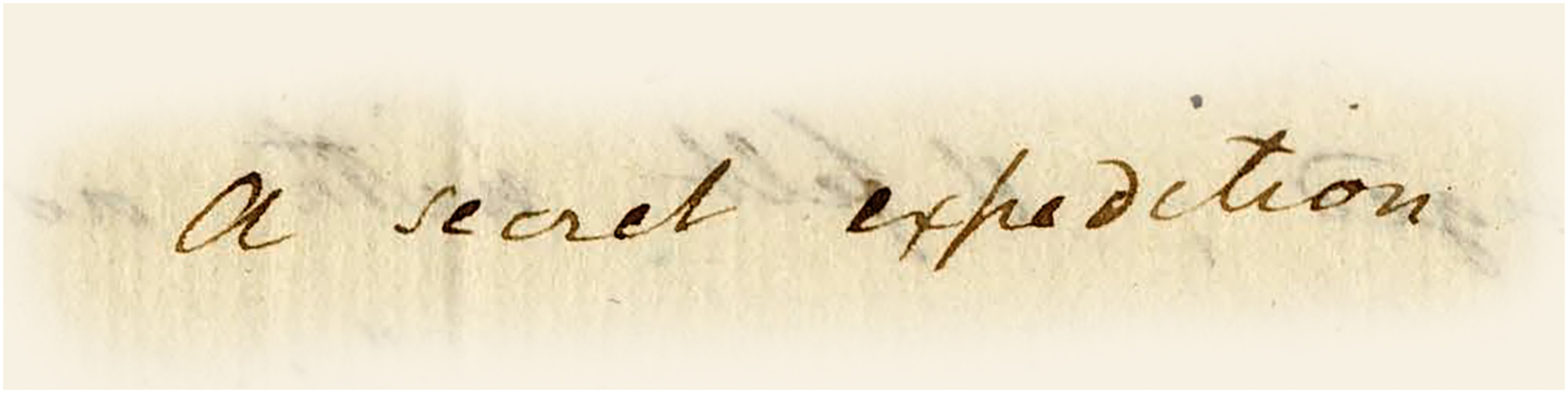
I have been overhauling and discharging what cargo I brought out, preparatory to a five months cruise in the Pacific Ocean. A secret expedition. I shall certainly have a schooner with me, and I believe a ship; over which I shall play Commodore. I am going in search of an Island, lately discovered by a Yankee Captain somewhere in the South Pacific, where I shall obtain a cargo of sandalwood. This Yankee has only communicated his secret to Mr. Wilcocks of Canton, with whom he entered into a contract to supply this wood, and sailed about a month since to prepare for us.
20
(William Lewis, 9 May 1812) (Figure 2)
The Packet eventually anchored in Taiohae Bay, where it was visited by James Wilson, an Englishman who had lived among the natives for numerous years and had largely gone native himself, insofar as he understood their culture and could speak their language fluently, he dressed in a simple loincloth in the same fashion as the men of the island, and his skin had been covered over with intricate tattoos of the native style. Wilson lived with the Typee during the first two visits of the Hunter. 23 He had accompanied Peter Cox when the first samples of sandalwood were brought out to show Rogers during the first visit in March 1811; he had acted as a translator throughout the second visit, and he helped to negotiate the trades which saw the Hunter filled with sandalwood and the ship's stores replenished with food and water. Wilson left the Typee at some point after the ship departed the second time, and he made his way over to Taiohae Bay, and the Taeeh tribe. The move may have been forced upon him.
Trouble in Paradise
In 1817, Camille de Roquefeuil recorded a story told by George Ross. The anecdote contained several errors, yet it confirmed that Rogers ‘had ivory, which he fashioned on board into the form of whales' teeth, not having been able to procure them in sufficient quantities. This fraud produced him a large profit; but the natives soon discovered it, and cannot now be deceived by it’. 24
When the Hunter returned to Nuku Hiva on 6 August 1812, Rogers faced a changed situation. All but one of the men who had stayed behind the prior January came back aboard the ship as soon as it returned. The Typee had turned against them, they said, ‘had used them very ill and at many times they had been in danger of their lives’. 25 The men were trying to build a craft to get themselves off of the island, but they had made poor progress with it owing to a lack of tools and hardware. They expressed great joy when the ship returned again, and they eagerly signed back on as crew.
The Typee had no prior knowledge of elephant ivory, so they had initially valued the carved ivory as if it had come from a whale, but at some point the deception was found out, possibly betrayed by the men who stayed behind in January: ‘They had also hurt our trade in this place so that they [the natives] appear to have no inclination of cutting wood for us again they tell us our ivory is no good’. 26 The Typee were furious, and remained so for a very long time. Six days later, unable to trade for sandalwood, food, or even water, the Hunter left Nuku Hiva.
William Lewis arrived in the Marquesas expecting to ‘play commodore’ to a schooner and a second ship. That expectation was based on the assumption that Rogers would procure his second cargo of sandalwood as quickly as he had the first. If that timetable had held true, the Hunter would have been near to a full cargo by the time of the Packet's arrival. Instead, at the end of September 1812, Rogers was still a long way from obtaining his cargo, and Lewis would have to wait his turn.
The schooner Lydia, Captain Nathaniel Lecatt, was owned by James and Benjamin Wilcocks, and it arrived at Tahuata one day before the Packet. Until the middle of December, John Child recorded that the Lydia assisted the Hunter in collecting sandalwood, as it delivered several small loads of wood to the larger ship during that time. The ship America, Captain Matthews, arrived at Vaitahu (Resolution) Bay from Canton on 29 October, and sailed for Nuku Hiva the following day; this may have been the ship Lewis was to be in charge of, if all had gone to plan.
While the Packet and the America were apparently able to trade for food and water, the Taeeh tribe, who inhabited the shores of Taiohae Bay, were unwilling to trade for any substantial amounts of sandalwood. The Lydia went from Tahuata to Nuku Hiva on 14 November and was gone for a month. It returned to the Hunter at Tahuata on 14 December, with news that the America was ready to depart for China, and that the America and the Packet both had very little wood. Also reported on 14 December was the transfer of two crewmen from the Lydia to the Packet. One of them was Phineas Fairbanks, who was previously among the crewmen from the Hunter who had stayed on Nuku Hiva to witness the souring of relations with the Typee.
The Hunter departed for Canton on 16 December, more than four months after arriving in the Marquesas. After that, Lecatt presumably acted in the same capacity for Lewis as he had for Rogers, in accordance with the plan set forth by James and Benjamin Wilcocks. The Hunter arrived at Whampoa on 29 January 1813. On 1 February the America arrived at Whampoa, reportedly with only 15 tons of sandalwood aboard. 27
The Packet departed Nuku Hiva on or about 4 February 1813, and arrived at Whampoa on 22 March, after a 46 day passage. 28 On board was 100 tons of sandalwood, less than half the ship's capacity. While food and water could be obtained by trading for trinkets, including elephant ivory, sandalwood could only be gained with the cooperation of the chiefs. The problem for the sandalwood traders was that the island economy had long been isolated and self-sufficient, so the merchandise the newcomers had to offer was a curiosity, but it had limited value to the chiefs, who controlled the access to sandalwood.
Maury's first letter to Lewis
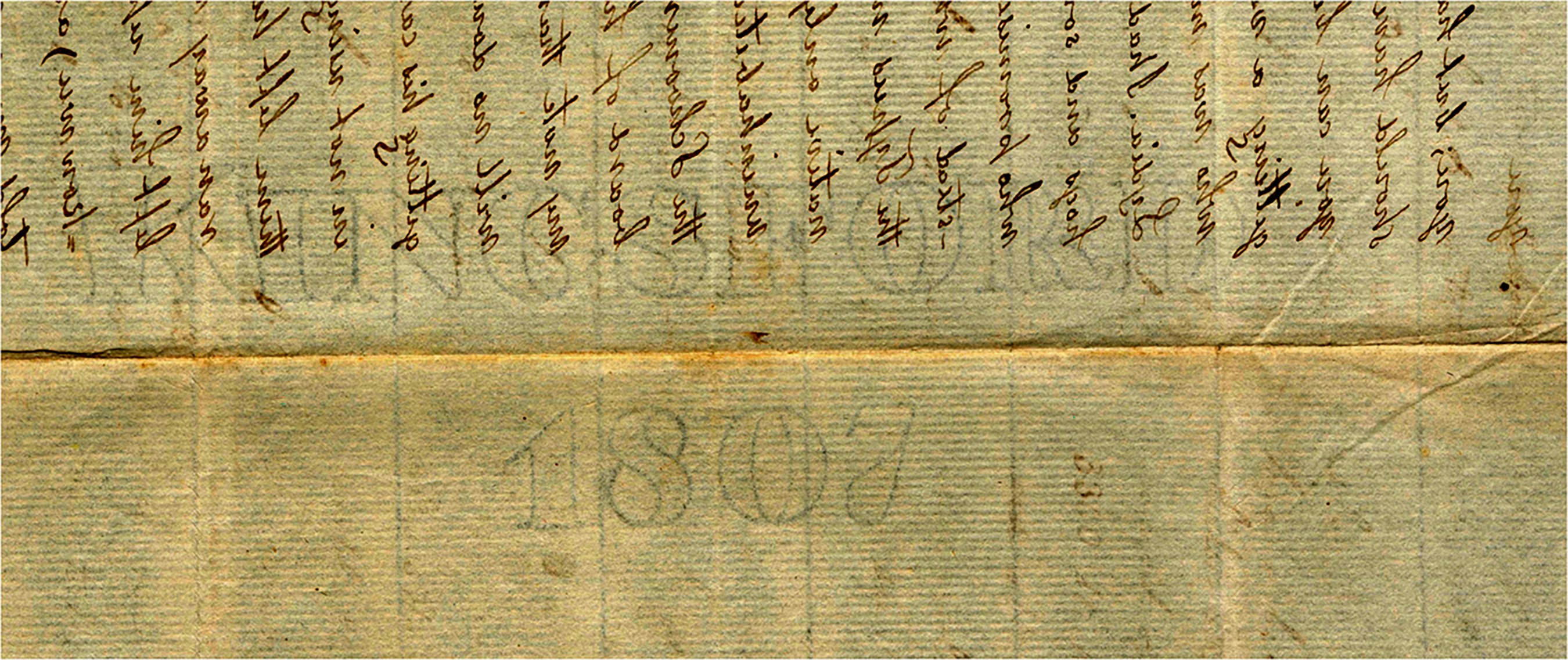
This image, of Maury's undated letter to William Lewis, has been reversed and enhanced to highlight a watermark, “Kingsford 1807.” The same watermark exists on paper used by Lewis while in Macau in 1812, before sailing to Nuku Hiva. Any question as to the authenticity of Maury's letters was dispelled by this forensic discovery.
John Maury, Phineas Fairbanks and William Brudenell watched from shore as the Packet left Nuku Hiva on or about 4 February 1813. James Wilson, the Englishman turned islander, was with them. The remaining trade goods from the Packet had also come ashore, and the men intended to continue trading with the natives for more sandalwood until the ship returned. In the interim, Lewis had placed Maury in command, which also put him in charge of the Lydia. Lecatt immediately questioned Maury's authority: I sent down to Lecatt to know the reason of his having the Schooner but the scoundrel would not allow any person to go on board of him nor would he deign to send me any other answer to my note than ‘he studied his own interest and not Mr Maury's’.
29
(Figure 3)
In time, Lecatt was compelled to acknowledge Maury's authority. In March, five crewmen from the Lydia stole a whale boat and deserted. A few days after that, three Chinese crewmen jumped ship. With too few men to handle the schooner, Lecatt came to Maury: and solicited my assistance in the most humble manner, told me a number of lies in excuse of his neglect of me before saying he did not know that I was left here as Mr. Wilcocks’ agent: why had I not been on board of him before, proposed a great desire of being serviceable to me, was sorry you had not empowered me to apply to him in case I should happen to want any trade before he left the Islands, and at last had the face to tell me he meant to have turned the boat over to me, although when Wilson wanted to buy her he told him that if he thought I was to derive any benefit from her he would burn her sooner than he should have her and in fact abused me in the most infamous manner in the presence of all his crew although I had never exchanged a word with him in my life and you also had a large share of it. I thanked him coldly for his offer of friendship which I knew to be faithless and told him as the vessel belongs to Mr Wilcocks I would do him all the service in my power which was not detrimental to my own interest. I got him his Chinese again and persuaded Wilson to go with him again who had left him a few days before on account of his brutal behaviour.
30
Maury was at Hakaui Bay, near the west end of the island, when Lecatt met with him in March. Lewis had been there too, during his time on the island, and he apparently had some success trading there for sandalwood: David Porter and Camille de Roquefeuil, and other contemporary visitors, referred to Hakaui as either Lewis or Louis Bay, in his honour. After coming to an understanding with Lecatt, Maury took possession of the Lydia's stolen whale boat: I have bought half of the whale boat from Lecatt's men for which I gave them trade to the amount of $26. I found her of a great deal of use but she is now so crazy that it is dangerous to go in her and I have no nails to repair her.
31
Maury did not reveal the holder of the other half-interest in the whale boat, although a reasonable guess might be Wilson, who had an equal share in the sandalwood they collected. Even with Wilson's help, their efforts to acquire sandalwood met with a tepid response from the islanders: I have met with but poor success in collecting sandalwood which the natives are very unwilling to part with for ivory or iron and as for the red cloth I have not sold them an inch if I had a good boat I believe I might sell it to advantage at Chucowwa [Hakuai] for whilst the boat was fit I refrained from trading there on account of the schooner.
32
The trinkets and tools which the white men had to offer may have held little value to the island's elite, but Maury did manage to get some sandalwood. He was also told, in no uncertain terms, what the chiefs wanted most of all: Between Wilson and myself there is about 3300 sticks of very good wood which may weigh seventeen tons although I have made use of all my eloquence I have not been able to get them to cut a stick their answer is that when they see the whales teeth they will cut it.
33
Sandalwood was not the only commodity of value on Nuku Hiva. Food was often in short supply, or so it seemed, since hogs were reserved by the chiefs for special occasions, and so were often not readily available for trade. Within the Marquesas, some islands had more pigs available than others, and Maury tried to take advantage of the situation by sending Phineas Fairbanks with Lecatt on a trading venture. This resulted in the only casualty of the expedition: I have been so unfortunate as to lose Fairbanks who was murdered on the 8th of June as he was coming up from the Lydia. I had sent him to the weather islands with Lecatt to trade for hogs and some other things which I thought would sell to advantage here who promised to deliver him and his property to me in twenty days instead of which he carried him to the other side of the Island amongst the Typees when he attempted to come up in a small canoe with one native only who murdered him whilst he was asleep at a place uninhabited.
34
The Typee and the Happah tribes attacked the Taeeh while Maury was with them, possibly because he was with them. The ivory Maury had to offer may have been of little value to the island's elite, but it was traded freely with the common classes in a sufficient volume that, a few months later, David Porter wrote: ‘Ivory is worn by the lower and poorer classes, made into the form of whales’ teeth, and as ear ornaments, while the whales’ teeth is worn only by persons of rank and wealth’.
35
The ivory Porter saw came from the Packet and the America. When the Typee discovered that the Taeeh were trading with white men for elephant ivory, that activity may have added insult to injury. The onset of hostilities came soon afterward, and Maury was forced to choose sides: I have joined these people in a war against the Harpahs and Typees I was induced to do it for my own safety as I was apprehensive that these people would be drove off their land when I knew that my neutrality would be no protection for me and I have already felt the good effects of it as I enabled to go in any part of this place without the least fear.
36
To protect himself and the remainder of his trading stock, Maury began work on a house in the trees, but not amongst the coconuts: I have to keep a regular watch as I am afraid of the Harpahs burning the house; they have already robbed us of a large opportunity of trade of different descriptions; but I am building a kind of house on bread fruit trees about twenty feet from the ground which I think will be much safer as it will not be so easily burnt and we shall be able to annoy them greatly with large stones should they attack us.
37
By October, Maury began to suspect – correctly – that Lecatt had departed from the Marquesas, and that he was stranded. Even so, he mostly lamented the loss of the trade goods still aboard the Lydia. The letter ended abruptly, without a closing salutation, unlike all of his other surviving letters, and the signature at the end appears to have been added by a different quill, possibly at a later date (Figure 4). It was almost as if his writing was interrupted by larger events, like the arrival of an American frigate: I now despair of Lecatt's coming here as he has been gone upwards of a month but shall conclude my letter as it is possible he may have gone to Magdelina after wood for when I saw him last he told me he intended to take in a deckload of it if he could get it if he has left the islands and a ship does not arrive by the appointed time we shall be in a fine pickle for I am reduced to 3 Axes 1 Hatchet 25 Tokus 3 Harpoons and the Red cloth. The trade on board of him is considerable there being 18 Axes 12 Hatchets 40 Tokus a large quantity of Red paint a number of curios and airy cloths a musket & pistol besides a number of other articles which in the whole may amount to $150.00 I am reduced to twenty cartridges which is but a small number when I have to keep the muskets constantly loaded. Jn M Maury
38
In short, Maury never ‘lost hope of ever being rescued’, because he barely knew – and cared even less – that he was temporarily stranded, as the appointed time for his relief ship was still in the future. Even so, he knew that his situation was becoming increasingly tenuous.
Expected in about two months
Maury's circumstances changed abruptly on 25 October 1813. On that day, the USS Essex and several other ships arrived in company outside Taiohae Bay, so Maury went out in a native canoe, with Wilson and Brudenell, to greet them. Wilson was dressed in his usual loincloth; Maury and Brudenell were in tattered clothing. Aboard the Essex, Captain David Porter assumed the approaching men were beachcombers, and forbade his crew to return their hails. Disappointed, the trio turned back towards the beach.
Maury's undated letter was neatly written - a second draft - except that it lacks a closing sentiment, unlike his other letters. The signature also appears to have been added using a different quill at a different time, evidenced by the change in stroke width and the presence of ink splotches (otherwise absent in most of the letter), as if the final draft was interrupted before it was concluded, possibly by the arrival of the USS Essex.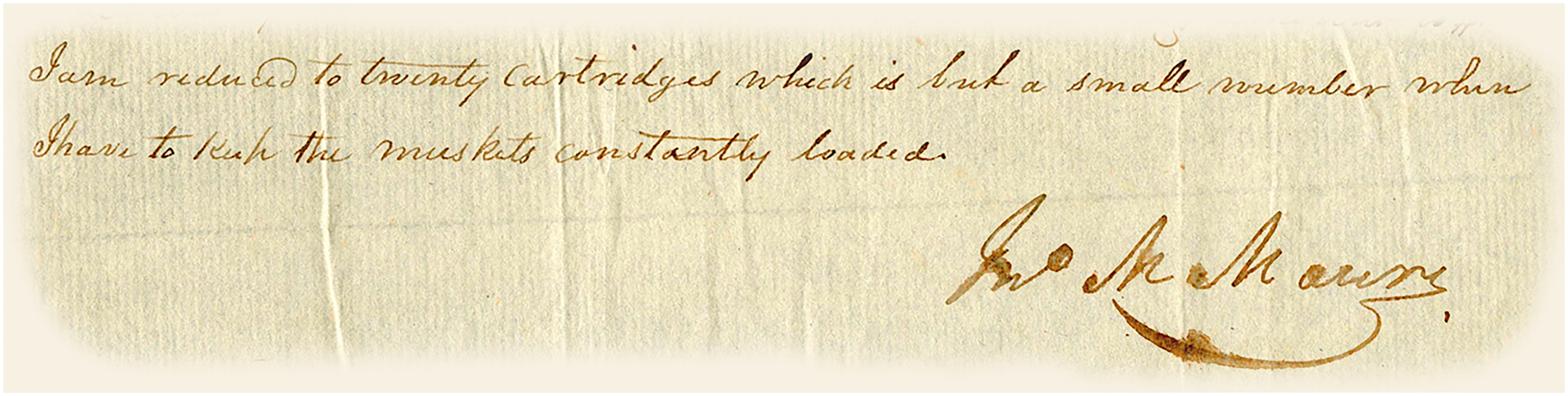
On the way back to shore, their canoe was met by several other canoes, the latter all manned by native men. Words passed between them, and then they all returned to the shore, where even more natives gathered in the general excitement. Not long afterward, Porter followed them, along with four boatloads of armed marines. The approaching force terrified the islanders, who all retreated behind the trees. Maury remained to greet the new arrivals: The beach was abandoned at our approach; but on landing, I was met by one of the persons who had come off in the boat: and to my great astonishment, I discovered him to be a midshipman of the United States navy, named John M. Maury, who had left the United States on furlough, with lieutenant Lewis for Canton, in the ship Pennsylvania Packet; from which place he sailed for this island, to procure sandalwood. Here he remained several months; and after procuring his cargo, sailed for Canton, leaving Mr. Maury with a party, and the remainder of his stock of trade, to collect a cargo for him against his return: he had been expected in about two months; but the news of the war, of which we brought the first accounts here, destroyed all expectations of again seeing him: and as Mr. Maury and his party saw no other prospect of getting away, he requested me to take them onboard. To this I consented, provided lieutenant Lewis should not return before my departure.
39
A sick man
Tell Gallagher he has not treated me well. He ought to have written me his determination, as I have rejected some good offers on his account, and am now without a 1st officer.
40
(William Lewis, Philadelphia, 18 June 1811)
William Lewis drove himself hard as captain of the Packet. He had to, because the men under his command were mostly inexperienced, including his officers. As a result, he arrived in Pernambucco, ‘thin as a skeleton, and burn’t nearly black’.
41
The voyage from Rio to Macau also took its toll: The latter part of the voyage has been not a little fatiguing to me. I have grown three or four years older for it. I was unfortunate in leaving Philadelphia without having an officer with me capable of doing his duty, and I have in consequence been obliged to expose myself a great deal in very bad weather – I feel the effects very sensibly I assure you.
42
When the Packet left Nuku Hiva in February 1813, at least part of the reason for the departure was the frail health of its captain. His exact ailment was never disclosed, although exhaustion and exposure may well have been contributing factors. He was ill enough that Maury did not know if he would come back, as expressed in the opening line of his first letter to Lewis: I now comply with my promise of writing you; but have not the least prospect of your receiving this unless you should have returned to America and if you have not I do not think you can be many days sail off it if you have been fortunate in getting a vessel.
43
Whatever Lewis’ health concerns were, they were not life-threatening, since he was able to deliver the Packet to Whampoa Harbor on 22 March, and he spent several days in Canton before he went back to Macau. From Macau, on 9 April, he finally had the opportunity to write to Edward Herndon: I arrived at Canton a few days since, after a long voyage to the Marquesas Islands in the South Sea. My expectations have been sorely disappointed; and what is worse, my health has suffered severely, and I fear irreparably. I am here [Macau] on this account, and I am enabled to take exercise, and have the advice of an amiable and excellent man, the physician of the English East India Company.
44
In actuality, Lewis had no intention of letting his physical condition interfere with his Marquesan venture, but circumstances intervened: news of the War of 1812 met him when he arrived in China.
45
As a lieutenant in the US Navy, he was obligated to terminate his furlough and return to duty, so he resigned as captain of the Packet, and from the larger sandalwood enterprise that he would otherwise have continued to pursue: Although I have been unsuccessful in my voyage, yet the information I obtained was such as would have rendered a second attempt pretty certain. Unfortunately, the war with England prevents my doing any thing, situated as I am. The plan which I had arranged is about to be carried into effect. In the prosecution of it I had left Jn Maury at the Marquesas, and should have returned there myself, with the intention to remain two years more. There is nothing to be apprehended on his account, as he is amongst an inoffensive and kind people, who look on him as a creature of almost superior nature.
46
The Marquesan sandalwood venture
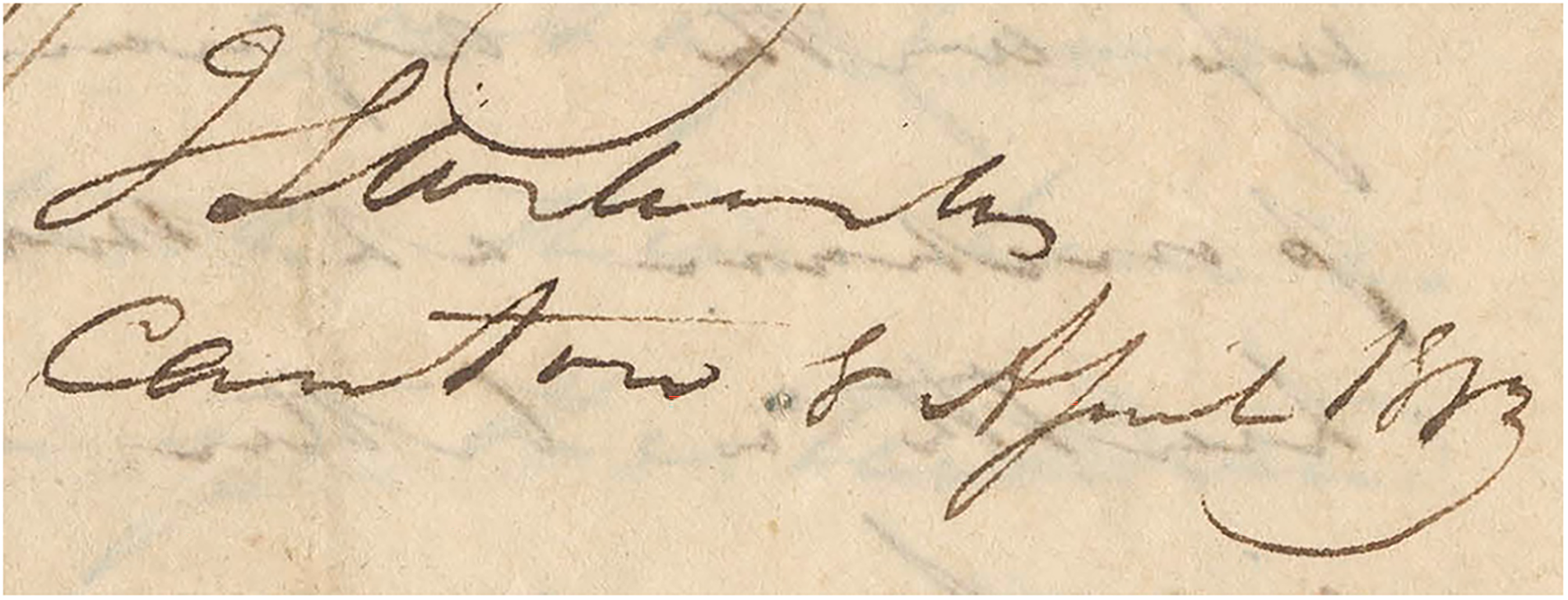
“JS Wilcocks, Canton, 8 April 1813.” While hard to decipher, Wilcocks' letter provided a wealth of information pertaining to the venture he, Lewis, and Maury were engaged in.
While Lewis was in Canton he explained the situation in the Marquesas to the Wilcocks cousins. The need for genuine whales’ teeth was stressed. On 8 April, James Wilcocks scribbled a reply to Lewis which detailed the scope of the operation. Some of the details are of particular interest: Davis and Winship seem to have little doubt but there are many teeth to be procured at the places they are going to. They have seen them often and the only fear is that they may have been worked up with ornaments. (two or three undecipherable words) that the inhabitants there have no prejudice in favour of the teeth and that ivory will do quite as well so that if they have that article they can even get the ornaments in exchange for it. These are large and will do to work over at the Marquesas or perhaps be valuable there in their present form. We should send such people as you advise out in these ships with DeMestre if he will go, and as you know so much more about the minutiae of the business than either Ben or myself, we are anxious that you should come up and write directions for their government. You can if you will, go out with Davis or Winship and control the whole proceedings, and think you are wrong if you do not determine to do so. At all events come up here and let us talk to you on the subject.
47
(Figure 5)
Davis and Winship were both merchant sea captains, and their early explorations and exploitations were along the northwest coast of North America. While trading along that coast they undoubtedly noted that whales periodically washed up on the shore, and that the natives collected the teeth to use in ornamental carvings. If ivory might serve as a reasonable exchange item for whales’ teeth, the teeth could then be traded for sandalwood in the Marquesas. Since Lewis was compelled to return to active duty with the navy, the proposed leader of this next phase of the sandalwood operation was Prosper de Mestre.
Prosper de Mestre
Jean Charles Prosper de Mestre was born in France. He was an infant when his family fled to the Caribbean to escape the French revolution. His father, a French military officer, was killed shortly thereafter, when a cannon in his command fired while he was inadvertently standing in front of it. After that his mother married a British officer, and a few years later de Mestre found himself in Philadelphia, where he completed his education. He became a naturalised American citizen in that city on 5 June 1811, and he left the United States shortly thereafter, never to return.
Lewis never mentioned de Mestre by name. The closest he came was on 16 April 1812, and again two days later, when he wrote about ‘a young gentleman who came out with us.’ 48 Both of these mentions suggested that Lewis and the unnamed man would share the consignments on the next part of the voyage, after leaving Macau. It is highly likely that de Mestre went to the Marquesas aboard the Packet. He certainly went there aboard the Albatross – Captain William Smith – which departed Whampoa Harbor on 20 April 1813, in company with the O’Cain (Winship) and Ezebela (Davis). 49 As for the Packet, it departed Whampoa on 2 May with a new captain (Meek), more than two weeks before John Child reported, on 18 May 1813, the arrival of an English frigate at Macau, signalling the start of the British blockade of American ships in China.
Smith's first port of call was Hawaii. Upon their arrival there, the Albatross was chartered by Wilson Hunt to deliver supplies to an American/Canadian trading outpost on the mouth of the Columbia River. The ship reached Astoria on 20 August, to discover that the men who had remained there were ready to abandon the outpost. It was then hoped that the Albatross could remain long enough to take off the skins and other trade goods that were at the outpost, but the captain had to decline: Captain Smith had chartered his vessel to a Frenchman named de Mestre, who was then a passenger on board of her, to go and take a cargo of sandalwood at the Marquesas, where that gentleman had left some men to collect it, the year before.
50
Maury's second letter
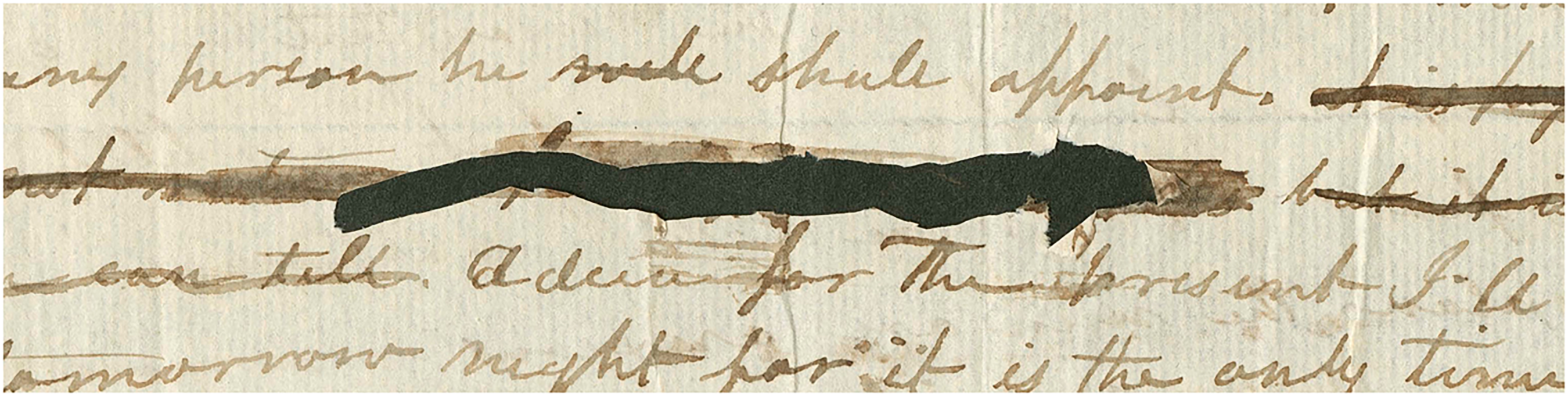
Maury apologized to Lewis for not having time to make a second copy of his second letter. The writing is hurried and sloppy, and he had to physically remove portions of the letter as written, to eliminate sensitive information just in case the letter was captured by the British.
The Albatross appeared outside Taiohae Bay on 15 November 1813, three weeks after the arrival of the USS Essex. The new arrival startled and alarmed Captain Porter, who dispatched the Essex Junior (a captured and converted British whaling ship formerly known as the Atlantic) to intercept the unknown vessel. Aboard the Albatross, Captain Smith feared that the approaching ship was British and he attempted to flee, unsuccessfully. A few days later, Maury mentioned the incident in his second letter to Lewis: When the Albatross came off here the Essex Junior gave chase to her and DeMestre was so imprudent as to throw all his papers overboard fortunately Ross had your letter or I suppose it would have shared the same fate.
51
Towards the end of the first segment of his response, Maury turned his attention to business matters: DeMestre refuses staying here unless I will but he is differently situated from myself for had I known of this war I should certainly not remained and the reasons he gives for going away are frivolous and in fact there is very little foundation for his fears. But more of this hereafter as he has not fixed on any plan the men are anxious to remain – all have arrived except the carpenter who returned from the Sandwich Islands I have determined to have nothing to do in the business he asked my opinion and I told him he ought certainly to remain as I suppose it to be of great importance to help Mr Wilcocks. He said he would not remain on any consideration whatever without me; and at the same time told me he had determined a very short time after he left Canton to give the whole affair up to me and return in the Albatross.
55
DeMestre has determined to abandon the scheme the men are going away but do not know how he intends settling with them. I have advanced Brudenell in cash & trade 54 dollars & gave him an order on Mr Wilcocks for the balance 128 dolls & it being 9 months & 3 days at 20 doll/mo. your bargain being such.
56
As Wilcocks’ agent, Maury was obligated to settle accounts with the men under him. He only had one man to pay. He also transferred his share of the sandalwood over to Captain Smith: ‘I have taken Capt Smith's receipt for the wood which is only 1559 sticks and may weigh from 8 to 10 tons’. 57 In Maury's first letter to Lewis, 3300 sticks of wood were estimated between Maury and Wilson, so this would be consistent with a 50/50 agreement between the two (Figure 7).
Whales' teeth did not garner any mention in Maury's second letter. David Porter wrote about teeth and ivory at some length, but not in conjunction with the visit of the Albatross. As such, it is not known whether de Mestre or others in his party had any success in trading ivory for whales’ teeth on the American coastline. What is known is that the Albatross stumbled upon a true bonanza at Nuku Hiva, as Captain Porter related: The arrival of the Albatross was hailed by our seamen as the most joyful event: she had brought from Canton a cargo suited to this Island, consisting of beads and various other trinkets, to exchange with the natives for sandal-wood. She soon procured all that was to be obtained, and disposed of to our seamen the principal part of her remaining trade at the most exorbitant prices; they had all received their advance money; it was to them useless trash, and soon disposed of for such articles as would be most likely to please their female friends, who soon hearing of the abundance of fiee fiees (for so they called beads) and other tie ties, with which our men were supplied, flocked round our settlement from every tribe with whom we were at peace; for it must be observed that in all our treaties, the first point insisted on by the chiefs of the different tribes was that their women should be permitted to enjoy the same privileges as those of the valley of Tieuhoy.
58
Aftermath
Upon his arrival in Taiohae Bay, Porter observed numerous groups of natives on the surrounding mountains. When he enquired about them, he was told that ‘a warlike tribe residing beyond the mountains had been for several weeks at war with the natives of the valley’. 59 To gain the security required to repair his ship, Porter sided with the Taeeh. Within days, he committed his men to engage the Happah tribe in battle, and soon thereafter he attacked the Typee. The Happah lost their enthusiasm for battle early on, but the Typee were further removed from the American encampment, and ignorant of the threat of organised firepower. To pacify the Typee, Porter laid waste to the whole of the Taipivai Valley, in a brutal campaign which clearly demonstrated the power of musketry to all the islanders.
De Mestre departed with the Albatross. George Ross and William Brudenell remained to trade for sandalwood. Maury left with Porter. Porter left a garrison force behind under the command of US marine lieutenant John Gamble, along with captured ships and British prisoners, in a slowly deteriorating situation that came to a violent end in May 1814, when the Englishmen escaped and the natives rebelled, compelling the remaining men under Gamble to abandon the island. Brudenell was killed during that episode, but Ross survived, and remained in the Marquesas for several more years as Wilcocks’ agent.
Maury left Nuku Hiva as first lieutenant aboard the Essex Jr, and he returned to America in time to fight against the British on Lake Champlain during the Battle of Plattsburg, on 11 September 1814. He then journeyed to Tennessee to visit his family, and while he was there he shared the tales of his island adventure with them. These tales proved to be a great influence on his youngest brother, Matthew Fontaine Maury, who entered the navy (against his father's wishes) in 1825, and went on to an illustrious career that established the scientific foundations of modern oceanography.
William Lewis finally departed Macau on 3 March 1814, and got back to the United States 12 months later, after the war was over. He promptly married his sweetheart, Frances Whittle, the daughter of Conway Whittle, a prominent Norfolk merchant. 60 Lewis was promoted to Master/Commander shortly after he returned, and he assumed command of the USS Guerriere in May; Maury was assigned to serve under his command, and they sailed to the Mediterranean together. A few weeks after their arrival Lewis was ordered back to America, as courier for the recently completed treaty with the Dey of Algiers. He sailed as a passenger aboard the USS Epervier, which left Gibraltar in July 1815 and was never seen again, lost at sea with all hands.
After serving on the Guerriere, John Maury married his first cousin, Eliza Maury, on 3 April 1817. He next embarked on a tour of duty aboard the USS Macedonia as first lieutenant, along the Pacific coast of South America, and after that he joined Commodore David Porter in the Caribbean, where he became acting captain (a field commission) of the supply ship Decoy, and served as flag captain of Porter's fleet. It was during this duty that Maury contracted yellow fever, and died at sea in June 1823. He left behind two sons, who heard the stories of their father's adventures through his youngest brother, Matthew Fontaine Maury, who became a father figure to the boys after John's death.
Immediately upon the end of the War of 1812, Nuku Hiva was inundated by ships seeking sandalwood. The supply was quickly decimated. Writing in 1817, Camille de Roquefeuil stated: The exportation of nearly 1800 tons has almost exhausted the resources of this little island; the small quantity of sanders wood which is still in the interior, is crooked, stunted, and very small, most of the pieces not exceeding two inches in diameter.
61
With some comparatively trifling exceptions, the natives take nothing in exchange but muskets, powder, or other ammunition. These articles must retain their value on account of the continued state of hostility in which the natives live. Whale's teeth are not valued, unless they are of the enormous size of three fingers’ breadth in diameter. The teeth of the black fish and seals are also of some value when they are strong and well sorted. Hatchets, and some other utensils are in request, but iron, in general, is not much esteemed. Handkerchiefs, blue and white linen, are in fashion, chiefly among the women. They have also the usual predilection of their sex for looking-glasses. Plumes of feathers, especially red ones, are much sought after. All these articles, however, are only accessories in the traffic, the basis of which is arms and powder.
The sandalwood boom on Nuku Hiva was short-lived, and by 1821 the trade had virtually collapsed. Still, white men continued to come, and whaling soon took over as the primary reason for ships to stop in the Marquesas. It was a whaling ship that brought Herman Melville to Nuku Hiva in 1842, an adventure which inspired his popular novel, Typee: A Romance of the South Seas.
For the islanders, the continuing visitations by traders and whalers brought about a slow decay of the native society and culture. Sandalwood and provisions were not the only items the natives traded away: war clubs and other intricate examples of Marquesan craftsmanship were given in exchange for whales' teeth and muskets. Chiefs saw their influence diminished as white men traded indiscriminately with the lower classes. The following years ushered in foreign diseases, missionaries and occupation by the French. By 1920, fewer than 2,000 indigenous inhabitants remained.
