







Abstract
The aim of this article is to analyse the identity-making role played by the maritime factor in promoting the international picture of the young Finnish republic by using the case study of the frigate Suomen Joutsen on its international voyages from 1931 to 1939. The rituals of naval diplomacy meant that the political, diplomatic and commercial authorities of the nations visited were brought on board the ship and contacts were made with the recently established Finnish consular network. In addition to such contacts, the extensive use of the press and radio was an important factor in promoting the young Finnish republic. Moreover, in countries with important communities of Finnish emigrants, contacts were made with those groups. Finally, with a floating exhibition of Finnish products on board, it was possible to establish commercial relations. Hence, the international cruises of the Suomen Joutsen were fundamental channels for the representation of the young Finnish nation.
Introduction
Little is known about the importance of the sea in building Nordic identities or its significance as a link between the Baltic - Scandinavian region and the outside world. The aim of this article is to analyse the identity-making role played by the maritime factor in promoting the international picture of the small, and young, nation of Finland by using the international diplomatic missions of the frigate Suomen Joutsen.
Although the Scandinavian nations developed their own merchant marines and navies over many centuries, Finland's case distinguishes itself due to its size – only approximately two per cent of world tonnage before the First World War – and, from another perspective, a stagnation and backwardness in the technological transition of its merchant fleet from the last two decades of the twentieth century, due to its economic and, above all, political peculiarities.
As Yrjö Kaukiainen suggests: ‘from being a rather typical maritime nation of the 1860s and 1870s, Finland stagnated into a very atypical one’, remaining ‘the last western maritime nation to stick to sail’ and maintaining a fleet that, in 1913, had only 18.2% of steam tonnage, including motor vessels. 1 Long before the country became independent, the Finnish commercial fleet, though small in size, had carried out the role of making contact with the outside world, exporting and providing its own ships and sailors for transport on the main ocean routes. 2 However, Finland had been part of the Russian Empire from 1809 to 1917, although it had maintained a certain administrative and legislative autonomy. On 6 December 1917, it declared its independence and, in the 1920s, developed the political, diplomatic and economic structures of an independent state.
Finland needed its own domestic and international representation – that is, institutional and cultural practices that would promote a distinctive picture of the country in international relations and commercial terms, thereby legitimizing its existence at a domestic level and promoting its prestige abroad.
3
Recognition, in order to guarantee visibility and increasing international credibility, alongside the security of entry into the League of Nations were indeed priorities for the first Finnish governments. In this regard, it is important to bear in mind the ambiguous role of Finland in its relations with the defeated Germany, the internal divisions after the civil war in 1918 and, finally, its bilingual character, with an influential minority of Swedish speakers. The use of naval diplomacy was one of the instruments available to Finland in order to achieve these aims. On this subject, Jessica Gienow-Hecht had argued: States require a perception as authentic performers on the international stage to play any significant role. If they fail to achieve internal and external recognition, they do not exist. If, on the other hand, they are successful, they can achieve credibility, influence and power.
4
According to Ezio Ferrante, on the other hand, referring specifically to the Italian Navy, representation outside the country foresaw the use of naval officials as the alter egos of the classic roles of diplomats. Naval officials, because of their elitist origins, strict training and knowledge of languages, and the ease with which they knew how to move in international circles, were the perfect prototypes for the fusion between diplomacy, naval policy and the promotion of foreign trade. 10
From another perspective, the symbolic use of a ship or another technology associated with promoting foreign trade, and of the characteristics of a nation in its most miscellaneous expressions, is part of cultural diplomacy – part of the much greater whole of the policies of public diplomacy. As outlined by Clerc and Milton Cummings, it should be understood as a strategic instrument of the foreign policy of a nation and consists of ‘actions planned, coordinated or organized by central public institutions, aiming to support the objectives of the state’ 11 and ‘to foster mutual understanding in the nations visited’. 12 The same cultural diplomacy is regarded by Kalervo Siikala as a means of support for foreign trade, ‘either the direct acquisition of export markets for cultural goods or indirectly cultural support for other forms of exports’. 13
During the 1930s, Finland chose to be represented in international waters by an elegant white sailing ship, the school ship Suomen Joutsen, thereby inaugurating a decade of cruises that were useful for getting the country known around the world. In contrast to the maritime powers, which aimed to find prestige and power, the Suomen Joutsen was an ambassador of Finland abroad and a symbol of a small, young, proud nation that had recently become independent. Although the first missions served to ‘fly the flag’, from the mid 1930s, with a display of national products on board, it was possible to initiate, and sometimes establish, commercial contacts with distant and less important markets. The main aim of the ‘floating exhibition’ in 1934–1937 was to promote the various industrial sectors of Finland by delegating the negotiations for sales to commercial agents. The representation of Finnish internal products, which was developed according to a cultural perspective that aimed to show the diversification of Finnish industrial output, contributed to strengthening and diversifying foreign trade. Moreover, the naval diplomacy meant that political and diplomatic representatives from the nations visited were brought on board the ship. The characteristic traits of Finland were presented to the international press, contacts were made with the recently established Finnish consular service, and greetings were offered to the Finnish emigrant communities. Many Finns had emigrated between 1860 and 1930, not least to the United States.
The case of the Suomen Joutsen thus appears to be original and instrumental for an analysis of the activities of representation used by a small nation, which have aims and applications that are radically different from those of the great maritime powers. The construction of a symbolic universe centred on the Finnish sailing tradition, which the country embodied, was combined with the use of some typical elements of the ‘small-state toolkit’ of international representation outlined by Clerc and Glover. This included support for networks and diasporas abroad, and individuals on board being imbued with the idea of defending national interests and acting in a semi-diplomatic capacity, as well as the mobilizing power of ‘total’ consensual national images through slogans and strategic stereotypes. Then there was the deceptive use of a blank canvas, whereby small nations are perceived as innocuous and benign international actors, being more dependable, less duplicitous and less imperialistic than their larger counterparts. 14
In the first part of this article, the concept of a ship as a symbol of the nation is analysed, following a line of historiographic research on similar case studies from Great Britain, Germany, Italy and Finland itself, which infer that some of these ships were built and used as ‘national monuments’ – gestures to reach and mystify membership among nations in the first half of the twentieth century. Starting from this theoretical and comparative approach, attention is then directed to the narrative of the frigate Suomen Joutsen in its 28-year career at sea, before it was bought and transformed by the Finnish government into a school ship. In the third section, the international missions of the frigate during the 1930s are analysed, showing how these, alongside the normal training activity, had the particular aim of promoting the Finnish nation in the countries visited. In the fourth part of the article, the relationship between the ship, as a symbol of the nation, and the communities of Finnish emigrants is analysed. The aim of this analysis is to discuss further the role of the ambassadors of the motherland in countries with the largest emigration, such as the United States. Finally, the promotion of Finnish culture and manufacturing through the floating exhibition on board the Suomen Joutsen is analysed. In conclusion, the objective of this article is to show how, with national aims, the symbolic use of the Suomen Joutsen promoted the political, cultural and commercial representation of Finland abroad before the commencement of the Winter War between Finland and the Soviet Union in 1939–1940.
The ship as a symbol of the nation
Jan Rüger, in his fascinating book on the great Anglo-German naval arms race in the decades before 1914, states that ‘the navy was a genuinely national institution that brought together key sources of identification such as monarchy, empire, technology, geography and gender’. 15 Although this definition may be regarded as valid mostly for a case study of great powers such as Germany and Great Britain, it is still useful in providing a much wider perspective than history attributes to the symbolic aspect of a ship or a navy, and introduces concepts of cultural, social and political history.
The organization of lavish naval displays and the cult of the Navy and its past, developed in Great Britain and Germany, as well as the national symbolism emphasized by the presence of the King/Emperor, played a central role in celebrating the greatness of the two countries and their monarchies, and in defining their national identities. The grandiose naval shows held between 1880 and 1914 by the two naval superpowers, aimed at displaying the military force and modernity of the British and German Empires in their reciprocal projection of power, were designed to astonish the home and international public. 16 However, it is clear that the great powers – primarily Great Britain and Germany – used their navies for very different aims in comparison with small states such as Finland.
Another case study of interest is that of the ‘steamship nationalism’ of the German transatlantic passenger liners of the Hapag company in Hamburg, analysed by Mark Russell. Russell shows the role of national monuments in German popular culture and in the British and American press of the luxurious transatlantic Imperator-class ocean liners, concluding that these favoured the definition of a new image of imperial Germany – technologically modern and completely integrated in late-nineteenth-century globalization. 17 Russell demonstrates that the Imperator, Vaterland and Bismark represented much more than physical objects: they ‘were also advertising, media and cultural constructions that attained notable status … through a variety of ephemeral representations on paper published on both sides of the Atlantic’. 18 In this sense, Russell maintains that through the widespread and sometimes hyperbolic use of articles in the popular press that represented the magnificence and luxury of these passenger ships, they became ‘virtual monuments’, guaranteeing a variety of interpretations ‘concerning the nature, achievements, and ambitions of the new continental superpower’, 19 and contributing to creating an idea and prestigious image of the German nation among a wide public.
Another interesting example of the symbolic use of the navy is the Nave Italia, a commercial ship that was fitted out by Italy in 1924 and headed to South America. 20 The aim of this ship was to promote commercial relations and contacts with the numerous Italian migrant communities in the New World. According to Laura Moure Cecchini, it was also an early attempt to spread fascist ideology in the Atlantic world, as is also argued by Laura Fotia. 21 The Nave Italia, being a travelling exhibition of Italian products, became an identity-making symbol of the Italian nation, thanks to the participation of King Vittorio Emanuele III and ‘the Poet’ Gabriele D’Annunzio in the organization of the journey, and also because there was an exhibition of mementos that were useful to rekindle connections with the homeland in the members of the Italian community who were invited aboard.
Typically Finnish is the case study by Saara Matala and Aaro Sahari on technological nationalism and winter sailing in Finland.
22
Scholars argue that in the century from 1878 to 1978, the narratives and policies connected to the development of efficient and continuous winter navigation represented a tangible historical experience that must be interpreted and contextualized in the 10-year process of Finnish nation-building. The introduction of advanced technologies, such as icebreakers, to guarantee winter navigation favoured the definition of an international image of Finland as a modern industrial nation and, above all, closely linked to the West: icebreakers became not only necessary for the economy and national well-being but also ‘monuments of collective identification’. In fact, still today, they are seen as something inherently Finnish, brave and innovative. As such the development of the Finnish winter navigation exemplifies how technocratic beliefs and nationalism were intertwined projects.
23
Each of the case studies presented here contains some particularities, since each nation, due to different kinds of issues, pursued diverse objectives in the symbolic use of its ships, which depended on the strength of its fleet, its industrial development, its role in international relations, and its guidelines for commercial and foreign policy.
Suomen Joutsen: historical legacy of the name and the legacy of the Finnish sailing tradition
The story of the Suomen Joutsen began in 1930 when the Finnish government decided to buy a fully rigged ship and convert it into a training ship for the Finnish Navy. 25 The choice was a 28-year-old ship that had been built in 1902 in a shipyard in St. Nazaire, France, and named the Laënnec. 26 In November 1922, the ship had been sold to a German shipping company in Hamburg, which, after repair works and agreements made with the German government, had designated it as a school ship for the German merchant navy. The ship got a new name: the Oldenburg. 27
In 1930, the vessel was bought by the Finnish government after a careful evaluation of different ships that would be suitable for training purposes, among others Gustav Erikson’s ships in Åland. The modifications, which took about a year, were made in the shipyards in Uusikaupunki, and the name that was chosen for the magnificent white sailing ship was the Suomen Joutsen/Finska Svan (Finnish Swan).
The ship was officially named the Suomen Joutsen on 1 November 1931. Many factors contributed to guaranteeing its identity-making role, beginning with its symbolic name, the Suomen Joutsen. Indeed, at first glance, the name seems appropriate, especially because of the aesthetic beauty of its white hull and the soaring lines of its three masts and white sails (Figure 1).
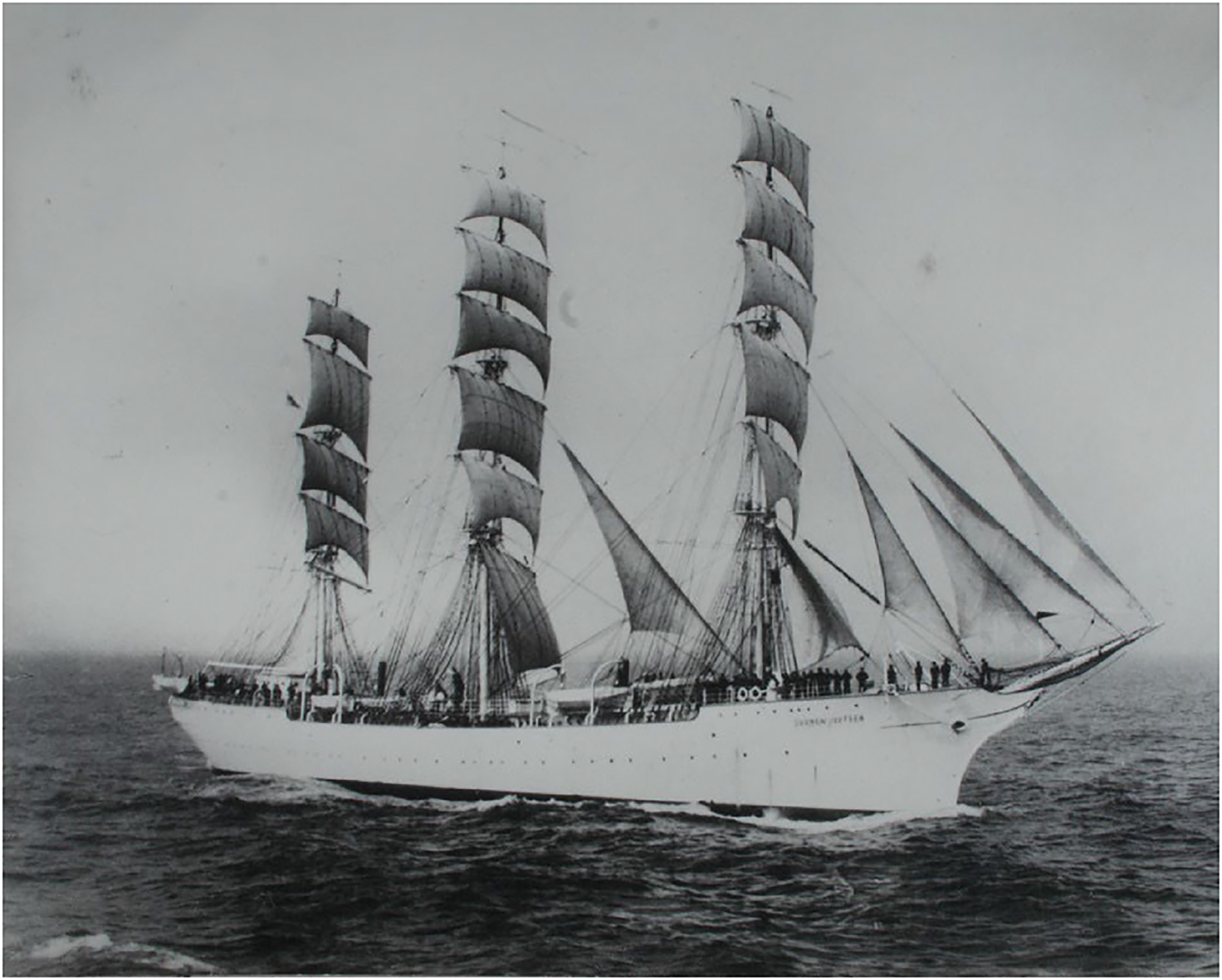
The Suomen Joutsen during the navigation across the Ocean (by courtesy of the Forum Marinum Maritime Museum, Turku).
However, the name of the ship did not only refer to its appearance, but was based on an ancient historical source – that is, the wartime experience of the Swedish sailing ship Finska Svan, which was built in Turku/Åbo by the master Jacob Henriksson and had fought in the 1500s during the so-called Northern Seven Years’ War (1563–1570). 28
The ship started out as a training ship for cadets of the Finnish Navy, in order to guarantee sufficient naval military training on different seas. The use of sailing ships for training was normal in all the marines in the world, 29 and in the specific case of the Suomen Joutsen, the missions were carried out at prearranged periods: ‘the ship left Finland towards the end of the year and returned in the latter part of May, after the ice had disappeared from the Baltic Sea’. 30
Alongside a military tradition, the choice of a sailing ship, though equipped with two supporting Skandia engines, not only seemed logical from a training point of view, but also followed Finland's old maritime traditions. 31 However, it also attested to the difficulties of obtaining more modern tonnage in the aftermath of World War I. 32 From a maritime point of view, Finland, like the other Nordic nations, had a considerable maritime sector, which had its golden age in the late nineteenth century due to low local labour costs and the global demand for shipping capacity.
The Finnish maritime sector was indeed a positive legacy for independent Finland since it had brought huge benefits in the modernization process of the region thanks to the experience of Finnish shipowners. These shipowners had knowledge of how to weave important commercial networks between Finland, by then part of Russia, and the world. Moreover, three schools for the education of shipmasters had been in operation since 1812. These schools provided training not only in navigation but also in correspondence in English and accounting, and guaranteed an excellent education for the captains of the Finnish merchant fleet. 33 It was not by chance that the captains of the Suomen Joutsen, Arvo Alfred Lieto (1891–1973) and, especially, John William Konkola (1886–1955), had been trained in the merchant marine.
The international missions of the Suomen Joutsen and the image of independent Finland
Between 1931 and 1939, the Suomen Joutsen carried out eight international missions, with two aims: (1) to train its crews on different seas and (2) to visit nations that no official Finnish ships had visited, thereby strengthening political and commercial relations with them. They were mainly Atlantic cruises lasting many months, which were concentrated, in particular, on the Americas and Africa. Only on two occasions did the missions involve the Mediterranean. The missions were as follows:
22 December 1931–22 May 1932: Finland – Denmark – Faroe Islands – England – Canary Islands – Azores – Spain – Finland.
20 October 1932–3 June 1933: Finland – Canary Islands – Brazil – Uruguay – Argentina – United States Virgin Islands – Azores – Finland.
1 November 1933–15 May 1934: Finland – France – Egypt – Italy – Canary Islands – Haiti – Portugal – Finland.
31 October 1934–3 May 1935 (exhibition on board): Finland – Spain – Greece – Lebanon – Israel – Egypt – Morocco – Azores – England – Finland.
9 October 1935–2 July 1936 (exhibition on board): Finland – Portugal – Venezuela – Colombia – Panama – Peru – Chile – Argentina – Brazil – Finland.
2 November 1936–1 May 1937 (exhibition on board): Finland – Portugal – Senegal – Dominican Republic – Mexico – Cuba – United States – Norway – Finland.
10 October 1937–12 May 1938: Finland – Madeira – Uruguay – South Africa – France – Finland.
27 October 1938–23 April 1939: Finland – France – Morocco – Brazil – Puerto Rico – Azores – Netherlands – Finland.
As already mentioned, the periods in which the journeys were organized coincided with the ice season on the Baltic Sea. The destinations were decided on by the Finnish Navy in agreement with the officials of the school ship. However, in the cases of the missions with the floating exhibition on board, the itinerary was agreed with the Suomen Vientiyhdistys (Finnish Export Association), and it followed the indications of the consular network for the development of foreign commerce. 34 From a conceptual point of view, in a time of peace, as has been illustrated by Jerker Widen, this type of mission or voyage (‘fly the flag’) was to show the presence of a given nation in international waters, thereby, with the use of the press, carrying out a role of indirect influence on the minds and perceptions of the policymakers of the powers visited and their citizens. 35
Beyond the now classical theories on sea power of Alfred Thayer Mahan and Julian Stafford Corbett
36
and their imperialistic and generally hostile applications represented by gunboat diplomacy,
37
historiography has introduced new and more subitle and suitable meanings to the concept of naval diplomacy that surpasses the borders between diplomacy and Navy.
38
It is clear that naval forces can be useful not only for defence, but that they also have a symbolic, supportive and coercive value. Warships and navies are symbols of national sovereignty and power, using the sea as a means of transportation. When cruising the seas and oceans of the globe, they are not only ships but also political entities and floating ambassadors.
39
Captain Konkola was assigned special authority to get in contact with all the Finnish merchant ships anchored in the ports of destination in order to allow the captains of these ships to visit the Suomen Joutsen, and even to help and employ Finnish citizens in economic distress for possible temporary work. Moreover, already in 1931, it was customary that if there was no Finnish consul representation in the port visited, the Ministry of Foreign Affairs saw to organizing a welcoming reception for the consuls of other Scandinavian or Baltic states. Another example is taken for granted in the guidelines for the sixth journey in 1936–1937, in which it was pointed out that the aim of the new mission was to encourage commercial relations and knowledge of Finland abroad. 42 The visits to international ports thus followed the typical customs of the naval diplomacy of the time. Captain Konkola and the official corps welcomed aboard the most important political, diplomatic, commercial and military people of the cities and countries visited, as shown in the ship's guestbook. 43
The list of people to be invited on board the Suomen Joutsen was compiled at the discretion of the Finnish consul or the plenipotential minister in the mooring area. There were no specific indications found, regarding this, by the Finnish Minister for Foreign Affairs, but different lists were kept of people invited to the various places. 44 In the majority of cases, the most prominent people of the town were invited, as well as representatives of political authorities and sometimes the ministers of the countries visited, the diplomatic corps and high-ranking public officials of the military navies, as well as the ships in the ports; then, if there were Finnish emigrants present, they were invited too. In the three missions between 1934 and 1937, with the exhibition on board of products from the Finnish Export Association, more invitations were sent to foreign commercial authorities and representatives interested in imports and exports with Finland. Finally, the authorities of the port, police officers and customs officials were also invited on board.
Nevertheless, some of the Finnish exhibitors thought that the large and varied public invited onto the ship did not have direct commercial interests, and that the aim of the floating exhibition on the Suomen Joutsen was, after all, to promote the products on display. The commercial and contractual part was then carried out by the commercial agents in the countries visited and not on board the ship. 45 Hence, in the years 1934 to 1937, the Suomen Joutsen also maintained its military-ship characteristics, representing Finland abroad and balancing as much as possible diplomatic political invitations with others of a more commercial nature.
During the periods spent in the ports, parties, special events, receptions and lunches were organized aboard, with the purpose of striking up friendly relationships with Finland. Similarly, with the help of the consular authorities, the officers and crew were involved in events organized in honour of the Finnish guests, such as concerts, official dinners, tributes to war memorials and courtesy exchanges with other crews docked in the port. There was a band on the school ship and a football team was organized to play matches against local teams.
Captain Konkola and the diplomatic representatives took care of relations with the local press – a great means of promoting the country abroad. This favoured the publication of detailed presentation articles about Finland and the promotion of Finnish industry. The development of active policies of cultural diplomacy by means of the press had an impact as a ‘soft power’, informing a wide and general public about Finland. On a theoretical level, the cultural strategy applied by Finland is noticeable in the missions of the Suomen Joutsen: the articles published in the newspapers of the nations visited by the ship were part of this line of action, organized by the Finnish consular network, with paid contents supplied for publication.
46
As an example, here is a short extract from one of the presentations of Finland in the Senegalese press, entitled ʻQue savez vous de la Finlande?’ (‘What do you know about Finland?’): Probably very little or none at all. Most of us know that it is a country in Europe, located in the far North, near the Arctic Circle. We imagine that the Finns live in primitive tents, in a steppe landscape, feeding on reindeer meat and wearing ferocious animal skins. These representations are very common but totally false.
47
Over the last 70 years, Finland has become a remarkable industrial country whose products, especially wood and its derivatives, are sold in all parts of the globe. Nowadays, Finland is on the international market and it is the largest supplier of newsprint paper except for Canada... Finland has also a remarkable transatlantic export of other products, such as crystal and porcelain, skimmers, matches, and others.
48
Captain Konkola and his crew actively took part in this cultural strategy, sometimes giving interviews to the invited journalists or speaking on the radio. All of the people involved in Finnish cultural diplomacy abroad – in addition to the members of the Soumen Joutsen – actively favoured spreading a positive representation of the young Finnish nation to the world. Thus, knowledge of Finland at a global level was guaranteed, which otherwise would have occurred only with great difficulty – but with a huge cost for the northern state.
The Suomen Joutsen and the Finnish community abroad
Another aspect that should be considered is contact with Finnish communities abroad. Finland experienced a period of high emigration between 1860 and 1930, when approximately half a million Finns emigrated. The so-called ‘great emigration’ had left by sea towards the Americas. The majority of the Finnish emigrants disembarked in the United States (about 300,000) and Canada (about 60,000). 49 In the countries with important communities of Finnish emigrants, the missions of the Suomen Joutsen were opportunities for striking up contacts with these local groups. This happened particularly on the sixth voyage of 1936–1937, which took the ship to the United States. However, contact with the consular networks and small Finnish communities abroad was just as fruitful on the other journeys because it brought those communities closer to their home country though with minimum effect.
Among the destinations reached by the ship on its voyages, the visit to New York from 3–9 March 1937 was unique due to the characteristics of the American background, with respect to other destinations, precisely because of the active involvement of the Finnish Americans. 50 What has been conjectured by Clerc and Glover 9 with the concept of the representation of a nation in foreign contexts can be found in the New York stopover during the sixth journey of the school ship. The symbolic universe of the Suomen Joutsen was realized to its greatest potential with the practices of naval diplomacy, the promotion of Finnish products, the exhibition on board the ship and, above all, the involvement of the Finnish communities of America, since they could visit the ship and take part in the festivities. The use of pictures, text and radio interviews guaranteed that a much wider public could be reached, and news of the arrival of the ship extended to all of the American territory.
As claimed by Anderson, the importance of the use of newspapers in building ‘imagined communities’ is crucial in modern societies. 51 This cultural concept of identifying oneself with the nation through print capitalism is confirmed in pieces in the New York Times. 52 There were other articles in the tri-weekly newspaper of Michigan, Amerikan Suometar, 53 and the New York Herald Tribune, 54 which were full of photographs of the ship and crew, as well as detailed descriptions of the events. All of this contributed to bringing Finland into the spotlight of one of the greatest world powers, and also to bringing the Amerikansuomalaiset to a motherland that people could be proud of. And all of this happened thanks to a visit by a ship – the Suomen Joutsen.
The ship arrived in New York Harbor on 3 March 1937 in the presence of American naval authorities and the Finnish vice-consul, Kuusamo (Figure 2). According to the press, it was the first docking of a Finnish ship in the United States. 55 Captain Konkola said he was proud of this honour and, being astute about diplomacy, affirmed that he and his crew were happy to dock ‘in the world's finest harbour’. 56 On 4 March, Captain Konkola was greeted by the mayor of New York, Fiorello Henry La Guardia, who visited the ship, which was docked in the quay of the Hudson River. In his official speech, delivered at the New York Town Hall, La Guardia said: ‘I am very happy to welcome you. We consider the Finnish people most progressive. It was from your early experience with prohibition that we learned a lot along the same line’. 57 Afterwards, Captain Konkola visited Admiral Harris Laning and was greeted by a cannon salute by the school ship Seattle.
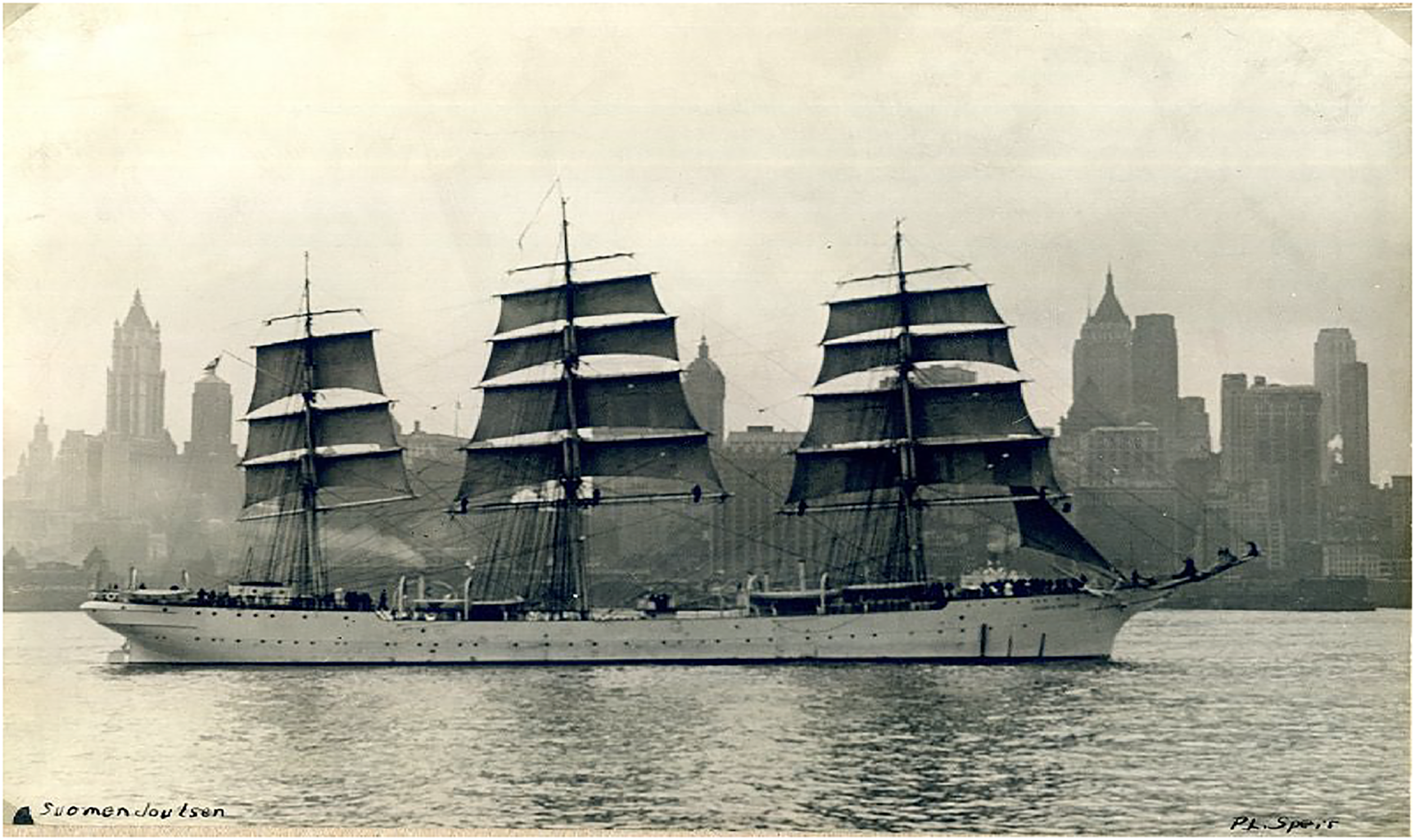
The Suomen Joutsen in New York, 1937 (by courtesy of the Forum Marinum Maritime Museum, Turku).
The main festivities for the visit, besides the official receptions, were in the presence of the Finnish people in the United States. The Finnish community in New York did all that it could to ensure that the ship received the best welcome, and organized different events for the crew, with welcome speeches and guided tours of the city.
58
It is meaningful to mention that many of the sailors on the Suomen Joutsen had relatives in New York. Lieutenant Tamminen wrote that visiting the metropolis with its lively Finnish community was like being at home.
59
The visit to the Finnish quarter of the city (Finntown) was an occasion for patriotic speeches. The participation of the officers and crew in the events organized by the Finnish societies and organizations in New York was particularly significant in terms of national pride. The visit was very important for Finnish Americans: While some of the 184 officers and crew of the Finnish naval training frigate Suomen Joutsen spent the day sightseeing here yesterday, or paying official or personal calls, a crowd estimated at between 5,000 and 10,000 persons visited the ship, which is docked at the foot of Thirty-fifth Street in the North River. At 5 o’clock, while several hundred persons still were outside the pier gate, officers passed the word that no more visitors were to be allowed on the ship, and a crush followed which necessitating the calling of radio police and an emergency squad.
60
The floating exhibition on the Suomen Joutsen, 1934–1937
One of the most interesting aspects of the naval diplomacy of the Suomen Joutsen was the floating exhibition of Finnish products. The very first trips showed, indeed, that there was great interest in the Finnish training ship and its home country in the ports visited. For this reason, in the mid 1930s, the Finnish Export Association planned a campaign to market Finnish export products in the Mediterranean area. 63 Negotiations with the Finnish Ministry of Foreign Affairs and the Finnish Navy resulted in the installation of an exhibition on the Suomen Joutsen, which was due to leave on a training voyage.
Alongside the direct commercial promotion of the products, typical strategies of the cultural diplomacy of the period were used to present the different characteristics of Finland, highlighting its uncontaminated nature and history and, subsequently, promoting internal production. The use of cultural diplomacy to encourage exports, already outlined by Siikala and, later, by Clerc in their studies,
64
was effective also in the case of the Suomen Joutsen. Although the objective was shared, it should be stressed that the Finnish Export Association favoured the expansion of commerce to new markets in using the floating exhibition. The Finnish government's aim, instead, was to maximize the use of the ship for the promotion of Finland abroad, presenting the northern nation in the variety of its national production, and also in tourism and cultural terms: But the Finnish industry is, on the other hand, striving to increase the diversity of goods it can sell abroad and to seek new markets throughout the world for domestic industry products. The paper industry sells products all over the world.
65
The Suomen Joutsen had an export exhibition on three ocean voyages during the years 1934–1937. Forty exhibitors took part in the first trip, 43 in the second and 21 in the third. In total, 62 Finnish companies were represented on the Suomen Joutsen's three exhibition trips. 68 The exhibition was located in the crew's quarters and had two goals: (1) to find markets for Finnish export products and (2) to make Finland known around the world. As reported by the Finnish Trade Review: ʻthe goods exhibited were not for sale, nor were orders accepted on board. The intention was to introduce the goods to importers and agents for future measures between the interested parties'. 69 For this reason, the Finnish Ministry of Foreign Affairs had given clear guidelines to support the requests of the Finnish Export Association but recommended that any activity that involved the use of state funds was to be avoided. 70 The Ministry played a vital role in arranging the exhibitions. Local consuls saw to it that invitations were sent to businessmen who were interested in Finland, and supplied the press with photographs (Figure 3) and text well in advance of the ship's arrival.
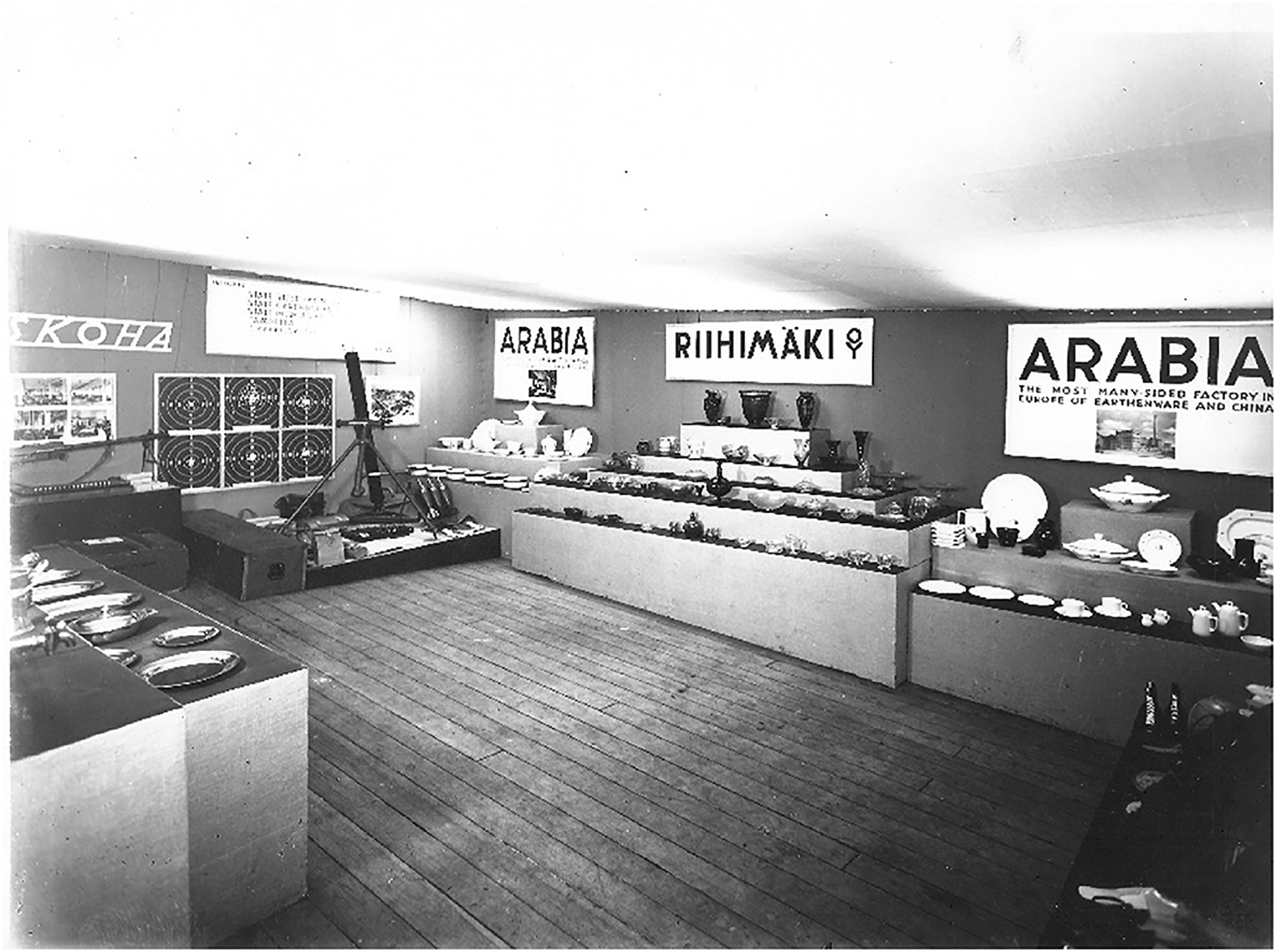
The floating exhibition on board the Suomen Joutsen (by courtesy of the Forum Marinum Maritime Museum, Turku).
The first exhibition voyage, which was the ship's fourth long-distance voyage, went to the Levant area.
71
It opened in Piraeus, Greece, and then proceeded to Lebanon, British Palestine, Egypt, Morocco and the Portuguese Azores. The last ports were added during the voyage as the popularity of the exhibition exceeded expectations. With respect to these missions, the main aim became to guarantee sufficient visibility for the products of Finnish industry and to promote commercial relationships with the countries visited. An example from the archives of the Finnish Ministry of Foreign Affairs traces the brief visit of the ship to Palestine during the first days of 1935: The usual official visits were exchanged and I wish to mention the courtesy and friendly feeling extended by the Commander and his officers to the persons they met while in Haifa port, which was very highly appreciated. Many visitors attended the Exhibition, which was excellently arranged, and I hope that later results will prove themselves, in the endeavour to promote the import into Palestine of Finnish products.
72
Two or three days before the arrival of the ship, the Finnish consul, Langdon Rees, organized the publishing of ‘a small article describing the ship, and the Exhibition on board appeared in the leading British, French, Italian, Greek and Arabic newspapers of Cairo and Alexandria’ with the aim to ‘awaken the interest of the public in the ship and the Exhibition’.
73
On the evening of its arrival, a welcome dinner was organized for Captain Konkola and three senior officers of the Finnish ship in the presence of the governor of Alexandria, the president of the Egyptian Chamber of Commerce, the general director of the ports and lighthouses, the commander of the Alexandria city police and many others. On the morning of the following day, the guests were welcomed on board the Suomen Joutsen in the presence of the captains of the ships and yachts that were present in the Egyptian port. The careful presentation of the events was aimed at guaranteeing a select and sensitive public, focused on imports: At 4.30 p.m. on the 23rd inst. [Instant], the official opening of the Exhibition took place. The list of persons invited to this is attached herewith. The guests were welcomed by Commander Konkola in a short speech and were then shewn round the Exhibition, in which they appeared to take the liveliest interest. On the 24th inst., at 10 a.m., the Exhibition was opened to the general public and throughout the 24th and 25th inst., the two days that the Exhibition was opened, over four hundred persons attended the Exhibition. Further articles appeared in the newspapers on the 24th inst., describing the official opening of the Exhibition and further details of the Exhibition.
74
Many of these opinions with regard to the local consul relations were emphatic and self-celebratory, aimed at valorizing the hard work put into the preparation for the events by the diplomatic network, but the documents in the archives testify unmistakably to the tens of daily newspapers that were interested in the promoted articles. Langdon Rees declared that he was sure that there would be ‘a considerable increase in the trade between Finland and this Country’. 76 The wish of the consul evaluated with trust the impact that the Suomen Joutsen could have on commercial exchanges with Egypt.
It is difficult to establish if the increase in Finnish exports to the East in the following months was due to the presence of the school ship. The Finnish Export Association, at the end of the journey of the Suomen Joutsen, said that the results of the floating exhibition in the East were so interesting that it had been decided to organize a second floating exhibition in the countries of South America. 77 The second exhibition voyage, complying with the wishes of the Finnish Export Association, went to Portugal and South America (Venezuela, Colombia, Panama, Chile, Argentina and Brazil), and similar success was observed in the ports visited there. 78 Finally, the third and last exhibition, on the ship's sixth voyage, opened in French West Africa then continued to the Dominican Republic, Mexico and Cuba. The reasons that led to the failed embarking of the floating exhibition on the seventh journey of the Suomen Joutsen were really of a strategic nature. The Finnish Export Association evaluated that the markets of the southern Atlantic could be of less interest from a linguistic as well as a commercial point of view because they could be fragmentary. 79
The floating exhibition was not even brought aboard during the eighth journey. It is hypothesized that the reasons for this were due to the transformation of the Finnish Export Association, the private organizer of the floating exhibition, into Suomen Ulkomaankauppaliitto (now Finpro Oy), an organization belonging to the Finnish state aimed at promoting exports, investments and tourism. For this reason, and also because of increasing logistic difficulties and the limited space that a training ship could guarantee for such types of events, it is conceivable that, since 1938, the ways of promoting Finnish industrial products have developed along other channels with respect to the Soumen Joutsen. 80 The outbreak of the Winter War (1939–1940) permanently interrupted the training missions of the school ship and, with them, commercial promotional activities.
The role of the floating exhibition aboard the Suomen Joutsen was another means of representation for the Finnish nation. In addition to the real increase in Finnish foreign commerce in the nations visited, there was tangible interest aroused in those markets and among the local political, commercial and diplomatic authorities with the passing of the school ship. During the three years of the floating exhibition, the Suomen Joutsen played the role of an ambassador for Finland in every sense, presenting not only a naval and maritime tradition but also, above all, an expanding economy.
Conclusion
In this article, an attempt has been made to show that the diplomatic and cultural success of the Finnish school ship Suomen Joutsen in its international missions from 1931–1939 attests to the importance of the identity-making role of the maritime factor in promoting the international image of a nation. The concept of ‘representation’, as used by Clerc and Glover, would seem to be appropriate to describe, according to new interdisciplinary approaches, the case of the Suomen Joutsen in its role as an ambassador for Finland in the world.
The Suomen Joutsen, alongside its main aim of training, firstly played a symbolic and identity role as an heir to the Finnish sailing tradition. The aesthetic beauty of the structure with the romantic memory of the great nineteenth-century sailing ships attracted visitors, fascinated by the shapes of the white sailing ship.
The use of classic rituals of naval diplomacy contributed to strengthening the ties of friendship between Finland and the nations visited. This was thanks to the preparations and promotion work done by the Finnish consular network, together with the dedication and the discipline of Captain Konkola and his crew. The contacts with the emigrant communities, mainly in the United States, were useful to reinforce a sense of belonging to, and patriotism for, Finland, and to strengthen participation in the ‘imagined community’ they felt they belonged to.
What made the case of the Suomen Joutsen unique was the variety of institutions and people involved in the missions, alongside the instruments and different approaches used. What Clerc, Glover and Siikala theorize is confirmed in the use of cultural diplomacy and ‘soft power’, with strategies of communication and narratives focused on the promotion of Finland in the press, as well as on the school ship itself. It was a clear national marketing project that had nothing spontaneous about it, since it was backed by texts and images that were supplied, and sometimes paid for, by the Finnish consular networks. The use of the press and, sometimes, radio also contributed to increasing the visibility of the mission far from the destination ports and, in particular, it was able to create an international picture of Finland, presenting it in all of its many physical, political and economic characteristics in the press and journals of the nations visited, and reaching a wide and heterogeneous linguistic and cultural public.
The idea of having a floating exhibition on board the Suomen Joutsen between 1934 and 1937, in order to establish long-term contacts with the main commercial counterparties – particularly in less important and more distant markets – was certainly a stimulus for overseas business. It is currently not possible to confirm with any scientific evidence that the floating exhibition was important in the considerable developments in foreign trade in the 1930s. However,it contributed to making the variety of the Finnish industrial production known to the main economic and political counterparts of the nations visited, maximizing the objectives of the missions.
The floating exhibition, though not directly promoting sales, was regarded by the Finnish government as a tool of cultural diplomacy and ‘nation branding’. The Finnish Export Association, which financed the exhibition, saw it as a space to promote and establish contacts, and subsequently formalize the visits to the ship through commercial agents.
In conclusion, the wise choice to use various strategies of ‘representation’ together with the ‘small-state toolkit’ was at the basis of the international success of the Suomen Joutsen, of Finland itself and of its international projection. With the missions of the Soumen Joutsen in the 1930s, this small outlying Nordic country rose to a global dimension, well before the outbreak of the Winter War in 1939. Of particular interest in maritime terms is the transformation of the Suomen Joutsen from a sailing symbol of Finland in the 1930s to a minesweeper and then, finally, to a national monument and floating museum in Turku – a splendid representative of the centuries-old sailing tradition of the country.
Footnotes
Declaration of conflicting interests
The author declared no potential conflicts of interest with respect to the research, authorship and/or publication of this article.
Funding
The author received no financial support for the research, authorship and/or publication of this article.
