







Abstract
The Russo-Japanese War was the first international war that Taiwan experienced after becoming a Japanese colony. However, its impact on the colony has received relatively little attention. In particular, from a microeconomic perspective, how did Japan's wartime special taxation policies, the requisitioning of commercial ships for military use, and the overall economic climate affect individual traders and firms? How did these merchants respond and make decisions under such circumstances? This study examines the impact of the Russo-Japanese War on rice exports by using the commercial correspondence of the Chen Yuanshun Firm (陳源順號), which was based in Dadaocheng (大稻埕), Taipei, from 1904 to 1906, as a primary historical source. It analyses the firm's responses to wartime taxation, shipping disruptions and insurance mechanisms. In 1899, the Chen Yuanshun Firm became one of the first companies to engage in direct trade with Japan, acting through the Nagasaki Chinese merchant Chen Ruichun (陳瑞樁) and his son. With the advent of war, it faced various temporary policies and challenges. By analysing its adaptations, this article sheds light on the business resilience of Taiwanese merchants during the war.
It finds that the Chen Yuanshun Firm actively capitalized on the surge in export trade between Taiwan and Japan, facilitated by the policies of the Japanese Empire and the colonial government. The rising demand for rice led to price increases, while additional taxes and tariff protections further incentivized rice exports from Taiwan to Japan. As a result, the firm's business flourished amid the wartime economic conditions. The Chen Yuanshun Firm seized this business opportunity and quickly rose to become a major rice merchant in Taipei. However, to transport large quantities of rice to Japan, it had to navigate the challenges posed by wartime chaos in shipping and issues related to insurance.
Introduction
As is widely known, the Russo-Japanese War erupted as a struggle between the Japanese Empire and the Russian Empire for dominance over Korea and Manchuria (滿洲). 1 For colonial Taiwan, it was the first international war since Japan's acquisition of the island in 1895. However, the impact of the Russo-Japanese War on the colony has received little scholarly attention.
To cover the enormous military expenditures of the Russo-Japanese War, the Japanese government significantly increased taxes. In February and April 1904, two rounds of the Emergency Special Tax Law (Hijō Tokubetsu Zeihō, 非常特別稅法) were enacted, doubling the rates of land, business and income taxes. After the war, since Japan did not receive reparations from the defeated Russian Empire, as much as 70 per cent of these wartime tax increases were made permanent. 2 The wartime tax-increase policies of the Japanese Empire and their lasting impact on colonial Taiwan, particularly on commercial trade operations, constitute a critical issue that is worthy of serious examination.
As early as the nineteenth century, amid the wave of globalization, sugar from southern Taiwan was already being directly exported to Japan, while Japanese goods such as seafood, cotton textiles and matches were imported into Taiwan in large quantities. However, this trade was primarily conducted through indirect trans-shipment via third countries or regions. After Japan established colonial rule over Taiwan in June 1895, Taiwan's long-standing domestic trade with China was reclassified as foreign trade. Meanwhile, under Japanese policy, direct trade between Taiwan and the colonial metropole gradually increased. From 1897 onwards, Taiwan's rice exports also shifted from the Chinese market to direct shipments to Japan. Notably, in 1899, the colonial government imposed tariffs, prompting rice merchants in Taipei to take the lead among Taiwanese merchants in expanding direct trade with Japan. 3
Previous studies have already pointed out that, by 1903, the volume of Taiwanese rice exported to Japan had surpassed that exported to China. During the Russo-Japanese War, in order to reduce the financial burden on the Japanese government caused by large-scale rice imports, the demand for Taiwanese rice to be mixed with Japanese rice increased significantly. In response, the Taiwan Governor-General's Office (臺灣總督府) also actively encouraged the expansion of Taiwan rice exports to Japan. 4 How did this new situation impact Taipei's rice-exporting trade firms?
Past studies on the Russo-Japanese War have mostly analysed it from the perspectives of East Asian or global military and political history, 5 rarely focusing on its economic aspects and paying even less attention to its impact on the colonies. To date, the only work analysing Taiwan's economic dynamics before and after the war is by Huang Shaw-Herng (黃紹恆), who examines changes in sugar industry investments to illustrate the capital movements of the Taiwanese landlord class. 6 However, the traders who dominated Taiwan's economy were likely the most affected by the war. Despite numerous studies on the Nagasaki Taiyi Firm (長崎泰益號) and Taiwan's trade, 7 very few have examined the impact of the Russo-Japanese War on East Asian traders or Taiwanese merchants. This study aims to examine the impact of the war on trading firms from an individual economic perspective. To do so, it uses the correspondence of the Chen Yuanshun Firm found in the Nagasaki Taiyi Firm’s documents as its core historical source. 8
The Chen Yuanshun Firm in Dadaocheng (大稻埕), originally known as Lao Yuanshun Firm (老源順號), 9 was the most prominent trading firm in Taipei that dealt with the Nagasaki Taiyi Firm; it served as a principal intermediary within Taiyi's trading networks in Taipei and Keelung. 10 Established as a seafood wholesale business by Chen Yuanpu (陳源普) no later than 1880, the firm had a capital of 3,000 yen in 1898 and primarily traded with Hong Kong. 11 The manager (jiazhang, 家長, literally ‘family head’) of the Lao Yuanshun Firm was Chen Tiansong (陳天送). In January 1899, following the December implementation of the Taiwan Governor-General's tariff policies, Lao Yuanshun Firm began trading with the Nagasaki Taichang Firm's (泰錩號) Chen Ruichun (陳瑞椿)and his son Chen Shiwang (陳世望). After Chen and his son established the Taiyi Firm in November 1901, they shifted their business to this new firm, mainly exporting rice from northern Taiwan and importing Japanese seafood. 12 Between 1902 and 1905, the Lao Yuanshun Firm was the largest exporter of rice in Taipei to Taiyi Firm in Nagasaki. 13
During the Russo-Japanese War, Chen Tiansong changed his name to Chen Xilin (陳錫麟). Chu Te-lan (朱德蘭) has noted that this renaming was an attempt to evade excessive business taxes, 14 but the issue has not been explored in depth. Additionally, while Chen Tiansong sent only 36 letters to Taiyi between 1901 and 1903, this number surged to 140 between 1904 and 1906, indicating a significant shift in the relationship between Chen Yuanshun Firm and Taiyi Firm. 15 Why did this change occur? How did these two firms respond to the temporary policies and conditions brought about by the Russo-Japanese War? Amid wartime disruptions in shipping and increased risks, how did these two firms manage to export rice to Japan? These are the key questions that this study seeks to explore.
In short, this study centres on the Chen Yuanshun Firm correspondence found within the Nagasaki Taiyi Firm’s archives, 16 focusing on the period from 1904, when the war began, to 1906, a year after the war ended. It examines the impact of the Russo-Japanese War on Taipei's rice exporters from an individual economic perspective, exploring how merchants made decisions and adapted to challenges. The analysis will be structured around three key aspects: rice exports, the impact on shipping, and decision-making about insurance.
The surge in Taipei rice exports to Japan in wartime and policy changes
As mentioned earlier, in response to the enormous military expenses of the Russo-Japanese War, the Japanese Empire implemented a tax increase policy, enacting the Emergency Special Tax Law in 1904, which remained in effect until its repeal by Law No. 13 in 1914. 17 Initially, the Taiwan Governor-General's Office believed that Taiwan, unlike mainland Japan, did not require additional taxation. 18 However, to prevent tax evasion, Taiwan began levying new taxes in March 1904, including a sugar consumption tax, import duties, and consumption taxes on woollen fabrics and petroleum. 19 On 31 December, the Emergency Special Tax Law was amended to introduce additional taxes, such as land tax, import duties, stamp tax, business tax and income tax. The implementation timelines varied depending on the specific tax category. 20
It is evident that although colonial Taiwan implemented the Emergency Special Tax Law later than mainland Japan, it still faced taxes increases. Among these, the two taxes that had the most significant impact on Dadaocheng traders specializing in rice exports was the newly introduced 15 per cent business tax and the 15 per cent ad valorem tax on rice subject to import duties. 21 The imposition of the rice import tax made Taiwanese rice more competitive in the Japanese market than imported foreign rice.
In fact, prior to 1902, Taiwan's rice exports largely followed the path established during the Qing period, with China remaining the primary destination. It was not until 1903 that the quantity of Taiwanese rice shipped to Japan exceeded that exported to China. 22 The outbreak of the Russo-Japanese War once again created new opportunities for Taiwanese rice exports to Japan. In February 1904, as Japan severed diplomatic ties with Russia, the demand for military provisions surged in the war zones, leading to a sharp rise in Japanese rice prices. Consequently, large quantities of Taiwanese rice were exported to Manchuria and shipped to Japan. 23 Rice imports from foreign countries declined due to wartime special taxation policies. In 1905, Japan experienced a poor domestic rice harvest, causing rice prices to skyrocket and increasing the demand for imports. As a result of the wartime special tax imposed on foreign rice, colonial Taiwan's rice became more competitive in price and was continuously exported to Japan in large quantities. 24 Its share of total rice exports rose significantly, reaching 88 per cent, and remained above 95 per cent after 1906. 25 During the Russo-Japanese War, Taiwan's rice exports thus surged due to high military demand, poor rice harvests in Japan and increased taxation on foreign rice.
However, the quality of Taiwanese rice varied significantly. 26 Taiwanese rice merchants paid little attention to the milling quality, leading to discrepancies in the rice exported from Taiwan. Japanese merchants tended to export higher-quality rice, while Taiwanese merchants exported lower-grade rice that was often not fully dried or hulled, resulting in a coarser product. To regulate and improve the quality of exported rice, the colonial government implemented the Rice Export Inspection System on 1 September 1904, 27 establishing inspection offices in Taipei and Keelung ports. 28 Within a week, this measure prompted Taiwanese merchants to focus on enhancing the milling quality. Chen Tiansong was the first to submit his rice for inspection. The Haishankou rice exported by the Lao Yuanshun Firm was found to be of unprecedented quality, with both the milling and overall standards meeting the highest grade. 29
The implementation of the Rice Export Inspection System enhanced the reputation of Taiwanese rice in the Japanese market, increasing its profitability and, in turn, boosting the competitiveness of Taiwanese rice merchants. 30 Before 1903, many Japanese merchants were involved in the export of Taiwanese rice. However, after September 1904, only Mitsui Bussan & Co. (三井物產) and the Miyafuji Firm (宮副商會) remained in the trade, while Chen Tiansong quickly rose to prominence as a key rice exporter in Dadaocheng. 31 With the colonial government's certification and promotion of inspected rice, Chen Tiansong's reputation soared. This likely gained him greater recognition from the Taiyi Firm in Nagasaki, enabling the two parties to transition from acting as independent trade agents to forming a direct partnership.
Due to the wartime surge in Taiwanese rice exports, the Lao Yuanshun Firm significantly expanded its trade volume and increased its revenue. 32 As shown in Table 1, between 1904 and 1906, the seafood-wholesaler Lao Yuanshun Firm was ranked sixth among Taipei's rice exporters to Japan and fourth among Taiwanese merchants overall. By 1905, the owner Chen Yuanpu's assets had reached 80,000 yen, 33 a staggering 27-fold increase compared to the 1898 survey. However, alongside this rapid wealth accumulation, Lao Yuanshun Firm had to adapt to changes brought about by the wartime special taxation laws, which imposed higher business taxes. This necessitated strategic adjustments in its operations.
Rice exported from Dadaocheng, Taipei, to Japan, 1904–1906 (unit:jin).
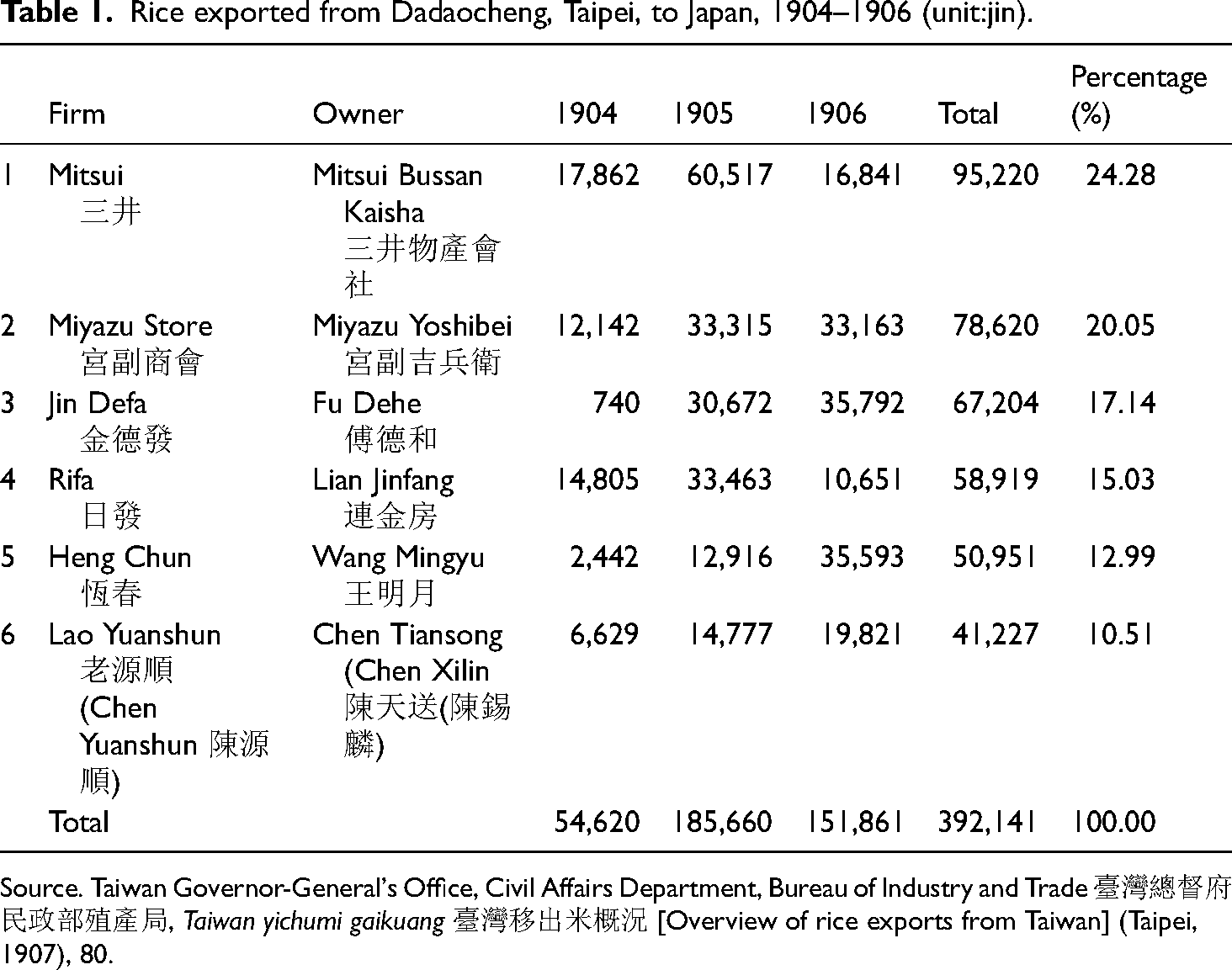
Source. Taiwan Governor-General's Office, Civil Affairs Department, Bureau of Industry and Trade 臺灣總督府民政部殖產局, Taiwan yichumi gaikuang 臺灣移出米概況 [Overview of rice exports from Taiwan] (Taipei, 1907), 80.
In January 1905, Taiwan imposed a business tax increase of up to 15 per cent. In November and December, Chen Tiansong of the Lao Yuanshun Firm wrote to the Taiyi Firm, specifically emphasizing the following points in his letters: From this point onward, please address all correspondence and transaction documents to Chen Xilin at the Chen Yuanshun Firm. Due to the excessively heavy business tax imposed by the government, we have decided to change the business name accordingly. Our firm ‘Lao Yuanshun’ has been renamed ‘Chen Yuanshun’, and my name Tiansong has been changed to Xilin. This change was made due to the excessive burden of business taxation. After careful consideration, we found no alternative but to make this adjustment in hopes of reducing the business tax.
34
Evidently, the tax increase prompted businesses to quickly seek ways to reduce or avoid these fees, including changing the names of their business and agents. 35 Consequently, they requested that Taiyi Firm update the names on all future correspondence and envelopes accordingly.
During the Russo-Japanese War, Japan implemented extraordinary special tax laws to address wartime military expenditures, which inadvertently accelerated the development of direct trade between Taiwan and Japan. Due to the war, rice prices surged and demand increased significantly. By strategically utilizing the colonial government's rice inspection system for exports, the Chen Yuanshun Firm in Dadaocheng transformed from a seafood wholesaler into a major rice exporter specializing in shipments to Japan. However, to evade the 15 per cent increase in business tax, the original Yuanshun Firm and Chen Tiansong had to change their names to the Chen Yuanshun Firm and Chen Xilin, respectively.
Shipping impact and rice export chaos
The impact of war on transportation, particularly communications and shipping, is typically the most immediate. During the Russo-Japanese War, businesses such as Chen Yuanshun Firm in Dadaocheng and Taiyi Firm in Nagasaki were significantly affected due to the conflicts taking place in China and the ripple effects of the Battle of the Yellow Sea, which caused major disruptions in shipping. How did this impact the shipping routes between Taipei and Nagasaki? What challenges did Taipei's rice merchants, who needed to transport large quantities of rice to Japan, face? How did they respond or make decisions? These are the key questions discussed in this section.
Since the opening of Taiwan's ports in the late Qing dynasty, the island's maritime shipping had been dominated by companies operated by British and German merchants. The British firm Douglas Lapraik & Co. in Hong Kong nearly monopolized the South China shipping routes. In the early years of Japanese rule, Douglas Lapraik & Co. operated three steamships, while the German company Reuter, Brockelmann & Co. had one steamship, serving routes between Hong Kong, Xiamen and Tamsui. 36
Facing the monopoly of foreign merchants over Taiwan's shipping industry, the Taiwan Governor-General's Office in 1896 subsidized the shipping company Ōsaka Shōsen Kaisha (大阪商船会社, OSK) in the amount of 60,0000 yen annually to establish a route between Kobe and Keelung. In 1899, the company further expanded its operations to include routes to South China. In the face of government patronage, Douglas Lapraik & Co. could not compete and withdrew from Taiwan's regular shipping routes in 1902. 37 In March 1903, despite Douglas Lapraik & Co. establishing an agency in Dadaocheng, operated by the British firm Samuel & Co. Ltd., 38 to run the same Tamsui–Hong Kong route as OSK, it was reduced to operating irregular or temporary voyages during gaps in OSK's schedule. This competitive relationship continued until 1906. 39
On the other hand, according to the Japanese Ship Act, vessels navigating within the Empire were required to be of Japanese nationality. 40 However, British ships were not affected due to the Anglo-Japanese Alliance treaty signed in 1902. In August 1903, Samuel & Co. Ltd. applied to the Governor-General's Office for permission to operate routes between Keelung, Tamsui and Japan. 41 Nevertheless, from 1901 to February 1904, before the Russo-Japanese War, all trade between Lao Yuanshun Firm in Dadaocheng and Nagasaki was conducted using Japanese-registered steamships. 42
The outbreak of the Russo-Japanese War caused a shortage of ships, made shipping routes dangerous and disrupted transportation. 43 As a result, Taiwan's port traffic temporarily decreased between 1904 and 1905. 44 However, this situation also created an opportunity for Samuel & Co. Ltd.'s foreign steamship routes between Taiwan and Japan. First, in response to the war, the Japanese Empire requisitioned commercial steamships for military use as official military vessels (goyōsen, 御用船), 45 causing Japan's position in East Asian shipping to drop from second to third place. 46 Documents from the Chen Yuanshun Firm reveal that the commercial steamships it used – Nichiei Maru (日英丸), Yamashiro Maru (山城丸) and Sanchin Maru (三鎮丸) – were requisitioned for military use. As a result, OSK had no choice but to charter foreign ships. 47 In September 1904, Chen Yuanshun Firm planned to export rice to Nagasaki, entrusting the Taiyi Firm to sell it on their behalf. However, the Nichiei Maru was instead deployed to transport troops from Takao (Kaohsiung, 打狗) to Nagasaki, leaving the already-procured Haishankou Rice (海山口米) in doubt regarding its shipment. 48 Clearly, this was Chen Tiansong's first experience of wartime ship requisitioning, which prevented him from exporting rice as usual.
Second, due to the necessity of trade and transportation, the colonial government granted special permission for foreign ships to operate domestic routes. At the same time, with a large number of commercial steamships requisitioned, freight rates soared. Given the shortage of available ships, merchants had no choice but to rely on foreign vessels. 49
Although the Chen Yuanshun Firm and Taiyi Firm preferred to use OSK for shipping, the situation changed on 4 February 1904 when Japan declared war on Russia and began mobilizing troops. The very next day, the Chen Yuanshun Firm encountered difficulties shipping rice to Nagasaki, as OSK's Kūtsō Maru (交通丸) lacked sufficient capacity, forcing it to wait for the next available ship, Shantou Maru (汕頭丸). By April, Taiyi Firm had begun using foreign ships to transport goods to Taiwan and, in May, Chen Yuanshun Firm followed suit. Between May and September, they relied heavily and continuously on foreign vessels, using at least eight different ships. 50 In August 1905, Chen Tiansong explicitly stated that 293 bags of rice, which had been waiting for shipment in Keelung, were rejected by OSK. Nearly a month later, a foreign vessel from Samuel & Co. Ltd. was heading to Nagasaki, so he took the opportunity to ship a total of 1,537 bags of rice in two separate batches. 51 It is evident that, due to the impact of the Russo-Japanese War, commercial shipping schedules became uncertain, cargo capacity was insufficient and some shipments were even rejected. As a result, Chen Tiansong had no choice but to pragmatically switch to using foreign ships belonging to Samuel Samuel & Co. Ltd. for rice exports, at least temporarily. However, apart from the early stages of the war – when the Chen Yuanshun had to routinely rely on foreign ships due to the massive transportation of troops – the firm still predominantly used Japanese-registered steamships, as foreign ships operated on an irregular and temporary basis.
In September 1905, the war ended and, by the end of the year, the orders requisitioning Japanese ships for military use were gradually lifted. At the same time, the regulations permitting foreign ships to engage in Japan's coastal trade were abolished. Shipping gradually returned to its pre-war state. 52 Nevertheless, the disruptions in shipping schedules and insufficient cargo capacity caused by the war continued to present numerous new challenges for merchants engaged in the rice trade in Taipei.
As previously mentioned, during the Russo-Japanese War, Japan faced a rice shortage, causing rice prices to surge. However, due to the war's disruption of maritime transport, the greatest challenge for Chen Yuanshun Firm and Taiyi Firm at the time was how to export rice in large quantities. Before the war, shipping issues were often caused by operational errors, such as shipments arriving at the wrong ports or miscoordination in cargo transfers. However, in the early stages of the war, the frequent occurrence of the insufficient cargo capacity of merchant ships due to troop transport and the extremely short turnaround times for steamers in ports, which hindered timely loading and unloading, often resulted in the Lao Yuanshun Firm's rice not being able to be shipped out smoothly in a single consignment. 53
In May 1905, due to the uncertainty of ship schedules, Chen Tiansong hesitated to purchase rice, even though rice prices in Nagasaki were high. Five days later, as rice prices in Taichung and Taipei surged, he rushed to buy four cartloads of rice for shipment to Nagasaki, only to find no ships available for transport. 54 After 1905, the issue of insufficient shipping capacity became even more severe. Due to irregular shipping schedules and difficulties in exporting rice, the price of rice at ports across Taiwan remained high. Under these circumstances, Chen Tiansong went so far as to instruct the Taiyi Firm that if there was no profit to be had, it should store previously transported high-quality rice in the warehouse. This situation persisted into 1906. At the end of February, of 792 bags of newly purchased rice, the Katori Maru (香取丸) only shipped out 600. As a result, by March 1906, over 1,000 bags of rice intended for export to Japan were left waiting at Keelung by Chen Yuanshun Firm. 55
To navigate the risks of the wartime rice market and shipping uncertainties, Nagasaki Taiyi Firm and Chen Yuanshun Firm transitioned from an agency-based relationship to a partnership in March 1905. Their rice trade volume grew significantly; however, wartime shipping capacity remained insufficient to meet demand. This resulted not only in the procured rice often being unable to be shipped out in a single batch, but also in the backlog of rice waiting for transport at Keelung port continuing to grow.
Traders began developing new countermeasures. In July 1905, of the 432 newly purchased bags of Hsin Hua Luo rice (新花螺米), nearly 100 could not be shipped. Taiyi Firm suggested that the Lao Yuanshun Firm transfer the rice to Kobe. However, the difficulties with maritime transport were widespread. Chen Tiansong pointed out that only a few hundred bags of rice bound for Kobe from Taiwan had been loaded by the Rifa Firm (日發號) from Keelung, while all other traders were unable to ship their goods; the plan to divert shipments to Kobe was unfeasible. The Taiyi Firm then proposed reserving cargo space in advance with a shipping company. However, the shipping company in Taiwan planned to wait until the ship arrived and then load as much cargo as possible, making advance reservations unacceptable. 56 This illustrates the significant difficulties of transporting rice from Taiwan to Nagasaki or Kobe between 1905 and 1906, as well as the need for traders to continuously face these challenges together and devise new strategies in response.
In short, because the battleground of the Russo-Japanese War was in China, the North East Asian shipping routes became dangerous. Additionally, commercial vessels were requisitioned by the Japanese government, leading to skyrocketing freight rates, insufficient shipping capacity and unpredictable schedules. These factors had a significant impact on the rice trade in Taipei. Although the Chen Yuanshun Firm and Taiyi Firm took advantage of the booming rice market to jointly export large quantities of rice to Nagasaki, the difficulties in maritime transport often made it impossible to ship all the rice. As a result, they were sometimes forced to use foreign vessels or adopt various strategies to cope with the situation.
Insurance responses and decision-making
Since the opening of Taiwan's ports in the late Qing period, foreign firms and compradors had been engaged in trade and acted as insurance agents, introducing property insurance. Marine insurance (haishang baoxian, 海上保險), which included hull insurance for ships and cargo insurance for goods, was limited to western sailing ships and steamships, and was handled exclusively by foreign firms (yanghang, 洋行). 57 In 1887, after Chen Zhonghe (陳中和) established the Hexing Company (和興公司) in Takao, he also began acting as an agent for insurance companies based in Hong Kong and Penang (檳城). 58
Before Japan's acquisition of Taiwan, the Tokyo Marine Insurance Company (東京海上保險株式會社) had already established a branch in Osaka, 59 aiming to secure ship insurance business from OSK. In 1900, it successfully obtained insurance contracts for 16 steamships, including the Taichū Maru (台中丸) and Tainan Maru (台南丸), which operated on the government-designated route between Japan and Taiwan. In 1901, after the dissolution of the Osaka Insurance Company, the Japan Marine and Fire Insurance Company (日本海陸保險公司)—which had previously partnered with OSK—not only took over all of OSK’s vessel insurance, but OSK also became its official insurance agent. In other words, both OSK and Nippon Yusen Kaisha (日本郵船會社) collaborated with Tokyo Marine through insurance partnerships, generating income from insurance premiums in addition to freight revenue. 60
As for the Chen Yuanshun Firm in Dadaocheng, due to its limited capital scale, it likely refrained from purchasing insurance for cost-related reasons and did not participate in any insurance measures before 1904. It was not until the Russo-Japanese War, when the company began engaging in joint trade with Taiyi Firm, that it started considering marine insurance under Taiyi Firm’s influence. A letter from Chen Tiansong to Chen Shiwang, dated 21 May 1905, explains: As for war-risk insurance (bingxian, 兵險) and water-damage insurance (shuizixian, 水漬險), we have not taken out any coverage. Considering that the route from Keelung to Nagasaki is a calm waterway, I believe there should be no serious obstacles, even without war-risk insurance. In short, if we purchase more rice upon arrival, we still do not intend to buy war-risk or water-damage insurance. Since this is a partnership, it is only proper to explain our approach in advance to ensure both sides are in agreement. That is my view, though I do not know if you agree. I hope you will give me your instructions before we proceed.
61
At this time, for traders, marine shipping insurance was divided into two types: war-risk insurance and water-damage insurance. War-risk insurance was a special provision introduced in response to wartime conditions, while water-damage insurance referred to cargo insurance covering losses incurred when goods were damaged by water during transit.
Although marine insurance was generally taken out in 1905 for trade between Taiwan and either mainland Japan or the coast of China, 62 as seen above, the Chen Yuanshun Firm – established during the late Qing period – appears to have had no prior experience with it. Only due to its partnership with Taiyi Firm in the Taipei–Nagasaki trade route was it now compelled to consider insurance. At this moment, the Russian Baltic Fleet (俄羅斯波羅的海艦隊) had already entered the waters surrounding Korea and was about to engage in fierce combat with the Japanese navy. 63 As shown in his letter, Chen Tiansong actually believed that the voyage from Keelung to Nagasaki was a ‘safe passage’ and there was no need for insurance. Moreover, he had no intention of purchasing additional coverage in the future.
However, the Taiyi Firm disagreed. As a result, Chen Tiansong had to make inquiries with an insurance company in Keelung, but due to the high risk of naval warfare, the company was unwilling to provide cover. In a reply dated 1 June, Chen Tiansong emphasized: ‘If they are willing to insure [us], we shall purchase insurance for peace of mind; if they are unwilling, then it is truly beyond our control’. Shortly after sending this letter, he received news that Japan had won a major naval victory, and he immediately sent a telegram to the Taiyi Firm stating that insurance would not be purchased. That same afternoon, Chen Shike from the Taiyi Firm in Kobe also sent a message that war-risk insurance premiums had plummeted to 15 yuan per 1,000 yuan of coverage. On 2 June, Chen Tiansong further explained the situation in detail to Chen Shiwang in Nagasaki. He mentioned that he had inquired with the insurance company, but the premium quoted was as high as 56 yuan per 1,000 yuan. Given Japan's decisive naval victory, he believed that maritime travel should now be safe and thus still chose not to purchase insurance. On 12 June, the Taiyi Firm replied, agreeing that there was no need to purchase war-risk insurance. 64
Chen Tiansong was consistently unwilling to purchase war-risk insurance primarily due to considerations of habit and cost. Even when the Taiyi Firm requested him to look into it, he ultimately gave up on the idea because the premiums were too high. This was because, when the Baltic Fleet approached the waters near the Vietnamese coast (越南海域), insurance premiums began to soar, and some insurance companies even refused to underwrite such risks. It was not until Japan's naval victory that premiums returned to normal, as they no longer included wartime surcharges. 65 While the Chen Yuanshun Firm and Taiyi Firm went through the experience of dealing with wartime insurance, Chen Tiansong, driven by cost concerns, repeatedly declined to purchase it – and his gamble ultimately paid off.
In contrast to refusing to buy war-risk insurance, the Chen Yuanshun Firm eventually began purchasing insurance against water damage, apparently due to its partnership with the Taiyi Firm and various past experiences during cargo transportation. 66 In October 1906, the Chen Yuanshun Firm's rice cargo, which was being transported by the Nanto Maru (南都丸), got wet. Chen Tiansong and the Taiyi Firm each obtained inspection certificates from the Nagasaki water police, and eventually received an insurance payout of 41.66 yuan in Dadaocheng, which was evenly split between the two parties. Another water-damage incident occurred in November, this time involving the Seitoku Maru (勢德丸). The Chen Yuanshun Firm intended to seek compensation from OSK together with Wang Anshou (王安受) of the Jintailong (金泰隆) Firm. However, as of the end of 1906, the matter had still not been resolved. 67
In short, during the Russo-Japanese War, the Chen Yuanshun Firm – which had never previously dealt with insurance – was compelled to consider purchasing cover due to its partnership with the Taiyi Firm. However, because it was wartime, insurance companies introduced temporary war-risk coverage, and premiums rose repeatedly as the conflict progressed. In some cases, insurance companies even refused to underwrite shipments due to the high level of risk. While the Chen Yuanshun Firm ultimately decided not to purchase war-risk insurance, citing excessive premiums and cost concerns, it did begin to take out insurance against water damage. The process by which merchants chose whether or not to buy insure, and how they made such decisions, is vividly illustrated in this case.
Conclusion
Previous research on the Russo-Japanese War has rarely focused on its impact on colonial Taiwan, particularly from the perspective of individual economic actors, such as merchants engaged in the rice-export trade. This study, based on commercial correspondence sent from the Chen Yuanshun Firm in Dadaocheng, Taipei, to the Taiyi Firm in Nagasaki, highlights the commercial resilience of traders in the face of wartime disruptions.
First, the demand for military rice and Japan's domestic rice shortages significantly increased the need for rice imports. Coupled with the imposition of special wartime taxes by the Japanese government – which raised tariffs on imported rice – this situation led to a surge in rice exports from Taiwan to Japan. In response, the Taiwan Governor-General's Office implemented an inspection system for rice exported to Japan. Ironically, this allowed rice exporters like Chen Yuanshun Firm to certify the quality of their first-grade rice, enhancing their reputation. What was originally a rice-export relationship primarily based on agent relationship between the Taiyi Firm in Nagasaki and the Lao Yuanshun Firm in Dadaocheng evolved into a full partnership in order to seize this new opportunity of large-scale rice exports to Japan during wartime.
Second, amid the booming rice exports to Japan, both Lao Yuanshun Firm and the Taiyi Firm benefited greatly. However, due to the expanded scale of trade, the Lao Yuanshun Firm was affected by a special wartime law that imposed a 15 per cent business tax. To reduce the burden of this business tax, the firm changed its name to the Chen Yuanshun Firm, and its manager, Chen Tiansong, adopted the new name Chen Xilin.
Third, beyond making sea routes more dangerous, the war had a significant impact on regular maritime transport between Taiwan and Japan. The Japanese army and navy requisitioned commercial vessels, resulting in unpredictable sailing schedules, insufficient shipping capacity and the frequent offloading of rice cargo originally slated for export. Despite the sustained rise in rice prices and a thriving rice market during wartime, merchants were often unable to ship out their entire stock. This led to large accumulations of rice at Keelung port. Taiyi Firm even suggested that Chen Yuanshun Firm consider rerouting rice shipments through Kobe or booking cargo space in advance.
Previous research has noted that Douglas Lapraik & Co., which had long monopolized Taiwan's external maritime transport, withdrew from the Taiwan–South China route in 1902. In fact, during the Russo-Japanese War, the requisitioning of Japanese merchant ships for military use ironically created a competitive opening for the irregular shipping routes operated by Douglas Lapraik & Co., represented in Taiwan by the British trading firm Samuel & Co. Ltd. Although Chen Yuanshun Firm and Taiyi Firm had originally preferred to use Japanese vessels for transport, the disruption in maritime logistics forced them to make temporary use of foreign ships handled by Samuel & Co. Ltd. Thus, as of 1906, competition between OSK and Samuel & Co. Ltd. was still ongoing.
Fourth, to manage the risks of wartime maritime transport, traders had to consider not only traditional cargo-damage insurance but also temporary war-risk insurance. However, as the war intensified, the premiums for war-risk insurance rose dramatically. Although pressured by Taiyi Firm to take out such insurance, Chen Yuanshun Firm, considering insurance for the first time, refused to purchase war-risk coverage due to cost concerns. Ultimately, this gamble paid off thanks to Japan's decisive naval victories. This illustrates why smaller-scale Taiwanese traders were reluctant to enter the insurance market, highlighting the constraints posed by limited capital.
Overall, the experience of the Chen Yuanshun Firm in Dadaocheng during the Russo-Japanese War challenges the overly simplistic narrative of colonial economic exploitation found in earlier accounts. Despite Japan's imposition of heavy wartime taxes and the Taiwan Governor-General’s Office's enforcement of the Rice Export Inspection System in response to the surge in exports, one of Taipei's major seafood merchants transformed into a rice exporter and seized the opportunity to improve the quality of its exports, thereby establishing its reputation in the market. Even in the face of fierce competition from Japanese merchants, Chen Tiansong capitalized on colonial policies to emerge as a prominent rice trader in Taipei. This case study illustrates the initiative of colonial merchants and the early stage of Taiwan's economic integration during its transition from rule by the Qing dynasty to the Japanese Empire, a process shaped by the Russo-Japanese War. Whether the interesting case of Chen Yuanshun Firm was exceptional remains a question for further comparative study.
Footnotes
Acknowledgements
This article is a revision of part of my Chinese-language article ‘Ri-E zhanzheng yingxiang xia Taibei shangren yu Riben de maoyi: Yi Dadaocheng Chen Yuanshun hao wei zhongxin’ 日俄戰爭影響下臺北商人與日本的貿易:以大稻埕陳源順號為中心 [Trade between Taipei merchants and Japan during the Russo-Japanese War: A case study of the Chen Yuanshun firm in Dadaocheng], Taiwanshi yanjiu 臺灣史研究, 32, No. 1 (2025), 45–82. This revision focuses on rice exports, incorporates new perspectives and historical sources, and corrects previous errors. It was presented at the panel ‘Maritime Trading and Commodity Frontier: Taiwan's Business Network in Late Nineteenth and Early Twentieth Century East Asia’, organized by Lin Yuju and Chiang Kuo-Yu for the 22nd Annual Conference of the European Association of Taiwan Studies held at Palacky University, Czechia, 20–22 June 2025.
Declaration of conflicting interests
The author declared no potential conflicts of interest with respect to the research, authorship and/or publication of this article.
Funding
The author disclosed receipt of the following financial support for the research, authorship and/or publication of this article: This work was supported by the National Science and Technology Council (grant number: NSTC 114-2410-H-001-092).
