







Abstract
Background
Canada, a key player in global humanitarian affairs is faced with enormous challenges in relation to housing and homelessness. As international migration continues to occur, homelessness among immigrant families is increasing worldwide; a situation that needs urgent attention and action.
Purpose
We designed this study to explore the needs of homeless families, identify risk factors associated with family homelessness, and to find strategies that could assist in mitigating and preventing homelessness among families in Canada.
Methods
This paper reports qualitative findings from a focused ethnographic study embedded in participatory action research that explored the experiences of 11 immigrant families with housing challenges in Ontario Canada.
Results
Thematic analysis yielded five (5) major themes: life challenges; lack of understanding of the system; difficulty with conflict resolution; escaping as a solution for hardship; and reducing immigrant family homelessness.
Conclusion
Findings from the study highlight the urgent need for advocacy and a well-tailored supportive housing policy to address family homelessness in Ontario.
Background and purpose
As international migration continues to occur, homelessness among immigrant and refugee families around the world continues to pose a public health concern for all (United Nations et al., 2017). Homelessness refers to the situation of an individual or family without stable, permanent, or appropriate housing, or the immediate means and ability of acquiring it (Canadian Observatory on Homelessness [COH], 2012; Gaetz et al., 2012). Individuals facing homelessness have been grouped into various categories. The COH (2012) classifies homeless persons as individuals who are absolutely unsheltered; in an emergency shelter; in transitional housing; or at risk of homelessness due to poor economic or housing situation (COH, 2012; Gaetz et al., 2012). Canada, a key player in global humanitarian affairs is faced with enormous challenges in relation to housing and homelessness. Among the group of people facing homelessness in Canada are immigrant and refugee families with children.
In this paper, the term ‘newcomer’ has been used broadly to refer to persons born outside of Canada including immigrants and refugees irrespective of the time spent in Canada. For consistency, the term ‘immigrant family’ has been used in most part of this paper to represent both migrant and refugee families. Immigrants may be diverse in country of origin, pre-migration experiences, language and culture, level of education, religion and even time of arrival in Canada. This diversity makes the situation of immigration even more delicate, exposing them to unfamiliarity in their new environment; a situation that needs urgent attention and action. Access to adequate, suitable and affordable housing is primary in assisting immigrant family integration into Canadian society. There is a general paucity of published literature concerning the experience of immigrant homeless families in Canada, making it difficult to ascertain the extent of the problem. Few recent studies have looked into the immigrant family homelessness experiences in Canada (Bartel, 2018; Immigration Refugees & Citizenship Canada, 2016; McKeary & Newbold, 2010; Polillo & Sylvestre, 2019; Sjollema et al., 2012; Sylvestre et al., 2018).
The majority of families at risk of homelessness either use shelters or double up with other families (Bush & Shinn, 2017). Those who have other family members in Canada are more likely to double-up instead of going into a shelter, but families who have no significant others living in Canada have no alternative but to use shelter services. In both scenarios, these families are unable to achieve their housing needs due to unstable housing and frequent movement between homes (Shinn et al., 2013).
Since 2005, the government of Canada has settled more than 1,63,644 refugees from all over the world through its settlement programs (Wilkinson & Garcea, 2017). Despite the fact that Canada received refugees from several parts of the world, the government gave priority to Syrian refugees through the Government Assisted Refugee programs (GARs) (Rose, 2019). Among all the Syrian refugees that immigrated to Canada, 43% settled in Ontario (United Nations High Commission for Refugees [UNHCR], 2015); of which nearly 50% of live in Toronto (Citizenship and Immigration Canada, 2018). For instance, in a recent report, London-Middlesex was said to hold a large number of immigrants mostly from Syria, India, Iraq, Colombia, Philippines, and the United States (Daniszewski, 2017). Among the immigrants, Syrian refugees were the most dominant group (about 2,065 Syrian refugees between November 2015 and December 2017) in the London Census Metropolitan Area (CMA). London, a relatively small city only makes up about 1.4 percent of Canada's overall population yet carries about five percent of all the Syrian immigrants (about 40,081) coming to Canada. Not all immigrants receive assistance from the Canadian government. Even those who receive assistance obtain limited income support for about a year, after which they have to find other means of income to take care of themselves (Guruge et al., 2018). Majority of the families have difficulty supporting their children with the limited income support they receive from the Canadian government due to already existing loans they must pay back to the government as travel aid to Canada (Hyslop, 2014).
Most immigrant families are vulnerable and at risk of becoming homeless due to the temporary nature of their housing; i.e. shelter arrangements lack permanence (COH, 2012), affordability difficulties, lack of awareness about available social services, and discrimination (Paradis et al., 2008). Immigrant families experience high levels of discrimination due to sex, age, race, ethnicity or culture, language, religion, disability and physical appearance ( Nangia, 2013). According to Mahtani (2008), negative media stereotyping of immigrants leads to such prejudices against newcomers in Canada.
Due to low income, most immigrant families are unable to afford housing (Brunner et al., 2010; Li, 2017; Paradis et al., 2014). The majority of immigrants do not find work easily, and therefore rely on social assistance for survival (Luck, 2017). Immigrant families in Canada are more likely to spend more than 30% of their total household income on housing (Canada Mortgage & Housing Corporation, 2017), live in overcrowded housing with poor conditions (CMHC, 2017 ; Wayland, 2007) and experience barriers of affordability, housing policies, income status, and lack of knowledge about the housing system (Wayland, 2007). The housing needs of immigrants become even more challenging for families with children. Work discrimination manifests in lower wages, discriminatory job placement or promotion practices all of which may increase the risk of homelessness among families (Nangia, 2013).
Furthermore, it must be noted that immigrant settlement is a slow and difficult process. Available support systems including governmental, and other informal migrant networks (family, friends, and significant others) are best positioned to help with the settlement process of newcomers in pursuit of suitable accommodation, childcare, job and other social and health services to ameliorate any unforeseen contingencies (Bodvarsson & Van den Berg, 2009).
The influx of immigrants has had immense impact on the resources in many cities including housing facilities for families. It was reported in late 2017 that the London-Middlesex area in Ontario contained about 33 percent of refugees out of the total immigrant population; more than double the national average of 15.1 percent (Daniszewski, 2017). Recent reports indicate that emergency Family Shelters were overcrowded and operating at 200 percent above capacity in some cities in Ontario (Stacy, 2018). The lack of affordable housing has significantly influenced the worsening homelessness situation in Ontario (The Homeless Hub, 2013). It has been revealed that one-third of people living in shelters use them on a chronic basis; thus, signaling that family homelessness has reached a critical point, necessitating calls for lasting interventions to be put in place to ameliorate the situation. This study was designed to explore the needs of homeless families in an Ontario city, to identify risk factors associated with family homelessness, and develop strategies to assist in mitigating and preventing homelessness among families.
Methods and procedures
Design
In this study, we used a focused ethnographic approach guided by the principles of participatory action research (PAR) (MacDonald, 2012). After explaining the tenets of the study and obtaining their written consent, the research team worked with the participants to collaboratively investigate issues ranging from problem identification to solution implementation (McIntyre 2008). This study used a focused ethnography approach (Cruz & Higginbottom, 2013; Forchuk et al., 2020a, 2020b) for data collection. Unlike traditional ethnography, focused ethnography allowed the researchers to focus on participants’ homelessness within a shorter period of time, and researchers were able to partner and empower participants by encouraging them to speak about their difficulties and solutions in relation to their housing needs (Cruz & Higginbottom, 2013; Forchuk et al., 2020a, 2020b; Higginbottom et al., 2013). The focused ethnographic technique also helped researchers to focus on some emic perspectives; the distinct and shared experiences of immigrant families in relation to homelessness and culture in Canada (Cruz & Higginbottom, 2013; Rashid et al., 2015). We undertook focused ethnography to pay attention to the specific issues surrounding homelessness as experienced by families from the Arabic immigrant community. Ethics approval was obtained from the Western University Research Ethics Board.
The Prevention of Homelessness Among Families (PHAF) project partnered with a Family Shelter to evaluate the homelessness prevention pilot program. This pilot program initially received one year of funding to hire an additional staff member to work with families at imminent risk of homelessness. Working in the community, this staff member helped families address the issues that contributed to their at-risk status. The PHAF project extended this staff member's role by an additional year so that the shelter prevention program could be properly evaluated. This evaluation aimed to better understand the problems faced by homeless families. The shelter-extended pilot program was evaluated to identify the risk factors associated with familial homelessness and to develop strategies to prevent homelessness among families. The program evaluation was conducted by collecting both quantitative and qualitative data. The qualitative data used in this paper were collected through focus group with homeless Arabic Immigrant families residing in the Shelter. The study answered the following questions; (1) what are the factors and situations that homeless immigrant families accessing the homeless prevention program perceive to put families at risk for homelessness? (2) What do participants think are the strategies and solutions for reducing homelessness among immigrant families?
Data collection
Posters in English announcing the research study were distributed in the Shelter for participant recruitment. Researchers were approached by a large number of interested Arabic immigrant families asking to be interviewed in the Arabic language. The research team had members who spoke several languages including Arabic and decided to conduct a focus group in Arabic to understand the experience of family homelessness from a cultural diversity perspective.
Focus group
Data were collected through an in-depth focus group discussion lasting up to 1.5 hours each in a family shelter. We conducted one focus group discussion with the participants. The group was interviewed in the Arabic language. The focus group was facilitated, translated, and transcribed by an Arabic-First language speaker researcher. Then, the transcripts were validated by a second Arabic speaking team member to enhance the credibility and dependability of the data collected. The focus group discussion with the participants were audio-recorded. These recordings were translated, transcribed verbatim and validated by a second Arabic speaking team member; to enhance the credibility and dependability of the data collected. In addition to the group facilitator, two note-takers attended each group and recorded field notes to assist in determining which participants made each comment (e.g., female 1, female 2, etc.) and to note nonverbal communication. This information was integrated into the transcript such that the final document for the group included the verbal and nonverbal communications. In general, the group session began with guiding questions such as ‘What are the factors and situations that you perceive to put families at risk for homelessness? How do family structure, gender, race, age, and mental health status affect these factors?’
Sample
The focus group included 11 immigrant families staying at a family shelter in Ontario. The majority of participants were married (80%) and staying at the Shelter together with their partners. Most of the focus group participants (8) were male, while only three females agreed to participate in the study.
Data analysis
The researchers analyzed the transcribed data using Leininger’s ethnographic analysis technique (Leininger, 1985). The technique involved the following four steps: (a) we collected data through a focus group and field notes. (b) we recorded and classified the collected data. (c) We identified, categorized and reviewed the data, and (d) we interpreted and synthesized the findings into a report. In accordance with this method, two members of the research team coded the transcripts according to the topics discussed (e.g., factors and situations that put families at risk of homelessness, difficulties and challenges, barriers and facilitators). The two members from the research team separately read through the transcribed data while listening to the audio-recording, after which they started coding. This process helped the researchers find meaning and patterns within the data. The researchers manually identified initial codes by writing notes against the texts, and later matched the codes up with data extracts and placed them into meaningful groups (Tuckett, 2005). At this point, the two research members compared and merged their codes into subthemes based on commonalities and differences within the data. The research team further reviewed the identified codes and subthemes to ascertain thematic patterns. Discussion of initial themes occurred during team meetings, where transcripts were subsequently re-read to make sure identified themes reflected the views of the participants. After assessing the themes for internal homogeneity and external heterogeneity i.e. data coherence within themes and distinctions between themes (Patton, 1990), the identified themes were categorized into major themes. As per the PAR process, after incorporating all comments from the research team, the principal investigator presented the findings that emerged to participants at a meeting to establish the validity of the study findings. Participants’ comments were inculcated into the final report to validate their interpretations. The post-analysis interactions with the study participants helped in establishing trustworthiness and credibility of the findings.
Results
The current paper reports the findings of a pilot program evaluation that explored the needs of immigrant families to identify risk factors associated with family homelessness and the strategies that could help mitigate and prevent homelessness among these families.
Qualitative findings revealed that there are certain pathways that immigrant families pass through leading to homelessness. Pathways to immigrant family homelessness involve four (4) major themes which include: 1) life challenges; 2) lack of understanding of the system; 3) difficulty with conflict resolution; and 4) escaping as a solution for hardship. Furthermore, solutions for reducing immigrant family homelessness was a theme that emerged from participants’ recommended strategies for dealing with family homelessness in the community. A framework demonstrating the pathways to immigrant family homelessness is presented in Figure 1.
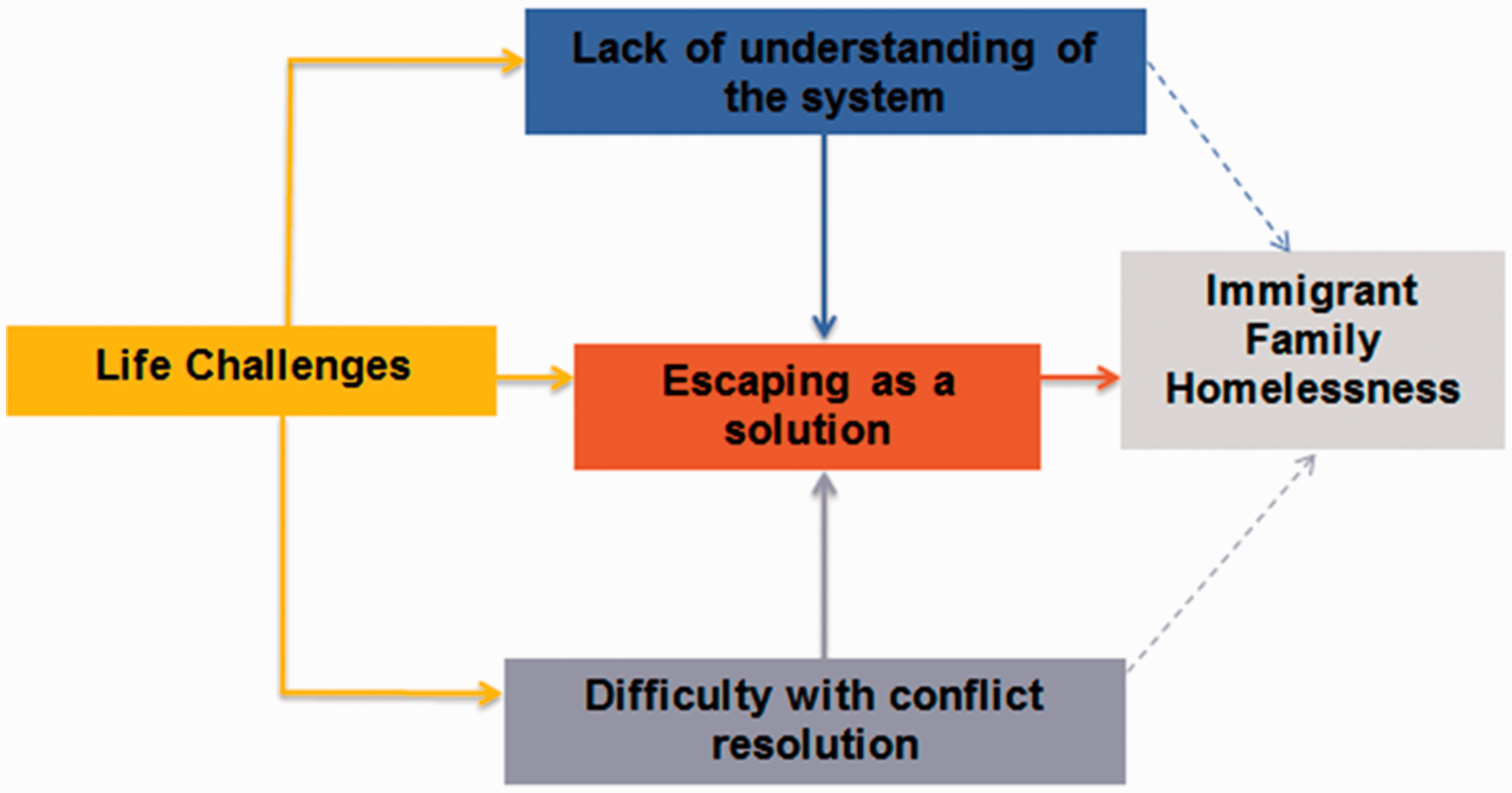
Pathways to immigrant family homelessness.
Theme I—Life challenges
Life challenges such as socioeconomic problems are probable primary predisposing factors that could be exacerbated by having limited knowledge of systems, structures, and regulations, or limited conflict resolution skills. Families could not navigate the systems, and structures around them. They perceived themselves as having limited options to change their circumstances. Study participants identified circumstances that they perceived put families at risk for homelessness. These experiences included: (a) Insufficient social and financial assistance (b) lack of family/friend’s support; and (c) lack of job opportunities for immigrants due to a lack of the required Canadian educational qualifications alongside language issues, leading to missed employment opportunities. Participants also commented on (d) case worker attitudes, (e) perceived cultural insensitivity/lack of understanding of cultural differences and (f) perceived discrimination and racism.
Insufficient social and financial assistance
Participants mentioned that inadequate finances led to their homelessness. While some claim they lost money through various means; others blamed immigration officials for restricting them in terms of the amount of money they could carry.
For instance, a male participant disclosed, “When you come here, you can’t have a lot of money, you are not supposed to have a lot of money. Immigration asks that the money should not exceed $300. More than $250 to $300 is prohibited”.
On the other hand, some participants disclosed that the Ontario Works money was not enough in catering for their housing and family needs. Ontario Works constitute benefits (mostly financial) instituted by the government of Ontario for vulnerable people who need money because they cannot find work or temporarily cannot work. Participants believed that the money should match the size of the family and the current housing rates so that they could rent and maintain their housing. One participant disclosed, All I have from Ontario works was $700 and the least rent was $1200, plus utilities it would be $1500. How can we get all this money? We need to have some money when we go to our house, for example for the furniture … yes they give $500 for the furniture but are that enough? The $500 will cover only 2 mattresses, we need beds, dining table, so if we have any saved money, it will cover preparing the house for living. I don’t know what to do anymore.
A participant recounted: This is my second time, my first time was in 2015, Alberta economically was going down and life became too expensive, we decided to move. I went to Ottawa, then Montreal. In Montreal, the French was hard for my kids, we stayed there 9 days, and Ottawa didn’t have good Ontario works. Toronto was not a family city although there are a lot of Arab families, but I did not feel comfortable … I came [to this City] of course there was a huge difference.
Lack of family/friend’s support
Some of the participants wished they had family members already staying in Canada. They believed this would have lessened their predicament and put them on the right footing to start life. This parent divulged, “My husband’s brother came the same way as us but no other family…my husband’s brother was living in a shelter too.” Another female participant made this comparison, “We do not have anybody here in Canada, I know some friends at school, they have families here, and they helped them to rent a house but we do not know anybody.”
Lack of job opportunities
Most study participants highlighted high job requirements and Canadian accreditations by potential employers. They believed their joblessness was widely linked to them not having the required level of Canadian education leading to missed employment opportunities, thus, culminating in their current state of homelessness. The following are excerpts of participants’ views: “I know that [my City] does not have many job opportunities, sure I will search for jobs, but it is not easy.” … when you go and ask for a job, they will ask for at least 5 years work experience in Canada. I have been here for 4 years only, how can I get hired. I applied for a truck driver job, it was the same. So, we are obliged to stay on Ontario Work at least for the first 2 to 3 years until I find a job.
Perceived case worker attitudes
Participants shared their disappointment concerning some shelter staff attitudes. They believed attitudes of some case workers at the shelter were not helpful and thus caused some families to lose housing opportunities that came their way. Participants noted that even though not all case workers were insensitive to the needs of their clients, they believed that some cared less about the plight of their clients and thus delayed in responding to their needs. Some workers were however very helpful; assisting participants with translators and helping them carry out some chores. They were appreciative and thankful for such good gestures from the workers.
A participant detailed: We were looking for a house, and we applied for Housing, and I went to them [housing officials] to check and [they] said ‘you have missed 2 opportunities for available houses’ because our case worker did not answer [their phone call]. And after one month they called again for a second house but she missed it too.
Perceived lack of understanding of cultural differences
Study participants observed that some case workers lacked knowledge about the families' background in relation to the culture of the people they were dealing with. To them, this led to strained relationships in the course of interaction and search process for appropriate housing. A participant said; Basically, the case worker should know the family’s background. For example, I found some houses but they were not suitable for us, some houses had bad smell, some had unsafe neighborhood, some had pets, we are not used to have pets inside our house. Yes, we are refugees but it didn’t suit us, and our children.
Perceived discrimination and racism
Issues of racism and discrimination of all forms featured prominently during focus group discussions. The participants described that some staff attitudes toward them made them feel they were not liked. Participants believed services that the case workers offered were not the same for everybody. Participants observed inconsistencies in the way case workers applied shelter rules and regulations. Some focus group participants believed service providers were discriminatory in applying shelter rules. This participant revealed; … the frustrating part of that is the fact that they are discriminating, caseworker picks who she wants to stay. There are some people here; I think some stayed here for 5 months. So, their case workers were cooperating with them, not like ours. We didn't even hit the limit and she had to make us leave.
Overall, it appears immigrant families face various life challenges on arrival in Canada due to a lack of knowledge about how the Canadian social system operates. Not only do the challenges lead to difficulties with conflict resolution, but they also result in constant mobility in an attempt to escape from these challenges.
Theme II—Lack of understanding of the system
Focus group discussion with the participants revealed that a lack of understanding about the Canadian social system contributed to their homelessness. Participants had limited knowledge of tenancy rights and responsibilities, including protocols and procedures of social service organizations. Study participants mentioned lack of understanding of the laws and regulations governing the Canadian social system. The participants also expected high living standards before immigrating to Canada’. Participants also perceived staff inflexibility in applying shelter rules, as a lack of understanding and compassion from the shelter staff.
Lack of Awareness of the Laws and Regulations for New Immigrant/Refugee
Most immigrant families who come to Canada are unfamiliar with the day-to-day toils in Canada. There is a lack of awareness of the Canadian social system, which makes transitioning difficult. The only option for participants of the current study was to go to the shelter for survival. The participants believed if they knew the impending difficulties from the onset, they would have been better prepared to avoid homelessness. This is what one of the participating family members expressed: We came as refugee; the first thing is we don’t have money, to rent, we don’t even know the law of the country, so you need to settle somewhere until you prepare yourself. This is a general reason for all people. Yes! This is one of the main problems; we cannot have money to deal with the expenses, so you don’t have any solution except coming to the shelter. I don’t know anything about Canada, do not have money, I have young children, when I first came; I met with a Sudanese guy at the bus station, I asked him where can I go, he said ‘I will take you to the shelter’ … As a refugee, you don’t know what to do, where to go, how to eat or drink…If we were told from the beginning about everything, we would not be homeless for this long time.
Expecting high living standards
Study participants disclosed that they initially had high expectations about life and housing in Canada, but upon arriving in Canada and facing difficulties, the participants expressed regret and began lowering the standards they had set apriori. This participant disclosed: … In the beginning when we came, we were dreaming that we will find a big house with 2 bathrooms…we were saying that to the case worker but when we found it so difficult we went down from 3 bedroom house, with 2 bathrooms then settled for an apartment, then couldn’t find one. Another participant added; So people come to Canada knowing that Canada is the best place, they have high standards, they come here I want a good house, and this is what my parents think, they saw many houses but they say no, this is small, [because they have high standards], they understand that most probably they are going to get a better house but they realized that they have to accept whatever they get.
Perceived inflexibility in applying shelter rules/regulations
Study participants in the shelter expected the workers to be accommodating in terms of how they administered the rules governing shelter activities. The participants believed the rigid nature in which the workers sometimes applied shelter rules led more families into homelessness as they could not fulfill some housing requirements before their given time expired. One participant stated So they just stick to the standards, they don’t change their minds no matter what, they have to understand that through time the country changes so you know, houses are harder to find, house rents go up, they stick to the standard, ‘oh no we start like this we’re going to end like this’, they do not interact with you, they do not understand what you mean. They just like I said stick to the papers. The other problem is … They don’t put the fault on their workers, no matter what, it does not make sense what their worker is doing but they still stick to them, they don’t blame them at all. They said they do not have any, because I need a 4 bedroom house. I said there are some families who stayed less time than us and they got housed, why? They said because they asked for a 3 bedroom house. I said OK, I want a 3 bedroom house, it is better than being on the street. They said no, it is forbidden; you should have a 4 bedroom house because of your family size. I asked them why we get kicked out, and we were told that we weren’t seriously looking but the truth is we were looking. Actually, my problem was with my case worker. I am really upset; they kicked us out in a very bad way. They said ‘we booked you a hotel, it is the cheapest hotel … you have to get out today’. We called the manager of the shelter to explain our situation and we asked him if we can stay for only one week to have enough time to look for 2 bedroom house but the manager rejected our request [saying] we were late in finding a home. They insisted they kick us out or they will call the police, and if we don’t go to the hotel and stayed out in the street, [they] will call the child aids services to take away our children. My daughter started crying because of the behavior of the shelter. My kids suffered mental health issues.
Theme III—Difficulty with conflict resolution
Participants encountered crises in relation to problems with landlords, their kids’ education and neighbors. Despite the existence of affordable housing programs, participants complained that they were not accessible. Some participants hoped that housing would be made available and affordable and safe to provide them comfort to be able to take care of their children. Family members believed the interpersonal obstacles they faced prevented them from obtaining appropriate housing, thus, contributing to their homelessness. The study participants indicated the following; (a) lack of affordable and accessible housing, (b) rejection by landlords, and (c) unreasonable housing/space requirements.
Lack of affordable and accessible housing
Participants observed that housing was expensive; making it impossible for them to rent a house of their choice. To them, being an immigrant in Canada worsened their plight as it became very difficult to navigate the housing system. In the end, they called for assistance so that they could be housed. Some participants spoke about the humiliation they faced in relation to their housing search. A participant revealed; We don’t have enough money to live in a hotel. They booked a cheaper hotel $1200 as a package. But still $1200 for the hotel only, and what about food, living expenses, bus tickets? We stayed in the hotel for 10 days until all our money finished. After we finished our money, we went to the case worker in Ontario works and she referred us to another place that provides community services. We asked them to help us find a house because we do not want to stay in the hotel any longer. Ontario works helped us looking and the community services helped as well and they both did not find anything. We put an ad on Kijiji for a place to stay for one month, any place even one bedroom, but nothing until now and they gave me until the next week and I have to leave. They do not want to cooperate.
Rejection by landlords
Focus group discussions brought to light landlord discrimination against families on Ontario Works. Study participants wondered why landlords refused to offer them housing simply because they were on assistance from the government.
A female participant disclosed “There is another thing, we were looking for a place to rent, the landlords as soon as they knew that we are on Ontario Works, they rejected us”. Another participant revealed; This happened to me. I paid the rent for the first month and paid the deposit with a cheque I thought that it was done. Suddenly after few days they called me and said ‘no, because you are on Ontario Works’. They returned my money, and I started from zero again.
Unreasonable housing/space requirements
Participants did not understand why they were expected to secure accommodation that was far too spacious and expensive for them to rent. They articulated that service providers allow them to rent houses based on the amount of money they had and not based on the family size. A mother of three stated: We have to get 3 bedrooms house because I have two sons and a daughter and they told us that you are not allowed to get a house less than 3 rooms. We were looking but as said before it was expensive to rent. When I wanted to apply for Housing, the case worker said you have to find a 4 bedroom house. It was not easy to find that big house, if it is 2 or 3 bedroom house it would be easier. I told her I have 2 boys and they can be together in a room and the girl in a room, so 3 bedrooms house will do. She said no, it should be 4 bedroom house because there is a big age difference between the boys…each one should be in a separate room. They forced us to get 4 bedrooms house and that is so difficult, it will take a year or 2 waiting.
Theme IV—Escaping as a solution for hardship
When significant problems or aversive events occurred, families turned to, "Escaping as a solution for hardship". Relocation was described as the primary method used by many families to cope with different kinds of hardships. Hardships included relationship conflicts with partners, parents, landlords, and neighbours. They included other social determinants of health such as insufficient social support, inadequate finances, insufficient Ontario Works money, lack of family/friend’s support, lack of job opportunities for immigrants, case worker attitudes, perceived cultural insensitivity, and discriminatory behaviours. Overall, the study participants shared some situations they believed influenced the path to their current state of homelessness. These include: (a) family safety, (b) school issues for their children, and (c) unsafe neighborhoods.
Family safety
Some participants disclosed that even though they were living well financially back home in their respective countries of residence, they were concerned for the safety of their respective families due to political unrest. The only safe option was to leave for Canada to safeguard the future of their kids. This participant revealed; Although we have been living in Saudi Arabia for a long time, we are not Saudi citizens or have permanent residency there. They said that we will be deported to our original country which is Sudan. We have political issues in Sudan and if we go back to Sudan we would be facing a lot of hardships. Our lives would be in danger if we go back. It was necessary to find somewhere else.
School issues of kids
Some participants complained that their kids faced difficulties at school. This made them move with their families from their respective cities of residence to the shelter. A mother expressed her family’s fears, A kid brought a knife from home…My son got scared and went to the teacher to complain. The kid with the knife got angry at my son and he followed him and hit him with the knife in the school cafeteria …He was suspended for only one week; the principal told me she could not do more; she did not have the authority… and told me to go complain somewhere else. My kid became afraid. I was expecting them to move that kid from the school or at least change the bus for my son. I waited for them to do something and nothing was done. The kid’s parents were saying to their kid ‘it was not your fault you did not do any wrong’.
Unsafe neighborhood
Some participants felt insecure based on the difficulties they faced in the neighborhood. This made them move from their respective community of residence and ended up in shelter with their families. one parent shared: I felt sorry for my kids, they were always upset, afraid of going outside, and self-esteem was low. My wife had an incident. Once she was at the bus stop on a main road, she got pushed by two teenagers, they said sorry, but I do not know if they did that intentionally or they were joking or what, I have been here in Canada for seven years. I have never seen anything like this neighborhood. I stayed at the house for 9 months you know… the standards were extremely low.
Theme V—Solutions for reducing immigrant homelessness
Research participants identified some strategies that could assist in lessening immigrant homelessness in Canada. These include: (a) Longer shelter stay, (b) affordable housing, (c) social assistance, e.g. Ontario Works (OW) money, (d) upstream solutions, and (e) greater understanding and compassion towards effective supportive services.
Longer shelter stay
For some participants, instead of driving them out of the shelter into the streets after the expiration of the allowable length of time, they appealed to the officials to extend their stay in the shelter to give them ample time to secure appropriate housing. To them, this gesture will help them avoid homelessness. A participant suggested: Because this is the situation now, they should give us some more time to stay in the shelter or they could help us looking instead of kicking us out! The situation now becomes worse than before regarding housing and rents, they need to be more cooperative and revaluate their rules.
Affordable housing
Participants recommended an effective collaboration between housing officials and the private sector to provide more subsidized and affordable houses for families. They also mentioned that the City Council should assist them in getting co-signers. That way immigrant family homelessness could be curbed. A participant proposed; One of the solutions regarding homeless people, because housing officials do not have enough houses for everyone, they should have something like a contract with the private sector and they could have rates for rent according to the income, they [housing officials] could be the link to the private sector.
Ontario works amount of money
While some participants suggested that officials should increase Ontario Works such that it matches the size of the family and the current housing rates in their city, others called for efficient welfare process implying that it was slow and takes longer to access. This male participant shared: If the money for rent is enough, the shelter would be empty every 15 days. The settlement process will be fast. To manage the rent money, people are cutting from the children money and adding to the rent but that does not leave any coverage money for needs of the children. The problem is with the welfare, if the process of having the welfare was not slow, it would have helped in improving the income. The process of getting the welfare is too long sometimes 2 to 6 months.
Upstream solutions
The participants called for more understanding from service providers towards the plight and settlement of immigrants and refugees. To them, early settlement will aid in getting employment and subsequently enhance their economic status. Participants made the following recommendations: “The process of [settlement] should be faster.” The solutions should come from upstream. They [should] give us work permit to be able to work. If we work they should not cut off our money unless we have a high income, let us work to be able to rent a place even for $300, this can help us in renting and in living expenses. It is forbidden for you to work until you have residency. The problem is, my hearing has been postponed and they did not set a time for the hearing. It could be a full year, should I stay without work?
A need for greater understanding and compassion
Participants called for more sensitive and supportive social services from the government. ‘One solution fits all’ is not the best strategy to handle the problem of homelessness. Therefore, they suggested grass root service providers be given priority in shelters to aid with early settlement and housing stability. A participant shared: They have good service here but they need to be more empathetic. They can bend some rules or try to go around it in a way to help some difficult cases. As long as they let them [refugees] enter Canada, they should facilitate the process of documentation, housing and settling down. I think the shelter should help more. They have to be more flexible. Yes, they have a big number of families but, they have to prioritize their cases. This participant questioned: What is the benefit if you kick someone out to the street and have a new one in off the street instead? You do not solve the problem, yet you still have someone in the street. It is not fair; sometimes they have a family of a father and one kid or a family of a husband and a wife and kick out, a whole family with 4 kids.
Discussion
The current study was designed to explore the needs of homeless families; to identify risk factors associated with family homelessness and develop strategies to assist in mitigating and preventing homelessness among families.
Immigrant families reportedly face precarious situations with housing on arrival in Canada due to systemic difficulties related to information availability, rights, and responsibilities, and other socioeconomic problems. Some of these socioeconomic problems have to do with availability of financial resources, credit history, lack of employment, and lack of security for the whole family (Brabant & Raynault, 2012; Spracklin, 2018). For instance, a recent report by the Royal Bank of Canada’s Economic Research on housing trends and affordability reveals rising interest rates in home ownership cost. The cost of housing has risen above affordability levels of most Canadians in recent times; rising from 43.2 percent in 2015 to about 53.9 percent in 2018, while income levels continue to drop (RBC Economic Research, 2018).
Lately, there are well established systems such as the Citizenship and Immigration (CIC) that help settle or integrate immigrants. However, families with children continue to face problems on arrival in Canada (Bartel, 2018; Immigration Refugees & Citizenship Canada, 2016; Polillo & Sylvestre, 2019; Sjollema et al., 2012; Sylvestre et al., 2018). As revealed in our study, immigrants arrive in Canada with high expectations, hoping that life circumstances will change for the better within a short time. Immigrants become disappointed when experiencing the realities of what life can offer in Canada. Immigrants struggle to survive in their newfound country; they strive to adapt to the environment and integrate into the 'Canadian system' in terms of the culture, language, and lifestyle.
The study revealed that most immigrant families belonged to the low-income groups and did not have the financial resources to afford housing. It is reported that participants usually have no stable or appropriate housing when they initially arrive in Canada (COH, 2012) and they have no immediate means of acquiring housing either. In our study, barriers such as lack of appropriate education, discrimination, communication (language) difficulties, and non-recognition of education or skills received from outside Canada were identified as some of the precursors to immigrant family joblessness. Effective integration processes such as recognizing the education and work credentials and experiences of immigrants within the workforce has the potential of fostering immigrant families’ economic growth and independence, while contributing to and enhancing the Canadian economy.
Study participants identified various forms of discrimination related to race, ethnicity, culture, housing and job search. The participants commented on case worker attitudes, as well as perceived staff and landlord cultural insensitivity/lack of understanding of cultural differences. The participants perceived high level discrimination and racism from both staff and landlords they encountered. The participants believed such negative attitudes made them feel not liked. Participants observed inconsistencies in the way case workers applied shelter rules and regulations; and that services the case workers offered were not the same for everybody in the shelter. These findings are in line with contemporary studies such as ( Nangia, 2013; Ontario Human Rights Commission [OHRC], 2007; Paradis et al., 2008) that have reported on existing discrimination against immigrant families in relation to sex, age, race, ethnicity/culture, language, religion, and physical appearance.According to Mahtani (2008), negative media portrayal of immigrants influences most discriminatory acts against newcomers in Canada. We emphasize however that Canada highly upholds the United Nations charter on human rights, and the 1951 Refugee Convention and its 1967 Protocol, as well as the rights and dignity of everyone including immigrants and their families. The OHRC (2007) adds that adequate housing is a human right and essential to human dignity irrespective of place or time. The OHRC believes adequate housing enhances security and integration as well as gaining and keeping employment, recovery from disability including mental illness, by acting as a route to escaping physical or emotional violence, and keep custody of one’s children (OHRC, 2007). The OHRC continues to advocate against all forms of discrimination including the protection of immigrants through education, public awareness and the enforcement of rules and regulations governing housing rights such that housing providers, tenants, and society benefit.
Participants’ lack of knowledge about available social services also contributed to their homelessness, and further exposed them to some economic hardships which they could otherwise have surmounted. As Canada continues to admit culturally diverse populations into its territories, there is the need to ensure cultural competency training for service providers on how to assist immigrants with their settlement while making information available about services that could enhance integration. By cultural competency, we mean the ability of service providers to effectively interact, work, and develop meaningful relationships with people of various cultural backgrounds (de Guzman et al., 2016). Improved cultural competence among service providers has the potential of breaking barriers, while boosting the interrelationship between immigrants and staff within a social context of care and interaction. To deal with some difficulties associated with immigrant family homelessness, Kirmayer et al. (2011) suggest that case-specific inquiry, use of trained interpreters and culture brokers (i.e. personnel who could bridge, link, or mediate between persons of different cultural backgrounds). As well, holding meetings with families involved, while consulting with community organizations could help with successful integration of new families into the Canadian way of life.
Implications
The current study explored the needs, risks and strategies to assist in mitigating and preventing homelessness among immigrant families in Ontario Canada.
In the short-term, we expect this pilot study to inform policy-makers, nurses and other service providers, concerning the experiences of migrant families’ predicament across the homeless spectrum for necessary action. In the medium term, we expect findings from the study to stir potential change in policy on immigrant family settlement processes in Ontario and Canada through supportive advocacy from nurses and other stakeholders. This study findings, if implemented has the potential of helping families avoid homelessness while attaining housing stability. In the long-term, it is hoped that nurses will advocate for and collaborate with other care providers to offer individualized and culturally competent care that is engaging, dignifying, emancipatory and inclusive towards successful integration of newcomers in Canada. Findings from our study have the potential of lessening housing expenditures through a reduction in shelter costs by implementing well-tailored housing strategies that are culturally sensitive and appropriate to the welfare of immigrant families towards integration.
Immigrants have innovative ideas as well as productive skills that can be tapped to facilitate economic growth. It is imperative that the government recognizes nurses as key resource partners who have the potential to play a leading role in housing matters through advocating and supporting vulnerable groups in implementing the National Housing Strategy in Canada. Such roles may also include assisting with finding suitable housing in safe communities where immigrant families can raise their kids whiles securing access to appropriate jobs.
Limitations
Although the step by step analysis techniques of Leininger (1985) applied in this study enhanced the credibility and trustworthiness of the study findings, only immigrant families at the shelter were able to participate in the study. Views from other immigrant families outside the shelter were not captured. It is likely that conducting a single focus group with 11 families could pose a drawback to the transferability of the study findings in the near future. The fact that the recruitment poster was in English could be a potential study limitation in terms of sample recruitment as some individuals at the shelter could not speak nor read in English. The authors believe that conducting focus group discussions with a cohort of participants with similar culture, language and experience, helped to generate rich data. In the end, both participants and researchers understood the challenges facing immigrant families for solutions compared to what data from individual interviews would have yielded. It is essential that future large-scale mixed method studies are conducted in multiple settings in Ontario to ascertain the extent of immigrant family homelessness for appropriate action.
Conclusion
The paper reported on findings of a pilot program evaluation that explored the needs of immigrant families in relation to housing in a Family Shelter in Ontario. The study findings will inform policy makers, practitioners, and the general public as to the lived experiences of migrant families’ predicament across the homeless spectrum and the remedies thereof to deal with the situation. It is hoped that findings from the study will influence policy change towards culturally sensitive and appropriate preventative strategies to enhance immigrant family integration in pursuit of improved housing in Canada.
Footnotes
Declaration of Conflicting Interests
The author(s) declared no potential conflicts of interest with respect to the research, authorship, and/or publication of this article.
Funding
The author(s) received the following financial support for the research, authorship, and/or publication of this article: The authors received financial support from the Local Poverty Reduction Fund from the Province of Ontario, Canada.
