






Abstract
Accelerometry provides information on habitual physical capability that may be of value in the assessment of function in Duchenne muscular dystrophy. This preliminary investigation describes the relationship between community ambulation measured by the StepWatch activity monitor and the current standard of functional assessment, the 6-minute walk test, in ambulatory boys with Duchenne muscular dystrophy (n = 16) and healthy controls (n = 13). All participants completed a 6-minute walk test and wore the StepWatch™ monitor for 5 consecutive days. Both the 6-minute walk test and StepWatch accelerometry identified a decreased capacity for ambulation in boys with Duchenne compared to healthy controls. There were strong, significant correlations between 6-minute walk distance and all StepWatch parameters in affected boys only (r = 0.701-0.804). These data proffer intriguing observations that warrant further exploration. Specifically, accelerometry outcomes may compliment the 6-minute walk test in assessment of therapeutic interventions for Duchenne muscular dystrophy.
Duchenne muscular dystrophy is the most common and severe muscular dystrophy of childhood. Affecting 1 in 3500 boys, the disease causes progressive and relentless muscle weakness, limiting life expectancy to the second or third decade. 1,2 Standards of care for Duchenne muscular dystrophy have been radically revised in recent years, and now include virtually universal use of corticosteroids, whereas other treatments are the subject of promising clinical trials. With these advances comes a need to select appropriate measurement tools to accurately assess the efficacy of new interventions for this disease.
Identification of reproducible and clinically meaningful outcome measures for such a severe, rapidly progressive multisystem condition as Duchenne muscular dystrophy has been challenging. 3 Historically, although manual muscle tests were used to measure muscle strength in boys with Duchenne, these tests have been plagued by issues of unreliability and clinical relevance. 4 Improved ambulatory capacity has now been identified as a more meaningful objective outcome measure and has been used in numerous clinical trials. Functional measures that assess ambulatory capacity, such as the 6-minute walk test, have therefore been the focus of much recent attention. The 6-minute walk test is a highly reliable assessment tool (r = 0.91) 3 that, by measuring the distance a subject can walk in a specific time interval, provides an objective measure of functional capacity that also allows serial measurements. 3,4 Although the 6-minute walk test provides a meaningful outcome for clinical trials, it is unclear if improvements in the 6-minute walk test translate into increased activity outside of a controlled environment.
Quantitative measurement of ambulation patterns outside of the hospital setting can provide important information regarding day-to-day functional capacity. One means of assessing this parameter is via accelerometry. The StepWatch™ activity monitor appears particularly appropriate for Duchenne research because of its accuracy in recording step counts in individuals with widely varied gait patterns. 5
The overall objective of this descriptive study was to conduct a preliminary exploration into the use of accelerometry as a complementary functional outcome measure in Duchenne muscular dystrophy. It aimed to describe the relationship between community ambulation measured by the StepWatch activity monitor and the current standard of functional assessment, the 6-minute walk test, in boys with Duchenne muscular dystrophy and healthy controls.
Methods
Boys with Duchenne muscular dystrophy were recruited from the neuromuscular clinic at the Royal Children’s Hospital, Melbourne, Australia, as a part of a randomized controlled trial investigating a multicomponent nutritional supplement. Pretreatment measures were used for this study. Eligible participants were ambulatory boys aged 5 to 13 years with a definite diagnosis of Duchenne muscular dystrophy defined by an identified deletion or duplication in the dystrophin gene, or absence of dystrophin on muscle biopsy, in conjunction with phenotypic evidence of characteristic clinical symptoms or signs by 9 years of age (ie, proximal muscle weakness, waddling gait, and Gowers maneuver), an elevated serum creatine kinase, and progressive difficulty with ambulation. To be eligible, boys were also required to be able to complete at least 75 m during the 6-minute walk test. Individual dystrophin mutations from either multiplex ligation-dependent probe amplification or dystrophin sequencing were collected for each participant from the child’s medical record. Ethics approval was obtained from the Royal Children’s Hospital, Melbourne, and Monash University human research ethics committees (HREC 30022 and 2010001692, respectively). Healthy control males, aged 5 to 13 years but not specifically age-matched to subjects, were recruited through Monash University via the staff intranet website, global staff emails, and flyer advertisements around the Monash Clayton campus. Ethics approval was obtained from Monash University human research ethics committees (HREC 2010000344) and informed consent was obtained from parents or guardians.
Body height and mass were determined with a portable stadiometer and digital weight scales (both Seca, Deutschland). All boys were able to stand for the height measure, and none had a scoliosis or contractures that affected the height measure or walking ability. Body mass index was calculated as body mass (in kilograms) divided by height (in meters squared). Body height, mass, and body mass index z scores were determined using the Centers for Disease Control and Prevention reference values for children. 6
Six-Minute Walk Test
The 6-minute walk test measures the distance that a subject can walk in a period of 6 minutes and requires only a marked course across a smooth, straight, and little-used internal thoroughfare and a stopwatch. The test reflects submaximal functional capacity, as participants exercise at their desired intensity and are allowed to stop and rest during the test. Boys with Duchenne muscular dystrophy completed the 6-minute walk test in the Children’s Neurosciences Centre at the Royal Children’s Hospital, Melbourne, whereas healthy control subjects completed the test at the Monash University Clayton campus.
The 6-minute walk test was set up according to the American Thoracic Society guidelines 7 as a straight flat course, although a length of 25-m was selected in accordance with Duchenne-specific protocols, rather than the 30-m course recommended by the society. 3 The test sequence used was also conducted in accordance with Duchenne-specific protocols. 3
StepWatch Activity Monitoring
The StepWatch accelerometer (Orthocare Innovations, Washington) is a small device worn around the ankle, which records the number of steps taken in real time. It is a research-grade instrument for assessment of ambulatory activity during day-to-day life. It is waterproof and provides no visual feedback to the user.
StepWatch settings were calibrated by the researchers for each individual participant. After entering the subject’s body height, quick stepping, walking speed, and leg motion (dynamic, gentle, or normal) were programmed for each child individually. During this calibration procedure, the child was required to walk 20 m while wearing the monitor as the researcher manually counted the steps taken. If there was an anomaly, monitor settings were adjusted. Calibration took approximately 5 to 10 minutes for each participant and very few setting adjustments were required. Subjects wore the StepWatch monitor for 5 consecutive days and were instructed to remove the monitor when they showered or slept.
Following the monitoring period, data was downloaded using the StepWatch software. Figure 1 displays an example of a daily activity summary demonstrating step patterns in real time. Preprogrammed activity levels in the StepWatch accelerometer were utilized: inactive (zero step rate), low activity (1-15 steps/min), medium activity (16-30 steps/min), and high activity (more than 30 steps/min). Data from the first day, when the data were incomplete, were excluded.
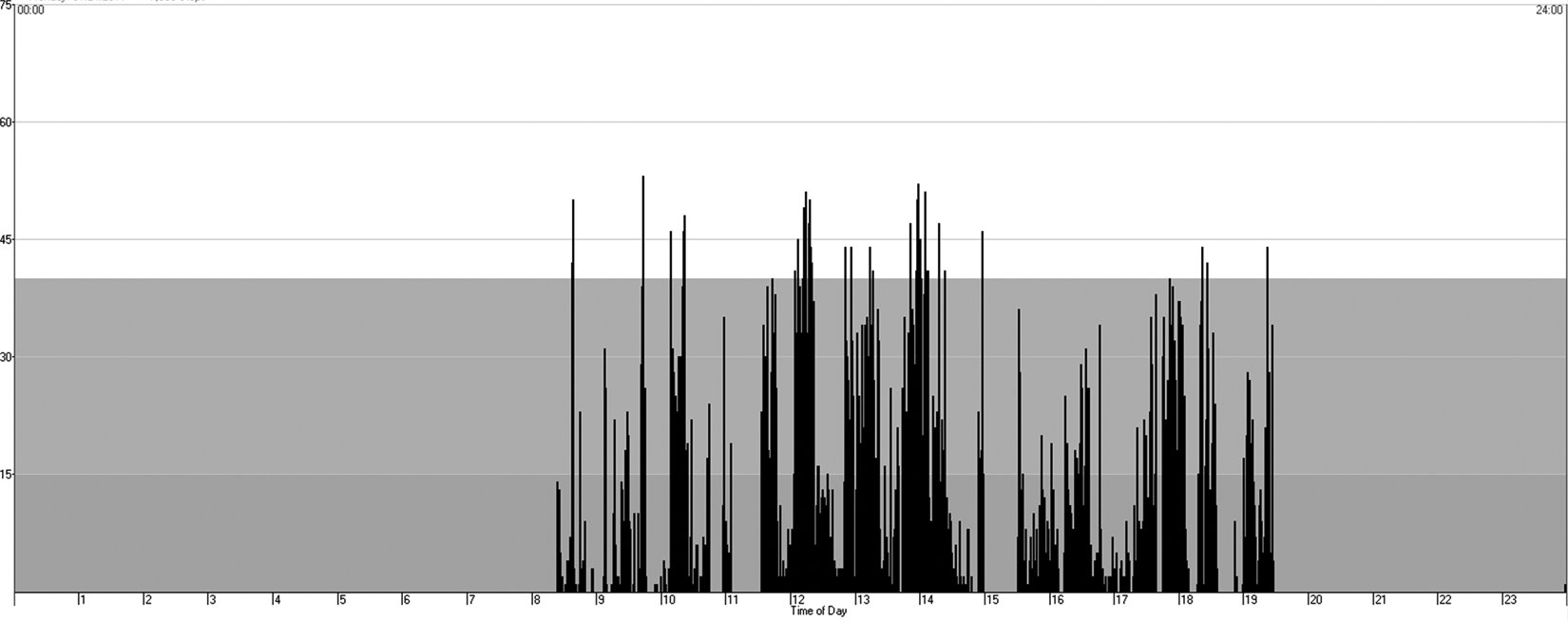
Display from a StepWatch activity monitor illustrating step rate per minute in actual time across a 24-hour period.
Statistical Analysis
Statistical analyses were conducted using SPSS, version 18.0 (SPSS Inc, Chicago). Normality of the data was confirmed using the Shapiro-Wilks test. Independent Student t tests were used to compare differences in anthropometric and functional measures between boys with Duchenne muscular dystrophy and control participants. Pearson correlations were applied to explore the relationship between 6-minute walk distance and anthropometric and StepWatch outcome variables. Although categorizations of correlation coefficients are somewhat arbitrary, the following cut-offs were used to describe the strength of relationships: r ≤ 0.35, weak; r = 0.36 to 0.69, moderate; r = 0.7 to 1.0, strong. 8 Data are presented as the mean ± standard deviation and significance was accepted at P ≤ .05.
Results
Sixteen boys with diagnosis of Duchenne muscular dystrophy and 13 healthy controls completed a 6-minute walk test and StepWatch activity monitoring for 5 continuous days. All participants successfully completed the 6-minute walk test. Clearly erroneous StepWatch readings indicating the participants took zero steps were received from 2 participants (Duchenne = 1, control = 1). These inaccuracies appeared to be due to incorrect usage or noncompliance rather than equipment failure. StepWatch readings only from these 2 boys were excluded from the analysis. The individual dystrophin mutations for each boy with Duchenne are listed in Table 1 together with the child’s age and 6-minute walk distance. Most boys with Duchenne were receiving daily corticosteroid treatment (prednisolone, n = 9, 0.45-0.78 mg/kg/d; or deflazacort, n = 5, 0.53-0.79 mg/kg/d). Anthropometric data are summarized in Table 2. Although weight z scores were similar between the 2 cohorts, boys with Duchenne muscular dystrophy were significantly shorter than control participants. This was reflected in significantly higher body mass index z scores in the Duchenne cohort.
Individual Genetic and Functional Profile of Included Boys With Duchenne Muscular Dystrophy.

aBrothers.
Anthropometric Characteristics of Boys With Duchenne Muscular Dystrophy and Healthy Controls.a
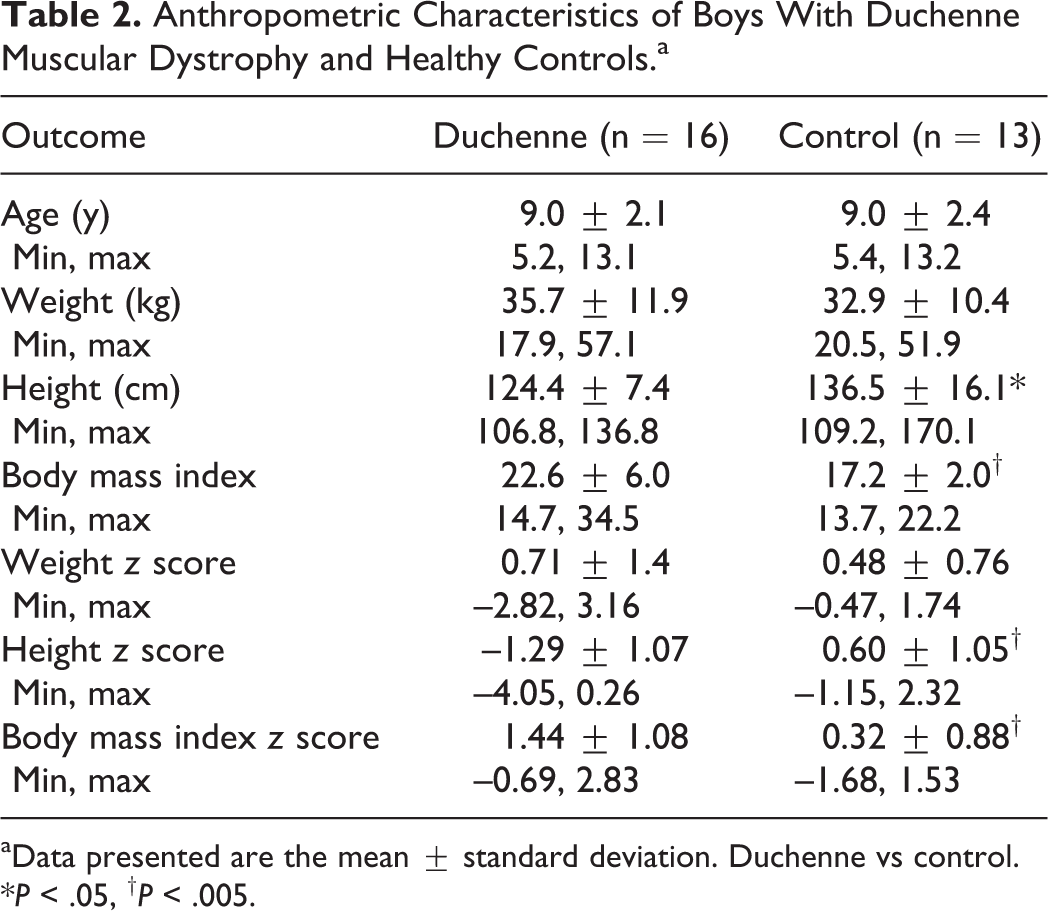
aData presented are the mean ± standard deviation. Duchenne vs control.
*P < .05, † P < .005.
A comparison of outcome measures between boys with Duchenne muscular dystrophy and control participants is presented in Figure 2. Affected boys walked significantly shorter distances in the 6-minute walk test compared to healthy controls (387 ± 86 m vs 598 ± 63 m, respectively, P < .0005). Data from the StepWatch activity monitors also demonstrated that boys with Duchenne were inactive for longer periods (Duchenne 1103 ± 134 minutes vs control 1016 ± 62 minutes, P = .036), took fewer steps each day (Duchenne 5138 ± 2500 vs control 7239 ± 2621 steps, P = .044), and spent less time in high activity (Duchenne 25 ± 17 vs control 53 ± 34 minutes, P = .018). Conversely, there was no difference between the 2 cohorts in time spent at low activity (Duchenne 205 ± 74 vs control 251 ± 44 minutes, P = .059) or at medium activity (Duchenne 107 ± 51 vs control 120 ± 33 minutes, P = .455).
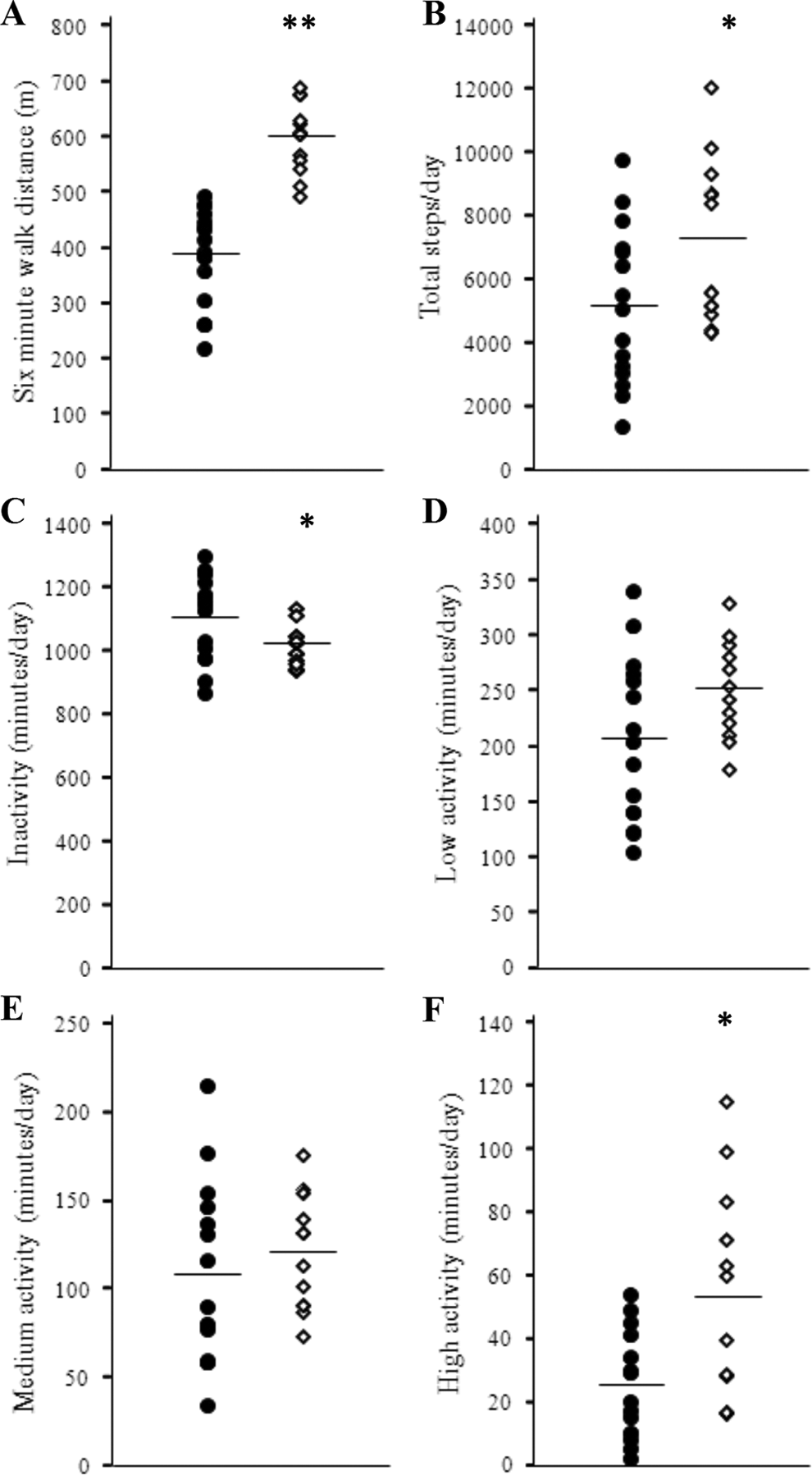
Differences in functional outcome measures between boys with Duchenne muscular dystrophy and control participants. Graph A presents data from the 6-minute walk test; graphs B to F present data from StepWatch activity monitoring (n [Duchenne] = 15 and n [control] = 12). Horizontal bars represent the mean score for each cohort. Individual boys with Duchenne are presented by circles, and control participants by diamonds. *Duchenne vs control P < .05, **Duchenne vs control P < .005.
Relationships between functional outcome measures and anthropometric data were also explored. Strong significant relationships were observed between all StepWatch parameters and the 6-minute walk distance only in boys with Duchenne muscular dystrophy and not in the healthy controls (Table 3). Figure 3 shows the inverse relationship between inactivity and the 6-minute walk distance in affected boys. In control participants, the 6-minute walk distance was only significantly associated with age. No relationships were evident between anthropometric variables and 6-minute walk distance or StepWatch data (not presented) in either cohort.
Correlations Between Six-Minute Walk Distance and StepWatch™ and Anthropometric Variables Evaluated Using a Pearson Correlation Coefficient.a

aIndependent variable: distance walked in a 6-min walk test.
bn (Duchenne) = 15, and n (control) = 12.
* P < .005, † P < .0005.
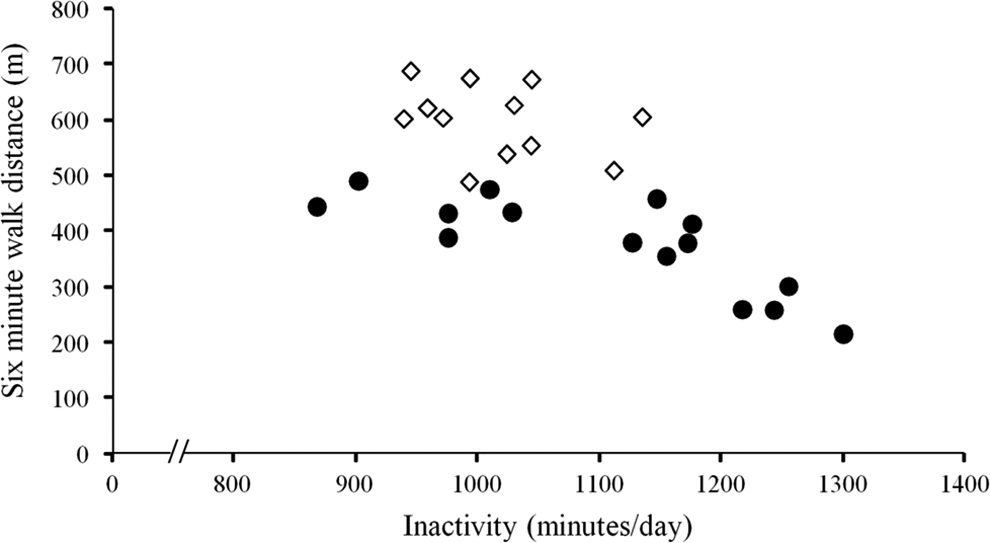
Relationships between 6-minute walk distance and inactivity measured by StepWatch activity monitoring in boys with Duchenne muscular dystrophy. Individual boys with Duchenne muscular dystrophy are presented by circles, and control participants by diamonds (n [Duchenne] = 15 and n [control] = 12). Duchenne: r = 0.803, r 2 = 0.645, P = .0003; Control: r =0.323, r 2 = 0.104, P = .3065.
Discussion
In this study, both the 6-minute walk test and StepWatch activity monitoring were specific in identifying a decreased capacity for ambulation in boys with Duchenne muscular dystrophy when compared to healthy controls. On average, boys with the disease walked more than 200 m less than the control group in the 6-minute time frame. Since these data were collected, several publications have supported use of the 6-minute walk test as an outcome measure in boys with Duchenne. Reliability of the 6-minute walk test in the condition has been demonstrated, 3,4 and longitudinal data have shown sensitivity to functional deterioration over time, with distance walked over 6 minutes decreasing in a 12-month period by an average of 57 m in boys 4 to 12 years old in one series 9 and 26 m in young males aged 4 to 17 years in another. 10 Changes over time in this parameter were quite variable, with some younger boys showing improvements in the test over the 12-month period. To account for this limitation, Henricson et al very recently explored the use of percentage-predicted 6-minute walk distance in boys with Duchenne muscular dystrophy. 11 Using an age- and height-based equation from normative data, the group showed that younger boys with Duchenne, instead of improving in the 6-minute walk test, were rather stable at 80% of that of their typically developing peers. The 6-minute walk test is the only Food and Drug Administration–approved primary endpoint in clinical trials of ambulant boys with Duchenne muscular dystrophy and has been the primary outcome measure in phase 2 clinical trials investigating novel therapies for the disease (Ataluren [PTC124®] and exon skipping).
The data generated here by StepWatch activity monitoring also identified significant differences between subjects with Duchenne and controls. In a community setting, affected boys were less active, took fewer steps, and spent less time at high activity. Interestingly, there was no difference between time spent at low and medium activity, suggesting that the intensity of activity is an important consideration in identifying differences between patients and unaffected boys. Step activity monitoring in Duchenne and healthy controls has been investigated previously by 2 studies. 5,12 Similarly, these studies demonstrated that boys with Duchenne had significantly more inactive minutes and took significantly less steps when compared to control cohorts. 5,12
The StepWatch is a relatively new assessment tool, and the literature on its use in pediatric populations is limited. Validity of the StepWatch monitor was investigated in 6- to 20-year-old healthy children. 13 During a 10-minute walk, the monitor had an agreement of almost 100% with observed steps and was moderately correlated with heart rate in a community setting (r = 0.49). Control data obtained in this study (total steps/d 7239 ± 2621) were similar to values in the literature (7604 ± 2485 14 and 7001 ± 580 13 ). The available data examining StepWatch monitoring in the Duchenne population suggests that test-retest correlation is high in this population (r = 0.73-0.81). 12,15 A recent review evaluating the clinometric properties of physical activity measures in young children with a motor disability concluded that the StepWatch offers a comprehensive measure of habitual walking activity. 16
StepWatch activity monitoring has also been used alongside the 6-minute walk test in Phase 2b trials of Ataluren (PTC124®). Data from pretreatment evaluations were used to explore the relationship between 6-minute walk distance and total steps/d. 12 A moderate correlation (r = 0.53) was revealed between the 2 outcomes. This relationship was weaker than that identified in the present cohort (r = 0.776). Here, strong, significant relationships were observed across all StepWatch parameters and 6-minute walk distance (r = 0.701-0.804). It is likely that we obtained a stronger correlation in our cohort because of differences in the clinical profiles between the 2 studies. The moderate correlation (r = 0.53) was obtained in a cohort of males aged 5 to 20 years with both Duchenne muscular dystrophy and Becker muscular dystrophy. 12 The inclusion of males with Becker muscular dystrophy, who may have similar ambulatory patterns to healthy controls, may have weakened the correlation. Conversely, our cohort included males aged 5 to 13 years with Duchenne only. This is the first study to show such strong relationships between these 2 functional outcomes. Interestingly, the relationship between the North Star Ambulatory Assessment and the 6-minute walk test is slightly lower (r = 0.68). 10
Differences in correlations between StepWatch parameters and 6-minute walk distance were also observed between the Duchenne and healthy control cohorts. This could be due to differences in gait patterns previously observed between the 2 groups. McDonald et al demonstrated that in healthy controls, 6-minute walk distance and stride length increase with age and height, whereas cadence (steps/minute) decreases with age and height. 3 Conversely, both 6-minute walk distance and cadence decrease with age and height in males with Duchenne muscular dystrophy, whereas there is little relationship between stride length and age and height. 3 Our results did not show a strong correlation between 6-minute walk distance and age in the Duchenne group; however, total steps per day did decrease with decreasing 6-minute walk distance. It is possible that we did not see a reduction in walk distance with age because 14/16 boys were receiving daily steroid treatment in our cohort compared to 5/21 in the cohort described by McDonald et al (a further 10 children were receiving steroid treatment of variable regimes). 3 Steroid treatment is proven to increase walking function 17 and may have removed some of the effect of age on 6-minute walk distance.
Regardless, the strong associations observed here indicate that the 6-minute walk test may provide a surrogate measure of community ambulation in boys with Duchenne muscular dystrophy. Conversely, these results also challenge the current practice of the 6-minute walk test as the only acceptable outcome measure for clinical trials for the disease. When comparing the 6-minute walk test and accelerometry directly, both provide objective data and are relatively cheap, quick, noninvasive procedures that require 1 or 2 trained evaluators. Results from the 6-minute walk test can be compromised by a participant’s lack of motivation, whereas accelerometry assessment can be limited by poor compliance. Accelerometry, however, offers additional benefits.
As an outcome measure, functional data from StepWatch assessment could contribute rich and complementary information regarding a boy’s real-world activities and participation through observations on duration, frequency, and intensity of physical activity. A potential therapeutic that not only results in an improvement in the 6-minute walk test but also translates into increases in daily and habitual physical activity seems intuitively more appealing to both families and regulatory bodies. The StepWatch monitor in particular can also record activity for up to 2 months at 1-minute intervals allowing researchers to determine if functional improvements or declines are sustained. In addition, because they are worn consistently for several days at a time, accelerometers can be used to predict energy expenditure when combined with estimation of resting energy expenditure. 18 Two small studies have demonstrated that accelerometers may be valid tools to predict energy expenditure in children with cystic fibrosis and cerebral palsy. 19,20 The clinical utility of using accelerometry for prediction of energy expenditure in Duchenne muscular dystrophy would be high because it would enable individualized dietary management. Excess weight gain is a significant issue for boys with Duchenne, even for those who are steroid naive. The prevalence of obesity, defined as weight above the 90th percentile, has been documented as 44% and 54% in steroid-naive cohorts. 21,22
Limitations of this study include the small sample size. Also, the cross-sectional design meant we were unable to address if accelerometry will be sensitive to the natural history of change in Duchenne muscular dystrophy. Longitudinal data from StepWatch monitoring is currently lacking and would both resolve this discrepancy and clarify the utility of serial StepWatch monitoring as a marker of disease progression and response to therapeutic interventions. However, based on the strength of the relationship between the 2 assessments, one could hypothesize that accelerometry will demonstrate similar sensitivity to change as the 6-minute walk test. The use of a control cohort and the data on correlations between the 2 measures studied contribute novel evidence to this area. Future investigations will include longitudinal comparisons of the 6-minute walk test and StepWatch monitor in larger populations of subjects with Duchenne muscular dystrophy. Longer duration of accelerometry is also recommended to facilitate understanding of environmental influences on habitual activity such as seasonal impacts or timing of school semesters and holidays.
In summary, this descriptive study evaluates the relationship between the 6-minute walk test and community ambulation measured by accelerometry. Both assessments were specific in identifying a decreased capacity for ambulation in boys with Duchenne when compared to healthy controls. Of interest, StepWatch parameters correlated strongly with 6-minute walk distance. Although this is a small data set, it proffers intriguing observations that warrant further exploration. Functional outcomes provided by accelerometry may contribute valuable information on habitual physical capability to complement the 6-minute walk test in the assessment of therapeutic interventions for Duchenne muscular dystrophy.
Footnotes
Acknowledgments
This research was conducted at the Royal Children’s Hospital and Monash University, both in Melbourne, Australia. Aimee Segman completed data collection for the control cohort.
Author Contributions
ZED designed the study, conducted the data collection at both sites, performed all data analyses under supervision, drafted and revised the manuscript, and approved the final manuscript as submitted. MMR supervised the data collection, reviewed and revised the manuscript, and approved the final manuscript as submitted. AJK supervised the data collection, critically reviewed the manuscript, and approved the final manuscript as submitted. KZW provided statistical instruction, reviewed and revised the manuscript, and approved the final manuscript as submitted. HT conceptualized the study, reviewed and revised the manuscript, and approved the final manuscript as submitted.
Declaration of Conflicting Interests
The authors declared no potential conflicts of interest with respect to the research, authorship, and/or publication of this article.
Funding
The authors disclosed receipt of the following financial support for the research, authorship, and/or publication of this article: This work is supported by funding from the John T. Reid Charitable Trust, Muscular Dystrophy Australia, and Murdoch Childrens Research Institute.
Ethical Approval
For the participants with Duchenne muscular dystrophy, ethics approval was obtained from the Royal Children’s Hospital, Melbourne and Monash University Human Research Ethics Committees (HREC 30022 and 2010001692, respectively), and for the control participants, ethics approval was obtained from the Monash University Human Research Ethics Committee (HREC 2010000344) and informed consent was obtained from parents or guardians.