






Abstract
Opsoclonus-myoclonus syndrome is a rare but serious neurological condition resulting in loss of control of eye movements, often accompanied by difficulties in posture and movement control with reports of sensory sensitivities potentially impacting on behavior. This pilot study characterizes the presence of atypical sensory behaviors in opsoclonus-myoclonus syndrome through questionnaire survey of a cohort of families. The Short Sensory Profile, Vineland Adaptive Behavior Scale, and Developmental Behaviour Checklist were distributed to 30 families; 16 were returned anonymously. Atypical sensory behaviors were identified in a large proportion (62.5%). Children reported as being more anxious showed greater sensitivity to auditory stimuli, U(14) 11, P = .026. This is consistent with recent recognition of more extensive disease neurocognitive effects in Opsoclonus-myoclonus syndrome. Further research is needed to increase understanding of the complex pathology of this disease and to provide indicators for sensory and behavioral as well as pharmacological interventions.
Opsoclonus-myoclonus syndrome, also known as “dancing eye syndrome,” typically presents in children between 12 months and 3 years of age with variable outcomes. 1 -4 Children develop opsoclonus, a rapid, involuntary, conjugate, multidirectional, saccadic eye movement disorder, accompanied by myoclonus and ataxia. Irritability and sleep disturbance are often also observed; and less frequently neurological symptoms like vomiting and mutism may also feature. 3,4 While the illness may be monophasic or multiphasic, many (over 50%) children experience learning, behavioral, and coordination difficulties with problems persisting into adulthood. 3 -6 A recent report suggests some improvements in outcomes with increased immunosuppression. 7
A neuroblastoma is present in about 50% of children and presumed to be an immune-mediated paraneoplastic condition whereby immune perturbations have been identified in the form of reactivity of patient derived humoral and cellular components to tumor cell lines. 8 Central nervous system auto-reactivity in opsoclonus-myoclonus syndrome may also occur in the absence of tumor, where a postinfectious etiology is purported to be the trigger. 3,4 Clinical and radiologic evidence now points to extracerebellar involvement in opsoclonus-myoclonus syndrome. 9 Electrophysiological studies also appear to support the clinical observation that some of the neurobehavioral sequelae following opsoclonus-myoclonus syndrome may result from aberrant sensory processing and modulation. 10,11
Sensory modulation dysfunction is defined as the impaired ability of an individual to regulate and organize responses to sensations in a graded and adaptive manner and appropriate to situational demands, manifesting as overresponsiveness (reduced sensory threshold), underresponsiveness (high sensory threshold), or sensory seeking behaviors that may be representative of an underresponsive sensory system. 12,13 It has been conceptually and empirically associated with a number of behavioral manifestations particularly among individuals with neurodevelopmental disorders 14 -22 Atypical sensory processing has been suggested as a major factor reducing participation and engagement in daily activities across a number of developmental disorders. 12 -23 Patient reports, clinical observations of features associated with opsoclonus-myoclonus syndrome, and electrophysiological evidence suggest that overresponsiveness to sensory stimuli may significantly impact on participation in daily activities.
The relative contribution of sensory overresponsiveness as an independent symptom is however confounded with the overlap of symptoms with those of anxiety and the lack of a “gold standard” for the identification of sensory modulation dysfunction or sensory processing disorder, with questionnaire report most commonly used. 12,22,23 The determination of an abnormal behavioral response (a defined cut point) from quantitative analysis of deviations of what generally constitute a range of typical behaviors may be augmented by biological measures (eg, electrodermal responses) as developed by Miller and colleagues; 12,13 however the correlation between these and behavior report are not universal.
This background provides a plausible argument for sensory modulation dysfunction and or anxiety affecting performance in daily activities for young people opsoclonus-myoclonus syndrome. The aim of this study was to gather preliminary information, via an anonymous questionnaire survey, of the presence of sensory processing problems (and/or anxiety) in opsoclonus-myoclonus syndrome and their impacts on cognitive, social and adaptive functioning, to guide future research.
Methods
This project was designed as a questionnaire survey of a convenience cohort of families with a young person with opsoclonus-myoclonus syndrome. Ethical approval conforming to the Declaration of Helsinki was received from the National Research Ethics Service (2/LO/0115).
Participants
Questionnaire packs with information regarding the project were distributed to families with a child/young adult with opsoclonus-myoclonus syndrome via the Dancing Eye Syndrome Support Trust, with an anonymous code linking the questionnaires within the pack. Stamped self-addressed envelopes were provided for return to the research team. Informed consent was assumed via return of completed questionnaires. Sample size was therefore limited to 30 registered families, with a return rate of 53%, resulting in a sample of 16. Recruitment and enrolment did not distinguish between individuals at different disease phases (eg, acute, ongoing treatment, remission).
Measures
Demographic information was collected alongside questions regarding the age opsoclonus-myoclonus syndrome was acquired and reason (if known) alongside any current medical treatments, therapeutic procedures received, and educational placement.
The Short Sensory Profile Caregiver Questionnaire 24 was completed to establish the profile of sensory responses. Sensitivity and specificity have not been published although discriminate validity is reported as greater than 95%. Total scores range from 38 to 190 with cutoff scores defining typical (155-190) versus probable (140-154) and definitely atypical (38-141) sensory behaviors determined from the standardization of the Short Sensory Profile. 24
The Vineland Adaptive Behavior Scale 25 was used as a standardized scale of adaptive behavior and development obtained through parental/key caregiver report across 4 domains of social, communication, daily living, and motor skills. Questions relate to relevant skill areas and contribute to an overall adaptive behavior score. Good reliability and validity are reported. 25
The Developmental Behaviour Checklist, 26 a 96-item parent report instrument of childhood behavioral disorders, was used to measure anxiety. An anxiety score is derived by summing the 12 items of the anxiety subscale with high scores reflecting high anxiety (score range 0-24). Items linked to sensory behavior are limited to 2, and data can be rerun removing these items.
Data Analysis
Statistical analyses, using the statistical package SPSS (v19), were undertaken relevant to the original aims. Missing data were prorated if less than 10% of subscale was missing as an average for the section. Descriptive statistics explored the distribution, characteristics and results of the children across questionnaires. Primary outcomes considered the proportion of individuals who are reported to have sensory processing problems. Secondary outcomes considered the relationship between anxiety and adaptive behavior and participation in daily activities, controlling for additional factors that may influence engagement and participation through Spearman correlation analyses and between-group comparisons of children with and without reported anxiety. Model assumptions were checked and parametric (ANOVA) and nonparametric (χ 2 and Mann-Whitney U) analysis methods used as reported.
Results
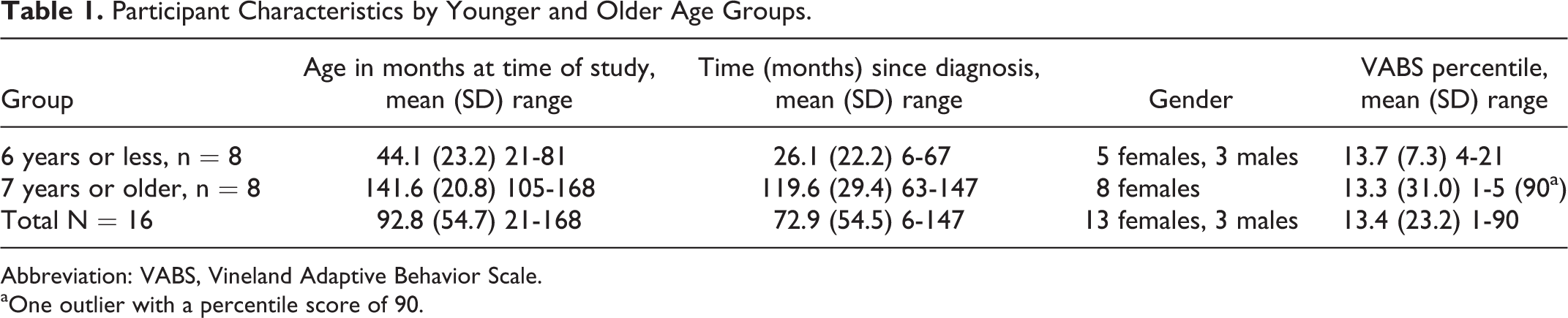
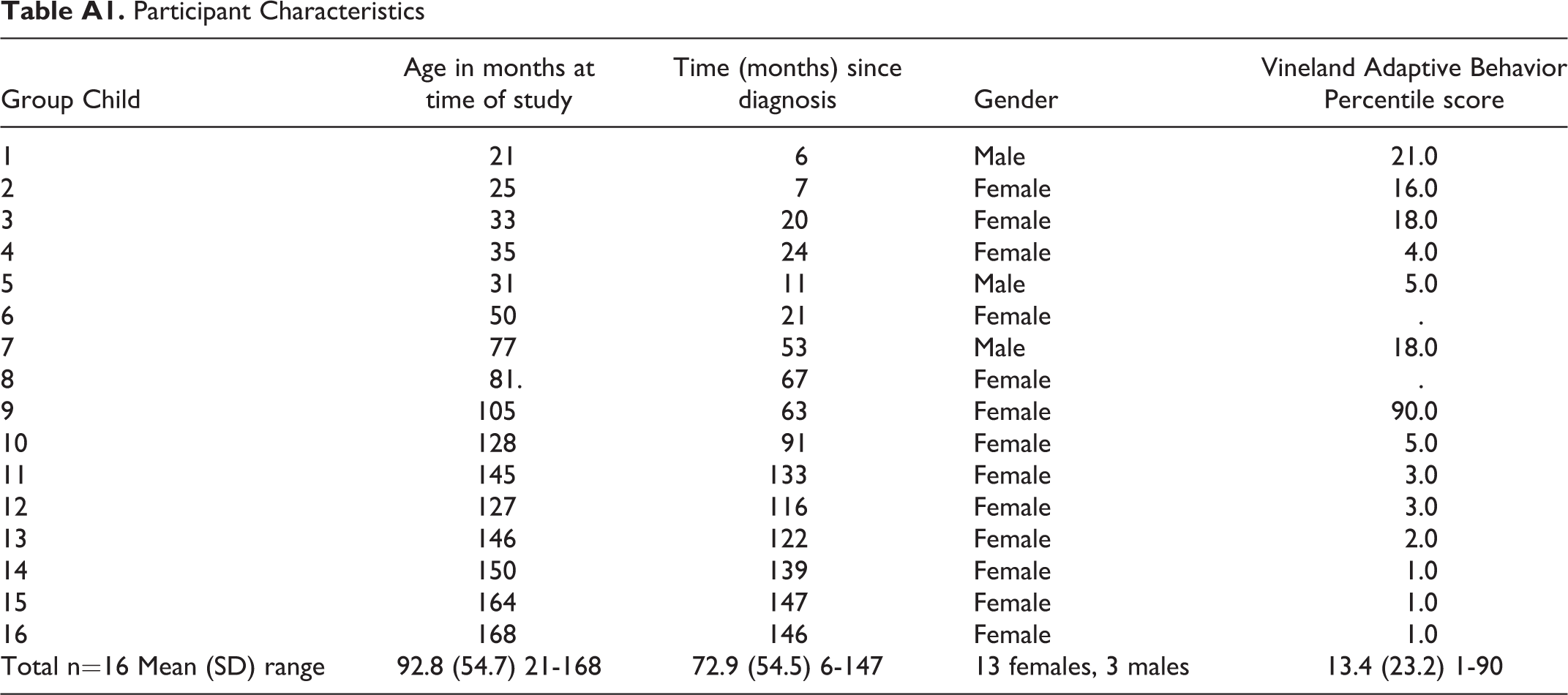
Sixteen of 30 (53%) questionnaires were returned for 13 females and 3 males. Mean age was 7 years 6 months (range 21-168 months) at time of questionnaire completion. Time since diagnosis ranged from 6 months to 12.4 years (mean = 6 years, SD = 4.5). Eleven children were reported to have had a neuroblastoma and 2 a known viral infection, with 3 not providing information. At time of study 9 children were not on medication, 1 on cyclosphosphamide and 3 on prednisolone (see Table 1 and the appendix for participant characteristics). Two returned Vinelands required prorating on 1 or 2 scales and 2 were not possible to prorate.
Participant Characteristics by Younger and Older Age Groups.
Abbreviation: VABS, Vineland Adaptive Behavior Scale.
aOne outlier with a percentile score of 90.
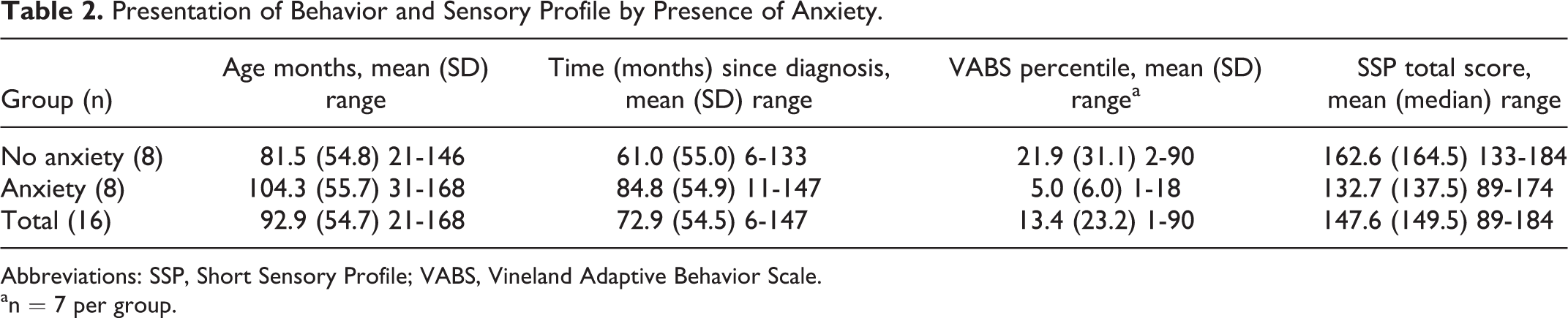
There were no significant differences in developmental ability between older or younger children, contrasting impact of relatively acute versus chronic stage of opsoclonus-myoclonus, nor between males and females (see Table 1). However, all but 1 of the older children showed significant delays in adaptive behavior with percentile scores of 5 or below as opposed to only 2 of the 5 younger children. (Data were reanalyzed without the outlier on the Vineland and differences between younger and older children were evident only on overall adaptive behavior with older children reportedly more delayed for their age across domains [P = .053].) There were also no differences in age, time since diagnosis, and overall developmental ability (as measured on the Vineland) between children reported on the Developmental Behaviour Checklist as being anxious or not, t(13) < 135, P > .05 across all measures (see Table 2).
Presentation of Behavior and Sensory Profile by Presence of Anxiety.
Abbreviations: SSP, Short Sensory Profile; VABS, Vineland Adaptive Behavior Scale.
an = 7 per group.
Younger children (50%) were more likely to be on medication than children over 6 years (20%), at questionnaire completion, as they are temporally closer to disease onset. Older children (>6 years; n = 8) showed poorer overall development as reported on the Vinelands, U(14) = 7.5, P = .029. Older children (90%) had also received more therapies such as physiotherapy, speech and language therapy, and occupational therapy and additional educational support than younger children (30%).
There were 8 children reported to have atypical sensory behaviors (50%), 2 probable (12.5%), and 6 (37.5%) considered to be within the typical range according to the criteria of the Sensory Profile. Differences in sensory processing were evident between children reported as having anxiety and those that did not with children with anxiety reported to have hyper-responsiveness to auditory stimuli (Auditory: U = 11, P = .026, r = .593), which contributed to the differences in the Short Sensory Profile total (U = 12.5, P = .038, r = .513). The numbers of children reported as having anxiety were significantly higher among children who also met criteria for atypical sensory behavior, χ2(2) = 8.56, P = .032, with the likelihood ratio reducing, χ2(2) = 5.74, P = .061, with removal of the 2 children who were below the standardization age (3 years) of the Sensory Profile and Developmental Behaviour Checklist. See Table 2 and Figures 1 and 2.

Short Sensory Profile domain scores of children with and without anxiety as reported on the Developmental Behavior Checklist.

Numbers of children meeting criteria for sensory processing disorder with or without anxiety.
Significant correlations were evident between sensory behaviors and anxiety subscale of Developmental Behaviour Checklist (ρ = –.724, P = .028), standard scores and percentile scores of the Vineland (ρ = .761, P = .002, ρ = .593, P = .025, respectively), and the anxiety scale of the Developmental Behaviour Checklist and both Vineland standard scores and percentiles (ρ = –.708, P = .033; ρ = –.681, P = .043). In view of 2 children being outside of the standardization range on the Sensory Profile and Developmental Behaviour Checklist the authors reanalyzed their data without these children with similar trends across results.
Discussion
This study aimed to gather preliminary information via questionnaire survey of the potential presence of sensory processing problems in opsoclonus-myoclonus syndrome and possible impact on cognitive, social and adaptive functioning. The results suggest that anxiety was associated more specifically with hyper-sensitivity to auditory stimuli rather than a generalized sensory modulation dysfunction in some, but not in all of the children.
Ben-Sasson and colleagues, 16 in a meta-analysis of sensory modulation dysfunction, in individuals with autism spectrum disorders, showed that presentation of sensory modulation dysfunction is influenced by age, severity of autism and type of control group used for comparison, while Lane et al 14 found anxiety to be influenced by the magnitude of response to sensory stimuli. Sensory-based phenotypes based on specificity of sensory responsiveness in autism have also been suggested. 27 These findings suggest a potentially important interaction between anxiety and expression of sensory symptoms. Schneider and colleagues 28 used a primate model to show the influence of prenatal stress (including exposure to alcohol and or adverse sounds) on both striatal dopamine levels, evaluated using positron emission tomography, and increased withdrawal to sensory stimuli (aversion to repetitive tactile stimuli and reduced habituation to stimuli across trials in 5 to 7 year old rhesus monkeys). Infant stress (neuroinflammation) may therefore be hypothesized to contribute to an attenuation of sensory sensitivity, as a protective response in the initial stages but may later contribute to presentation of negative behaviors (eg, withdrawal from light touch or auditory stimuli). What is unusual in these data is that this negative response appears to be relatively restricted to auditory stimuli.
The authors had anticipated that more atypical responses would be evident across sensory systems in line with Schneider et al 28 as a systemic response to infant stress. Currently, the selectivity of the hypersensitivity to the auditory system in patients in this cohort is surprising as opsoclonus-myoclonus syndrome appears to involve oculomotor components including blurred and or double-vision. A recent neuroimaging study has however suggested more extensive degeneration with cortical thinning across visual as well as cognitive, language, and motor areas additional to cerebellar involvement of pontine-cerebellar regions. 9 What has not previously been considered is whether there is a direct effect on the inferior colliculus and the processing of auditory stimuli. Autoimmune mechanisms may therefore be more “site specific” in opsoclonus-myoclonus syndrome than originally conceptualised. 3,4,29 What is not possible to conjecture from these results is the representation of atypical sensory behaviors in opsoclonus-myoclonus syndrome based on etiology as evidenced in developmental and genetic disorders. 27,30 -32 As such, the potential selective impact on auditory processing in opsoclonus-myoclonus syndrome could perhaps be explained by the focality of inflammation around inferior colliculi and auditory pathways or the vulnerability of auditory processing to a more generic disease effect (cortical or subcortical) with consequent developmental impact.
There is as yet no known relationship between hyperacusis and auditory sensitivity across different environmental sounds. The complex pathway of opsoclonus-myoclonus syndrome with some children showing rapid spontaneous improvement without treatment and others showing persistent presentation of multiple symptoms with unclear links to etiology suggests a complex interaction between the infant, disease and environment. 4 Of note is the potential influence of prednisolone on behavior. Analysis of the reported behaviors of the 3 children in the study on prednisolone (ages 1 year 9 months, 4 years 2 months, and 8 years 9 months) showed all to be reported as anxious, but all within normative ranges on the Vinelands and only 1 showing significant sensory behaviors on the Sensory Profile. Consideration of the interaction of medication on symptom expression in opsoclonus-myoclonus syndrome requires elucidation through further research.
While modest, the current results suggest a potential role of auditory hypersensitivity in opsoclonus-myoclonus syndrome, which may be integral to the condition and or a secondary consequence in some cases, which may exacerbate or represent the persistence of symptoms. What remains unknown is whether sensory modulation dysfunction is evident in other neuroinflammatory diseases which might provide potential markers for the disease process. Comparisons with other diagnostic groups that have received immunomodulation as well as those with neurodevelopmental disorders with and without sensory processing deficits, may provide insights into this complex disease, neurological sequelae and current management. The important aspect of the current findings is the identification of a risk of sensory processing difficulties, particularly of auditory stimuli, linked to anxiety in opsoclonus-myoclonus syndrome. The authors recommend that parents and clinicians consider the child’s responses to auditory stimuli through observation, and report of behaviors across contexts with consideration of appropriate therapies to reduce sensory sensitivity.
Limitations
The use of the Short Sensory Profile to identify sensory processing disorders in children is confounded by the limited discrepancy between chronological age and mental age and lack of specificity due to overlay with diagnostic criteria within the Sensory Profile. The anonymous distribution of questionnaires in this survey did not allow for provision of age specific questionnaires nor exploration of etiological and early medical inventions as factors contributing to outcome. While variations of the full Sensory Profile exist for infants and adolescents, the Short Sensory Profile is only available in 1 version, which may not be sensitive to differences in younger and older children—although this limitation is more likely to magnify results. The disproportionate response rate with more females than males is not considered to represent a bias of presentation of opsoclonus-myoclonus syndrome in either the acute or chronic phases. However, gender differences in the persistence of behavior symptoms remains an unanswered question and further research with a broader population is needed. While the current sample size was small, the recruitment rate was nonetheless high for this type of study (53%). This raises the question as to whether families may have been invested in the concept of sensory processing difficulties in opsoclonus-myoclonus syndrome. The study could also have been improved with the use of a sibling control group, however this would have increased the burden to respondent families.
Conclusion
The atypical responses to sensory processing in a large proportion of the modest sample support the need for further research in this area to (1) increase understanding of the complex pathology and developmental, psychological, and sensory functioning of opsoclonus-myoclonus syndrome and their interactions and (2) provide indicators for behavioral as well as pharmacological interventions. Findings will provide invaluable markers regarding the need and nature of more structured and sophisticated projects.
Footnotes
Appendix
Participant Characteristics
| Group Child | Age in months at time of study | Time (months) since diagnosis | Gender | Vineland Adaptive Behavior Percentile score |
|---|---|---|---|---|
| 1 | 21 | 6 | Male | 21.0 |
| 2 | 25 | 7 | Female | 16.0 |
| 3 | 33 | 20 | Female | 18.0 |
| 4 | 35 | 24 | Female | 4.0 |
| 5 | 31 | 11 | Male | 5.0 |
| 6 | 50 | 21 | Female | . |
| 7 | 77 | 53 | Male | 18.0 |
| 8 | 81. | 67 | Female | . |
| 9 | 105 | 63 | Female | 90.0 |
| 10 | 128 | 91 | Female | 5.0 |
| 11 | 145 | 133 | Female | 3.0 |
| 12 | 127 | 116 | Female | 3.0 |
| 13 | 146 | 122 | Female | 2.0 |
| 14 | 150 | 139 | Female | 1.0 |
| 15 | 164 | 147 | Female | 1.0 |
| 16 | 168 | 146 | Female | 1.0 |
| Total n=16 Mean (SD) range | 92.8 (54.7) 21-168 | 72.9 (54.5) 6-147 | 13 females, 3 males | 13.4 (23.2) 1-90 |
Acknowledgments
The authors specially thank the Dancing Eye Syndrome Support Trust and families for their support to this project.
Author Contributions
DG was the principal investigator and was involved in all aspects of the study including design, ethical preparation and submission, data collection and analysis, and overall responsibility for manuscript preparation. ML and BL were involved in data analysis and review and manuscript preparation. KP was involved in study execution, research governance, and review of data and manuscript preparation. JT was involved in design of the study proposal and assisted with the paperwork for ethical preparation and submission, execution of the study, and manuscript preparation.
Declaration of Conflicting Interests
The authors declared no potential conflicts of interest with respect to the research, authorship, and/or publication of this article.
Funding
The authors disclosed receipt of the following financial support for the research, authorship, and/or publication of this article: Funding support was provided by the employer of the first and last authors, providing internal support for this study.
Ethical Approval
The study was approved through the UK Integrated Research Application System of London and Surrey Borders (Ref: 12/LO/0115) and conducted in accordance with the Declaration of Helsinki.