






Abstract
The purpose of this study was to evaluate the feasibility of a 35-week exercise program and its efficacy on neurocognitive and psychological variables in children with benign epilepsy with centrotemporal spikes. Ten children with benign epilepsy with centrotemporal spikes (aged 8 to 12 years) completed a 35-week exercise program consisting of supervised sport activities for 5 weeks and home-based exercise program for 30 weeks. The children and their parents participated in neurocognitive and psychological evaluations including measures of attention, executive function, behaviors, and quality of life at baseline and postexercise follow-up at the 35th week. At postintervention evaluation, significant improvements were seen relative to baseline in neurocognitive domains such as psychomotor speed, sustained attention, divided attention, and inhibition-disinhibition ability, and in psychological domains including internalizing behavior problems, general health, and general quality of life. Long-term exercise intervention may have benefits for some aspects of neurocognitive and psychological function in children with benign epilepsy.
Regular physical exercise can provide both physiological and psychological benefits for people with epilepsy. 1,2 Considering the growing evidence in the literature regarding the positive effects of exercise for both seizure control and improvements in quality of life, it seems reasonable to investigate exercise programs as an efficacious and comprehensive non-pharmacological treatment of epilepsy. 1,3,4 Nonetheless, there are limited data available on the effects of long-term exercise programs in children with epilepsy. 3,5 -7
Epilepsy is a chronic disorder that affects behavioral and cognitive functioning in children. 8 For benign epilepsy with centrotemporal spikes (BECTS), the term benign refers to a very good prognosis of the disorder in terms of seizure control and long-term seizure, and developmental outcome. 9 Although neurologic and psychological functioning have been traditionally considered to be intact in benign epilepsy with centrotemporal spikes, there is an increasing evidence of neuropsychological impairment, 10 -12 behavioral problems, 13,14 and impaired social ability. 15
In a previous pilot study, we demonstrated feasibility and beneficial impact of a 5-week short-term supervised exercise program on neurocognitive and psychobehavioral function in children with benign epilepsy. 16 The overall purpose of the current study is to assess the feasibility and effects of a 35-week long-term exercise program targeting the neurocognitive and psychological functions of children with benign epilepsy with centrotemporal spikes. We hypothesized that participants in the long-term therapeutic exercise program will experience long-term improvements in neurocognitive and psychological function.
Methods
Ten children with benign epilepsy with centrotemporal spikes (4 boys, 6 girls) were recruited from an outpatient clinic and participated in a 35-week therapeutic exercise program consisting of 10 sessions of supervised exercises at a gym over 5 weeks and home-based exercises for the following 30 weeks. Demographic and clinical summaries are presented in Supplementary Table 1.
Neurocognitive and Psychological Evaluation Tools.
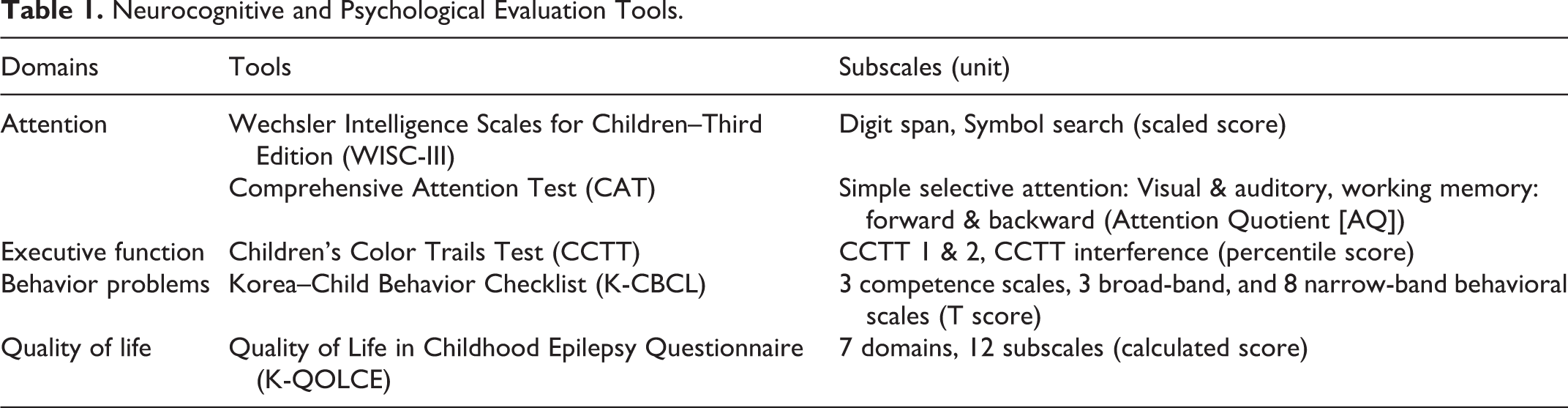
Electroencephalography (EEG), seizure frequency, and neuropsychological and psychological functioning (evaluation of attention, executive function, behavioral problems, and quality of life) were assessed at baseline, and at the 35th week when the exercise program ended (Table 1).
All participants attended the supervised exercise program twice weekly during the first 5 weeks. Each session lasted approximately 3 hours and consisted of 2 different activities for 90 minutes each. Activities included basketball, soccer, table tennis, badminton, jumping rope, and line dance. Participants were divided into 2 teams and they competed with each other. The instructor and participant ratio was 1:2 to 1:3.
After the 5-week supervised exercise program, participants were asked to continue to exercise through a home-based program. The home-based exercise program consisted of resistance exercises using their own body weight such as sit-ups and push-ups and 20 to 30 minutes of aerobic exercise. Participants were provided with a pedometer and encouraged to walk more than 7000 steps per day. Home-based exercise is different from supervised exercise such that children perform the exercise program on their own with encouragement of their parents at home. Detailed instructions for the home-based exercise program were given each month by exercise specialists. Also, children were asked to keep an exercise diary, which included when, what, and how they exercised, and how they felt after the exercise.
During the 30 weeks of home-based exercise, children and their parents participated in 4 follow-up meetings, which consisted of leisure activities such as hiking and bowling and education sessions. The importance of physical activity participation for children with epilepsy as well as how to motivate their children to continue exercising were addressed during education sessions for parents. Parents also received information on the management of children with epilepsy from experts including clinical psychologists, nurses, exercise physiologist, and pediatric neurologist. Children received feedback on their exercise participation based on exercise diary and pedometer record. Another purpose of the follow-up meetings was to instruct parents and children to continue participating in exercise at home independently after the study finishes.
Neurocognitive Outcome Measures (Table 1)
Neurocognitive assessments were administered at baseline and at follow-up. The neurocognitive assessments included 2 subtests, Digit Span and Matching, of the Wechsler Intelligence Scales for Children-Third Edition (WISC-III) 17 and the Comprehensive Attention Test (CAT). 18,19 These tests were used to evaluate psychomotor speed and simple visual and auditory attention. The Children’s Color Trails Test (CCTT), which includes 2 components, CCTT1 and CCTT2, was used to evaluate attention and executive function. Children’s Color Trails Test 1 has been shown to evaluate perceptual tracking, sustained attention, and psycho-motor speed, and Children’s Color Trails Test 2 examines divided attention, sequential processing, and inhibition-disinhibition ability. 20
Psychological Outcome Measures
Psychological outcome measures were completed by parents at baseline and at follow-up. Parents completed the Korean version of the Child Behavior Checklist (Korea–Child Behavior Checklist; K-CBCL) 21 for children’s behavioral problems and competence. For children’s quality of life, parents completed the Korean version of the Quality of Life in Childhood Epilepsy Questionnaire (K-QOLCE). 22
Satisfaction Surveys
Satisfaction with the exercise program was assessed by 2 separate satisfaction surveys, one filled out by the parent and the other filled out by the child. The questionnaire addressed enjoyment, satisfaction, and emotional and thought change, rated using a 5-point Likert-type scale from not at all (1) to very much (5).
Data Analysis
Neurocognitive and psychological outcome variables analysis were performed in children who participated in exercise therapy. Data processing and analysis were done with SPSS version 20.0. Descriptive statistics and nonparametric statistics such as the Wilcoxon signed-rank test were used for comparisons between baseline and long-term evaluation at week 35. Chi-squared tests were used for gender-based comparisons. In the case of identified outliers in each variable, we reanalyzed and confirmed P values after removal of outlier values.
Results
Demographic Data and Epilepsy Characteristics (Supplementary Table 1)
All participants completed the exercise program (4 boys and 6 girls) and were included in the analysis. The average age in the exercise group at the time of baseline evaluation was 10.3 years (range from 8.5 to 12.5), and at the time of postevaluation at 35 weeks was 10.8 years (range from 8.9 to 12.9). The mean age of onset (diagnosis with benign epilepsy with centrotemporal spikes) was 7.8 years (range from 6.5 to 9.3). Patients’ characteristics are summarized in Supplementary Table 1.
Long-Term Effects of Intervention on Neurocognitive Function (Table 2)
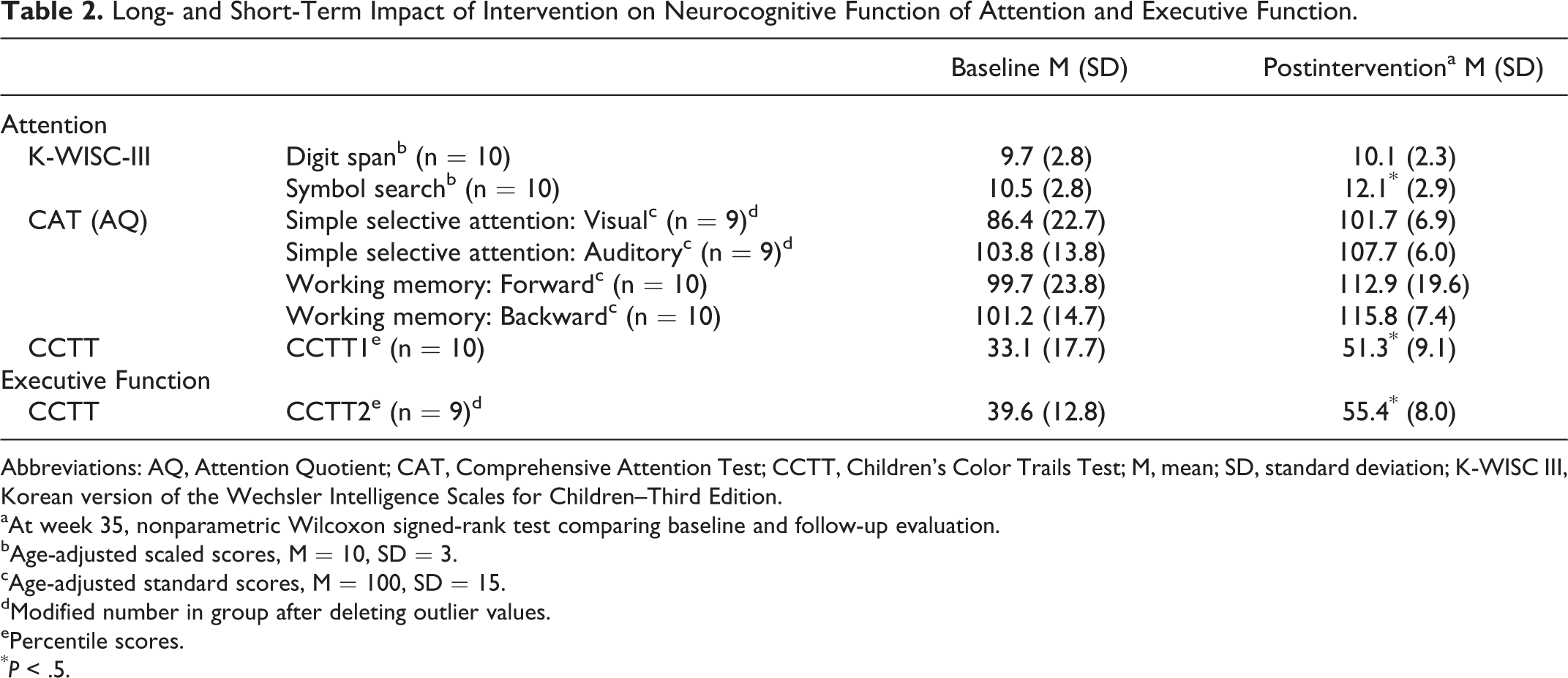
Long- and Short-Term Impact of Intervention on Neurocognitive Function of Attention and Executive Function.
Abbreviations: AQ, Attention Quotient; CAT, Comprehensive Attention Test; CCTT, Children’s Color Trails Test; M, mean; SD, standard deviation; K-WISC III, Korean version of the Wechsler Intelligence Scales for Children–Third Edition.
aAt week 35, nonparametric Wilcoxon signed-rank test comparing baseline and follow-up evaluation.
bAge-adjusted scaled scores, M = 10, SD = 3.
cAge-adjusted standard scores, M = 100, SD = 15.
dModified number in group after deleting outlier values.
ePercentile scores.
*P < .5.
Attention
At week 35, the Symbol Search subtest of the WISC-III (P = .041) and the Children’s Color Trails Test 1 (P = .035) showed significant improvements compared to values at baseline. Visual simple selective attention (P = .068) and working memory of backward (P = .068) from Comprehensive Attention Test showed trends toward improvement compared to their baseline values.
Executive function
The percentile mean score of CCTT2 for executive function was significantly improved (P = .012) at the 35th week.
Long-Term Effects of Intervention on Competence and Behavioral Problems (Table 3)
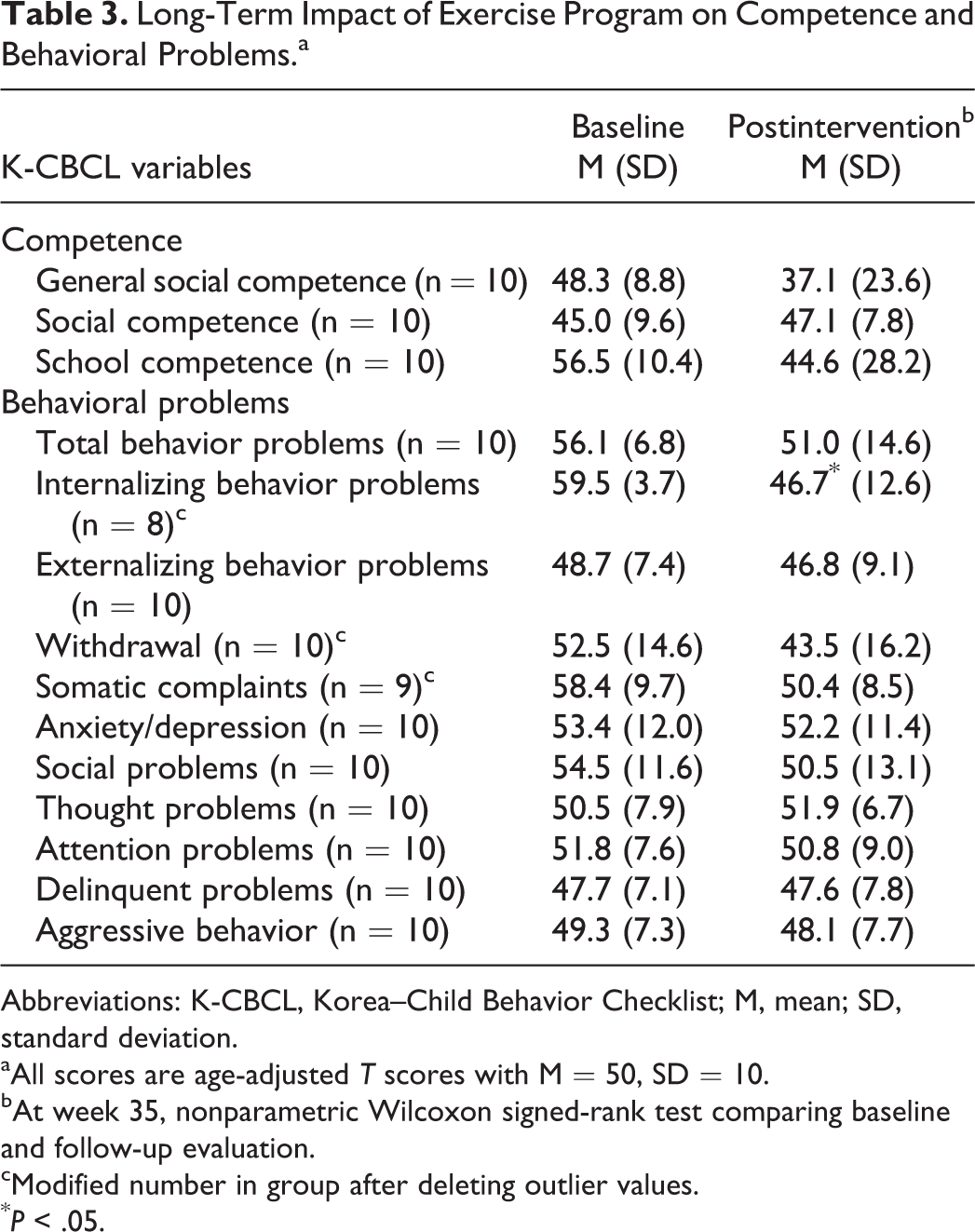
Long-Term Impact of Exercise Program on Competence and Behavioral Problems.a
Abbreviations: K-CBCL, Korea–Child Behavior Checklist; M, mean; SD, standard deviation.
aAll scores are age-adjusted T scores with M = 50, SD = 10.
bAt week 35, nonparametric Wilcoxon signed-rank test comparing baseline and follow-up evaluation.
cModified number in group after deleting outlier values.
*P < .05.
Competence
No significant change was observed at 35 weeks post evaluation compared to baseline.
Behavioral problems
A significant reduction in internalizing behavior problem score was found (P = .028) at 35 weeks post evaluation.
Effects of Intervention on Quality of Life (Table 4)
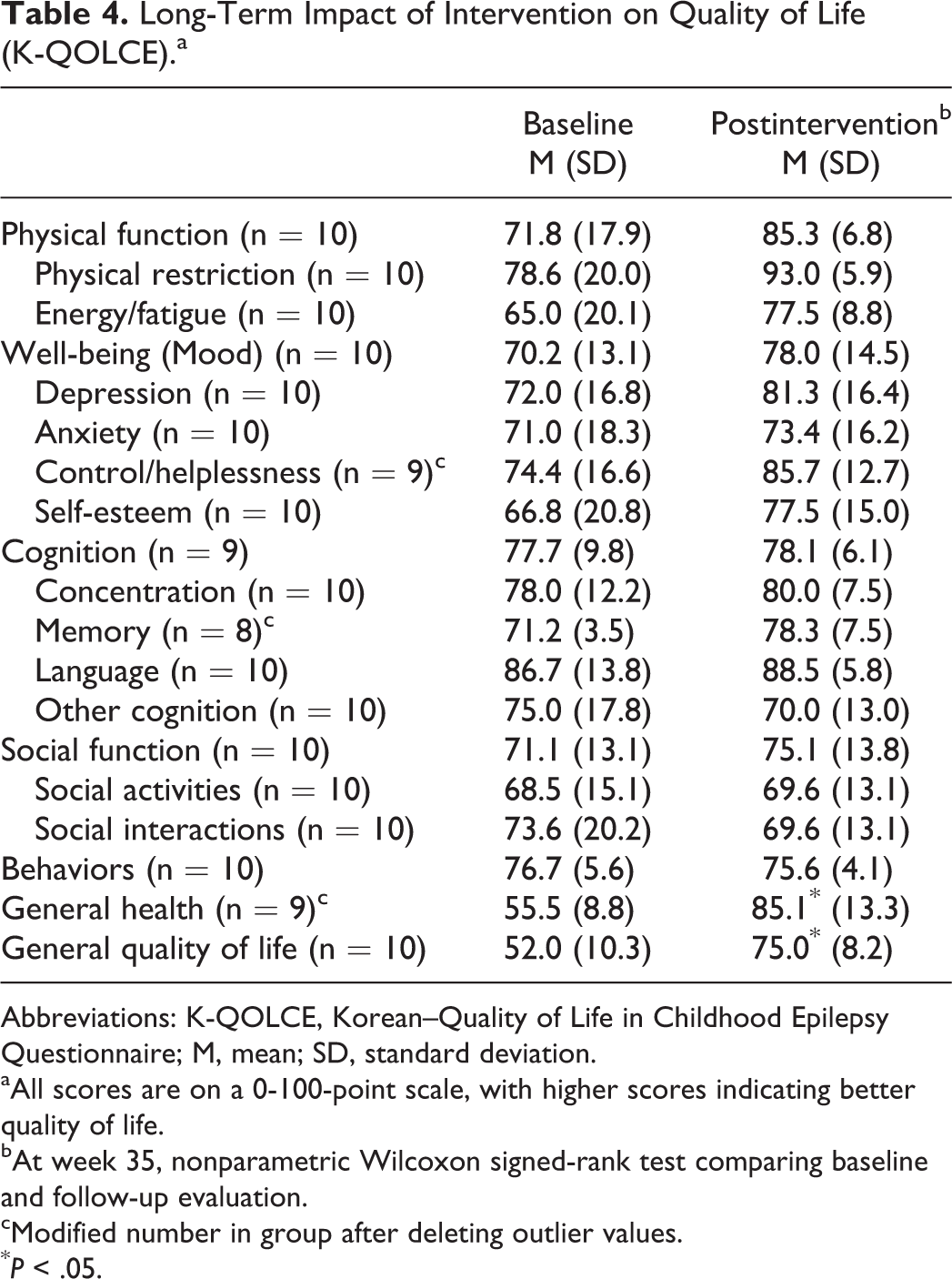
On Quality of Life in Childhood Epilepsy Questionnaire, general health (P = .018) and quality of life (P = .017) were significantly improved after 35 weeks compared to baseline levels.
Long-Term Impact of Intervention on Quality of Life (K-QOLCE).a
Abbreviations: K-QOLCE, Korean–Quality of Life in Childhood Epilepsy Questionnaire; M, mean; SD, standard deviation.
aAll scores are on a 0-100-point scale, with higher scores indicating better quality of life.
bAt week 35, nonparametric Wilcoxon signed-rank test comparing baseline and follow-up evaluation.
cModified number in group after deleting outlier values.
*P < .05.
Satisfaction surveys (Supplementary Table 2)
Both parents and children alike reported high levels of satisfaction with the exercise program. Both parents and children found it easy to use. Parents and children reported high levels of overall satisfaction (parents 4.3 ± 0.4, children 4.2 ± 0.7) and satisfaction with the quality of the content of the exercise program (parents 4.9 ± 0.3, children 4.5 ± 0.5). Both found that it addressed their needs well (parents 4.5 ± 0.7, children 4.2 ± 0.6), and they also found it enjoyable (parents 4.8 ± 0.4, children 4.8 ± 0.3). Most importantly, both parents and children reported that they noticed positive changes in their child’s (or their) thought or emotion over the 35-week course of the exercise program.
Discussion
This is the first clinical study to investigate the impact of a long-term exercise program in children with epilepsy. Previously, we tested the feasibility and the short-term benefits of a 5-week supervised exercise program for children with benign epilepsy. 16 For this study, we tested possible long-term intervention effects for the children after 35 weeks of supervised exercise and home-based intervention participation. At postevaluation, we found significantly higher levels of neurocognitive function and quality of life, and lower internalizing problems in children with benign epilepsy with centrotemporal spikes. These findings appear consistent with the previous report that there are benefits from exercise as an intervention for people with negative emotions. 23
In addition, it is interesting to note that ratings of general health and general quality of life from Quality of Life in Childhood Epilepsy Questionnaire significantly improved, whereas those measures did not show significant improvement in the short-term exercise program. 16 This result may reflect the fact that parents may notice children’s overall satisfaction on their health and quality of life at long-term assessment, in which therapeutic exercise therapy ultimately intends to pursue as a long-term goal. Because quality of life reflects an individual’s subjective sense of satisfaction, it may take longer for this impact to be realized and show improvement. Thus, our long-term study was able to detect this impact and improvement in quality of life due to exercising.
There are several possible explanations for the improved and maintained neurocognitive and psychological outcomes evident during long-term exercise program in this study. To increase feasibility in school-aged children with epilepsy, our long-term exercise program was composed of initial supervised sessions followed by a home-based exercise program. Supervised exercise sessions were comparatively intensive and instructive over a short period of weeks, whereas the home-based program focused more on daily exercise that could be continued for longer periods. Because children were encouraged to keep exercising at home after the supervised exercise program, which was followed by 4 follow-up meetings with group leisure activity and exercise diary checkups, they appeared to continue the habit of exercising they had learned from 5 weeks of supervised sessions. 16
In addition, based on surveys with children and parents about their satisfaction with the exercise program, it was qualitatively reported that parents could see higher levels of energy, motivation, and self-confidence than they had seen before the exercise program. These changes might also be related to ratings of lowered internalizing behavior problems and enhanced quality of life. Throughout the whole 35-week exercise program, children seemed to achieve and maintain benefits such as positive thinking, a self-assertive attitude, and higher working motivation that were reflected by their parents’ report on the satisfaction survey. These benefits could be obtained from enhanced physical, behavioral, and neurocognitive function during the supervised exercise program by keeping an increased exercise level.
Another possible explanation for the improved psychological outcomes may be increased social support. 24 Participating children experienced group play with peers, supervision with an exercise expert, and emotional support from their parents throughout 35-week exercise program, which seemed to make them feel supported. This finding may be related to the results of the previous study, which suggested indirect effects of peer/parent support and increased intrinsic motivation on physical activity and quality of life in students (aged 10-16 years). 25 Even after the supervised exercise program ended, encouragement and support from supervisors and parents continued to provide children with a sense of support and incentive to continue the habit of exercising.
These data demonstrate that a long-term exercise program may offer some neurocognitive and psychological long-term benefits in children with benign epilepsy with centrotemporal spikes. They suggest that the long-term program does not need to be intensively supervised but that it may be accomplished using initial supervised sessions followed by home-based exercise. As the feasibility and advantages of home-based exercise were reported in other clinical group, 26,27 a home-based exercise program followed by initial supervised sessions and instruction may be a more practical option for school-aged children.
We expect the results of this study to encourage the use of exercise as a supplemental therapeutic intervention in children with benign epilepsy, as exercise does not have the risk of drug-drug interactions and medication-related adverse effects, 6 and as it is likely to be time and cost-effective compared to psychotherapy for children with benign epilepsy.
However, it is important to acknowledge the limitations of our study. As a pilot study, the number of subjects was small and only included benign epilepsy with centrotemporal spikes cases, which are a very restricted group because they are almost seizure free, so we could not overgeneralize this result to other groups of children with epilepsy. Also, without a comparison group, it is hard to conclude whether the effects noted are uniquely related to exercise in children with epilepsy. Furthermore, it is important to be cautious in implementing exercise programs for children with benign epilepsy. Our subjects continued to be seizure free or very rare in seizure frequency during exercise program, and there was no significant change in the number of antiepileptic drugs during exercise. In addition, careful consideration needs to be taken in pediatric epilepsy with coordination difficulties, which might lead to more difficulties with exercise. Previous research has shown a high association between motor problems including developmental coordination disorder and epilepsy, and the possible role of rolandic spikes in developmental coordination disorder. 28,29 Despite of these limitations, the current results provide a foundation for future study of therapeutic exercise programs in pediatric epilepsy.
In conclusion, a long-term exercise program may provide some benefits with regard to neurocognitive function and psychological well-being in children with benign epilepsy with centrotemporal spikes. Especially for young children, exercise should be considered as a candidate for therapeutic intervention in childhood epilepsy.
Footnotes
Acknowledgment
The authors would like to thank the CROWN Confectionary Co., Ltd. for generous donation to the Epilepsy Research Institute. The authors also thank the patients, their parents, and exercise experts who participated in this study.
Author Contributions
HDK and JYJ contributed equally to this work. HDK, JYJ, and SE were responsible for the conception and organization of the research project; HDK and JYJ equally contributed to drafting and revising the work, and to the final approval of the version. SE was responsible for the design and execution of statistical analysis, and interpretation of data for the analysis; DL was responsible for the review of clinical variables. MKL, JHP, and JYJ were responsible for the administration and supervision of the exercise program, and JYJ, HCK, and JSL were responsible for article preparation.
Declaration of Conflicting Interests
The authors declared no potential conflicts of interest with respect to the research, authorship, and/or publication of this article.
Funding
The authors received no financial support for the research, authorship, and/or publication of this article.
Ethical Approval
This study had ethical approval from Severance Hospital’s IRB (4-2011-0274).

References
Supplementary Material
Please find the following supplemental material available below.
For Open Access articles published under a Creative Commons License, all supplemental material carries the same license as the article it is associated with.
For non-Open Access articles published, all supplemental material carries a non-exclusive license, and permission requests for re-use of supplemental material or any part of supplemental material shall be sent directly to the copyright owner as specified in the copyright notice associated with the article.
