






Abstract
Friedreich ataxia is an inherited disorder characterized by degeneration of the peripheral and central nervous system and hypertrophic cardiomyopathy. Homozygous mutations in the frataxine (FXN) gene reduce expression of frataxin and cause accumulation of iron in the mitochondria. Deferiprone, an oral iron chelator, has been shown effective in cell and animal models of Friedreich ataxia. The results of a 6-month randomized, double blind placebo-controlled study suggested that deferiprone 20 mg/kg/day may reduce disease progression. The authors present their experience of 5 Friedreich ataxia patients treated with deferiprone (20 mg/kg/day), in addition to idebenone treatment, followed over a period of 10-24 months, under off-label authorization. The patients were monitored for laboratory parameters, cardiac assessment, neurological evaluations, and quality of life. The authors conclude that combined therapy of a low dose of deferiprone with idebenone is relatively safe, might improve neurological function, and seems to improve heart hypertrophy, warranting further studies.
Friedreich ataxia (FA) is the most common form of hereditary ataxia characterized by a progressive gait and limb ataxia, areflexia, spasticity, and loss of proprioceptive sensation. Patients develop dysarthria and are wheelchair dependent within about 15 years of disease onset. The neuropathological features comprise degeneration of the dorsal columns of the spinal cord, the dorsal root ganglia sensory neurons as well as the spinocerebellar and pyramidal tracts. 1 The most common cardiac abnormality in Friedreich ataxia is hypertrophic cardiomyopathy which affects about 63% of the Friedreich ataxia patients and at final stages progresses toward arrhythmia that leads to early death; 2 life expectancy in Friedreich ataxia is reduced to ∼30-40 years. 3
Friedreich ataxia is caused by a recessive mutation in the frataxine (FXN) gene (usually a homozygous expansion of a GAA repeat in the first intron), resulting in decreased expression of frataxin, a key player in iron-sulfur cluster protein formation and thereby in citric acid cycle and respiratory-chain activity. Restricted iron-sulfur cluster protein formation and ensuing reduction in iron utilization causes iron accumulation in mitochondria in labile forms that leads to oxidative damage by promoting reactive oxygen species formation, and also to cytosolic iron depletion. Metabolically active cells in the nervous system, heart and endocrine glands, are particularly affected by the mitochondrial dysfunctions associated with frataxin deficiency. 4 -6 An attempt to improve a defective mitochondrial respiratory function in Friedreich ataxia leaned on the administration of a coenzyme Q10 analog as potential antioxidant and electron carrier. Clinical studies based on a daily dose of 5 mg/kg idebenone showed a minor reduction in oxidative stress markers and cardiac hypertrophy, but no effect on neuromuscular function. 7 Although subsequent studies with larger doses of idebenone provided some indications for possible neurological benefits, 8 the general efficacy of Friedreich ataxia treatment with antioxidants alone is still to be established. Another approach, aimed at relieving the toxic effects of iron that accumulates in mitochondria of Friedreich ataxia-deficient cells, providing that treatment addresses regionally accumulated iron while sparing systemic iron pools, 9 was based metal chelators. 10 Deferiprone (3-hydroxy-1, 2-dimethylpyridin-4-one, deferiprone) is a mild oral iron chelator used in the treatment of systemic iron overload 11,12 that can cross cell membranes including the blood brain barrier, has the ability to gain access to organellar iron pools, to chelate labile iron and to transfer the metal to cellular acceptors or circulating transferrin. 13,14 Deferiprone treatment led to functional improvements in cell functions affected by reduced expression of frataxin 15 and was effective in animal models, 16 paving the way for an open-label clinical study with deferiprone (20-30 mg/kg/day) in conjunction with idebenone (5 mg/kg/day). The treatment resulted in a significant reduction of iron foci in the dentate nuclei (by R2* MRI) and a mild amelioration in neurological signs and symptoms in young Friedreich ataxia adolescents 17 that were confirmed in another study with a larger number of patients that additionally demonstrated a remarkable improvement in affected cardiac function. 18 The results of a 6-month randomized, double blind placebo-controlled study were recently published 19 and demonstrated an acceptable safety profile of deferiprone at 20 mg/kg/day. Subgroup analyses suggested that, in patients with less severe disease, deferiprone 20 mg/kg/day may reduce disease progression, while higher doses appeared to worsen ataxia.
The authors hereby present their local experience with a selected number of Friedreich ataxia patients treated with deferiprone and followed up for 12 to 24 months for neurological, cardiological, and hematological outcomes.
Patients and Methods
The authors report the outcome of 7 Friedreich ataxia patients (age range, 16-36 years; average, 23.5 years) who were seen at the authors’ clinic during the years 2009-2013. The diagnosis of Friedreich ataxia was confirmed genetically and the patients had no other significant medical conditions, or any hematological or hepatic disorders. All were offered deferiprone treatment under off-label authorization. The drug was delivered on a compassionate basis and they were instructed to take deferiprone orally (20 mg/kg body weight per day in 2-3 divided doses) following an initial 4-week titration period. The patients were followed by a multidisciplinary team comprised of neurologists, a hematologist and a cardiologist. They started therapy under a strict safety and efficacy protocol with periodic laboratory tests (every 3 months) that included general chemistry, hemoglobin A1C, serum iron, ferritin, transferrin, vitamin B12, and folic acid levels and weekly complete blood counts as means to monitor the risk of anemia, neutropenia, or agranulocytosis. All patients went through a detailed clinical assessment at baseline and every 3 months, including a complete neurological exam and scoring according to the Scale for Assessment and Rating of Ataxia, 20 the Friedreich Ataxia Rating Scale, and quality of life rating using the Short Form (36) Health Survey. The Friedreich Ataxia Rating Scale is a neurological scale of ataxia developed specifically for rating Friedreich ataxia and comprises an item of functional staging for ataxia (score 0 [normal] to 6 [confined to wheelchair]), an item of activities of daily living, an item of neurological examination and a last item of instrumental examination to measure finger dexterity (the 9-hole peg test for both hands], that is not included in the total score. 21,22 At baseline and then every 6 months the patients went through a cardiologic assessment, which included a standard 12-lead electrocardiogram, an echo-Doppler study, 24 hours Holter recording and a physical check-up. Left ventricular hypertrophy was defined as left ventricular wall thickness ≥ 12 mm.
The patients’ data report was approved by the institutional Helsinki committee. Seven patients started treatment with deferiprone and 2 stopped deferiprone intake due to poor tolerance during the adjustment period. They complained of general weakness, fatigue and dizziness that resolved spontaneously after discontinuation of treatment. Here the authors report the outcome of 10-24 months deferiprone treatment for the 5 remaining patients (4 males, age range: 16-36 years; average: 23.8 years); all patients continued with idebenone treatment (between 5 and 15 mg/kg/day) that they had been taking.
The patients’ baseline characteristics are given in Tables 1 and 2.
Characteristics of Patients With Friedreich ataxia Along With Neurological Outcomes and Quality of Life on Deferiprone Therapy.
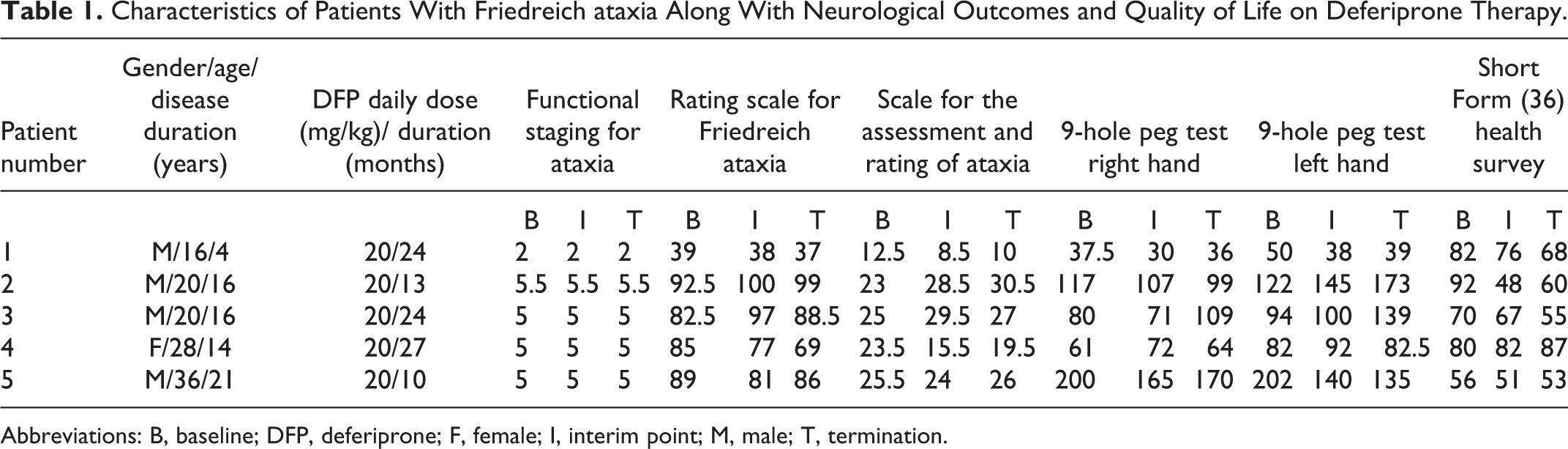
Abbreviations: B, baseline; DFP, deferiprone; F, female; I, interim point; M, male; T, termination.
Cardiac Outcomes and Adverse Events Related to Deferiprone Therapy.
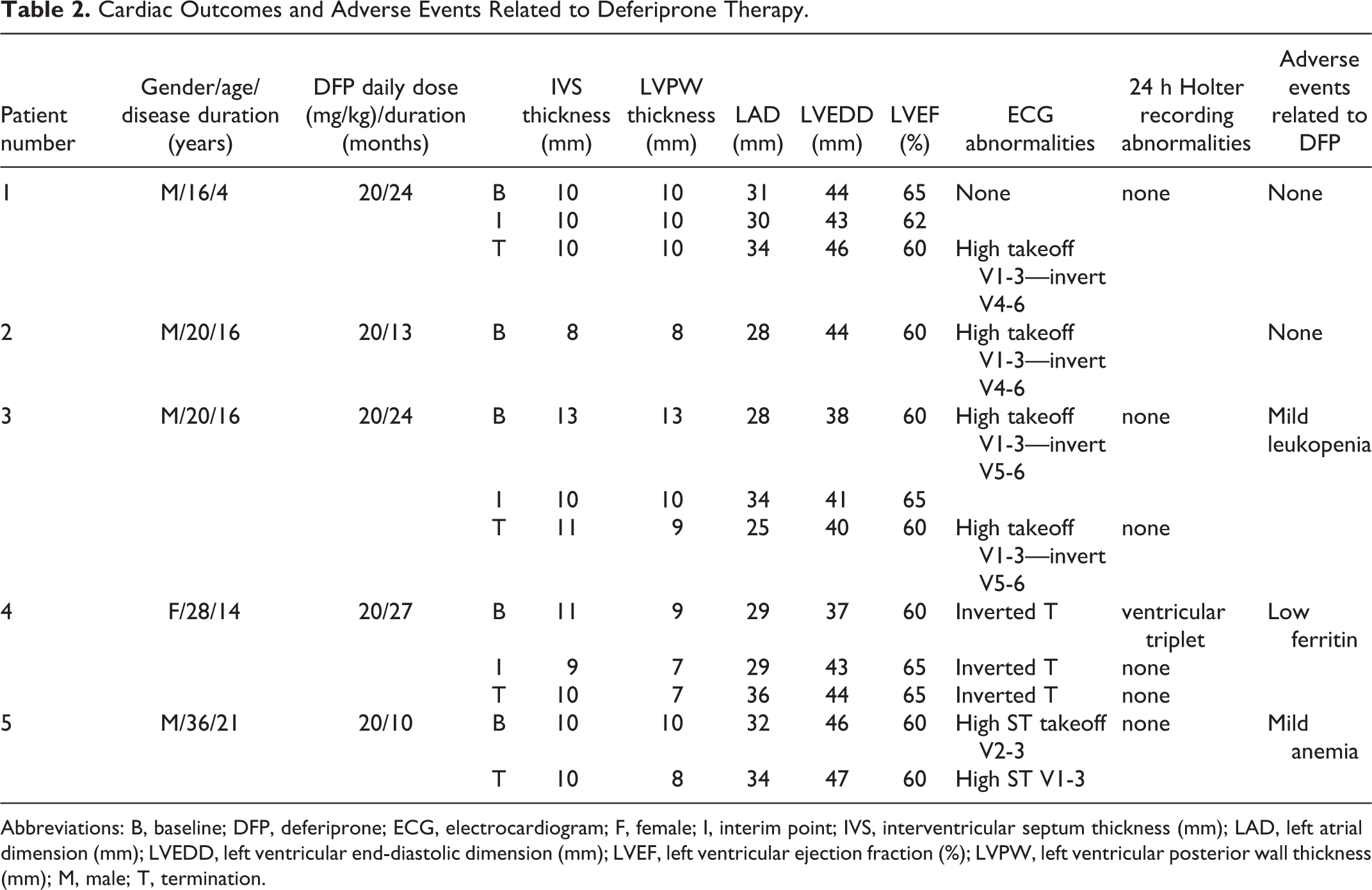
Abbreviations: B, baseline; DFP, deferiprone; ECG, electrocardiogram; F, female; I, interim point; IVS, interventricular septum thickness (mm); LAD, left atrial dimension (mm); LVEDD, left ventricular end-diastolic dimension (mm); LVEF, left ventricular ejection fraction (%); LVPW, left ventricular posterior wall thickness (mm); M, male; T, termination.
Results
Neurological Measures
The neurological outcome of treatment with deferiprone (n = 5), at baseline, at an interim point, and at the end of the follow-up, is presented in Table 1. Patient 1, (male, 16 years old), who started deferiprone 2 years from onset of Friedreich ataxia symptoms, still ambulatory without aid, completed 2 years of treatment. He showed an improvement of the Friedreich Ataxia Rating Scale score (from 39 to 37), the Scale for Assessment and Rating of Ataxia score (from 12.5 to 10) and the 9-hole peg test times (right hand: from 37.5 to 36 sec; left hand: from 50 to 39 sec); he stayed at stage 2 (symptoms present, recognized by the patient but still mild) at the termination of the study. Patient 2 (male, 20 years old), 16 years of Friedreich ataxia symptoms at baseline and wheelchair-dependent for 5 years, completed 13 months of treatment but worsened along. Friedreich Ataxia Rating Scale score worsened from 92.5 to 99, Scale for Assessment and Rating of Ataxia score from 23 to 30.5, and 9-hole peg test timing of left hand worsened (from 122 to 173 sec). Only 9-hole peg test timing of right hand improved (from 117 to 99 sec). This patient remained at stage 5.5 until the end of follow-up. Patient 3 (male, 20 years old), with 16 years of Friedreich ataxia symptoms, who completed 24 months of treatment, showed a worsening of the neurological parameters: Friedreich Ataxia Rating Scale score worsened from 82.5 to 88.5, Scale for Assessment and Rating of Ataxia from 25 to 27, the 9-hole peg test times for the right hand, from 80 to 109 sec and for the left hand from 94 to 139 sec . He remained at the stage 5 of the disease. Patient 4, (female, 28 years old) after 14 years of Friedreich ataxia symptoms, wheelchair dependent for 7 years, completed 27 months of treatment. She showed an improvement of the Friedreich Ataxia Rating Scale score (from 85 to 69) and of the Scale for Assessment and Rating of Ataxia score (from 23.5 to 19.5). There was a worsening of the 9-hole peg test times (right hand: from 61 to 64 sec; left hand: from 82 to 82.5 sec). She remained at stage 5 (confined but can navigate a wheelchair) to the end of follow-up. Patient 5 (male, 36 years old), with 21 years of Friedreich ataxia symptoms at baseline and wheelchair-dependent for 7 years, who completed 10 months of treatment, showed an improvement of the Friedreich Ataxia Rating Scale score (from 89 to 86), a worsening of the Scale for Assessment and Rating of Ataxia score (from 25.5 to 26) and an improvement of 9-hole peg test time (right hand: from 200 to 170 sec; left hand: from 202 to 135 sec). He remained at stage 5 at last visit.
Cardiological Assessment
The electrocardiography (ECG) and echocardiography measures at baseline, follow-up, and termination are presented in Table 2. All patients were in sinus rhythm but most had minor ECG abnormalities. These include high ST takeoff in the right precordial leads or T wave inversions but none had voltage criteria for ventricular hypertrophy or conduction abnormalities. On echocardiography 2 patients had mild left ventricular hypertrophy at baseline. All had normal ventricular size and function without atrial enlargement or evidence of diastolic dysfunction. Holter recordings documented no significant arrhythmias or conduction abnormalities, although 1 subject (patient 7) had a brief episode of a 2nd degree atrioventricular block (Mobitz type I) recorded. Four, including 1 subject with left ventricular hypertrophy, were treated with deferiprone for 18-30 months. When reassessed after 16 and 30 months of deferiprone treatment, patient 3 displayed a regression of the left ventricular hypertrophy with a decrease of wall thickness to a normal range. None of the others developed left ventricular hypertrophy or dysfunction on the follow-up, although 1 patient developed typical ECG changes after being 2 years on therapy (Table 2).
Quality of Life Parameters
The Short Form (36), a generic questionnaire of quality of life, showed deterioration for all the patients except 1 (patient 4), during deferiprone treatment (Table 2).
Adverse Iatrogenic Effects
No adverse effects were reported except for the 2 patients who therefore discontinued deferiprone (Table 2).
Biochemical and Hematologic Parameters
Although deferiprone treatment showed no major hematological damage, most patients displayed a minor decrease in white blood cell count (only in patient 3 it fell temporarily below the normal range) and red blood cell count and in ferritin levels, all of which resolved spontaneously after dose adjustment.
Discussion
Friedreich ataxia is a disease of iron imbalance that results from reduced mitochondria iron utilization caused by a deficiency in frataxin. The ability of deferiprone to scavenge labile mitochondrial iron and render it bioavailable, served as rationale for testing its ability to restore cell functions affected by frataxin deficiency in the experimental cell setting 15,16 and clinically inpatients. 17,18,23 In the recently published multinational multicenter randomized placebo-controlled phase II trial, 19 3 daily doses (20, 40, and 60 mg/kg/day) of deferiprone versus placebo were tested on Friedreich ataxia patients during 6 months. The high dose arm was suspended early after treatment onset due to a worsening of ataxia in a few patients. The medium dose arm showed possible worsening while the low dose arm showed no conclusive results. The authors failed to show significant neurological improvement in the treated patients, probably in part due to lack of worsening in the placebo group and due to the short duration of the trial. Indeed, the placebo effect could overcome the disease progression in such a short duration study. On the other hand, the left ventricle mass index significantly decreased in the 20 and the 40 mg/kg/day arms but not in the placebo arm.
In this report of deferiprone treatment combined with idebenone, of the 7 recruited patients, 2 withdrew due to poor tolerance to low doses during the adjustment period and irrespective of their baseline iron status (ferritin or blood count). One of the patients had a low baseline ferritin level, without anemia, while the other did not. Reduced ferritin/iron levels were common in the authors’ patients, but other subjects did not complain of similar adverse reactions. It seems that drug intolerance appeared too early to be attributed to an effect of deferiprone on global or regional cell iron status and that it is probably due to an iatrogenic effect of the original drug per se or one of its metabolites that are generated hepatically by secondary metabolism. 24
Four out of the 5 remaining patients treated with deferiprone for a significant period, had started treatment when they were already wheelchair-dependent. Although 3 out of them improved neurologically, the small sample precludes us from attributing any statistical significance to treatment efficacy. In addition, one cannot rule out a placebo effect as this was an open label treatment.
The worsening in the Friedreich Ataxia Rating Scale score that was observed in 2 of the 5 patients treated with deferiprone is concordant with the expected decline rate of approximately 6.2 points over a 2-year period, 25 suggesting that the deterioration probably reflected the natural disease course independent of deferiprone treatment. It is noteworthy that in the authors’ report the most impressive improvement of Friedreich Ataxia Rating Scale score was seen in patient 4 who entered the study while at Friedreich Ataxia Rating Scale score of 85 points. In the prior mentioned natural history study, a substantial ceiling effect was shown at scores greater than 89 points. Within the limitations of open-label treatment, this may suggest that even at advanced stages of Friedreich ataxia, significant improvements can be seen after 2 years of deferiprone treatment. However, it should be mentioned that this patient’s quality of life (Short Form [36]) score were markedly different from that of the remaining patients. Thus, the authors cannot rule out a placebo effect.
With regards to the single patient with left ventricular hypertrophy that fully responded to deferiprone treatment by normalizing the left ventricular wall thickness, the authors cannot dismiss the possibility that treatment with idebenone for 2 years contributed indirectly to deferiprone evoked cardiac improvement. However, taken in total, the beneficial effect of deferiprone on the heart as compared to the peripheral and the central nervous system, might be related to starting treatment at an early stage of cardiac dysfunction, as indicated also by others. 18,26 If that is the case, it could indicate that deferiprone therapy for Friedreich ataxia might be particularly beneficial if initiated early, before irreversible cell damage takes place.
The limitations of the present report apart from the small number of patients, include the concomitant treatment with idebenone that makes differentiation of benefit from each medication difficult. Additional limitations include variability of the duration disease and of treatment, with most patients of prolonged duration and significant neurological disability, which may not be reversed or halted with any treatment.
Regarding the effect of deferiprone treatment on quality of life, the authors think that the large number of rating tests that draws patients’ awareness toward their deficits, along with the burden of frequent blood testing demanded by the safety protocol may worsen quality of life. These points should be taken into consideration by medical teams that deal with patients with chronic disease, poor prognosis and serious handicap. Such patients could potentially obtain improvement of their self-perception and global health as well as test performance by adequate psychological support and physiotherapy.
The authors conclude that combined therapy of a low dose of deferiprone with idebenone is relatively safe, might improve neurological function and seems to improve heart hypertrophy, warranting further studies.
Footnotes
Author Contributions
SEB and AG contributed equally to data acquisition, neurological follow-up of patients, results interpretation, and manuscript writing. DM was responsible for hematological follow up, adverse reactions management, dosage re-adjustment, and manuscript revision. EK participated in data acquisition; IC was responsible for project conception, data interpretation and manuscript revision; and MA and DF performed cardiological assessment, cardiological data interpretation, and revision of the manuscript. SHB supervised the project conception; data acquisition and interpretation; and manuscript writing, editing, and revision.
Declaration of Conflicting Interests
The authors declared no potential conflicts of interest with respect to the research, authorship, and/or publication of this article.
Funding
The authors received no financial support for the research, authorship, and/or publication of this article.
Ethical Approval
The patients’ data report was approved by the institutional Helsinki committee.