






Abstract
The objective of this study was to determine the efficacy and safety of levetiracetam in treatment of neonatal seizures due to hypoxic ischemic encephalopathy. Seizures often persist in neonates with hypoxic ischemic encephalopathy despite phenobarbital. A retrospective single-center study was conducted in neonates ≥36 weeks gestation with hypoxic ischemic encephalopathy. A total of 127 neonates were identified born 2008-2015. Clinical seizures occurred in 83 infants. Fifty-one neonates (61%) had cessation of seizures with only phenobarbital. Thirty-two neonates received levetiracetam after phenobarbital, and the seizures stopped in 27 of these neonates. The mean total loading dose of levetiracetam was 63 mg/kg. Mean maintenance dose of levetiracetam was 65 mg/kg/d. We found no negative side effects in neonates following levetiracetam use. Our study finds that levetiracetam is an efficacious medication in treatment of seizures in the setting of neonatal hypoxic ischemic encephalopathy. Future prospective studies should explore its use as a first-line medication.
Keywords
Hypoxic ischemic encephalopathy affects 1 to 6 per 1000 live births. 1 Seizures occur frequently in neonates with hypoxic ischemic encephalopathy and studies report incidence ranging from 30% to 90%. 2 -4 Neonates undergoing therapeutic hypothermia show a decrease in seizure burden (total amount of time seizures are present) during the acute period of injury. 2 However, electrographic seizures are still present in almost 50% of infants receiving therapeutic hypothermia. 2,4 Data suggest that prolonged electrographic seizures lead to poor neurologic outcome 5 ; thus, effective treatments for neonatal seizures are critical. Historically, the first-line medication for treatment of seizures in the neonatal intensive care unit is phenobarbital. Second-line medications have included fosphenytoin and midazolam. 6 Treatment with phenobarbital may be problematic because it produces the phenomenon of electroclinical dissociation. This occurs in neonates as a result of efflux of chloride from γ-aminobutyric acid A (GABAA) receptors. 7 Further, phenobarbital use has been linked to poor neurocognitive outcome. 8
With the availability of intravenous formulation of antiepileptic drugs such as levetiracetam, there has been an increase in its use in the neonatal population. Studies examining safety, tolerability, and efficacy of levetiracetam in neonates report favorable findings. 9 -12 However, neonates in these studies had diverse seizure etiologies, including hypoxic ischemic encephalopathy, genetic disorders, metabolic derangements, and/or brain structural abnormalities. 9,10 There was also great variability in levetiracetam treatment doses. 9,10 It is unclear whether etiology of injury can influence effectiveness of levetiracetam in control of neonatal seizures. The objective of this study was to examine the safety and efficacy of levetiracetam in controlling seizures in neonates specifically with hypoxic ischemic encephalopathy. Doses used in this study are also higher than previously reported.
Methods
This was a retrospective single-center cohort study. The institutional review board at Cincinnati Children’s Hospital Medical Center approved the study, including waiver of consent. Neonates treated for hypoxic ischemic encephalopathy between August 2008 and April 2015 at Cincinnati Children’s Hospital Medical Center were considered for this study. Inclusion criteria for neonates in this study were the following: (1) gestational age >35 weeks, (2) clinically recognized encephalopathy or seizures, and (3) one of the following: fetal distress at delivery; need for resuscitation at birth; Apgar score <6 at 5 minutes; metabolic acidosis (pH <7.1 or base deficit >10). These criteria have been used in previously published literature of neonates with perinatal asphyxia or hypoxic ischemic encephalopathy. 13 -17 Additional eligibility criteria for cooling included meeting the following physiologic and neurologic criteria.
Physiologic criteria
Cord blood gas or any postnatal blood gas at ≤1 hour of life with a pH of ≤7.0 or a base deficit of ≥16. If no blood gas was available or blood gas had pH 7.01-7.15 and/or base deficit of 10-15.9 and neonate had a history of an acute perinatal event (placental abruption, cord prolapse) and met at least 1 of the following 2 criteria: Apgar score ≤5 at 10 minutes of life or continued need for ventilation initiated at birth and continued for at least 10 minutes.
Neurologic criteria
The presence of moderate/severe encephalopathy or seizures. Neonates were considered for therapeutic hypothermia (whole body cooling) if meeting recognized criteria prior to 6 hours of life.
Exclusion criteria
Exclusion criteria for therapeutic hypothermia included presence of a known chromosomal anomaly and/or major congenital anomalies, severe intrauterine growth restriction (<1800 g birth weight), or gestational age less than 36 weeks. In addition to these criteria, neonates were excluded from our study if inborn error of metabolism or genetic epilepsy was identified. Both cooled and uncooled neonates with hypoxic ischemic encephalopathy were included in our study.
Medical records were comprehensively reviewed and data were collected regarding demographic information, perinatal and neonatal course, post-natal follow-up and clinical and laboratory findings. Our primary outcome measure was to assess efficacy of levetiracetam in controlling clinical seizures. Secondary outcome measures included assessing side effects of levetiracetam and duration of maintenance on levetiracetam.
Cincinnati Children’s Hospital Medical Center is a referral hospital and all neonatal intensive care unit patients are transferred from the birth hospital for further care. Antiepileptic drugs were initiated in a portion of neonates at the birth hospital if there was clinical suspicion of seizures or detection of subclinical seizures on amplitude integrated electroencephalography (aEEG) tracings. Continuous prolonged video EEG monitoring was not performed in all neonates. In those who received levetiracetam (32 neonates), all but 4 neonates (88%) underwent continuous EEG monitoring at Cincinnati Children’s Hospital Medical Center. Two neonates received initial care at other institutions without continuous EEG capability; insufficient records were available for 2 neonates to accurately determine whether continuous EEG monitoring was present during levetiracetam administration. In 2012, a neonatal seizure protocol was implemented for use in neonates at Cincinnati Children’s Hospital Medical Center. This protocol has the following guidelines: (1) loading dose of phenobarbital 20 mg/kg; (2) if seizures continue, second loading dose of phenobarbital 20 mg/kg; (3) if seizures continue, loading dose of levetiracetam 50 mg/kg; (4) if seizures continue, a second loading dose of levetiracetam 50 mg/kg; and (5) if seizures continue, a loading dose of levetiracetam 20 mg/kg. If seizures continue following this loading dose, discussion with attending neonatal neurologist to determine subsequent medication plan; options include pyridoxine challenge, initiation of midazolam drip, fosphenytoin or other antiepileptic drugs. Once a loading dose of a given antiepileptic drug is administered, neonates are placed on maintenance dose(s) of the medication(s).
Statistical Methods
Data were analyzed using Microsoft Excel. Categorical variables were reported as percentages and compared using chi-squared test; continuous variables were reported as median or mean with ranges.
Results
Demographic and Clinical Information
One hundred twenty-eight neonates with diagnosis of hypoxic ischemic encephalopathy were identified. One neonate was excluded because of the presence of chromosomal anomaly, resulting in a study cohort of 127 neonates. There were 75 males (59%) (Table 1). The median gestational age was 39.1 weeks (range: 35.0-42.4 weeks) and median Apgar scores were 1 at 1 minute and 4 at 5 minutes (Table 1). Mean maternal age was 27.6 years and the most common identifiable intrapartum complications were meconium aspiration, placental abruption, and chorioamnionitis (Table 1). Eighty-seven underwent therapeutic hypothermia. Forty neonates were not cooled.
Demographic and Clinical Information About Patient Population.

Abbreviation: SD, standard deviation.
Phenobarbital Use in Infants With Hypoxic Ischemic Encephalopathy
Seizures occurred in 83 neonates (65%) with hypoxic ischemic encephalopathy (Table 2). Eighty neonates received phenobarbital as a first-line medication. Overall, 51 infants (61%) had cessation of seizures following administration of phenobarbital. Comparison of cooled and uncooled neonates showed no difference in the incidence of neonates with seizures (63% cooled vs 70% uncooled; P = .46) or in response to phenobarbital (P = .16) (Table 3).
Antiepileptic Drug Response All Infants.a
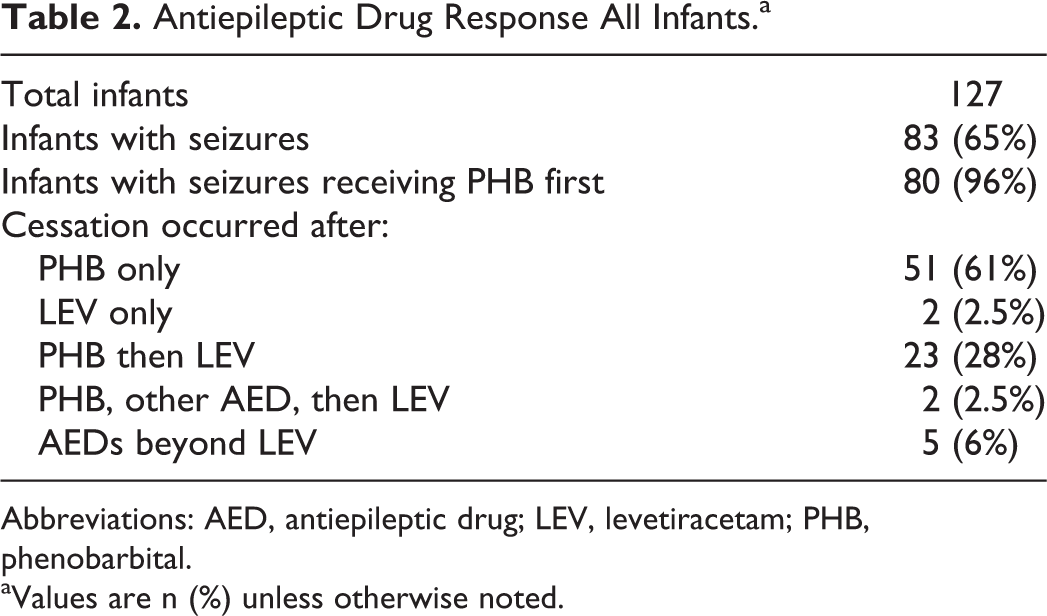
Abbreviations: AED, antiepileptic drug; LEV, levetiracetam; PHB, phenobarbital.
aValues are n (%) unless otherwise noted.
Antiepileptic Drug Response: Comparison of Cooled and Uncooled Infants.

Abbreviations: AED, antiepileptic drug; LEV, levetiracetam; PHB, phenobarbital.
Levetiracetam Use in Neonatal Seizures
Our primary outcome measure was to assess the efficacy of levetiracetam in controlling clinical seizures. Thirty-two neonates received levetiracetam. Twenty-eight of these neonates underwent prolonged (>24 hours) continuous EEG monitoring at Cincinnati Children’s Hospital Medical Center. In 25 of these 28 neonates (89%), seizures were shown to stop on EEG monitoring after receiving levetiracetam. Overall, seizures stopped in 27 of 32 of neonates (84%) after receiving levetiracetam, and no further medications were needed. The majority (n = 23; 72%) received levetiracetam as a second-line medication following phenobarbital. The mean dosing time period between these 2 antiepileptic drugs was approximately 6 hours (range: 1-15 hours). In this subset of neonates, seizure cessation was achieved within 72 hours of seizure onset.
Two neonates (6%) received levetiracetam as a third-line medication. Neither neonate required additional antiepileptic drugs. One neonate received bolus dosing of phenobarbital (20 mg/kg × 2) followed by initiation of versed drip; levetiracetam in bolus doses of 50 mg/kg followed by 25 mg/kg was administered within 8 hours of having received the first dose of phenobarbital. The other neonate was transferred to our institution on day of life 4; this infant had received phenobarbital (10 mg/kg) and fosphenytoin prior to starting levetiracetam (unclear dosing based on available documentation) on day of life 4 at the outside hospital. He was maintained on a dose of 44 mg/kg of levetiracetam. Phenobarbital and fosphenytoin were discontinued upon transfer to Cincinnati Children’s Hospital Medical Center, and no seizures were noted.
Two babies received levetiracetam as first-line medication at a dose of 50 mg/kg and achieved seizure cessation; one infant continued on maintenance medication at 44 mg/kg/d and the other infant died during the hospitalization due to complications from systemic illness.
Five neonates (16%) required additional antiepileptic drugs beyond levetiracetam. One neonate received 3 loading bolus doses (each dose: 50 mg/kg) of levetiracetam as a first-line medication and required additional antiepileptic medications (phenobarbital: 20 mg/kg and topiramate 5 mg/kg) for seizure-control during the acute period. One baby received phenobarbital, followed by levetiracetam, fosphenytoin, topiramate and versed drip. The remaining 3 babies received levetiracetam following phenobarbital but did not achieve seizure cessation until fosphenytoin was added. This typically occurred around 48 hours after receiving the first dose of phenobarbital.
The mean total loading dose of levetiracetam was 63 mg/kg (range: 20-150 mg/kg); this dose was typically divided into multiple smaller doses administered within a 24-hour period. The initial loading dose in the majority of the infants, particularly after the institution of a neonatal seizure protocol in 2012, was 50 mg/kg. Mean maintenance dose was 65 mg/kg/d (range: 30-100 mg/kg/d). The mean maintenance dose at time of discharge was 58 mg/kg/d (range: 5-100 mg/kg/d). Maintenance dosing was divided every 12 hours in the majority of neonates (n = 17); 3 neonates initially received levetiracetam every 8 hours. Thereafter, dosing was switched to every 12-hour interval.
As a secondary outcome measure, we also examined the side effects of levetiracetam. We evaluated vital signs including heart rate, blood pressure, and urine output 24 hours before and after administration of levetiracetam. We also examined laboratory data at discharge (hepatic and renal function). We found no negative effects on these parameters in neonates following levetiracetam use. We also examined duration of therapy. Of the 32 neonates who received levetiracetam, 20 (63%) were discharged home on this medication; 8 infants (25%) died and the remainder were not maintained on it. Infants on levetiracetam therapy were followed for a mean of 32 months (range: 2-64 months). Mean age of discontinuing levetiracetam was 4.4 months (range: 21 days-8.7 months).
Discussion
Phenobarbital continues to be used as first-line medication in treatment of neonatal seizures in most institutions despite management difficulties conferred by its tendency to produce electroclinical dissociation. 7 This phenomenon is attributed to developmentally regulated expression of chloride transporters in the cerebral cortex. There is a high expression of NKCC1 chloride transporter, which facilitates inward transport of chloride ions in the developing cortex. 7 In the mature brain, NKCC1 expression is downregulated and there is upregulation of KCC chloride transporter, which facilitates efflux of chloride out of the cell. 7 In the immature cerebral cortex, activation of the GABAA receptors by phenobarbital leads to efflux of chloride down its concentration gradient, producing a depolarizing cellular response. 7 The result of this phenomenon is that treating neonatal seizures with phenobarbital can cause outward manifestations of seizures to cease while electrographic seizure activity continues. This complicates clinical seizure management, particularly where continuous EEG monitoring is not available because the bedside clinician can have a false impression that seizures have stopped. Phenobarbital is also potentially problematic because there is evidence that it can lead to suboptimal developmental outcome. 8 Its use in older children has been linked to attention and memory deficits. 18 Evaluation of infants who received PB for seizures in the neonatal period showed worse neurodevelopmental outcomes than those who received levetiracetam in cognitive and motor domains. 19
Levetiracetam was first approved by the United States Food and Drug Administration in 1999 for treatment of partial-onset seizures in adults. 20 In 2007, the FDA expanded its use as an adjunctive medication in treatment of primary generalized tonic-clinic seizures for patients >5 years of age. The availability of intravenous and oral formulations has made it very appealing to use as an off-label medication in treatment of neonatal seizures. Other favorable features include rapid oral absorption, urinary excretion/metabolism, lack of interaction with other medications, and relatively short half-life compared with phenobarbital. 11 Its mechanism of action is not fully understood but it is thought to inhibit excitatory neurotransmitter release presynaptically by acting on SV2a receptor within synaptic vesicle and preventing vesicular fusion at presynaptic sites. 21
Our study examines the use of levetiracetam in neonates with hypoxic ischemic encephalopathy. In our study cohort of 127 patients with hypoxic ischemic encephalopathy, seizures occurred in 83 infants (65%). The overall incidence of seizures in our population (63% of cooled and 70% of uncooled infants) is similar to findings in previous studies. 2,22 Conventional EEG was not used to confirm presence of seizures in all infants, and some infants were treated with phenobarbital for clinical suspicion of seizures alone. Given the difficulty in accurately identifying clinical seizures in neonates, 23 this may have led to misidentification of seizures. It is important to note that many centers in the United States that utilize therapeutic hypothermia do not have continuous video EEG and epilepsy monitoring capability. Our study, in part, reflects the current practice environment in the majority of centers. However, in our study, majority (88%) of infants who received levetiracetam did undergo continuous video EEG monitoring and had electrographic confirmation of seizures.
In our study, 32 infants received levetiracetam, and 28 of these infants (88%) underwent continuous EEG monitoring during initiation of levetiracetam. Twenty-three infants received this as a second-line medication (after phenobarbital) and achieved seizure cessation. Two infants received levetiracetam as a third-line medication and neither required additional antiepileptic drugs. Two infants received levetiracetam as a first-line medication and achieved seizure cessation. Thus, 84% of neonates achieved seizure cessation with addition of levetiracetam within 72 hours. Our study cannot assess the contribution of phenobarbital in seizure cessation. Our findings are consistent with other studies of neonatal seizures. A retrospective study by Khan et al 9 evaluated the effectiveness of levetiracetam in 22 neonates with seizures of diverse etiologies, including hypoxic ischemic encephalopathy, metabolic disease, meningoencephalitis, hemorrhage, and brain malformations. The majority of their patients had received phenobarbital or another antiepileptic drug as first-line medication. 9 They found that 86% achieved seizure cessation by 48 hours. 9 Another retrospective study by Abend et al followed 23 neonates with seizures due to diverse etiologies. Levetiracetam was administered as a second- or third-line agent in the vast majority (83%) of their patients. 10 They reported seizure reduction in 65% of patients. 10 Differences in response to levetiracetam may be due to the underlying etiology of seizures, and it is possible that seizures resulting from pathologies other than hypoxic ischemic encephalopathy may be more refractory to treatment with this antiepileptic drug.
The mean loading dose of levetiracetam used in our study was 63 mg/kg over 24 hours, and the mean maintenance dose was 65 mg/kg/d. Sixty-three percent of neonates were discharged home on levetiracetam. Previous published studies in neonates have used a wide range of total loading doses and range from 10 to 80 mg/kg, with the vast majority using doses less than 50 mg/kg. 9,10 Pharmacokinetic studies of levetiracetam in neonates show that the median half-life is about 8.9 hours, compared with 5 to 7 hours in older children. 11 The volume of distribution is higher in neonates, 11 and therefore a higher loading dose is likely needed compared with adults and children; in latter groups, a loading dose of 20 to 40 mg/kg is typically used. 24
Our study monitored safety parameters including vital signs, urine output, and hepatic and renal function. None of these parameters showed negative effects following levetiracetam use, even at the higher doses used in this study. These findings have encouraged us to institute a protocol for neonatal seizures that uses higher dosing than previously published. In infants with seizures refractory to phenobarbital, levetiracetam at a dose of 50 mg/kg is administered. With continued seizures, additional doses of 50 mg/kg, followed by 20 mg/kg, are administered. Given the favorable side-effect profile in neonates at higher doses than previously used, future clinical trials of levetiracetam use in neonates may benefit from using similar or even higher doses.
Our study suggests that levetiracetam is a good choice in neonates with seizures secondary to hypoxic ischemic injury. The retrospective nature of our study imposes numerous limitations. Prolonged video EEG monitoring was not performed on each neonate to confirm presence of seizures. Since the vast majority of the infants received phenobarbital, the relative contribution of each medication to seizure control is unclear. Future prospective trials are needed to evaluate the effectiveness of levetiracetam when compared to phenobarbital as a first-line medication to treat neonatal seizures in neonates with hypoxic ischemic encephalopathy.
Footnotes
Author Contributions
CV: design of the study, interpretation of the data, drafting of the manuscript, revising of the manuscript. MS, CT: design of the study, interpretation of the data, revising of the manuscript. SY: design of the study, interpretation of the data, revising of the manuscript.
Declaration of Conflicting Interests
The authors declared no potential conflicts of interest with respect to the research, authorship, and/or publication of this article.
Funding
The authors received no financial support for the research, authorship, and/or publication of this article.
Ethical Approval
This study was approved by the Institutional Review Board at Cincinnati Children’s Hospital Medical Center. (IRB approval number: 2013-7409).