






Abstract
Youth who identify as transgender and gender nonconforming (TGNC) are at increased risk of anxiety, depression, bullying, and loss of social and family support. These factors may increase the risk of developing functional neurologic disorder (FND). If the risk of FND is increased in TGNC youth, then identifying which youth are at increased risk, and the particular times when risk is increased, may allow for earlier diagnosis and treatment of FND. Better awareness of functional symptoms among clinicians who care for TGNC youth may prevent disruption of gender-affirming care if FND symptoms emerge. Patients diagnosed with FND who are TGNC may require different forms of intervention than other youth with FND. We present 4 cases from our multidisciplinary pediatric FND program of TGNC youth who developed FND. In all individuals for whom follow-up information was available, access to gender-affirming health care was associated with marked improvement or resolution of FND symptoms.
Keywords
Both the transgender and gender-nonconforming (TGNC) and functional neurologic disorder (FND) populations have elevated rates of comorbid psychiatric and general medical diagnoses. The unique intersections of adolescence—when physical and sexual development, identity formation, separation from familial structures, and age-mediated susceptibility to comorbid neuropsychiatric disorders converge—are points at which TGNC youth may have increased risk of developing FND. We hope to draw attention to this unique population by describing their various risk factors in a narrative literature review and by describing a series of 4 pediatric TGNC patients with FND.
Functional Neurologic Disorders
FNDs are defined as 1 or more symptoms that affect motor, cognitive, or sensory function; cannot be explained by another neurologic, medical, or mental health disorder; shows evidence of clinical incompatibility with recognized neurologic symptoms; and causes impairment in daily life. 1 Examples of FND include functional weakness, nonepileptic seizures, and functional tremor. FND is increasingly conceptualized as a neuropsychiatric disorder with differences in both structure and functioning of specific brain regions, such as sensorimotor circuitry, limbic structures including the amygdala, and self-monitoring regions such as the prefrontal cortex and right temporoparietal junction.2,3 FND can occur throughout the life span. Although it is rare in very young children, it becomes more common through middle childhood and approaches adult levels of prevalence by late adolescence.4–6 A large population-based study of FND in Australia estimated an annual pediatric incidence of 2.3/100,000, 4 and other studies in the health care setting have found that FND patients comprise around 10% to 20% of referrals to pediatric general and specialty clinics or psychiatry consult-liaison services.6,7 Notably, these types of studies, which identify patients through the use of International Classification of Diseases (ICD) diagnosis coding, may underestimate the actual cost and incidence of FND by 4.4-fold. 8 More recently, a study based at a children's hospital in the United Kingdom that recruited patients based on active monitoring of diagnostic criteria, found a much higher incidence of 18.3/100,000. 9 The cost of providing medical care for FND is similar to medical expenditures for multiple sclerosis, amyotrophic lateral sclerosis (Lou Gehrig disease), or refractory epilepsy. 10
In existing studies of both pediatric and adult populations, demographic descriptions of FND do not typically distinguish between sex assigned at birth and gender identity. Although sex-distinguishing characteristics have been described, gender identity has typically not been specified and it is unknown whether TGNC individuals were included in these studies. It is possible that TGNC individuals were excluded, were included in the group aligned with their sex assigned at birth, included in the group aligned with their gender identity, or that they did not come to attention in these relatively small studies. In the next paragraph, we use the terms “male” and “female” in the same way that they are used in these prior studies, which is not specifically inclusive to TGNC individuals.
In preadolescence, FND occurs at roughly equal rates in males and females. It becomes more common in females with increasing age. By late adolescence, the sex ratio approaches that of adulthood, in which FND is 2 to 3 times more common in females. FND also presents differently across sex in terms of age of onset and type of symptom. Sex-related differences in children with FND have received little attention, but male children are more likely to have academic problems, school services, attention deficit/hyperactivity disorder, and tonic-clonic activity. Female children are more likely to have peer conflict or bullying, depression, and atonic falls.11,12
Children with FND experience higher lifetime rates of anxiety, depression, and posttraumatic stress disorder as compared to their siblings. 13 Compared with demographically matched controls, however, emotional and personality variables have been found to be generally similar. 14 The rates of trauma in the pediatric FND population are roughly equivalent to the general population. The majority of children with FND have common life stressors that include school difficulties or peer conflict. 15 This is contrary to the assumption that functional symptoms only follow a severe stressor. Indeed, a recent study found that although psychiatric symptoms are a common predisposing factor for children with FND, most children do not experience these symptoms and even fewer meet full criteria for a comorbid psychiatric diagnosis. 9 Children with FND have been found to be more perfectionistic and emotionally sensitive, and they are more likely to utilize solitary and/or passive coping strategies.5,13 They process information differently, showing poorer selective attention, less cognitive inhibition, and a reduced sense of control when presented with FND–related stimuli. 16 They rate their families as less supportive, but they do not endorse lower rates of support from peers or their communities. 17 In summary, although there are complex variables and associations that are not fully understood, FND in children is typically not caused directly by stress, psychiatric comorbidities, emotional variables, or family dynamics.
The Transgender and Gender-Nonconforming Community
TGNC refers to people with a diverse array of gender identities that do not align with a person's sex assigned at birth and/or gender expressions that do not conform to societal expectations for binary standards of sex and gender. 18 Please see Table 1 for definitions of terminology regarding the TGNC community. The prevalence of TGNC identities is difficult to quantify for several reasons, but a review of multiple studies in 2019 estimated that 0.1% to 2% of the population self-identifies as TGNC. 20 Based on current population estimates, 21 between 350 000 and 6.5 million individuals in the United States likely identify as TGNC. Present-day estimates suggest that expression of gender-nonconformity is more common in younger generations 22 ; a large survey of high school students in 2017 revealed that approximately 2% identified as TGNC. 23
Definition of Terms. 19

The United States Centers for Disease Control and Prevention has called for additional support of TGNC youth because of increased mental health risks. 24 In a 2017 study, 35% of the TGNC high school students surveyed reported a history of attempted suicide. 25 A review of studies published between 2011 and 2016 found that TGNC youth have higher rates of depression and eating disorders than cisgender youth. 26 Access to gender-affirming care helps to improve mental health outcomes for TGNC individuals. Specifically, access to gender-affirming hormones has been associated with an 81% to 222% decrease in adjusted odds ratio of severe psychological distress and a 21% to 135% decrease in adjusted odds ratio of suicidal ideation, with larger decreases found in individuals who accessed hormones in early adolescence as compared to late adolescence or adulthood. 27
Minority stress and resilience have been recently described in TGNC communities. Minority stress includes systemic disparities that are driven by both proximal (intrapersonal) and distal (interpersonal and structural) factors, and is caused by stigma, discrimination, harassment, internalized prejudice, violence, and a variety of other negative experiences as well as the fear of such experiences.28,29 Many TGNC people experience gender minority stress, which is associated with an increased risk for negative neuropsychiatric outcomes and adverse health outcomes, such as cardiovascular disease, 30 substance use disorders, 31 and human immunodeficiency virus infection. 32 Increasing resilience (the ability to overcome adversities or adapt to stressors) among TGNC people can reduce the risk for negative health outcomes, including mental health disorders. Various strategies to improve resiliency in the TGNC community have been described, including community building, developing psychosocial support structures, engaging in self-advocacy, role modeling, and developing positive coping mechanisms such as distress tolerance and self-agency. 30
Familial response to the disclosure of a TGNC identity has a significant impact on subsequent mood disorders. 31 Lack of family support, lack of community support, and bullying are specific risk factors for poor mental health outcomes in TGNC youth. 32 The broader social and systemic context in which most TGNC individuals live is also a significant influence. Access to treatment that might mitigate negative outcomes is limited by social and legislative barriers to health care utilization. A survey of health outcomes in more than 2000 TGNC teens found that these students reported worse health than their cisgender peers, were more likely to visit their school nurse, but were less likely to access preventative care services. 33 Biases in the health care system are driven in part by lack of education and awareness of TGNC health care within the professional and clinical practice spaces.34,35 In many parts of the world, providing gender-affirming care to children and adolescents exposes families and providers to risk of criminal charges, threatens the professional licenses of health care providers, and may lead to the revocation of institutional funding. These legislative barriers have increased in recent years,36,37 including in Texas (USA), where we cared for the patients described here.
Functional Neurologic Disorders in TGNC Individuals
There is little known about the overlap between an FND diagnosis and TGNC identity. One cross-sectional study of an Australian adult FND clinic found a higher proportion of TGNC patients than would be expected based on census data, although the authors speculated that there may have been an underrepresentation of TGNC individuals in the census. 38 A case report from Israel described an adolescent who presented with dense hemiparesis, hemisensory loss, and unilateral diminished reflexes that mimicked an acute stroke. 39 These symptoms occurred during a period of “severe emotional stress while questioning his gender identity.” Orfanelli and Borkowski detailed their care of a 10-year-old transgender boy with FND. The child required psychiatric treatment for comorbid mental health concerns. His FND symptoms resolved after socially transitioning, although direct conclusions could not be drawn as to what role gender-affirming care might have played in his improvement. 40
Other research and case reports describe TGNC individuals with stress-exacerbated and somatoform disorders. Although FND is a separate entity from somatic symptom disorder, there is considerable overlap in terms of comorbidity, characteristics, and pathophysiology41,42 Thus, this related area of the literature is worth reviewing, especially in light of the overall dearth of available information. A study in Germany found an increased risk of somatoform disorders in TGNC individuals compared to age-matched cisgender individuals. 43 Similarly, the Hijra, a gender minority community in South Asia, are reported to have an increased lifetime risk of somatoform disorders. 44 Morabito et al. described a 15-year-old adolescent, assigned female at birth, who presented with a 2-month history of headache, myalgia, fatigue, and scattered arthralgias. These somatic complaints were proposed to be secondary to gender dysphoria, as the parents were nonaffirming of their child's gender and refused referral for gender-affirming care. 45 These somatic symptoms resolved when the patient socially transitioned. The interactions between gender identity, stress, and somatic and functional symptoms appear complex, but there are emerging signs that gender-affirming care should be considered as one part of the treatment plan for these individuals.
We propose that multiple sources of vulnerability may increase the susceptibility to FND in TGNC youth. Mistrust of the medical system among TGNC individuals may delay the diagnosis of FND, and thus delay access to treatment. TGNC youth who have FND are doubly vulnerable. Both TGNC people and those diagnosed with FND experience discrimination and invalidating treatment within the health care system.8,34,35,46,47 For TGNC youth, family support is a key source of resiliency, but youth with FND often experience their families as less supportive. 17 FND in TGNC youth may also disrupt or preclude gender affirming care, which could increase the risk of suicidal thoughts and acts. 27
Below, we describe 4 TGNC youth who were patients in our multidisciplinary pediatric FND clinic. These were the first 4 patients who disclosed a TGNC identity since our clinic opened in 2018. In each case, we will highlight some of the risk factors described above as well as describe their clinical course and provide details about their neurologic and neuropsychological examinations. The families consented to the use of their information, and some noncontributory demographic information has been changed to protect their privacy. Case reviews are exempt from Institutional Review Board approval at the facility where these patients were seen.
Patients and Methods
Patient 1
Patient 1 was a transgender male who began to express clinical symptoms of gender dysphoria at 13 years of age. The patient developed a functional gait disorder at 15 years of age. His abnormal ambulatory pattern was associated with pain and “popping” in his right ankle, which quickly progressed to pain in both legs that limited the speed and duration of ambulation. We evaluated the patient in our clinic 4 months after the onset of his FND symptoms. He had been diagnosed with FND previously by another neurologist, but the family was not yet comfortable with the diagnosis. Physical examination revealed knee-buckling astasia-abasia that was distractable.
As we discussed the patient's prior history, we learned that he had ongoing struggles with depression and anxiety, including suicidal ideation with one aborted suicide attempt at age 14 years. He had been prescribed antidepressant and anxiolytic medications (sertraline, fluoxetine, and bupropion). The patient also participated in individual psychotherapy and a peer support group for transgender teenagers. He began social transition at age 13. Medical transition with gender-affirming hormone therapy (oral medroxyprogesterone and testosterone injections) was initiated soon after. However, his testosterone treatment was paused for several months at the onset of his FND out of concern that this medication might have triggered his abnormal movements. He also had an unrelated prior history of supraventricular tachycardia requiring ablation.
During his initial visit, we performed a neuropsychological screening battery. His performance on a screener of intelligence was above average. On memory testing, he demonstrated valid performance in the average range. Self-report questionnaires (Minnesota Multiphasic Personality Inventory, Adolescent Version, Revised Form [MMPI-A-RF] 48 and Pediatric Quality of Life Inventory [PedsQL] 49 ) indicated poor quality of life, a tendency to minimize distress, a tendency to exhibit physical symptoms in response to stress, and symptoms of depression. Parent report questionnaires (Parenting Stress Inventory, Fourth Edition, Short Form [PSI-4-SF], 50 Behavior Assessment System for Children, Third Edition [BASC-3], 51 PedsQL 49 ) revealed that his mother was resistant to acknowledging her own stress, but that she felt the patient's quality of life was being impacted by his symptoms. No other areas of concern were noted.
When we discussed our findings with the family, the patient's mother was surprised to learn that his testing revealed depression, despite his previous history and his tearful demeanor during the session. The family was open and receptive to the FND diagnosis. Their biggest concern was that providers had been “quick” to attribute his FND symptoms to his gender transition. The patient and his parents were anxious to restart gender-affirming treatment. We reassured the family that continued physical therapy, counseling, and psychiatric management would help the patient's quality of life regardless of the underlying causes. Although we felt that the stress associated with the transition process could be contributing to the clinical picture, we felt that both the FND and the depression required treatment in addition to gender affirming care.
After our initial visit, the patient's symptoms waxed and waned, and he used a wheelchair or crutches when they were at their worst. Five months after the onset of his motor symptoms, he developed intermittent, bilateral forced eye closure, rendering him effectively sightless. As these episodes of forced closure occurred only with active examination (the lids were otherwise passively closed) and were triggered by stress but not by common triggers for blepharospasm, this symptom was consistent with a new manifestation of his FND rather than a distinct neurological disorder.
The patient participated in FND-informed physical therapy, restarted sertraline, and attended an intensive multidisciplinary treatment program for functional neurologic disorder out of state. He underwent mastectomy at age 16 years. Throughout his gender-affirming treatment, the patient expressed satisfaction with the changes seen in his body. By age 17 years, the patient's vision and ambulation had largely returned to normal. He no longer reported depression, anxiety, or body image distress. Although he continued to take medications to manage depression and anxiety (sertraline and later venlafaxine), he no longer participated in psychotherapy. By age 18 years, he had resumed psychotherapy, but his FND remained in remission.
Patient 2
Patient 2 was a nonbinary child who was assigned male at birth. In the fifth grade, the patient moved to a new school. Unfortunately, school staff and administration were hostile toward the patient's gender identity, including refusal to use their name and pronouns. At the same time as their parents worked to advocate for their needs, the patient's health worsened. Their legs became weak, and they had trouble walking. They missed several days of school because they could not lift themselves out of bed. The patient withdrew from school and began homeschool.
The patient's weakness continued in a waxing and waning pattern for several months. Their parents had to carry them on some days, but they were able to walk, albeit unsteadily, on others. They developed an intermittent tremor of their arms and legs. Magnetic resonance imaging (MRI) of the brain and routine electroencephalogram (EEG) were normal. They began physical therapy. Their symptoms began to improve gradually over the course of a year.
Approximately 14 months after initial symptom onset, the patient had an abrupt worsening. They were largely confined to bed. Their tremor worsened. It was at this time that the family was referred to our pediatric FND clinic. During the approximately 4-week wait between the referral and the appointment, the patient's psychiatric medications were adjusted and their symptoms rapidly improved. At the time we evaluated the patient, they had been walking well for several weeks, but continued to experience tremor. They also continued with their other chronic health complaints and pain. However, they and their parents reported that their emotional state was the best it had been in months. We interviewed the patient and their family about their history of gender identity over time. They began to express gender-nonconformity at 5 years of age. They experimented with a variety of stereotypically feminine, masculine, and androgynous gender expressions, including dress, hairstyles, and interests. By age 10 years they began consistently using they/them pronouns across multiple settings and began the use of a gender-neutral chosen name shortly thereafter. Their gender dysphoria increased after the onset of puberty. The patient had started leuprorelin injections 2 months prior and subsequently received a histrelin implant (for puberty suppression) 2 days prior to the appointment.
We learned that the patient had a long history of anxiety and had been participating in individual therapy for several years. They had been followed by a psychiatrist and had tried multiple psychiatric medications from multiple different medication classes. Their parents were divorced, shared custody, and actively coparented despite ongoing tension between them. Both parents were supportive of the patient's gender identity.
Further, the patient had multiple chronic health concerns, including chronic pain and lightheadedness. The patient was followed by multiple medical specialists and had a complicated medication regimen that was frequently changed. The patient had a long history of inconclusive and contradictory medical test results, and they had also pursued various complementary and alternative medicine treatments. At the time of our evaluation, they were taking midodrine, modafinil, naltrexone, pyridostigmine, guanfacine, and amitriptyline (to address dizziness, fatigue, pain, weakness, tremor, and depression).
During the physical examination, the patient exhibited functional tremor (distractable, and of variable frequency and amplitude) in response to strength and reflex testing. They were able to walk but with intermittent leg buckling. On neuropsychological screening, their effort was good. Their nonverbal reasoning and verbal memory were above average. Self-report questionnaires (Multidimensional Anxiety Scale for Children, Second Edition [MASC-2], 52 male and female norms, PedsQL 49 ) revealed significant symptoms of anxiety in most subdomains. Parental report (BASC-3 51 ) indicated significant anxiety, depression, and somatic symptoms.
The FND diagnosis had been provided to the family before our visit, but they had been reluctant to accept it. We had the impression that they had not yet received detailed and thorough psychoeducation about FND. The family had a high level of medical literacy, in part because of the complexity of the child's medical history. We reviewed the diagnosis again with the child and both parents at the visit. They were eager to understand the brain-based complexities of functional neurologic disorder. They asked many questions, and we stayed with them to address all their concerns. We also provided them with resources to do their own research about FND.53,54 The parents were not surprised by the findings of depression and anxiety. They understood that the patient had been struggling with the fallout from the invalidating school environment and that managing multiple chronic health conditions was stressful. We recommended that they continue their plan of care, especially individual therapy, physical therapy, psychiatric medication management, and gender-affirming puberty suppression.
Following our visit, the family continued the interventions as recommended. The patient's FND symptoms continued to improve. With a renewed emphasis on managing stress and anxiety, some of their other chronic health symptoms improved as well. They were able to discontinue some of their medications. At the time of this writing, the patient's gender-affirming care was ongoing and uninterrupted by their FND symptoms. They continued to be followed by multiple medical specialists, but their overall functioning improved, and they continued to walk without limitations.
Patient 3
Patient 3 identified as genderfluid and used both they/them and he/him pronouns. They were assigned female at birth. The patient developed functional movement symptoms at 14 years of age. He exhibited lower extremity weakness, balance impairment, and gait abnormality in both legs. They experienced severe shaking in their legs that necessitated support and assistance when standing or walking. Shortly after onset, he began using a wheelchair for ambulation. We evaluated the patient 4 weeks after the onset of their functional symptoms. He reported worsening of symptoms with stress or anxiety, especially regarding school.
Review of records indicated initial disclosure of gender nonconformity within the prior 6 months, shortly after turning 14. During our interview, the patient reported that his mother was aware of their TGNC identity and was generally supportive. They had not disclosed their TGNC identity to their father, although they otherwise had a generally positive relationship. His friends were aware of and supported the patient's identity.
We learned that the patient had a history of vocal cord dysfunction and had experienced a persistent dry cough for 4 weeks prior to his first appointment with us. Other symptoms included malaise, low-grade fever, nausea, vomiting, and shortness of breath. Tests for COVID-19, respiratory syncytial virus, and strep throat were negative. They experienced an asthma attack shortly after these other symptoms and their mother treated with albuterol and ipratropium every 4 hours. The patient was evaluated by a pulmonologist, who recommended behavioral strategies to address cough and speech therapy to address vocal cord dysfunction. One day after this visit, the patient was treated in the Emergency Department because of vomiting, cough, headache, and the motor symptoms described above.
The patient also had a history of persistent anxiety for the 2 years preceding symptom onset, and an earlier-life struggle with separation anxiety following the death of their older sister. They experienced panic attacks, frequent headaches, and breathing issues, which had worsened just prior to our meeting them. The patient had been attending psychotherapy for about 1 year at the time of the visit. He reported meeting with 3 therapists before finding one who was affirming of the patient's nonbinary identity. The patient had been prescribed escitalopram approximately two years prior but experienced a sharp onset of suicidal ideation. Their pediatrician referred them to a psychiatrist to wean from escitalopram, and no other medications were tried. Historically, the patient had done well academically and had recently completed a full schedule of pre-advanced placement classes in eighth grade; however, they found this to be too stressful and reduced to only 1 pre-advanced placement class for ninth grade. Although he had recently returned to in-person school following the relaxation of COVID-19 restrictions, he went back to virtual learning 2 days after symptom onset because of finding the school to be too large to navigate given his recent motor symptoms.
Physical examination revealed the patient had a functional tremor (distractible, with irregular frequency and amplitude) in both legs while standing. Their gait was remarkable for knee-buckling astasia-abasia. He underwent neuropsychological screening and results indicated reduced effort. Their nonverbal and verbal memory were high average. Self-report questionnaires (MMPI-A-RF 48 and PedsQL 49 ) revealed several indicators of somatization, as well as negative emotions, self-doubt, social avoidance, and anxiety-related behavior restriction. Results also indicated a tendency to present themselves as virtuous and conventional but also overreport some symptoms. His parent rated the patient as having significant anxiety, depression, somatization, and withdrawal, and rated his general quality of life as poor (BASC-3 51 and PedsQL 49 ).
We recommended that the patient continue psychotherapy and consider consultation with a multidisciplinary gender-affirming program if he wished to seek gender affirming care. The patient stated they were not ready to pursue a medical gender transition, so we provided information on accessing services if they desired gender-affirming care in the future. Additional recommendations included considering a closely monitored trial of a selective serotonin reuptake inhibitor and physical therapy to address motor symptoms. We recommended that he return to Neurology for monitoring of FND symptoms in 3 months. The patient and their parent were receptive to the FND diagnosis and plan of care; however, records indicate that they have not returned to the clinic or followed through with recommended providers. No other information regarding his progress or treatment was available.
Patient 4
Patient 4 was assigned female at birth. At the time we met this patient, at age 17 years, he identified as nonbinary and his pronouns were they/them. Later in our evaluation and treatment, this patient began identifying as a transgender male and used he/him pronouns. The patient experienced mild tics as early as sixth grade. He also struggled with regular panic attacks. There was a severe exacerbation of tics approximately 1 month prior to his coming out as nonbinary at age 16 years. At that time, the patient's older sister was exhibiting significant illness requiring hospitalization. Tics and panic attacks continued to worsen over the next several months. He began experiencing episodes of body stiffness and losing consciousness. These episodes were captured on EEG and had no epileptiform correlate. He started seeing a therapist and began taking medication for anxiety. Several anti-tic medications were trialed, with limited success. He was evaluated by cardiology, and his fainting episodes were determined to not have a cardiac etiology. He was diagnosed with FND by a community neurologist but was referred to our clinic for diagnostic confirmation and additional support.
The patient's exacerbation of symptoms occurred 11 months prior to our first visit. He showed frequent motor and vocal tic-like movements throughout the visit, all of which were phenomenologically consistent with functional tic disorder. He recognized that these new “tics” were unlike those he experienced earlier in life: they lacked a premonitory urge, were not suppressible, and changed in type more frequently than his organic tics had in the past. In retrospect, his tics shared some features with functional tic-like behaviors observed during the COVID 19 pandemic,55–57 such as adolescent onset, self-injury (hitting his face), and long verbal phrases. However, this phenomenon was just beginning to be widely reported and we did not explore the patient's social media use in detail. The patient and his parents described the loss of consciousness episodes in detail, and we identified multiple features of functional etiology in these descriptions, such as limb rigidity with retained awareness immediately afterward.
On neuropsychological screening, his nonverbal reasoning was average. His verbal memory was below average, but he scored poorly on performance validity testing. Self-report questionnaires (MMPI-A-RF 48 and PedsQL 49 ) revealed significant distress, including somatic, neurological, and cognitive concerns, a lack of joy, feelings of isolation, social discomfort, fearfulness, and a negative outlook. Parent report (BASC-3 51 ) indicated only mild anxiety. The family was already accepting and understanding of the functional neurologic disorder diagnosis, so our discussion focused on family and psychological factors, as well as treatment planning. We learned that he first expressed gender dysphoria at age 16, but his family (especially his father) and neighborhood/community were not accepting. He pursued social transition slowly, by changing to a gender-neutral name, haircut, and style of dress over time. When his parents were out of the room, the patient revealed that his mother had lately been supportive of his gender identity, but his relationship with his father remained difficult.
Given the time association between the acute exacerbation of symptoms and revealing his gender identity, we proposed that stress related to coming out and paternal disapproval were playing a role in the patient's presentation. We recommended adjustments to medications, continued counseling, and additional support in school to minimize the impact of tics on his functioning in the classroom. During the conversation with parents, we kept our comments about the contribution of minority stress brief and general. Although we did not want to minimize the importance of this struggle, we wanted to avoid shaming the parents, especially the father. We hoped that we could frame the family relationships as a potential source of strength and thus encourage the father on a journey toward acceptance. Privately, we provided validation and empathy for the patient's struggles with his father. He said that this was a recurring theme within his counseling sessions. His parents displayed only mild surprise when we described his level of distress and admitted that their increased focus on the patient's sister may have prevented them from noticing the full extent of his struggles. We provided them with information about resources for gender-affirming care and emphasized that seeking information or support from these resources would not commit them to any specific treatment plan. Although we remained vigilant during the conversation for signs of defensiveness or rejection, especially from the patient's father, they were receptive and agreeable.
We saw the patient 4 months after our original visit. He had begun identifying as a transgender male and used he/him pronouns. He came out as male to friends and family. He began using a traditionally masculine name and pronouns and changed his hair and style of dress to a masculine gender expression. The patient reported that he had taken further steps in social transition and had established care with a gender-affirming provider. He was eager to begin testosterone. His tics and fainting symptoms, while still present, had improved considerably. However, he had developed new symptoms of astasia-abasia (knee buckling subtype) and leg pain. He used a cane intermittently to help him walk. We recommended further medication adjustments and physical therapy.
We last saw the patient soon after his graduation from high school, 10 months after our initial visit. He had clear physical changes in response to testosterone treatment, and he was very pleased. His panic attacks had resolved. He had experienced only 1 brief episode of loss of consciousness in the past 6 months. Despite not accessing physical therapy, he was no longer experiencing astasia-abasia or leg pain. He continued to have tics, but they were mild and not impairing; he felt that these were his baseline organic tics and that his functional tics had nearly resolved. He reported that starting testosterone had played a role in his improved symptoms, as he felt happier and “more stable.” His mother was vocal in her support for the patient, and his father had become more accepting, including use of the patient's name and pronouns, and their relationship had improved.
Results
We have described 4 pediatric TGNC patients with FND. A summary of some of the important demographic and clinical variables is presented in Table 2. All 4 of the patients had undergone some form of social transition, 3 beginning in adolescence and one in childhood. Three of the 4 had received gender-affirming medical care. All 4 had at least 1 parent described as supportive.
Summary of Demographic and Clinical Variables.
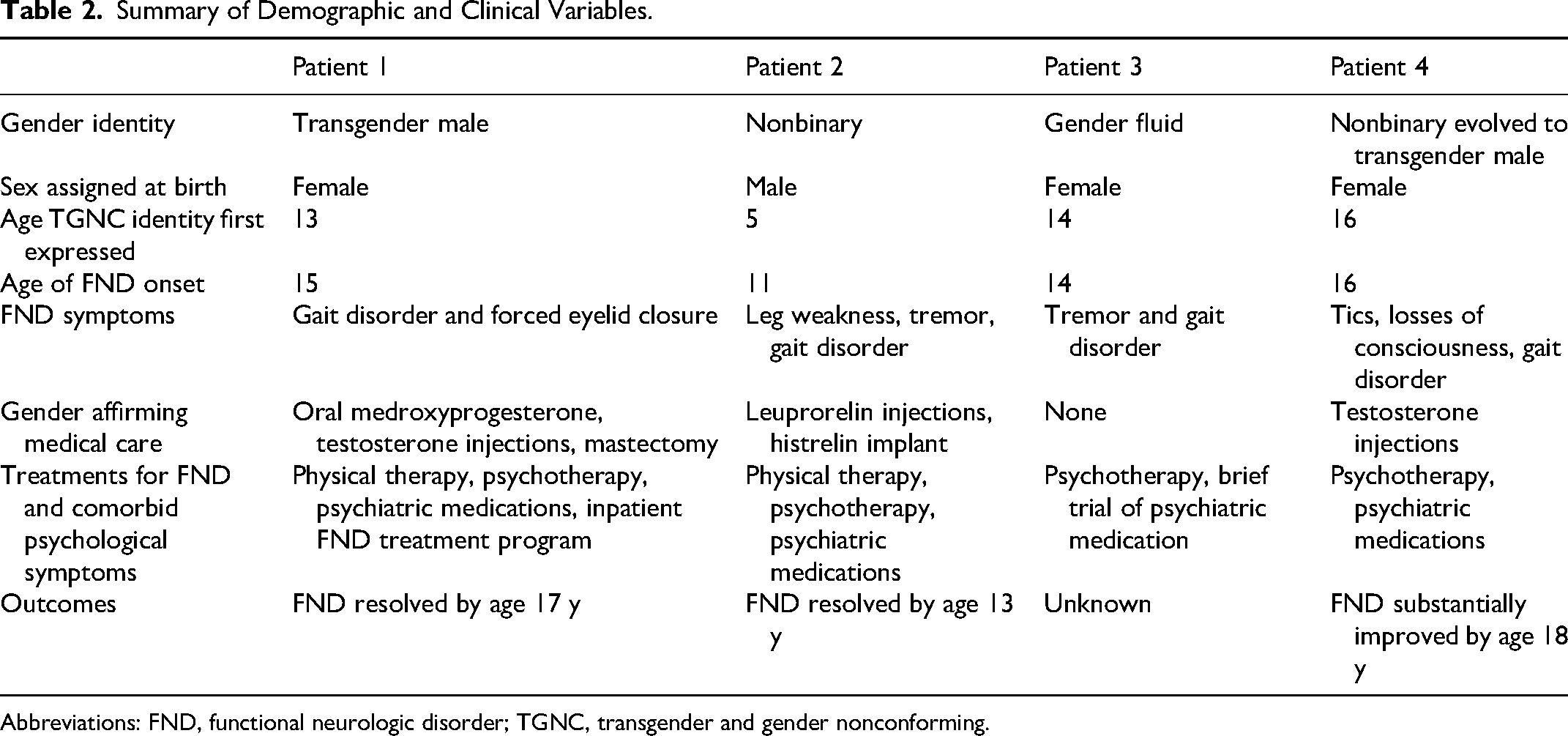
Abbreviations: FND, functional neurologic disorder; TGNC, transgender and gender nonconforming.
All 4 of our patients lost the ability to ambulate independently at some point in their course of symptoms, and 3 of 4 used a wheelchair during their FND course. All 4 had some form of chronic pain. Three of the 4 had chronic health concerns of varying severity prior to the recognition of their TGNC identity or development of FND. Patients 1 and 2 had onset of FND symptoms prior to, and patients 3 and 4 during, the COVID-19 pandemic.
With respect to psychological functioning, all 4 of our patients had a history of anxiety prior to the development of FND. Two had depression and suicidal ideation. Two of our patients experienced environments explicitly described as nonaffirming, as patient 2 was discriminated against in school and patient 4 experienced rejection from his father and community. Patient 3 had not yet felt comfortable discussing gender identity with their father, which suggests anticipatory rejection. Interestingly, all 4 struggled with finding a helpful psychiatric medication regimen. Three of the 4 were tried on multiple medications from multiple pharmacologic classes. The fourth had a poor response to the first medication and the family declined to try others.
On neuropsychological screening, only 2 of the 4 patients showed valid performance on effort testing. All had average or better scores on nonverbal reasoning and 3 of the 4 had intact verbal memory. Self-report questionnaires for all 4 patients revealed some degree of emotional distress, including features of anxiety and depression. Parent report for 3 of the patients revealed anxiety and/or depression. The fourth parent's pattern of responding suggested a reluctance to disclose difficulties. All 4 patients had indicators of poor quality of life.
We have follow-up information on 3 of the 4 patients (patients 1, 2, and 4). All 3 experienced substantial improvement in their FND symptoms, though the course of improvement waxed and waned. In the case of patient 3, the family requested a referral to the physical therapy clinic affiliated with our institution, but later canceled the appointment. They have since been lost to follow-up. Although we are hopeful that they improved significantly enough not to need follow-up care, we acknowledge that there are a variety of other reasons they might not have kept these appointments. It is also possible that the family developed resistance to the FND diagnosis and/or the patient's TGNC identity.
Discussion
Treating comorbid anxiety and depression in patients with FND is often part of the treatment plan.58,59 Although FND symptoms can improve whether or not comorbid mood symptoms improve, 60 treating mental health issues in patients with FND can improve quality of life. 61 Further, there is considerable evidence that affirming a person's gender identity and receiving gender-affirming medical care can reduce depression and improve mental health outcomes in TGNC individuals.27,32 For our 3 patients with follow-up data, improvements in FND symptoms occurred alongside gender-affirming medical care and supportive mental health treatment. For patient 1, we were able to provide reassurance that gender-affirming treatment was not the cause of his symptoms, allowing him to resume his prior care plan. His quality of life markedly improved with transition. Patient 4 stated that gender-affirming treatment was instrumental in the improvement of his FND. The positive outcomes for our patients is not surprising, given the optimistic prognosis for youth with FND.5,9 We cannot conclude that gender-affirming care caused improvement for our patients, but our case series suggests that gender-affirming care has a place in the treatment plan for TGNC youth with FND.
Working with families is a key component of providing care to any pediatric population. Family support is a predictor of mental health outcomes for TGNC youth. 32 A lack of perceived family support is a risk factor for developing FND. 62 We speculated that lack of support from their fathers could have increased the risk for symptoms in patients 3 and 4. Patient 4 described the positive change in his relationship with his father as part of his overall improved quality of life. TGNC adults describe the strain of having to educate their families and others in their lives about TGNC experiences as a specific source of stress. 63 Social support, connection to an affirming community, and pride in oneself have been shown to bolster resilience against gender minority stress. 64 Support from other TGNC peers has been specifically shown to moderate the relationship between social stigma and psychological distress. 65 For TGNC adults, hope has been highlighted as a protective factor against suicidality, 66 and self-compassion has been described as an effective way of coping with minority stress. 63 The families of TGNC youth with FND, therefore, may require additional sensitivity, care, and attention from clinical providers.
Unfortunately, many children with FND experience heightened stigma relative to other neurologic disorders. 67 Per the reports of our patients, in many cases this stigma follows directly from the words and attitudes of clinical staff. FND can be found in every clinical setting, and conversations involving FND can be a source of frustration for clinicians. The fact that this common condition is generally not taught during medical and nursing education may be a consequence of this stigma.68–70 Appropriate education, empathic listening, and connection to resources could improve outcomes for patients by giving patients and their parents the tools needed to support them in both their TGNC identity and FND care. We provided psychoeducation regarding FND for all 4 of our patients’ families. For patients 3 and 4, we offered information about gender-affirming care while maintaining an empathic stance toward their parents’ journey toward acceptance. Clinical providers can also pay special attention to fostering resilience in TGNC youth by encouraging connections with the TGNC community promoting self-acceptance, patient strengths, self-advocacy, and hope. 30 We explored resources for connection and support for all of our patients, and they were all able to identify close relationships with people in their lives who were accepting.
TGNC youth with FND are in a uniquely vulnerable position within health care systems. TGNC youth confront multiple barriers in accessing affirming health care. 33 These barriers are increasing as legislation preventing access to gender-affirming care increases; as a result, mental health risks among TGNC youth are likely to increase.36,37,71 Patients with FND also struggle to find care providers, as neurologists often defer treatment to mental health providers, but mental health providers may feel ill-equipped to address neurologic symptoms. Patients and their families may resist mental health care for their physical symptoms, especially if it means discontinuing care in a neurologic setting. Multidisciplinary collaboration can lessen this resistance by providing physical and emotional care as linked, equally vital facets of recovery. Multidisciplinary collaboration can also reduce the likelihood of incomplete diagnostic workup, minimization of symptoms, and other clinical errors that can occur when working with complex presentations. For families living in rural and under-resourced communities, for families with limited financial resources, and for those living in states that have criminalized gender-affirming health care, accessing mental health providers trained in both pediatric care and gender-affirming care is especially difficult.
Conclusions
We reviewed the literature regarding TGNC youth and youth with FND and found little research examining the overlap in these populations. Our 4 cases suggest the need for investigation of the overlap between TGNC identity and FND diagnosis, particularly given the potential for stigma in health care settings to delay or impede the provision of gender-affirming medical care for patients with FND. However, the limited nature of the case series methodology precludes broad application of our observations. Thus, there is a need for further studies to describe this population in order to uncover whether TGNC youth are overrepresented in the FND population. Longer-term observations of patients with combined TGNC and FND may identify positive prognostic indicators and specific targets for treatment, as well as risk factors for poor outcomes. Given that the percentage of children and young adults identifying as TGNC is increasing over time, greater study of the unique health care needs of these individuals is essential to decreasing the risk of suicide, increasing educational and workplace participation, and reducing the morbidity of comorbid disorders, such as FND.
Footnotes
Declaration of Conflicting Interests
The authors declared no potential conflicts of interest with respect to the research, authorship, and/or publication of this article.
Funding
The authors received no financial support for the research, authorship, and/or publication of this article.
Author Contributions
The authors confirm contribution to the paper as follows: case series conception and design: AWS, JW; clinical care for patients described: AWS, KK, JW; draft manuscript preparation: AWS, ML, KK, JW. All authors reviewed the results and approved the final version of the manuscript.
